Category: TRAI

  • TRAI meets MCOF’s Prabhoo on LMO issues

    TRAI meets MCOF’s Prabhoo on LMO issues

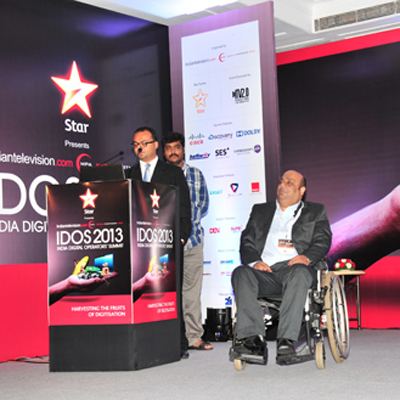
    MUMBAI: It was at indiantelevision.com & MPA’s (Media Partners Asia) India Digital Operators Summit (IDOS) that Mumbai-based cable TV heavyweight and MCOF (Maharashtra Cable Operators Federation) president Arvind Prabhoo first presented to India’s cable, DTH, regulatory and broadcast leaders the local cable TV operators’ perspective. Everyone was impressed including Telecom Regulatory Authority of India (TRAI)’s advisor N. Parameswaran, who said the regulatory body would like him to come and present at its headquarters in Delhi.

    The wheelchair bound Prabhoo did exactly that three days ago on 6 November when he presented the LMO’s viewpoint once again before the TRAI’s N Parmeshwaran, Wasi Ahmed, S K Singhal and G S Kesarwani.

    Prabhoo once again highlighted the issues that are bothering the LMOs and the role they can play in phase III and phase IV of digitisation.

    “There is a crisis in DAS I and II areas regarding LMO-MSO relationship,” says Prabhoo, adding that it was important to address the problems. Prabhoo has told TRAI that his major concern was the MSO-LMO-subscriber relationship. Subscribers belong to LMOs who collect money from them and give it to the MSOs who in turn pass it on to broadcasters. However, the MSOs believe that subscribers belong to them and not to the LMOs.

    Prabhoo also raised the issue of uneven pricing of packages in cities like Mumbai. He wants all MSOs to have similar packages so that it is convenient for a subscriber to migrate and that will even make money collection easier. At the same time, clarity on a-la-carte channels is missing even today.

    He also brought to fore the issue regarding the ownership of set top boxes (STBs). He thinks it is a big bone of contention. “On one hand, customers think they own the STBs, while the MSOs think that STBs are their property,” he remarks. “This disallows customers from migrating from one provider to another using the same STB when he shifts to a new place with a new provider and if he does, the LCO is held responsible for it. Because of this, many subscribers are shifting from cable to DTH, as it seems to be more convenient.”

    Since there’s no fixed revenue sharing deal between the MSOs and LMOs, Prabhoo came up with few solutions. He suggested that for an FTA (Free to Air) channel the sharing between MSO and LMO can be 20:80, while for pay channels it can be 75:25.

    He also suggested that the price of a STB can be reduced and a free basic broadband service be given to communicate by mail. Another suggestion was to rename the LMOs as Horizontal Connectivity Provider Agency (HCPA).

    Prabhoo also brought to TRAI’s notice the issue of entertainment tax. The 42B licenses of LMOs have not been renewed since two to three years and yet the tax is being collected from them. TRAI seemed to be unaware about the issue and has told to get in touch with the chief secretary of Maharashtra soon. They also said that as a regulator they had done everything they could.

    “There needs to be more interaction between LMO, MSO, broadcaster and TRAI if we need a proactive solution to address all our concerns,” concludes Prabhoo.

  • 87% drop in complaints against VAS after regulations: TRAI

    87% drop in complaints against VAS after regulations: TRAI

    NEW DELHI: There has been a decline of around 87 per cent in the number of complaints made against wrong activation of value added services (VAS) like mobile internet and caller tunes since July.

    The drop has been witnessed after the Telecom Regulatory Authority of India (TRAI) issued directives to operators for putting an end to such practices.

    On 10 July, TRAI issued directives to telecom operators to take double confirmation from consumers before activating VAS and refund money of subscriber if the complaint is made within 24 hours for services that are valid for more than a day and six hours if a service is valid for a day.


    Under the rules, consumers can register complaints about wrongful activation of VAS on a toll-free common number, 155223, irrespective of the network they use.

    The regulator observed that total number of complaints received for VAS almost halved from 1,85,468 in July to 95,510 in August.

    The VAS activation on mobile network also came down by about 57 per cent from about 70 million in June – when rules were not in place – to 30 million in July. 

    The data did not incorporate details of state-run BSNL, Sistema Shyam, Videocon and Punjab based Quadrant.  

  • TRAI should reconsider Spectrum Trading, says DoT

    TRAI should reconsider Spectrum Trading, says DoT

    NEW DELHI: A Department of Telecommunications (DoT) committee has for the present turned down any proposal to permit spectrum trading.

    In a report to the Telecom Commission, this Committee has however admitted that this finds place in the National Telecom Policy (2012). It has said there is need for a more holistic view on the matter to prevent ‘some unintended consequences’.

    It feels that the Telecom Regulatory Authority of India (TRAI) should be asked to give a detailed recommendation in this regard. At present, only right-to-usage of spectrum is auctioned and the legal framework under which it can be treated as transferable and tradable in whole or part needs to be prepared, the Committee added.

    According to the report, any Presidential Reference on this issue should be in conformity with the Supreme Court order in the 2G spectrum allocation case.

    The Committee says there is need for assessment of market sale of spectrum. This would assume more importance in merger and acquisition (M&A) cases, for assessment of the fair value of spectrum, where the entire business might be taken over as a going concern along with the spectrum, without separate determination of the price. It should also have provisions to curb fly-by-night operators entering for only trading benefits.

    Earlier, the DoT had sought TRAI’s views on the conditions and timing for allowing trading of what got through auction, the quantity for trading by an operator, revenue payable and the legal, regulatory and technical framework. This followed a recommendation by Planning Commission Deputy Chairman Montek Singh Ahluwalia to Communications and Information Technology minister Kapil Sibal to allow trading of spectrum. The matter was also discussed in a meeting of the Empowered Group of Ministers (EGoM) on telecom headed by Finance Minister P Chidambaram.

    The DoT committee has said TRAI should reconsider sharing of spectrum. Guidelines are to be finalised for the sharing of spectrum in accordance with the TRAI suggestion on a spectrum management and licencing framework. However, the present recommendation for a flat spectrum usage charge would impact the previous recommendation, it felt.