Category: Animation

  • Galli Galli goes to the ‘gallies’

    Galli Galli goes to the ‘gallies’

    NEW DELHI: From the highest level of technology, the TV, to the oldest poor-man’s ‘movie’ entertainment, the bioscope: that’s what mass education programme Galli Galli Sim Sim, will give to the slum children in its mass education programme.

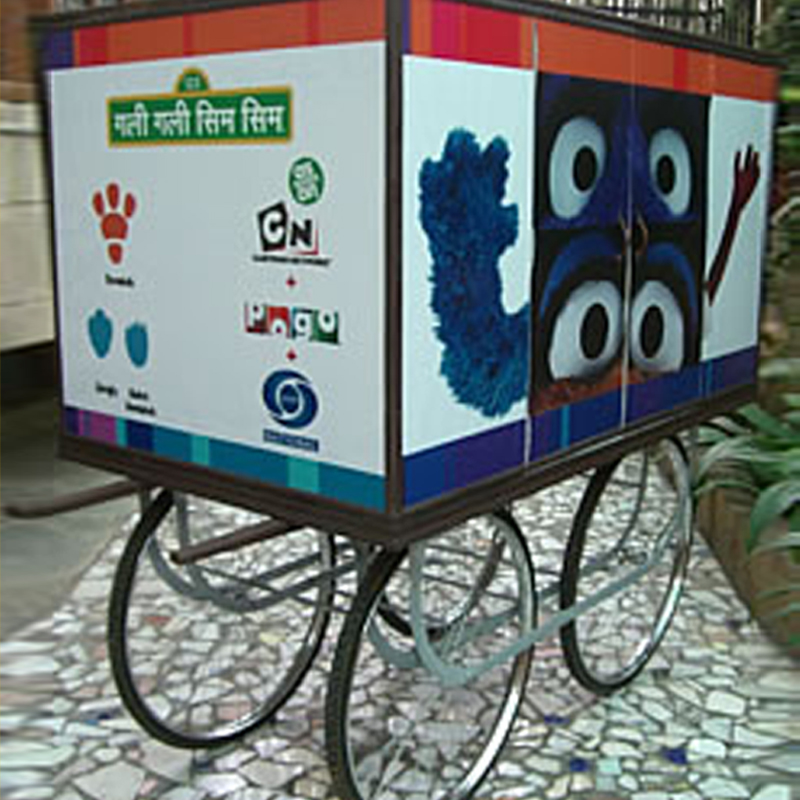
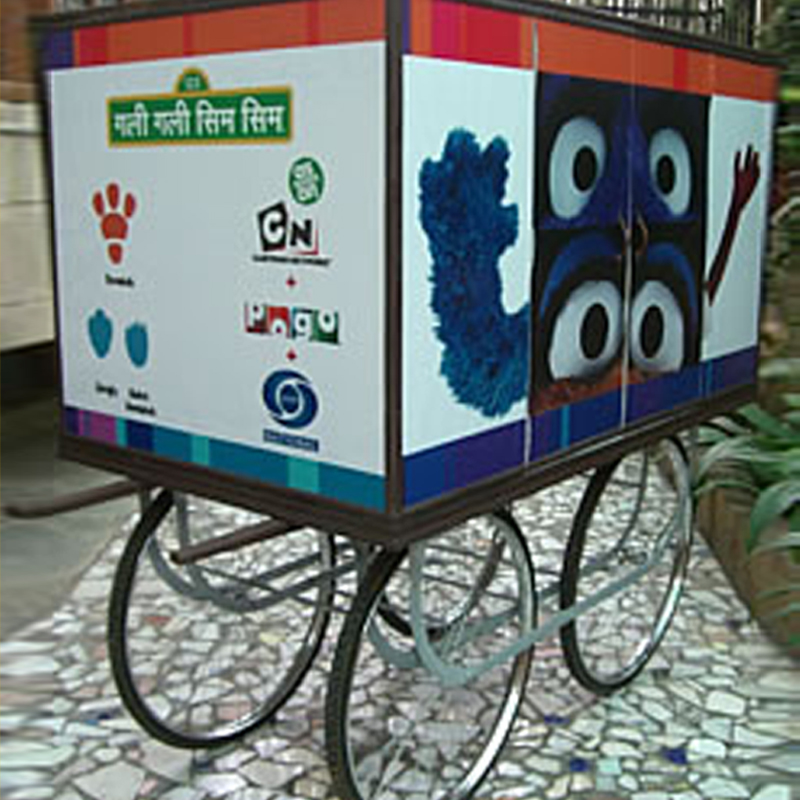
    At the moment, the programme will be shown to children through TV sets carried on designed pushcarts, but the prototype for the bioscope is being readied as well.

    “We have modernised the bioscope and we shall deploy these vends when these are ready to slums as part of our programme for mass education for those millions of children who cannot access TV,” Shaswati Banerjee, executive director Sesame Workshop India (SWI), which runs the programme, tells indiantelevision.com.

    The programme, Galli Galli Sim Sim, is a hit on Doordarshan and Pogo channels, with the TG of two to six-year-olds, and the funding for the initial educational outreach was provided by a corporate social responsibility grant from Turner Entertainment Networks Asia. In an effort to reach these millions, SWI, a subsidiary of Sesame Workshop, the non-profit educational organization behind Galli Galli Sim Sim and other educational media for children, has kicked off a mobile viewings programme, in which during the first phase, starting 15 February, one branded pushcart with a TV set and a DVD player will reach the poorest of slums and show the programme.

    Banerjee explained that the trial phase, in which a Maruti van was used to take the programme to the slums, proved too costly and could not give the intended impact. Hence, they designed a pushcart that can be taken to any corner of a slum.

    “Initially, we reached 22,000 children over the 25-day period of the pilot project. Using the cart, we shall be able to show the programmes to much larger numbers and run the programme during the whole day,” Banerjee said.

    She added that the cart is fitted with cells that would do away with the necessity of power connection, which means it would be able to look at localities where there is no regular power supply. Over all, this changed mode of delivery will increase the number of screenings from just three a day to between eight and 10. The trial with five pushcarts will start in Sanjay Colony, Bawana and Madanpur Khadar slums of Delhi, and in five locations in Mumbai, including Dharavi, Gavandi, Borivili and two other places yet to be finalised, she added.

    January to March will be the testing period, and from April the full programme will be launched. Sometime about then, the bioscope boxes, once extremely popular as entertainment source in villages and small towns, will be introduced as well.

    Testing of the prototype replacing the TV set with the bioscope will start too.

    The baseline survey will be conducted and impact measured during the pilot project. And finally the impact-based model for delivery will be worked out, Banerjee said.

    The cost per child, the ratio that funding agencies use to measure, varies according to the models, of which there are two, she added.

    In the outreach-based model, which is the pushcart with TV set model, in which the programmes are screened and also educational material left with the NGOs handling the Balwadis, costs Rs 25 per child.

    The cost for the impact-based model, in which only educational materials are given, costs Rs 15 per child. These are the ones being tested before being scaled up and become replicable across the country.

    Galli Galli Sim Sim is the Indian version of the world-renowned children’s television series Sesame Street, and airs on Cartoon Network, Pogo and Doordarshan.

    Commenting on the successful completion of the first phase of Galli Galli Sim Sim’s outreach initiatives, Soumitra Saha vice president, regional entertainment advertising sales for Turner Entertainment Networks Asia, said: “Turner’s partnership with Sesame Workshop goes beyond television.

    “Given how many young children in India don’t have access to basic educational and developmental needs, it is highly rewarding for Turner to partner with Sesame Workshop in their carefully created and well coordinated educational outreach programme to help fill this gap.”

    Based on the work in the pilot phase, the Michael & Susan Dell Foundation has awarded Sesame Workshop a grant, which the organisation will use to support Sesame Workshop India to research, develop, and implement similar educational interventions in slum areas in India’s six largest cities such that there are measurable improvements in children’s learning outcomes.

    “Sesame Workshop India’s unique outreach programme reaches large numbers of children and instills them with the power of learning at a very early age, which is extremely important in a country like India where several million children drop out of school before they reach the fifth grade,” said Barun Mohanty, Director of the Michael & Susan Dell Foundation in India.

    “Equally impressive is Sesame Workshop India’s commitment to measuring its impact on learning levels to ensure sustainable, positive changes in early childhood education, Mohanti added.

    “We are excited to help bring this program to India’s urban slums, as Sesame Workshop India draws upon its global expertise and lessons learned from similar communities in Egypt, South Africa and elsewhere,” Mohanti emphasised.

    The initiative is estimated to reach over 1.5 million children and caregivers over the next five years.

  • 4Kids Entertainment licenses ‘Teenage Mutant Ninja Turtles- Fast Forward’ to major international broadcasters

    4Kids Entertainment licenses ‘Teenage Mutant Ninja Turtles- Fast Forward’ to major international broadcasters

    MUMBAI: 4Kids Entertainment has secured a number of key broadcast sales for its hit animated action comedy adventure series Teenage Mutant Ninja Turtles – Fast Forward to leading international broadcasters.

    New episodes of one of the most successful brands in global kids TV entertainment are set to launch on ITV Network (UK), RTVE (Spain) and Media Set (Italy) among others. ITV (UK) has acquired rights to both ITV and CiTV while RTVE (Spain) has acquired all 130 episodes of the TMNT series.

    Brian Lacey, EVP international for 4Kids Entertainment noted that recent licensees for the all-new hit animated action comedy adventure series also included SIC (Portugal), Ten Network (Australia), Cartoon Network (Australia & NZ), DR TV (Denmark), and Mediacorp TV12’s Kid Central (Singapore) among others.

    The Turtles are also returning to the big screen with an all-new CGI-animated feature film TMNT premiering on 23 March. The movie, produced by Imagi Entertainment, will be distributed by Warner Bros. Pictures domestically and The Weinstein Company internationally.

    The Teenage Mutant Ninja Turtles (130 x 30’) animated series has been a top-performing program around the world. The global broadcast lineup already includes TF1 (France), Alter TV (Greece), Teletoon (Canada), Cartoon Network (U.S.), RTL 2 and Jetix (Germany), TV3 (Russia), RTL Klub (Hungary), Minimax (Hungary, Czech Republic, Slovakia, Romania) and Nova TV (Bulgaria), RTE (Ireland), MTV3 (Finland), RTL-TVI and VMM (Belgium), Cartoon Network (Scandinavia), TV3 (New Zealand), SABC2 (South Africa), Televisa (Mexico), TV3 (Malaysia), Children’s Channel (Israel), Icelandic Broadcasting Corp. (Iceland), ABS-CBN (Philippines) and Cartoon Network (Philippines) among others.

    The Teenage Mutant Ninja Turtles were created in 1984 when Peter Laird and Kevin Eastman published a 40-page, black-and-white comic book. From the late 1980’s through the early 1990’s, the original animated adventures of the Teenage Mutant Ninja Turtles dominated kids’ entertainment.


  • Flying Bark Productions Licences Khufu The Mummy to iToys for DVD-based board game

    Flying Bark Productions Licences Khufu The Mummy to iToys for DVD-based board game

    MUMBAI: Sydney-based entertainment studio Flying Bark Productions has finalized a licensing deal with Canadian toy and game manufacturer iToys for Khufu The Mummy, a DVD-based board game spin-of from the successful Atmosfear – The Gatekeeper.

    iToys, which will introduce Khufu The Mummy at the upcoming New York International Toy Fair, has set Fall 2007 for the retail roll-out of the board game.

    Fully interactive, Khufu The Mummy allows players to interact directly with the on-screen host (the freaky Pharoah) and play interactive games using the DVD remote control. Random DVD programming ensures infinite possibilities and a new game experience every time.


  • Fisher-Price unveils ‘Galli Galli Sim Sim’s’ Elmo singing & dancing to the ‘Hokey Pokey’

    Fisher-Price unveils ‘Galli Galli Sim Sim’s’ Elmo singing & dancing to the ‘Hokey Pokey’

    MUMBAI: Fisher-Price, the infant and pre-school brand from Mattel Toys has introduced Galli Galli Sim Sim’s main character Elmo to the Indian market, as a soft toy that can dance, sing and speak. What’s more, it speaks the local language, Hindi. Apart from Elmo, the range also includes other characters like Bharat, Ernie and Biscuit Badshah from the show.

    The surprise element of the range is that the first-ever Hindi speaking Elmo sings and dances to the tune of “Hokey Pokey” while grooving to the beats and doing all the steps, including turning around in a full circle and shaking all about.

    The assortment from Fisher-Price includes soft toys including Bharat, Ernie, Biscuit Badshah and Elmo in 9 and 18 inch sizes, priced at Rs. 299 and Rs. 799 respectively. While a jumbo size of 24 inches is priced at Rs. 1099. The customised ‘Hokey Pokey Elmo’ is 11 inches tall, and is available for Rs. 1399. The complete range will be available at all leading departmental and toy stores, informs an official release.

    Sesame Street’s Indian adaptation Galli Galli Sim Sim aims to empower young children by making learning fun. International versions of Sesame Street are given their own muppets to reflect local issues. In India, they have characters like Googly, Chamki, Aanchoo and Boombah, who have been specially created with Indian characteristics and elements.

    Developed with the help of Indian educational experts, the show exposes children to reading and counting and claims to help children to cope with their emotions, develop healthy habits, value diversity, take pride in their culture and treat others with respect.


  • Animax Asia signs output deal with Japanese anime studio Gonzo

    Animax Asia signs output deal with Japanese anime studio Gonzo

    MUMBAI: Animax has sealed a new long term output deal with Japan’s leading animation studio Gonzo to bring the latest edgy animation to Asia.

    With this, Asian viewers will now get the chance to watch anime programmes from Gonzo soon after viewers in Japan. The deal commences immediately for Animax.

    Animax vice-president Programming and Production Betty Tsui says, “We are delighted to have a strong partner like Gonzo as the studio’s original creative direction is in sync with Animax’s overall strategy to provide world-class anime entertainment for the youth of today. With the recent launch of the Animax refresh campaign, the timing of this output deal is a fantastic opportunity for both Animax and Gonzo to showcase more unique anime that wows and inspires viewers.”

    Responsible for some of the most innovative and stylish animation using 2D and 3D computer graphic techniques, Gonzo has brought to viewers around the world extremely popular titles like Samurai 7, The Count of Monte Cristo, and Hellsing. The synergy of Gonzo and Animax is apparent as both partners strive to provide the youth and young adult market with varied and quality programme offerings that wow audiences.

    With a reach of over 25 million households across Asia 24 hours a days, the new partnership represents enormous potential for Gonzo to showcase its new titles and become a household name in the Asian region.

    Rolling out the output deal is the spectacular animation creation, Trinity Blood. Having premiered first and exclusively in Hong Kong on 1 June 2006, Trinity Blood is broadcast on Animax every Thursday at 10 pm.

  • Animation industry gung-ho on proposed mandate on local content

    Animation industry gung-ho on proposed mandate on local content

    MUMBAI: Some proposals in a draft Broadcast Bill 2006, prepared by the information and broadcasting ministry for the Union Cabinet’s consideration, has evoked mixed reaction from the industry.

    The Indian animation industry is excited that the government is mulling mandating a certain percentage of programming on TV channels to be sourced from India.

    “We are absolutely delighted. The proposed bill is a surprise and will be a catalyst for growth. I would like to however add that Cartoon Network, Nick and Disney have anyways gotten interested in local content and this regulation is a bit late, “DQ Entertainment CEO & MD Tapas Chakravarti.

    He went on to add that 15 per cent is too less and that China and Japan have close to 50 per cent of local programming share on TV channels.

    Chakravarti also reveals that the development has inspired DQ to go ahead with its investment plans in Intellectual Property (IP) in India.

    “At DQ, we have taken a decision internally almost six months back for creating Intellectual Property (IP) in India. We are planning $10 million investments on our part and our French and American partners will bring in similar numbers. The idea is to create products for global market but with Indian stories. This will be something similar to what Disney did with Jungle Book,” he explained.

    As per the draft bill, TV channels on a mandatory basis would have to have 15 per cent of their total weekly programming produced locally. It’s also being proposed the share of public service/socially relevant programme content shall not be less than 10 per cent of the total programme content of a channel broadcast during every week.

    This would mean that channels like Cartoon Network, Animax, Discovery, Animal Planet and Discovery Travel and Living would have to have a prescribed percentage of content generated from India, which has been a long-standing demand of Indian animators.

    Concurring with Chakravarti is Phoebus Media CEO Rahul Bakshi. “15 per cent is too less, but is a good start and will have a multiplier effect. It gives companies like ours conviction and confidence that we are on the right track having already invested a lot in local content,” he added.

    The industry also feels that the move will give it shelter from the rain as well as boost the job scenario.

    “Such a government move will help us get more conviction to stick to original content. Thousands of jobs will be created and more animators means more animation outsourcing also,” says Green Gold Animation CEO Rajiv Chilakalapudi.

    According to Graphiti Multimedia director Munjal Shroff, the proposed regulation could help content creators look at other markets to compliment the revenues.

    “Usually there has always been a block because TV channels find it much more economical to buy animated content from markets like Mipcom at $500 to $1000 per episode rather than commissioning new shows in India. If the bill is passed and local content does become compulsory, then it will give local content creators a space to exist and once there is a minimum local market, then content creators can always look at other markets to compliment the revenues,” says Shroff.

    Color Chips CEO Sudhish Rhambotla felt that channels would either commission local content or also have the option of shifting production of some of their shows being produced elsewhere into the country, which again would be “good for the business.”

    On their part, the kids channels expressed their readiness to make changes in their programming structure if need be.

    The Walt Disney Company India managing director Rajat Jain said, “Whatever changes have to be made, will be made in our programming according to the Broadcast Bill when it is passed. At the end of the day, one has to comply with the laws of the land.”

    When queried as to what percentage of programming on Disney Channel and Toon Disney were local presently, Jain said, “It is difficult to calculate at this point in time what the percentage of local content is.”

    Hungama TV COO Zarina Mehta says her channel already plays more than 15 per cent of local content.

    “I don’t know the exact percentage of local content that we have on the channel but currently it will definitely be more that 15 per cent. If fact, we will be the only kids channel that have that much of local content,” she says.

  • China celebrates 80th birthday of cartoon & animation industry

    China celebrates 80th birthday of cartoon & animation industry

    MUMBAI: The second edition of the China International Cartoon and Animation Festival was kicked off in China on Thursday. The highlight of the festival is the 80th birthday celebrations of China’s cartoon and animation industry.

    The week-long festival has chosen “cartoon and animation make life wonderful” as its theme. The event is co-sponsored by the State Administration of Radio, Film and Television and Zhejiang provincial government.

    Eminent cartoon producers from France, Japan, the United States, Hong Kong and Croatia are participating in the festival.

    The festival will take a look at the progress made by China international cartoon and animation industry, apart from debating on the prospect the industry. A competition on cartoon and animation works in China will also be held.