Category: Viewership

  • Sony Sab continues as most watched pay TV Hindi GEC across genres

    Sony Sab continues as most watched pay TV Hindi GEC across genres

    BENGALURU: Sony Pictures Network India (SPN) Sony Sab continued as the most watched pay TV Hindi GEC in week 11 of 2019 (Saturday, 14 March 2020 to Friday, 20 March 2020, week or period under review). The channel had replaced Viacom18’s flagship Hindi GEC Colors which until recently had been the most watched Hindi GEC for a few weeks in 2020.

    Most watched pay channels across genres in week 11 of 2020

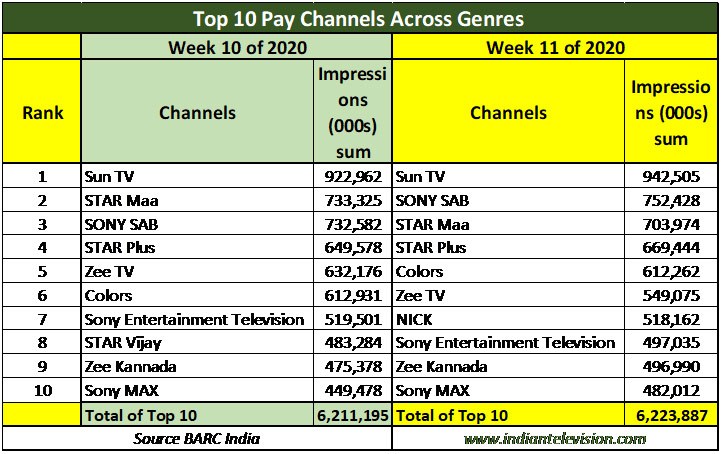
    Five Hindi GECs and one channel each from the Hindi Movies, Kannada, Kids, Telugu and Tamil genres comprised BARC’s weekly list of the Top 10 Pay Channels Across Genres for week 11 of 2020. There were three channels from Sony Pictures Network India (SPN), two channels each from Star India, Viacom18 and Zee Entertainment Enterprises Limited (Zeel) and one channel from the Sun Tv Network. Eight of the channels were GECs’, while there was one each from the Kids and Hindi Movies genres during the week under review.

    The list of top 10 pay channels across genres for week 11 of 2020 was the same up to rank 4 as compared to the previous week. Star India’s flagship Tamil GEC Star Vijay exited the list in week 11 of 2020 and was replaced by Viacom18’s kids channel Nick.Colors climbed up a place to fifth rank, while Zeel’s flagship Hindi GEC dropped a place to sixth rank in week 11 of 2020 from fifth rank in the previous week. SPN’s Hindi Movies retained its 10 rank in the list in week 11 of 2020. SPN’s flagship GEC Sony Entertainment Television also dropped a place to eighth rank in week 11 of 2020 as compared to seventh rank in the previous week.

    Refer to the figure below for ratings of the Top 10 Pay Channels Across Genres for weeks 10 and 11.
    Most watched free channels across genres in week 11 of 2020

    Enterr 10 Television’s Hindi GEC Dangal led BARC’s weekly list of Top 10 Free Channels Across Genres in week 11 of 2020, as it had in the previous weeks. Dangal has generally been the most watched channel across genres ever since BARC recommenced publication of data in week 13 of 2019 after the implementation of Telecom Regulatory Authority of India or TRAI’s New Tariff Order or NTO.

    During the period under review, four channels from the Hindi Movies and three channels from the Bhojpuri from Hindi GEC,two channels from the Bhojpuri and one channel from the Hindi Music genre comprised BARC’s weekly list of Top 10 Free Channels in week 11 of 2020.  Four of the channels were from Zeel and there were three channels from Enterr 10 Television, two channels from B4U and one channel from the SkyStar Network.

    Nine of the channels in BARC’s weekly list of Top 10 Free Channels in week 10 of 2020 were the same as in the previous week with changes in ranks. B4U’s Bhojpuri channel B4UBhojpuri exited the list in week 11 of 2020, while SkyStar’s Hindi Movies channel ABZY Movies reentered the list.

    Please refer to the figure below for ratings of the Top 10 Free Channels Across Genres for weeks 10 and 11

    Most watched channels on all platforms across genresin week 11 of 2020

    Dangal continued its domination of BARC’s weekly lists of Top 10 Channels on All Platforms Across Genres in week 11 of 2020 at rank 1 as it has in the recent past. The first five channels in BARC’s across genres on all platforms weekly list during week 11 were the same in rank and file as in week 10 of 2020. One channel reentered the list -Nick, while Star India’s Telugu GEC Star Vijay exited it.

    Nine of the 10 channels in BARC’s weekly lists of Top 10 Channels on All Platforms Across Genres in week 10 of 2020 were GECs’. Seven of the channels were Hindi GECs’, while there was one channel each from the Kids,Tamil and Telugu genres in the list. From the networks’ perspective, there were three channels from SPN, two channels each from Star India, Viacom 18 and Zeel and one channel from the Sun Tv Network.

    Refer to the figure below for ratings of the Top 10 Channels on All Platforms Across Genres for weeks 10 and 11


     

  • Zee Bangla brings back 8 old shows to entertain viewers

    Zee Bangla brings back 8 old shows to entertain viewers

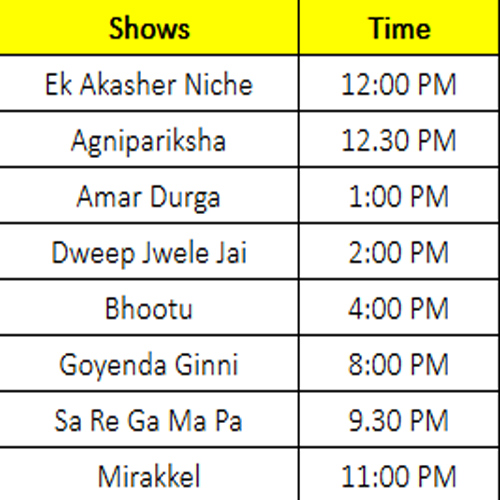
    MUMBAI: Starting 30 March, Zee Bangla is bringing back some of its iconic shows: Ek Akasher Niche, Agnipariksha, Amar Durga, Dweep Jwele Jai, Bhootu, Goyenda Ginni, Sa Re Ga Ma Pa, and Mirakkel in order to keep its viewers entertained.

    These shows will give  the viewers daily dose of entertainment while adding a bit of nostalgia to the regular ‘TV Time when people are staying at home and reducing public contact to curb the spread of COVID-19. 

    Zee Entertainment Enterprises Ltd East cluster head Samrat Ghosh said, “Zee Bangla always puts its consumer at the centre of everything and has been successful in delivering the entertainment needs of the wide Bengali diaspora for last 20 years. We heard the consumer voice to bring back some of our milestone shows from 20 years in terms of both fiction and non-fiction. I am very hopeful that the cult shows will surely bring back strong nostalgic values and take viewers back in their good old days and enhance quality family time and help them sail through this difficult phase.”

    The channel has realigned its programming with the relaunch of a series of pathbreaking and iconic shows of yesteryear's, which will present the families with an opportunity to relive memories, subsequently striking a happy conversation among the family members. The same has been envisaged as an extension of their “20 Ke Kurnish” campaign, a yearlong campaign which was launched by Zee Bangla last year to celebrate its glorious journey of 20 years.

    Following is the list of some of the most popular shows, which in themselves are landmark productions that helped recraft the Bangla TV industry. These are the shows that the audiences still crave for.


  • Despite viewership growth, DD needs to overcome content, advertising challenges

    Despite viewership growth, DD needs to overcome content, advertising challenges

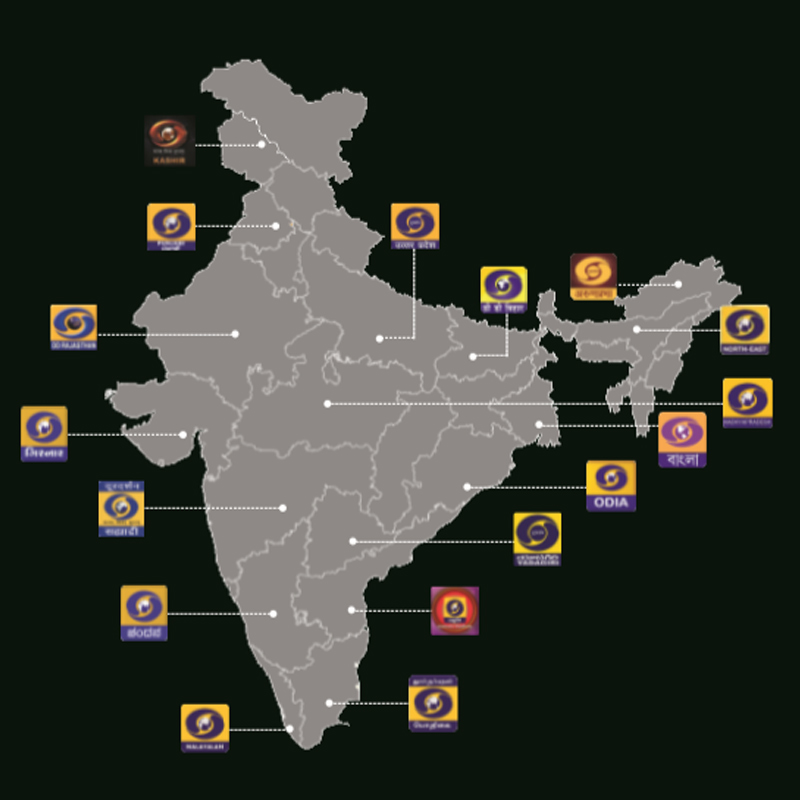
    MUMBAI: India’s public broadcaster, Prasar Bharati, is one of the largest public broadcasters in the world. It got a big boost with DD Free Dish that enabled it to reach into the interior parts of the country where pay channels didn’t have much headway. In 2019, Prasar Bharati added 11 regional channels on DD Free Dish to expand its reach, gaining 16 per cent more viewership over the previous year (2018). Half of its viewership comes from Hindi channels and the other half from regional language channels.

    Among the 24 DD channels measured by BARC India, the viewership of its English news channel DD India grew 63 per cent over the previous year, while that of DD Kisan gained 48 per cent. Notably, in the English news space, DD India contributes to 22 per cent of the entire genre viewership.

    Prasar Bharati CEO Shashi S Vempati says, “Doordarshan is not just a broadcaster; it is an institution that has helped germinate, build and popularise television in India. In the dynamic broadcast sector, Doordarshan, too, is transforming itself to keep in sync with its core mandate of public service broadcasting as well as meet audience expectations.”

    He further says, “Towards this, we rely on data and insights from BARC India to help target and deliver our content in a more effective manner. BARC India has done a great job in building the world’s largest TV viewership measurement system. As a key stakeholder of BARC India, we continue to engage and collaborate with the industry body as it consolidates and expands its services further.”

    Recently, the pubcaster revived two of its shows Ramayan and Mahabharat during the covid-19 crisis. Although it no longer enjoys a monopoly position, Doordarshan continues to have its dedicated audience and exercises its specific responsibility of public service and socially-relevant broadcasting.

    Joel Multimedia founder & CEO Varghese Thomas says, “India's public broadcaster was the one and only destination for television advertisers three decades ago. DD National, DD Metro and about 15 regional channels used to feature in all TV plans until the late 1990s. The public broadcaster has gifted a lot of good shows to the Indian television Industry such as Mahabharat, Ramayan, Surbhi, Rangoli, Chitrahaar, Superhit Muqabla, Shanti, Swabhiman etc. (Some of them were privately produced). The Friday and Saturday Hindi feature films were bumper hits among advertisers. Has anyone thought of creating a fantastic show out of a morning time band at 7 am on Sundays with a show like Rangoli? That was the power of Doordarshan during those days.”

    Thomas believes that after the entrance of satellite TV channels, pubcasters could not withstand the fast-changing trends and lost audience to private channels. He says, “Today, the HSM market has 57 per cent penetration of TV in the urban+rural markets. The proliferation of satellite channels with deep pockets and focus on innovative content has changed the way TV is consumed in India.  From fiction to sitcoms to reality shows, satellite channels have all that to entertain the ever-hungry TV audience. As the audience moved, advertisers have also moved to satellite channels as it was offering multi-dimensional opportunities for the brand rather than just buying a TV spot of 30 seconds.”

    Thomas, however, believes that though people in metros prefer satellite channels over public broadcasters only due to the programming, it would be a good idea to consider the public broadcaster for smaller towns and villages. “The terrestrial reach of the broadcaster is exclusive and no other broadcaster caters to that space which is very important. DD Free Dish is another superhit with 35 million connections and it's a great platform for even FTA satellite channels for distribution. Last year, the public broadcaster has generated revenue of Rs 500+ crore only by striking distribution deals with private channels.”

    According to the 2nd edition of BARC India- What India Watched 2019, the total viewership on DD grew to 573 billion viewing minutes in 2019 from 492 billion viewing minutes in 2018. The viewing minutes on DD's GEC channels grew by 19 per cent from 355 billion viewing minutes in 2018 to 424 billion viewing minutes in 2019.

    News genre witnessed five per cent growth in 2019 at 25 billion viewing minutes from 24 billion viewing minutes in 2018. Sports grew by four per cent at 101 billion viewing minutes in 2019 from 98 billion viewing minutes in 2018 and niche/others genre grew by 48 per cent at 23 billion viewing minutes in 2019 from 16 billion viewing minutes in 2018.

    “In spite of an increase in viewership, the number of advertisers in 2019 reduced by eight to10 per cent. In terms of spends there was growth in 2018 but in 2019 overall spends across DD network dropped by 30-35 per cent. Large CPG brands have also reduced spends on the DD channels in 2019,” informs Carat India executive VP Mayank Bhatnagar.

    He, too, agrees that the network has a vast untapped potential in the rural belt of the country. “The government has taken several steps to improve the quality of content and added new content to attract viewers. The viewership growth is exceptional, driven by the quality of the content and audience connect via increased presence on social media platforms. However, currently facing immense pressure from other FTA channels, DD needs to invest in the right content which is relatable and relevant to audiences,” he opines.

    Havas Media Group CEO India and South East Asia Anita Nayyar believe that if the public broadcaster is able to help advertisers with an attractive number of eyeballs and quality reach through innovative programming, it can get more investments.

    Nayyar says, “Depending upon the kind of audience and the markets it caters to and reaches, the investments follow. Advertisers are interested in reach and that too quality reach. With reach, the focus should be on quality of programming and that will get quality advertisers. As long as the same is delivered it should automatically attract advertisers and investments.”

    She further opines, “Unfortunately, the perception of public broadcasters in spite of the reach is not up to the mark and perceived to be low quality on both the audience and content fronts. With so many options available to view and great quality content available all across they have tough competition and will need to rise to the occasion.”

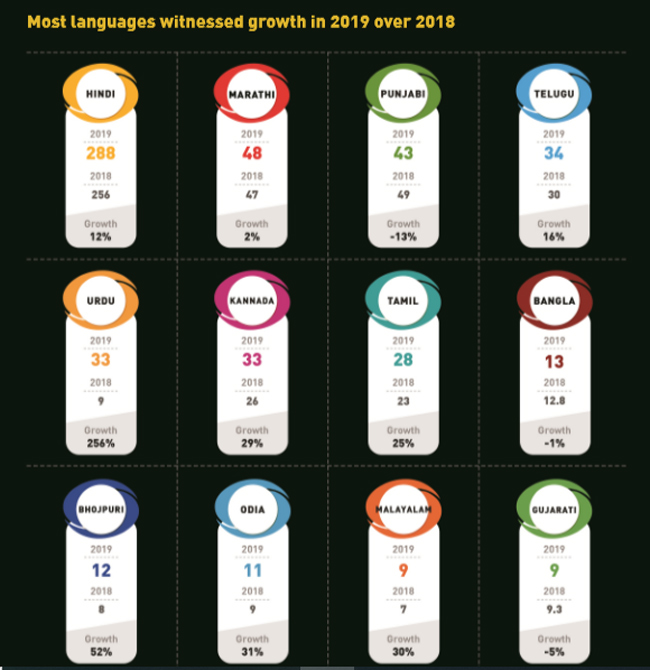
    There was some negative growth as well in some of the languages like Gujarati and Punjabi. Gujarati witnessed a fall of 5 per cent, the viewing minutes decreased to 9 billion in 2019 from 9.3 billion in 2018. Punjabi witnessed a 13 per cent fall in viewing minutes from 49 billion viewing minutes from 43 billion viewing minutes in 2018. 

  • BARC week 11: Sony SAB holds pole position in urban and pay platforms

    BARC week 11: Sony SAB holds pole position in urban and pay platforms

    MUMBAI: Sony SAB led the urban market and pay platforms in week 11 of BARC India ratings. The channel also moved up from fifth position in the last week to fourth position this week. The channel's leading show Taarak Mehta Ka Ooltah Chashmah has garnered 6610 weekly impressions (000s) in the urban market and 9441 weekly impressions (000s) on pay platform. The has been leading for more than three consecutive weeks on both the platforms. Star Plus continued to hold its second position on pay platform and urban markets. This week, Colors jumped to third position on pay platform and Zee TV slipped down to fourth position. 

    On pay platform Sony SAB, Star Plus, Colors, Zee TV, Sony Entertainment Television, Star Bharat, Dangal, Star Utsav, &TV and Colors Rishtey were the top ten channels in the week 11of BARC India ratings.

    Pay Platform

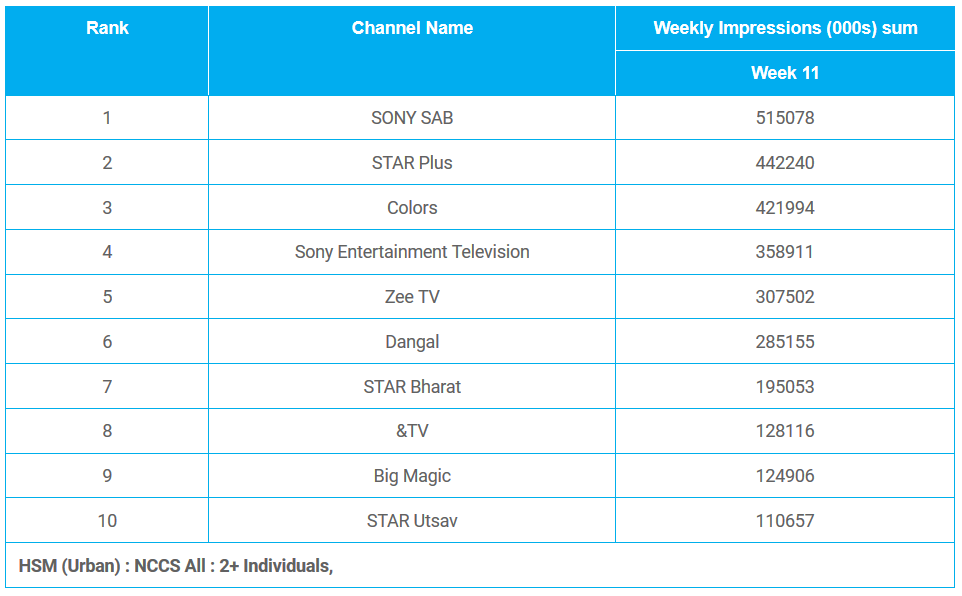
    In the urban market, the top ten channels were Sony SAB, Star Plus, Colors, Sony Entertainment Television, Zee TV, Dangal, Star Bharat, &TV, Big Magic and Star Utsav in week 11 of BARC India ratings.

    Urban

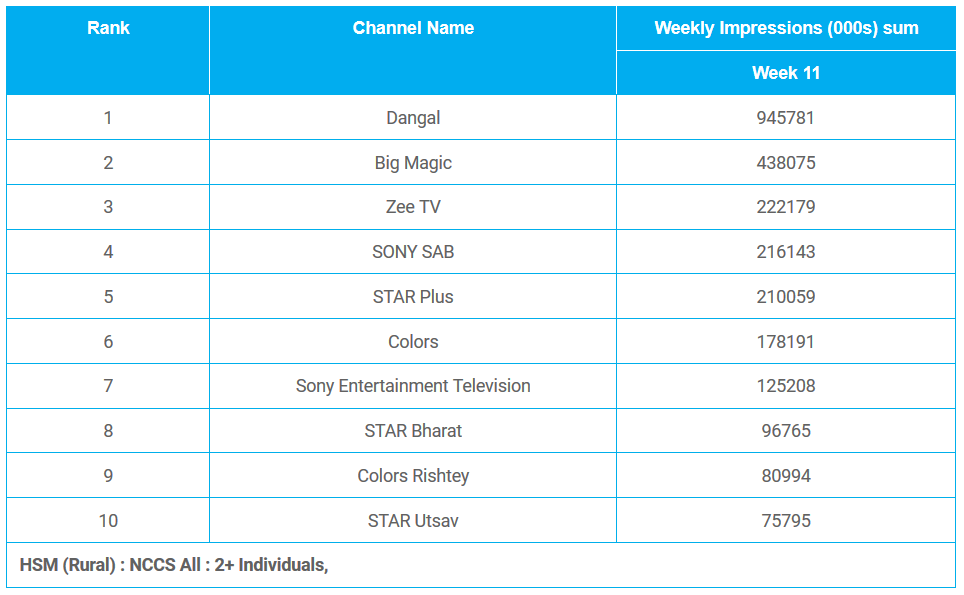
    Dangal, Big Magic, Zee TV, Sony SAB,  Star Plus, Colors, Sony Entertainment Television, Star Bharat, Colors Rishtey and Star Utsav were the top ten channels in the rural market

    Rural

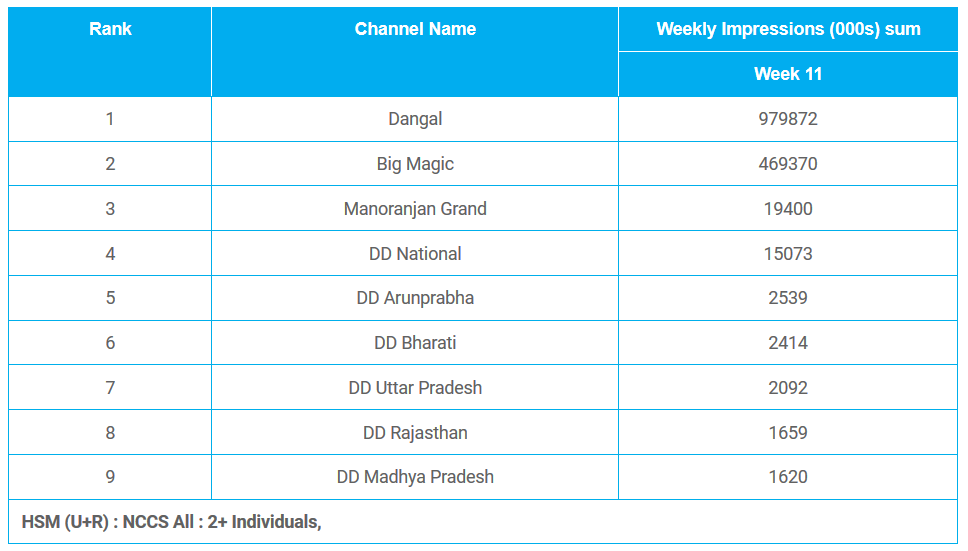
    On free platform Dangal, Big Magic,  Manoranjan Grand, DD National, DD Arunprabha, DD Bharati, DD Uttar Pradesh, DD Rajasthan and DD Madhya Pradesh were the top nine channels in BARC ratings.  

    Free Platform

  • BARC week 11: Zee Biskope leads in Bhojpuri market

    BARC week 11: Zee Biskope leads in Bhojpuri market

    MUMBAI: In the regional space of week 11 of BARC India ratings, Zee Biskope grabbed the leading position in the Bhojpuri market. The channel jumped from third position to first. Zee's other regional channel Zee Punjab is also leading in the Punjabi market this week. But Zee Keralam slipped down to fifth position from third in the last week. In the Telugu market, Star Maa Movies replaced Gemini Movies in the fifth position. 

    In the Bangla market, Star Jalsha, Zee Bangla, Jalsha Movies, Sony Aath and Colors Bangla were the top five channels in week 11 of BARC India ratings.

    Bangla

     
    Rank Channel Name Weekly Impressions (000s) sum
        Week 11
    1 STAR Jalsha 330581
    2 Zee Bangla 310034
    3 Jalsha Movies 84765
    4 Sony Aath 62715
    5 Colors Bangla 58414
    WB (U+R): NCCS All : 2+ Individuals, 

    In the Bhojpuri market, Zee Biskope, Bhojpuri Cinema, Big Ganga, B4U Bhojpuri and Danbang were the top five channels in week 11 of BARC India ratings.  

     
    Bhojpuri 
     
    Rank Channel Name Weekly Impressions (000s) sum
        Week 11
    1 Zee Biskope 59519
    2 Bhojpuri Cinema 55413
    3 Big Ganga 45041
    4 B4U Bhojpuri 36158
    5 Dabangg 13068
    Bihar/Jharkhand (U+R) : NCCS All : 2+ Individuals, 

    In the Gujarati market, Colors Gujarati Cinema, Colors Gujarati, TV9 Gujarati, ABP Asmita and News18 Gujarati were the top five channels in week 11 of BARC India ratings.  

    Gujarati

    Rank Channel Name Weekly Impressions (000s) sum
        Week 11
    1 Colors Gujarati Cinema 35959
    2 Colors Gujarati 22019
    3 TV9 Gujarati 16698
    4 ABP Asmita 16635
    5 News18 Gujarati 11359
    Guj / D&D / DNH (U+R): NCCS All: 2+ Individuals, 

    In the Kannada market, Zee Kannada, Colors Kannada, Udaya TV, Star Suvarna,  and Udaya Movies were the top five channels in week 11 of BARC India ratings.  

    Kannada

     
    Rank Channel Name Weekly Impressions (000s) sum
        Week 11
    1 Zee Kannada 486689
    2 Colors Kannada 212792
    3 Udaya TV 209928
    4 Star Suvarna 206562
    5 Udaya Movies 165729
    Karnataka (U+R) : NCCS All : 2+ Individuals, 

    In the Malayalam market, Asianet, Mazhavil Manorama, Flowers TV, Surya TV, and Zee Keralam were the top five channels in week 11 of BARC India ratings    


    Malayalam
     
    Rank Channel Name Weekly Impressions (000s) sum
        Week 11
    1 Asianet 313311
    2 Mazhavil Manorama 88404
    3 Flowers TV 75020
    4 Surya TV 72994
    5 Zee Keralam 68051
    Kerala (U+R) : NCCS All : 2+ Individuals, 

    Zee Marathi, Colors Marathi, Star Parvah, Fakt Marathi and ZeeTalkies were the top Marathi channels in week 11 of BARC India ratings  
     

    Marathi
     
    Rank Channel Name Weekly Impressions (000s) sum
        Week 11
    1 Zee Marathi 242185
    2 Colors Marathi 179795
    3 STAR Pravah 172976
    4 Fakt Marathi 122941
    5 Zee Talkies 100769
    Mah/ Goa (U+R) : NCCS All : 2+ Individuals, 

    Zee Punjabi, PTC Punjabi, Pitaara TV,  Maha Punjabi and DD Punjabi were the top five channels in week 11 of BARC India ratings.  
     

    Punjabi
     
    Rank Channel Name Weekly Impressions (000s) sum
        Week 11
    1 Zee Punjabi 50386
    2 PTC Punjabi 50235
    3 Pitaara TV 47414
    4 Maha Punjabi 27817
    5 Manoranjan Movies 22193
    Pun / Cha (U+R): NCCS All: 2+ Individuals,

    Sun TV, Star Vijay, Zee Tamil, KTV and Star Vijay Super were the top five Tamil channels in week 11 of BARC India ratings  
     

    Tamil
     
    Rank Channel Name Weekly Impressions (000s) sum
        Week 11
    1 Sun TV 868544
    2 STAR Vijay 436306
    3 Zee Tamil 406964
    4 KTV 331956
    5 STAR Vijay Super 137411
    Tamil Nadu/ Puducherry (U+R) : NCCS All : 2+ Individuals, 
    Star Maa, Zee Telugu,  ETV Telugu, Gemini TV, and  Star Maa Movies were top five Telugu channels in week 11 of BARC India ratings  
     
    Telugu
     
    Rank Channel Name Weekly Impressions (000s) sum
        Week 11
    1 STAR Maa 659254
    2 ETV Telugu 446625
    3 Zee Telugu 442705
    4 Gemini TV 374737
    5 Star Maa Movies 201007
    AP/ Telangana (U+R) : NCCS All : 2+ Individuals, 
  • Weekly TV viewing mins up by 8%, smartphone time spent up by 6.2% during Covid-19: BARC India & Nielsen

    Weekly TV viewing mins up by 8%, smartphone time spent up by 6.2% during Covid-19: BARC India & Nielsen

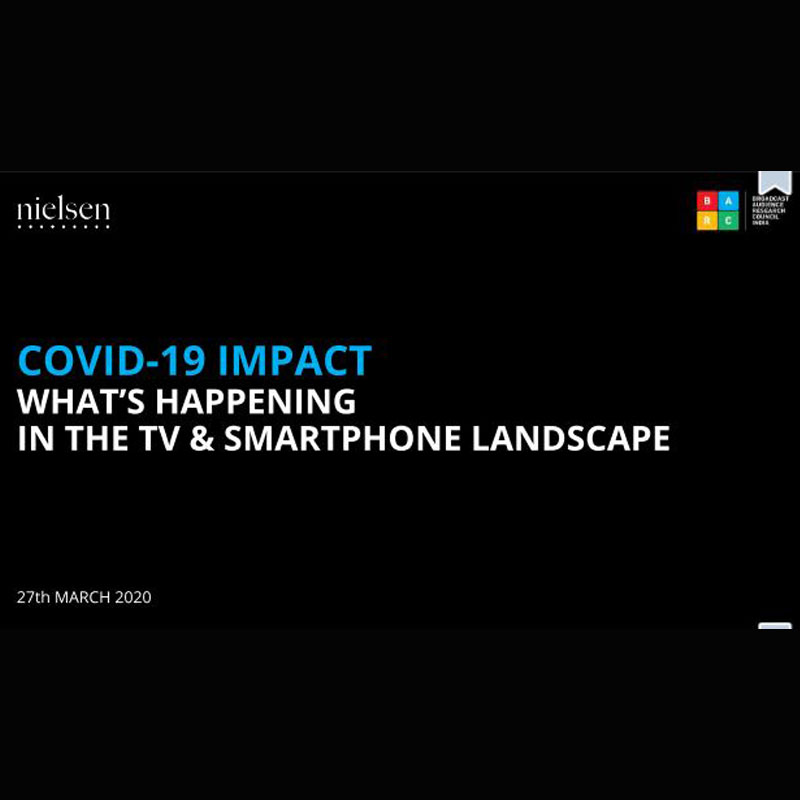
    MUMBAI: As India goes through an unprecedented lock-down in living memory due to the Covid-19 crisis, people are increasingly consuming more content on TV and smartphones, according to a report. BARC India and Nielsen have jointly put together a report to understand the changes in consumption behaviours of TV and smartphones, respectively, given the extraordinary situation surrounding the Covid pandemic and its fallout.

    Key highlights: –

    1.  Expectedly the COVID disruption period has seen an increase in television viewership – 6% increase in TV reach and 8 per cent increase in TV viewing minutes /week. The time spent on TV / viewer has seen a jump by 2 per cent.
    The PM’s address to the nation on complete lockdown garnered unprecedented viewership of 197 million watching it across the country. 
    2.  When we look at smartphone behaviour the time spent on smartphones per user has gone up by 6.2 per cent. The time spent/user/week on VOD apps has also seen an increase of 3 per cent. If we look at the increase in the time spent/user/week over that of the previous week (to take away the impact of cricket viewing in the PRE COVID period considered), we can see a jump of 5 per cent.
    3.  Kids’ schools being shut down and the stress of exams off their shoulders; this increase in Television viewing is driven by Kids (+20 per cent). With corporate India getting into work from home mode, we are seeing NCCS A showing an 11 per cent increase in viewership. Even on smartphone usage, the increase in driven NCCS A (+7.7 per cent) and 35-44 year olds (+10.7 per cent).
    4.  People staying at home means watching TV throughout the day and hence the growth in TV viewing is coming during non-prime time slots (8am – 5 pm).
    5.  The need for continuous updates expectedly has led to a huge increase in news consumption on television (57 per cent increase in Impressions), while spending more time as a family together could be leading to the movies genre and the kids genre also showing significant increases. 
    6.  This behaviour is seen in digital consumption as well with news and gaming showing huge increases. News apps saw 8 per cent more users per week with an increase of 17 per cent in time spent/user/week. This growth was led by non-English News apps (+87 per cent). Gaming apps saw an increase of 2 per cent in users/week and with a 11 per cent increase in time spent/user/week.
    7.  With a lot of uncertainty around what is happening, people have increased their time spent on chatting (+23 per cent) and social networking (+25 per cent) apps.  Almost all social networking apps – Facebook, Instagram and TikTok have seen significant increases not only in time spent /user/week but also in the sessions/ user/ week. 
    8.  Expectedly shopping apps, travel apps and food apps have seen a huge drop in both users/ week and time spent/user/week. 
    9.  It’s not just TV viewership that has seen an increase – we can advertising FCT on TV has increased by 13 per cent. 

    Sharing her views on the current surge in smartphone usage, Nielsen Global Media, South Asia country leader Dolly Jha said, “We are living through unprecedented times! physical social distancing seems to have led to a phenomenal growth in virtual social togetherness with an almost 20 per cent increase in time spent per user on chats, social media and news in the last one week. And we anticipate this to grow further.”

    Elaborating on the topic BARC India CEO Sunil Lulla said, “These are unfortunate and unprecedented times. Working closely with Nielsen, we bring for our customers and stake-holders, this very significant and important update, on change in content and advertising consumption behaviour, with a significant population at home. We will report soon enough, the impact of total lockdown. Our respective brave teams are working (WFH) round the clock to ensure the TV measurement currency, continues uninterrupted.” 

    On 24 March 2020, with the prime minister announcing a total lockdown in the country, peo ple are slowly coming to terms with the new normal. It started with many states enforcing the lock-down, partially and fully, and many places of work enforcing work from home (WFH). Faced with the predicament of not being able to move out of their homes, people are creating new ways of spending time productively.

    It is a well known fact that Television Viewing is an integral part of the Indian ethos. An average Indian is known to spend a considerable number of hours with 3 hours, 51 minutes every day on TV. So, it is obvious that forced confinement will lead to changes in TV consumption behaviour.

    Today if there is one device besides the TV which is an integral part of the Indian consumers’ lives, it is the smartphone. People today depend on their smartphones not just for communication and social interactions, but also for entertainment, banking and financial transactions, purchase of daily need goods like groceries, personal care to durables.  It is but natural that this period of forced confinement would also engender some change in the way people interact with their smartphones.

    As the situation continues to evolve in the coming weeks, BARC and Nielsen will also continue to track shifts in TV and Smartphone audience behaviour. Future reports will be released on a weekly basis to keep the ecosystem abreast of how audiences in India are adjusting their TV and Smartphones consumption around the new normal.

    BARC is the official currency on Television Measurement in India and Nielsen runs a 12000 strong smartphone panel passively capturing smartphone behaviour.
     

  • DD National to telecast 80’s show ‘Ramayana’ from tomorrow

    DD National to telecast 80’s show ‘Ramayana’ from tomorrow

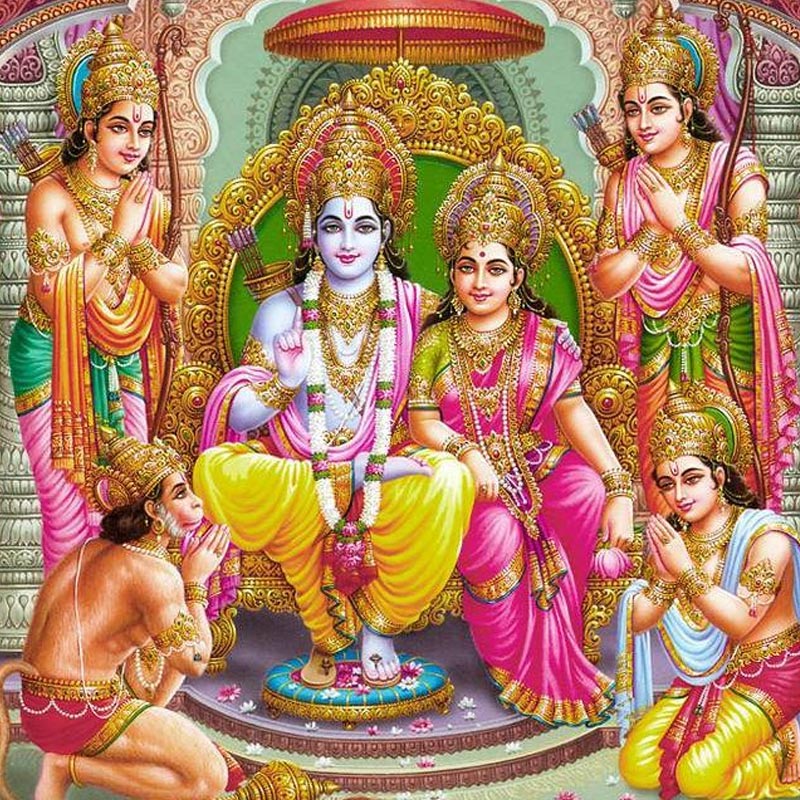
    MUMBAI: Those who have been quarantined in their homes have one great reason to cheer! One of the most iconic TV serials of the 80s, Ramayana, is making a comeback from tomorrow. 

    DD National will re-telecast the serial from tomorrow (28 March). While one episode will be telecast between 9 am and 10 am, another episode will be aired between 9 pm and 10 pm, informed minister for information and broadcasting Prakash Javadekar.

    The minister said: "Happy to announce that on public demand, we are starting retelecast of 'Ramayana' from tomorrow, Saturday, March 28 in DD National."

    The series, aired on all Sundays between January 1987 and July 1988 in DD, has been etched in the nostalgic memories of Indians.

    Just yesterday, we reported that Prasar Bharati is looking at re-runs of some of its iconic shows from the 80s. The other show that is likely to be re-commissioned is Mahabharat.

  • English news becomes top gainer in Chrome DM week 11, 2020

    English news becomes top gainer in Chrome DM week 11, 2020

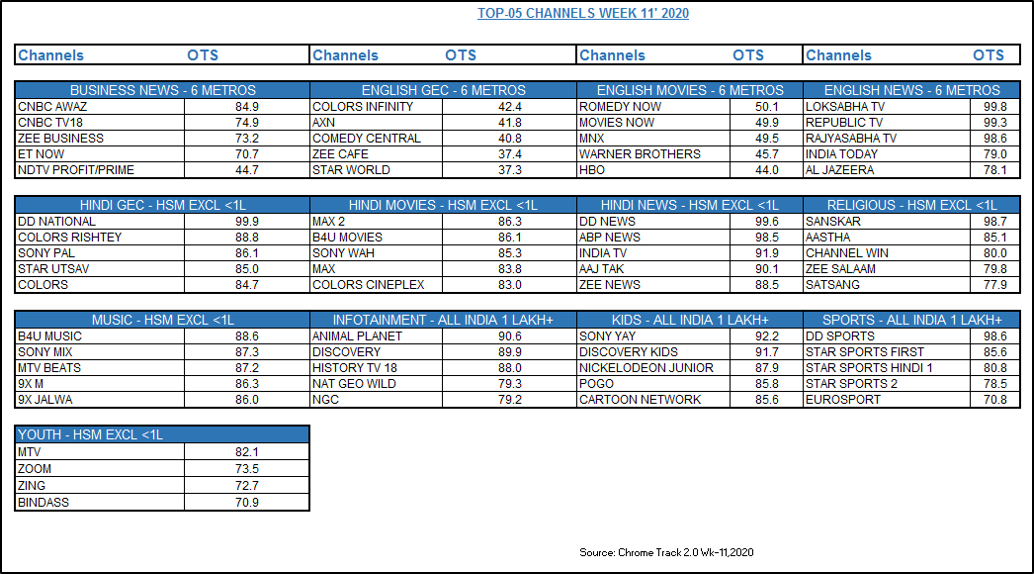
    MUMBAI: English news has become the top gainer in week 11, 2020 of Chrome Data Analytics and Media data. The genre grew by 1.25 per cent. In this genre, Lok Sabha TV channel gained the highest OTS with 99.8 per cent in six metro market. 

    OTS is the actual census based, percentage connectivity of a channel spread across 86 million homes, reported by Chrome Data Analytics & Media,  spread across Analog cable, Digital Cable and DTH. The same is updated and reported to 400+ channels on a daily basis in Chrome Track 2.0.

    This week, Kids genre gained second position and grew by 0.78 per cent in all India 1 lakh+ market. In this genre, Sony YAY! Kids channel gained the highest OTS with 92.2 per cent. Business news channel stood in the third position by gaining 0.66 per cent in six metro markets. CNBC Awaz secured the highest OTS with 84.9 per cent.

    English movies genre stood in the fourth position in six metro market and grew by 0.28 per cent. Romedy Now channel gained the highest OTS with 50.1 per cent.  

  • Regional GECs on an upward growth trajectory

    Regional GECs on an upward growth trajectory

    MUMBAI: In the last four to five years, the regional television market witnessed a significant growth in viewership. Even the ad spend in the regional market has grown by 20 to 25 per cent in 2019 with more and more brands aiming to reach specific audiences. So how has the ROI improved for the regional channels? National broadcasters are expanding their footprints and businesses in the regional market by investing more on regional content and even brands are focussing more on the regional channels to reach specific markets.

    Carat India executive VP Mayank Bhatnagar says, “The overall growth of regional channels is healthy and all the key regional channels have grown. In fact, some of them have witnessed a healthy growth in ad revenue. The overall ad spends this year (2019) on regional channels have increased by 20 to 25 per cent.”

    As per BARC data, over a period of four years, regional viewership has grown to 30 – 35 per cent for languages such as Marathi, Gujarati, Bhojpuri, Odiya and Assamese. South continued to grow at around 9 to 10 per cent on an average. Hindi grew at about 7 to 8 per cent.

    Viacom18 Regional TV Network head Ravish Kumar says, “Regional channels have always offered great value to their advertisers and prioritised innovation, fresh concepts and new talent while perfecting the art of great storytelling. With their rich repository of theatre, literature, culture and music, regional content is making waves across mediums, screens and languages. So, the ROI on regional channels continues to be as strong as ever earning it an outperform rating in today’s value-seeking markets.”

    He further says: “Brands today have understood the reach a regional channel can give them. In addition to regional brands seeing value in our offerings, national advertisers too are understanding the importance of regional markets. While FMCG, auto, handset manufacturers continue to invest, there are newly emerging sectors such as education and gaming which are ramping up their advertising spends.”

    Joel Multimedia founder-CEO Varghese Thomas, however, believes that all regional players are not breaking even as content acquisition is an expensive affair and it takes time to recover the cost incurred in a highly competitive market environment like today.

    Regional channels also help brands to get the reach within a lower budget. “If we want to do a small campaign, these regional channels will help to drive efficiency. Regional will continue to grow as it is more efficient and help us to build the reach at much lesser cost as compared to HSM,” says Bhatnagar.

    Other major reasons for the growth of regional content are enhanced data bandwidth, cheap tariff and increased smartphone penetration that has resulted in digital explosion and accelerated digital adoption by audience due to which they started consuming content across screens. This resulted in regionalisation of the content from both production and consumption perspectives.

    Omnicom Media Group India Investment & Enterprise national head Yatin Balyan says, “For a national broadcaster mainline Hindi GEC continues to drive maximum business. However, regional channels are contributing more towards business growth for the network. Networks try to increase volume share with Hindi GEC as well as grow the business on the back of regional channels. National broadcasters investing in regional content also have to create a content bank for their respective OTT platforms.”

    He also believes that regional channels have seen a gradual increase in business coming from regional or retail advertisers. He says, “There is a prominent shift in how regional channels are being considered from a campaign planning perspective. Campaigns for regional markets are being planned with far more focus as advertisers started considering all these markets as mini India within one Big India.”

    Thomas is of the view that regional retail advertisers used to be the largest contributors of advertising revenue for the regional channels. But post demonetisation, the ad spends by retail business is on a downward trend and it has been really challenging to balance the revenue. Some of the players have come up with non-FCT ideas to cope with the challenges and it's paying off to an extent.

    When broadcasters look at expanding their footprint and diversifying into non-core areas of business, regional markets emerge as an option to explore. Though most of the regions are already flooded with a bunch of players, broadcasters are exploring the possibility of adding another channel to their basket in order to be part of the regional success story. It is interesting to know that some of the recently-entered regional players are doing extremely well and they have already made their position in the top 5 channels and started contributing to the growth of the network.

    Thomas says, “It's challenging for broadcasters to approach these markets with an innovative programming strategy. So, at times, they do an adaptation of their successful shows from their national channels. They also have an option to dub some of their super hit shows in to the regional languages where they are present.”

    Balyan, however, believes that Hindi GEC still commands the maximum business share within a broadcaster networks and it would be incorrect to assume that Hindi GEC has come to a level of saturation. TV penetration in the Hindi hinterland, which is still not at 100 per cent, is primarily driven by Hindi GECs. I see scope of further growth in Hindi GEC business with increased scope of audience measurement.”

    According to Kumar, from a macro perspective, 2019 was a challenging year for the entire broadcast industry, including regional, due to the impact of the new tariff order as well as the weak advertising and investing climate. However, he believes things are settling down now, and hopefully, this year will see a lot more buoyancy coming back in.

    He says, “I believe that regional markets offer more opportunities than the challenges they present. Regional audiences have become increasingly aware and hence content that is being presented to them needs to be more relatable, rooted and relevant. There is a growing demand for disruptive content, both in fiction and non-fiction spaces. Viewers are looking for fresh content experiences and stories which have believable characters. This is a great opportunity for storytellers like us.”

    Regional channels contribute significantly towards the overall growth and this will only continue to increase.

  • BARC week 10: Sony SAB continues to lead in urban market and pay platform

    BARC week 10: Sony SAB continues to lead in urban market and pay platform

    MUMBAI: In week 10 of BARC India ratings Sony SAB continued to lead in the urban market and pay platform for the second consecutive week. The channel was followed by Star Plus which held second position in the urban market and pay platform. On pay platform this week Zee TV has grabbed third position whereas the channel held the fifth position in the urban market. Colors slipped to fourth position from third in the last week on pay platform. Sony Entertainment Television continued to hold its fifth and fourth positions in pay platform and the urban market, respectively.

    On pay platform Sony SAB, Star Plus, Zee TV, Colors, Sony Entertainment Television, Star Bharat, Dangal, Star Utsav, &TV and Colors Rishtey were the top ten channels in the week ten of BARC India ratings.

    Pay

    Rank Channel Name Weekly Impressions (000s) sum
        Week 10
    1 SONY SAB 712995
    2 STAR Plus 629989
    3 Zee TV 602942
    4 Colors 597804
    5 Sony Entertainment Television 501224
    6 STAR Bharat 288633
    7 Dangal 237881
    8 STAR Utsav 173637
    9 &TV 160203
    10 Colors Rishtey 150982
    HSM (U+R) : NCCS All : 2+ Individuals, 

    In the urban market, the top ten channels Sony SAB, Star Plus, Colors, Sony Entertainment Television, Zee TV, Dangal, Star Bharat, &TV, Big Magic and Star Utsav were the top ten channel in week ten of BARC India ratings.

    Urban

    Rank Channel Name Weekly Impressions (000s) sum
        Week 10
    1 SONY SAB 517066
    2 STAR Plus 430145
    3 Colors 423870
    4 Sony Entertainment Television 372457
    5 Zee TV 344712
    6 Dangal 273782
    7 STAR Bharat 194651
    8 &TV 121502
    9 Big Magic 110102
    10 STAR Utsav 104431
    HSM (Urban) : NCCS All : 2+ Individuals, 

    Dangal, Big Magic, Zee TV, Star Plus, Sony SAB, Colors, Sony Entertainment Television, Star Bharat, Colors Rishtey and Star Utsav were the top ten channels in the rural market.  

    Rural

    Rank Channel Name Weekly Impressions (000s) sum
        Week 10
    1 Dangal 903990
    2 Big Magic 382738
    3 Zee TV 260224
    4 STAR Plus 201613
    5 SONY SAB 197726
    6 Colors 175638
    7 Sony Entertainment Television 129948
    8 STAR Bharat 94456
    9 Colors Rishtey 76291
    10 STAR Utsav 70299
    HSM (Rural) : NCCS All : 2+ Individuals, 

    On free platform Dangal, Big Magic, DD National, Manoranjan Grand, DD Rajasthan, DD Bharati, DD Uttar Pradesh, DD Arunprabha and DD Madhya Pradesh were the top nine channels in BARC ratings.    

    Free Platform

    Rank Channel Name Weekly Impressions (000s) sum
        Week 10
    1 Dangal 939891
    2 Big Magic 416461
    3 DD National 22422
    4 Manoranjan Grand 19796
    5 DD Rajasthan 2548
    6 DD Bharati 2547
    7 DD Uttar Pradesh 2238
    8 DD Arunprabha 1969
    9 DD Madhya Pradesh 1940
    HSM (U+R) : NCCS All : 2+ Individuals,