Category: Viewership

  • ZEEL’s Prathyusha Agarwal applauds the champions

    ZEEL’s Prathyusha Agarwal applauds the champions

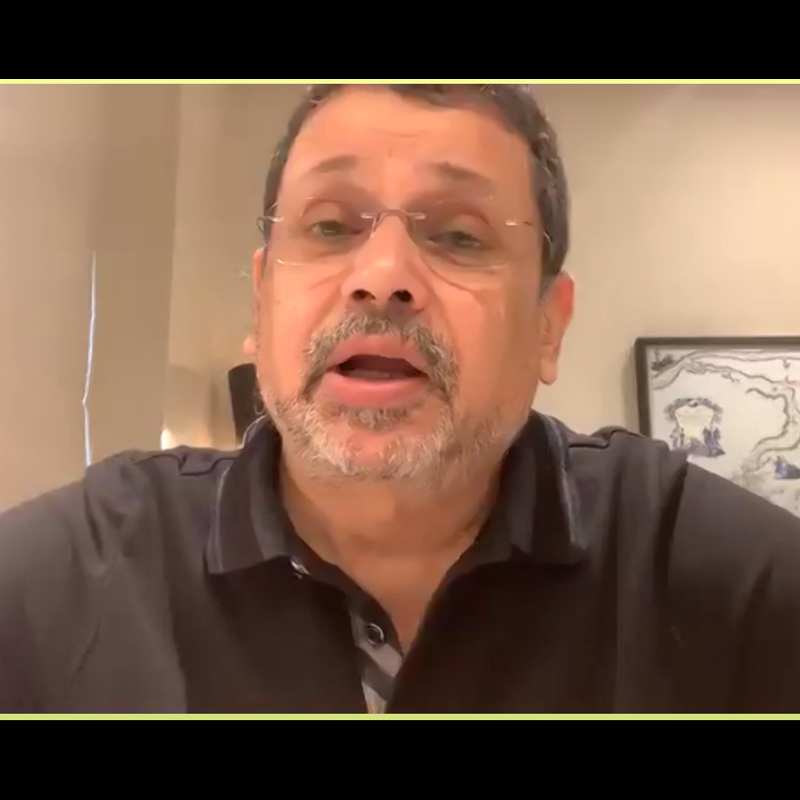
    MUMBAI: Zee Entertainment Enterprises Ltd (ZEEL) chief consumer officer Prathyusha Agarwal thanks the real heroes – health workers, doctors, policemen, etc. – who are at the forefront of fighting the COVID-19 pandemic. Adjusting to the new normal is not easy, but desperate situations call for extraordinary measures, she says. She applauds and salutes all those champions who are stepping out of their comfort zones every single day to ensure that we all stay healthy and safe and our essential services and goods are delivered.  

    Watch the video:

  • Television viewership peters down slightly in Week 14

    Television viewership peters down slightly in Week 14

    BENGALURU: The first three weeks of Indian COVID-19 lockdown have expanded television viewership in India to an extent that was probably never imagined earlier. As many average Indian citizens, bound by the lockdown within the confines of their homes, sought to comfort their minds with news of what was happening within the country and the world and with the pseudo realism that Movies provide, their television viewership habits changed week-on-week. Here’s how.

    Viewership

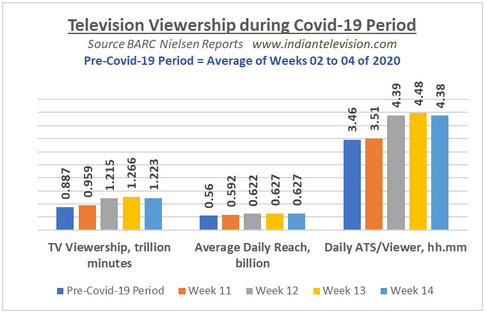
    In the third week of the Indian COVID-19 lockdown (week 14 of 2020, Saturday, 4 April 2020 to 11 April 2020), television viewership at 1.223 trillion minutes was 37.9 per cent higher when compared to the average of Weeks 2 to 4 of 2020, or the pre-COVID-19 period according to joint Broadcast Audience Research Council of India (BARC) Nielsen reports. But then, this was 3.4 per cent lower than the 1.266 trillion minutes of the previous week, despite the same average daily reach of 627 million television viewers. Hence, the average time spent was obviously lower at 4 hours 38 minutes in Week 14 of 2020 as compared to the 4 hours and 48 minutes that television viewers spent in Week13.

    As is obvious from the chart below, TV viewership has grown like never before during the lockdown week, but week 14 data shows that week-on-week, viewership in Week 14 of 2020 is slightly lower than the previous week, which has so far seen numbers peak at high levels. Please refer to the chart below:

    Effect on genres

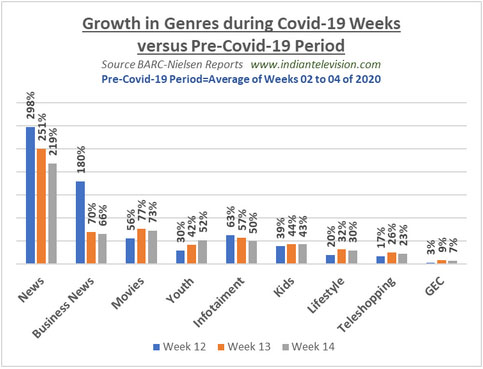
    News, which until the COVID-19 period had seven per cent share of viewership, saw it triple to 21per cent in Week 12, or the first week of the Covid-19 Lockdown in India. Though news is still the leader in terms of growth in viewership, the growth of the genre in relation to the Pre-Covid-19 period has been lower in Weeks 13 and 14 as compared to Week 12 of 2020. Business news also seemed to be following the trends of its larger sibling, news. The other seven genres have seen growth in Weeks 13 and 14 vis-à-vis the Pre-Covid-19 Period averages.

    Since no fresh content was being produced, GECs’ saw the smallest growth during the first three weeks of the Covid-19 lockdown. It must be noted that GECs’ are the largest genre in terms of viewership, so the 9per cent and 7per cent growth in Weeks 13 and 14 respectively versus the Pre-Covid-19 are good numbers.

    In the Pre-Covid-19 Period, Hindi GECs’ had a 32per cent share of viewership of the Hindi speaking market of HSM. Hindi GEC’s in the urban Hindi speaking market or HSM (U) which reduced to 29per cent in Week 14. Despite this Hindi GECs’ in HSM (U) attained an all-time high of 4 billion impressions. HSM (U) viewership grew by 26per cent in Week 14 in relation to the average of the Pre-Covid-19 Period. This growth could be attributed mainly to GECs’ resorting to airing old classics. The major growth drivers of the genre were pubcasterDoordarshan’s GECs’ DD National and DD Bharti which saw the return of programmes such as Ramanand Sagar’s Ramayan and B R Chopra’s Mahabharat, as well as soaps like Dekh Bhai Dekh, Byomkesh Bakshi, Shaktimaan, ShrimanShrimati, Buniyaad and Circus. The other GECs’ generally saw flat growth according to BARC.

    Please refer to the figure below:

    GECs’ in South India continued to lead viewership in Week 14 of 2020, but with a lower share as compared to the pre-COVID-19 period. The movies and news genres saw higher viewership in Week 14 as compared to the Pre-Covid-19 Period. Please refer to the chart below:

    Who was watching television when?

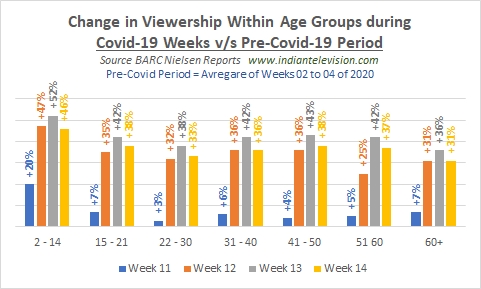
    Growth in viewership continued to be led by the younger generation –the 2-14-years age groups followed by the 15-21 and the 31-40-years age groups as well as in the week preceding (Week 11) the lockdown and during the three weeks of the lockdown (Weeks 12, 13 and 14 of 2020). However, growth was lower amongst all age groups in Week 14 of 2020 as compared to Week 13 with respect to the Pre-Covid-19 Period.

    Please refer to the figure below:

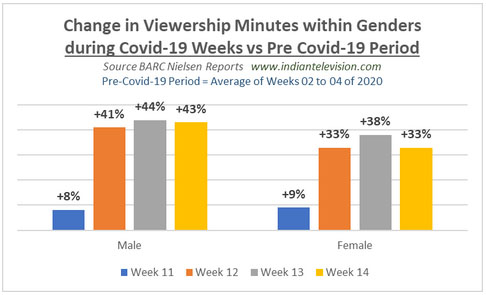
    Since people spent time at home, growth in time spent in minutes for watching television was higher among males. The change was slightly lower in Week 14 of 2020 as compared to Week 13 for males and females with viewership of both the weeks in relation to the Average of the Pre-Covid-19 Period. Please refer to the chart below:

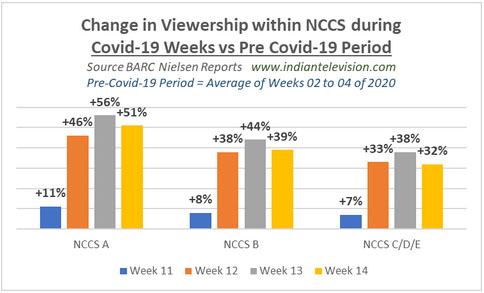
    A BARC Nielsen Report dated 16 April 2020 said that BARC’s NCCS A saw the highest growth during the three weeks of the lockdown as well as Week 11 of 2020 as compared to the average of the Pre-Covid-19 Period.  NCCS A has seen the highest growth in Weeks 12, 13 and 14, with growth peaking in Week 13 of 2020 and then petering slightly in Week 14 of 2020. Please refer to the chart below.

    Non-primetime continued to be a growth driver of Television viewership in Week 14. While Full Day All India Television viewership grew 38per cent in Week 14 as compared to the Pre-Covid-19 Period, Rural India viewership growth was driven by non-Primetime viewership. Primetime viewership grew 10per cent in Urban India, while it remained stable in Rural India.

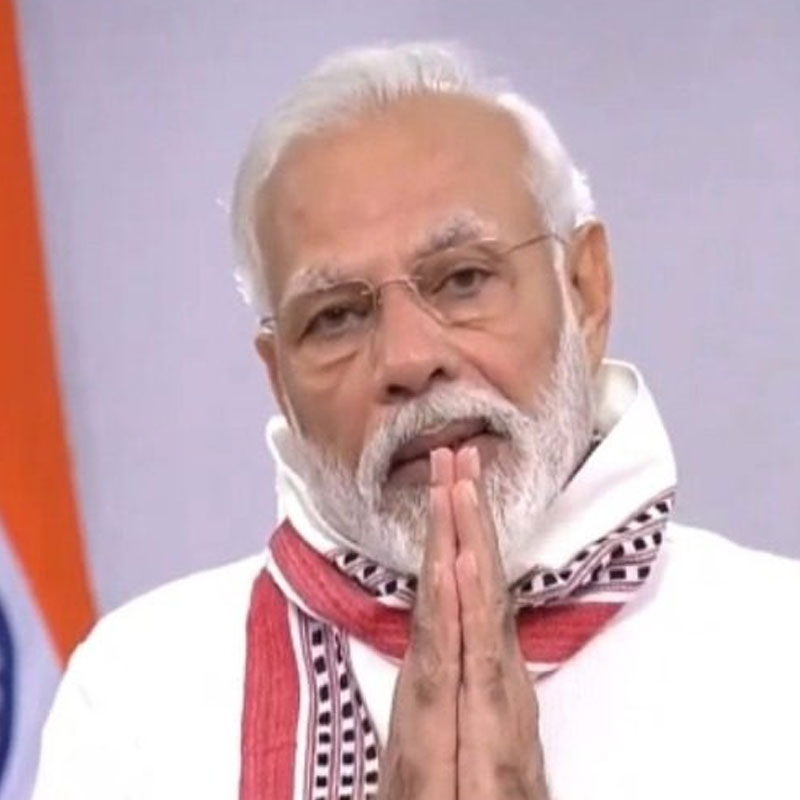
    News is event driven. Week 15 of 2020 has seen the Covid-19 lockdown in India being extended to 3 May 2020. Prime Minister Narendra Modi’s speech on 14 April 2020 announcing the extension of the lockdown which was aired on 199 channels garnered the highest ratings at 3,937.3 million viewing minutes as compared to his previous 3 addresses to the nation on the Covid-19 crisis.

  • POGO collaborates with DD National to simulcast ‘Chhota Bheem’

    POGO collaborates with DD National to simulcast ‘Chhota Bheem’

    MUMBAI: India’s homegrown kids’ entertainment channel POGO has partnered with public service broadcaster Doordarshan to simulcast ‘Chhota Bheem’, on DD National. The hugely popular animation features the superhero Bheem who comes all the way from Dholakpur to entertain kids every afternoon from 2-2:30 PM on DD National from April 17- May 3, 2020.

    WarnerMedia Entertainment Networks in South Asia managing director Siddharth Jain said: “These are challenging times and we believe that POGO’s fun-filled, relatable content will keep kids engaged and entertained. We are very pleased to collaborate with a platform as distinguished and popular as Doordarshan. The agreement ensures that an even larger number of young viewers across the country will be able to enjoy ‘Chhota Bheem’, one of our most prominent shows.”

    Prasar Bharati CEO Shashi Shekhar Vempati said: “Doordarshan is pleased to partner with POGO to simulcast Chhota Bheem on DD National. Chhota Bheem is one of children’s most favourite cartoon character, and we are delighted to bring him on our channel to entertain our young viewers.”

    Since the commencement of the lockdown, DD National has been re-telecasting its iconic shows to entertain viewers across age groups while they stay home. With this collaboration, DD National will be able to broadcast immensely popular and iconic kids’ entertainment content from POGO, captivating audiences across the country.

  • BARC week 14: DD National leads in urban, rural and pay platform

    BARC week 14: DD National leads in urban, rural and pay platform

    MUMBAI: In week 14 of BARC India ratings, Sony SAB is the only Hindi GEC which continues to hold its position. When most of the channels are slipping down in the urban and rural market, Sony SAB and Sony Entertainment Television are seeing holding their respective position on pay platforms. Compared to last week, Zee has slipped down to tenth position in the urban market while Colors has moved out of the top ten channels’ list in the rural market. Week 14 witnessed growth in DD Bharati's viewership. The channel jumped to third position in the urban market and fourth position on pay platform. Last week, DD National was leading in the urban market, and pay platform this week the channel is also leading in the rural market.

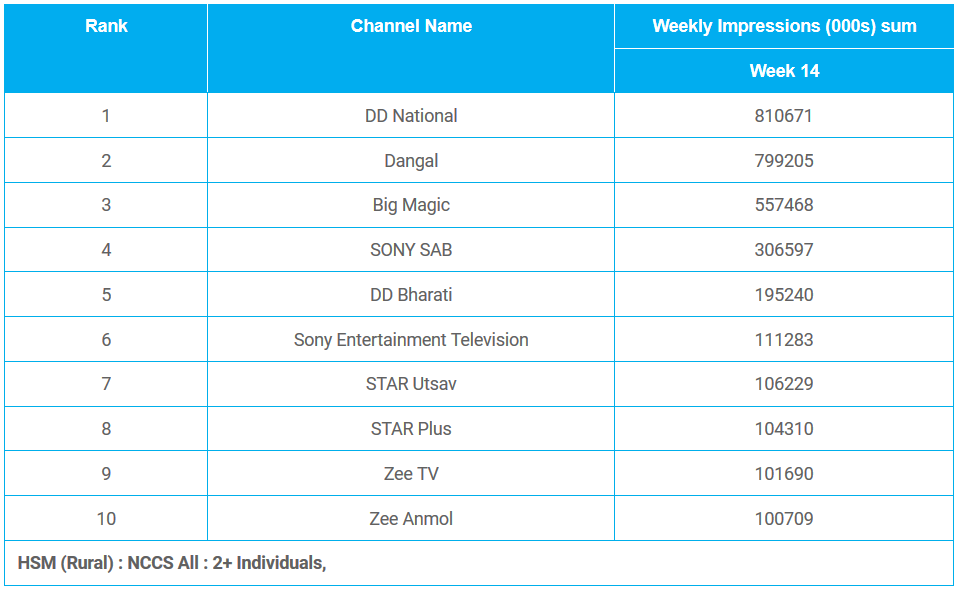
    DD National, Dangal, Big Magic, Sony SAB, DD Bharat, Sony Entertainment Television, Star Utsav, Star Plus, Zee TV and Zee Anmol were the top ten channels in the rural market.

    Pay

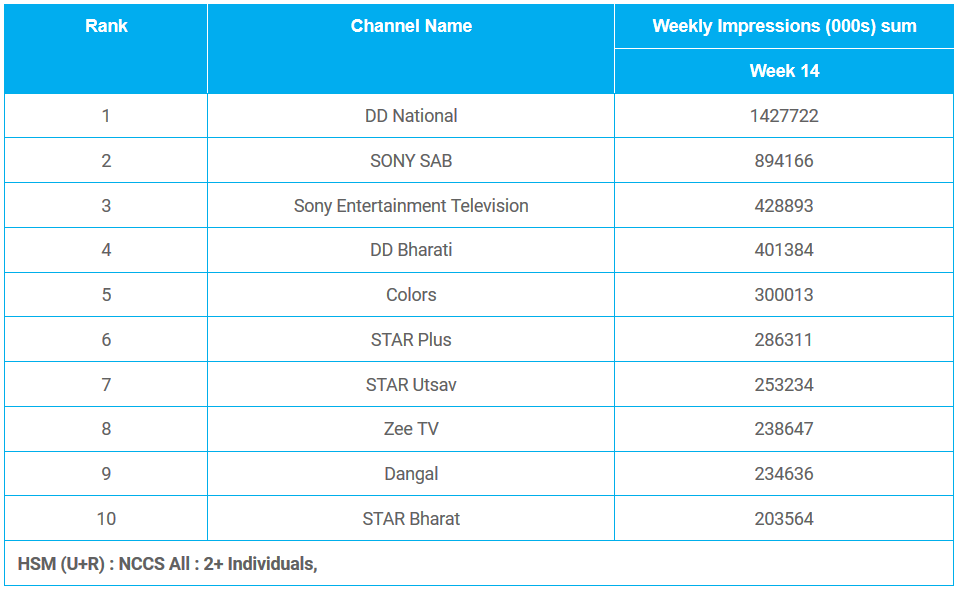
    In the urban market, the top ten channels were DD National, Sony SAB, DD Bharati, Sony Entertainment Television, Dangal, Colors, Star Plus, Star Utsav, Big Magic and Zee TV and in week 14 of BARC India ratings.

    Urban

    DD National, Dangal, Big Magic, Sony SAB,  DD Bharat, Sony Entertainment Television, Star Utsav,  Star Plus, Zee TV and Zee Anmol were the top ten channels in the rural market.

    Rural

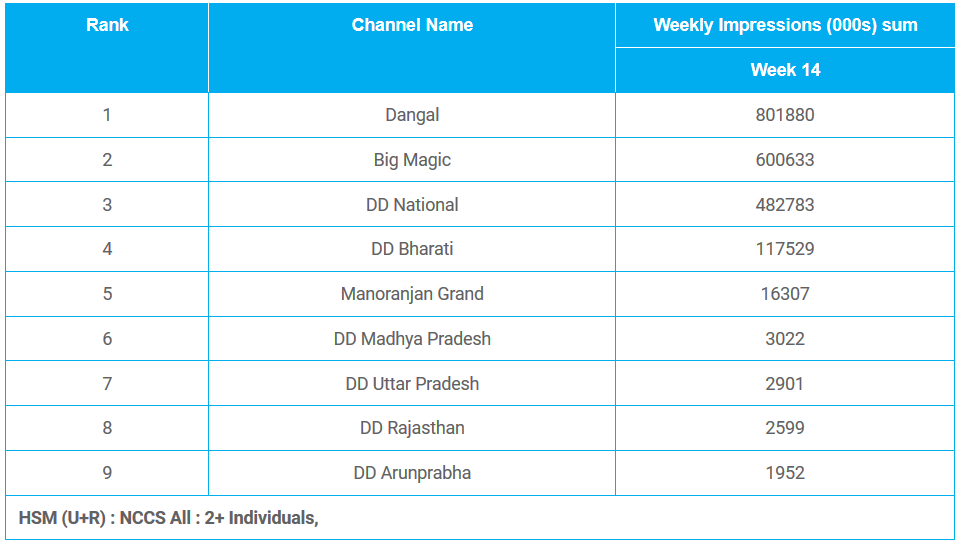
    On the free platform Dangal, Big Magic, DD National, DD Bharati, Manoranjan Grand, DD Madhya Pradesh, DD Uttar Pradesh, DD Rajasthan and DD Arunprabha were the top nine channels in week 14 of BARC ratings.

    Free Platform


  • Ad FCTs slump by 26% in week 14: BARC-Nielsen report

    Ad FCTs slump by 26% in week 14: BARC-Nielsen report

    NEW DELHI: For the first time in COVID-19 period, ad FCT has seen a slump, as revealed in the fourth edition of the BARC-Nielsen report, which compares data from the post-COVID period in January on a weekly basis with the current numbers. Overall FCT dropped from 28 million seconds to 20 million seconds, a dip of 26 per cent, in week 14.

    The slump was evident even after 72 per cent of the advertisers remaining active during the COVID-19 period.  

    The drop has been observed across genres, with music taking the biggest hit of 58 per cent, followed by youth recording a dip of 52 per cent and movies and kids slumping by 43 per cent. 


    The dip was constant across languages when it comes to GEC but EEC recorded a growth of 19 per cent. The biggest drop was noticed on Tamil GECs with a 52 per cent dip. Bangla GEC was next with 47 per cent drop in ad FCTs. 


    In movies, English films remained the least impacted with a one per cent slump in ad FCTs. The highest drop of 58 per cent was noted in Punjabi movies, followed by Tamil movies (-57 per cent), and Punjabi movies (-54 per cent). 


    Among the ad sectors, social ads have grown exponentially during COVID-19 period. Even essential products are showing signs of growth.


  • Hindi GEC hits new all-time high with 4 bn impressions in week 14

    Hindi GEC hits new all-time high with 4 bn impressions in week 14

    MUMBAI: In week 14 of TV viewership, the Hindi GEC genre has witnessed an all-time viewership high since 2015. According to the BARC-Nielsen -TV+ smartphone consumption data, the genre has grabbed four million impressions in the HSM urban market. 

    Ramayan is said to be the biggest driver of viewership growth in the urban HSM market in week 14. There have been 73 per cent episodic duplications and 83 per cent weekly duplication for Ramayan which was the highest among all Hindi GEC shows. 

    This week Ramayan grabbed 61,397 weekly impressions (000s) on DD National. The channel was leading on pay platform with 1,427,722 weekly impressions, and in the urban market it was leading with 1,099,834 weekly impressions (000s).

    22 per cent of kids are watching Ramayan with their grandparents/senior people at home. Co-viewing with 15+ years grew by 88 per cent. 

  • PM Modi’s lockdown extension address got 4 bn viewing mins

    PM Modi’s lockdown extension address got 4 bn viewing mins

    MUMBAI: Prime minister Narendra Modi’s address to the nation regarding the first extension of the lockdown on 14 April garnered four billion viewing minutes, as per latest data released by BARC-Nielsen. 

    This address garnered the highest viewership among his four addresses to the nation regarding COVID-19.  In his recent address, PM Modi announced that the nation-wide lockdown will be extended till 3 May.

    The lockdown extension speech received 3937.3 million viewing minutes while the earlier one on 3 April got 1024.5 million viewing minutes. The PM’s first lockdown announcement on 24 March got 3862.9 million viewing minutes, the second-highest among the four.

    The latest 25-minute address of the prime minister was shown on at least 199 channels with over 200 million people watching it. The recent address was the most important one compared to the three previous addresses, as PM Modi was about to speak on the future of lockdown imposed due to the COVID-19 crisis.

    PM Modi’s first address (Janta Curfew) on 19 March had garnered over 1.2 billion viewing minutes. In his second address, he announced the 21-day lockdown, which helped gain over 3.8 billion viewing minutes. The third address was only able to achieve 1 billion viewing minutes, during which he urged citizens to light a lamp and candles to stand together in India's fight against the pandemic. 

  • DD Bharati viewership grows by 43% in urban market

    DD Bharati viewership grows by 43% in urban market

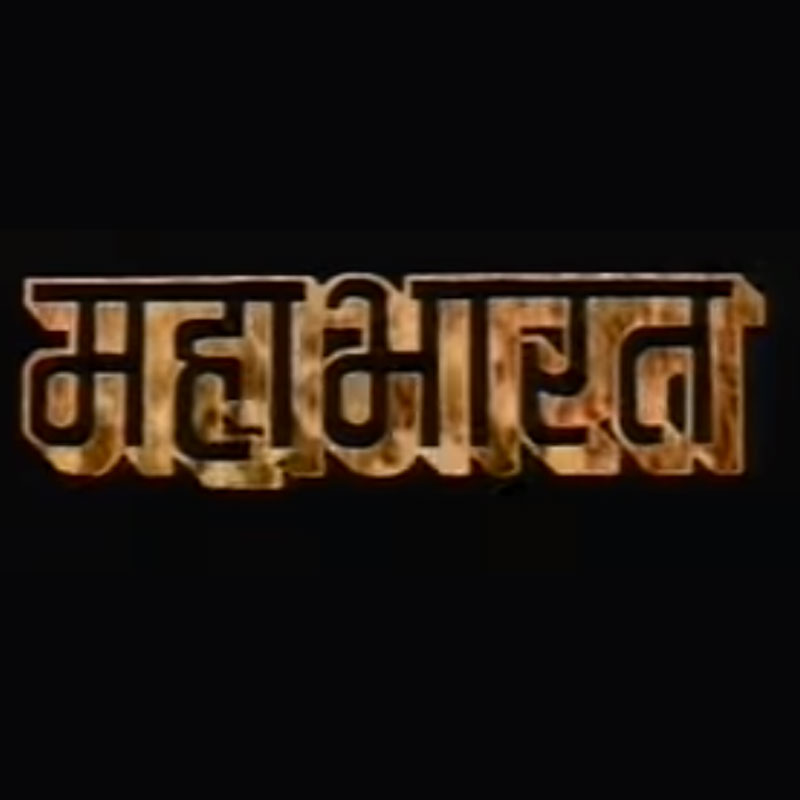
    MUMBAI: DD Bharati has grabbed its position among the top five Hindi GEC channels list. According to the fourth edition of BARC-Nielsen – TV+ smartphone consumption, as India braces for lockdown 2.0, the re-airing of Mahabharat helped the channel to enter the urban market. In NCCS A the viewership contribution by the show grew by 43 per cent. 

    The channel is being co-watched. 25 per cent of Kids (2-14 years) are watching the show with their grandparents/ senior person at home. 

    In the week 14 of BARC India ratings, DD Bharati grabbed third position with 323,674 weekly impressions (000s). On pay platform, the channel has grabbed the fourth position. 

    In week 13, DD Bharati was seen at the tenth position on pay platform with 221,511 weekly impressions (000s) while in urban market the channel was seen at sixth position with 189,077 weekly impressions (000s). 

    The channel started airing the popular serial Mahabharat from 28 March at 12 noon and 7 pm. 

  • Uday Shankar’s tips to win COVID2019 crisis

    Uday Shankar’s tips to win COVID2019 crisis

    MUMBAI: It is hard to measure the impact of COVID2019, harder to predict when everything will get back to normalcy. The uncertainty created by a virus, which is worse than a war, is instilling fear into minds. How does someone come out stronger amidst this chaos? The Walt Disney Company APAC chairman and Star and Disney India president Uday Shankar suggests simple measures – building core strength, reduce liabilities, taking calibrated risks and strategising.

    Even as the fear of catching the virus looms large, the economic instability is adding more worry. However, Shankar prioritises safety and reminds that unless you are safe there is nothing to look forward to.

    “The economy does look bad. There’s no trying to soften the bad news. So, let’s all get prepared. Today, if the entire country is going to be locked down, the wings of economy have come to a halt and it looks like a couple of quarters will be lost in terms of economic value,” he says reminding us about upcoming second-order, complex challenges like reduction in salaries, job losses, businesses struggling with liquidity and cash, etc.

    “This is a kind of economic setback that this country has not seen since independence. We had many hiccups and turbulences along the way but this kind of undifferentiated and pan-national economic crisis is not something we have seen,” he states.

    Despite all the negativity surrounding us, Shankar advises us to have a positive outlook. “I think the world has become tougher. This virus has created a crisis which is unprecedented. However, the world is not going to come to an end; this is not Armageddon. It has seen crises like this and has survived to grow stronger,” he says.

    Calling himself a ‘practitioner’, as is true with Shankar’s shift and rise from a journalism background to being one of the world mavericks of the media and entertainment world, his suggestion is to not let the fear of the unknown overtake you.

    Here are his four tips:

    Calibrated risks

    Shankar’s first tip to everyone – individuals and businesses –  is to reduce the risk. Focus on your core skills and build on that by acquiring knowledge. “Invest your time in learning a new skill. Knowing something is always uplifting. It gives you confidence. It is a journey from awareness to knowledge,” he says.

    However, he warns against gambling in this uncertain period. “There’s a difference between a gamble and a risk. You don’t know if this is the bottom or it’s further down. So, I don’t recommend gambling,” he points out.

    Reduce liabilities

    With less cash in your pockets, everyone needs to reduce their liabilities. Anything that’s not urgent can wait. Sharing an anecdote from his life at Star India, Shankar says that right after he took over the business, the world was hit by the 2008 economic crisis.

    “It looked like the world that would come to an end but I decided that there has to be an opportunity. My team and I decided to build on our core strength – our entertainment channel Star Plus. We decided to invest in that and not do anything new for some time. After that, our core business got stronger and we had fewer liabilities,” he shares.

    Strategise

    Even without an MBA background, Shankar spells out strategy in simple words: making choices. “There’s no better time than now to take decisions on what you will do, absolutely not do or postpone. All you need is clarity and purpose. Hit pause, rethink and think about how to lighten your load,” he guides those in the webinar.

    What has helped Shankar take the right calls in his journey from being a journalist to a media honcho is going with his gut instinct. He advises not to turn away from any information but process it for yourself.

    Star India, being one of the biggest content churning broadcasters, gets a lot of story pitches on a daily basis. Shankar picks what his gut says will work. “There’s no guarantee it will succeed but I will know that I failed doing what I wanted to do rather than what someone else wanted to do. You don’t want to fail and feel miserable that it was someone else’s suggestion. In most cases, the first attempt is not successful but if it’s something you’ve always wanted, you will make it work,” he says.

    Conviction

    Star India’s OTT platform Disney+Hotstar, launched five years ago as just Hotstar is today one of the top world players. But, in 2015, Shankar’s ambition was criticised. India was an expensive and data-dark market. But Shankar envisioned that people without TVs but with access to smartphones would want to consume video content. So, despite someone warning him that his “company has too much money and bosses too much faith in him”, akin to saying you’re investing in a losing proposition, his bet has played off.

    As data got democratised, opportunities opened up. “I wouldn’t have had the confidence if I did not have the conviction,” he says.

    Similarly, the company placed a bet on sports when everyone thought it had nothing new to offer. “I believed the power of cricket was only going to grow. That’s been our experience in the last five to six years. The number of consumers has doubled. The other is the story of kabaddi. They believed it was a 1000-year-old dead sport. Ronnie (Screwvala) was one of the first to believe that people will watch kabaddi if it’s made to look like a serious modern sport. Today, it is the second-most-watched sport in the country,” he reminisces.

    Along the way, he rejected taking up many other sports, such as basketball, which have been successful in other countries. “I believed I understood India and I realise that Indians would like to watch something they’ve grown up with and seen in their neighbourhood. So, my message is to stay with your conviction and do not go for applause in the stadium,” he says.

    His final message is to stay positive. If you're safe and healthy you will be able to finally triumph. He also tells people to look into the failures of those who have been successful. “There are a lot of us who admire many leaders. The problem with all of us is we read only the success. Rarely do we get an insight into the journey to success. All the people that I admire have had to face many setbacks, failures and handicaps before gaining the success that the world admires,” he states.

    Praising the country’s tackling of COVID-19, Shankar mentions, “This country has been ahead of the curve. Yes, a lockdown is miserable. But individuals and the country will come out stronger. We need to be positive and not selfish. Today, we need community, friends, family and the nation even more than we have needed in the past.”

    In a short Q&A session, Screwvala posed a question on how the youth can have long-term views rather than weekly. Shankar reiterates the need to think long-term because the short term is only likely to get worse.

    “It is going to be fluid and bad. Though we should hope for it to get better, we need to be realistically prepared for it to get worse. India is a country of youth. We have a long life ahead of us. A few quarters and even a year or two is not what we’re planning. The youth are impatient and full of energy. They want to achieve everything overnight. You will dissipate a lot of energy and get frustrated in doing that.

    To do that, Shankar says that people need to build endurance which he thinks is a skill visible in a marathon, even though the marathon runner may look ‘unattractive and unsexy’ as compared to a 100-metre sprinter.

    Speaking on consumer patterns, the Disney boss is aware that people will be extremely cautious about being in crowded places and that will determine their behaviour. The environment is going to be cynical and full of fear. Consumers will be conservative as the changing lifestyle will persist even after the lockdown is lifted. Hence, instead of going for five things at a time, he asks to take one-two tasks and see if they can deliver the same business goals.

    While many have been pushed into working from home, Shankar is no different. But this new normal, for him, has brought more efficiency.  “It is exhausting and tiring because there is no difference between work and home but I find myself more productive since I can focus more on what’s important and urgent. At work, we spend a lot of time doing trivial and inessential things,” he shares about his work-from-home experience.

    Leading a bunch of teams across APAC, Screwvala asks what qualities he admires in other countries. To this, Shankar says that China’s discipline and Japan’s dedication and collaborative spirit are admirable.

    To leaders, Shankar says that it is a time to pause and start again. He calls the COVID-19 crisis a washout. Just because something worked before the crisis, does not mean it will afterwards, too. “Production of our [Star India] shows has stopped and the habit may have been interrupted. The fact that it was doing well before lockdown is not the reason why the show will be watched again,” he says grimly.

    To the youngsters looking at a career in media, he says that one of the key reasons to choose this field is because “Even Corona doesn’t stop the consumption of media”. Shankar says that whenever the world feels uncertainty, it gravitates to media – content. Information and awareness give you a sense of comfort and assurance in the volatile world.

    However, the media is also relentless and if you don’t mind challenging yourself every single day, and being fine with the fact that what you’re going to say is going to be judged by every person, there’s every reason to be in media.

    He concludes with a cricket analogy. “It’s the time to watch every cricket ball and let most of the balls go. Then pick your ball and hit it out of the park.” 

  • ChyronHego launches training resource for industry professionals

    ChyronHego launches training resource for industry professionals

    MUMBAI: ChyronHego has launched ChyronHego Academy, a training resource designed to help industry professionals acquire and update essential skills in working with the company's graphics products. Offering a self-paced online curriculum created by product experts, ChyronHego Academy provides a pathway to becoming a certified ChyronHego product designer or operator. The initial ChyronHego Academy courses focus on PRIME Graphics and will be followed by courses on additional products from the ChyronHego portfolio.

    "Over the years, ChyronHego has been a trusted partner of Lyric freelancers, as well as the many designers and operators working with ChyronHego's Lyric and PRIME Graphics solutions at broadcast and production facilities worldwide," said Carol Bettencourt, manager of strategic marketing projects at ChyronHego. "With ChyronHego Academy we're extending support for these users, giving them the tools to increase their knowledge and expand their career opportunities from the comfort of their home. To support the broadcast community as a whole during the COVID-19 crisis, we're making ChyronHego Academy courses and certification available at no cost."

    ChyronHego Academy makes skills training accessible and convenient to all types of participants, from freelance designers and operators looking to boost their own knowledge base to teams working within larger media organizations. Learning from the best — and on the latest technology — participants can complete basic, intermediate, and advanced course modules to earn certification.

    Freelance designers and operators can leverage ChyronHego Academy certification to demonstrate their skill and expertise to potential employers. Managers within a broadcast organization can take advantage of certification training to raise the overall proficiency of staff designers and operators, as well as to evaluate new ChyronHego products.

    "ChyronHego products have long set the industry standard, and broadcasters know that an investment in our technology gives them access to best-in-class capabilities plus the opportunity to hire top-notch operators from an active user community," added Bettencourt. "We look forward to supporting this great community with our brand-new ChyronHego Academy course offerings."

    Information about the full ChyronHego product portfolio is available at www.chyronhego.com.

    ChyronHego is ushering in the next generation of storytelling in the digital age. Founded in 1966 as Chyron, the company has played a pioneering role in developing broadcast titling and graphics systems. With a strong foundation built over 50 years on innovation and efficiency, ChyronHego has become a household name and global leader in broadcast, with a focus on customer-centric solutions. Today, the company offers production professionals the industry's most comprehensive software portfolio for designing, sharing, and playing live graphics to air with ease. ChyronHego products are increasingly deployed to empower OTA and OTT workflows and deliver richer, more immersive experiences for audiences and sports fans in the arena, at home, or on the go.

    ChyronHego is headquartered in New York with operations in 11 countries. ChyronHego is a portfolio company of Vector Capital, an investment and management firm dedicated to the growth of technology companies.