Category: Viewership

  • BARC India changes TG to 2+ for all genres from week 17

    BARC India changes TG to 2+ for all genres from week 17

    MUMBAI: Broadcast Audience Research Council (BARC) has informed that from the coming week, week 17, it will release data with TG as 2+ for all genres. For English, lifestyle and infotainment genres the market has been changed to All India. This change will allow for more direct comparison between genres and aligns with common measurement best practices.

    The ratings body said that over the years it has been getting requests to display data for different TG cuts on the website.

    “We have evaluated all the requests and to maintain uniformity across, it has been decided that from (coming week) week 17, BARC India will release data on website and mobile with TG as 2+ for all genres and market as All India for English, lifestyle and infotainment genres. This change will allow for more direct comparison between genres and aligns with common measurement best practices,” said the statement.   

    Earlier, the cuts were based on different age groups and ABC sections as well as male/female separation.

    Follow Tellychakkar for the consumer facing news & entertainment

  • Comcast posts growth in broadcast TV revenue in Q1

    Comcast posts growth in broadcast TV revenue in Q1

    MUMBAI: Broadcasting and cable television company Comcast Corporation has reported results for the quarter ended March 31, 2020. While broadcast television revenue increased 8.8 per cent to $2.7 billion in the first quarter of 2020, distribution revenue and ad revenue decreased 1.5 per cent and 2.2 per cent, respectively.

    Broadcast television

    Growth in broadcast television revenue reflects increases in content licensing revenue and distribution and other revenue. Content licensing revenue increased 31.3 per cent due to the timing of content provided under licensing agreements. Distribution and other revenue increased 6.9 per cent, due to higher retransmission consent fees. Advertising revenue was consistent with the prior year period, reflecting higher pricing and local political advertising, offset by audience ratings declines and reduced advertiser spending due to Covid2019.

    Adjusted EBITDA increased 29.6 per cent to $501 million in the first quarter of 2020, reflecting higher revenue, partially offset by an increase in operating costs and expenses. The increase in operating costs and expenses was primarily due to an increase in programming and production costs, which was partially offset by the favorable impact of adopting updated accounting guidance.

    Cable networks

    While it lost 388,000 residential video subscribers in the first quarter, cable networks revenue of $2.9 billion was consistent with the prior year period, reflecting decreases in distribution revenue and advertising revenue, offset by an increase in content licensing and other revenue.

    Distribution revenue decreased 1.5 per cent, reflecting a decline in subscribers, partially offset by contractual rate increases and the timing of contract renewals. Advertising revenue decreased 2.2 per cent, reflecting audience ratings declines and reduced advertiser spending resulting from the postponement of sports events due to Covid2019, partially offset by higher pricing.

    The Covid209 pandemic, it seems, has not eroded its other revenue streams. Content licensing and other revenue increased 13 per cent due to the timing of content provided under licensing agreements. Adjusted EBITDA decreased 1.2 per cent to $1.2 billion in the first quarter of 2020, reflecting flat revenue, and flat operating expenses, as higher other operating and administrative costs were offset by lower programming and production costs. The decline in programming and production costs was primarily due to decreases in the recognition of sports programming costs as a result of the postponement of sports events due to Covid2019.

    Filmed entertainment

    Filmed Entertainment revenue decreased 22.5 per cent to $1.4 billion in the first quarter of 2020, reflecting decreases in theatrical revenue, content licensing revenue, home entertainment revenue and other revenue. Theatrical revenue decreased 28.8 per cent, reflecting a difficult comparison to the success of films in the first quarter of 2019.  

    “Society is being challenged like never before in our lifetime, and I couldn’t be prouder of our company, our employees, and our leadership team across Comcast Cable, NBCUniversal, and Sky. Now more than ever the world needs to stay connected, and we’re extremely pleased that our investments in our network continue to pay off as we are handling significant increases in traffic and meeting our customers’ needs," said Brian L Roberts, chairman and chief executive officer of Comcast Corporation.

    “While parts of our business have been more impacted by COVID-19 than others, we have continued to innovate. We are distributing our content in new ways, as evidenced by the recent launch of Peacock on X1 and Flex. We've also taken decisive action, having moved over 95 per cent of our US call-centre employees to work from home and putting in place new procedures that have allowed more than 15,000 construction workers to safely come back to work to build our theme park in Beijing. All the divisions of our company are in constant communication, and the level of collaboration has been extraordinary. We have a strong balance sheet, terrific portfolio of assets, and a world-class management team. This is a moment in time; and when it passes, I am very confident that the decisions we are making now will enable us to emerge from this crisis as a healthy, strong company that is well positioned to continue to grow and succeed,” he said.

    Theme parks

    Theme Parks revenue decreased 31.9 per cent to $869 million in the first quarter of 2020, primarily due to the closures of Universal Studios Japan in late February and Universal Orlando Resort and Universal Studios Hollywood in mid-March as a result of COVID-19. Adjusted EBITDA decreased 84.7 per cent to $76 million in the first quarter of 2020, reflecting lower revenue and higher operating costs. The increase in operating costs was primarily due to increases in employee-related costs and pre-opening costs associated with the Universal Beijing Resort and Super Nintendo WorldTM in Universal Studios Japan, partially offset by lower park operation costs due to the park closures.

    Consolidated results

    Revenue for the first quarter of 2020 decreased 0.9 per cent to $26.6 billion. Net Income Attributable to Comcast decreased 39.6 per cent to $2.1 billion. Adjusted Net Income decreased 6.1 per cent to $3.3 billion. Adjusted EBITDA decreased 4.9 per cent to $8.1 billion.

    Earnings per Share (EPS) for the first quarter was $0.46, a decrease of 40.3 per cent compared to the first quarter of 2019. Adjusted EPS decreased 6.6 per cent to $0.71.

    Capital Expenditures decreased 10.1 per cent to $1.9 billion in the first quarter of 2020. Cable Communications’ capital expenditures decreased 6.9 per cent  to $1.3 billion in the first quarter of 2020. NBCUniversal’s capital expenditures decreased 16.7 per cent  to $377 million. Sky's capital expenditures decreased 24.1 per cent to $197 million. Net Cash Provided by Operating Activities was $5.8 billion in the first quarter of 2020. Free Cash Flow was $3.3 billion.

    Dividends paid during the first quarter of 2020 totalled $977 million.
  • ‘Chhota Bheem’ boosts DD National’s 2 pm slot viewership

    ‘Chhota Bheem’ boosts DD National’s 2 pm slot viewership

    MUMBAI: Chhota Bheem on DD National improved the slot viewership, according to the latest BARC-Nielsen report data.

    Kids in the 2-14 age group contributed 38 per cent of the slot viewership of 2-2.30 pm.

    In the Hindi Speaking Market (HSM) 2+ category, the programme saw an increase from 154,000 impressions during the pre-Covid2019 period to 1,729,000 impressions in week 16. This is a jump of 11 times.

    In the HSM 2 to 14 years, it increased from 34,000 impressions in pre-Covid period to 662,000 impressions in week 16, which was a jump of 20 times. 

  • FCT for most genres stable in Week 16: BARC-Nielsen

    FCT for most genres stable in Week 16: BARC-Nielsen

    NEW DELHI: As per the sixth edition of BARC-Nielsen data, which shares insight into the media habits during the COVID2019 period, brands that advertised heavily during summers have seen a drop in FCTs as compared to the weeks 14-16 of 2019. However, most of the categories sustained FCT levels in week 16 of 2020 as compared to the previous week, with soft drinks and squashes seeing a marginal increase. 

    Also, the overall FCT, across genres, remained largely stable in week 16, noticing just one per cent dip in overall numbers as compared to the past week. 

    News genre kept growing compared to pre-COVID period with Hindi, English, Gujarati and Oriya channels witnessing the highest growth when it comes to FCT. There has been a marginal dip in several languages, however, as compared to week 15. 

    Inventory levels of top 10 brands dropped marginally, by four per cent, as compared to the past week. For the next 40 brands, the drop was 10 per cent. The number of total brands on TV also witnessed a marginal drop, as compared to week 15. It went from 2013 brands in week 15 to 1947 brands in week 16. 

    Several top advertisers increased their inventory across genres while GSK, ITC and Colgate increased FCTs on GECs, Reckitt Benckiser, HUL and National Informatics Centre on news channels. GSK, Colgate, and Amazon upped their FCTs on movie channels. 

  • DD National viewership drops by 46% as ‘Ramayan’ concludes

    DD National viewership drops by 46% as ‘Ramayan’ concludes

    MUMBAI: DD National has been at the top of the charts for the last few weeks with its airing of Ramayan. However, as the last episode of the show aired in week 16 and gave way to Uttar Ramayan, there was a drop in viewership by 46 per cent, according to BARC-Nielsen report. 

    Ramayan aired at 9 am and 9 pm while Uttar Ramayan airs only at 9 pm. The morning slot saw a dip of 66 per cent while the night slot saw a 29 per cent drop. While morning viewers shifted to news, kids, music, the evening ones went to other GECs and movie channels.

    Follow Tellychakkar for the consumer facing news & entertainment

  • IPL viewers shift to GEC, movies & news

    IPL viewers shift to GEC, movies & news

    MUMBAI: The April and May season is generally peak time for sports and the Indian Premier League (IPL). In 2019, sports took 20 per cent of total viewership, led by IPL viewers, which has dropped to two per cent this year during week 13 to 16, according to BARC-Nielsen report.

    These sports viewers have moved to GECs, movies and news genres. GEC saw a rise from 38 per cent in 2019 to 40 per cent in 2020. News saw a rise from nine per cent in 2019 to 19 per cent in 2020. Movies went from 21 per cent in 2019 to 28 per cent in 2020. 

    Follow Tellychakkar for the consumer facing news & entertainment

  • Total TV viewership sees drop in week 16: BARC-Nielsen

    Total TV viewership sees drop in week 16: BARC-Nielsen

    MUMBAI: Total TV viewership in week 16 saw a 6 per cent drop from week 15, standing at 1.16 trillion viewing minutes, as per BARC-Nielsen data. It says that the drop is driven by rural India and can be attributed to the summer impact. The drop is also because week 15 was a festive season in South India which had spiked ratings for that week.

    Comparing week 16 (lockdown week 6) with the pre-Covid time, there is a 31 per cent increase. While week 15 saw 1.239 trillion viewing minutes, the pre-COVID time had just 0.887 trillion viewing minutes.

    Additionally, the average daily reach also saw a drop of one per cent since week 15. Week 16 recorded 619 million average daily reach while week 15 had 627 million. However, week 16 has a 11 per cent jump from the pre-Covid time when it was just 560 million. 

    Follow Tellychakkar for the consumer facing news & entertainment

  • DD National, Sun TV & Zee Biskope see viewership growth across genres

    DD National, Sun TV & Zee Biskope see viewership growth across genres

    BENGALURU: Week 13 of 2020 was a peak week in terms of television viewership which had climbed to an all-time high. Viewership fell in week 14 of 2020, but seems to have recovered a bit in week 15 of 2020 (Saturday, 11 April 2020 to Friday, 17 April 2020, week under review). Towards the mid-end of Week 12 of 2020 was when the Indian COVID-19 lockdown happened (25 March 2020), but events such as the Janta curfew happened at the start of week 12. Hence, week 12 can be considered the first week of the Indian COVID-19 lockdown. Television viewing habits and viewership have changed completely during the lockdown period in the country.

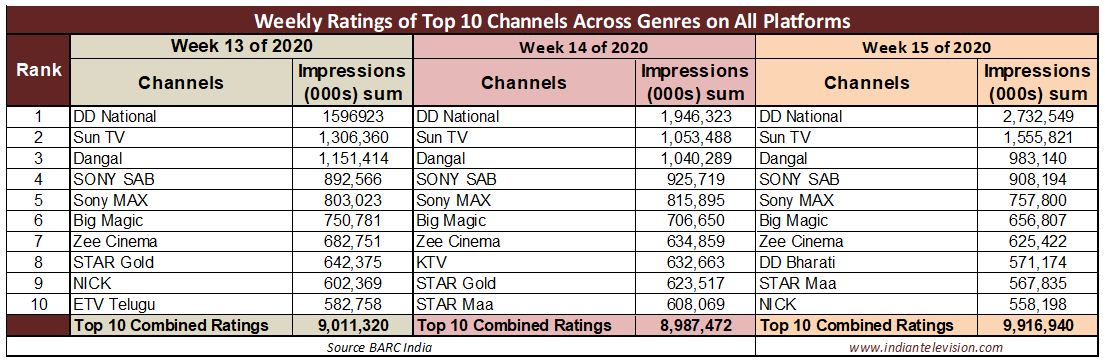
    Broadcast Audience Research Council of India (BARC) data for week 15 of 2020 reveals that only one of the nine channels that were present in BARC’s weekly list of Top 10 Channels Across Genres on All Platforms, on pay platform and free platform in weeks 13, 14 and 15 of 2020 have seen viewership growth in week on week (w-o-w) to week 15 as compared to the peak week. Pubcaster network Doordarshan’s (DD) flagship channel DD National saw viewership grow 21.4 per cent in week 14 of 2020 as compared to week 13 and saw it grow further in week 15 by 38.2 per cent vis-à-vis week 14 in BARC’s weekly across genres lists on all platforms. The most widely available terrestrial channel in the country saw viewership grow 68 per cent in week 15 as compared to week 13 in BARC’s weekly across genres lists on all platforms. The rerun of the mythology shows Ramayan and Mahabharat and a number of classics from the 80’s and 90’s of the previous century have helped two channels of DD grow viewership tremendously.

    Top 10 channels across genres on all platforms

    Nine channels have appeared in BARC’s weekly across genres lists on all platforms during all the three weeks under consideration here. The only exception was the Sun Network’s Tamil movies channel KTV, which exited in BARC’s weekly across genres lists on all platforms in week 14 of 2020, to be replaced by Viacom18’s Kids channel Nick.

    Sun TV Network’s flagship Tamil channel Sun TV saw viewership decline in week 14 by19.4 per cent as compared to week 13 of 2020, but then climb again strongly in week 15 by 48 per cent as compared to week 13.

    Two channels, each from DD, Sony Pictures Network India (SPN) and Zee Entertainment Enterprises Limited (Zeel) and one channel each from Enterr 10 Television, Star India, Sun Tv Network and Viacom18, were present in BARC’s weekly list of Top 10 Channels Across Genres on All Platforms in week 25 of 2020.  Five of the channels were Hindi GECs; there were two Hindi movie channels and there was one channel each from the kids, Tamil and Telugu genres present in the list in week 15 of 2020.

    Please refer to the chart below

    Top 10 Pay Channels Across Genres

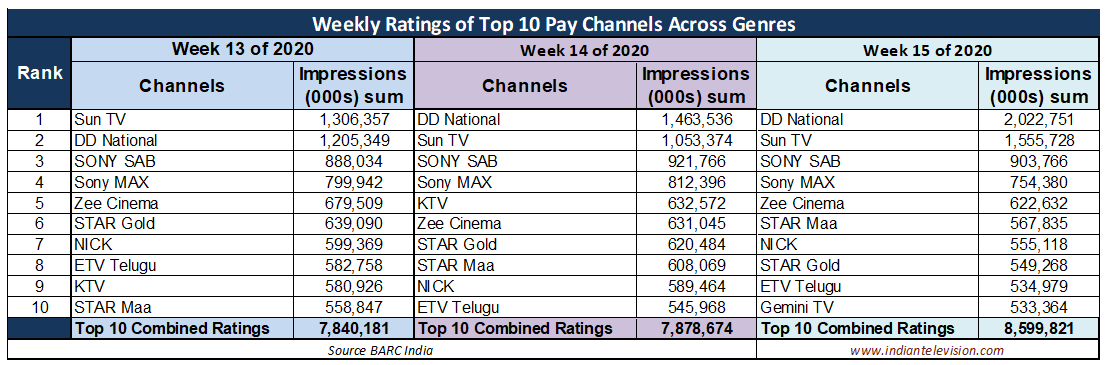
    In BARC’s weekly lists of Top 10 Pay Channels Across Genres for weeks 13, 14 and 15 of 2020, DD National was the only channel that saw w-o-w growth in weeks 14 and 15 as compared to week 13 of 2020.

    Nine of the channels in BARC’s weekly list of Top 10 Pay Channels Across Genres have been the same in weeks 13, 14 and 15 of 2020 with a shuffling of ranks. The only change was when KTV exited the list in week 15 of 2020 to be replaced by its network’s sibling Telugu GEC Gemini TV. 

    Three channels each from the Hindi movies and Telugu genres, two channels from the Hindi GEC genre and one channel each from the kids and Tamil
    genre made up BARC’s weekly list of Top 10 Pay Channels Across Genres in week 15 of 2020. Two channels each from SPN, Star, Sun and Viacom 18 (one from Viacom18 and one from Eenadu TV group in which Viacom18’s majority owner Network18 has a stake) and one channel each from DD and Zee were present in BARC’s weekly list of Top 10 Pay Channels Across Genres.

    Please refer to the charts below:

    Top 10 Free-to-Air Channels Across Genres

    In the case of BARC’s weekly lists of Top 10 Free-to-Air Channels Across Genres, it was again DD National that maintained its w-o-w growth in weeks 14 and 15 as compared to week 13 of 2020. Further, Zeel’sBhohpuri cinema channel Zee Biskope also showed growth during week 15 vis-à-vis week 13, but it had seen a viewership drop in week 14 as compared to week 13 of 2020.

    Four Hindi GECs’, three channels from the Hindi Movies, two channels from the Bhojpuri genre and one channel from the Youth genre comprised BARC’s weekly list  of Top 10 Free-to-Air Channels Across Genres in week 15 of 2020. There were three channels each from Enterr 10 Television and Zeel and two channels each from B4U and DD networks in BARC’s weekly list of Top 10 Free-to-Air Channels Across Genres during the week under review. 

    Here also, nine of the channels were present during the three weeks under consideration in this paper, but again with some shuffling of ranks. The India Today group’s Hindi News channel AajTakexited the list in week 14 to be replaced by DD’s Hindi GEC DD Bharati.

    Please refer to the charts below:


  • Megacities see reach, ATS growth in COVID-19 week 5

    Megacities see reach, ATS growth in COVID-19 week 5

    MUMBAI: Megacities like Mumbai, Chennai and Bangalore have grown during week 5 of COVID-19 driven by both reach and ATS, as per latest data from BARC and Nielsen. ATS for Mumbai has grown the most by 1 hour 42 minutes (39 per cent growth). 

    Follow Tellychakkar for the consumer facing news & entertainment

    Megacities also showed growth in GECs except for Kolkata. Consistent growth was witnessed across the Hindi-speaking market over the southern market in week 15 (COVID week 5).

    Prime-time, as well as non-prime time, registered growth.  While news and movies continued to grow, genre-wise, movies saw increased viewership.  

    The news genre saw two-fold growth in the current week with 198 per cent followed by business news and movies. News grew to 16 per cent from seven per cent in the last few weeks as compared to the pre-COVID period

    Growth in movie viewership is coming largely from pay platforms across urban and rural market (82 per cent, 69 per cent), respectively 

  • Mythological shows contribute 43% to Hindi GEC viewership in COVID week 5: BARC-Nielsen

    Mythological shows contribute 43% to Hindi GEC viewership in COVID week 5: BARC-Nielsen

    MUMBAI: Mythological shows became the main source of entertainment among Hindi GECs in COVID week 5, according to BARC- Nielsen data, with 43 per cent of viewership contribution to Hindi GEC genre with a total of 466 hours of content.

    Follow Tellychakkar for the consumer facing news & entertainment

    Mythological shows garnered 109 billion viewing minutes and it was watched by 353 million viewers.

    Off late, broadcasters have started showing re-runs of several mythological shows. The DD Network revived two classics – Ramayan and Mahabharat as did other GECs.

    Additionally, Hindi GECs attained an all-time viewership high in HSM in week 15 with 8.5 billion impressions. In HSM, Hindi GECs showed growth across platforms in non-prime-time in week 15 over pre-COVID period.