Category: Viewership

  • ShortsTV inks content deal with Viacom18 Studios, expands Indian short films portfolio

    ShortsTV inks content deal with Viacom18 Studios, expands Indian short films portfolio

    Mumbai: ShortsTV, the world’s first 24/7 channel for short films, has inked a content deal with Tipping Point, the digital content production arm of Viacom18 Studios. As a part of the deal, ShortsTV has bagged the South Asia distribution rights of 15 short films featuring some of Bollywood’s top actors and directors.

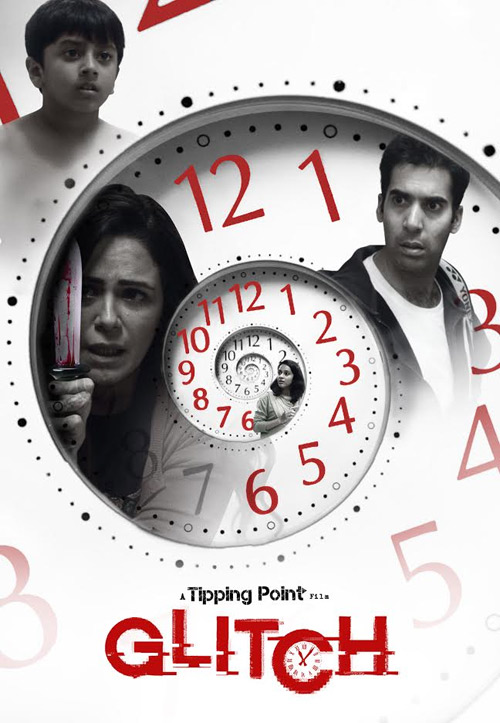
    ShortsTV’s depth of films is unrivalled, drawing from a growing catalogue of more than 13,000 Indian and international short films. With this new partnership, ShortsTV has added to its bouquet top Indian short films such as Maya, Geek Out, The Epiphany, Glitch, The Daughter-In-Law, Grey, Red Velvet, A(U)N Usual Day, On the Road, Joy Ride, Teaspoon, Tea, Kill Me with Love, Hidden Cricket and A Twist in Love.

    These boundary-breaking stories, featuring popular actors such as Vicky Kaushal, Sayani Gupta, Mona Singh, Fardeen Khan span across genres as diverse as drama, thriller, adventure and mystery and are produced by Tipping Point.

    ShortsTV chief executive Carter Pilcher said: “In line with our endeavour to bring the highest quality short entertainment to film buffs, we are delighted to partner with Viacom18 Studios’ Tipping Point to add the most popular Indian short films to our growing library. During these unprecedented times when people are indoors and looking for new entertainment options, ShortsTV is ready to deliver content extraordinaire from across the globe, to be enjoyed from the safety of our homes.”

    Viacom18 Studios COO Ajit Andhare said: “In just over a year, Tipping Point as a young digital content brand, has managed to create content that cuts across demographics, set genres and formulas. Our latest association with ShortsTV for our widely appreciated short films is a step towards deepening that connect with discerning consumers. From licensing our content to top Indian OTT players like VOOT or global platforms like Netflix & ShortsTV – we will continue to connect stories to audiences across the globe.”

    Debuting in India in 2018 first on Tata Sky, ShortsTV is now available across all leading DTH platforms reaching over 60 million households, providing short filmmakers an excellent platform to showcase their work. ShortsTV is available ad-free on Dish TV and d2h as ‘ShortsTV Active’ (channel 135), on Airtel Digital TV as ‘Airtel ShortsTV’ (channel 259) and on Tata Sky as ‘Tata Sky ShortsTV’ (HD channel 112 and SD channel 113).

    In addition, ShortsTV has founded the Best of India Short Film Festival inviting filmmakers to make their submissions aiming to qualify more Indian short films for Oscar consideration. This year, the festival has already received more than 1000 entries.

    Follow Tellychakkar for the consumer facing news & entertainment

  • Travelxp 4K HDR expands availability in German-speaking markets

    Travelxp 4K HDR expands availability in German-speaking markets

    MUMBAI: M7 Deutschland, Germany’s leading provider of TV entertainment for cable and IP networks, has expanded its ultra HD (UHD) portfolio: International travel and lifestyle channel Travelxp 4K HDR. The channel is now available to network and platform operators in the German-speaking markets for distribution to their subscribers.

    The world's first travel channel in UHD/HDR resolution shows reports and features covering holiday destinations in more than 60 countries around the world 24 hours per day. The programmes are offered in German language on networks supplied by M7 in Germany, Austria and Switzerland.

    "We are excited about this attractive new addition to our UHD line-up: Travelxp 4k brings foreign cultures and exotic locations directly into the living room and enables viewers to experience destinations far away, particularly now that travelling is difficult," said Christian Heinkele, managing director of Eviso Germany GmbH, business partner of M7 in Germany.

    "Travel reports and landscape images are the perfect examples of content where excellent TV/video resolution and powerful distribution infrastructures are essential. This is a great opportunity for public utility companies, network operators and fibre-optic providers to show what their networks are capable of."

    Sumant Bahl, managing director, Europe & Africa, Travelxp, said: "We are delighted to further strengthen both our relationship with M7 Group as well as our 4K distribution in Germany. Travelxp 4K HDR is among the best in 4K and travel shows in the world. Apart from the vivid and immersive picture quality our channel offers, we are also excited about showcasing the original and interesting travel content we produce in diverse genres. We are confident that M7 audiences will love our shows."

    With Travelxp 4K HDR, M7 offers its partners a total of three UHD channels for distribution on their networks. This agreement builds upon the cooperation M7 Group and Travelxp have already established in the Benelux and central Eastern European markets.

    Launched in 2011, Travelxp is currently distributed in 97+ million homes across 40+ countries with several global feeds localised in 15+

    languages. Travelxp 4K HDR, the world’s first 4K HDR linear channel, provides immersive experience with 10 bit colour depth, 50 frames and HLG HDR.

    Travelxp’s content strategy to showcase exclusive, well researched, in-depth depiction of destinations around the world has been inspiring viewers to explore the world like never before. Travelxp is the world’s leading travel influencer inspiring millions to choose their holiday destination based on content that they consume on Travelxp.

    As one of the largest platform operators for satellite and IP-based TV, M7 Group SA serves more than three million end customers in Europe. In Germany and Austria, M7 is also the landmark B2B provider for TV services. 

  • Uday Shankar speaks on IPL and sports post-Covid2019

    Uday Shankar speaks on IPL and sports post-Covid2019

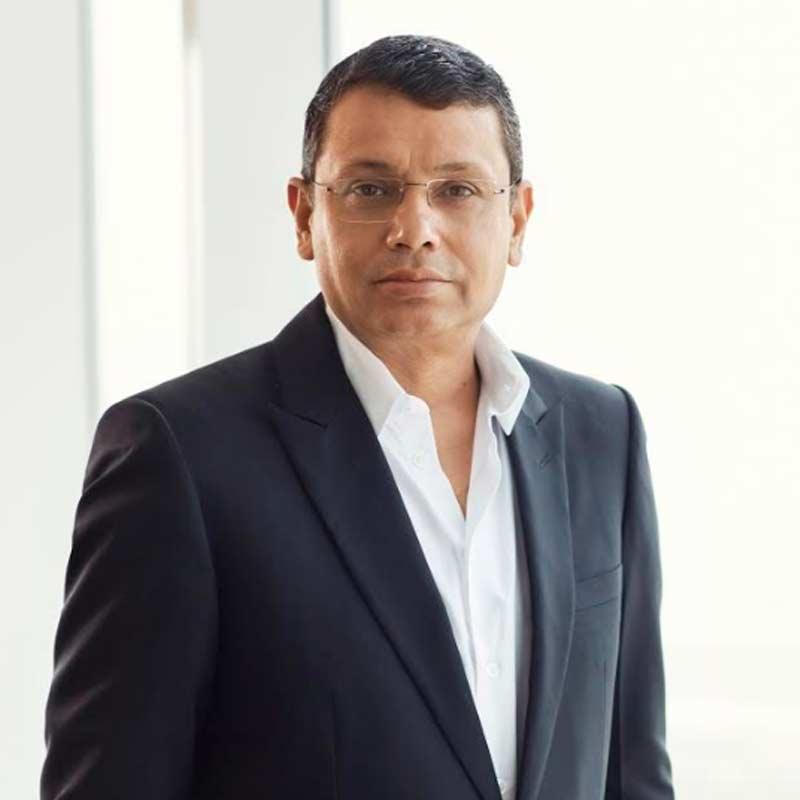
    MUMBAI: It seems like nothing can put this journalist-turned-CEO down. Even as most would have been wringing their hands in despair following the disruption in the way business operates following the Covid2019 effect, Uday Shankar, the head honcho of Disney Star India, is taking things in his stride.

    “We need to break our muscle memory. No matter which business you are in, those who are able to think differently and work backwards from the new reality, they will be able to create much more value,” said Uday Shankar, while interacting with Indian Express about how his company will deal with the fact that its biggest cash cow the IPL has not happened in the 2020 season, and may not happen if the virus continues to wreak havoc in India and the world.

    The Board for Control of Cricket in India (BCCI) has been mulling over options like finding a date in the calendar when the IPL can be pushed in and how the matches will be played in stadia when distancing and safety regulations may prevent large public gatherings in them.

    Shankar explained that even empty stands during the IPL when it does happen post clearances from various country boards would not be a problem. He pointed out that players could come in, and instead of coming in five days earlier, they could come in two weeks prior and serve the quarantine period before getting on the field. 

    “I don’t buy it when people say, ‘oh, the experience will be incomplete’. Sports has become bigger because people are able to watch it on multiple media. Yes, the presence of the audience at the ground does help to create an atmosphere, so we will figure out ways of creating and enhancing the atmosphere through graphics, audio, sound effects and all that,” he elaborated. “It will be a challenge and we are required to deal with it for the first time. But it will get easier. Look, on Day 1 of lockdown, even using sanitiser and mask was a big disruption. I heard so many people say that they were not able to breathe properly. Now everybody is wearing masks. We will get used to it.”

    He further went on to state that technology will step in and his company was working on ways to get the home-viewing audience’s experiences onto the TV screen.

    “It’s a creative challenge; it’s not a sporting challenge. You watch sports at home on TV or Hotstar. Whenever you’re watching a tense moment, do you not have a very intense expression on your face? So, all we need to do is capture it. And today technology is ready for that. So, you can be at home but you can also be on television,” he said. “Our ability to recreate the same atmosphere for the fans who are watching it from home is limited only by our imagination; otherwise the fan gives you enough opportunity to capture those moments of intensity and excitement. It will be a somewhat different experience but it surely will be as rich, if not richer. If this had happened 20 years ago, without broadband and hundreds of millions of smartphones with cameras, it would be a challenge. Today it’s happening at a time when we’re ready.”

    Shankar believes that the sports bodies are going to be supportive of any initiatives that Disney Star India takes to bring sport back into Indian homes. Said he: “It has hurt us greatly; but it has hurt everybody. So, I won’t read too much into this. Look, first and foremost, we have a contract. We are an honourable company and we will honour it. But you should also understand that sports bodies are also aware of the challenges in the market place… The economy and incomes have taken a hit. And as far as Star and cricket are concerned, it is the goose that lays the golden egg. We have invested more in cricket than any other media company, any time in the world. I think in my experience, all sports bodies and authorities value the fact that our commitment to cricket is so high. If there is a real problem, we will go to them and I’m sure we will get a fair audience.”

  • Star India, Disney+Hotstar join hands with Project Mumbai in Covid2019 battle

    Star India, Disney+Hotstar join hands with Project Mumbai in Covid2019 battle

    MUMBAI: When the entire world is hobbled by a never-before-seen pandemic of this scale, what the world wants is an unwavering sense of camaraderie that is rooted in humanity. In such a crisis, people and organisations, transcending all man-made restrictions, help each other so as to put up a collective fight against the Covid2019 pandemic.

    The country has already seen how the entertainment industry has come out to help those in need of succour.    

    Now, media organisations are coming to the forefront in this hour of crisis to do their bit for the health and safety of individuals who are at the forefront in their battle against the pandemic.

    Star India and Disney+Hotstar have joined hands with the NGO Project Mumbai by donating 200,000 personal protection equipment (PPE) kits to the health workers at BMC and an additional 10,000 khakhi-coloured kits for the Mumbai police.

    Mumbai, which is seeing a spike in cases with each passing day, needs the consistent support and help of non-governmental organisations in dealing with a massive crisis like this one. This is where Star India and Disney’s contribution matters. The support will help the ongoing efforts in meeting the demand for PPE kits for almost four weeks. Showcasing solidarity with the numerous medical, health, and protection warriors, the initiative seeks to equip the selfless warriors who are at the frontline, battling the pandemic.

    Project Mumbai CEO-founder Shishir Joshi told Indiantelevision.com that Uday Shankar, president of The Walt Disney Company Asia Pacific, and chairman of Star India, was very keen to extend a helping hand to help Mumbai tide over the crisis.

    “Uday Shankar was very keen to do something for Mumbai. Star has its base prominently in Mumbai. He himself has lived in Mumbai for a longer period of time. He asked us what needs to be done. We told him that doctors need to be helped out. They need PPE,” he said.   

    According to him, this is biggest contribution of its kind by a media company in India after Covid2019 has broken out. People need to come to help the city, especially given the fact that Mumbai has been seeing spike in cases.

    Project Mumbai has been at the forefront of helping the needy in these times. “We are feeding over 2,000 doctors every day. We are also feeding 70,000 homeless people,” said Shishir Joshi.

  • Is television viewership petering out as India adjusts to lockdown?

    Is television viewership petering out as India adjusts to lockdown?

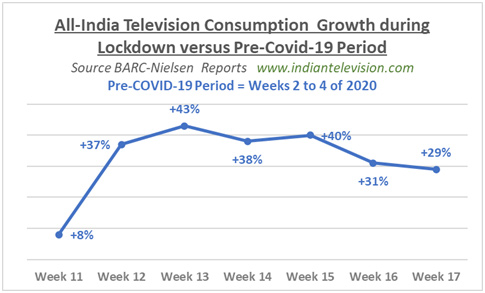
    BENGALURU: Television consumption in India seems to be petering out, according to Broadcast Audience Research Council of India (BARC)-Nielsen Reports. Of course, even in the sixth week and the second extension of the national lockdown to lockdown 3.0, television consumption is 29 per cent higher than during pre-Covid2019 periods. BARC and Nielsen have compared data for the pre-Covid2019 period with average numbers for Weeks 2 to 4 of 2020. Television consumption had peaked in Week 13 of 2020, the first full week since the lockdown commenced in the middle of Week 12 of 2020, on 25 March 2020 in India. Television consumption grew 43 per cent in Week 13 of 2020 as compared to the pre-Covid2019 period. BARC-Nielsen reports are available for the period starting Week 11 of 2020 until Week 17 at the time of writing of this paper.

    Please refer to the figure below for All-India television consumption trends.

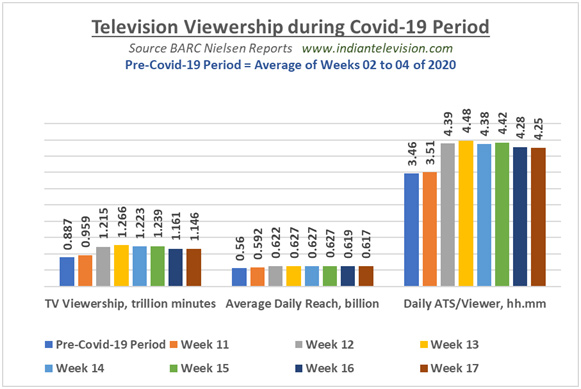
    The basic currency for total television consumption is trillion minutes. Average television viewership during the pre-Covid2019 weeks considered in the BARC-Nielsen Reports (Average of Weeks 2 to 4 of 2020) was 887 billion minutes with an average daily reach of 560 million. This worked out to a daily average time spent (ATS) watching television of 3 hours 46 minutes. In Week 13 of 2020, this peaked to 1,266 billion minutes with a reach of 627 million and ATS of 4 hours and 48 minutes.  These numbers have been sliding down since then. Please refer to the figure below.

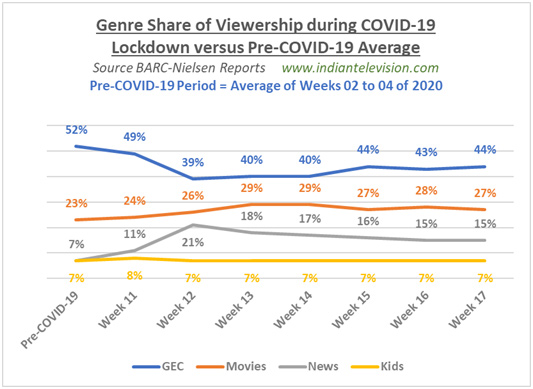
    In the pre-Covid2019 weeks, four genres had 89 per cent of viewership share – in terms of size, they are GEC, Movies, News and the Kids genres.  During the 7 weeks for which BARC-Nielsen Reports are available (Weeks 11 to 17 of 2020) at the time of writing this report, their combined share grew to 93 per cent. During the pre-Covid2019 weeks considered in the BARC-Nielsen Report (Weeks 2 to 4 of 2020) GEC had the largest viewership share of 52 per cent, followed by Movies with 23 per cent, the news and the kids’ genres with 7 per cent each. During Week 13 of 2020, this had changed to 40 per cent for GEC, 29 per cent for Movies, 18 per cent for news and 7 per cent for Kids. It must be noted that though share of the Kids channels was has generally been steady, overall television viewership has gone up during the lockdown period, and hence the number of viewers and ATS on the Kids was much higher than earlier times. It must further be noted that News had a share of 21 per cent in Week 13 of 2020.

    GECs, which had been experiencing a decline in viewership share during the Covid2019 lockdown due to the lack of fresh programming, got a breath of fresh air by way of re-runs of mythology and old classics on pubcaster network DD’s DD National and DD Bharati.  GECs’ viewership share has climbed to 44 per cent in weeks 16 and 17 from a low of 39 per cent in Week 12. The Movies genre seems to have stabilized at abut 27 per cent share as compared to the 23 per cent share during the pre-Covid2019 weeks considered in the BARC-Nielsen Reports.

    Please refer to the figure below:

    Overall, television consumption seems to be petering out slowly across the other major genres also.  Besides the four genres mentioned above, business news, youth, infotainment and lifestyle have witnessed changes in consumption growth. Relatively, the lifestyle genre seems to have had stabilized with about 32 per cent growth since week 13 of 2020 as compared to the average of the pre-Covid2019 weeks considered by BARC-Nielsen. The news genre, which had seen consumption triple in week 12, has stabilized consumption at around 165% growth in Weeks 16 and 17 of 2020 as compared to the average of the pre- Covid2019 weeks. Please refer to the figure below:

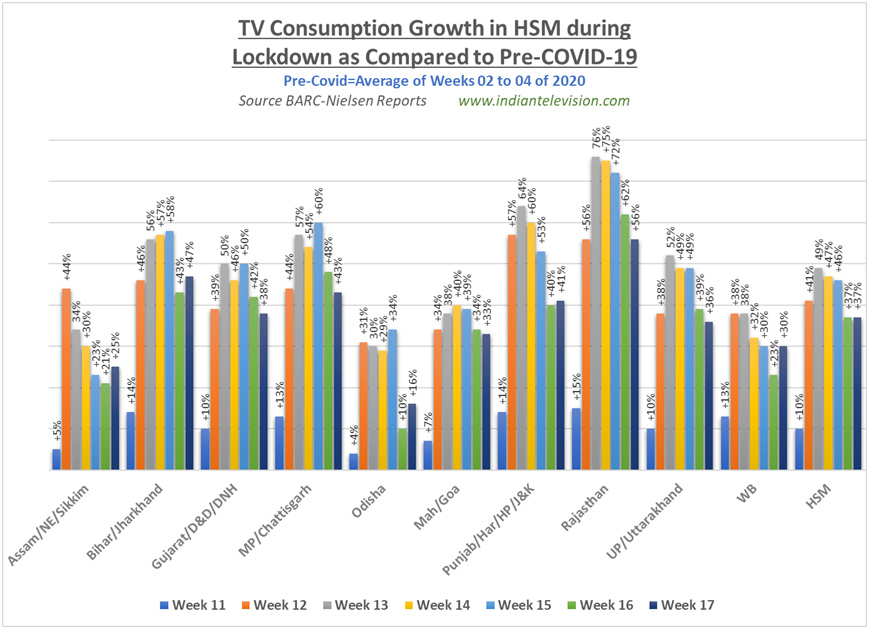
    BARC considers the Hindi Speaking Market or HSM as All India minus the four Southern Languages: Kannada, Malayalam, Tamil and Telugu. The South is a mature market with a higher penetration of television as compared to the HSM. Television consumption is also higher in the South. Hence, growth in the South market has been more muted as compared to the HSM during the lockdown weeks to date as compared to the average of the BARC-Nielsen Covid2019 weeks. The North Eastern states saw television consumption peak in week 12 itself – this was the week when the Janata Curfew and a couple of days later the first series of Lockdown or Lockdown 1.0 were announced by Indian Prime Minister Narendra Modi.  Most of the states saw viewership peak in Week 13. The exceptions were a few states where more of local ‘Covid2019’ and or/or events such as the lynching of the Sadhus in Maharashtra or the swearing in of ministers in Madhya Pradesh. There has been a general decline in television consumption since then, as mentioned before. Please refer to the figure below:

    Further, as mentioned above, South India has seen lower growth in viewership during the lockdown weeks because of its higher base and longer ATS spent even before the Covid2019 lockdown weeks. Hence the decline in television viewership since the peak has been lower in the South markets as compared to HSM. Please refer to the figure below:

    Is this the way forward?

    Television networks have tried to bring in viewership and maintain viewer stickiness. News by itself has grown as a genre because of the playout of events around the lockdown. Taking a cue from the movies genre, many networks have started beaming film-based content, but this has not been enough. The South GECs have witnessed growth on the back of comedy films over the last few days. Channels have brought back mythology and classics. Reruns of the Ramanand Sagar Ramayan and the B R Chopra Mahabharat, through daily episodes as opposed to the weekend episodes that were experienced when these magnum opuses were first aired, have brought in viewers and ensured their loyalty in the case of DD National and DD Bharati. Since mythology seems to have worked for DD, private networks have decided to include them in their programming mix. This seems to have worked to an extent in the case of Star Plus which launched of Ramayan in Week 17, and that slot for the channel has seen viewership grow by 65 per cent according to a preview of data by BARC for Week 18. Viacom18’s flagship Hindi GEC Colors has seen viewership growth of 24 per cent in Week 18 for the time slot when it commenced airing Mahabharat.

    It is still early days for a cure or vaccine for the pandemic to make things easier for humans, to bring back some form of normalcy. A lot more people will continue to stay at home. As the world and India slowly limp back in a phased manner to a ‘new normal’ from the Covid2019 lockdown, fresh content will surely be produced. However, given the circumstances globally, the ‘new normal’ has yet to take on a definite shape. If study, work, exercise, etc. from the home becomes the ‘new normal’, then ‘entertainment consumption at home’ is definitely set to be a big part of daily life. Content viewership from home, be it on the OTT platform, or the idiot box, or on the smart phone or a computing device, is definitely set to be much larger than during the pre-Covid2019 weeks. The question is“Will it be higher than during lockdown weeks?”

  • Need to use Covid2019 situation to create 21st century content delivery biz: Uday Shankar

    Need to use Covid2019 situation to create 21st century content delivery biz: Uday Shankar

    MUMBAI: “We are in for a long, dark and scary winter,” says Uday Shankar, president, The Walt Disney Company, APAC and chairman, Star & Disney India, regarding the current situation, in an interview with ET Now. He dwelt at length on the Covid2019 crisis, its impact on the media, especially the TV business, and the road ahead.

    Regarding advertising revenue, he said, April and May are the months when advertising climaxes. “This is the time of IPL. In the seven weeks of the IPL matches, it generates six to seven thousand crores of economic value just around the IPL. And all of that has become zero this year. A larger number of advertisers wait for IPL to launch special campaigns and products. All of them have stopped."

    Regarding post-covid2019 world, he feels that life has changed a lot. “But the basics are remaining the same. We are still alive and still looking positively about priorities. We are running our businesses. We have to run our businesses very differently. We can't travel or go to the office. My portfolio stretches across the Asia Pacific region. So the level of my challenges is even higher. But one I think I realize is that people are extremely adaptable and they are trying to make it work."

    According to him, the new ways of working and adaptability to them are pretty exciting, he states. The biggest challenge, he says, is that the economy has taken a massive hit, especially in India which is going through a lockdown.

    Regarding the impact on advertising revenue, he said: "Leave aside sports, even entertainment too has come down: from the normal to down to 20-25 per cent. That's the aggregate level. The news business is holding up there."

    Programming has stopped due to lockdown, but even when they restart it will be difficult.   

    According to him, all broadcasters will have to aggressively revisit their programming costs. So those who are doing ten shows will start with four. The financial pressure will pose even bigger challenges. And there is only going to be so much advertising available.

    “We make our money in this country disproportionately from advertising; the distribution income is still small. People advertise only because they realize that there is a market for their goods to be bought and sold. If nobody is going to buy a car, why would a car manufacturer advertise? So we are in it for a long and dreaded winter. Newspapers are going to face even bigger problems. And everybody thinks that it is a great time for digital, but I don’t think so. Digital advertising has taken a hit and it will continue to be like that for a while.”

    Regarding sporting activity for which his company has invested heavily, he said: “Sports has taken a hit globally. There is nothing you can do. People’s health and safety come before everything else. It would be naturally selfish or immature on our part to even think that regardless of everything, sports should happen.”

    He feels that once the situation is back to normal, live sports events will happen with massive restrictions on spectators’ presence. You can’t have a plan-B for live sports, he said.

    Regarding cost-cutting across the media sector, he said that his organisation has also taken some measures. “We urged our senior executives to take a voluntary reduction in salaries. People have responded very positively to that.”

    But some organisations, he said, have been forced to take measures as a last resort. Job losses will happen, he said.

    According to him, the way the media works in this country is “very antiquated.”  Do you need so many people to shoot a show? Does everybody have to sit in one place? If supply chains are distributed globally, why is the entire media chain different?”

    On what he is trying at this moment of crisis, he said: “I am trying three things. First of all, we don’t treat this as new normal. I believe this is a passage into a new world. Within the discipline of my company I won’t really put pressure on people to come to work every day even if everything becomes normal. Star has already taken some lead in that direction. We don’t have mandatory attendance. We don’t ask people to sign in at a time. Or we don’t have fixed leave. I think we were pretty liberal. We should actively encourage people to work from wherever they are. We should look at lighter ways of creating content, which is less resource-intensive, less human power-intensive, but very heavy on creativity and technology.”

    “And I think we should revisit the whole concept of gigantic headquarters where everybody sits together. For our business television has always been under pressure, partly because of the shift that has been happening in the environment and also because of the fact that television in this country is unfortunate to have a regulator who has no understanding of the business and who is out to destroy the business. So the television business has been under pressure. And its odds for regaining its health are much less than I would like to think.”

    So how can we make it lighter, nimbler, direct to consumer and use this Covid2019 situation to make a 21st century content delivery business in this country is the question.

    According to him, regulation means that there should be an even-playing field and transparency. If businesses are not able to succeed, then nobody is going to invest, he says. “That’s the real risk of the TV sector in India. Advertising income was strong and the regulatory fees pressure that was value-destructive in the distribution side was sort of mitigated to some extent. Now it is a twin shock on the advertising and distribution fronts. It is going to be really tough for the television business. And it is very challenging for fresh investments. I don’t think people will come and pour money,” he explained.

    As to why his company wants to invest in India, he said: “Star India is the number one media company in India. Everyone knows in the power of India. When I took over Star India the entire television business was much smaller, but today it is one of the biggest media and entertainment markets in the world despite all the challenges. We remain optimistic about the power of 1.3 billion people, the big market, and the creativity in this country. So those who have already invested, they will continue to be committed. But new people who have to start from scratch many of them will rethink before investing.”

    Regarding the kind of content consumers will consume in the times to come, he said: “We give too much credit to ourselves and too less to consumer. Consumers may not be able to articulate it, but they are usually far ahead of the business. Our innovation usually catches up with where the consumers’ mind is. When we started Hotstar, people said I was being delusional and that we were going to lose money. And with the data revolution that happened we have seen the explosive change. In the next three year or so there will be 700-750 million people who will watch content on their mobile devices. And 250 million on TV. That’s where Covid crisis has taken us to. People are home, working but also catching up entertainment.” 

    Follow Tellychakkar for the consumer facing news & entertainment

  • TV industry needs to come out of old ways: Sanjeev Kapoor

    TV industry needs to come out of old ways: Sanjeev Kapoor

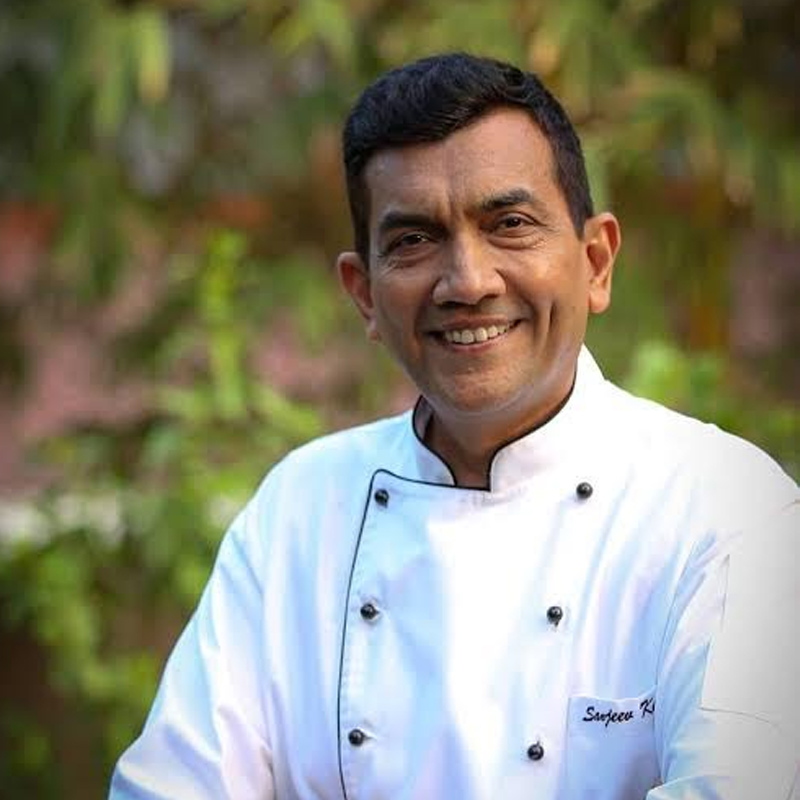
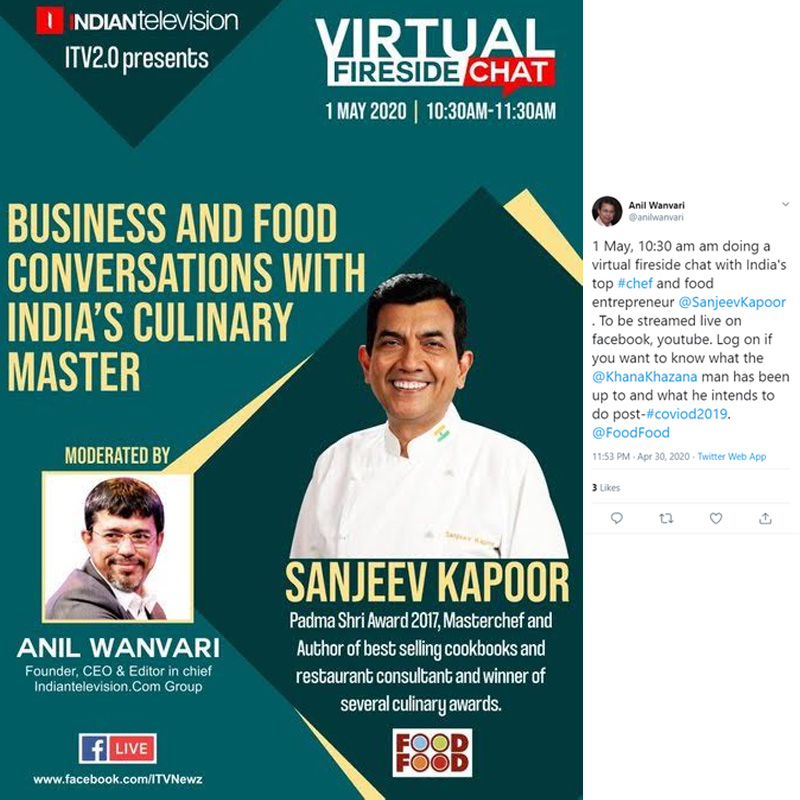
    MUMBAI: A number of brands often advertise on speciality TV channels to reach a specific target audience. But, with the lockdown, advertisers have nearly stopped ad spends on niche channels. Celebrity chef and food entrepreneur, Sanjeev Kapoor, in a virtual fireside chat with indiantelevision.com founder, CEO and editor-in-chief Anil Wanvari spoke at length about his speciality channel Food Food, his company Wonderchef and life after NTO 2.0.

    Kapoor said that in the upcoming times, speciality is going to bring more premium. It is easier to understand target audience in social media. There is more data available to provide brand and advertisers. Whereas on TV, a specialised channel is asked many questions. 

    Kapoor highlights that the premiumisation of speciality channels has already started on digital and all the creamy digital assets are being taken and TV has not understood this concept yet.

    He also gives a warning to TV channels. “I have said this three years ago that the death of TV is coming and I don’t think so it is about consumption. According to data, the consumption of content on digital assets in the last month has doubled which is not the case with TV. The CPMs are also good on YouTube which is not the case with TV. And look at how the world is still living in the old ways."

    According to Kapoor nothing has changed post NTO 2.0 whether you are a paid channel or free. No matter what, you have to pay carriage fees. He feels that if you are a smaller channel there is more arm twisting. 

    India's most-loved chef seems to be upset with the situation for his channel during lockdown. He said, "Even in the lockdown when everyone says be compassionate, there is a ticker that says Food Food channel is not available.  As far as carriage fee is concerned, I am not in that position to pay. Do you think when people want to see content on food this is how television should act? We still believe in the power of content. So, we will partner with distribution mechanisms who are fair."
    He added, "Tata Sky understands speciality. They are our partners for quite a long time. With Jio coming in I see a hope for speciality channels. But the people who think old school have not changed."

    Food Food is currently available on Tata Sky and Airtel. On the cable side it is available on Siticable, GTPL Hathway and small cable networks.

    He also felt that there is a need to change the way advertising works on TV.

    He said, “There should be a mechanism where people will feel benefited from advertising; it should not be shot in the dark. People say that a GEC channel's and a specialty channel like FOOD FOOD’s rate should be the same. That's like saying a general physician and a heart surgeon should charge the same. It doesn’t work like that. Our media has not understood this yet. I think this is the time to change, to respect each and every person and all specialties.”

    Kapoor, who runs a company named Wonderchef and is also the brand ambassador of the same company, believes in spending wisely.

    "If money cannot be converted into sales then it is money not spent well. This is my approach since the beginning.That is why I say variable cost model is important. I am ambassador for many brands. I tell them that I will not take the money if I cannot give you better sales. You can do a percentage sales with me; a royalty kind deal." 

    In the future he looks at investing in artificial intelligence, ML platforms and Google Home. "I would invest more on solutions for bringing better content and better quality in food," he concluded.

  • Film-based programmes up in South: BARC-Nielsen report

    Film-based programmes up in South: BARC-Nielsen report

    MUMBAI: Film-based programmes increased in the South, according to BARC-Nielsen data for 17 week. In the South, repeat telecasts of comedy programmes saw a high SOD and SOV growth as compared to other sub-categories.

    Whereas in HSM and South a deep dive into sub-categories for serials indicates that duration of dramas and soaps declined more in South than in the HSM.

    Thirteen per cent of the viewers of the last six weeks have not watched news during the first six weeks of 2020.  While Rajasthan and Gujarat have the highest proportion of new viewers, south has lower per cent of news viewers than the HSM.

    In the music genre, despite significant increase in daily tune-ins the genre has seen a drop in viewership. While reach increased across all markets, the genre share has dropped throughout.

    In the South and HSM, it has dropped to 4 per cent. While Tamil Nadu, Kerala, Pondicherry, West Bengal, and Punjab grew at more than 10 per cent during week 13-17, viewership decreased across all age groups except those above 41. 

  • Restaurant industry can introspect and reinvent during Covid2019: Sanjeev Kapoor

    Restaurant industry can introspect and reinvent during Covid2019: Sanjeev Kapoor

    MUMBAI: The restaurant industry, just like any other industry in the country, has suffered huge losses since the Covid2019 outbreak. India’s culinary master and food entrepreneur, Sanjeev Kapoor, in a virtual fireside chat with indiantelevision.com founder, CEO and editor-in-chief Anil Wanvari talks about the spirit of generosity, lessons learnt during Covid2019 and his personal evolution. He also explains how the restaurant industry needs to reinvent itself in order to grow ahead.  

    Explaining about his work during the pandemic, Kapoor said, “In Mumbai we have partnered with Taj Group to distribute food to 45,000 people every day and same is the case in Delhi and Bangalore.”

    As people will not stop eating food, there is a significant growth in the consumption of digital content where audiences are looking up their favourite chefs to acquire cooking skills. Hence, Kapoor is keeping himself busy looking after his specialised channel Food Food and also creating content for his digital platforms where he is creating content and live shows with the help of his family members who have turned into sound and camera persons.
    According to Kapoor, reviving restaurants during this pandemic is very essential. Because people's need to eat is still there. What they will eat or where they eat may change. Which means that skills are still required. He added, “If you want to eat a rumali roti you cannot eat at home.You need skilled people to do that. I have been advising people in the restaurant industry to bring in new concepts, new thoughts to sustain and grow.  Also, this is the time to look at what was going wrong in the industry.”

    Kapoor is of the opinion that the fixed cost in the restaurant industry is very high. He notes businesses should look into compensation based on the work being done. They should create work that functions on a variable cost model in order to survive.

    The one positive outcome of the pandemic will be a chance for the restaurant business to refurbish itself.

    Kapoor feels that the restaurant industry will have to go in for some major modification in the coming future. When the business starts, it is important to let go of outdated business practices and develop new concepts, thoughts and more innovative ways to feed people.

    According to Kapoor, the hospitality industry is a very resilient sector, but going forward, will they change their traditional model of doing business? He said, “Meal kits are going to be the next big thing in the industry. We have already started our meal kits. I will include primary ingredients, a recipe card along with a cook along with Alexa, where you scan the QR code and the cook will guide you. It is about changing the model and creating opportunities.”

    Kapoor, who closely works with Akshay Patra, serves 18 lakh meals every day. The food is prepared at 50 large kitchens. According to Kapoor, the restaurant industry was not looking at sectors like that as an opportunity. Institutions like Akshay Patra have interns from top universities including Harvard and Stanford whereas top Indian colleges do not even go there. He thinks that a food service solution needs people who understand processes and taste.

    He says, “If today you want to eat Thai food at home and if you are vegetarian, you don’t want something with fish oil and shrimp paste. You want an Indian solution for that. There are many such opportunities in the market like I closely work with, such as pharma companies. Has anyone thought if medicine tasted good what miracles it would create? There are nutritional and functional foods which need to be healthy and tasty. So, many companies need that intervention. This is the time for specialists and there are many opportunities. We just have to keep our ears and eyes open. I have always advised people to look beyond the standard option.”

    About the options available for a corner-side restaurant, Kapoor said, “They are way better warriors than us. I know many people who are supplying food to a hospital chain. There will be two kinds of people: one who will fight and another who will wait. The ones who are fighting will survive and those who are waiting will also survive but they will need much more time.”

  • Technology comes to broadcasters’ rescue to create content during Covid2019

    Technology comes to broadcasters’ rescue to create content during Covid2019

    MUMBAI: Technology has been the saviour for most broadcasters while producing content amid the nationwide lockdown due to the Covid2019 pandemic. This was the unanimous view of panellists from news and entertainment channels, who came together for a virtual panel discussion to share their experiences of generating content from home or remote locations.

    The virtual panel discussion, an initiative by indiantelevision.com held on 5 May, was moderated by Indian Television Group founder, chief executive officer and editor-in-chief Anil Wanvari. The panellists who participated in the virtual discussion were TVU Networks SVP solutions Jared Timmins, Mathrubhumi Television senior manager-technical Bijumohan R, Asianet News Network chief promo director Ajith Nambiar, Fakt Marathi co-founder Shirish Pattanshetty, TV9 Network technical head Devendra Maurya, ABP News Network SVP broadcast technology and operations Manish Sharma, Odisha Television head technical and engineering Sukanta Rana, Hoichoi VP-content Anindo Banerjee and senior TV Journalist Bhupendra Chaubey.

    Explaining how they have been able to provide tech-based solutions to broadcasters across the globe, TVU Networks SVP solutions Jared Timmins said, “We have seen people getting on cloud technology as soon as possible during this crisis situation, and our mobile application TVU Anywhere has seen 500 per cent jump in usage.” TVU Networks provides IP-based live video solutions.

    “Unlike video call applications such as Skype and Zoom, our technology helps the broadcasters to achieve desired audio and video quality within the given internet bandwidth,” added Timmins. He also showed a presentation of their latest offerings of new technology and cleared the doubts of news and entertainment broadcasters who participated in the panel discussion.

    Majority of the broadcasters are forced to use all the available resources amid lockdown to create content for the viewers. In this context, Bijumohan R said, “We have been using remote technology before the pandemic too, but the current crisis has forced us to use video calling apps such as Skype and Zoom more frequently.”

    The news channel has reduced the workforce by two-third and has asked people to work from home or wherever  they are located. The remaining one-third workforce has been asked to come to the office.

    Echoing Bijumohan's views, Sharma said, “The technology that majority of news broadcasters are using today was already available and they have been using it now at an optimum level for content production.” ABP News Network was the first news broadcaster in India to use the very first model of TVU Networks.

    Sharma believes that bonded server technology is a life saviour during these testing times. He added, “All our reporters, guests, speakers have been using the TVU Anywhere mobile application to send live information and also access to this app is given to all our guests during a live debate or for their byte.”

    The news broadcaster organised its current edition of a summit called Shikhar Sammelan virtually with the help of the TVU Anywhere mobile apps and backpacks.

    Chaubey, who moved on from CNN-News18 a month ago, has since then been working on his digital channel. He said, “The era of normal ways of broadcasting has completely gone. All those old broadcasting technologies are behind us.” He adds, “Digital or Zoom summits are exactly the kind of platform you’re talking about and is the way forward in future.”

    News has been the TV content consumption driver during this Covid2019 period, as the Broadcast Audience Research Council (BARC) India and Nielsen India joint report states. news channels are the only ones successfully producing fresh content compared to other genres.

    In this regard, Pattanshetty, said, “Majority of GECs are showing repeat telecast of broadcasted shows unless they have some content in the bank.”

    Banerjee added, “Television has come to a standstill due to the Covid2019 scenario and repackaging of shows is the only way we are trying to survive. We are planning to come up with Live TV in our application; we have a huge library of over 200 films and series.”

    Rana explained how the channel has been creating a 1.5-hour show every day from home for one of their GEC channels. He says, “We have created a script and have asked the artists to record their part on the mobile phone and send to the broadcaster, which we edit and telecast it on our channel every afternoon.”

    The virtual panel discussion, appreciated by the panelists for its topicaliy and relevance, was watched by over 1000 people during a live stream on indiantelevision.com’s Facebook platform. It also received a resounding engagement on its Twitter handle.