Category: Viewership

  • #ActNow for mental health awareness, says Times Network

    #ActNow for mental health awareness, says Times Network

    MUMBAI: In 2017, 197.3 million people had mental health disorders in India (lancet psychiatry 2020), implying that while at least 14 per cent Indians are living with such issues, an alarming 86 per cent is behind a veil of ignorance. India’s mental health landscape presents a grim reality of poor implementation of mental health policies, age old discriminatory attitude towards those suffering from mental health illnesses, compounded with shortage of qualified personnel and low perceived need for care. With the Covid2019 outbreak triggering implications that reach far beyond the direct impact on people’s physical health, there has been an exacerbated spiralling of tension and anxiety, further increasing the load on India’s overtaxed mental health machinery.

    Addressing the rampant stigma and discrimination around mental health problems, Times Network has launched #ActNow, an initiative to spread awareness, normalise conversations around the issue and sensitise people to be responsive to the mental health needs of others.

    A special campaign film #ActNow  takes an outside-in view of the problem and targets the ‘people around’ to act, rather than the one living with mental health issues. Mirroring how societal structures treats a person living with a mental ailment with ignorance, pity, annoyance and utter disbelief, the film unravels the state of mind of someone who is besieged by misinterpreted advice of his near and dear ones as he fights a lone battle. A clarion call to realign our minds to escape from the entrapment of the prevalent social stigma and recognize mental health as an existential crisis for humanity, the impactful film urges public at large to remain receptive to the deteriorating mental health of people around and take appropriate course of action to offer support without prejudice and fear. The initiative launched on a special edition of Mirror Now’s Urban Debate, hosted an expert panel that analysed and discussed the deteriorating condition of mental illness in India.

    The initiative which encourages the essential steps of acknowledging the signs, choosing the right words and urging people to talk to an expert, draws relevance from Times Network’s nationwide research study commissioned to Nielsen India titled, ‘How Urban India Perceives Mental Health’. The study indicates that while awareness levels related to mental health ailments have gone up recently, there is a pressing need to disseminate the factual information to tackle the strong undercurrents of stigma and lack access to quality mental healthcare. Mental health conversations remain the single most important detriment and solution for this issue. The quantitative study that examines the dynamics, culture, mindset and perceptions of the people towards mental health was conducted through three prolonged evaluations based on secondary research, in depth interactions with mental health experts and a survey with India’s cross-section of urban population.

    Key findings as follows:

    ·         70 per cent of urban India claim to suffer/know of someone who has suffered from a mental health ailment

    ·         Among people who are suffering/know someone suffering from mental health ailment, depressions come out as the most prominent at 58 per cent.

    ·         76 per cent perceive that “People are not open to talk about mental health to everyone” and there is still shame and stigma associated around mental health ·          52 per cent of the people face problems in accessing a mental health professional and 63 per cent perceive that there is difficulty in procuring medication

    ·         54 per cent people are not completely aware about the diseases covered in a health insurance policy and 47 per cent of the people are unaware of the government mandate for health insurance policies to cover treatment of mental health ailments

    ·         57 per cent of urban India considers financial pressures to be the leading cause of negative impact on mental health

    The study took a sample size of 2,440 people across Mumbai, Delhi, Chennai, Kolkata, Hyderabad, Bangalore, Jaipur, Patna, Ahmedabad, Mangalore, Vishakapatnam, Bareilly, Guwahati, Raipur, and Mangalore.

    Times Network president – strategy and business head – news and English entertainment cluster Vivek Srivastava said, “The new normal has triggered anxiety and deepened emotional turmoil, consequently leading to a quieter but concerning rise in the number of people grappling with mental health issues. ActNow is our endeavour to spread awareness and drive dialogues to break barriers around the mental health issue. Through our multi-faceted campaign, we urge the society at large to look beyond the happy faces that conceal the sufferings and encourage healthy and judgement-free conversations on mental health.”

    Refining and bringing a comprehensive view on mental health with the expert voices, the Network has onboarded Jaslok Hospital as the knowledge partner. Psychologists and mental experts from the hospital will provide critical inputs and steer the campaign with relevant information and decode the complex challenges associated with mental health crisis. Fostering positive mental health and evoking a sense of response amongst the millennials, Times Network has partnered with youth marketing firm, Viral Fission to drive community engagement through student advocates of mental health.

    #ActNow will be driven across Times Network channels and digital assets, print sds across The Times of India daily and a dedicated page on the network's digital news destination, Timesnownew.com, which will host a curated series of articles on mental well-being.
  • BARC week 48: Colors regains second spot on pay platform

    BARC week 48: Colors regains second spot on pay platform

    MUMBAI: Sony Sab has slipped down to third spot on pay platform in week 48 (Saturday 28 November 2020 to Friday 4 November 2020) of Broadcast Audience Research Council of India (BARC) data. Colors has secured second position on both pay platform and urban market. Dangal has climbed up to the eight spot on pay platform. 

    Pay Platform


    In week 48 of BARC India ratings, the top ten channels on pay platform were Star Plus, Colors,Sony Sab,  Zee TV, Sony Entertainment Television, Star Utsav, Sony Pal, Dangal, Star Bharat, and ColorsRishtey.

    Urban Market


    In the urban market, the top ten channels were Star Plus,Colors,Sony Sab, Star Utsav, Sony Entertainment Television, Zee TV,  Sony Pal,  ColorsRistey, Dangal and Star Bharat in week 48 of BARC India ratings.

    Rural Market


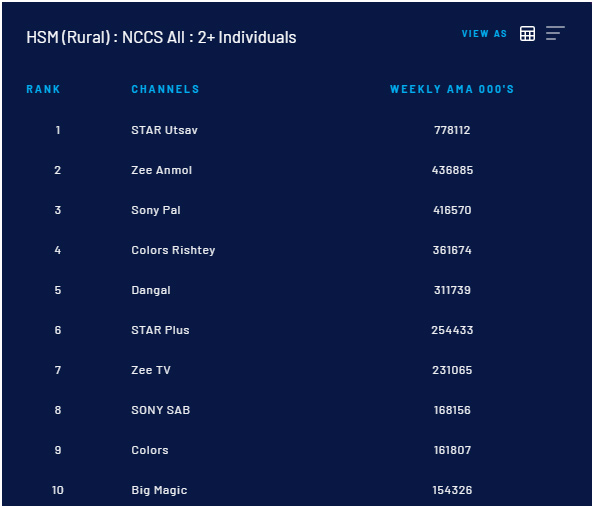
    Star Utsav, Zee Anmol, Sony Pal, ColorsRishtey, Dangal, Star Plus, Zee TV, Sony Sab, Colors and Big Magic were the top ten channels in the rural market in week 48 of BARC India ratings.

    Free Platform


    On the free platform, Star Utsav, Zee Anmol,Sony Pal, ColorsRishtey, Dangal, Big Magic, Shemaroo TV, DD National, DD Retro and DD Uttar Pradesh were the top ten channels in week 48 of BARC India ratings.
     

  • BARC week 48: PolicyBazaar leads the brand list

    BARC week 48: PolicyBazaar leads the brand list

    MUMBAI: The Broadcast Audience Research Council (BARC) of India has released its data for top advertisers and brands for the period between 28 November and 4 December 2020.

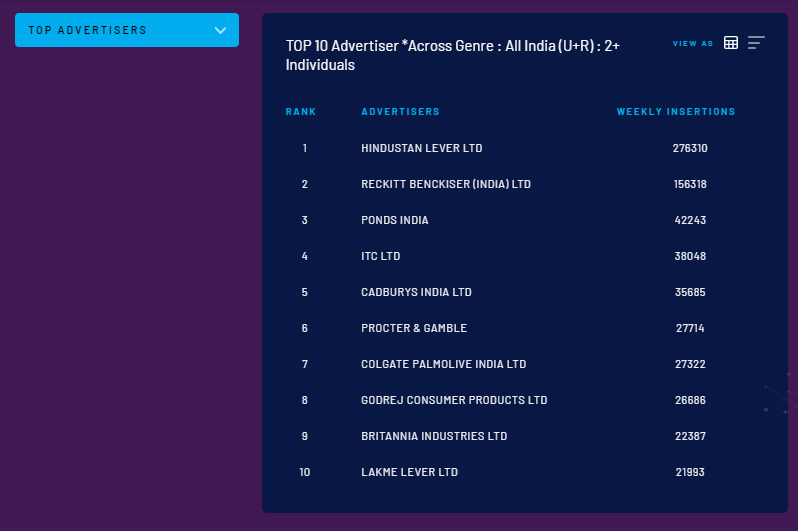
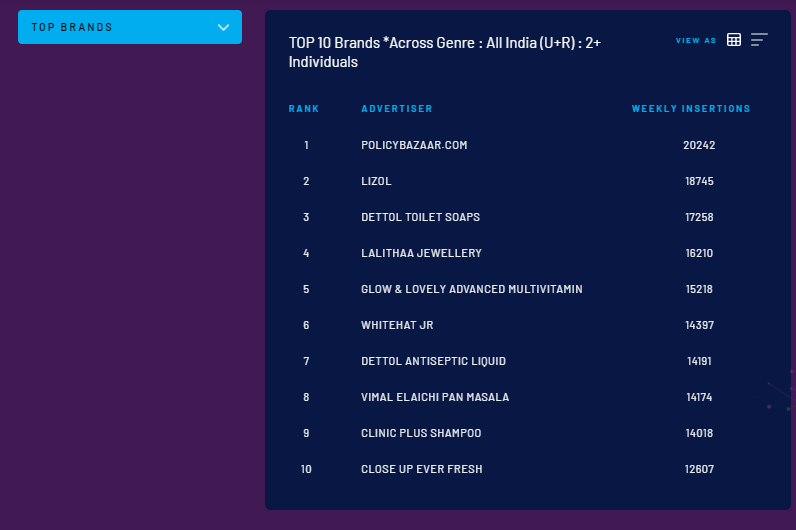
    The data reflects the top 10 advertisers and brands across genres on India’s television, 2+ Individuals, NCCS. All demonstrating ads that were inserted the most in week 48 of 2020.

    Top Advertisers:

    Hindustan Unilever continued to be the biggest advertiser this week also with 276310 insertions.

    It was followed by Reckitt Benckiser India, which ranked second with 156318 ad generations.

    Ponds India bagged the third rank this time with 42243 ad AMA. ITC came in fourth with 38048 ad insertions.

    Cadbury India and P&G secured fifth and sixth place with 35685 and 27714 ad views respectively.

    Other top brands in the pecking order were as follows: Colgate Palmolive India Ltd, Godrej Products, Britannia, and Lakme.

    (Advertisers data pic)

    Top Brands:

    This week PolicyBazaar.com led the chart with 20242 ad impressions, followed by Lizol with 18745 ad views. Dettol Toilet Soaps secured the third position with 17258 ad insertions.

    The fourth and fifth spots were acquired by Lalitha Jewelery and Glow & Lovely Advanced Multivitamin with 16210 and 15218 ad AMA.

    WhiteHat Jr bagged the sixth spot with 14397 ad views.

    Other top brands in the pecking order were as follows: Dettol Antiseptic Liquid, Vimal Eliachi Pan Masala, Clinic Plus Shampoo, and Close Up Fresh. 

  • Covid effect: Italian TV market shrinks by over €400 million

    Covid effect: Italian TV market shrinks by over €400 million

    MUMBAI: After debilitating Italy right at the outset, Covid2019 is now hitting the country in a different way. The Television Market in Italy 2020-2022 report published by Rome-based ITMedia Consulting has estimated that the Italian TV market has lost over €400 million in value this year.

    The report states that pay-TV is the only resource that is growing, while advertising has dropped by 13 per cent.

    Notably, pay-TV has surpassed FTA for the first time in terms of revenues, while the TV market should start growing again as a result of the considerable increase in pay-TV revenues and the partial recovery of the advertising market.

    A strong contribution is expected with the entry of Sky Italia as a network triple player operator and SVoD, which should see a 31.3 per cent CAGR in the time period.

    Although Sky Italia, Mediaset and RAI will remain the dominant players overall (over 75 per cent of the total combined), they will lose market share to other operators whose joint turnover will reach almost €2 billion in revenues. While Mediaset still collects over half of the advertising investments, it is losing ground and now accounts for less than 20 per cent of overall TV sector revenues.

    Sky Italia is still the main market player, albeit with a downward trend, as new and aggressive VoD players increasingly gain market share.

    The report highlights that traditional players that rely only on consolidated business models are being penalised, to the benefit of new players that are able to exploit new technological means and changing viewer demand, increasingly moving towards a personalised, multi-platform and multi-screen experience.

    The pandemic has accelerated and amplified ongoing shifts in consumers’ behaviour, pulling forward digital disruption and forging industry tipping points that wouldn’t have been reached for many years. As a result, the entertainment and media world in 2020 has become more remote, more virtual, more streamed. In the Entertainment & Media Outlook in Italy 2020-2024 report predicted that total E&M revenues in Italy will rise at a compound annual growth rate (CAGR) of 3.0 per cent to reach €39.5 billion in 2024.

    In conclusion, this year's ITMedia Consulting report shows how Italian consumers today are also following the new consumption patterns accentuated by the pandemic. They are watching TV with a greater awareness of the different offers and business models, both linear and non-linear.

    Traditional broadcast TV has sensed the looming and very dynamic presence of online streaming services, and adapting their business models to match those of international operators. Even Sky is leaving no stone unturned to develop new strategies to better confront these internet-based players.

    The report also points out how operators who rely solely on consolidated models are being penalised, to the benefit of new entrants who are able to exploit the opportunities offered by technological evolution and the changing needs of demand, translating them into an attractive offer to the public, increasingly oriented towards personalised use, multi-platform, multi-screen, even on mobile.

  • Ad volumes for auto sector witnessed 36% growth during festive season in 2020: BARC

    Ad volumes for auto sector witnessed 36% growth during festive season in 2020: BARC

    New Delhi: Every product category has been hit in 2020 by the pandemic and lockdowns. The sales for most of these product, categories got impacted as people were restricted to their homes and were reluctant in spending money even after the lockdowns were over.

    Initially, the advertising volumes of many such categories was also hit but soon it started reviving as marketing heads realised that it is not the time to stop but to be even more aggressive if they wanted to make the best out of this year.

    Automobile is one such category that was affected. Most brands did not make a sale of a single unit in the lockdown period (excluding exports). However, once the lockdown was lifted, the brands started opening up their showrooms and retail experience centers and started inviting customers to come and sample their product.

    Initially, the response of audiences was slow but digital marketing came to the rescue as many of these brands created a virtual experience of their product and created enough content around it for the customer to research and find information that he/she was looking for.


    Slowly, the customers also started returning to the retail centers. And, if we go by the festive season reports, the sales for several of two-wheeler and four-wheeler brands have increased. These reports have induced a lot of positivity in the industry and a lot of it has also come from the massive advertising campaigns taken by the brands across national and regional channels.

    Broadcast Audience Research Council (BARC) has released a report comparing the ad volumes and share of the automobile industry for 2019 and 2020 between 1 Oct and 27 Nov (festive season).


    The report states that the ad volumes for the automobile sector have grown by 36 per cent in 2020. In 2019, the total advertising done during this period was around 9.3 million seconds which grew to 12.6 million seconds in 2020.

    Also, the ad volumes for four-wheelers have increased by two times. In 2019, there were approximately 2.39 million seconds of advertising while in 2020, there have been more than 5.86 million seconds of advertising. The ad volume share has also increased from 26 per cent to 46 per cent in the last year.

     It will be interesting to see if the industry can carry forward this momentum and continue selling the products.

  • There will be a ‘Mahabharat’ between TV & OTT: BARC’s Sunil Lulla

    There will be a ‘Mahabharat’ between TV & OTT: BARC’s Sunil Lulla

    MUMBAI: BARC India CEO Sunil Lulla is in a unique position, being at the helm of a body which is the only industry currency for the 3.5-billion-dollar television advertising market. Needless to say, it comes with a lot of responsibility.

    Lulla brings over 35 years of significant leadership and domain proven knowledge, with ground-up experience in growing brands and building businesses. Having worked across media, brands and advertising, he has occupied leadership roles at MTV, Sony, Times Television Network, SaReGaMa, Diageo, Indya.com, GREY group, JWT and Balaji Telefilms. Sunil maintains active interests in serving industry interests to foster the spirit of self-regulation and collaboration. He is an active long-distance runner, enjoys sailing and evocative conversations.

    During an interaction with Governance Now’s Kailashnath Adhikari, Lulla talked at length about the impact of Covid2019 on the television and broadcast industry, key takeaways during the pandemic, television viewership, technology, advertising, and much more.

    Lulla shared that the peak in television viewership has gone down compared to the pre-Covid2019 level, but it is slowly picking up. Said he: “We are more than 902 million viewing minutes, it picked up to one billion viewing minutes. As people are confined into their homes the lines have blurred between primetime and non-prime time. The prime-time hours of 6 am to 6 pm witnessed a major shift in viewing.”

    With filming being halted during the lockdown, no production of televised content was happening, so the only option left with audiences was to watch news, movies and kids’ content. Hence, the news genre picked up pretty well – it went from seven per cent of viewing to 21 per cent, then back down to 14 per cent. Now it’s holding steady at seven per cent share of the category. Similarly, kids watched a lot of content before schools went online. Movies became big and once original programming started general entertainment channels (GECs) are back with higher viewership than the pre-Covid2019 period.

    TV will continue to remain as the screen of the household, claimed Lulla, but the initial few months into the lockdown were difficult for the industry as a whole. While there was a peak in viewership, advertising went down. The gap has never been as difficult to bridge before. “However, now advertising volumes are higher than what they were last year, so the shortfalls that are present will not be as bad as expected,” he said. A whole new set of advertisers and brands have come in, health and hygiene products, digital, gaming, e-commerce, ed-tech became huge during this time.

    In the middle of the crisis, digital has picked up fairly because of more mobile connections, higher data consumption, digital show launches. Also, despite being a difficult time period, the IPL has performed well both in terms of viewing and advertising.

    Another aspect that Lulla highlighted is the stiff competition between television and OTT. As audiences are now moving towards online content it is believed that digital advertising will outgrow television advertising in the coming years. Lulla quipped that there will be a Mahabharat between TV and OTT.

    “I think in 2020 in the US, digital advertising may overtake TV advertising but that’s unlikely  to be the case in India before 2030. It’s a question of quality service, quality of economy and what happens to the overall economy. It is not about OTT content or mobile screen. It is more about screen time. I think there will be growth in digital advertising. TV is not dropping, it is sustaining. Because if you want to reach the masses of India, TV is still the best medium.”

    In the last few months, the duration of a lot of niche channels like English GECs and infotainment has witnessed a lot of turbulence, courtesy the pandemic and NTO. But the question that begs to be asked is: weren’t they already seeing a slow death?

    Lulla explained that English is a sliver of the content pie, with less than one per cent of Indian audiences watching English programming. Later, the audiences started watching content on other mediums. So, in order to survive English GECs will have to rework their strategies.

    Another challenge before the television is that it is too advertising dependent, which is not the case in the west, where there is a balance between advertising and subscription. But since cable service in the country is cheap, compounded by a price tariff regime, very few channels are going to make profitable money on subscription alone, Lulla concluded.

  • BARC week 47: Sony Sab returns to form

    BARC week 47: Sony Sab returns to form

    MUMBAI: Sony Sab has regained its position on pay platform, replacing Zee TV on the second spot in week 47 (Saturday 21 November 2020 to Friday 27 November 2020) of Broadcast Audience Research Council of India (BARC) data. Dangal has slipped down to ninth place on pay platform.

    Pay Platform

    In week 47 of BARCIndia ratings, the top ten channels on pay platform were Star Plus, Sony Sab,  Zee TV, Colors, Sony Entertainment Television, Star Utsav, Sony Pal, Star Bharat, Dangal, and Colors Rishtey.

    Urban Market


    In the urban market, the top ten channels were Star Plus,Sony Sab, Colors,Star Utsav, Zee TV, Sony Entertainment Television, Sony Pal,  Colors Ristey, Dangal and Zee Anmol in week 47 of BARCIndia ratings.

    Rural Market


    Star Utsav, Zee Anmol, Sony Pal, Colors Rishtey, Dangal, Zee TV, Star Plus, Sony Sab, Big Magic and Colors were the top ten channels in the rural market in week 47 of BARCIndia ratings.

    Free Platform


    On the free platform, Star Utsav, Zee Anmol,Sony Pal, Colors Rishtey, Dangal, Big Magic, Shemaroo TV, DD National, DD Retro and DD Bharti were the top ten channels in week 47 of BARCIndia ratings.

  • BARC India renames impressions to average minute audience (AMA)

    BARC India renames impressions to average minute audience (AMA)

    MUMBAI: Keeping in line with global television measurement standards, BARC India will transition from using the term ‘impressions’ to ‘average minute audience (AMA)’, in cognisance with the technical committee.

    Data releases via the BARC India website for week 47 (Saturday 21 November, 2020) onwards will reflect AMA. The change in terminology started reflecting on YUMI Analytics for BARC subscribers from 1 December 2020.

    In a statement, BARC India emphasised its determination to evolve with changing times and provide the industry with metrics that are clear, match global standards, and a true representation of “what India watches.”

    Average minute audience (AMA) is defined as the number of individuals of a target audience who viewed an "event", averaged across minutes. The methodology for the calculation of AMA will continue to remain the same as that of impressions.

    BARC India measurement science and business analytics chief Dr. Derrick Gray said, “It is our constant endeavour to ensure that our subscribers are provided with a currency which is a true representation of ‘what India watches.’ At the same time, we are determined to provide our stakeholders with technology that is at par with global standards as well as clear metrics that match up to global metrics. We recently completed our transition to YUMI Analytics and as a step forward will move on to using AMA across data releases. We will continue to introduce world class practices and standards for our clients while evolving as a robust measurement body.”

  • Guest column: Why BARC renaming impressions as AMA makes sense

    Guest column: Why BARC renaming impressions as AMA makes sense

    CHENNAI: What is known as ‘impressions’in India is known as AMA in Canada, ‘average audience’ in the US and ‘projections’ in Australia. Regardless of the name, average minute audience is what it is and it is not just a case of a rose by any other name.

    BARC has defined impressions as the number of individuals (in '000s) in a target group who viewed an event averaged across minutes.

    The formula for impressions is:

    Impressions= Total Viewing Minutes/Program Duration (in mts)

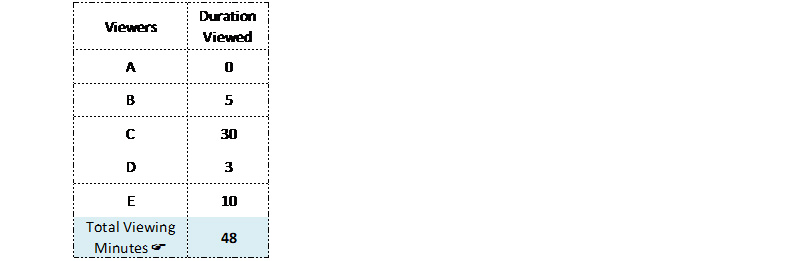
    As is evident from the formula, total viewing minutes of a programmeis not the same as the programme duration. Suppose there are five individuals A, B,C, D and E in the target group and we want to measure the impressions of a 30-minute programme(or ‘event’ if you insist on jargon).


    Here, total viewing minutes of a 30-minute event is  0+ 5+ 30+ 10+3 = 48 minutes

    Total viewing minutes being the sum of minutes watched by all individuals in the TG.

    When applied in the formula,impressions = 48/30 = 1.6

    In other words, 1.6 is the average number of individuals viewing the event per minute.

    To refer to this as ‘average minute audience’ is just making life easier for everyone

    (( Total Viewing minutes is also Avg. daily reach x Avg. Time spent per viewer

    In our example, Average Daily Reach is 5 and Average Time Spent per viewer = 48/5 = 9.60))

    Impressions is a metric used in online response measurement as well. An impression is recorded when a web server responds to a page request by a user's browser. Using the same term in TV audience measurement was cause for confusion and this rechristening is a welcome move. In the new avatar as average minute audience, the concept becomes self-explanatory:

    “The average number of individuals who viewed the event in a minute.”

    Simple!

    Soccer and football maybe the same, but football is self-explanatory and soccer is jargon.

    The writer is managing partner of adMAX Media Consultants. The opinions expressed here are his own and Indiantelevision.com may not subscribe to them.

  • Star & Disney India unveil ad solutions suite Sirius

    Star & Disney India unveil ad solutions suite Sirius

    MUMBAI: Star & Disney India have launched Sirius, a powerful end-to-end suite of advanced advertising solutions for marketers, media planners, and creative agencies. Built on standard measurement paradigms while bringing in proprietary technology capabilities through multiple associations, Sirius covers a comprehensive gamut of advertising solutions, reimagining how brands plan, communicate and measure with Indian audiences, hence providing a fresh perspective. With Sirius solutions, advertisers can access a majority of the content portfolio of Star India network & Disney+ Hotstar, optimised to get the most out of their advertisement investment. 

    Star & Disney India have joined forces with Mediaocean, Kantar, TVision Insights, and Ipsos to impact evaluation to advertising spend on television and OTT. Powered with independent third-party ratified insights, Sirius solutions will help brands unlock acumen into advertisement exposure to gauge metrics such as attention to advertising, and measure advertising impact on mind metrics, and purchase behaviour. 

    “The focus of our measurement solutions is to demonstrate the effectiveness of campaigns across Star India network and Disney+Hotstar in shaping brand and business outcomes along with offering differentiated insights on creatives to enhance the overall impact. We are enthused by the early response from media agencies and top advertisers who have shown keen interest in Sirius. Our aim is to act as a bridge for brands to strengthen their relationship with consumers,” said Star & Disney India ad-sales head Nitin Bawankule.

    The advertising solutions specifically encompass four critical aspects of media planning, thereby bringing the television proposition holistically to the digital age.

    1) Cross-screen measurement and planning

    Star & Disney India have jointly developed a new cross-screen measurement tool with Mediaocean for identifying unduplicated reach across linear and digital mediums. A cross-screen platform amalgamates multiple high-quality data sources which are recent and relevant to ensure the most efficient cost effective campaign plan for marketers. Brands can create integrated media plans with optimised reach-frequency goals across the Star India network and Disney+Hotstar. This will provide seamless targeting and efficiency by reaching audiences on Disney+Hotstar in a manner that complements the delivery of the television plan.

    2) Sharper targeting on TV

    Brands can go beyond traditional demographics to target advanced audience cohorts on television. Star & Disney India’s analytics with the ZAPR panel will help identify target groups with specific interests like fashion, travel, parenting, etc. on Disney+Hotstar which will enable sharper targeting on bespoke cohorts. With the help of Sirius solutions, brands can fine-target audiences on television and build a differentiated media plan based on the audiences’ life-stage, interests and behaviour; doing away with peripheral wastage associated with demographic targeting.

    3) Next-gen campaign evaluation

    With best-in-class collaborations, Sirius solutions take impact measurement to granular depths. Star & Disney India’s association with Kantar, debuts India’s first single-source panel for measuring Star India network of channels and Disney+Hotstar and  campaign impact on CPG brand sales. This single-source panel will demonstrate the lift in metrics like brand penetration, consumption, and frequency of purchase across different ad exposure cohorts relative to those unexposed to the campaign at scale. 

    Attention insights is another significant aspect to help advertisers determine ‘Quality of viewing’ and going beyond the traditional metric of time spent. Star & Disney India has collaborated with TVision Insights to make India the third country ever to track viewer-attention on television, enabling a deeper understanding of creative efficacy. This tool measurement solution presents multiple possibilities to marketers including competitive benchmarking of campaigns attention performance, insights on media placement choices, and more. 

    The partnership with Ipsos allows brands to unlock insights on ad exposure amongst those who watched the advertisements to gauge metrics such as brand awareness, top-of-mind recall, and purchase intent; making it deterministic and not probabilistic. 

    4) Creative ad solutions

    While the media planning solutions will help create an optimal plan, the creative solutions offered by Sirius will elevate the performance of the creative assets further. The creative ad solutions offered,  leverage AI/ML capabilities for contextual ad placements and native integration weaved within premium TV content. This enhances the advertising proposition by breaking through the clutter, providing a more immersive experience for audiences, and enhancing message noticeability without interruption.