Category: Viewership

  • BARC week 49: Lizol led the brand tally

    BARC week 49: Lizol led the brand tally

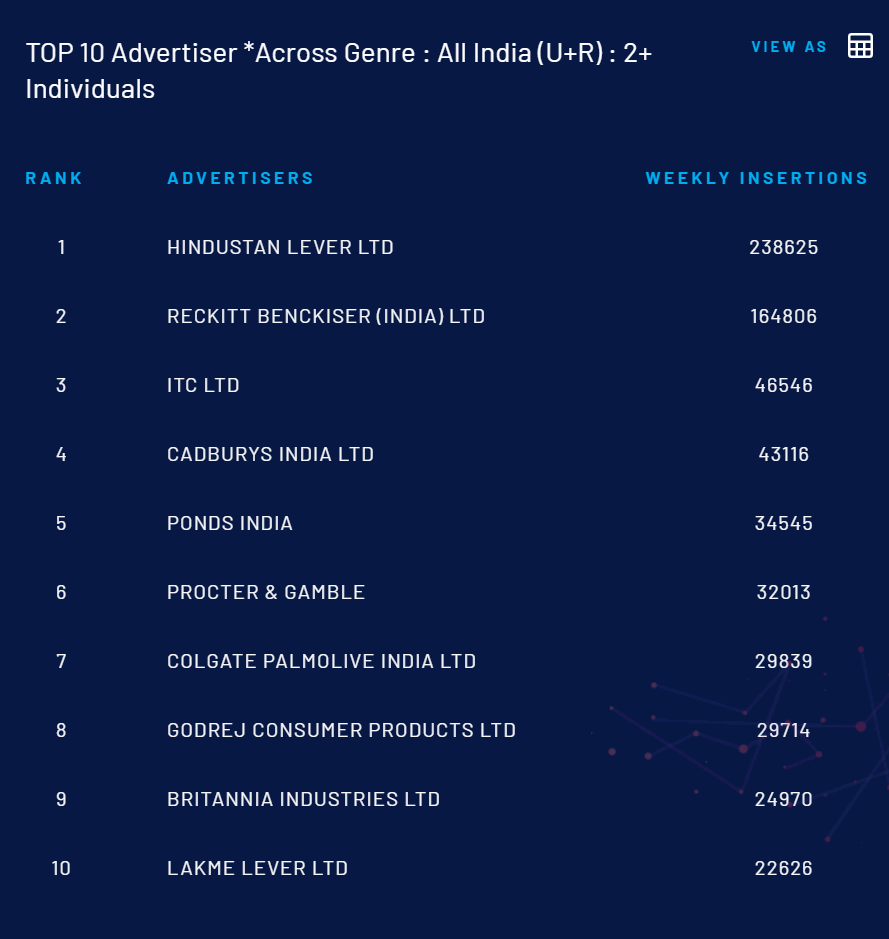
    MUMBAI: The Broadcast Audience Research Council (BARC) of India has released its data for top advertisers and brands for the period between 5 December and 11 December 2020.

    The data reflects the top 10 advertisers and brands across genres on India’s television, 2+ Individuals, NCCS. All demonstrating ads that were inserted the most in week 49 of 2020.

    Top Advertisers:

    Hindustan Unilever continued to be the biggest advertiser this week also with 238625 insertions.

    It was followed by Reckitt Benckiser India, which ranked second with 164806 ad insertions.

    ITC bagged the third rank this time with 46546 AMA. Cadbury came in fourth with 43116 ad insertions.

    Ponds India and P&G secured fifth and sixth place with 34545 and 32013 ad insertions.

    Other top brands in the pecking order were as follows: Colgate Palmolive India Ltd, Godrej Products, Britannia, and Lakme.

    Top Brands:

    This week Lizol led the charts with 20463 ad insertions, followed by Lalithaa Jewellery with 19994 AMA. Dettol Antiseptic Liquid secured the third position with  17687  ad insertions.

    The fourth and fifth spots were acquired by Policybazaar.com and Dettol Toilet Soaps 17620 and 15983 AMA.

    Jio Postpaid Plus bagged the sixth spot with 15013 ad insertions.

    Other top brands in the pecking order were as follows: Vimal Elaichi Pan Masala, WhiteHat Jr, Glow and Lovely Advanced Multivitamin, and Dettol Liquid Soap.

  • Viewing on TV, digital doesn’t have to be either-or question

    Viewing on TV, digital doesn’t have to be either-or question

    MUMBAI: For decades, television has been the platform that’s commanded the attention of the maximum number of people in India. However, thanks to cheap mobile data costs and smartphones, there has been a surge in digital video consumption, and audiences are fast changing the way they view content.

    With viewers starting to divide their content consumption across TV and digital, it now makes sense for broadcasters to also spread their budgets across both mediums to reach more audiences.

    To address this change, the Confederation of Indian Industry (CII) has organised the Big Picture Summit 2020, where it deliberated upon India’s multi-screen obsession and what it means for content owners. The panel comprised Shemaroo Entertainment COO Kranti Gada, ministry of information and broadcasting additional secretary (broadcasting) & CVO Neerja Sekhar, ABP news CEO Avinash Pandey, Discovery India MD Megha Tata, and Boston Consulting Group MD & partner Vikash Jain.

    Of late, and especially with the onset of Covid2019, broadcasters are pushing the digital agenda, realigning their content strategies, business models to cater to consumers’ interests; some fear this may be to the detriment of their traditional business, noted Gada. However, Tata, who has spent more than three decades in the media and entertainment industry, pointed out how every time a new platform emerges, talking heads pronounce the death of the previous one. Contrary to this perception, all mediums have stayed strong and grown – whether its print, radio, cinema, television, and now digital.

    “We don’t have to be an either-or world all the platforms can co-exist. It is absolutely not an easy decision to make but yes we need to think about where we are putting our money. These are very difficult questions where there is no rule book. Our approach is that both need to survive,” said Tata.

    She highlighted that unlike the west, where the death knell has been sounded on linear television, India has actually beaten the trend. This requires a fine balancing act on the part of broadcasters. Both the mediums are important – one is the business of today and the other is the business of tomorrow.

    “During pandemic, there has been a huge growth in television consumption but at the same time OTT growth has been stupendous. We launched Discovery+ in the middle of the lockdown. The question is how do you balance this act. You have to protect our linear business that is funding your digital business because there is still time for digital business to reach profitability and monetisation status and TV has to play a key role in that,” she explained.

    There’s no denying that streaming platforms have emerged as a major challenge to linear television, but the latter is a Rs 79,000 crore industry that has stood the test of time and is still going strong, claimed Sekhar. “We are seeing the convergence in infrastructure where wired broadband and wireless distribution are much in demand and both are giving better choices to consumers. We are seeing one content on different platforms with multiple screen options.”

    She went on to say that the pandemic threw up major changes in viewership pattern, where family viewership has taken over. But one factor that has remained consistent is content. There has been a huge uptick in demand for entertainment, followed by localised or regional content. She also shared that during the lockdown, OTT content was watched double that of linear programming. But linear television remains primary as far as the consumer is concerned. “With the number of OTT players rising we don’t know how self-sustaining OTT platforms are going to be. Market will change, technology will change but content will be of utmost importance.”

    The question that arises in a multiscreen world is how the business model changes. Television was largely advertising-driven whereas in digital, larger multinational companies take away 60 to 70 percent of the ad pie and then broadcasters grapple with what is remaining. There are other players also who are looking at the same ad pie. It is quite a challenging situation for broadcasters.

    Pandey explained that the whole ecosystem has changed: a content is created then there is a distributor cable operator which downlinks the signal and sends it to the consumer. Based on the business model, whether you are a free channel or a paid channel, you get the subscription money which is shared by the DPO operators. Then the carriage fee is accordingly paid to some other person. Broadcasters are in control of their audience through a third party – BARC, which tells you what the consumer is watching, and the price is determined on that basis. Things work differently on digital – streaming platforms that serve the consumer on pull medium, where the viewer looks for his choice of content and consumes that; the entire push system of that content is now controlled by two companies.

    “Streaming platforms decide what rate to sell and they give you the share. There is no value for the content that we are creating. If you look at two big content creators, they take your content and serve it to the consumers. They know the data and how to push their content and they will be the one who will take the share out of the advertising and give you some money,” he stated.  

    Behind all this lies the platforms’ algorithm, which pushes the content, but no one knows what makes it tick. In Pandey’s view, the government will have to step in and see to it that all parties are treated fairly. At the end of the day, content creators need to get their due.

    “Fortunately, we are seeing that in the European Union and Australia, creators are looking at getting good value for their content,” said Pandey, adding that he hopes that the day’s not far off for India, too.

  • Zee Entertainment to acquire Zee Studios film biz

    Zee Entertainment to acquire Zee Studios film biz

    MUMBAI: Zee Entertainment Enterprises Ltd (ZeeL) is going to the movies. The company has announced that it is all set to acquire the film production and distribution business of its subsidiary Zee Studios on a slump sale basis over the next two months. It has priced the acquisition on a cash payout of Rs 275 crore.

    Zee Studios generated a revenue of Rs 124.11 crore in FY 2019-20, Rs 299.54 crore in 2018-19, and Rs 165.98 crore in FY 2017-18.

    In a regulatory filing to the BSE, ZeeL has stated that the acquisition of the business is going to result in growth opportunities for it. The company’s board gave the transaction the go-ahead on Thursday.

    Incorporated in 2010, Zee Studios has been behind films such as Gadar Ek Prem Katha, Sairat, Rustom, Mom, Secret Superstar, Raees, Fukrey Returns, Half Girlfriend, Hindi Medium, Veeri Di Wedding, Mannikarnika: The Queen of Jhansi, Milan Talkies, Article 15, Good Newz, Uri: the Surgical Strike, Gold, Gully Boy, Dream Girl, among many others. It’s headed by CEO Shariq Patel.

  • Govt working on draft national broadcast policy

    Govt working on draft national broadcast policy

    NEW DELHI: The ministry of information and broadcasting (MIB) is working towards creating a draft national broadcast policy and consultations on the animation, visual effects, gaming and comic (AVGC) policy will also be held soon, the government said at the ninth CII BIG Picture Summit.

    I&B ministry additional secretary (broadcasting) and CVO Neerja Sekhar mentioned that the Centre is close to creating a draft version of the policy. “Though consultations on the National Broadcasting Policy were held with stakeholders and industry, we have included emerging issues as well. We are close to a draft version. As an emerging sector with great potential, we are also working on AVCG and will hold consultations soon,” she added Sekhar.

    The media and entertainment sector is growing rapidly in India and is emerging as a key contributor to the Indian economy. Sekhar mentioned that different forms of media are growing simultaneously and offering consumers unique content across TV, print, radio, films, and digital platforms.

    She also sought the industry’s support in getting infrastructure status to the broadcasting industry, and help from industry bodies like CII in conducting “good periodic surveys and research” on media consumption patterns.

    “We work on data and what is happening in the market as there has to be a co-relation with the reality. But data is available on piecemeal basis. A good periodic survey will help us make policies, as our data is dispersed,” she said.

    Echoing the sentiment, I&B joint secretary Vikram Sahay shared that OTT platforms provided a huge opportunity for young artists, directors, actors, singers, musicians, and technicians to come up and present their skills to a larger audience and that the government is trying “to ensure that our consumers are protected in all ways” from fake news and other unacceptable content.

    “The concerns are uniform across the world. It has nothing to do with India, specifically it is concerned with protecting children from content not suitable for them. And therefore, we have been in touch with the industry to work out a model which is acceptable to all of us,” he added.

    The virtual event saw eminent speakers from all over the industry sharing their thoughts on how to make the sector progress faster. 

  • Zeel brings in two solid independent directors

    Zeel brings in two solid independent directors

    MUMBAI: As part of his Zee 4.0 vision commitment, CEO Punit Goenka had vouched to strengthen the company’s board by inducting very well-qualified independent directors. Living up to that promise, the company has announced the appointment of angel investor Kae Capital MD Sasha Gulu Mirchandani (48), and former Price WaterhouseCoopers senior executive Vivek Mehra (65) – who is also actress Neena Gupta’s husband – on its board as independent directors.

    Mirchandani has experience at the intersection of finance, technology and digital commerce in India, having seed/venture funded and mentored some of the largest unicorns in India. He has deep insights about how technology is shaping new business models and how companies can leverage emerging technologies to get competitive advantage in products and markets. He sits on the boards of Hathway Cable and Datacom, Nazara Technologies, Healthkart, Kae Capital Management Private Ltd, Algorhythm Tech Private Ltd, among others. Previously, he served on the boards of Myntra, 1Mg, and Ador Welding, to name a few.

    Mehra, on the other hand, worked at PWC for almost two decades. During his tenure there, he founded and headed the regulatory and M&A tax practices and was elected to the governance oversight board of PWC for two terms. He sits on the boards of HT Media, Chambal Fertilisers and Chemicals, Jubilant Life Sciences, Havells India, Digicontent, and DLF, among others.

  • BARC week 49: Zee TV replaces Sony Sab on pay platform

    BARC week 49: Zee TV replaces Sony Sab on pay platform

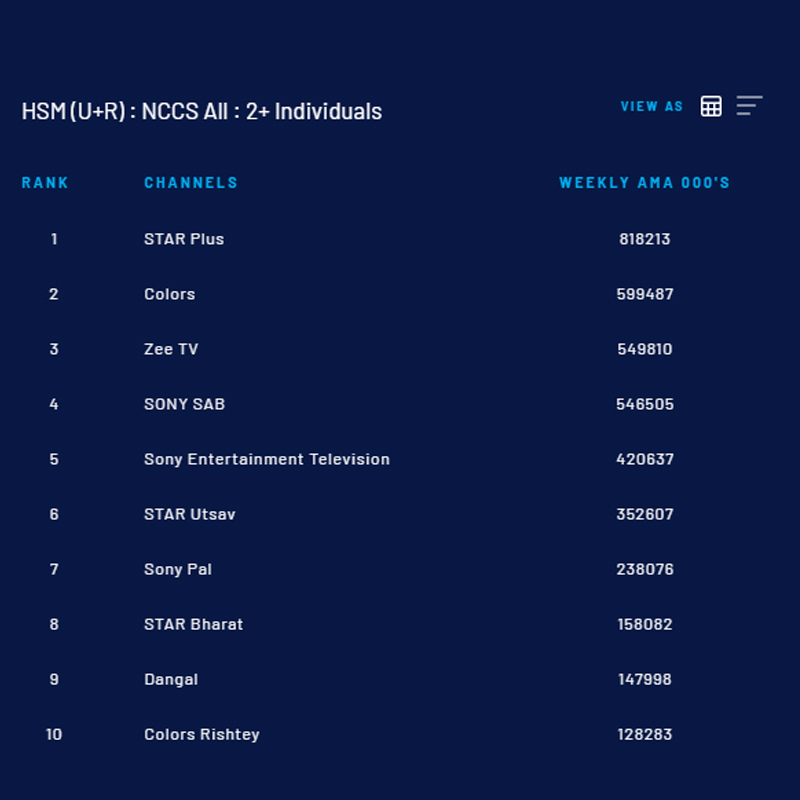
    MUMBAI: Zee TV has pipped Sony Sab for the third spot on pay platform in week 49 (Saturday 5 December 2020 to Friday 11 December 2020) of Broadcast Audience Research Council of India (BARC) data. Sony TV has slipped down to sixth place on in urban market. Colors has continued to retain the second position on both pay platform and urban market. 

    Pay Platform

    In week 49 of BARC India ratings, the top ten channels on pay platform were Star Plus, Colors,Zee TV, Sony Sab,  Sony Entertainment Television, Star Utsav, Sony Pal, Dangal, Star Bharat, and Colors Rishtey.

    Urban Market

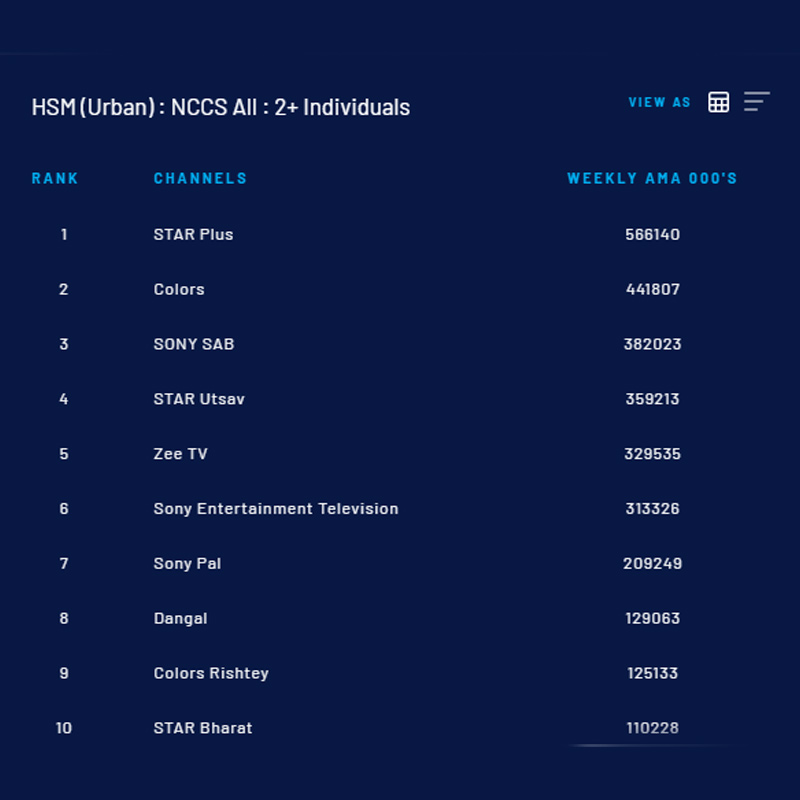
    In the urban market, the top ten channels were Star Plus,Colors,Sony Sab, Star Utsav, Zee TV, Sony Entertainment Television, Sony Pal, Dangal, Colors Ristey, and Star Bharat in week 49 of BARC India ratings.

    Rural Market

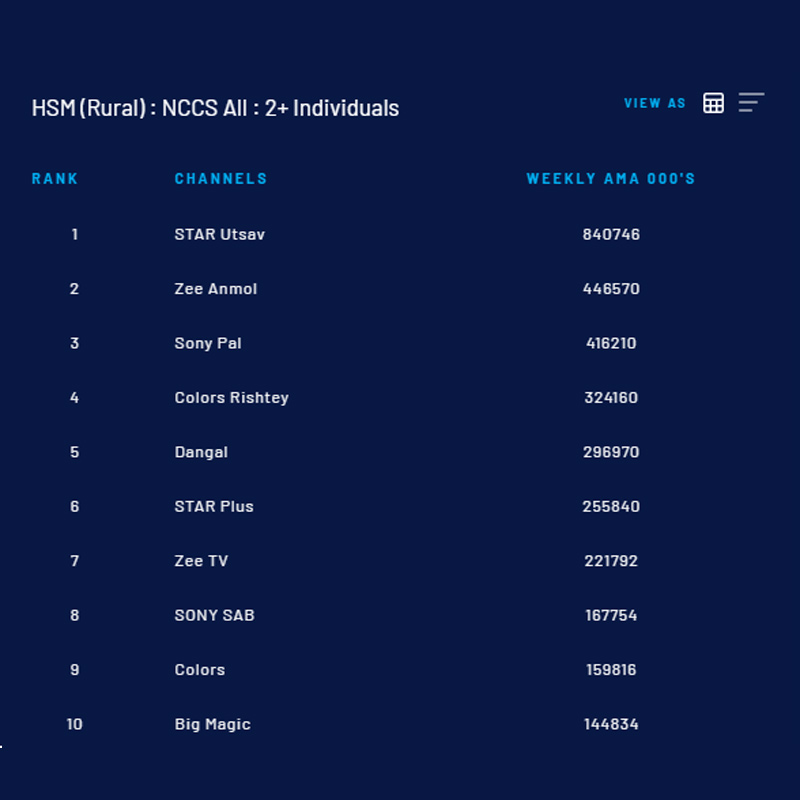
    Star Utsav, Zee Anmol, Sony Pal, Colors Rishtey, Dangal, Star Plus, Zee TV, Sony Sab, Colors and Big Magic were the top ten channels in the rural market in week 49 of BARC India ratings.

    Free Platform

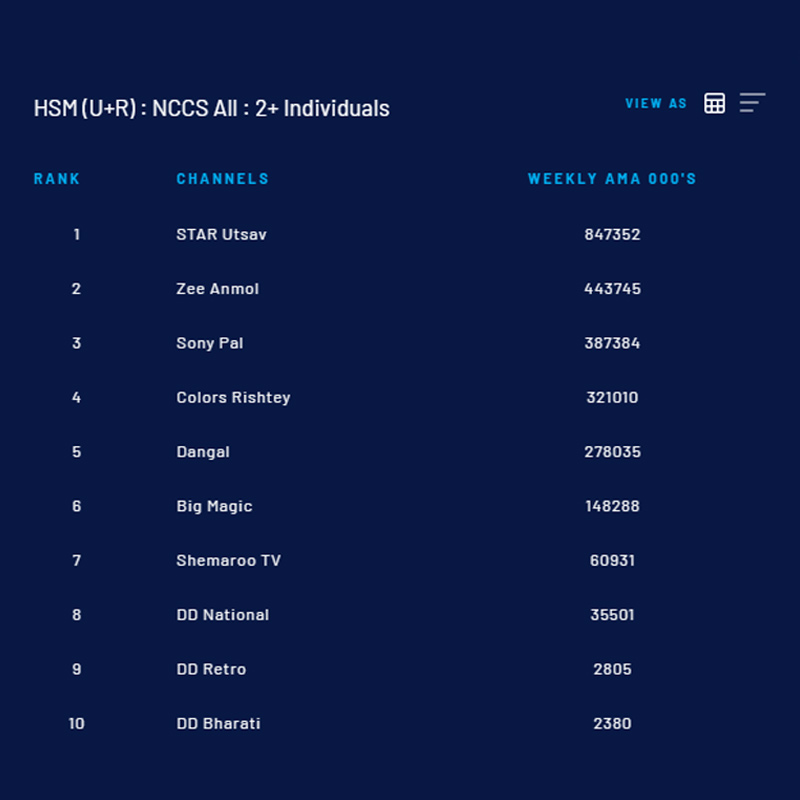
    On the free platform Star Utsav, Zee Anmol,Sony Pal, Colors Rishtey, Dangal, Big Magic, Shemaroo TV, DD National, DD Retro and DD Bharati were the top ten channels in week 49 of BARC India ratings.

  • The Walt Disney Company to have separate heads for APAC & India

    The Walt Disney Company to have separate heads for APAC & India

    NEW DELHI: The Walt Disney Company has announced that it will have two separate leaders for APAC and India. The development comes weeks after Star & Disney India chairman and president – APAC Uday Shankar’s decision to step down.

    In an internal memo to the organisation, The Walt Disney Company chairman international operations and direct-to-consumer Rebecca Campbell mentioned that a leader for India business will be announced in early 2021. In the interim period Star & Disney India head K Madhavan and Disney+ Hotstar head Sunil Ryan will report to her directly.

    She further announced that Luke Kang will be the new president of The Walt Disney Company Asia Pacific. He will oversee the company’s business in Australia/New Zealand, Greater China, Japan, Korea and Southeast Asia.

    Kang will report into Campbell.

    For the record, Uday Shankar resigned in October and will exit the organisation at the end of December. He is moving on to pursue an entrepreneurial career wherein he would support and mentor India’s young minds to create transformational solutions with funding from global investors.

  • TV ad revenues recover by 86% in Q2 : ICRA

    TV ad revenues recover by 86% in Q2 : ICRA

    KOLKATA: After bearing the brunt of the initial shock of the pandemic, TV broadcasters saw a strong sequential recovery of 86 per cent in advertising revenue in Q2. Although it was lower by 20 per cent year-on-year basis, the growth was aided by the lifting of the lockdown, easing of restrictions and resumption of fresh content on general entertainment channels (GECs) with effect from June 2020, according to credit rating agency ICRA Ltd.

    As per the report, GECs regained their popularity and market share that they had lost to news and movies during the quarantine phase. FMCG, ecommerce and consumer durables remained the top contributors in terms of advertisement spends in Q2 FY2021.

    Overall, TV broadcasters in ICRA’s sample set reported a 21 per cent  year-on-year decline in revenues in H1 FY2021. Advertisement revenues witnessed a sharp 40 per cent year-on-year decline in H1 FY2021, though the same was partly offset by the nine per cent year-on-year growth in subscription revenues as subscribers increased their TV viewing during the pandemic.

    In Q1, ICRA’s sample set of TV broadcasters witnessed a 59 per cent year-on-year decline in advertisement revenues, as corporates pulled back their advertisement spends, amid the uncertainty during the then imposed lockdown and the pandemic. Depending on genres, advertisement revenues were impacted by 25-60 per cent (vis-a-vis pre-Covid average monthly revenues) in Q1 FY2021.

    While news and movies genres were on the lower end of the spectrum, with an average decline of 25-30 per cent in advertisement revenues, GECs and sports channels witnessed a sharp 50-60 per cent reduction in advertisement revenues in Q1 FY2021, given the absence of fresh content and deferment of high viewership driving sports events – including the IPL, UEFA 2020, Olympics 2020, among others.

    TV viewing remained high during the first half of the year, which resulted in increase in subscription revenues, up by 12 per cent on a year-on-year basis in Q1 and seven per cent in Q2. Since advertisement revenues account for more than 55 per cent of the total revenues of TV broadcasters, this decline adversely impacted the operating profit margin (OPM) of TV broadcasters, which contracted to 26.6 per cent in H1 (for ICRA’s sample set).

    However, ICRA expects the TV broadcasting industry to witness year-on-year contraction of 15-20 per cent in revenues in FY21. Subscription revenues for TV broadcasters are expected to hold steady in H2 FY21 as consumers are likely to continue their TV viewing amid limited outdoor avenues of entertainment. Overall, subscription revenues are expected to witness mid-single digit revenue growth in FY2021.

    Advertisement revenues witnessed good traction during the festive season and most of the TV broadcasters have witnessed an uptick in ad rates in Q3 FY2021. Industry players expect to reach pre-Covid advertisement revenues in Q3 FY2021. Advertisement revenues will thus witness a strong recovery in H2 FY21, as economic activity and growth improves, though it will be lower by five per cent on a year-on-year basis.

    The OPM in the period was supported by the savings on fresh content creation costs. Given the anticipated year-on-year revenue decline for H2 FY21, ICRA expects the OPM to remain under pressure and overall contract by 400-500 bps in FY21. Profitability pressures have also risen due to the increasing investments in content necessitated by increased competition from digital platforms, ICRA states.

  • Webinar: Building a homegrown content distribution security system

    Webinar: Building a homegrown content distribution security system

    KOLKATA: Taking ahead its webinar with experts across media and entertainment industry, Indiantelevision.com will be hosting a panel discussion on content security distribution ecosystem.

    Moderated by Indiantelevision.com founder, CEO and editor-in-chief Anil Wanvari, the discussion will revolve around – “Television: getting back to business; building a homegrown viable content security distribution ecosystem.” It will focus on other areas like acceptance of Indian origin CAS, digital TV tech, and how the vocal for local narrative will yield results for operators.

    Some of the prominent speakers include MyBox Technologies MD and CEO Amit Kharbanda, SITI Networks Ltd CEO Anil Malhotra, TRAI advisor Arvind Kumar, among others. It will be held on Wednesday, 16 December at 4 pm.

  • Chrome DM week 49: English GEC genre emerges as top gainer

    Chrome DM week 49: English GEC genre emerges as top gainer

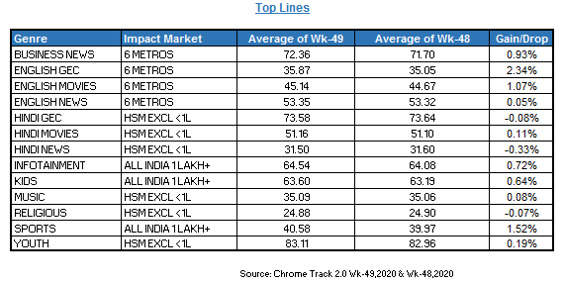
    NEW DELHI: English GEC is the top gainer for week 49, 2020 of Chrome Data Analytics and Media data. The genre clocked a marginal growth of 2.34 per cent.

    In this category, Comedy Central has gained the highest OTS with 42.8 in the HSM excl < 1 market. OTS is the actual census-based percentage connectivity of a channel spread across 81 million homes, as reported by Chrome DM, across analogue cable, digital cable, and DTH.

    This week, the sports genre has emerged as a close second on the top gainers list with a marginal growth of 1.52 per cent in the all India market. In this genre, DD Sports gained the highest OTS with 97.3 per cent.

    Read more coverage on ChromeDM

    Among other genres, English Movies, Business News, and Infotainment have grown slightly by 1.07 per cent, 0.93 per cent and 0.72 per cent.