Category: Viewership

  • Bangla TV viewership sees sustained rise; Assembly polls insulate from Covid blow

    New Delhi: Even as the TV markets across the country reeled under the second wave, the regional Bangla market was insulated from its severe blow. The high-octane Assembly elections, which were also the longest-ever state polls to be held so far, kept the industry abuzz with a sustained rise in viewership.

    Overall, the viewership of Bangla news increased by 30 per cent during week 13-17 when the election process was underway, according to Broadcast Audience Research Council (BARC) data. The number of active advertisers on Bangla news channels also rose by 11 per cent during the election period, coupled with a 12 per cent growth in ad volume, as some national news networks also expanded their footprint into Bangla news to cash in on the election fervour.

    The data was presented by Broadcast Audience Research Council (BARC) India, head, client partnership & revenue function, Aaditya Pathak during the inaugural edition of the Tele-wise Bangla – the power of television organised by Indiantelevision.com on Tuesday. The day-long event was organised in partnership with Zee Bangla and witnessed insightful discussions with representatives from the field of television, advertising, marketing, and media.

    Impact of Second-wave & elections

    According to BARC, the overall television viewership across markets was subdued during the second wave. However, West Bengal witnessed less severe impacts, according to BARC. The state saw an eight per cent drop in viewership compared to last year, while the impact was much more severe in neighbouring Odisha, where the viewership declined by 18 per cent and north-eastern states of Assam and Sikkim where it dropped by 22 per cent.

    “In terms of Genres, the viewership for GECs sustained well during the second wave, with minimal disruption of original content. But, Bangla news and movie channels recorded higher viewership than the pre-Covid levels of 2020, partly on the back of tailwinds from elections,” said BARC India, head, client partnership & revenue function, Aaditya Pathak.

    West Bengal TV Market

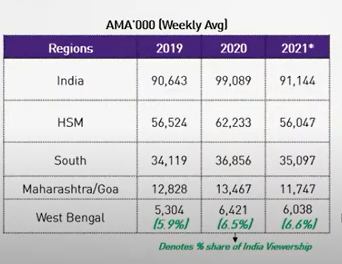
    West Bengal contributes roughly 15.3 million TV households (6.6 per cent) to the overall national TV market of 210 million TV households. This share has increased over the last three years, from 5.9 per cent in 2019 to 6.6 per cent in 2021, contrary to the viewership trends seen in Maharashtra/Goa, south, or the Hindi-speaking markets (HSM). (All India, 2+, Total TV viewership in AMA ‘000, weekly avg). Also, while the daily tune-ins fell across markets in 2021, they remained higher in West Bengal vs 2019 levels, showed BARC data.
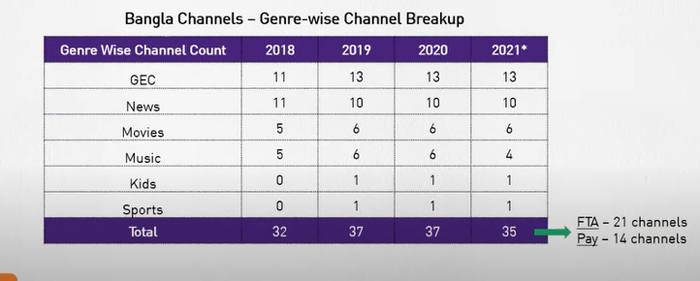
    As of 2021, the state has 35 channels on air that are part of the BARC ecosystem, out of which 21 channels are free-to-air (FTA), while 14 are on pay platforms. This includes 13 GECs, 10 news channels, six movie channels, four for music, and one each for kids and sports. The free platform contributes to 1.9 per cent of the TV viewership, while the share of the Pay platform stands at 98.1 per cent.

    However, unlike other regional markets like Maharashtra where Hindi rules TV viewership, the West Bengal TV market is dominated by its local language, Bangla which contributes 65 per cent to the overall TV viewership in the state, while Hindi’s share is 33 per cent. “In fact, Bangla is the fifth largest language in terms of TV viewership in the country, closely followed by Marathi,” said Pathak, “The average time spent on TV in West Bengal is also quite comparable to the Hindi-speaking market (HSM) average.”
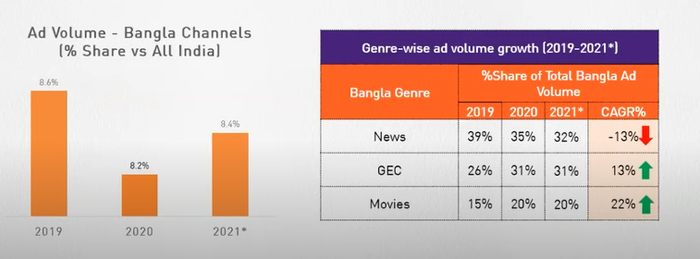
    Since 2019, the overall ad volume share for Bangla channels has not wavered much since 2019 and remained in the 8-9 per cent range compared to the all-India levels. “It’s a GEC-driven market and the ad volume shares for Bengali GEC and movies have demonstrated growth over the years of 13 per cent and 22 per cent, respectively. However, news channels have witnessed a decline in ad-volume of almost 13 per cent compared to 2019,” said Pathak.
  • ZEE BISKOPE announces World TV Premiere of Blockbuster Prem Pyaar Mein

    New Delhi: Bhojpuri movie channel ZEE Biskope is all set to regale its audiences with the exclusive world television premiere of superhit Bhojpuri movie Prem Pyaar Mein on 27 June at 6:00 PM, Jila Top band.

    The movie stars Kunal Singh, Surya Ravi, Hemant Bharti, Bobby Pravin, Prem Singh among others.

    Prem, the protagonist of the movie, is the son of the landlord of his village. Prem’s father, who is approaching his late 50s is planning to remarry, due to which Prem’s mother falls on her deathbed. The story revolves around the complications created by his father and his intention to marry Prem’s girlfriend but because his father is rich, the girl’s parents agree to her marriage. How will this situation resolve and how will Prem manage his relations is what the movie will unfold?

    Bhojpuri Cluster, senior vice-president Amarpreet Singh Saini said, “We curate premieres based on extensive study of consumer insights so that we land the right kind of movie meeting at par with viewer expectations. Weekends especially show a surge in consumption that we ardently cater to. With the world television premiere of Prem Pyaar Mein, we are sure to keep our viewers hooked giving them the right mix of excitement, happiness and entertainment.”

    Zee Biskope is available on Airtel (channel no 663), Tata Sky (channel no 1120), DEN Bihar(channel no 840), DEN Jharkhand (channel no 839), DD Free Dish (channel no 31), d2h (channel no 859), Dish TV (channel no 1555), Siti Cable (channel no 214) and Darsh Digital (channel no 189). It’ll soon be available on all other major cable platforms. 

  • Nickelodeon celebrates International Yoga Day with #YogaSeHiHoga campaign

    KOLKATA: Nickelodeon continues to celebrate International Yoga Day year-on-year to engage its little fans and make Yoga a daily practice. This year, the kids’ entertainment channel is taking Yoga Day activities a notch higher with the latest edition of its fun and spirited #YogaSeHiHoga campaign. 

    As a part of the initiative, the brand has partnered with SARVA Yoga Studios, a wellness start-up, to bring Yoga closer to its little fans and educate them about the enormous benefits derived from Yoga. Nickelodeon and SARVA are bringing yoga to the audience in a fun manner through a unique interactive Yoga workshop with Nicktoons Shiva, Rudra, and Happy. The brand has also curated workshops with yoga experts from SARVA studios to instil a healthy lifestyle that is sure to de-stress kids in these difficult times.

    Viacom18 Kids TV Network, marketing head Sonali Bhattacharya said, “At a time when a large part of a child’s routine has changed with great restrictions on physical movement, we believe that with this unique campaign and with the power of our amazing Nicktoons, kids would get the stress buster they so deserve! By collaborating with like-minded partners, we are creating innovative and safe moments for kids to be healthy and happy in difficult times like this.”

    Ministry of AYUSH, joint secretary PN Ranjit Kumar said, the ministry is happy to support Nickelodeon’s initiative Yoga Se Hi Hoga second time after seeing the excellent response received from little yogis last year. “As the pandemic continues to challenge us, it is noteworthy to see kids brands like Nickelodeon coming forward to highlight the ability of Yoga to strengthen immunity. The campaign aligns with the theme of IDY 2021 ‘Yoga for wellness’, and we hope that people utilize this period as an opportunity to strengthen their health through Yoga practice,” he added.

    SARVA founder Sarvesh Shashi said, “SARVA has always aimed to break the myth that Yoga is boring. During the pandemic, the presence of a positive, friendly influence like the Nick toons only encourages children to keep practising and have fun while doing so. We are so glad to have tied up with Nickelodeon especially during this time where we have been urging the world saying #StartTohKaro!”

    The campaign will be promoted by a 360-degree marketing and communications plan which will include on-air promotions across the Nickelodeon franchise, digital promotions, and a robust program of mommy networks and influencers who will amplify the reach to audiences at large.

    In addition to this, a virtual workshop is designed for all Viacom18 employees and their kids. Furthermore, the initiative will be brought alive on social media through a #YogaSeHiHoga program and a Kid Yoga Series through an array of fun short-form videos encouraging kids to imbibe Yoga in their daily lifestyle. Kids can upload their picture/video of them doing their favourite yoga pose on nickindia.com and the best ones would get featured on the channel.

    To emphasize the tremendous advantages that Yoga offers, the brand has collaborated with child prodigies Ishwar Sharma and Harsha Nivetha to come forward and extend their support to the initiative. Through a host of quirky videos and actions on-air, and Yoga workshops by Nicktoons, the entire campaign will be supported by the Ministry of AYUSH.

    In 2019, Nickelodeon celebrated International Yoga Day wherein Nicktoons Motu-Patlu performed Yoga with Prime Minister Narendra Modi and 40,000 people at Prabhat Tara Ground, Ranchi, and collaborated with Mumbai’s biggest Yoga event – ‘Yoga by the Bay’. Last year, owing to the pandemic, Nickelodeon celebrated Yoga Day virtually in partnership with AYUSH ministry to inculcate yoga habits and highlight the importance of building a healthier immune system. The digital partnership was extensively promoted through interactive posts, videos, followed by a nationwide contest that reached out to over 630,000 mothers & kids combined through digital mediums and 3000+ entries received under the Yoga contest hosted on the brand platform.

  • Cartoon Network fans thank Indian police force in latest campaign

    Mumbai: Kids’ entertainment channel, Cartoon Network’s latest social media campaign- #ThankYouForBeingDabangg has received more than 500 messages of gratitude from across the country, for the Indian police force.

    The unique social media campaign aimed to honour the relentless work of India’s supercops during the ongoing challenge of COVID-19 and was launched alongside the channel’s latest Bollywood-inspired action-comedy ‘Dabangg – The Animated Series’ on 31 May.

    Watch the video montage of the kids’ messages here

    Supported by parenting platform, Momspresso, the initiative saw kids and parents share messages in the form of handwritten notes, drawings, and videos, on social media. Bollywood actor Salman Khan who plays Dabangg’s iconic ‘Chulbul Pandey’ and movie producer and actor Arbaaz Khan also encouraged kids to participate through their social media posts.

    Notable kids’ academy ABCD Dance Factory also shared their messages in their distinctive artistic style via Instagram Reels, set to the ‘Dabangg – The Animated Series’ title track while prompting its students to follow suit. YouTube Kids sensations Aayu and Pihu also participated via their eponymous show and encouraged their followers too, to join in the conversation.

    Speaking on the campaign, South Asia Network Head for Cartoon Network and POGO, Abhishek Dutta said, “#ThankYouForBeingDabangg was launched to collectively pause and appreciate the constant endeavour of the police force during the COVID-19 pandemic. It was heartening to see responses pouring in from every corner of the country, in various ways and multiple languages, like Hindi, English, Tamil, Telugu, Marathi, and more. It brings us immense joy to have created this movement and saluting our fearless heroes.” 

    Speaking on the initiative DCP, Mumbai S.Chaitanya said, “We are truly grateful for the enormous amount of love we have received from kids across the country through the #ThankYouForBeingDabangg initiative. This was such a thoughtful initiative by Cartoon Network and the creative ways in which the kids thanked us was very touching. We promise to continue being Dabangg for all of you!”

    Co-presented by Chocoliebe Eclairs and Cue Learn along with associate sponsor BritanniaTiger Krunch, the animated version of Bollywood’s sensational supercop franchise airs every day at 12 pm, only on Cartoon Network.

  • May’21 ad volume 64% higher than last year : BARC

    Mumbai: Television continues to stay strong and resilient as a medium of advertising amid the second wave of the pandemic. Despite a marginal dip in April 2021, ad volumes in May 2021 have witnessed a 64 per cent growth as compared to May 2020, said Broadcast Audience Research Council (BARC) in its latest THINK report for May, 2021. The growth numbers remained at par with 2018 and 2019.

    In a piece of good news for the broadcasters, out of the total of 2142 advertisers in May 2021, as many as 1,347 (63 per cent) were new advertisers. The FMCG category continued to dominate ad volumes with 72 per cent share, followed by ecommerce, with 10 per cent share in May.

    “2021 began on a high note for television Ad Volumes. Moreover, it attracted over 60 per cent of the total advertisers in May this year, indicating that advertisers continue to bank on the medium. With lockdown easing up and upcoming big events, we expect TV Advertising to remain strong this year,” said BARC India Head – client partnership and revenue function Aaditya Pathak.

    Regional genres bounce back

    Advertising on GEC and movies genre continued to grow and both the genres outperformed the same period for the previous three years. While GECs witnessed a growth of 74 per cent, over last year, movies genres saw a growth of 76 per cent compared to May 2020.

    Owing to the increasing consumption of regional content, advertising on South language GECs registered a staggering growth of 103 per cent while the rest of the Regional GECs witnessed 53 per cent growth in May 2021 vs May 2020. South Movies and Regional Movies channels witnessed 85 per cent and 129 per cent growth for the same period.

    Steady growth of Top 10 advertisers

    While over 70 per cent of advertising was dominated by the Top 50 Advertisers in May, the Top 10 advertisers had the highest share of 54 per cent since 2018. Advertising by the Top 10 advertisers continues to see steady growth.

    Growth observed in ad volumes in the first quarter of 2021 has evidently seeped into the ongoing second quarter of the year, despite state-wide partial lockdowns being implemented in various parts of the country. Moreover, the growth witnessed in May 2021 reinforces the strength and robustness of television as a medium.

  • BARC week 22: Star Plus continues to reign pay platforms

    Mumbai: Hindi general entertainment channel (GEC) Star Plus continues to maintain its hold on the top position in the list of channels on the pay platform, according to the Broadcast Audience Research Council of India (BARC) for Week 22 (29 May to 4 June). 

    The channel recorded an average minute audience of 2873.92, thanks to its show Anupamaa, which has remained a viewers’ favourite ever since it went live. Star Plus is followed by Sony SAB (2462.64), Colors (1511.73), and Sony Entertainment Television (1332.12) at the second, third, and fourth spots, respectively. 

    With an AMA of 1238.61, Zee TV bagged the fifth spot. The remaining channels in the list of Hindi GEC pay platforms are Star Utsav (884.02), Star Bharat (719.62), Sony Pal (598.04), Colors Rishtey (485.73), and Dangal (451.54). 

    Star Utsav topped the free platforms’ list with 1941.52 AMA, followed by Colors Rishtey (1096.41) and Zee Anmol (1013.33) in the second and third spots, respectively. The fourth spot was bagged by Sony Pal (938.99), while Dangal (762.41) got the fifth spot in the week 22 list released by BARC. 

    The remaining channels in the week 22 list of free platforms are The Q (660.49), Big Magic (336.32), Shemaroo TV (136.37), DD Retro (17.43), and DD National (16.79).

    Star Utsav topped in the rural market with 2017.55 AMA, while Colors Rishtey bagged the second spot with 1134.63 AMA. Sony Pal (993.01), Zee Anmol (979.07), and Star Plus (944.35) bagged the third, fourth, and fifth spots respectively in BARC’s week 22 list in the rural market. 

    Other channels which found their top spots in the rural market are Sony SAB (800.46), Dangal (793.64), The Q (637.3), Colors (504.77), and Zee TV (497.23). 

    In the urban market, Star Plus bagged the top spot with 1943.01 AMA, followed by Sony SAB (1686.69), and Colors (1013.78) in the second and third spots respectively. The remaining channels in the list are Sony Entertainment Television (919.24), Star Utsav (808), Zee TV (743.53), Sony Pal (544.01), Star Bharat (499.21), Colors Rishtey (447.51), and Dangal (420.19).

  • Get a jab, industry urges staff, workers as it resumes operations

    New Delhi: With the second wave of the pandemic beginning to show signs of a slowdown, organisations across the country are gearing up to welcome their employees back to the office. But with the threat of a third wave looming large, they are taking no chances and making arrangements for their employees to get vaccinated on time. The media and entertainment industry was also hit hard by the pandemic. With TV, film shoots suspended, the losses only mounted. Now as states begin to unlock and restrictions ease, the industry is also taking steps to resume business.

    “Vaccination is the only wave to combat this dreaded disease. I’m sure it will eliminate the disease to a large extent and pave the way for a fearless and anxiety-free shooting in Maharashtra,” said Indian Film and TV Producers Council (IFTPC) president Sajid Nadiadwala.

    IFTPC has already begun vaccinating about 10,000 media and entertainment workers. The trade association has tied up with Kokilaben Ambani Hospital for the vaccination drive at the IFTPC office in Andheri West. It has decided to add two to three more vaccination centers once the return journey of crews shooting outside Maharashtra begins.

    “Vaccination will be given free of cost to all the workers, but a nominal fee will be charged from high-end professionals and technicians,” said IFTPC chairman (TV and web), J D Majethia, adding that the first vaccination drive is being funded by Motion Pictures and TV Producers’ Welfare Trust, the philanthropic wing of IFTPC.

    On 8 June, the Federation of Cine Technicians and Workers of Eastern India (FCTWEI) also conducted a mass vaccination drive and inoculated as many as 108 people, including artists, technicians, executive producers, and writers. 

    The Producers Guild of India (PGI), the association of Indian film, television, and digital content producers also conducted a mass vaccination campaign for its guild members and associated production crews on a multi-day drive on 1 June. “Mass vaccination drives will help to facilitate safer shooting as the production has been resumed in limited hours,” it stated.

    Broadcasters are not far behind either. Zee Entertainment has begun the vaccination drive for artists, technicians, crew members, other associates, and partners. Zee Kannada and Zee Bangla have already conducted the first drive, Zee Telugu will follow suit. Soumi Chakraborty, who plays Kamala in ‘Rani Rashmoni’ received the first dose of the Covid vaccine at the Zee Bangla office on 7 June.

    “As a responsible broadcaster and one of the important broadcasters in the TV ecosystem, we have taken the initiative to provide free vaccination for all our artists, technicians, the crew of production houses, and other associates and partners. This initiative has been driven by a core sense of health and safety first for all the partners and members who are associated with our various projects,” said Zee Entertainment cluster head (East) Samrat Ghosh.

    Yash Raj Films has also opened its studios for the first phase of the vaccination drive, in which it plans to inoculate as many as 4,000 workers. YRF had pledged to sponsor Covid-19 vaccines for 30,000 members of the Federation of Western India Cine Employees (FWICE).

    As the second wave recedes further, it may also become necessary for workers and staff to show proof of vaccination, when they resume work. The organizations are thus making efforts to dispel any concerns that their staff may have regarding vaccination and urging them to take the jabs.

  • How television can increase time spent viewing with interactivity

    MUMBAI: With streaming video services like Netflix, Amazon, Disney+Hotstar, and Zee5 grabbing a majority of the headlines, and becoming the flavor of the moment, many believe that linear television in India is losing its moxie. Yes, broadcasting companies are indeed responding aggressively to Netflix and Amazon’s invasions into what was once solely their territory by acquiring, merging, and launching their own OTT platforms. Not just in the US, but almost every nation, including India.

    Yes, it’s true that India alone has around 70-80 streaming platforms – if you include those with dubious titillating content, and which are available on the google play store. Yes, it’s true that almost every trade and business publication has raised the alarm that streaming video platforms are going to steal viewers and pull the rug from under television’s feet.

    But the fact is that the reality is as far from this fear-mongering, as is mount Everest from Mumbai. Television is only on the rise in India. That is quite evident from the television data the Broadcast Audience Research Council (BARC) reported recently. The number of Indian television households grew to 210 million by the end of 2020. Some 13 million homes were added to the TV universe since the last BARC study in 2018; of this rural India accounted for nine million. TV viewership also rose to 892 million individuals from 836 million. Add to that the fact that more than 90 million households have yet to own a TV set.

    Now if you compare those figures with the OTT universe: the biggest OTT platforms in India – Disney+Hotstar and Zee5 – have monthly active users which are around one-third of TV’s viewing population and other streamers have significantly lower numbers. Subscribers to the premium OTT services are also only in the single and double-digit million range. Revenues too are not comparable; the free ad-supported television streaming platforms are dwarfed by the ad revenues that Indian television –both pay and free to air channels are mopping up.

    Clearly, broadcast television has long legs and will continue to stride ahead of streaming services. What can help it proliferate even more is if interactivity can be built into it; with viewers being able to interact with it live from their homes. Just like it is possible with the streaming video which is delivered over internet protocol or the internet as is the case with OTT platforms. Sports fans have been fascinated by what has been playing out on their mobile phones wherein they can make comments while watching the IPL action on their smartphones on Disney+ Hotstar. They can engage with the video on their phones. Fans have also been quite taken up with being involved in Kaun Banega Crorepati with the play-along option available on their smartphones. That has probably added to SonyLiv’s stickiness.

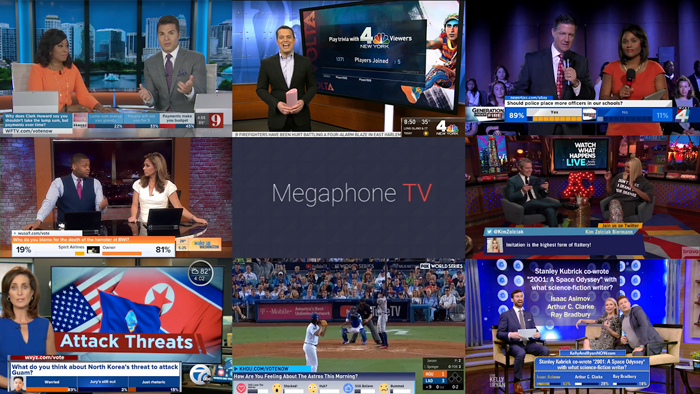
    But today technology is available which can bring similar – if not better – interactivity to television too. One of the best products available today is MegaphoneTV which allows viewers to interact with their programmes from the comforts of their sofas in their homes. It enables them to take part in opinion polls, trivia, social interaction, quizzes, express their fan love, expound their views on what’s going with the storylines and characters of their favourite TV shows – and their responses and names are transmitted to hundreds of millions of viewers all over India simultaneously immediately with a lag of fewer than 200 milliseconds. All they need is a smartphone. Megaphone TV allows TV to transform itself from being a dead one-way device to one with which viewers can correspond, that too without any latency.

    More than 160 channels globally are using Megaphone TV – from US broadcasters ABC, CBS, NBC, Bravo TV, CNN, Sky TV in the UK, and RTL in Germany. And they have benefited immensely from this tool with response rates and engagement with TV viewers going up exponentially.  

    Channels- both entertainment and news – globally have used MegaphoneTV to build loyalty by giving out rewards to loyal participants of the interactivity, thus increasing stickiness and spiking time spent viewing by TV viewers.

    New York-based Megaphone TV founder & CEO Dan Albritton points out that integrating the tool with the channel’s backend is extremely simple, adding that all that is needed are internet connectivity, two computers – one in the playout hub of the broadcaster, and one in the hands of a junior programming executive wherever he is located. He explains: “Being a white-label service, it takes on the channel’s packaging, branding, and look with no indication of Megaphone branding anywhere. The interactivity questions, polls, and quizzes can be entered to appear on-air on a TV channel on the fly by the junior executive after strategizing with the programming team. “

    Brands can be roped in by the channels ad sales team to sponsor the interactivity. And TV commercials by brands can also be created which encourage viewer responses live, thus in the process helping build sales funnels and consumer data, to which the broadcaster’s data teams and marketers have free access. “The American TV industry has recognized the value we are offering through Megaphone TV. We have won an Emmy Award for it, and have been nominated twice for some of the interactivity around other TV programmes,” says Albritton.

    In India, TV channel executives are just about getting exposed to Megaphone TV, he points out.

    “Two channels have been licensed to use this engagement driving tool. They will be coming out with their offerings soon. Some leading media agencies have seen it in action too, and are excited about the possibilities Megaphone TV offers,” he says. “I can visualize a time in the not too distant future when Megaphone TV will become ubiquitous in the very exciting Indian television ecosystem.”

  • TV advertising shows resilience during second Covid wave, says new report

    Mumbai: Several states have begun the unlock process, as the second wave of Covid-19 begins to ebb out after its catastrophic impact across sectors. Television and film shoots have resumed under strict restrictions, allowing the media and entertainment industry to emerge out of the crisis.

    According to a recent report by Elara Capital, the second wave has submersed advertising spends softly versus 2020 levels. The first wave that hit last year defaced Q1FY21 ad revenues with decline of 61 per cent YoY(ex-IPL) for TV, 79 per cent for print, and 87 per cent for radio sectors, highlighted the report. The report has not factored the impact of the Indian Premier League (IPL).

    “Nevertheless, we expect Q1FY22 tapering to diminish, versus FY20 base, at 25 per cent decline for TV, 45 per cent for print, and 35 per cent for radio. This is primarily because of the ongoing TV shoots led by a shift to alternate locations with minimal Covid impact on fresh content, state-level restrictions versus pan-India lock-down in 2020 and continued print-newspapers’ circulation and delivery, leaning on 2020 learnings,” said the report, adding that vaccination pace should trigger a sharp ebb in new cases, which could uncork a faster unlock versus 2020 levels.

    TV advertising to revive faster than print, radio

    According to the report, TV advertising will reach pre-pandemic levels by FY2022 faster compared to print and radio. It estimates TV/digital advertising will grow 18.6 per cent (ex-IPL)/25 per cent YoY in FY22 respectively as verticals such as FMCG, e-commerce, auto, and telecom enjoy a larger share in these mediums. TV also remains the preferred medium for brand-building and favoured choice for advertisers as it has the widest reach among mediums.

    While, it predicted tough times for print and radio which are likely to take a longer time, given higher exposure to local/SME advertising segments. Other verticals like cinema and out-of-home advertising (OOH) will also need more time to recuperate from the impact of the pandemic, it said.

    “The shoots were not stalled completely for TV and films as several producers had shifted to alternate locations. Moreover, verticals like FMCG and e-commerce have a good presence for TV ad spends. It’s also important to note that TV’s has the least reliance on local ad spends compared to other mediums,” said Elara Capital vice president and research analyst Karan Taurani. 

    Regional broadcasters and news genre to outshine others

    According to the Elara Capital report, regional broadcasters are expected to outperform others in FY2022 when the industry returns to normalcy. Sports and news are the two genres with continued demand for live consumption, which should support their growth in the linear medium.

    “Regional genres such as Marathi, Telugu, Tamil, Malayalam offer a largely untapped opportunity in advertising growth, as their transition to the digital medium should take longer versus Hindi and English genres. TV Today Network (TVTN) and Zee Entertainment (ZEEL) are our top picks within the listed broadcaster space given their presence in key genres and market share gain visibility,” as per the report.

    According to the report, the average time a person spends on television has risen drastically post the coronavirus lockdown, and the trend is still continuing. Moreover, social distancing norms may continue as a precautionary measure even after the lockdown, which could further elevate the TV viewing time. 

  • BARC week 21: The Q is heading to the big league of channels

    Mumbai: QYOU Media Inc has announced that The Q India, the company’s Hindi language youth-oriented channel has reported a new record gross rating point (GRP) level in week 21 of 2021, as measured by the Broadcast Audience Research Council (BARC). 

    GRP is a measurement that combines viewer impressions with the time spent viewing (TSV) a particular channel. In week 21, The Q recorded 94.65 million viewer impressions with an average TSV of 104.56 minutes, which on a combined basis has driven The Q to its highest GRP level in company history. 

    The GRP of The Q in the week 21 report of BARC is 53, and clearly indicates that the channel is making steady progress and heading into the big league dominated by mass-market channels that are operated by Sony, Zee TV, and Viacom (Colors). The Q also recorded an eight-week average GRP of 46.23. 

    It should be noted that GRP is one of the most vital metrics used to project potential future revenue growth. As The Q is gearing up with a line up of new programmes, the channel is expected to join the big league in the coming months. 

    “This has been an incredible ratings run and every week we are thrilled with the solid fan base that we are clearly establishing.  Perhaps the most amazing part of this is that we have yet to launch many of our new programs and series and in addition, there has been little to no marketing of the channel to date. This is happening organically and via the virtuous loop, we all believed in where our creators and their social presence are building our brand directly with our viewers. We are not resting on these results and expect to continue to build distribution, programming, and marketing efforts to push The Q to (still) higher and higher levels,” said QYOU chief executive officer and media co-founder Curt Marvis. 

    In a recent statement, the company said that The Q is available in over 100 million TV households and reaching over 612 million OTT and mobile users in India.