Category: Viewership

  • Chrome Data: Religious channels lead the chart in week 52

    Chrome Data: Religious channels lead the chart in week 52

    MUMBAI: It’s ironical to note that in the week when everybody is up for some celebration – partying, enjoying and vacationing – the viewership of religious channels have increased. Is it that the elders at home have got an easy access to the channels they want to watch in the absence of the younger members of the family? Or, is it that people at large want to wash off their sins at the yearend by spending some time in spiritual viewing?

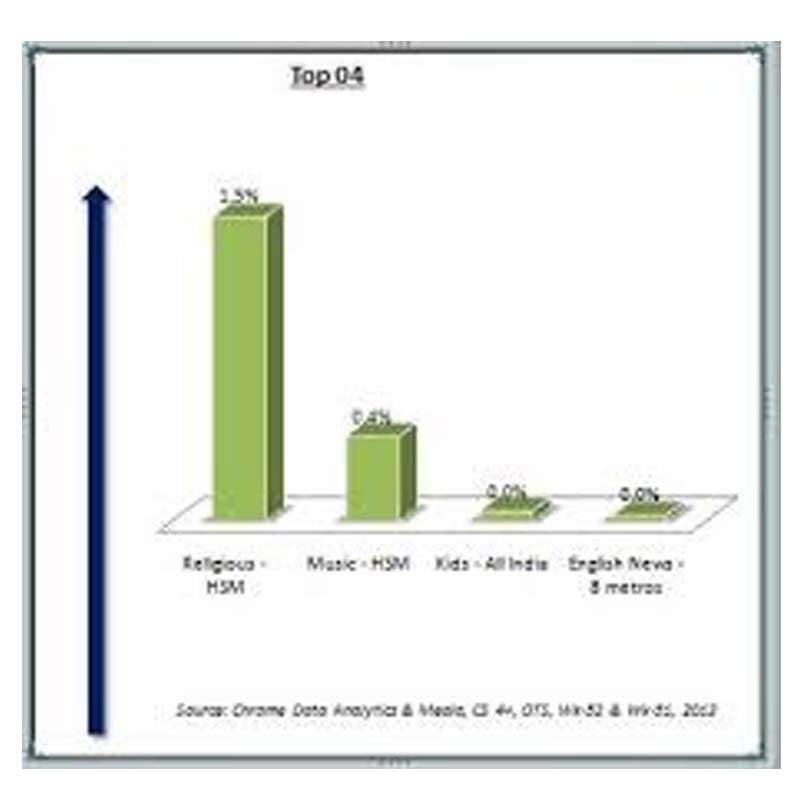
    Whatever the reasons may be, we are saying all this because in the week 52 of Chrome opportunity to see (OTS), the religious channels are leading the chart. The genre gained 1.5 per cent as per the data provided by Chrome Data Analytics & Media. Among all the religious channels, Aastha ruled with 98.3 per cent in the Hindi speaking markets (HSM).

    And not that the viewers just enjoyed the bhajans and spiritual lessons, they were in for some musical retreat as well. The music channels were at the second position in the week 52. The music genre in the HSM gained 0.5 per cent with Sony Mix ahead of other channels with 88.5 per cent OTS.

    The Kids genres across India and English news channels in the eight metros didn’t witness much change as compared to last week. However, the genres were in the top four. While Cartoon Network leads in the kids’ genre with 87.3 per cent, Times Now led in the news category with 90.4 per cent OTS.

    As for the bottom four, English entertainment channels saw a huge drop with 3.8 per cent in the eight metros. Star World overtook AXN to gain the first position with 81.1 per cent.

    The business channels couldn’t grab the viewers attention even after special line-ups featuring the high and low points of the year 2013. The genre in the eight metros saw 1.9 per cent drop with CNBC Awaaz leading the way with 83.8 per cent.

    English movie channels and Hindi news channels in the eight metros and HSM, respectively, saw a dip with former witnessing a drop by 0.6 per cent and latter by 0.4 per cent. Pix was at the top with 88.4 per cent, while Aaj Tak registered 94.6 per cent OTS.

  • India’s leading communication consultancyMavcomm forays into Odisha

    India’s leading communication consultancyMavcomm forays into Odisha

    New Delhi , August 29, 2013- India’s leading integrated communicationsconsultancy, Mavcomm Consulting, with its head office in New Delhi and a pan India presence today marked its entry into the state of Odisha. The company has opened its branch in the state capital of Bhubaneswar.
    To support its expansion in the eastern market the company is kicking-off a hiring drive to identify and secure strong & dedicated individuals from diverse backgrounds with the capability to coordinate and implement PR campaigns in the state.
    “The company is always in pursuit of adding new dimensions to its services and offerings based on market trends and changing dynamics. Opening of our new office in Odisha is a step in this directionSince the last decade Odisha has witnessed phenomenal growth with many companies entering the market. The state is attracting an unprecedented amount of investment in aluminum, coal-based power plants, petrochemicals, and information technology. We realized that though the major companies are present in the state, they are not getting the required visibility. We aim to support these organizations and individuals identify, strategize and achieve their communication goals,” said Siddhartha Upadhayay, Founder Director of Mavcomm Consulting pvt. Ltd.
    With its headquarter in Delhi, Mavcomm has branch offices in Mumbai, Bangalore and now Odisha which are the most important cities for communications consulting business. Apart from these cities, the company has created a network of affiliates located in strategically important locations such as Kolkata, Hyderabad, Ahmedabad, Chandigarh, Chennai, Bangalore, Pune, Kochi and Lucknow.
    Mavcomm Consulting has set benchmarks in conceptualizing and executing some of the best Public Relations Campaigns for national and multi-national corporations and brands across industry sectors.

  • Qatar Airlines Brings Light Shared Values Of Excellence, Passion, Pride And Culture

    Qatar Airlines Brings Light Shared Values Of Excellence, Passion, Pride And Culture

    Barcelona, SPAIN – Qatar Airways officially launched the start of its three year partnership with FC Barcelona at an event held today at Camp Nou.

    The airline’s partnership with FCB took effect from July 1st this year.

    In attendance were leading representatives of both organisations, the CEO of Qatar Airways, Akbar Al-Baker, the President of FC Barcelona, Sandro Rosell and Vice President of FC Barcelona Economic and Strategy Area, Javier Faus.

    Akbar Al Baker made the following remarks at the start of his address to the media during a press conference: “The joining of FCB and Qatar Airways is truly history in the making. It is the first time we enter into such a landmark, significant sports partnership.

    “We understand the importance of FCB to Catalonia, to Spain, and in fact – to every country around the world. It is a great honour to be standing side by side as you create and spread the excitement that this great game of football brings to fans.”

    Al Baker also spoke about the airline’s expansive communications campaign about the partnership that will cover various elements: “our aim with this new campaign is to show to the world how strongly we stand behind this new partnership, which we will share with passengers across our entire network.”

    He further described the partnership as “a fitting match for both organisations that share the same values: the pursuit of excellence, passion, pride and culture.

    The airline CEO added: “This partnership will also raise Qatar Airways and FC Barcelona to a new platform internationally, bringing the fans of FCB closer together.

    The State of Qatar’s national carrier, Qatar Airways began operating to Spain in December 2005 and currently flies 10-times-weekly to Barcelona and daily to Madrid.
    FC Barcelona football club President Sandro Rosell said: 

    “We have a long journey ahead lasting three years in which we will share experiences, with a common starting point and goals. Barça and Qatar Airways are united by many ideals, such as a passion to be better each day, the conviction that the human factor makes a difference and the integration of different cultures, but I would emphasize the desire we have to connect with people. And this desire leads us to want to be every day closer to our fans.”

    The new sports kit was first showcased during the Asia Tour earlier this month when the team travelled to Kuala Lumpur and Bangkok to play friendly matches in preparation for the upcoming season.

    The fans reunited with the team with great glory and the stands were filled with absolute excitement to have the likes of big players from FC Barcelona squad.

    Since its beginnings, FC Barcelona has been characterised by being not just a football organisation, but also a powerful force for globalisation, solidarity, integration and social cohesion. Qatar Airways fully identifies with these values, which is why this partnership between both organisations is much more than just a simple economic alliance. Furthermore, Qatar Airways’ partnership with FC Barcelona will help to position the airline in the world.

    Qatar Airways will work with FC Barcelona to create joint initiatives and will especially focus on connecting with the club’s fans and also with underprivileged children to spread the love of the game to all corners of the globe.

    Flying to 129 leisure and business destinations Qatar Airways is one of the fastest growing airlines in the world.

    Qatar Airways has so far launched six destinations this year – Gassim (Saudi Arabia), Najaf (Iraq), Phnom Penh (Cambodia), Chicago (USA), Salalah (Oman) and Sulaymaniyah (Iraq).

    Over the next few weeks and months, the network will expand with the addition of further destinations Chengdu, China (September 3), Addis Ababa, Ethiopia (September 18), Clark International Airport, Philippines (October 27) and Philadelphia, USA (2 April 2014).

  • Investment firm ups stake in ETC to 5.13%

    Investment firm ups stake in ETC to 5.13%

    MUMBAI: Investment firm Ruane, Cunniff & Goldfarb Inc has bought 20,000 shares, amounting to a 0.14 per cent stake in ETC Network Ltd, through a secondary market purchase, according to a BSE announcement.

    With this acquisition, Ruane, Cunniff & Goldfarb’s stake in ETC has gone up to 5.13 per cent (740,273 shares) from its earlier 4.99 per cent (720,273 shares).

    Ruane, Cunniff & Goldfarb is best known as the investment advisor and distributor of Sequoia Fund.

    ETC Networks Ltd. owns two channels – ETC Hindi and ETC Channel Punjabi. Zee Telefilms holds 54.42% shares in ETC Networks Ltd.

    The channel was launched in August 1999 as a 24-hour Indian Music Channel with the punch line “Aakhir Dil Hai Hindustani”. ETC was listed on the Bombay Stock Exchange in May 2000.
     

  • ‘You cannot build a sample on psychographics’ : LV Krishnan – TAM India CEO

    ‘You cannot build a sample on psychographics’ : LV Krishnan – TAM India CEO

    Media research agency Tam is in an expansion mode. Recently, it increased the number of peoplemeters from 4800 to 6917. And as direct-to-home (DTH) and conditional access system (Cas) took root, it also came out with the Elite Panel. The aim: to give broadCasters and media planners an idea of what the cr?me de la cr?me consume.


    Indiantelevision.com’s Ashwin Pinto caught up with Tam India CEO LV Krishnan to find out how the agency is gearing up to meet the challenges that new distribution technologies are throwing up.


    Excerpts:

    With conditional access system (Cas) and direct-to-home (DTH) taking root, what is Tam’s strategy going to be?

    We expected digitisation to happen sooner or later. We have been getting ready for it since a year. In April 2006 we released our first study under the Blinx series where we had the first DTH penetration data coming out. We also did a multi-city study on what was happening on Cas. We looked at the international availability of technology that could be used to measure these two platforms.


    We began work on the digital peoplemeter which we call the TVM5. Today all the six metros are completely aligned to the TVM5 digital peoplemeter. The peoplemeters are technologically hybrid. This was stage one done last year. We expanded the panel two weeks back and introduced the Elite Panel. After that, quite a large number of homes in the Elite Panel have moved onto DTH. In the regular panel a significant amount of homes are converted to Cas.


    This is clubbed with the C&S (cable & satellite) data and sent to the industry for usage. While this happens and the market moves from analogue to digital, there is growth in DTH and Cas for both panels. To validate this we are doing a regular penetration study. The data for this month will be out shortly. We will do studies in February and March to find out DTH and Cas penetration in the notified areas. It will be matched with our Elite Panel penetration also to see if it matches with those kinds of homes. Then data will go out to the user.

    Will Cas or DTH prevail and why?

    It is difficult to say which one will succeed. Each has advantages. Finally it is the service ability that counts. The demand is there. Pricing is important.


    Then there is the marketing activities done. Feedback is that demand for set top boxes is rising dramatically. But the service ability is the need of the hour. This is preventing more penetration.

    Tam has also increased the number of Peoplemeters and coverage area. Could you talk about this?

    We have been working with the joint industry body (JIB) for the last year and a half to look at the next step. Hence the decision to go to 7000 peoplemeters.


    Three things prompted the expansion. Firstly the universe has changed since the last expansion that happened in 2002 – 2003. The number of C&S homes has increased. New towns have been added on different strata of the population. The second reason is the sheer amount of fragmentation that is happening. With the number of channels available, TV viewing has become more fragmented. To look at data from specific segments of the population you need to go deeper. The Hindi speaking markets which is the North and West is where the bulk of the new metering has been done.


    In the South, the time spent on viewing is higher in proportion to the number of TV homes present. More samples have been added there. Then we wanted to plan for the future with new platforms coming in. You will see further fragmentation with DTH and Cas arriving. IPTV is also soon to launch. We wanted to be ready for this change.

    How much has Tam invested and what have the challenges been?

    The expansion has taken 10 months of work. We started last February. We moved from 73 towns to 151. We brought in the digital peoplemeters. At the same time we needed to ensure that the homes are counseled to deliver quality research. It has been great working along with the industry. Over Rs 250 million has gone into the expansion.

    Why did it take it so much time to expand?

    We touched 4800 in 2003. In 2004 there was no establishment study. We had to wait for 2005 to see the kind of growth rates that have happened. When we got NRS 2005 there was also census data for 2001 which came out in 2005. That data came to us in the second half of 2005.

    We are examining the possibility of expanding the Elite Panel to other markets like Bangalore, Chennai and Kolkata

    How do you choose the homes and how is user compliance ensured?

    The homes are chosen on the basis of key control variables divided into primary and secondary variables. The former are socio economic classes, the ability to watch C&S or terrestrial television. Number of home members is another variable. Apart from that, secondary variables include ratio of colour to black and white TV sets. In 2007 we have added a new variable, which is the presence of kids. A metric is used to gauge the compliance of a home to the peoplemeter which is button pushing. So we do surprise checks with these homes. Once we are sure that they are stable we add them to the reporting data.

    Rival ratings service aMap talks about the importance of pyschographic profiling and that 25+ SEC A is not enough if you want to know what for instance an executive consumes. Your views on this?

    You can include additional variables. However a panel needs to be put on strong foundation stones. They have to be stable over a period of time. Then you look at SEC, cable and satellite or terrestrial. Pyschographic variables are ever changing in nature. You cannot build a sample on psychographics. If you list pyschographic variables, which could be 100, you diminish your sample to miniature levels.


    You cannot have attitudinal factors being linked to viewing behaviour patterns. Attitudinal factors can be included in one off studies. But to expect a panel to give you solutions for every little thing will not be possible. A panel is supposed to give continuous behaviour changes so that you can do projections for the future based on past behaviour.


    In a dynamic market you have a cable operator changing the channel line-up, marketing etc. If you can pick up these changes and tie it to the numbers you can make better sense of the data rather than try to report things based on things that are affected by changing attitudes. It is important to have data that gives a clear picture of the changing marketplace rather than have a variable that is there for the sake of it.

    How has the channel standings been affected by the expansion of the panel?

    In general the expanded panel has come in with Cas implementation. Pay channels have taken a hit in Mumbai, Delhi and Kolkata. But the figures will improve as homes move to Cas or DTH. Distribution is key in the towns. Also when you geographically expand your ratings presence you see a difference in terms of power cuts. This environmental factor also affects channel shares. A strong distribution of channels in smaller towns will mean that share is not affected.


    Regional channels share has gone up. So has news. The free to air channels are also faring better. The mainline channels continue to stay strong. Certainly there is more fragmentation. Music and the English entertainment channels are stagnating. This has to do with content along with marketing. Colour TV sets have jumped to 70 per cent in the C&S homes. Remote control penetration has also grown. There is faster surfing and more sampling. The ad rate viewership is slipping vis-?-vis programme viewership. There is a 20 per cent difference. News has eaten into the share of GEC.

    What findings has the Elite Panel thrown up?

    The elite segment spends a limited amount of time on television. It is around an hour and a half each day compared to two hours and 10 minutes for the general panel. For those who own a DVD player it goes down further to around an hour and 10 minutes. The more the leisure opportunities present, the less he/she watches television. They are extremely choosy. What is interesting is that although the main language of 45 per cent of the Elite Panel is English, the time spent on watching Hindi content is more watched. English entertainment needs to touch the heart of the consumer better.


    It is clear that the members of the Elite Panel do not approve of the quality of content on the English entertainment channels, which is one reason why they are not spending much time watching television. They are basically surfing through the English channels and then going back to the Hindi shows. The English channels need to understand what the viewer requires. The elite segment represents an opportunity.

    Can you highlight any other findings that emerged from the Elite Panel?

    Firstly we need to segment general entertainment into two parts. One is soaps and the other is reality shows. The former is consumed by the housewife while the latter is consumed by the youth. On a national scale you have one TV set homes mostly. But in the Elite Panel there are multiple TV set homes. So while the overall numbers are the same when you break it down into soaps and reality shows the viewing is split evenly in the Elite Panel. This means that the second TV set is being used to watch reality shows by the younger members. This gives channels an idea of the kind of shows that can be created for the Elite versus what is being done for the rest of the country.


    The Elite segment has nuclear families with bigger homes. There are two kinds of homes. One is executive which has lesser kid’s, while some of them are Dink (double income no kid’s) homes. The business family is larger. The day parts both watch are different as also is the content.


    Another difference is the behaviour of this audience towards weekends. In a national panel time spent declines. Here it goes up. News is watched a lot. Sports viewing depends on the significance of an event. It needs to be interesting. They will watch an event whether it is cricket or tennis or Formula one if the match is interesting. Schumacher’s last Grand Prix touched a rating of over three in the Elite Panel while in the national panel it was 0.22. Viewing of sports depends more on the quality of the match rather than on the tournament per se. Kids and movies fare better on the Elite Panel.

    What has the media feedback been like for this service?

    It has been good. We are examining the possibility of expanding it to other markets like Bangalore, Chennai and Kolkata. It has been two years since we started work on the panel. The challenge was to keep the panel intact. We have 125 homes in Delhi and 125 homes in Mumbai.


    Technologically we had to make sure that data could be downloaded which is not easy given that the telecom infrastructure is already overloaded. We did special techniques to recruit homes. We spoke to them in terms of what we are trying to do. We had trained people visiting the homes with laptops.

    Can sports viewing for non-cricket grow?

    There are some learnings from cricket. Firstly you need star appeal. Would you watch cricket without Sachin, Saurav, Dravid and Dhoni?


    Secondly media coverage is crucial. The reason why the soccer World Cup last year fared so well was due to the enormous coverage and hype in the media particularly in newspapers. Then there needs to be drama. Cricket has controversy, which creates aura. For instance Saurav coming back sparked debate.

    What is your outlook for radio this year?

    We have expanded our measuring to 32 stations now for AdEx. Earlier it was 13 stations. We are seeing radio ad expenditure growing.

  • Anil Ambani plans foray into TV channel business

    Anil Ambani plans foray into TV channel business

    MUMBAI: Anil Ambani is planning to make an entry into the broadcasting business, the final piece in the media chain where he had so far stayed out.

    On his radar is the launch of an entertainment business channel through Adlabs Films, the listed company where he acquired a majority stake in mid-2005.
    “We are considering it and have given the proposal for the launch of an entertainment business channel. But the board has to approve of it,” Adlabs chairman and managing director Manmohan Shetty tells Indiantelevision.com.

    The idea is to capitalise on the contacts that Shetty has with the film industry and synergise content with Adlabs’ film production business. The channel would also provide information on the gross earnings from box office collections and other financial data.

    Shetty, however, did not wish to talk on the content front, saying “it was too early to talk about anything” till the go-ahead signal was given for launching the channel.

    Adlabs already has a presence in film processing, production and distribution business. The company is also stepping into TV content production and has bought out majority stake in Siddharth and Anita Basu’s production house Synergy Communications Pvt Ltd. Ambani has ventured into the FM radio sector with aggressive bids for stations.

    “The acquisition process is not completed yet. We would be pumping money into the content business after that. We will be making content for other TV channels through this company,” says Shetty. Synergy has produced popular shows like Kaun Banega Crorepati or KBC (an Indian version of the popular western game show Who Wants To Be A Millionaire) for Star and Jhalak Dikhla Jaa (a local adaption of Dancing With The Stars) for Sony.

    Adlabs has ambitious plans for animation. In the pipeline is a 3D feature film, Superstar, with Southern actor Rajnikanth’s Ochre Studios which is slated for release in April 2008. The second animation project is a feature based on the characters Gini & Jony, who represent one of the top brands in children apparel in India.

    “The first film will cost Rs 310 million and we will have a worldwide release. We haven’t finalised the budget for the second film as we are not ready with the script yet,” says Shetty.

    Rounding up the media cycle will be the foray into the broadcasting space. Ambani has already announced his plans for IPTV and a direct-to-home (DTH) service.

  • American Idol, Superbowl, Oscar Awards top viewership in US

    American Idol, Superbowl, Oscar Awards top viewership in US

    MUMBAI: American Idol, the Superbowl, the Oscar Awards and the dance based reality show Dancing With The Stars topped the list of most viewed television shows, according to Nielsen which looked at the most popular media trends among Americans during 2006.

    This is the first time the Nielsen companies have released a compilation of “Top 10’s” for the Nielsen brands.

    . CSI, Desperate Housewives, Without A Trace, Deal Or No Deal and Grey’s Anatomy also made the cut.

    In terms of films Pirates Of The Caribbean 2, Cars, X-Men 3, The Da Vinci Code and Superman Returns were the top grossers. An Inconvenient Truth featuring former US VP Al Gore was the top grossing documentary film. Cars, Ice Age 2 and Over the Hedge were top grossing animation films. In terms of DVD sales Harry Potter And The Goblet Of Fire came out on top followed by The Chronicles Of Narnia, Cars and Pirates Of The Caribbean 2. In terms of web brands Yahoo!, MySpace, Google and eBay were the top four.

    The top advertisers were Procter And Gamble, GM, AT&T, Ford, Daimlerchrysler and Time Warner. In the online space the top advertisers were Gus, Vonage Holdings, Netflix, NexTag and Verizon. In terms of product placement on television the top brands were Coca Cola, Chef Revival Apparel, Nike, 24 Hour Fitness Clubs and Chicago Bears.

    In terms of books sold in the US the top five were For One More Day by Mitch Albom, Beach Road by James Patterson, horror writer Stephen King’s Cell, James Patterson’s The 5th Horseman and Janet Evanovich’s Twelve Sharp. Going forward this informatio

  • INDIAN HOCKEY FEDERATION

    Unlike last two years where the league had two tiers with five teams each, the third edition of the PHL will have the top seven teams from the last years’s edition battiling for the country’s top Hockey team.The team have been chosen on the basis of their perfomance in last years PHL – namely, Sher-e-Jalandhar, Chandigarh Dynamos,Maratha Warriors, Banglore Lions and Hyderabad Sultans,the top two teams from Tier ||,that is,Orissa Steelers and Chennai Veerans will be playing in the Preimier division.


    The Premier division will have the seven teams play each other twice, in 42 matches, followed by a best of 3 play-off final between the top two teams in the league like last year. The total number of matches in all will be 45 and will span a period of two months.
    This edition of PHL will also see it move to a multi venue format with Chennai toplay host for the PHL for the first month, followed by Chandigarh in the second. All matches will under lights as before and be covered LIVE and and exclusive by ESPN STAR Sports.

  • Zee Marathi asserts good show by prime time soap ‘Wadalvaat’

    MUMBAI: Zee Marathi’s prime time soap Wadalvaat has recorded an impressive performance during the telecast of its 700th episode. According to the Tam data offered by the channel, the episode telecast on 7 April, registered a TRP of 15 in 1 million+ towns in Maharashtra and 9.27 in Maharashtra market in Fem 15+ABC category.

    In the CS4+ category, the ratings achieved by the particular episode in various markets in TVRs: Mumbai (4), Maharashtra 1 mn+ (3.3), Maharashtra .1 mn to 1 mn (1.4) and All Maharashtra (3.4).

    According to Zee Marathi business head Nitin Vaidya, Wadalvaat has been giving a good performance since a long time and it didn’t require any extra efforts to push its 700th episode. “Wadalvaat is our channel driver and it didn’t require any special efforts for us to promote its 700th episode. We were mainly banking the On Air Promos,” says Vaidya.

    Zee Marathi has also unveiled a couple of new properties. It is exploring the cricket game genre with the new show Cricket Club. The show is slotted for 10 pm on Fridays and 11:30 am on Sundays. Another show the channel has launched recently is Book Club for Sundays.

  • DVRs, HDTV to boost TV viewership, advertising in the US: PricewaterhouseCoopers

    DVRs, HDTV to boost TV viewership, advertising in the US: PricewaterhouseCoopers

    MUMBAI: PricewaterhouseCoopers has released its Global Entertainment and Media Outlook: 2006-2010 stating that digital video recorders (DVRs), digital television, and high-definition television (HDTV) will enhance the appeal of television, leading to increased viewership and advertising in the United States.

    The UK and Germany are the two largest markets in Europe, Middle East and Africa region at $10.7 billion and $10.1 billion respectively, in 2005. Italy ranks third, at $7.8 billion, and PwC expects it will reach the $10-billion threshold in 2010.

    Japan is the dominant country in the Asia Pacific in terms of value, at $19.7 billion in 2005, equivalent to 54 percent of total spending. Japan is slowly emerging from its long-term economic slump, and its television network market will expand at a 3.9 per cent annual rate through 2010. This marks a significant improvement compared with the 0.2 per cent growth compounded annually during the past few years.

    Venezuela will be the fastest-growing market in Latin America, at 14 per cent compounded annually. However growth will be artificially augmented by continued high inflation, a factor no longer present to a significant degree in the rest of the region.

    The television network market in Canada will expand at a relatively steady 4.3 per cent compound annual rate to $4.5 billion in 2010 from $3.7 billion in 2005.

    As far as distribution of television content is concerned in the US, video on demand will be the fastest-growing category, at 22 per cent compounded annually, and will grow to $3.9 billion in 2010.

    Italy will be the fastest-growing country in Europe, Middle East and Africa, with a 22.9 per cent compound annual growth, fuelled by a rapidly expanding satellite market and growing IPTV.

    In the Asia Pacific region, Hong Kong has been the fastest-growing market during the past two years, more than doubling as a result of the introduction of new channels and a developing IPTV market. Although Hong Kong constituted less than 1 percent of all subscription households in Asia Pacific in 2005, it accounted for 57 percent of the region’s IPTV households.

    The TV distribution market in Latin America, regardless of distribution platform, has been gaining momentum during the past three years and will post double-digit increases beginning in 2006 that will extend through 2009 before dropping to a high-single digit gain in 2010.

    In Canada, buoyed by the revitalization of cable, video on demand is taking off and by 2009 will generate more revenue than pay-per-view will.

    Sports: As far as sporting events are concerned in the US, gate revenues will total an estimated $20.7 billion in 2010, up 6.6 per cent compounded annually from $15.1 billion in 2005. In the Europe, Middle East and Africa region sponsorships, merchandising, and other revenue will rise to $10.1 billion in 2010, an 8.9 per cent compound annual gain from $6.6 billion in 2005.

    In the Asia Pacific region, large increases in TV advertising and subscription revenue will propel TV rights fees. In Latin America, an emerging broadband market and sustained economic growth will expand the sponsorship and merchandising market. The return of the NHL will propel all components of the sports market in Canada in 2006.

    Cinema: The American box office growth will average 4.3 per cent compounded annually during the next five years from a weak 2005, taking total box office spending from $9.0 billion in 2005 to $11.1 billion in 2010. However, admissions in 2010 will remain below the levels achieved during 2002-04.

    In the Europe, Middle East and Africa region online subscription services and video streaming services are entering the market. Together, they will reach $2.2 billion by 2010 from only $216 million in 2005, averaging 59.1 per cent growth compounded annually.

    In the Asia Pacific, high-definition video and reduced piracy will stimulate the sell-through market. PwC projects sell-through spending to grow at a 6.2 per cent compound annual rate to $6.2 billion in 2010 from $4.6 billion in 2005.

    Countries in Latin America are supporting local production through various subsidy programmes. As the experience of 2004-05 indicates, the success of local films can have a dramatic impact on the overall market.
    In Canada, sell-through growth will average 4.9 percent compounded annually to $3.8 billion, and rentals will be flat at $1.3 billion.

    Music: Licensed digital distribution in the US will rise from $653 million in 2005 to $4.9 billion in 2010, a 49.5 per cent compound annual increase. From a five per cent share in 2005, digital distribution will constitute 33 per cent of recorded music spending in 2010.

    The launch of new digital distribution services and growth in the number of broadband Internet subscribers in the Europe, Middle East and Africa region will fuel digital download spending. In the Asia Pacific, piracy will continue to cut into sales. On a more positive note improved enforcement, combined with an increasingly more sophisticated and enabled economy, will lessen its incremental impact as antipiracy efforts begin to yield results.

    In Latin America, anti piracy initiatives are beginning to yield results, and although still a major problem, piracy will have less of an adverse incremental impact on unit sales. New services and an expanding broadband market in Canada will boost licensed digital distribution services.

    Radio and Out-of-Home Advertising: In the US, satellite radio will increase from $1 billion in 2005 to $5.4 billion in 2010, a 39.5 per cent compound annual increase.

    PwC projects the radio and out-of-home market in the Europe, Middle East and Africa region will expand from $23.1 billion in 2005 to $29.2 billion in 2010,growing at a 4.8 percent compound annual rate.
    In the Asia Pacific, region the radio and out-of home market will increase from $11.0 billion in 2005 to $14.1 billion in 2010, growing at a 5.0 percent compound annual rate. Excluding Japan, growth for the remainder of the region will average 8.2 per cent compounded annually.

    In Latin America, rising employment will boost commuting and lead to increased exposure to out-of-home media. In Canada, the digital broadcasting market will boost the number of stations and expand the potential market, but increased audience fragmentation will dampen ad rates.

    Video Games: In the US, wireless games will experience the fastest rate of growth, increasing from $646 million in 2005 to $2.3 billion in 2010, a 28.6 percent compound annual increase.

    In the Europe, Middle East and Africa region the online game market will be driven by increased penetration of the broadband subscriber market as well as by the new consoles, which will emphasize online play.

    In the Asia Pacific region, online games became the second-largest category in 2005, passing the PC game total, and will increase by 23 per cent compounded annually, reaching $4.4 billion in 2010 as compared with $1.6 billion in 2005.

    As a result of lack of competition from the newer online and wireless technologies, PC games are relatively more important in Latin America and are not exhibiting the declines evident elsewhere in the world. Canada has one of the highest broadband penetration rates in the world, spurring growth in the online game segment.

    Magazine Publishing: In the US, advertising in this area will total $29.2 billion in 2010, up 4.5 per cent on a compound annual basis, with consumer magazines reaching $16 billion, growing by 4.5 per cent compounded annually, and business magazines rising to $13.2 billion, a 4.4 percent average annual increase.

    The UK has the largest magazine advertising market in the Europe, Middle East and Africa region and ranks second in circulation spending. The market has been bolstered by new titles targeting men.

    New regulations will encourage international publishers to invest in China and India, thereby stimulating magazine publishing in these territories.

    Brazil is the dominant market in Latin America, at $1.3 billion, 48 per cent of the total, followed by Argentina, at $606 million, and Mexico, at $598 million. Circulation spending in Canada rebounded in 2005 with a 0.9 per cent increase following five years of decline.

    Newspaper Publishing: In the US, newspaper web sites will drive advertising growth as online distribution becomes a significant delivery channel.

    In Europe, Middle East and Africa new formats and giveaways will boost circulation temporarily–largely at the expense of competitors utilizing traditional approaches while increased investment in presses will improve the appearance of newspapers and help attract readers over the longer run.

    Japan is the largest market in Asia Pacific, at $21.1 billion in 2005 and 45 per cent of the total. The market has been essentially flat during the past three years, which represented an improvement compared with low- to mid-single-digit declines during 2001-02.

    PwC projects newspaper publishing in Latin America will increase from $5.4 billion in 2005 to $7.0 billion in 2010, a compound annual gain of 5.4 percent. In Canada, cutbacks in household delivery together with competition from free papers will adversely affect paid circulation, but strength among smaller papers will limit the decline.

    Book Publishing: In the US, professional books are migrating to electronic formats, leading to a decline in print spending. The print book market in Western Europe will rise to $46.8 billion in 2010 from $43.2 billion in 2005, a 1.6 per cent compound annual increase.

    Japan and China are the dominant countries in the Asia Pacific region, at $9.0 billion and $6.8 billion, respectively. Together, they constituted 71 per cent of the print market in 2005.

    In Latin America, improved economic conditions will help consumer book sales, but low readership levels and piracy will restrain the market. Rising college enrollments and increased school spending will boost the educational book market in Canada.

    Theme Parks and Amusement Parks: New rides and attractions will lead to modest attendance growth, but only one major new regional park is planned in the US. France is the major theme park market in Europe, Middle East and Africa and has the most popular park in the region: Disneyland Paris. Disneyland Paris and Walt Disney Studios Park attract more than 12 million visitors annually.

    Improved economic conditions will lead to a rebound in Japan and South Korea, while increased investment and rising domestic tourism will stimulate the market in Australia.

    In the Latin America, more-stable economies will increase disposable income, which will contribute to growth in attendance and per capita spending.

    In Canada, the top two parks will grow slightly faster than the smaller parks, averaging 4.2 per cent compounded annually compared with 3.9 per cent annually for the smaller parks.