Category: Viewership

  • BARC India lays down rules of ratings usage for broadcasters

    BARC India lays down rules of ratings usage for broadcasters

    MUMBAI: Gone are the days when television channels and shows had a free reign over claiming leadership as per their whims and fancies by conveniently tweaking ratings data with permutations and combinations that best suit them.


    In light of false claims of leadership citing selective data by television channels, which in turn misleads the public at large, the new ratings measurement body Broadcast Audience Research Council (BARC) India has established bounds within which ratings can be used, particularly in the public domain.


    BARC India has laid down the following tests, which must be applied before making a claim of leadership:


    1) The period of comparison must cover at least four consecutive weeks of data.

    2) The period of comparison must cover at least four consecutive clock-hours of data.

    3) The tabulations used must be direct outputs of BARC India’s BMW user interface. Any number derived by extrapolating or interpolating BMW outputs is not permitted for use in the public domain.


    Additionally, claims of leadership must meet the following standards:


    1) Clear definition of target audience within BARC India audience taxonomy

    2) Clear definition of comparison set

    3) Period of comparison to cover at least 4 consecutive weeks

    4) Period of comparison to cover at least 4 consecutive clock-hours

    5) All data must be available directly and without interpolation or extrapolation from the BMW.


    Viewership Research – A domain of statistics


    BARC India has been established in pursuit of the vision of measuring “What India Watches.” At current reckoning, India has over 153 million TV homes, about 77 million each in rural and urban households. No presently available technology can capture and report every home on a ‘census’ basis. In the event, the only way of approaching the measurement task is by carefully recruiting and then closely tracking a representative sample drawn from this huge population.


    The scale of the sample bears a direct relationship to width and depth of coverage it can realistically provide. One comes at the cost of the other. The greater the width over which a sample is distributed, the less the depth of coverage that will be available for a particular geography. Statistics provides reliable techniques of sampling to best capture diversity in populations and analytical techniques to quantify the errors in the estimates produced. It should be intuitive that errors tend to ‘average out’ across large aggregates but get amplified when small slices are examined. A well-designed sample makes the sampling logic and the errors of estimate associated with it, explicit.


    Measurement of television viewership boils down to answering the following questions:


    · What was watched? (Content attribution)

    · Who watched? (Reach)

    · When and for how long was it watched? (Time spent)


    The concept of ‘rating’ is merely the product of the second and third.


    Rating = Reach x Time Spent


    BARC collects data and publishes measurement statistics on all these variables at both Household and Individual levels. Sampling ratios vary across different geographies and town classes. What may be measurable as a slice or segment in one market or geography may be too small to measure in another.


    Challenges of sampling India


    While India is only the second most populous country, its economic, ethno-cultural, geographic, social and demographic diversity is by far the most multi-hued on the planet. A wide and constantly expanding spectrum of television channels seeks to slice and segment this variegated audience. Disparate rates of economic advancement across linguistic/geographic segments are echoed in the range of broadcast content that courts them. More simply, greater prosperity cues greater choice. Though a large proportion of cable or DTH homes pay a monthly subscription, only a small portion of this reaches broadcasters. Not surprisingly, a numerically dominant majority of mostly small channels realises nothing from subscriptions and is wholly advertising dependent.


    By its nature, advertising is data driven. Ad placement is based on finding the right segment at the right time at the most competitive price. The first two considerations are all about audience measurement while the third reflects commercial negotiation, which is also inextricably linked with it.


    This, then, is the great measurement conundrum. The more desperately a channel needs measurement to survive commercially, the harder it is to measure.


    Priorities and Choices


    Panel size, while designed to grow steadily over the years, is defined at a given moment. BARC India assigns responsibility for assigning measurement priorities and making allocation choices to its Technical Committee. The Committee comprises representatives drawn from the stakeholder community and has to do the intricate balancing act between keeping the coverage wide enough to justify the “What India Watches” vision and delving deep enough to find and measure the burgeoning ‘long tail’.


    BARC India’s panel is already without precedent in terms of its coverage of Urban India. With its imminent expansion into rural India, it will be entering virgin ground for television measurement. As new markets get covered, or previously covered markets are put under higher magnification, many new audience segments, and by implication, content delivery opportunities are bound to be revealed. More measurement and better measurement will fire up the creative engine and a feedback loop will raise the bar further on future needs from the BARC India panel.


    The Indian broadcasting industry is entering a virtuous cycle of better measurement leading to more content differentiation leading to even better measurement and so on.


    Measurement and Comparison


    The two are inseparable. The moment anything is measured it becomes possible to compare it with another thing measured using the same metric. With television viewership, it is almost a reflex. Any content producer, or advertising inventory trader, starts comparing her reach, time spent and ratings with those secured by her competitor(s) no sooner than the week’s data are published. On the one hand, it serves a crucial function in terms of content evaluation and planning. On the other, it helps set prices for trading advertising inventory. In both instances, the key players are looking closely at their “Share of Market;” creative content professionals seek to lead/dominate share of time spent, at least within their genre and ideally across multiple genres; advertising sales people want to win the maximum and highest-value-per-viewer revenue and by implication starve their competition. This is fine so far as it stays within the broadcast organisation. Issues begin only when these professionals use the data for establishing their leadership to their respective ‘customer’ communities. When a television station announces that it is “Number 1” in its genre and offers BARC India data to substantiate this claim, the claim is no longer an internal issue but has entered public discourse.


    Ratings Leadership


    In its most essential sense, television measurement is just a special case of attempting to make sense of human behaviour. The constant battles between fickleness and loyalty, emotion and intellect, frivolity and seriousness play out vividly in the way in which we wield the remote. As is commonplace in nature, order eventually arises from this chaos.


    One aspect of this order is a marked propensity to Inertia. Purchase behaviour, of which viewership behaviour is a special case, is known to fall into two broad patters, ‘Repertoire’ and ‘Subscription.’ ‘Repertoire’ purchasing is when a consumer has a set of acceptable, quasi-peer, brands across which she switches. Conversely, ‘Subscription’ connotes a high level of loyalty to a single brand. In general, television viewing falls in the ‘Repertoire’ basket. Only the rarest content gets into ‘Subscription’ when it gets seen as ‘appointment viewing.’


    It is with this context that ‘Leadership’ in television must be understood. A leader is not created overnight. A given moment or in a given day part on a particular day, may show someone ahead or someone behind. This does not constitute leadership. Using such a momentary blip is a very weak foundation on which to base a leadership claim.


    Rules for commercial use of BARC India data


    1 All BARC India data is based on a sample, not census, of India’s television viewing population.


    a. Samples produce estimates of population parameters that lie within a range or ‘interval’. The midpoint of the range is used as the point estimate but what the sample actually produces is an ‘interval estimate’. 


    b. Some events are commonplace in the population; others appear less often. The rarer an event is, the harder it is to detect in a sample. Here is an example. A Cricket match is viewed by 30 per cent of all viewers in a population of 10 million. A Golf tournament is viewed by 0.1 per cent of all viewers in the same population. A sample of 632 individuals would suffice to estimate the Cricket match viewership with a 10 per cent Relative Error, i.e. ±3 per cent of the population parameter, or between 27 per cent and 33 per cent. To get the same relative accuracy for the Golf tournament, i.e. to get an estimate within ±0.01 per cent, we would need a sample of over 263,000 individuals. However, if we were prepared to accept a 100 per cent Relative Error, i.e. range of ±0.1 per cent or 0-0.2 per cent, the sample size comes down sharply to 2687 individuals. 


    c. Two events cannot be meaningfully contrasted if both are rare. Imagine comparing the Golf tournament cited above with a Chess Championship also watched by 0.1 per cent of the population.


    Assume that we are working with a sample of 2703 to keep both estimates in the 0-0.2 per cent range. Let us say that the sample produces an estimate of 0.05 per cent for Chess and 0.17 per cent for Golf. It would be tempting to declare Golf more popular by a factor of 3:1 but this would simply be a trick played by the sample and a grievous falsification of reality. 


    2. BARC India data are best understood as ‘Time Series’ data and not ‘Point’ data.


    a. Aggregating across periods, for example by using moving totals or moving averages damps out random variability. BARC India encourages use of 4-, 8- or 12-weekly moving totals or moving averages when evaluating a proposition.


    b. Time series data provide insights that a point does not. While unusual, extraordinary events will trigger the occasional spike in viewing, most viewing follows almost metronomically predictable patterns. The illustration below tracks overall viewership measured across the entire BARC India panel for four consecutive weeks between May and June 2015.


    Every genre/type of content creates a mix of appointment and occasional viewing. Plotting the viewership across multiple weeks helps to visualise the direction in which its popularity is headed. Two points on the path may suggest a pattern contrary to the broad trend and only plotting multiple periods can reveal this. Selective use of BARC India data to bestow an artificial advantage on a channel is not permitted.


    c. ‘No. 1’, ‘Leader’, ‘Winner’ and such like adjectives make sense in an Olympics athletic event but only serve to mislead in the context of viewership measurement. Viewers do not tune into a winning or losing channel. For a viewer, the channel they choose to watch at a particular moment, however popular or not might be with the rest of the universe of viewers, wins their attention for as long as they stay on it. As options multiply, programming targets ever more tightly defined audience/need combinations. 


    Even the biggest entertainment channel may not appear at all in the viewing repertoire of an International News addict. Audiences can and will be defined in endless combinations of gender-age-NCCS segment- geography-town class. Even if two channels pick nearly identical target audiences, they will attempt to differentiate their content from one another. While some viewers may consistently pick one over the other, there will be many who will distribute their time across both.


    d. Audience shares are designed to mislead, particularly when comparing small channel platforms. 

  • Regional TAM: Malayalam GEC genre witness 7% growth

    Regional TAM: Malayalam GEC genre witness 7% growth

    MUMBAI: In the south general entertainment channel (GEC) space, it was the Malayalam GEC genre that saw maximum growth. The genre rose by seven per cent recording 1,682 GRPs, up from 1,568 GRPs that it had registered in week 28.


    In week 29 of TAM TV ratings, Asianet garnered around four per cent of its viewership levels registering 901 GRPs, up from 866 GRPs. Mazhavil Manorama captured the second position with 257 GRPs, down from 259 GRPs. While, Surya TV garnered 29 per cent of growth recording 255 GRPs, up from 198 GRPs.


    To achieve its average threshold level in week 29, Tamil GEC genre observed the second slot in the category. Despite shedding numbers, Sun TV continued to dominate the chart with 1178 GRPs, down from 1201 GRPs. Sun TV’s fall was Vijay TV and Z Tamil’s gain. The channels notes 395 GRPs, up from 341 GRPs and 129 GRPs, up from 125 GRPs at number two and third respectively.


    Z Telugu has been on a growing trend and witnessed a rise of eight per cent in viewership levels with a leading position in the Telugu GEC genre. The channel marked 555 GRPs, up from 512 GRPs. Gemini garnered second position from its third spot last week with a rise of 13 per cent in viewership levels. It scored 551 GRPs, up from 489 GRPs followed by ETV with 426 GRPs, up from 402 GRPs at number three.


    Kannada GEC genre stood at the bottom most position with 1,441 GRPs, down from 1,445 GRPs. Udaya TV witnessed a minimal rise in viewership and scored 482 GRPs, up from 471 GRPs. On the other hand, Colors Kannada at number two reported 402 GRPs, down from 421 GRPs. Suvarna stood at number three with 256 GRPs, up from 253 GRPs.

  • TAM week 29: Sab topples Life OK to regain fourth position

    TAM week 29: Sab topples Life OK to regain fourth position

    MUMBAI: The tug of war between Sab and Life Ok for the fourth spot in TAM list of top channels continues. Life Ok, which regained its fourth berth on week 28, was dethroned again by SAB in the current week. SAB garnered 134 GRPs to stay marginally ahead of Life OK, which managed to register 131 GRP. 


    While the mid table battle is getting closer and tougher there seems to be hardly any chance of a shift and switch at the top. Despite a slight drop in rating, Star Plus stands tall in the pole position with 237 GRPs, followed by Colors with 204 GRPs. It may be recalled that Star Plus and Colors garnered 244 GRPs and 220 GRPs respectively in week 28. 


    Zee TV grabbed the third slot with 152 GRPs, while Sony, which piggyback rode on the PK television premiere, is back to number five position with 107 GRPs followed &TV with 65 GRPs.


    Zee TV’s Kumkum Bhagya leads the top program chart with 4.14 TVR, followed by Star Plus’ Ye Hai Mohabbatein with 3.42 TVR. Asit Modi’s Tarak Mehta ka Ulta Chasma relayed by SAB bagged the third spot with 3.3 TVRs, whereas Saathiya Saath Nibhana with 3.29 TVRs grabbed fourth berth in the list. The fifth and sixth top program came from Colors in Meri Aashiqui Tum Se Hi (3.28 TVRs) and Comedy Nights With Kapil (3.14TVRs). 


    Star Plus’ Yeh Rishta Kya Kehlata Hai and Diya Aur Baati Hum featured in seventh and eighth place with 3.12 and 3.05 TVRs respectively. Whereas Colors’ show Chakravartin Ashoka Samrat and Udaan bagged ninth and tenth berth with 2.75 and 2.69 TVRs respectively.

  • Chrome week 29: English News tops the chart

    Chrome week 29: English News tops the chart

    MUMBAI: English News emerged as the gainer in Chrome’s opportunity to see (OTS) analysis for eight metros. The sector registered a two per cent increase and saw Times Now as the leader with 71.2 per cent OTS in week 29.


    Next up, Religious channels with 1.1 per cent gain in the Hindi speaking markets (HSM) took the second spot in the list of top gainers. Aastha channel was the chart leader with 96.8 per cent OTS.


    Sports across all India category too noted 1.1 per cent growth. DD Sports emerged as the chart topper with 73.9 per cent OTS.


    Last but not the least, English Entertainment in the eight metros observed a 0.8 per cent rise with Comedy Central at number one slot with 51.0 per cent OTS.


    Meanwhile, with 0.7 per cent drop, Business News in the eight metros topped the loser category with CNBC Awaaz scoring 78.7 per cent OTS. With 0.6 per cent drop, Kids channels across all India booked the second spot. Cartoon Network emerged as the most affected channel with 78.2 per cent OTS.


    Music category across HSM markets too observed 0.3 per cent decline. MTV topped the list with 87.0 per cent OTS. Lastly, Hindi News genre noted 0.2 per cent drop in the HSM markets. ABP News grabbed the top position with 94.0 per cent OTS.


  • BARC India floats initiatives to add new industry subscribers

    BARC India floats initiatives to add new industry subscribers

    MUMBAI: BARC India is looking at adding more broadcasters and agencies from the industry as subscribers by offering them various sops. 

    BARC India currently has more than 370 channels and agencies on board as subscribers, which comprise approximately 94 per cent of the total viewership of channels in India, whereas the agencies control about 95 per cent of the ad spends on television. 


    Now with its larger objective of inclusiveness, BARC India has decided to help all the other broadcasters and agencies to use its data and insights.

    The television ratings monitoring agency has launched special initiatives together with the Indian Broadcasting Foundation (IBF) and Advertising Agencies Association of India (AAAI) to motivate broadcasters and agencies who are yet to invest and subscribe for BARC India’s commercial services.


    The highlights of the offerings for broadcasters are as follows:

    • ‘Special Limited Period Offer’ with lease, rental and buy-back option
    • Limited period offer, closes on 15 August, 2015
    • Installation, testing, commissioning and maintenance for entire contract period would be taken care by Cineom, the authorised resellers of watermarking equipment of Civolution. 
    • Post placing the order with Cineom, broadcasters can subscribe to BARC India’s commercial services

    Highlights of the offerings for agencies are as follows:

    • Special Prime and Supreme packages have been designed for small and medium sized ad agencies
    • A special discount is especially being offered for AAAI member agencies


    Star India CEO and IBF president Uday Shankar says, “As a joint industry body – BARC India has always kept the interest of industry stakeholders at the forefront. I look forward to newer broadcasters joining this special initiative designed to facilitate and ease the financial burden. This will help the broadcast ecosystem in India.”


    AAAI president M G Parameswaran adds, “I am happy that BARC India has extended a special offer to small and medium sized ad agency members of AAAI, our largest constituency. I am hopeful that many of them will avail of this special offer, join the movement and benefit from the state-of-art rating systems offered by BARC India.”

  • BARC week 27: No change in pecking order of Hindi GECs

    BARC week 27: No change in pecking order of Hindi GECs

    MUMBAI: The pecking order of Hindi general entertainment channels (GECs) remained the same in week 27 of Broadcast Audience Research Council India (BARC) ratings. 

    Star Plus continued to rule the genre with 416,916 (000s sum) followed by Colors with 364,741 (000s sum). Zee TV comfortably sat at the number three position with 284,517 (000s sum). 


    Life OK was spotted on the fourth spot with 239,459 (000s sum) followed by Sony Entertainment Television (SET) at the bottom of the chart with 177,934 (000s sum).

    Amongst the top programs in the GEC space, Star Plus’ Saath Nibhana Saathiya grabbed the first position with 6,166 (000s sum).


    Zee TV’s Kumkum Bhagya and Dance India Dance – Season 5 recorded second and third spot with 5635 (000s sum) and 4962 (000s sum) respectively. However, Colors’ Chakravartin Ashoka Samrat and Sasural Simar Ka occupied fourth and fifth spot with 4650 (000s sum) and 4595 (000s sum) respectively. 


    In the English news space, Times Now continued its dominance with 418 (000s sum) followed by India Today Television with 186 (000s sum). Lastly, CNN-IBN scored 170 (000s sum).


    In the Hindi news broadcasting space, India TV secured the top position with 27322 (000s sum) followed by ABP News with 26235 (000s sum). On the other hand, Aaj Tak claimed the third spot with 24968 (000s sum).


    In the sports genre, Ten Sports continued its dominance with 38309 (000s sum). Ten Cricket and Sony Six occupied the second and third position with 23383 (000s sum) and 11751 (000s sum) respectively.


  • TAM: Kannada GECs sole regional genre to witness rise

    TAM: Kannada GECs sole regional genre to witness rise

    MUMBAI: In week 28 of TAM TV ratings, Kannada was the only general entertainment channel (GEC) genre to witness a six per cent growth in viewership levels compared to last week. 


    Udaya TV garnered a rise of 12 per cent with 471 GRPs, up from 421 GRPs. Colors Kannada at number two, observed a growth by five per cent in viewership levels with 421 GRPs, up from 399 GRPs. Suvarna TV maintained its third slot with 253 GRPs, down from 248 GRPs.


    All other GECs witnessed a drop in viewership levels. 


    Despite shedding numbers and witnessing a six per cent drop in the viewership, Sun TV from the Tamil genre was the top contributor with 1201 GRPs, down from 1277 GRPs. Vijay TV noted a drop of seven per cent drop and registered 341 GRPs, down from 366 GRPs. Z Tamil stood at number three with 125 GRPs, down from 128 GRPs. 

      
    Overall, the Malayalam GEC genre witnessed a drop of five per cent in viewership levels in this week. Asianet was the most affected channel with seven per cent drop in viewership levels. It reported 866 GRPs, down from 928 GRPs. Mazhavil Manorama at number two recorded 259 GRPs, down from 266 GRPs. Lastly, Survya TV observed 198 GRPs, down from 205 GRPs at number three.


    The Telugu GEC genre witnessed a drop of four per cent in viewership levels in week 28. Z Telugu witnessed a growth of four per cent in viewership levels and garnered leading position among the Telugu GEC genre. It noted 512 GRPs, up from 493 GRPs. Maa TV secured the second position with a drop of three per cent in viewership levels and registered 494 GRPs, down from 508 GRPs. Gemini dropped to the third spot from its leading position with a seven per cent fall in the viewership and recorded 486 GRPs, down from 521 GRPs.

  • TAM: Life OK regains fourth position

    TAM: Life OK regains fourth position

    MUMBAI: In week 28 of TAM TV ratings, Life OK has regained its number four position from the sixth position last week on the ratings chart. The channel maintained stability with 129 GRPs. 


    Though there has been a lot of shuffling in the top rankings of Hindi general entertainment channels (GECs), Star Plus continues to remain strong at the number one spot with 244 GRPs, up from 232 GRPs on an individual level.


    Colors grabbed the second position with 220 GRPs, up from 206 GRPs. Despite a significant drop, Zee TV stood tall at the third spot with 166 GRPs, down from 174 GRPs. 


    Week 28 witnessed Multi Screen Media’s (MSM) offerings on the losing side. Both Sab and Sony Entertainment Television (SET) reported a drop in viewership. Thus, Sab at number five observed 128 GRPs, down from 140 GRPs and Sony at number six noted 114 GRPs, down from 140 GRPs. 


    Click here for the full individual report.

  • Chrome week 28: English entertainment top gainer, English news loses ground

    Chrome week 28: English entertainment top gainer, English news loses ground

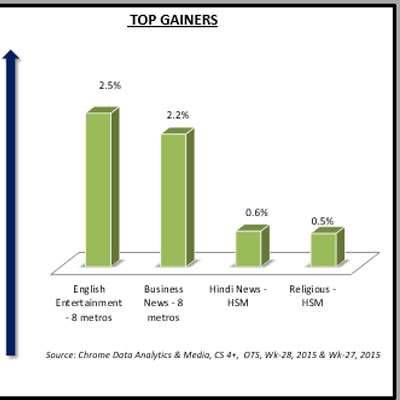
    MUMBAI: In the news over last few weeks, the English entertainment sector observed ascend in Chrome’s opportunity to see (OTS) analysis for eight metros. The sector registered 2.5 per cent increase and emerged as top gainer of week 28.


    On the other hand, English business news with 2.2 per cent gain in eight metros booked the second berth in the list of top gainers. Hindi news and religious genre with 0.5 per cent and 0.4 per cent gain grabbed third and fourth berth respectively.


    Meanwhile, the top loser category irked many as last week’s top gainer English news genre became top loser for week 28 in Chrome’s list. The genre lost 4.2 per cent OTS in eight metros, whereas the sports sector witnessed 3.9 per cent decline in All India Market. Music genre registered a decline of 0.9 per cent in HSM and was placed in third slot whereas kids genre saw another 0.5 per cent decline in all India market and was spotted in fourth berth.


    Zee TV with 95.4 per cent availability in HSM jointly led the tally of GECs with DD National, which also garnered the same percentile. Colors with 94.6 per cent OTS held the second position. Comedy Central from the top gainers English entertainment category led the tally with 52 per cent OTS.


    Times Now with 72 per cent led the lot of English News channel category followed by NDTV 24×7 with 69.9 per cent OTS.

  • TAM fortifies mobile app with version 2.0

    TAM fortifies mobile app with version 2.0

    MUMBAI: TAM Media Research, which launched its TV viewership app version 1.0 last year, has now packed a punch with the upgraded version 2.0 of the app.


    This new version is fortified with added data sets and customised user friendly features that will make the mobile consumption of TAM’s TV viewership data easier. Some of the new features of version 2.0 are as follows: TV viewership data in GRPs, TVRs for unique TV programmes and data for new two markets – Assam and Orissa. Additionally, this new version can be subscribed for by one and all.


    The TAM India mobile app has set a trend of facilitating speedy, on-the-go access of weekly top line TAM TV viewership data for all TAM subscribers across advertiser, media agency and TV broadcaster categories.


    TAM Media Research CEO LV Krishnan said, “We set a trend last year when we provided this mobile app facility to industry users. We have received tremendous response during the last one year. Version 2.0 is a fortified version that will allow not only existing but even new users to enjoy the benefits. The purpose behind this mobile app, very simply, is to enable users to access viewership information anytime, anywhere on the go so that they can take informed business decisions at the spur of the moment.”


    Highlights of TAM mobile app version 2.0:


    ·         GRP numbers: The new version will have TV viewership GRP data sets for all markets and all genres along with existing data points (GVT, Reach & Relative Shares).


    ·         TVR Data: Along with TVTs for the programmes, TAM India mobile app 2.0 will provide TVR for top unique programmes.


    ·         Addition of Markets: As compared to the earlier version, TAM India mobile app 2.0 will have data sets for Assam and Orissa along with the existing seven markets (Maharashtra, Andhra Pradesh, Karnataka, Kerala, Tamil Nadu, West Bengal and PHCHP).


    ·         Modified TG: Every genre and market will have a TG as per the requirements of each section.


    ·         Modified graphical representation: TAM India mobile app 2.0 will have graphs representing weekly data instead of the earlier format of four weeks average.


    ·         New pay version: TAM India mobile app 2.0 will be accessible even to the non-TAM subscribers at a minimal subscription cost.


    The mobile app will be updated every Thursday immediately after the regular release of TAM data to the industry.