Category: Viewership

  • BARC week 36: Colors clinches No 1 spot; topples Star Plus again

    BARC week 36: Colors clinches No 1 spot; topples Star Plus again

    MUMBAI: The race for the top slot between Hindi general entertainment channels (GECs) Star Plus and Colors continues. 


    In week 36 of Broadcast Audience Research Council (BARC) India ratings, Colors has yet again pipped Star Plus to gain the numero uno spot. It may be recalled that while in week 34 Colors made history by becoming the number one channel, in week 35, Star Plus managed to regain its lead position.


    In week 36, Colors lead the Hindi GEC brigade with 386518 (000Sums) followed by Star Plus in second position with 370135 (000Sums). Both channels witnessed an increase in rating points from the previous week where Colors had 354956 (000s Sum), while Star Plus had 355269 (000s Sum).


    On the other hand, Zee TV with 263194 (000Sums) held the third slot, whereas Life OK secured fourth position with 207606 (000Sums). Sab was at the fifth position with 177268 (000Sums) in week 36.


    Like last week, Zee TV’s Kumkum Bhagya led the chart of the top five Hindi GECs programmes with 7264 (000Sums) followed by Colors’Meri Aashiqui Tum Se Hi at the second slot with 6184 (000Sums). Star Plus’ Saath Nibhaana Saathiya secured third place with 5782 (000Sums), whereas Colors’ Swaragini and Udaan held fourth and fifth position with 5739 (000Sums) and 5643 (000Sums) respectively.


    In the kids segment, Nick led the pack with 46651 (000Sums) followed by Pogo and Cartoon Network in second and third slot 37138 (000 Sums) and 34556 (000Sums) respectively.


    Ten Sports continued to hold the top slot in the sports genre with 30850 (000Sums). Star Sports 1 secured the second berth with 15461 (000Sums), while Sony Six was in third slot with 13764 (000Sums).


    Amongst the English News channels, in first slot was Times Now with 511(000Sums), followed by NDTV at the second slot with 220 (000Sums), while CNN IBN with 165 (000 Sums) held the third position.


    With no change in position this week, Big Magic Ganga in the Bhojpuri genre led the tally with 4661 (000Sums) followed by ETV Bihar Jharkhand in the second spot with 1795 (000Sums) and Dangal TV in the third slot  with 1647 (000Sums).

  • TV viewers in Europe not averse to short ads if content is free: research

    TV viewers in Europe not averse to short ads if content is free: research

    NEW DELHI: This is something that could bring some cheer to the Indian television news channels fighting to remove any cap on advertising.


    A study by a British research firm in the United Kingdom, France and Germany has shown that over four in ten people say they expect advertising if the content is free.


    Another 12 per cent reported ‘there’s nothing wrong with ads’ and some respondents even said they enjoyed ads.


    Brightcove commissioned Vanson Bourne to interview around 4000 viewers last month on the same. 


    When asked for their opinion on the current state of advertising, 41 per cent of respondents cited advertising as a ‘nuisance’, but many were realistic about the necessity of ads. However, 39 per cent of viewers wanted the ads to be shorter, another 31 per cent wanted to be able to fast-forward through them and one in ten said they should be more targeted.


    Based on this research, to really ensure optimal ad engagement, broadcasters need to be mindful of the type of advertising they are serving to the type of audience who is viewing it, taking extra care to consider the length of the ad in relation to the content itself and the relevancy of that ad to the content being consumed.


    The study also showed that with new types of video services competing for viewers’ time, traditional players must respond to survive, according to Brightcove mobile business marketing director Tracy Williams.


    The study showed that viewers remain markedly loyal to traditional television and rank it very important to their lives; cross-platform services are a near requirement as four in ten viewers watch on multiple screens; online video content is being viewed throughout the day, including in the morning; and viewers are surprisingly realistic about the role of ads, particularly when in exchange for free content.


    Expectations are extremely high and broadcasters serve disparate audiences, grouped in this report into four notable segments. In fact, more than seven in ten (71 per cent) of European viewers surveyed said there is still a lot of room for improvement across content choices.


    More than half (51 per cent) of the viewers said that television is either important or really important to their life and over two-thirds (67 per cent) of respondents described themselves as loyal watchers of television programmes. Around 24 per cent said they are ‘hugely passionate’ about TV.


    Thus, while television is still important for European audiences, technical innovation is altering how they consume broadcast content. Moving from the choice of just a few channels in the 1950s and 60s, through to satellite and later digital TV, viewers can now pick from a huge range of live channels and on-demand content (both linear or online) and watch what they want, where they want and whenever they want.


    About 75 per cent viewers prefer PC or laptops, over a third are now using mobile (33 per cent) and around 34 per cent use tablets to view video content, highlighting the continued need for high-quality cross-platform services.


    Content owners who do not invest in delivering the complete service that viewers expect risk low adoption rates and loyalty to their services. Four in ten (41 per cent) European viewers use more than one screen when watching video content. This consumer behaviour adds both an opportunity and a risk for broadcasters – an opportunity to create interactions across both screens (through social channels, for example), and a risk through added competition for attention from the second screen.


    The study also indicated that online video content is now being consumed round the clock.. On average, the evening period is still peak time with over half (55 per cent) of all viewing taking place then. However, daytime (24 per cent), overnight (15 per cent) and morning (six per cent) viewing are catching up. 

  • Star Plus back to its first position in BARC week 35

    Star Plus back to its first position in BARC week 35

    MUMBAI: Star Plus has got back to its numero uno position in the Hindi general entertainment channel (GEC) genre, according to Broadcast Audience Research Council (BARC) India ratings in week 35.


    Star plus recorded 355269 (000s Sum) followed by Colors with 354956 (000s Sum), which got back to the second spot after enjoying the leadership position for a week.


    Zee TV and Life OK held the third and fourth position with 251608 (000s Sum) and 195705 (000s Sum) respectively.  Sab grabbed the fifth position with 187473 (000s Sum).


    Zee TV’s prime time show Kumkum Bhagya topped the list in top five GEC programme  with 6922 (000s Sum) followed by Colors’ Meri Aashiqui Tum Se Hi in second slot with 5742 (000s Sum). Colors’ another prime time show Sasural Simar Ka bagged the third position with 5557(000s Sum) and Star Plus’ Saath Nibhaana Saathiya secured the fourth position with 5552(000s Sum). In the fifth slot was Colors’ Swaragini which secured 5513(000s Sum).


    In kids genre, Nick led the chart with 49501(000s Sum) followed by Cartoon Network in the second slot with 39151(000s Sum) and Pogo with 34603(000s Sum) in the third spot.


    Sony Six has topped the chart again in the sports genre with 54895(000s Sum) followed by Ten Sports and Star Sports in the second and third space with 34361(000s Sum) and 9822 (000s Sum) respectively in week 35.


    In the English news channel genre, Times Now continued to lead the chart with 479(000s Sum). NDTV and India Today Television secured the second and third berth with 247(000s Sum) and 143(000s Sum) respectively.


    Big Magic Ganga led the chart with 5127 (000s Sum) in Bhojpuri genre. ETV Bihar Jharkhand and Dangal TV followed in the second and third slot with 2453 (000s Sum) and 1622(000s Sum) respectively.  

  • Chrome DM launches Bangladesh operations; to track overseas viewership

    Chrome DM launches Bangladesh operations; to track overseas viewership

    MUMBAI: Chrome Data Analytics & Media has launched Chrome Bangladesh Track, an exhaustive viewership and channel availability audit. With this, Chrome Data has become the first Indian distribution and audit firm to take an initiative towards tracking viewership and channel availability overseas.

    The Chrome Bangladesh Track report will contain vital indicators, specifically designed to provide channels with a holistic view of their performance, namely; performance index, distribution details, distribution summary, neighborhood analysis, OTS summary and weekly highlights enabling broadcasters to obtain data about the visibility of their channels.

    This strategic tool will cover 28 major cities of Bangladesh enabling broadcasters to view their own distribution status, as well as that of their competitive sets, across all key markets, at a head-end level. As a result, complete transparency in the system can be witnessed, allowing broadcasters to take immediate corrective distribution measures.

    Chrome Data Analytics & Media founder & CEO Pankaj Krishna said, “Preparations for commencement of Chrome Bangladesh Track have been in full swing since January, 2015. The team has worked relentlessly over the last eight months, to tap a new territory, which now takes Chrome DM to an international level, in line with our mission statement – to become the most respected media audit and intelligence company in India and globally, creating a substantial stakeholder value, through continuous improvement driven by the integrity, teamwork and innovative approach of its’ people.”

    Bangladesh is the world’s eighth most populous country with over 160 million people and is among the most densely populated countries. Making effective use of its concrete infrastructure of 150+ field staff, 50+ managerial staff and 125+ tele-callers speaking 22+ Indian languages, at par with their proprietary tools, Chrome DM will map 4.5 million households, on a monthly basis, in Bangladesh.

    Out of 182 channels available in Bangladesh, the majority (66 per cent) is made up of Indian channels:

    Genre-wise channel list:

    Also highlighted in the first top lines of Chrome Bangladesh Track, broadcaster’s can obtain data about the visibility of their channels. Currently, the channels that are most available in Bangladesh’s prime band are ATN Bangla, BTV, BTV World, NTV and Channel I. With regards to Indian origin channels, the most available channels in the prime band are Star Plus, Star Jalsha, Zee Bangla, Max and Sony.

  • TAM TV Ratings: Star Plus gains in week 36

    TAM TV Ratings: Star Plus gains in week 36

    MUMBAI: After witnessing continuous drop in ratings for a few weeks, Hindi general entertainment channel (GEC) Star Plus has registered a rise in the week 36 of TAM TV ratings. 


    Maintaining its top spot, Star Plus garnered 218 GRPs as against the 211 GRPs in week 35.


    With no change in the rankings, Colors remained at the second spot with 210 GRPs as against the 208 GRPs it registered the previous week.


    Zee TV at number three saw a hike in its ratings. The channel while had registered 148 GRPs in week 35, went up to 158 GRPs in week 36.


    Sab at the fourth spot recorded 131 GRPs, followed by Life OK with 108 GRPs. Sony Entertainment Television with 102 GRPs stayed at number six.


    &TV acquired the seventh position with 58 GRPs as against 56 GRPs in week 35.


    Amongst the top five programmes were Zee TV’s prime time show Kumkum Bhagya which led the chart with 4.09 TVR followed by Colors’ prime time show Meri Aashiqui Tum Se Hi  in the second slot with 3.75 TVR. In the third and fourth slot were Colors’ Swaragini and Chakrawartin Ashoka Samarat with 3.57 TVR and 3.29 TVR respectively.  Star Plus’ Yeh Hai Mohabbatein grabbed the fifth position with 3.25 TVR.


  • BARC India to roll out rural data; calamities on news most watched

    BARC India to roll out rural data; calamities on news most watched

    MUMBAI: Even as the Broadcast Audience Research Council (BARC) India is planning to roll out its rural India data, it has been noted that natural calamities, sudden deaths and political outrage remains the most watched content on news channels in India. A recent analysis of BARC India found Nepal earthquake as the first topic to boost news channels’ ratings since its inception.


    Between week 16 to 20, the coverage of first earthquake in Nepal reached over 800 (000s Sum) and gradually declined to over 500 (000s Sum). During the same period, the Salman Khan trial saga was on. The day he was sent to jail saw news channels garnering over 600 (000s Sum), his bail day was not far behind as the coverage helped news channels garner over 500 (000s Sum). The coverage of the second earthquake in Nepal observed close to 700 (000s Sum).


    Those numbers seemed to be innocuous when the ratings of Missile man Abdul Kalam’s last rite coverage came out. The sudden demise of the former president forced every Indian to tune in to news channels. Yakub Memom’s hanging also took place at the same time, whereas the Gurdaspur terror attack took place just before that. All these incidents resulted in high viewership on news channels, the number went up to as high as 3000 (000s Sum) in All India 1 lakh + market.


    The analysis also proves Times Now’s reliance on its editor-in-chief and news president Arnab Goswami. His three days of leave resulted in a 60+ per cent decline in the channel’s ratings. What’s more, during that period other channels successfully managed to up their ratings too. 


    On the other hand, currently the number one channel in General Entertainment Channels (GEC) category – Colors also faced a major setback after funny man Kapil Sharma’s departure. While the channel lost one in three eyeballs, it strategically uplifted the scenario and is currently in the numero uno spot.


    The line between India and Bharat is blurring with time as brands are no longer satisfied with urban figures and hence rural numbers are gaining importance. 


    Based on this insight, BARC is also considering the roll out of its rural data soon. 


    The rural analysis done so far shows:          


    · Consumer durables are growing at 25 per cent CAGR while All India is 17 per cent.

    · Tele Density is 50 per cent while all India is 76 per cent.

    · More than 80 per cent of the FMCG products posted faster than in Urban.

    · FMCG consumption grew at 12.5 per cent during 2013 – 14. All India accounts for 50 per cent of rural spending.

    · Rural markets are found to be bigger in many categories.

    · 36 per cent of mobile app users are from Rural India.

    · Rural India shows 75 per cent growth when it comes to TV households, while Urban growth rate is 20 per cent.

    · Rural India is estimated to have 75 million TV owning households.

    · 30 minutes gross impressions goes up 2.5 times with the inclusion of Rural India.

    · Average reach goes up by three times with the inclusion of Rural.


    From marketing strategy to prime time shift, after BARC India starts rolling out rural data there can be many a paradigm shifts. Also it remains to be seen if broadcasters rope in content to make a mark in Rural India’s minds.

  • BARC week 34: Colors topples Star Plus to capture numero uno slot in Hindi GECs

    BARC week 34: Colors topples Star Plus to capture numero uno slot in Hindi GECs

    MUMBAI: Toppling the market leader Star Plus in the Hindi general entertainment channels (GECs) genre, Colors secured the leadership position in week 34 with 360494 (000 Sums), according to the Broadcast Audience Research Council (BARC) India ratings.


    Star Plus stood at the second spot with 359509 (000 Sums). On the other hand, Zee TV and Life OK held the third and fourth position with 264237 (000 Sums) and 224264 (000 Sums) respectively.  Sab grabbed the fifth position with 186090 (000 Sums) in week 34.  


    Zee TV’s prime time show Kumkum Bhagya topped the list with 6576 (000 Sums). Four of Colors’ shows made it to the top five chart in week 34. While Sasural Simar Ka grabbed the second position with 5438 (000 Sums), Meri Aashiqui Tum Se Hi with 5365 (000 Sums) was in the third slot. Swaragini and Udaan secured fourth and fifth place with 5300 (000 Sums) and 5243 (000 Sums) respectively. 


    With no change of the position in sports genre, Ten Sports’ continued to top the chart with 640272 (000 Sums) followed by Sony Six in the second slot with 370673 (000 Sums) and Ten Cricket in the third slot with 8998 (000 Sums). 


    In the kids segment, Nick led the pack with 47180 (000 Sums) followed by Pogo TV with 39480 (000 Sums) on second position and Cartoon Network secured the third position with 31445 (000 Sums). 


    In the English news broadcast segment, Times Now continued to rule the roost and secured first position with 431 (000 Sums). On second and third slot respectively were News 9 with 208 (000 Sums) and India Today Television with 160 (000 Sums).

    On the other hand, Big Magic Ganga, in Bhojpuri section led the list with 4371 (000 Sums) followed by ETV Bihar Jharkhand on second berth with 1460 (000 Sums) and Dangal TV in third space with 954 (000 Sums).  

  • TAM week 35: Sab only gainer as other Hindi GECs see a dip

    TAM week 35: Sab only gainer as other Hindi GECs see a dip

    MUMBAI: In week 35 of TAM Media Research ratings, Hindi general entertainment channel (GEC) Sab was the only gainer in the genre. Other Hindi GECs including Star Plus, Colors, Zee TV, Sony and others witnessed a dip in the ratings.


    This is the third week wherein Star Plus witnessed a fall in ratings, scoring 211 GRPs, as against the 236 GRPs it bagged in week 34. However, the channel maintained its top slot. Colors with 208 GRPs stands at the second slot. The channel in week 34 had recorded 221 GRPs.


    In the third slot, Zee TV witnessed a marginal decrease. The channel recorded 148 GRPs in week 35 as against 156 GRPs in week 34.


    Sab, at the fourth spot, was the only gainer in week 35 and garnered 130 GRPs in comparison to week 34 where the channel recorded 127 GRPs.


    Life OK secured fifth position with 116 GRPs in week 35, while Sony Entertainment Television and &TV managed to hold the sixth and seventh position with 101 GRPs and 56 GRPs respectively.


    Amongst the top five shows for the week were Zee TV’s Kumkum Bhaygya that secured the fist position with 3.8 TVRs followed by Colors’ Meri Aashiqui Tum Se Hi with 3.7 TVRs in second slot. The channels’ another prime time show Swaragini grabbed the third spot with 3.63 TVRs.  In fourth position was Star Plus’ Ye Hai Mohabbatein which registered 3.28 TVRs while Colors’ Sasural Simar Ka managed to grab the fifth berth with 3.11 TVRs.          

  • TAM-BARC India JV: The King is dead, long live the King

    TAM-BARC India JV: The King is dead, long live the King

    MUMBAI: Merely four months after the new television ratings measurement body Broadcast Audience Research Council (BARC) India entered the fray, the battle of matrices saw a happy ending today (27 August) as Television Audience Measurement (TAM) gracefully bowed out of the ratings race.

    Seeing more wisdom in forming a joint venture with its now erstwhile competitor BARC India, TAM joined hands with it to form a meter management company.

    Industry Cheers Move

    The move has brought much cheer from the industry as this means a unified single ratings sans any confusion week on week. Moreover, this move will benefit broadcasters and advertisers alike.

    Indiantelevision.com spoke to multiple industry stakeholders to get their first reactions on the coming together of TAM and BARC India. Here’s what they had to say:

         Viacom18 Group CEO Sudhandhsu Vats

         “It’s very good news for the Indian broadcasting industry. With BARC consolidating all the video audience measurement assets, we are happy       that stakeholders will have a greatly improved view on reach and impact. The aggregation of people meters and panel management powered by       BARC’s technology gives us an effective measurement system that expedites the solution on geographical coverage, sample size, and rural-           urban reporting.” 

    ZEEL MD and CEO Punit Goenka  

    “This partnership is a big step forward and in this era of cooperation, we welcome this move forward as a joint industry body. The technology and methodological prowess of BARC, combined with the extra meters and the field force will definitely help the industry progress.”

    R K Swamy Hansa Group chairman Srinivasan K Swamy

    “It’s a good development. It has become a larger sample and a more robust study. The techcom is strong in BARC and I am sure they will seamlessly integrate the inputs from two sources to great advantage.”

    Times Network CEO and MD M K Anand  

    “It’s a great move. The new system has launched quite well. The usual teething troubles are mostly getting addressed. The lingering presence of the erstwhile measurement system as a shadow was confusing. There have been faint mentions of TAM by clients and that chatter needed to end. With this move, the industry is truly and completely on BARC. The additional boxes and some talent from the older system will surely help in getting to maturity quicker. All in all, a great move for the industry and the two players.”

    Madison World and Madison Communications founder, chairman and MD Sam Balsara

    “This is a step in the right direction and achieves multiple objectives at one stroke:

    1.       It eliminates possible confusion in the market because of 2 currencies

    2.       It enables Barc to scale up cost effectively by putting the additional meters to good and effective use

    3.       It enables Barc to have ready access to trained people in the field

    4.       It ensures that a large number of people don’t go out of their jobs

    There are sufficient checks and balances in place to ensure that Barc in course of time will discharge its responsibilities, honourably.”

     Dentsu Aegis Network South Asia chairman Ashish Bhasin

    “I think it’s great that BARC and TAM have joined forces for the meters because definitely we don’t need two currencies for television ratings and BARC is the officially accepted ratings currency for the industry to use. Moreover, it is also good that the TAM meters will get utilised because that will help speed up the process of scaling to the meters required for BARC, so that the entire country can be quickly covered. We now look forward to robust viewership data, covering the entire country, and are particularly looking forward to rural data commencing soonest.”

    To start with, the new JV company will have 34,000 meters covering all of India, and will supply raw data to BARC, which will use its own statistical processes and sampling design. The details of the formation and roll out of this new company will be shared in the coming weeks.

    After an unrivalled run of almost 17 years in the Indian broadcast space, TAM Media Research, which started its function way back in 1998 with the mandate to work neutrally, will now no longer be rolling out television ratings.

    To say “The King is dead, long live the King” would be an apt proclamation to summarise this latest development.
  • Chrome launches tool to study TV consumption pattern in rural India

    Chrome launches tool to study TV consumption pattern in rural India

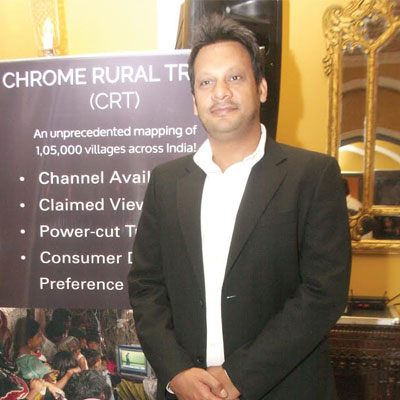
    MUMBAI: India’s TV research and analytics company Chrome DM has launched Chrome Rural Track. Every month, Chrome Rural Track will map 1,05,000 villages across India to study the consumption patterns in television viewing.

    The tracking will involve massive infrastructure of field staff and tele-callers, with knowledge of 22 languages, advanced technology, etc. through use of six proprietary tools.

    The field-work for Chrome Rural Track was initiated in April 2015 and the data compilation for Phase I comprising 25,484 villages is underway. Every month, Chrome Rural Track will encompass channel availability, claimed viewership, power-cut trends and consumer durable preference and ownership (colour TV, LPG stove, ceiling fan, car/jeep/van, two wheeler, refrigerator, washing machine, air conditioner, PC/laptop and agricultural land).

    The tracking will be categorised into four Chrome Rural Strata (CRS) based on population density. CRS 1 will be in villages with population greater than 20,000; CRS 2 between 10,001 – 20,000; CRS 3 between 5,000 – 10,000 and CRS 4 will track villages with population less than 5,000.

    The monthly tracking is aimed to assist the marketers in strategising for rural India. It will also help bring the issues affecting rural India into mainstream discussion, thus bridging the urban-rural divide in social and economical considerations too.

    Chrome DM CEO and founder Pankaj Krishna said, “The size and social-cultural complexity of India’s rural landscape warranted the tracking at such a scale. Despite constituting 69 per cent of the population, rural India remains considerably unmapped across segments. We believe that this is a part of our endeavour to bring rural representation on to the radar. Consumption patterns, consumer preferences and purchasing power of rural areas are significantly different from that of the cities. If we further dissect the data, there are radical differences in consumer behaviour within individual villages. Chrome Rural Track is our attempt to map the diversity that exists in our vast country and provide the industry/decision makers with rural data.”

    He further added, “Along with agriculture and simplicity of life – Rural India is today unfortunately synonymous with racism, gender inequality, honour killings and the highest rates of female foeticide across the globe. There are over 1000 female abortions in day in India. Any happening that does well for a story, genuine or non-serious makes it to the headlines across multiple media; however most of these stories are skewed to happenings in and around metros and urban centres. With the launch of Chrome Rural Track, across an unprecedented 105,000 villages of India, our endeavour is to bring Rural India on to the media radar.”

    Chrome Data Analytics & Media advisory board member Monica Tata asserted, “There is a huge gap in the understanding of India’s rural consumers. Marketers need information that is dissected to a village level across India. With television being the main tool to communicate with consumers, it is critical that the brands have a refined knowledge television viewing. Through Chrome Rural Track, we aim to bridge this gap. This data spanning 105,000 villages will be indispensable for both advertisers and agencies and help them take more informed decisions.”

    Some of the interesting findings from Chrome Rural Track include vast differences in the percentage between Cable, DTH and Terrestrial modes among various states. While 99.1 per cent of Kerala villages, 85.4 per cent of Gujarat villages and 70.3 per cent of Maharashtra villages get TV through cable, 62.4 per cent of villagers in Uttar Pradesh and Bihar access TV through DTH.

    Some of the other interesting findings are mentioned in the following table:

    Source – Chrome Rural Track August 2015

    Terming rural India as virtually a black hole in terms of available information on consumption habits, Chrome Data Analytics & Media member of advisory board Bharat Ranga said, “As part of the Zee Network and responsible for its multiple launches, I have actively used Chrome Data along with the highest levels of analytics. I am sure that Chrome Rural Track will help enhance our content production with a better understanding of rural tastes and lifestyle.”

    Mentioned below is a state-wise comparison of media preferences in rural areas across seven states: