Category: Viewership

  • Sports the most benefitted genre in week 30 of Chrome DM

    Sports the most benefitted genre in week 30 of Chrome DM

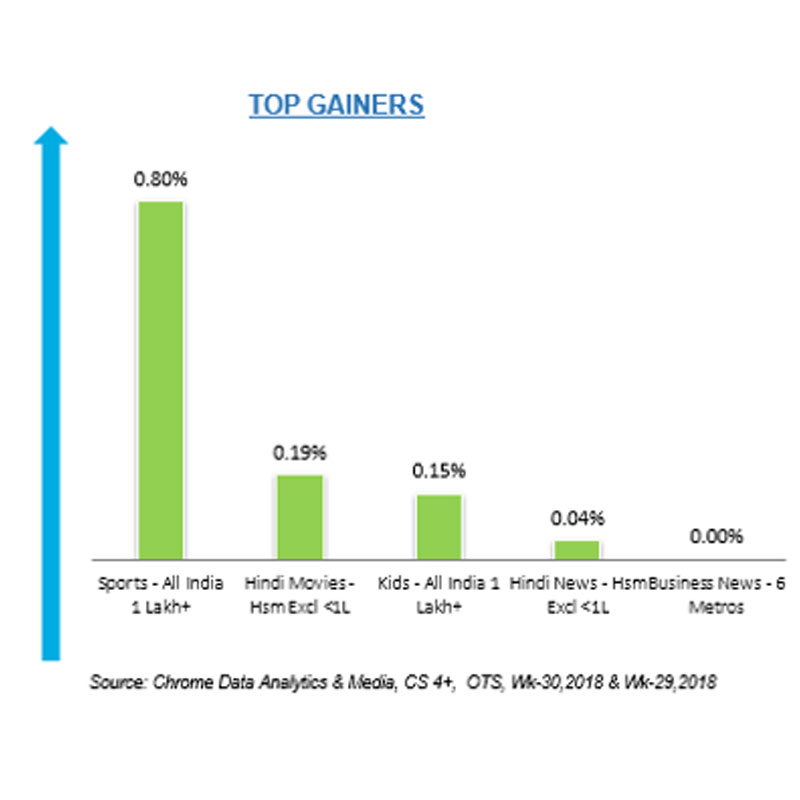
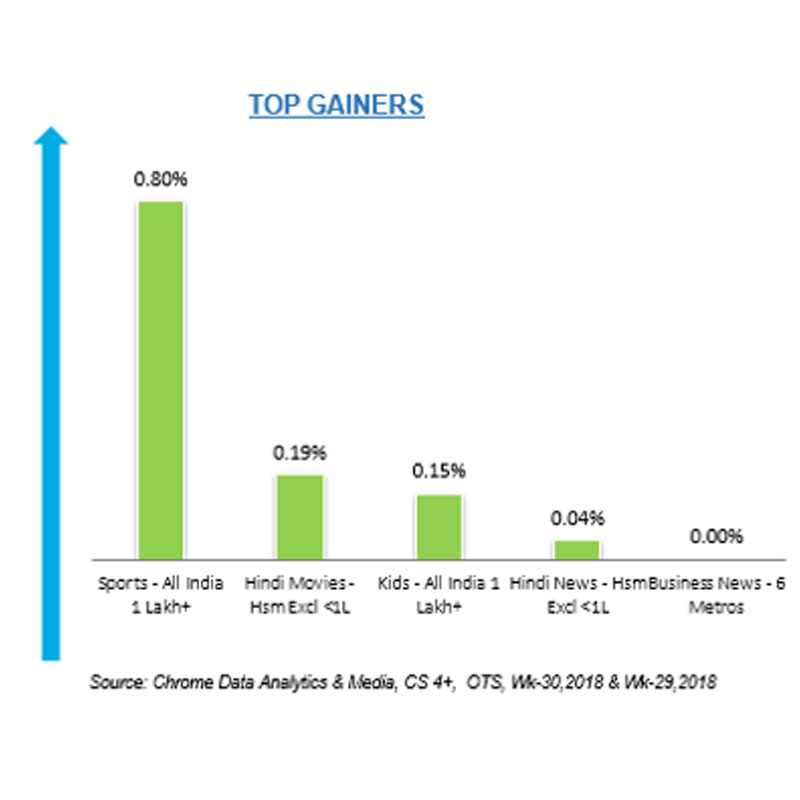
    MUMBAI: With a growth of 0.8 per cent as compared to last week (29), the sports genre marked the highest opportunity to see (OTS) among all categories in week 30 of Chrome Data Analytics & Media.

    In the sports genre, DD Sports gained the highest OTS with 93.6 per cent in All India 1 Lakh+ market.

    The religious genre, which was leading the chart for past two weeks, is nowhere to be seen in top gainers. Last week, the religious genre was the only one present in the top five list because the highest growth was 0.03 per cent.   

    OTS is the actual census-based percentage connectivity of a channel spread across 83 million homes, reported by Chrome DM, across analogue cable, digital cable and DTH. 

    The second position in the gainer’s list of OTS was grabbed by the Hindi movies genre with a growth of 0.19 per cent in HSM excluding the less than 1L-market. UTV Movies was the most benefitted channel in this category with 93.5 per cent.

    public://Top 05 Channels_0.png

    The third position in the gainers was garnered by kids genre in All India 1 lakh+ with 0.15 per cent OTS. Nickelodeon gained the highest OTS with 90.2 OTS.

    The Hindi news genre was at the fourth position in the list with 0.04 per cent growth and ABP News catered to 97.6 per cent OTS in HSM excluding the less than 1L-market.

    public://Top Lines_0.png

    The fifth spot was garnered by business genre with the minimum growth of zero per cent and Zee Business was the most benefitted channel with 86.2 per cent OTS in six metros.

  • Business news the most benefitted genre in week 30 of Chrome DM

    Business news the most benefitted genre in week 30 of Chrome DM

    MUMBAI: With a growth of 0.8 per cent as compared to last week (29), the sports genre marked the highest opportunity to see (OTS) among all categories in week 30 of Chrome Data Analytics & Media.

    In the sports genre, DD Sports gained the highest OTS with 93.6 per cent in All India 1 Lakh+ market.

    The religious genre, which was leading the chart for past two weeks, is nowhere to be seen in top gainers. Last week, the religious genre was the only one present in the top five list because the highest growth was 0.03 per cent.   

    OTS is the actual census-based percentage connectivity of a channel spread across 81 million homes, reported by Chrome DM, across analogue cable, digital cable and DTH. 

    The second position in the gainer’s list of OTS was grabbed by the Hindi movies genre with a growth of 0.19 per cent in HSM excluding the less than 1L-market. UTV Movies was the most benefitted channel in this category with 93.5 per cent.

    public://Top 05 Channels_0.png

    The third position in the gainers was garnered by kids genre in All India 1 lakh+ with 0.15 per cent OTS. Nickelodeon gained the highest OTS with 90.2 OTS.

    The Hindi news genre was at the fourth position in the list with 0.04 per cent growth and ABP News catered to 97.6 per cent OTS in HSM excluding the less than 1L-market.

    public://Top Lines_0.png

    The fifth spot was garnered by business genre with the minimum growth of zero per cent and Zee Business was the most benefitted channel with 86.2 per cent OTS in six metros.

  • Sony Max continues dominance over Hindi channels in across genres

    Sony Max continues dominance over Hindi channels in across genres

    BENGALURU: Sony Pictures Network India (SPN) Hindi Movies channel Sony Max was ranked second in Broadcast Audience Research Council of India (BARC) weekly list of top 10 channels across genres in week 29 of 2018 (Saturday, 14 July 2018 to Friday, 20 July 2018, week udder review). Like during week 28, when it pipped Zee Entertainment Enterprises Limited free to air (FTA) Hindi GEC Zee Anmol to second spot, Sony Max was the most watched Hindi channel during the week under review. The channel was also the most watched channel in BARC’s list of top 5 Hindi Movies channels in the combined urban and rural Hindi speaking market – HSM (U+R), as well is in HSM (U). In HSM (R) Sony Max was ranked fifth in the Hindi Movies genre.

    As is normal, the Sun TV Network’s flagship Tamil GEC Sun TV was ranked first in BARC’s weekly across genres lists in week 29 of 2018. The channel continued for to draw billion plus weekly impressions for the second week in a row.

    Six Hindi GEC, two Hindi Movies and one channel each form the Tamil GEC and Telugu GEC genres made up BARC’s list of top 10 channels across genres during week 29 of 2018. From the networks perspective, three channels each from SPN and Star India, two channels from Zee Entertainment Enterprises Limited (Zeel) and one channel each from the Sun TV Network Limited and Viacom 18 made up BARC’s across genres list for week 29 of 2018.

    Sun TV led the across the genres list in week 29 with 1,071.451 million weekly impressions as compared to 1051.589 million weekly impressions in week 28 of 2018. Sun TV also led BARC’s weekly list of top 5 Tamil channels in the Tamil Nadu and Puducherry market and all the 5 programmes in BARC’s list of top 5 Tamil programmes during primetime in these markets based on average rating across all airings (original and repeat) in the week under review were aired on Sun TV.

    At second rank was Sony Max with 746.904 million weekly impressions in week 29 as compared to 669.742 million weekly impressions in week 28 of 2018. Two Hindi feature films (HFF) that featured on Sony Max – Kanchana 3 and Sarrainodu were among the top 5 most watched Hindi Movies programmes during primetime based on average rating across all airings (original and repeat) in the week in HSM (U+R) and HSM (U). Another HFF-Bhairava was also among the top 5 Hindi Movies programmes during primetime in HSM (U).

    Retaining third place in week 29 was Zeel’s FTA Hindi GEC Zee Anmol with 717.589 million weekly impressions as compared to 653.296 million weekly impressions in week 28 of 2018. Zee Anmol was also ranked first in BARC’s weekly list of top 10 Hindi GECs’ in the combined urban and rural Hindi speaking markets or HSM (U+R) as also in HSM (R). The Balaji Telefilms produced soap Kumkum Bhagya aired on Zee Anmol was ranked  fourth in BARC’s list of top 5 Hindi GEC programmes during primetime based on average rating across all airings (original and repeat) in the week in HSM (U+R) and was ranked first in HSM (R). Another soap from the channel, Mahek, was ranked third in HSM (R).

    Climbing up a rank to fourth place in week 29 of 2018 was Star India’s flagship Telugu GEC Star Maa with 673.849 million weekly impressions as compared to 572.455 million weekly impressions in week 28 of 2018. Star Maa was ranked first in BARC’s weekly list of top 5 Telugu channels in the Andhra Pradesh and Telangana market. Three programmes that were aired on Star Maa were present in BARC’s weekly list of top 5 Telugu programmes during primetime based on average rating across all airings (original and repeat) in the week.

    Moving down one rank to fifth place was Zeel’s flagship Hindi GEC Zee TV with 649.355 million weekly impressions in week 29 of 2018 as compared to 614.840 weekly impressions in week 28. Zee TV was ranked second in BARC’s weekly list of top 10 Hindi GECs’ in HSM (U+R), third in HSM (U) and seventh in HSM (R) during the week. Two programmes that were aired on Zee TV- Kundali Bhagya, a spinoff of Kumkum Bhagya, was ranked second, Kumkum Bhagya was ranked third in HSM (U+R) in BARC’s list of top 5 programmes during primetime based on average rating across all airings (original and repeat) in the week. Kundali Bhagya was also ranked fifth in HSM (R) in BARC’s lists of top 5 Hindi GEC programmes during primetime based on average rating across all airings (original and repeat) in the week. In the HSM (U) market, Kundali Bhagya, Kumkum Bhagya and another soap Ishq Subhan Allah on Zee TV were ranked second, third and fifth respectively during the week under consideration

    Also retaining its previous week’s sixth place with 636.700 million weekly impressions in week 29 of 2018 as compared to 561.361 million weekly impressions in week 28 was Viacom18’s flagship Hindi GEC Colors. Colors was ranked third in BARC’s weekly list of top 10 Hindi GECs’ in HSM (U+R) and was ranked first in HSM (U). Naagin 3  found the top place in BARC’s weekly list of top 5 Hindi GEC programmes during primetime based on average rating across all airings (original and repeat) in the week in HSM (U+R) and HSM (U), while Naagin 3 was ranked fourth in HSM (R).

    Star India’s FTA Hindi GEC Star Bharat also climbed up a rank to seventh place with 598.615 million weekly impressions in week 29 of 2018 as compared to 548.708 million weekly impressions in week 28. Star Bharat was ranked fourth in BARC’s list of top 10 Hindi channels in HSM (U+R) was ranked fifth in HSM (R) and was ranked sixth in HSM (U) in BARC’s weekly list of top 10 Hindi GEC channels during the week under review.

    Re-entering BARC’s weekly list of top 10 channels across genres in week 29 of 2018 at eighth rank was another Star India FTA channel – Star Utsav with 597.617 million weekly impressions. Star Utsav was ranked sixth in BARC’s list of top 10 Hindi GECs’ in HSM (U+R), was ranked second in HSM (R) and was ranked eighth in HSM (U).

    Dropping down two ranks to ninth place in week 29 of 2018 was SPN’s women focused Hindi GEC Sony Pal with 590.263 million weekly impressions as compared to 555.366 million weekly impressions in week 28 of 2018. Sony Pal was ranked fifth in BARC’s weekly list of top 10 Hindi channels in HSM (U+R), was ranked third in HSM (R) and was ranked seventh in HSM (U). The sitcom Tarak Mehta ka Ooltah Chashmah aired on Sony Pal was ranked second in BARC’s list of top 5 Hindi GEC programmes during primetime based on average rating across all airings (original and repeat) in the week in HSM (R).

    At its previous week’s tenth rank was another SPN Hindi Movies channel Sony Wah with 584.938 million weekly impressions in week 29 as compared to 518.879 million weekly impressions in week 28 of 2018. Sony Wah was ranked second in BARC’s weekly list of top 5 Hindi Movies channels in HSM (U+R), first in HSM (R) and fifth in HSM (U) during week 29 of 2018. HFF The Return of Rebel that aired on the channel was ranked third in BARC’s list of top 5 Hindi Movies programmes during primetime based on average rating across all airings (original and repeat) in the week in HSM (U+R)  and was ranked first in HSM (R).

  • Bengali market gross viewership increased in BARC week 29

    Bengali market gross viewership increased in BARC week 29

    MUMBAI: Star continues to rule the south regions – Malayalam and Telugu with channels Asianet and Star Maa, while ZEEL’s regional channels Zee Bangla and Zee Marathi continue to rule their respective languages of Bengali and Marathi with Zee Bangla and Zee Marathi after BARC released its ratings for week 29. This week Colors Bangla didn’t do well and came down to fifth position, but in the Tamil market, Colors Tamil came as a new entrant. There wasn’t much change in the hierarchy for Bhojpuri, Kannada and Tamil with Big Ganga, Colors Kannada and Sun TV retaining their top slots.

    Bangla

    Zee Bangla continued to be placed in number one position in week 29 with an increase in viewership from 276815 impressions (000s) as recorded last week to 306953 impressions (000s) this week. Star Jalsha too remained in the second slot with 299539 impressions (000s) followed by Jalsha Movies, who maintained its third slot with 74170 impressions (000s). Colors Bangla and Aakash Aath exchanged their fourth and fifth positions this week with 56003 impressions (000s) and 59257 impressions (000s) respectively. This week, all channels in this market saw an increase in the viewership as compared to last week.

    Bhojpuri

    This week, Big Ganga managed to gain the highest number of viewership with 47281 impressions (000s), while Bhojpuri Cinema came second with 45442 impressions (000s), followed by Bhojpuri Dhamaka Dishum with 7230 impressions (000s). Mahuaa Plus climbed to fourth position from fifth with 2333 impressions (000s). Oscar Movies Bhojpuri came as a new entrant this week with impressions 1908 impressions (000s).

    Kannada

    Kannada region remained unchanged this week as well. Colors Kannada retained its top position but saw a decrease in viewership from 414372 impressions (000s) as recorded last week to 403690 impressions (000s) of this week. Zee Kannada and Star Suvarna retained their second and fifth positions with 382100 impressions (000s) and 151063 (000s) respectively. Udaya Movies and Udaya TV swapped their third and fourth positions this week with 228477 impressions (000s) and 2237431 impressions (000s) respectively.

    Malayalam

    Asianet, the Malayalam general entertainment channel of Star TV retained its first position this week as well with 299541 impressions (000s). Flowers TV got dragged down to fourth position from second position with 85860 impressions (000s) while Mazhavil Manorama crawled up to second position with 90247 impressions (000s). Surya TV and Asianet Movies retained their third and fifth positions this week with 86420 impressions (000s) and 75016 (000s) impressions respectively.

    Marathi

    This week, the Marathi market didn’t notice any change. Zee Marathi remained steadfast in the number one position with 279070 impressions (000s). Zee Talkies gained second position with 154940 impressions (000s) followed by Colors Marathi, Star Pravah and Zee Yuva in third, fourth and fifth positions with 145457 impressions (000s), 116852 impressions (000s) and 59103 impressions (000s) respectively. This week all the channels in this market saw an increase in viewership.

    Tamil

    Tamil market saw a slight change this week. Star Vijay, Zee Tamil and KTV retained their second, third and fourth positions with 496816 impressions (000s), 447840 impressions (000s) and 320731 impressions (000s). Sun TV retained its top position with a gross viewership of 1004673. This week Colors Tamil gained fifth position dethroning Sun Life with 78973 impressions (000s).

     Telugu

    Telugu region didn’t notice any change this week. Star Maa, Zee Telugu, ETV Telugu and Gemini TV retained their first, second, third and fourth positions with total viewership of 630131 impressions (000s), 545142 impressions (000s), 490403 impressions (000s) and 424919 impressions (000s) respectively. Gemini Movies also retained its fifth position with 200644 impressions (000s). This week all the channels in this region saw an increase in their gross viewership.

  • BARC week 29:  Zee News replaces News18 India in Hindi news rural

    BARC week 29: Zee News replaces News18 India in Hindi news rural

    MUMBAI: The Broadcast Audience Research Council data for week 29 showed Republic TV continuing to dominate the English news genre, whereas Aaj Tak led in Hindi genre. Zee News replaced News18 India in Hindi news Rural.

    English News

    Arnab Goswami’s Republic TV stood unbeaten at top position in English news genre with 1057 impressions (000s) sum as compared to 777 impressions (000s) last week. Times Now found itself at second position with 970 impressions (000s) sum, followed by India Today Television at third position  with 293 impressions (000s) sum. Mirror Now and CNN News 18 maintained their fourth and fifth positions with 265 impressions (000s) and 201 impressions (000s) sum.

    English Business News

    CNBC TV18 maintained its top position with 673 impressions (000s) sum as compared to 537 impressions (000s) sum last week. ET Now is in second position with 212 impressions (000s) sum.  BTVI and CNBC TV 18 Prime HD maintained their third and fourth positions with 77 impressions (000s) sum and 16 impressions (000s) sum.

    Hindi News (U+R)

    Aaj Tak stood at first position with 150333 impressions (000s) sum as compared to 125034 impressions (000s) sum last week. Where as  Zee News is at second position  with 103078 impressions (000s) sum, followed by India TV at third position with 101256 impressions (000s) sum. ABP News stepped down to fourth position with 94355 impressions (000s) sum as compared to 85738 impressions (000s) sum last week. News18 India maintained its fifth position with 93105 impressions (000s) sum.     

    Hindi News Rural

    Aaj Tak continued to dominate in Hindi news (R) with 69245 impressions (000s) sum as compared to 54097 impressions (000s) sum last week. ABP News maintained its second position this week with 45859 impressions (000s) sum. India TV is at third position with 39560 impressions (000s) sum. Zee News replaced News18 India at fourth position with 39264 impressions (000s) sum. News Nation stepped down to fifth position with 38263 impressions as compared to 32969 impressions (000s) sum last week.

    Hindi news urban

    Aaj Tak maintained its top position in Hindi news genre (U) with 81078 impressions (000s) sum as compared to 70936 impressions (000s) sum last week.  Zee News maintained its second position with 63814 impressions (000s) sum, followed by India TV and News18 India at third and fourth positions with 61697 impressions (000s) sum and 54989 impressions (000s) sum. ABP News maintained its fifth position with 48496 impressions (000s) sum.

  • TV homes up by 7.5%, total TV viewership up by 12%

    MUMBAI: The Broadcast Audience Research Council of India (BARC) has released the findings of its Broadcast India (BI) 2018 Survey, based on a sample study of 3 lakh homes in the country. As per the latest findings, TV homes in the country has seen a 7.5 per cent jump, outpacing the growth of homes in India which grew at 4.5 per cent.

    India currently boasts of 298 million homes, of which 197 million have a TV set, having an opportunity of almost 100 million more TV homes in the country. 

    Two big takeaways from BI 2018 survey is the rise of the middle class and the increase in the number of flat TV screens. As per the survey, with 123 million TV homes belonging to the middle class, NCCS B & C accounts for 63 per cent of TV homes in India.

    Together NCCS ABC or the affluent TV owning homes form 84 per cent of TV homes in the country. The fact that homes falling under the low-socio economic class (NCCS D/E) have seen a 13 per cent drop, highlights the improving disposable income of an Indian home and is in line with the rising economic growth and prosperity.

    BARC India CEO Partho Dasgupta said, “With BI 2018 we have been able to showcase the changing face of India. However, what hasn’t changed is the fact that TV remains the most effective platform for both content creators and advertisers to reach their audiences. This years’ survey is also special to us since we have been able to bring it in-house. We have been investing heavily on technology and talent and moving this almost entirely in-house is a proof of our capabilities.”

    Some interesting trends that have emerged with BI 2018 Survey are:

    ·   Number of TV viewing individuals grew by 7.2 per cent to 836 million from the previous 780 million. However, viewership increase in week 29 vs Previous 4 weeks is 12 per cent.

    ·   TV homes in urban and rural India grew by 4 per cent and 10 per cent respectively. Viewership uptake in urban India is 10 per cent, while that in rural India is 13 per cent. 

    ·   The average time spent (ATS) by TV viewing individuals too has seen a 3 per cent growth and currently stands at 3 hours 44 minutes. This is driven by urban which has seen an increase of 5 per cent in ATS (4 hours 06 min), ATS in rural India has grown by 2 per cent and stands at 3 hours 27 minutes.

    ·   Both HSM and South markets have seen a spike in viewership. HSM saw an increase of 12 per cent, while South grew by 10 per cent in week 29. 

    ·   The male-female split of TV owning individuals as per BI 2018 is: 429 million-407 million. Male viewers grew by 6.9 per cent, while female viewers saw a growth of 7.5 per cent over BI 2016. 

    ·   In terms of viewership, in week 29, male viewership has seen a 11 per cent growth, while female viewership has increased by 12 per cent.

    ·   Viewership contribution of the affluent class (NCCS AB) grew by 15 per cent.

    ·   The daily TV tune-ins in week 29 saw a healthy growth of 8 per cent and currently stands at 614 million viewers. The previous 4-week average was 569 million viewers. 

    “As for the trends, BARC India has maintained that India is a country which is driven by family viewing and this shows in the increase in the number of TV households. With a penetration of just 66 per cent, there is still a huge scope of growth in the space,” Dasgupta added. 

  • BARC India: TV homes up by 7.5%, total TV viewership up by 12%

    BARC India: TV homes up by 7.5%, total TV viewership up by 12%

    MUMBAI: The Broadcast Audience Research Council of India (BARC) has released the findings of its Broadcast India (BI) 2018 Survey, based on a sample study of 3 lakh homes in the country. As per the latest findings, TV homes in the country has seen a 7.5 per cent jump, outpacing the growth of homes in India which grew at 4.5 per cent.

    India currently boasts of 298 million homes, of which 197 million have a TV set, having an opportunity of almost 100 million more TV homes in the country. 

    Two big takeaways from BI 2018 survey is the rise of the middle class and the increase in the number of flat TV screens. As per the survey, with 123 million TV homes belonging to the middle class, NCCS B & C accounts for 63 per cent of TV homes in India.

    Together NCCS ABC or the affluent TV owning homes form 84 per cent of TV homes in the country. The fact that homes falling under the low-socio economic class (NCCS D/E) have seen a 13 per cent drop, highlights the improving disposable income of an Indian home and is in line with the rising economic growth and prosperity.

    BARC India CEO Partho Dasgupta said, “With BI 2018 we have been able to showcase the changing face of India. However, what hasn’t changed is the fact that TV remains the most effective platform for both content creators and advertisers to reach their audiences. This years’ survey is also special to us since we have been able to bring it in-house. We have been investing heavily on technology and talent and moving this almost entirely in-house is a proof of our capabilities.”

    Some interesting trends that have emerged with BI 2018 Survey are:

    ·   Number of TV viewing individuals grew by 7.2 per cent to 836 million from the previous 780 million. However, viewership increase in week 29 vs Previous 4 weeks is 12 per cent.

    ·   TV homes in urban and rural India grew by 4 per cent and 10 per cent respectively. Viewership uptake in urban India is 10 per cent, while that in rural India is 13 per cent. 

    ·   The average time spent (ATS) by TV viewing individuals too has seen a 3 per cent growth and currently stands at 3 hours 44 minutes. This is driven by urban which has seen an increase of 5 per cent in ATS (4 hours 06 min), ATS in rural India has grown by 2 per cent and stands at 3 hours 27 minutes.

    ·   Both HSM and South markets have seen a spike in viewership. HSM saw an increase of 12 per cent, while South grew by 10 per cent in week 29. 

    ·   The male-female split of TV owning individuals as per BI 2018 is: 429 million-407 million. Male viewers grew by 6.9 per cent, while female viewers saw a growth of 7.5 per cent over BI 2016. 

    ·   In terms of viewership, in week 29, male viewership has seen a 11 per cent growth, while female viewership has increased by 12 per cent.

    ·   Viewership contribution of the affluent class (NCCS AB) grew by 15 per cent.

    ·   The daily TV tune-ins in week 29 saw a healthy growth of 8 per cent and currently stands at 614 million viewers. The previous 4-week average was 569 million viewers. 

    “As for the trends, BARC India has maintained that India is a country which is driven by family viewing and this shows in the increase in the number of TV households. With a penetration of just 66 per cent, there is still a huge scope of growth in the space,” Dasgupta added. 

  • Chrome DM services help optimise viewership ratings: Pankaj Krishna

    Chrome DM services help optimise viewership ratings: Pankaj Krishna

    As you walk into the Chrome Data Analytics & Media’s office on the outskirts of Delhi, you see the company chief executive Pankaj Krishna ‘talking to himself’ in the wide-glass paned conference room. Only after being ushered in, you realise, he’s actually holding a business conversation with his colleague in the Mumbai office whose live images also appear on the big TV screen placed in the room. “This connection is always ‘live’ so any issue can be discussed asap,” he informs languidly, pushing back the chair’s backrest to the maximum.

    For a technology-driven market research and advisory firm with a pan-India on-ground presence and a list of clients that include Indian and global companies, apart from a prominent political party, Krishna looks less like a chief executive and more like a person out on a beach holiday. His hair pulled back in a casual pony-tail, and clad in a stylishly crumpled linen shirt, cotton trousers and kohlapuri chappals, he seems out of place in an office that’s buzzing with activity and some serious data analytics. “Just returned to office some time back after being up the whole night in the office with the masons, plumbers, etc. trying to get the main washroom relocated and refurbished according to Vaastu (the Indian system of architecture),” the man offers an explanation apologetically. Huh!!?? Probably, that’s also an indication of the nature of the person that he likes to get involved in even the smallest details of business.

    As of late 2017, the organisation had a team of big team of field staff, 150+ managerial staff and 450 tele-callers speaking over 22 languages to gather data from over 3,000 towns. With a major presence in villages too, Chrome DM also has a fairly expansive reach into rural India. That’s what the company website states. Krishna adds that there could be some small changes in those numbers as the company forays into new verticals (human resources placements, for example) and targets new avenues to monetise the huge amount of data that’s collected on a daily basis. So, you can very well be India’s Cambridge Analytica, one asks him cheekily. Without batting an eyelid, Krishna guffaws and counters: “Yes certainly, but minus the data leaks. We are very particular about data protection.”

    Chrome DM’s office on the eight floor of a building overlooking the expressway connecting the industrial hub of Noida to Delhi offers a great view, especially from Krishna’s personal office adjacent to the conference room. The vastness of the view also compares with the vision with which the company had been set up to do research, offer advisory and indulge in data crunching for an expanding list of clients — many of them from India’s billion-dollar broadcast and cable sectors.

    Indiantelevision.com engages Krishna, a first-generation entrepreneur, on a variety of issues ranging from TV audience-related research, dual LCNs, piracy of TV signals, India’s ongoing digitisation of TV services and data analytics. Excerpts from the interview:

    How would you describe what Chrome DM does?

    Chrome DM is a tech driven primary research and data analytics advisory catering to over 450 clients (broadcasting, FMCG, policy, government organisations, etc.) with over 1,000 data collection executives (field and tele-calling) covering 3,300 towns and 315,000 villages in India.

    Chrome DM has two major verticals: broadcast and media solutions (B&MS), and consumer and brand analytics (CBA). B&MS operates in real-time distribution tracking and monitoring and content research. CBA offers quantitative and qualitative research to brands in the form of primary surveys, retail audits, focus groups and campaign assessments.

    Is the company also into TV audience and viewership measurement?

    The company acts as an advisory for its broadcasting clients to optimise viewership ratings through efficient distribution practices and qualitative content research through its proprietary tools.

    How is the company different from BARC India, which measures what India watches and its numbers are used as benchmarks?

    Chrome DM is not in the viewership ratings space, but in the advisory space to enhance the same. We provide actionable data into optimising distribution, content and FPC practices, which have a direct bearing on ratings. Additionally, there are fundamental differences in sampling methodologies from what BARC India follows. Chrome operates in real time tracking through its proprietary Chrome Boxes, installed at respondents’ homes, offered to broadcasting clients as Chrome Live. However, that does not mean we do not respect what BARC does.

    Are all the services paid-only services?

    Chrome DM’s products are a mix of subscription services and one-time cost offerings.

    What are the new services/initiatives being launched by the company?

    Chrome DM is launching Chrome Live, an unprecedented service that lets broadcasters watch what the audience is watching while they are watching it. The technology, developed in-house, uses proprietary ChromeBox (patent is pending registration) installed at the respondent end that enables access to the respondent’s TV screen. This live access to the screen is complimented by advanced data analytics to create a one-stop, fully automated broadcasting solutions. The same is used as part of the advisory B&M services, which help in optimising channel spends towards maximising ratings 

    How does live tracking work and in what way such data would benefit a TV channel or a subscriber of the service?

    Live tracking lets broadcasters know in real time the effect of their distribution practices, content planning and air presentation on audiences. It also helps TV channels to identify areas where piracy is being done and helps taking precautionary measures. It could also help government organisations in understanding how’s and when’s of piracy of TV signals and other maladies prevalent in the industry and help them in cracking the regulatory whip for the benefit of the industry at large.

    (A demo given during the interview showed how on a particular day around 12.45 pm, a popular Hindi GEC was being aired illegally to the subscribers of a cable network in a Bihar town. After the LCO had been switched off by the broadcaster owing to some differences, the LCO was downloading signals of the said TV channel from a DTH platform and illegally relaying it on his network for its subscribers. Even the logo of the DTH platform could be seen on the TV screen via the ChromeBox installed on consumer premises. The routine was repeated for another GEC and this time the piracy was happening in a small town of Uttar Pradesh.)   

    If the owners and managers of the two TV channels shown for your benefit here could get hold of such an information on real time basis, then it would help them a lot in identifying the trouble spots and take corrective measures immediately.

    Has live tracking service being formally commissioned and how many clients are there at present?

    Chrome Live has just been launched and already been subscribed by some of the major broadcasting companies across genres. We are also in the process of closing negotiations with the remaining existing clients. As a value proposition, Chrome Live is the future of distribution, content and on-air- presentation (OAP) monitoring.

    Are Chrome DM data services mobile app based or can be tracked/accessed by a client in a traditional way on his/her desktop?

    The service comes in the form of a comprehensive web dashboard as well as an Android and iOS technology, as we prefer to call them. The technology is just one of the interfaces our clients can access Chrome Live on. Incidentally, the tech itself is a global first, and a mix of proprietary software and hardware. Clients can log on to the web dashboard at chromelive.in and access the technology on Google Playstore too.

    Is the analysis of data done in-house or outsourced to a third-party vendor? How is data protection ensured considered Chrome would be sitting over huge amount of consumer data?

    The analytics division is 100 percent in-house with a 150+ strong data analytics team. All data collected is anonymous and securely encrypted. The data is also collected with the express consent of respondents so nobody can accuse of mining data illegally.

    How is generating and analysing TV-related data different from, say, data/analysis done for a political party?

    While the nature of projects remains very different, the guiding principle of reducing human error and turn-around time by introducing technology remains the same. Often, learning from one leads to procedural improvements in the other.

    What, according to you, are some of the ills affecting the distribution of TV services in India?

    A lack of transparency, even after the introduction of digitisation, remains the foremost concern. In analog feeds, we have seen under-declaration of subscribers. Piracy remains rampant. Multiple subscriber management systems in the digital MSO space, akin to keeping two books of records, is also witnessed. 

    Hasn’t ongoing digitisation of TV services brought about more transparency in the whole eco-system or is the system still as opaque as before?

    Yes, and no. Chrome Live registers some 34,000 fluctuations every week on the ground. These could be anything from LCN change to channels being switched off/on. But we also see majorly analog markets, like Tamil Nadu and parts of Andhra Pradesh, along with smaller pockets of other states, which have so far resisted the digitisation process.

    As many TV companies and even distribution platforms now have in-house anti-piracy units, do you think the practice of piracy has gone down?

    Curbing piracy will always be a function of effective monitoring of the feed at the audience end. Chrome DM monitors 3,300 unique feeds on a daily basis, and we see that piracy remains a consistent practice. In a recent week, we had 173 instances of piracy being caught by our data collection team.

    How rampant is the use of dual LCN?

    According to Chrome Live, there were some 1,433 instances of dual LCN across all genres across the country in our Week 28, for example. Of these, TV channels falling in the genre of tele-shopping, Hindi GEC, Hindi movie, Hindi news and kids were the top five genres where dual LCNs were employed.

    Did regulator TRAI’s ban on employing dual LCN impact the industry?

    As stated earlier, with 1,433 instances of dual LCN in a single week, the practice is obviously prevalent. The objective of dual LCN is to monetise the simplest law of probability on the ratings. Of the over 1,250 channels we monitor, the fight is for the 106 channels in analog or approximately 300 in digital realm. This difference in supply and demand is made worse by dual LCNs. The practice is mostly seen during blockbuster events like presentation of Union Budget (for business news genre) and during new launches as part of the channel’s marketing exercise. 

    As the data that the company generates relating to TV services are based on sample sizes, how many boxes are actually seeded in the market?

    Chrome operates on a census-based distribution monitoring service — there are over 3,400 unique cable feeds (parent + child) — and we monitor each and every one of them. Of the 183.7 million cable and satellite TV households (Urban+Rural, ChromeTrack 2.0, May 2018), Chrome DM covers 119.8 million households.  

    Are there plans to ramp up number of boxes as the total number of TV HHs have gone up?

    Absolutely. As I mentioned, this is a real time track of distribution, OAP and programming. We have a long way to go, and the seeding process will continue going strong in the foreseeable future.

    Are the Chrome Boxes made in India or imported from East Asian countries like most other such boxes?

    Majority of the boxes have been indigenously created, with small parts being sourced from markets like Taiwan and China.

    How much of the tech in the boxes proprietary?

    The software and hardware have been designed and developed in-house and third-party vendors have been commissioned for manufacturing of boxes for large-scale seeding.

    As the company expands, investments are needed. How are funds being raised and how much does the company plan to invest in the current FY on expansion, technology and manpower?

    The business itself is hugely profitable, so we have enough working capital being generated. Most of the major investments have been into R&D, technology, including setting up and expanding the in-house tech team, and shoring up infrastructure like the seeding of boxes. These investments have been promoter driven.

    Are there any plans to take the company public?

    At the moment, there are no conscious plans of doing it. But we are not averse to the idea of exploring the option at the right time.

    Are Chrome DM services available only in India or are they available in other countries too?

    Chrome DM services can be replicated in any market in a cost-effective manner owing to the wealth of experience the team brings in. We’re actively looking at several markets other than India to expand into. Apart from bagging our first international client in the Q3 of last year (Trivago, Germany, for our media planning tool Chrome Optimal), we’re looking for suitable markets in the Middle East, South East Asia and Australia/New Zealand. 
  • Sony Max pushes its way to most watched Hindi channel across genres

    Sony Max pushes its way to most watched Hindi channel across genres

    BENGALURU: Sony Pictures Network India (SPN) Hindi movies channel Sony Max was ranked second in Broadcast Audience Research Council of India (BARC) weekly list of top 10 channels across genres (across genres list) for week 28 of 2018 (Saturday, 7 July 2018 to Friday, 13 July 2018, week or period under review). There were eight other Hindi channels in the across genres list in week 28 of 2018. This made Sony Max the most watched Hindi channel in BARC’s during the period under review. The channel was also the most watched channel in BARC’s list of top five Hindi movies channels in the combined urban and rural Hindi speaking market – HSM (U+R), as well as in HSM (U). In HSM (R) Sony Max was ranked fifth.

    At its normal first rank (except during IPL and a couple of weeks when Zee Anmol got ahead) was the Sun TV Network’s flagship Tamil GEC Sun TV, which returned to the billion pus weekly impressions after a long hiatus from that threshold number.

    Six Hindi GEC, two Hindi movies and one Tamil GEC and Telugu GEC made up BARC’s list of top 10 channels across genres during week 28 of 2018. From the networks perspective, three channels each from SPN and Star India, two channels from Zee Entertainment Enterprises Limited (Zeel) and one channel each from the Sun TV Network Limited and Viacom 18 made up BARC’s across genres list for week 28 of 2018.

    As mentioned above, Sun TV led the across genres list in week 28 with 1051.589 million weekly impressions as compared to 947.652 million weekly impressions in week 27 of 2018. Sun TV also led BARC’s weekly list of top five Tamil channels in the Tamil Nadu and Puducherry market and all the five programmes in BARC’s list of top five Tamil programmes during primetime in these markets based on average rating across all airings (original and repeat) in the week under review were aired on Sun TV.

    At second rank was Sony Max with 669.742 million weekly impressions in week 28 of 2018 as compared to fourth rank and 626.781 million weekly impressions. Two Hindi feature films (HFF) that featured on Sony Max – Bahubali 2 – The Conclusion and the world television premiere of HFF Mummy were among the top five most watched Hindi movies programmes during primetime based on average rating across all airings (original and repeat) in the week in HSM (U+R) and HSM (R). The concluding part of S S Rajamouli’s magnum opus was also among the five most watched Hindi movies programmes during primetime in HSM (R) during the week under review.

    Moving down a rank to third place in week 28 was Zeel’s FTA Hindi GEC Zee Anmol with 653.296 million weekly impressions as compared to 700.502 million weekly impressions in week 27 of 2018. Zee Anmol was also ranked first in BARC’s weekly list of top 10 Hindi GECs in the combined urban and rural Hindi speaking markets or HSM (U+R) as also in HSM (R). The Balaji Telefilms-produced soap Kumkum Bhagya aired on Zee Anmol was ranked fourth in BARC’s list of top five Hindi GEC programmes during primetime based on average rating across all airings (original and repeat) in the week in HSM (U+R) and was ranked first in HSM (R). Another soap from the channel, Mahek, was ranked second in HSM (R) as in the previous few weeks.

    Also moving down one rank to fourth place was Zeel’s flagship Hindi GEC Zee TV with 614.840 weekly impressions in week 28 as compared to 652.386 million weekly impressions in week 27. As in the previous week Zee TV was ranked second in BARC’s weekly list of top 10 Hindi GECs in HSM (U+R), second in HSM (U) and seventh in HSM (R) during the week. Two programmes that were aired on Zee TV- Kundali Bhagya, a spinoff of Kumkum Bhagya, was ranked second and Kumkum Bhagya was ranked third in HSM (U+R) in BARC’s list of top five programmes during primetime based on average rating across all airings (original and repeat) in the week. Kundali Bhagya was also ranked fifth in HSM (R) in BARC’s lists of top five Hindi GEC programmes during primetime based on average rating across all airings (original and repeat) in the week. In the HSM (U) market, Kundali Bhagya, Kumkum Bhagya and another soap Ishq Subhan Allah on Zee TV were ranked third, fourth and fifth respectively during the week under consideration.

    Climbing up a rank to fifth place in week 28 of 2018 was Star India’s flagship Telugu GEC Star Maa with 572.455 million weekly impressions as compared to 565.462 million weekly impressions in week 27. Star Maa was ranked first in BARC’s weekly list of top five Telugu channels in the Andhra Pradesh and Telangana market. Three programmes that were aired on Star Maa were present in BARC’s weekly list of top five Telugu programmes during primetime based on average rating across all airings (original and repeat) in the week.

    Viacom18’s flagship Hindi GEC Colors dropped a rank in week 28 of 2018 to sixth place with 561.361 million weekly impressions as compared to 576.642 million weekly impressions in week 27. Colors was ranked fifth in BARC’s weekly list of top 10 Hindi GECs in HSM (U+R) and was ranked first in HSM (U). Naagin 3  found a place in BARC’s weekly list of top five Hindi GEC programmes during primetime based on average rating across all airings (original and repeat) in the week in HSM (U+R) and HSM (U), while Naagin 3 was ranked fourth in HSM (R).

    SPN’s women focused FTA Hindi GEC retained its seventh rank in week 28 of 2018 with 555.366 million weekly impressions as compared to 555.128 million weekly impressions in week 27 of 2018. Sony Pal was ranked third in BARC’s weekly list of top 10 Hindi channels in HSM (U+R), was ranked second in HSM (R) and was ranked seventh in HSM (U). The sitcom Tarak Mehta ka Ooltah Chashmah aired on Sony Pal was ranked third in BARC’s list of top five Hindi GEC programmes during primetime based on average rating across all airings (original and repeat) in the week in HSM (R).

    Star India’s FTA Hindi GEC Star Bharat also retained its eighth rank with 548.708 million weekly impressions in week 28 as compared to 551.302 million weekly impressions in week 27 of 2018. Star Bharat was ranked fourth in BARC’s list of top 10 Hindi channels in HSM (U+R) was ranked fifth in HSM (R) and was ranked sixth in HSM (U) in BARC’s weekly list of top 10 Hindi GEC channels during the week under review.

    Re-entering BARC’s weekly across genres list was Star India’s flagship Hindi GEC Star Plus at ninth rank with 522.935 million weekly impressions in week 28 of 2018. Star Plus was ranked third in BARC’s list of top 10 Hindi GEC in HSM (U).

    Dropping down a rank to tenth place was another SPN Hindi movies channel Star Wah with 518.879 million weekly impressions in week 28 as compared to 526.551 million weekly impressions in week 27 of 2018. Sony Wah was ranked second in BARC’s weekly list of top five Hindi movies channels in HSM (U+R), first in HSM (R) and fourth in HSM (U) during week 28 of 2018. HFF Kanchana that aired on the channel was ranked fourth in BARC’s list of top five Hindi movies programmes during primetime based on average rating across all airings (original and repeat) in the week in the HSM (R) market.

  • Zee Anmol maintains lead in Hindi GEC (U+R) in BARC week 28

    Zee Anmol maintains lead in Hindi GEC (U+R) in BARC week 28

    MUMBAI: Zee Anmol retained its leadership position in Broadcast Audience Research Council (BARC) data for week 28 of 2018 in the Hindi GEC (U+R) market. Dangal TV and Zee TV swapped their sixth and seventh positions in the rural market while all the top 10 channels retained their positions as compared to the previous week in the urban segment.

    Hindi GEC (U+R)

    Zee Anmol and Zee TV retained their first and second positions with 651719 impressions (000s) sum and 577951 impressions (000s) sum respectively. Sony Pal jumped to the third position from fifth position as compared to the previous week with 551727 impressions (000s) sum.

    Star Bharat, Colors, Star Utsav and Star Plus stood at fourth, fifth, sixth and seventh positions respectively with 541652 impressions (000s) sum, 538323 impressions (000s) sum, 504288 impressions (000s) sum and 493095 impressions (000s) sum.    

    Rishtey, Sony Sab and Sony Entertainment Television retained their eighth, ninth and tenth positions with 429347 impressions (000s) sum, 410532 impressions (000s) sum and 407029 impressions (000s) sum respectively.

    Hindi Rural GEC

    Zee Anmol, Sony Pal, Star Utsav, Rishtey, Star Bharat retained their first, second, third, fourth and fifth positions with 503347 impressions (000s) sum, 377659 impressions (000s) sum, 346199 impressions (000s) sum, 306527 impressions (000s) sum and 285042 impressions (000s) sum respectively.   

    Dangal TV and Zee TV swapped their sixth and seventh positions respectively with 244443 impressions (000s) sum and 232042 impressions (000s) sum respectively.

    Big Magic, Colors and Star Plus retained their respective eighth, ninth and tenth positions with 167892 impressions (000s) sum, 163481 impressions (000s) sum and 147830 impressions (000s) sum.

    Hindi Urban GEC

    In urban GEC, no changes were observed. Colors, Zee TV, Star Plus, Sony Sab, Sony Entertainment Television, Star Bharat, Sony Pal, Star Utsav, Zee Anmol and Rishtey retained their first, second, third, fourth, fifth, sixth, seventh, eighth, ninth and tenth positions respectively with 374843 impressions (000s) sum, 345909 impressions (000s) sum, 345266 impressions (000s) sum, 300846 impressions (000s) sum, 298959 impressions (000s) sum, 2566