Category: Viewership

  • TRAI tariff order shakes up pay and FTA channel uptake

    TRAI tariff order shakes up pay and FTA channel uptake

    MUMBAI: Six weeks into the new tariff order (NTO) and the television landscape is changing, says Chrome data analytics and media report. It says that 96.5 per cent of the consumers in India are aware of the NTO, with 83.6 per cent coming to know about it via television.

    The report also highlighted the packages that the consumers have chosen. It mentioned that 50 per cent has gone with the DPO-defined packages, packages defined by operators, leaving the balance 50 per cent split into two components– 25 per cent with packages from broadcasters and the rest from a la carte package. 26 per cent has exercised both, which is a combination of a DPO package along with some kinds of a la carte, 2 per cent don't remember what they exercised. The report signalled that the consumers felt that they were earlier paying for content that they were not willingly subscribing to. So that leaves the tariff order in the right spirit of transparency where consumers are getting an idea of what each channel and each bouquet costs and they feel empowered to pick what they want.

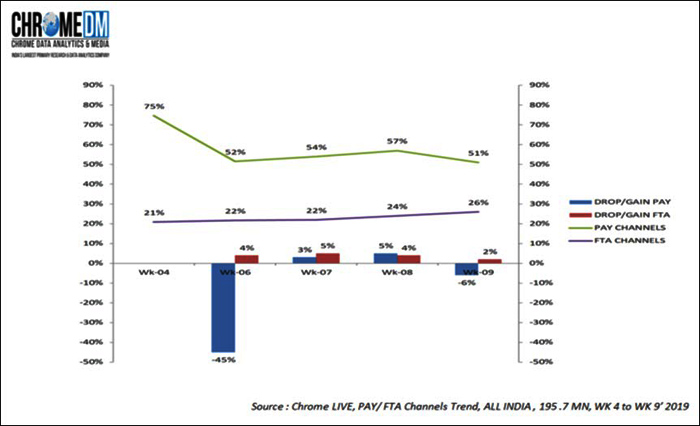
    Specifying about the reach or Chrome connectivity (OTS faired over the last six weeks), while broadly dissected into pay that observed a downfall and FTA which witnessing a hike. On one hand, pay channels with an average national connectivity of 75 per cent went down to an average of 51 per cent. FTA on the other hand, gained from 21 per cent to 26 which is a 23 per cent gain. 

    The report added that the operators right now are competing for consumers by providing the maximum number of channels within the fixed one hundred and thirty rupees. DTH –Tata Sky, Dish, Airtel – Average of 250 channels in the network capacity fee.

    Networks offering maximum channels within their Base pack

    HEAD END

    TOTAL FTA RUNNING

    TOTAL PAY RUNNING

    VISION POINT DIGITAL

    277

    23

    GAJANAN CABLE/NXT DIGITAL

    274

    180

    NXT DIGITAL

    264

    37

    AFTAB CABLE VISION

    230

    4

    JAK COMMUNICATION

    219

    48

    ATHULYA INFO MEDIA PVT. LTD.

    216

    14

    NXT DIGITAL

    190

    37

    CHIKHALI CABLE NETWORK

    186

    74

    KBC DIGITAL

    185

    110

    CRYSTAL CABLE

    185

    46

    PUNE CABLE SYSTEM

    185

    42

    VK DIGITAL NETWORK

    179

    71

    NXT DIGITAL

    177

    38

    MCBS DIGITAL

    176

    100

    ACT DIGITAL

    175

    32

    SITI DIGITAL

    174

    125

    KABLE FIRST DIGITAL

    173

    235

    GRAND GUMBER

    172

    8

    TATA SKY

    262

    135

    DISH TV

    202

    145

    AIRTEL DTH

    195

    125

    Source: Chrome LIVE, ALL India (Urban), WK 10, 2019

    State wise Package offtake status

    MARKET

    100 FTA CHANNELS RUNNING ON NETWORKS

    MORE THAN 100 FTA CHANNELS RUNNING ON NETWORKS

    LESS THAN 100 FTA CHANNELS RUNNING ON NETWORKS

    BIHAR

    17%

    67%

    17%

    GUJ, D&D & DNH

    9%

    55%

    36%

    KERALA

    3%

    72%

    25%

    MADHYA PRADESH

    5%

    31%

    64%

    MAH & GOA

    3%

    44%

    53%

    UP & UTTARAKHAND

    2%

    25%

    74%

    All INDIA

    2%

    46%

    52%


    MARKET

    100 FTA CHANNELS RUNNING ON NETWORKS

    MORE THAN 100 FTA CHANNELS RUNNING ON NETWORKS

    LESS THAN 100 FTA CHANNELS RUNNING ON NETWORKS

    AP & TELANGANA

    0%

    38%

    62%

    CHHATTISGARH

    0%

    60%

    40%

    DELHI

    0%

    42%

    58%

    HHPJ&K

    0%

    20%

    80%

    JHARKHAND

    0%

    17%

    83%

    KARNATAKA

    0%

    50%

    50%

    KOLKATA

    0%

    83%

    17%

    ODISHA

    0%

    53%

    47%

    PUN & CHA

    0%

    100%

    0%

    RAJASTHAN

    0%

    50%

    50%

    TN & PONDICHERRY

    0%

    100%

    0%

    WEST BENGAL

    0%

    89%

    11%

    Source: Chrome LIVE, ALL India (Urban), WK 10, 2019

    According to Chrome DM, in the long term, there is a price-quantity relationship which is already happening with operators putting in maximum number of channels to get maximum subscribers. On the broadcasting level, companies are graduating from pure distribution, lobbying driven business to consumer marketing organisations.

  • FTA channel adoption shoots up post TRAI tariff order implementation; pay channels dip

    FTA channel adoption shoots up post TRAI tariff order implementation; pay channels dip

    MUMBAI: Five weeks into the new TRAI tariff regime, there seems to be some shift in viewership patterns and consumer choices. According to Chrome LIVE data, pay channels witnessed a drop of 24 per cent from week 4 to week 9 in 2019. On the other hand, FTA channels saw a spike from 21 per cent to 26 per cent in the same time span.

    Prior to the implementation of the new tariff order (NTO), DPOs and broadcasters were mostly operating on a fixed fee model. However, the new regime is showing a significant impact on the channel reach, channel share, ratings of non-driver channels and the overall revenue.

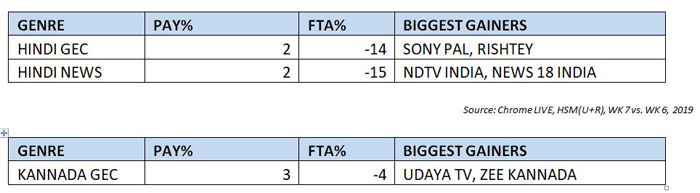
    Major fluctuations were seen across national channels over the last couple of weeks including Hindi GECs which saw a drop ranging between 0.5 to 10 per cent for pay channels and 0.1 to 5 per cent for FTA channels.

    Some passable changes enumerated in week 7 by way of reversal of the impact on connectivity of channels – exponential loss on pay had somewhat reduced owing to multiple operators putting on channels as per the old package after having switched them off. The same has also had an effect on FTA which had seen a spike.

    The second week of NTO extension continued seizing changes at PAN India level which earlier was a 3 per cent gain for pay and 5 per cent gain for FTA channels in Chrome DM’s week 7 data which in week 8 changed to 5 per cent and 4 per cent gain respectively.

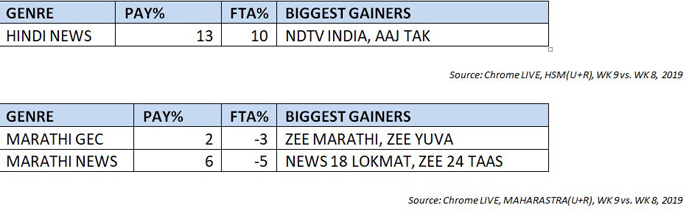
    Some more interesting changes as the NTO appendage concluded its third week on ground with pay channels registering a drop of 6 per cent owing to changes in channels’ connectivity across Free Dish and FTA gaining 2 per cent across the standard definition channels in Chrome DM week 9 data.

    The key to address these challenges for securing the correct revenue share amongst other things would entail consumer education, constant monitoring of consumer preferences and realignment of the bouquet packaging strategies taking into account consumer preferences.

    Under the new regime, consumers have the option of paying only for channels they want to watch and can drop other channels from their list and hence, the subscriber base will now solely depend on the communication between the DPOs and the end consumer, and in the event of any communication gap, the last mile consumer will not subscribe to the channels and these may result in significant erosion of subscriber base impacting the revenue of DPOs and the broadcasters.

  • Analysis: Top South Indian news channels in 2018

    Analysis: Top South Indian news channels in 2018

    BENGALURU: South Indians consumed more news  of the top 5 channels in their local languages than their Hindi speaking brethren of top 5 Hindi News channels  in their respective markets in 2018. Amongst the four south Indian languages spoken in six states, Malayalis’ (Denizens of Kerala, language Malayalam) consumed more news per household (HH) and per capita on the top 5 Malayama News channels than their South Indian brethren in 2018.  Overall, Kannadigas’ (People from Karnataka, language Kannada) consumed more volume of news in terms of average weekly impressions during the 52 weeks of 2018 on the top 5 Kannada News channels than the consumers of news on top 5 channels in the other three South Indian languages. The four South Indian languages are (in alphabetical order) Kannada, Malayalam, Tamil and Telugu.

    It may be noted that this analysis is based on Broadcast Audience Research Council of India (BARC) weekly data of top 5 News channels for each of the four South Indian languages and Hindi News as per the following demographics:

    Kannada News: Karnataka  Urban and Rural or (U+R): NCCS All: 2+ Individuals
    Malayalam News: Kerala (U+R): NCCS All: 2+ Individuals
    Tamil News: Tamil Nadu/Puducherry (U+R): NCCS All: 2+ Individuals
    Telugu News: Andhra Pradesh or AP/Telangana (U+R): NCCS All: 2+ Individuals
    Hindi News in HSM Markets (U+R): NCCS All 15+ Individuals

    To arrive at the per capita viewership or consumption, the author has considered the 52 week average number divided by the respective population of the respective market as per BARC India, Households and Individuals Universe Estimate – 2018 (BARC Population Estimates 2018). BARC considers HSM or Hindi Speaking Market as All India without the four South Indian markets. Hence, the author has subtracted the NCCS 15+ population of the four South Indian markets from the All India NCCS 15+ population to arrive at the HSM 15+ population numbers. In the case of per capita consumption for South India, the author has taken the sum of average weekly impressions of the top 5 channels for each language and then added the four sums to arrive at the total average weekly impressions for South India, this total average has then been divided by the 2+ population figures for each of the four languages/six states as per BARC Population Estimates 2018.

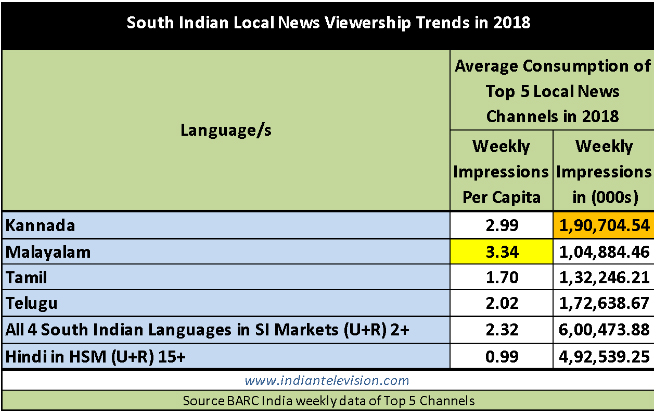
    Overall, across their four languages South Indians averaged 2.32 impressions per person per week of news  on the top 5 News channels in their respective language and territories in 2018 as compared to just 0.99 impressions per person per week of Hindi news on the top 5 Hindi News channels consumed in the HSM (U+R).  The combined average weekly news consumption of the top 5 news channels in each of the four South Indian languages was 6,00,473.88 thousand (000s) weekly impressions in their respective markets as compared to 4,92,359.25 (000s) weekly impressions viewership of the top 5 Hindi News in the HSM (U+R) market.

    Please refer to the figure below:
    Across the 52 weeks of 2018, viewership ratings of South Indian News channels was different when compared to viewership of Hindi News Channels. Even within the four South Indian languages, viewership ratings across weeks trended differently. South Indian news viewership in the respective South Indian markets peaked during weeks 32 and 33 of 2018 . In week 32, floods in Kerala and the death of the Tamil leader K Karunanidhi on 8 August 2018 spiked viewership in Kerala and Tamil Nadu. Like the HSM, Television news viewership peaked in week 33 in the South Indian markets also, and was relatively higher than HSM news viewership of top News channels in the respective markets.  Week 33 of 2018 was the week when Indians celebrated Independence day on 15 August and the former Indian premier Atal Bihari Vajpayee passed away the next day of 16 August. Please refer to the figure below

    South Indian News channels Trends

    As mentioned above, per capita local television Malayalam news consumption in Kerala is the highest amongst the four languages, while in terms of absolute viewership Kannada News in Karnataka scores the most average weekly impressions. The figure below is a scaled part of the figure above.

    Kannada News channels in Karnataka

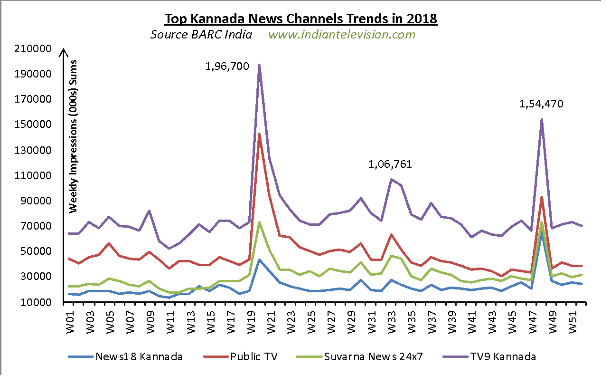
    There were four news channels that appeared in BARC’s list of top 5 Kannada News channels during all the 52 weeks of 2018 – they were TV9 Kannada, Public TV, Suvarna News 24×7 and News18 Kananda. TV9 Kannada was by far the most watched Kannada News channel in Karnataka with average weekly impressions of 78,059.65 (000s), about 64 percent more than the next most watched Kannada News channel in Karnataka – Public TV which scored an average of 47,622.5 (000s) weekly impressions during the 52 weeks of 2018. Suvarna News 24×7 was next with an average of 30,951.44 (000s) weekly impressions followed by News18 Kannada with a weekly average of 21,724.06 (000s) weekly impressions during the 52 weeks of 2018. Two other channels appeared in BARC’s weekly list of top 5 Kannada News channels during the 52 weeks of 2018 – they were Dighvijay 24×7 News (45 weeks) and BTV (7 weeks). Please refer to the figure below.

    As is obvious, Kannada News channels viewership in Karnataka peaked during the announcement of the drama laced results of the Karnataka State Assembly Elections in week 20 of 2018.
    Malayalam News channels in Kerala

    There were three Malayalam News channels that appeared in BARC’s weekly lists of top 5 Malayalam News channels during all the 52 weeks of 2018 – they were – Asianet News, Manorama News and Mathrubhumi News. Asianet News was by far the most watched Malayalam News channel in Kerala during all the 52 weeks of 2018 with average weekly ratings of 44,453 (000s) weekly impressions. Manorana News was next with an average of 23,157.13 (000s) weekly impressions, or about 52 percent of the ratings of Asianet News. Mathrubhumi News was next with average weekly impressions of 18,168.36 (000s) weekly impressions. Four other channels also appeared in BARC’s weekly lists of top 5 Malayalam News channels during the 52 weeks of 2108 – In no particular order, they were – News18 Kerala (43 weeks), Media One TV (42 weeks), Janam TV (12 weeks) and People TV (7 weeks).

    As in the case of Kannada News, Malayalam News viewership in Kerala also peaked in the face of local events – on 8 August 2018 ( during week 32 of 2018) Kerala was hit by some of the worst floods in its history due to excessive rainfall. In its neighbouring state of Tamil Nadu, one of India’s senior most politicians – K Karunanidi had passed away the previous day.  These events led to the surge in Malayalam News television ratings during the week. Please refer to the figure below.

    Tami News channels in Tamil Nadu and Puducherry

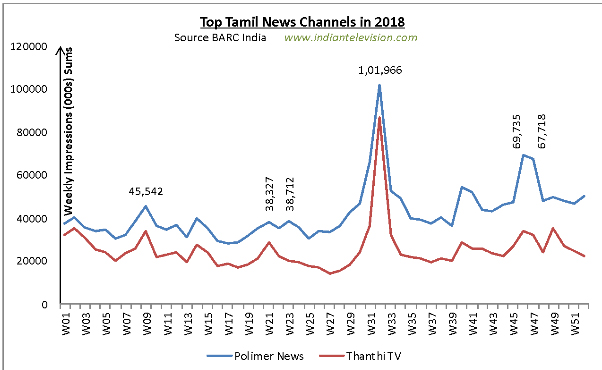
    Two channels appeared in BARC’s weekly lists of top 5 Tamil channels during all the 52 weeks of 2018. They were Poliimer News with average weekly impressions of 42,361.37 (000s) followed by Thanthi TV with 24,498.6 (000s) average weekly impressions during the 52 weeks of 2018.

    Four other channels – Puthiya Thalaimurai (50 weeks), Sun News (41 weeks), News18 Tamil Nadu (27 weeks) and Seithigal (1 week) also appeared in BARC’s weekly lists of Top 5 Tamil News channels during the 52 weeks of 2018.

    Like its Kannada and Malayalam news counterparts, Tamil News ratings peaked in Tamil Nadu/Puducherry in week 32 of 2018. On 7 August 2018 (week 32 of 2018) one of India’s senior most politicians and a former chief minister of the state – K Karunanidi had passed away. Also, floods in the neighbouring state of Kerala could have added to the viewership during week 32 of 2018. Please refer to the figure below.
    Telugu News channels in Andhra Pradesh and Telangana

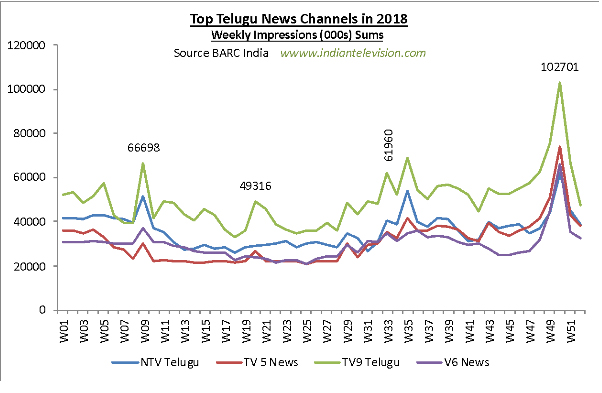
    Like all the other South Indian counterparts, Telugu News channels viewership in Andhra Pradesh/Telangana spiked upwards for local events – the biggest spike coming in week 50 of 2018, the week in which results of the assembly elections in Telangana were announced.

    Four channels appeared in BARC’s weekly lists of top 5 Telugu News channels during all the 52 weeks of 2018. They were: TV9 Telugu with average weekly impressions of 49,830.42 (000s) followed by NTV Teleugu with an average of  36,230.21 (000s) weekly impressions or about 72.7 percent of the viewership of TV9 Telugu. TV5 News was next with average 30,915.17 (000s) weekly impressions followed closely by V6 News with an average of 29,752.38 (000s) weekly impressions during the 52 weeks of 2018.  Four other Telugu News channels also appeared in BARC’s weekly list of Top 5 Telugu News channels during 2018. They were  T News (24 weeks), Sakshi TV (16 weeks), 10 TV (8 weeks) and ABN Andhra Jyothi (4 weeks). Please refer to the figure below.
    Conclusions

    South Indians watch more local news on the top 5 channels of their respective languages than their Hindi speaking counterparts do in the case of Top 5 Hindi News channels in Hindi speaking markets.

    Per capita local news consumption of top 5 News channels in Kerala is highest among the four South Indian languages. Overall, in terms of impressions, more Kannada news on the top 5 News channels in Karnataka is consumed than any of the other three South Indian languages.

    Viewership of South Indian languages news channels spikes when local events occur. The highest spikes in viewership of the Top 5 News channels in Karnataka and Andhra Pradesh/Telagana happened in the weeks when state assembly elections were announced in their respective markets. The highest spikes in viewership of Malayalam News and Tamil News channels happened during a calamity and death of a great political leader respectively.

    Viewership in respective markets of South Indian News channels also spikes in the case of a national event – such as Independence Day celebrations and the death of a national figure such as the former prime minister happen.
  • BARC responds after TRAI directive on ratings, TV viewership

    BARC responds after TRAI directive on ratings, TV viewership

    MUMBAI: After noticing that BARC India had stopped publishing TV viewership data on its website after the implementation of the new tariff order, the Telecom Regulatory Authority of India (TRAI), in a sternly worded letter, warned it to publish data for week ending 8 February by 25 February or else face consequences under the TRAI Act.

    BARC India has now released its statement on the same. It says, “To set the record straight, BARC India has not stopped publishing its viewership data. Every week, at 11 am sharp, all our subscribers have been getting all India weekly data without a hitch for the last 175 weeks, including the last 2 weeks that correspond to the NTO transition.

    “However, we have published data of last 2 weeks with the caveat that there are changes taking place on ground due to NTO rollout due to which viewership numbers will be volatile during the transition period. The India Society of Advertisers (ISA) too has advised its members that our data should not be used for media planning and buying in the transition period.

    “We also publish a limited amount of data on our website – intended only for larger benefit and information of trade and media. We temporarily held back release of this select headline data on our website. We did this purely to avoid misrepresentation of such data (Top 5 channels/programs etc) without looking at the larger context of NTO rollout and resulting volatility which could be misleading, lead to confusion and be counter-productive.

    “Our position is also aligned to Ministry of Information and Broadcasting Guidelines that govern us. The guidelines clearly say that “…data generated by the rating agency be made available, on paid basis, to all interested stakeholders…”. And “Sharing of the data/reports with a third party or in public domain be allowed subject to the fair usage policy of the rating agency. Such fair usage policy shall be provided on the website of the rating agency.”

    “TRAI has advised us that we should also consider resuming the display of top channels and programs data on our website. We are taking a considered view on that post consultation with our stakeholders.”

  • IAMAI suggests advertisers pay 0.25% of media spends to strengthen BARC measurement

    IAMAI suggests advertisers pay 0.25% of media spends to strengthen BARC measurement

    MUMBAI: Presenting counter comments to the Telecom Regulatory Authority of India (TRAI) consultation paper on BARC TV viewership measurement, the Internet and Mobile Association of India (IAMAI) has said that advertisers can pay 0.25 per cent of their media spends for TV viewership measurement every year. It will not only help them in making judicious investments but will also largely contribute to the process of increasing panel size for audience measurement.

    The association noted this in response to the question asking about methodologies and technologies to rapidly increase the panel size for television audience measurement and the related commercial challenges. It wrote, “Use of multiple technologies such as peoplemeter, RPD, channel video players, softwares measuring the consumption of OTT and data modelling should help increase the overall sample size without commensurate increase in the costs. Advertisers can pay 0.25 per cent of their media spend for measurement every year to make the currency more robust which in-turn helps them to make judicious investments.”

    IAMAI also stated that it feels Indian Society of Advertisers (ISA) and The Advertising Agencies Association of India (AAAI) members, who hold 20 per cent share each in BARC, are not much involved in the currency.

    It mentioned in its counter comments, “At present, IBF owns 60 per cent of BARC and 20 per cent each is owned by AAAI and ISA. As a result, IBF has a greater say in the functioning of BARC. However, globally, higher percentage of revenue is contributed by media owners.”

    “In past TRAI consulting papers, most contributions also came from the media owners. It seems ISA and AAAI members are not that involved with overall currency. Consultation with these constituents may help ensure equal contribution in functioning of BARC by all the three industry bodies, irrespective of the share of revenue contributed. Presently it is felt that with 60 per cent share IBF controls day-to-day functioning of BARC and future course of action,” the comment further read.

    IAMAI also vouched for introducing a competitive currency of viewership management; one based on peoplemeter and the other based on RPD.

    It noted, “We can do this for different types of data, whether from the set-top box in the home or mobile services that enable subscriber viewing on tablets or phones. This will add Digital Viewership Measurement, which is currently missing.”

    “The 2nd study of RPD can be done with Internet and Mobile Association of India (IAMAI), who represents most of the digital media and publishers, in partnership with relevant stakeholders,” its comment mentioned.

    Most of the broadcasters, in their responses to the paper, had denied the need of introducing competition in the viewership measurement domain, citing reasons like it would lead to chaos and duplication of data and skewing of results to the convenience of a few stakeholders.

    TRAI had released the said consultation paper in December last year to seek suggestions on how the existing TV viewership management system can be made more robust. It asked several important questions to various stakeholders, including if the current measuring system is apposite, should the sample size of the population be increased, and related commercial viabilities of the responses.

    The stakeholders were asked to file the comments by 2 January and counter comments by 16 January. However, the dates were further extended to 2 February and 16 February, respectively.

  • BARC exhorts TRAI to strengthen existing TV audience measurement system

    BARC exhorts TRAI to strengthen existing TV audience measurement system

    MUMBAI: Broadcast Audience Research Council India (BARC), the country’s premier TV audience data measurer, has suggested to the Indian regulator Telecom Regulatory Authority of India (TRAI) that having more multiple measurement and ratings mechanisms may not be “advisable” and could create confusion. Instead, it was better to invest further in the existing currency with the goal to make it more robust.

    “Having more than one ratings service/currency would not be in the interests of industry, and, hence is not desirable. Instead of increasing number of ratings agencies, it would be advisable to invest in the existing system and make it even more robust and accurate,” BARC India has said in its submission to a consultation paper on TV audience measurement overhaul  floated by the TRAI.

    Making a case to further boost the functioning of BARC India, the organisation has said steps were needed to be taken to “increase the sample/panel through cost effective technologies” like sample return path data (SRPD).

    “TV viewership measurement systems across most mature markets are carried out by a single agency. The existence of more than one rating agencies (and currency) will create confusion and will lead to inefficiency in the market. When there are more than one data sets for a same set of channels, it leads to ambiguity,” BARC India has argued.

    TRAI had floated a consultation paper on ‘Review of Television Audience Measurement and Ratings in India’ on 3 December 2018 seeking feedback from stakeholders with a view to examine various aspects of the system, which is presently done by BARC India that is a joint venture amongst three industry organisations — the Indian Broadcasting Foundation (IBF), Advertising Agencies Association of India (AAAI) and the Indian Society of Advertisers (ISA). The original deadline for making submissions was extended on request from the stakeholders.

    Arguing against promoting more competition in the audience measurement eco-system, BARC India has cited international media reports relating to this particular issue in the Philippines.
    “Philippines presents a typical example of confusion and ambiguity in market due to presence of more than one measurement agency. TV measurement in the Philippines is conducted by Kantar Media Philippines and AGB Nielsen Media Research Philippines. Data produced by the two companies are often used by competing channels to claim leadership,” BARC India has argued.

    Pointing out that accuracy of data can be ensured through larger panel that can, inter alia, be sustained by industry, BARC India has tried to put things in context by highlighting the US TV industry sustains a panel of 108900 individuals with a TV adex of $68 billion, while in India BARC India “runs a panel of 135,000 individuals with adex of approximately $4 billion”.

    However, for a more robust system to be in place, which will also strengthen BARC India, the organisation has said “regulatory and government support” was essential and the support should involve “mandating digital platform operators (DTH and cable), as well as TV OEM manufacturers (of smart TV sets), to share return path data from samples to measurement provider”.

    “To make data more accurate, there are steps required that go beyond the remit and domain of BARC. Legal and punitive framework to weed out panel tampering will go a long way in building further acceptance of our data,” BARC India has stated, reiterating its position on been backed by some legal teeth to fight attempts of data infiltrations and manipulation.

    While admitting that a high-tech landscape like audience measurement needed to constantly evolve as newer consumption and distribution modes and technologies were emerging (for example, digital consumption, proliferation of OTT platforms, etc), BARC India has made it clear it was exploring SRPD, second generation metre with newer detection techniques, and other technological solutions for TV measurement.

    “BARC India has also made progress in building capability to measure digital consumption with the goal of providing industry with cross platform and cross device video consumption: linear and time shifted, broadcast and digital. We have a strong foundation, established credibility and necessary transparency and accountability framework on which we can build further with emerging and suitable technologies,” the measurement organisation stated.

  • Most watched Hindi news channels in 2018

    Most watched Hindi news channels in 2018

    BENGALURU: News is event driven – that is a fact that is known and repeated a dozen times and more by all publications, newsletters, and whatnots.  As per a Broadcast Audience Research Council of India (BARC) report presented at FICCI-Frames 2018, Hindi content still rules the Indian television landscape in terms of viewership. After Hindi GEC, Hindi movies and Hindi music, Hindi news is the most watched genre in the country. The report also says that contrary to popular perception, TV viewership is highest amongst youth (15-30 years) even in the digital age.
    The BARC report says that news events cannot escape the lure of drama. And drama includes elections and election results, deaths of celebrities, high court and supreme court verdicts on celebrities and sensitive issues, major changes such as demonetisation announced by the central government, major public holidays such as Independence and Republic days and events that pertain to terrorist attacks and counter-attacks, etc.

    Data from the past few days have not been announced due to the migration to the new TRAI tariff regime from 1 February. BARC is giving the industry time to settle.

    So how did Hindi television news fare in 2018?

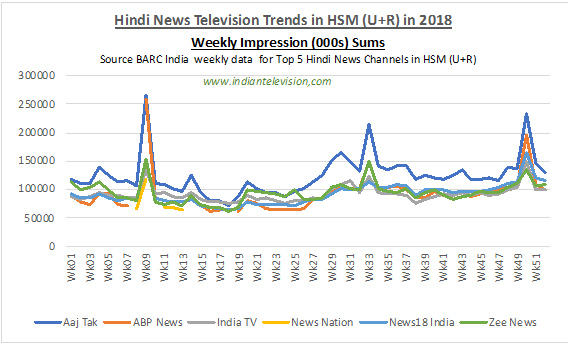
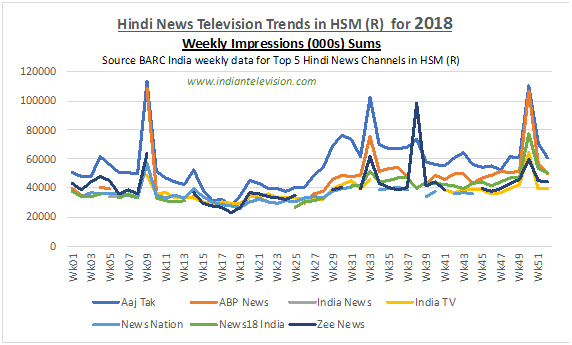
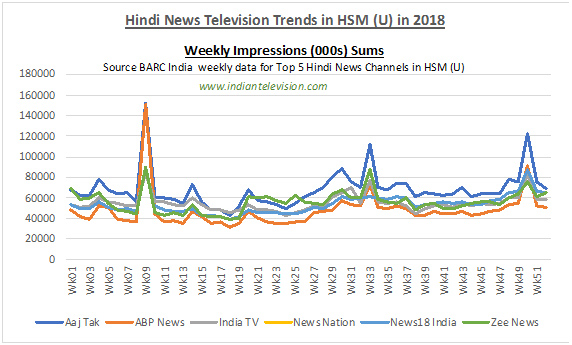
    Until recently, BARC had been releasing three sets of weekly viewership data for Hindi news in the Hindi speaking markets (HSM). The first was the combined viewership of the 5 top Hindi news channels in urban and rural Hindi speaking market – HSM (U+R). Besides, BARC also provided weekly viewership data of the 5 top Hindi news channels in the Hindi Speaking rural market – HSM (R) and the Hindi speaking urban market – HSM (U). The demographics for the three sets of data were: HSM (U+R) NCCS All : 15+ individuals; HSM (R) NCCS All : 15+ individuals and HSM (U) NCCS All : 15+ individuals.

    Like English news, Hindi news also peaked during elections that happened in central and the eastern part of India in calendar year 2018. Comparatively, the elections and elections results week in Karnataka managed just a small upward blip in overall Hindi viewership ratings in HSM (U+R), HSM (R) and HSM (U) as compared to English news channels.

    The most watched Hindi news channel in the Hindi speaking market (HSM) – be it urban (U), rural (R) or combined (U+R) was India Today TV Network’s Aaj Tak during the 52 weeks of 2018. The channel was present during all the 52 weeks of 2018 according to Broadcast Audience Research Council of India (BARC) data for weeks 1 to 52 of 2018 (Saturday, 30 December 2017 to Friday, 28 December 2018) in all the three weekly lists for HSM (U+R), HSM (U) and HSM (R).

    Viewership of the top 5 Hindi news channels in HSM (U+R) peaked in week 49 of 2018 – election results week of five states in the Hindi heartland and the north eastern part of the country – the top 5 channels scored a massive 931.068 million weekly impressions – 89 percent more than the 52 week weekly average of 492.539 million weekly impressions. The nadir was in week 19 of 2018 – a 34 percent dip at 324.188 million weekly impressions from the above mentioned 52 week average. Like their English counterparts, Hindi news channels also peaked during Independence Day week – the major events in these weeks being Independence day celebrations on 15 August 2018 and the demise of former Indian premier Atal Bihari Vajpayee the very next day -16 August 2018.

    Aaj Tak topped BARC’s weekly lists for HSM (U+R) during the 52 weeks of 2018 in terms of overall viewership. In HSM (U+R), Zee News was the second most watched Hindi news channel during the 52 weeks of 2018, followed by India TV. Only three channels appeared in BARC’s weekly list of top 5 Hindi news channels in HSM (U+R) during all the 52 weeks of 2018. Aaj Tak was ranked first for 50 of the 52 weeks of 2018, followed by Zee News and India TV which were ranked first for one week each in BARC’s weekly lists of top 5 Hindi news channels in HSM (U+R). Please refer to the figure below.

    In the HSM (R) market also, Aaj Tak topped ratings – it was ranked first for 51 of the 52 weeks of 2018. The one week where it was ranked third in terms of viewership was week 18 of 2018. Aaj Tak was the only channel that was present in BARC’s weekly list of top 5 Hindi news channels in HSM (R) during all the 52 weeks of 2018.
    Rural audiences also reacted like the overall Hindi speaking market – viewership peaked during the election results week of north-eastern India, Independence Day/Vajpayee week and the elections in the eastern part and Hindi heartlands towards the closing month of 2018. The elections and election results weeks for Karnataka did not mar the charts too much. 
    In HSM (R), the combined weekly ratings of the top 5 Hindi news channels were highest in week 50 of 2018 at 418.124 million weekly impressions, 94 percent more than the 52 week average of 215.162 million weekly impressions in 2018. The lowest combined impressions of the top 5 Hindi news channels in HSM (R) in 2018 were in week 2 of 2018 at 190.280 million weekly impressions.  Please refer to the graph below.

    HSM (U) also behaved in practically the same way that HSM (U+R) did in terms of viewership peaks and dips. Election results in the beginning of year and towards the fag end of the year in north-eastern and the Hindi heartland as well as Independence Day week saw viewership peaks. HSM (U) viewership ratings peaked in week13 of 2018 with combined weekly impressions of the top 5 Hindi news channels at 541.398 million weekly impressions, which were 93 percent more than the 52 week combined weekly impressions average of 280.285 million. The lowest combined weekly impressions happened in week 2 of 2019, at 264.155 million weekly impressions, 5.8 percent lower than the combined 52 week average for HSM (U).

    Aaj Tak, ABP News, India TV and Zee News were present in BARC’s weekly lists of top 5 Hindi News channels in HSM (U) during all the 52 weeks of 2018. Aaj Tak was the most watched Hindi News channel in HSM urban also. Please refer to the figure below.


  • GEC, regional channels’ viewership to dip further this year due to IPL, Elections

    GEC, regional channels’ viewership to dip further this year due to IPL, Elections

    MUMBAI: This summer, India is set to witness two major events, the Indian Premier League (IPL) and the much awaited General Elections, clash for votes and viewership. For the broadcast industry, those with general entertainment channels (GECs) are likely to see even further dip in eyeballs because of this.

    With Star India introducing several regional feeds for its first edition of IPL last year, the regional channels also saw a slight change. As per reports, viewership share of regional language telecast was reported to be 23 per cent followed by English with 22 per cent and Hindi dominating with 55 per cent.

    IPL telecast has also shown significant impact on viewing habits for other genres. While mapping viewership of various genres during IPL and non-IPL weeks, it was found that the share of the GEC genre declined marginally in all 3 years under review (2016-18), as viewers tuned in to IPL matches during primetime.

    According to Viacom18 Hindi mass entertainment and kids TV network head Nina Elavia Jaipuria, these events, no doubt, work well with audiences but that doesn’t mean that people stop watching GECs. She said, “What happens in any country when there is large mass viewership, there is one television, and the viewership time gets divided. But like I told you that the power of content is so much that there is no viewer who is going to stay without television for two months and without their characters. It’s the eleventh IPL and Hindi GECs have always done well. It is not that people stop watching GECs. So to my mind, there will be some division of time and little more time given to different genres of channels. But people will not stop watching their favourite shows and characters.” She is confident that Viacom18 has a very strong line up and there’s no reason that it will be losing viewership on the channels.

    Zee TV business head Aparna Bhosle claimed that Zee saw growth during IPL last year. She added that when the content offering is strong, viewership invariably grows. Media planners spoke to Indiantelevision.com and said that the loss of viewership will be little more than the previous year. On the contrary, while reports suggested that regional channels are expected to grow double digits, this year regional broadcasters felt that there could be a decrease.

    Fakt Marathi Enterr10 MD Shirish Pattanshetty said that it wouldn’t be the case with Hindi GECs as against regional channels. “Trend shows that regional could see 8 to 12 per cent decline,” he said.

    According to Dishum Broadcasting COO Partha Dey, the viewership on news and sports genre will definitely be high but rooted entertainment and spike programming on regional channels will cushion much of the impact.

    Talking about the growth of viewership on television, the impressions for IPL 2018 witnessed a growth of 41 per cent over the 2016 season and 16 per cent over the 2017 season. Even the average time spent went from 28 minutes in 2016 to 34 minutes in 2018. 

    Stratagem Media founder-director Sundeep Nagpal said that the loss of viewership can be expected to be a little more pronounced this year. Moreover, Carat Media SVP Mayank Bhatnagar explained that IPL viewership has been growing year-on-year. He added, “In 2018, GEC and movies genres’ viewership drop was 3-5 per cent. This year, there are back-to-back cricket events with IPL first and then the World Cup. So it’s imperative to have counter strategies to mitigate the risk.”

    As far as ad rates are concerned Pattanshetty said that overall it is likely to increase due to the mega events and regional especially may see double-digit growth.

    With the new TRAI tariff regime also set, there is likely to be fluctuations in the viewership pattern as well. The industry is giving time for viewership patterns to stabilise and is likely to see it happen before these events take place. 

  • Most watched English news channels in 2018

    Most watched English news channels in 2018

    BENGALURU: News is event driven. Events can be of two types – planned and unplanned. Among the planned events are elections, public events, etc.Unplanned events include deaths of celebrities, calamities, accidents and disasters, acts of terrorism, etc.

    Besides providing news, news channels help spread a message, build and influence public opinion and even policy. The multitude of debates and special
    programmes have often made celebrities out of the announcers, even when they shift channels. A classic and a living example is Arnab Goswami, who was instrumental in making Times Now the most watched English news in the country until he launched another channel – Republic TV. Right from the very first week of its launch in week 19 of 2017, Republic TV has topped Broadcast Audience Research Council of India (BARC) weekly ratings of top 5 English news channels, except for one week – week 31 of 2018.

    A digression. As a matter of fact, it’s Goswami’s style of debating, literally forcing his views, opinions onto the debate participants and viewers, that is unique. It is a style that has not been replicated by any other news announcer or debate moderator so far. His style has made the older stars of English news look pale, stale and redundant. Now onto how the news genres performed in calendar year 2018.

    Some major events such as elections, be they on a national, a regional or sometimes even on a local level, drive ratings of news channels north. Broadcast Audience Research Council of India (BARC) provides data for the top 5 English news channels. As mentioned above, ratings, BARC ratings to be more precise, of the English news genre peaked around the periods before, during and after the assembly elections three times in 2018. During election period, ratings normally have an upward spike in the week in which the election results are announced. Channels go hyper during the days leading to election results day with campaigns for attracting viewership across a number of mediums – television, newspapers, social media, hoardings and even local radio. Important scheduling of the programming to come is shared with viewers. BARC data indicates that channels release lower ad time and sell it a premium during election periods.

    In 2018, the first set of elections that lead to a spike in ratings were the assembly elections in north eastern states, followed by elections in Karnataka,the period during which English News peaked. The Karnataka elections were followed by elections in three Hindi heartland states, one in East India and one state in North east. Ratings also peaked in mid-August 2015 – (week 33 of 2018) the major events at that time being the Indian Independence day celebrations on 15 August, followed by the demise of former Indian prime minister Atal Bihari Vajpayee the very next day on 16 August 2018.

    As mentioned above, right from its launch week, week 19 of 2017, Republic TV has been at rank no 1 in BARC’s weekly list of top 5 English News channels (All India (U+R) : NCCS AB : Males 22+ Individuals). Republic TV was followed by Times Now, often quite closely.

    Of the six English news channels that appeared in BARC’s weekly lists, four – Republic TV, Times Now, India Today TV and CNN News18 were present in the list during all the 52 BARC weeks of 2018. Two other channels – NDTV 24X7 and the Times Group’s Mirror Now also made it to the lists for 39 weeks and 13 weeks respectively.Please refer to the chart below for English News ratings BARC ratings trends in the chart below.

    Republic TV averaged 877.635 (000s) weekly impressions during the 52 BARC weeks of 2018 with a peak of 1,650 (000s) weekly impressions in week 20 of 2018 (Karnataka election period) and a nadir of 547 (000s) weekly impressions in week 11 of 2018.

    Times Now averaged 739.885 (000s) weekly impressions with a peak of 1,417 (000s) weekly impressions in week 20 of 2018 and a low of 445 (000s) weekly impressions in week 11 of 2018.

    India Today TV averaged 326.154 (000s) weekly impressions during the 52 weeks of 2018 with a peak of 814 (000s) weekly impressions in week 13 of 2018 and a low of 210 (000s) weekly impressions in week 41 of 2018.

    CNN News18 averaged 214.539 (000s) weekly impressions during the 52 weeks of 2018 with a peak of 943 (000s) weekly impressions in week 33 of 2018 and a low of 161 (000s) weekly impressions in week 25 of 2018.

  • Tariff order implementation: Pay channels’ connectivity drops ranging from 61% to 0.5% across genres

    Tariff order implementation: Pay channels’ connectivity drops ranging from 61% to 0.5% across genres

    MUMBAI: The ongoing flux in the broadcast sector due to the new TRAI tariff order implementation has had a significant impact on the connectivity of pay channels in the country. After the new regulatory framework kicked in on 1 February, pay channels’ connectivity witnessed a drop ranging from 61 per cent to 0.5 per cent across genres. Free-to-air (FTA) channels, however, seem to have benefitted under the new regime so far.

    “NTO deployment is creating massive nightmare for all DPOs, whether it is DTH or cable. The technology is unable to handle the massive data that is getting ported to these boxes. So what’s happening is the technology is collapsing, they don’t know what is happening in the data centres because of which the channels are dropped out,” CEO of a major broadcaster told Indiantelevision.com on the condition of anonymity.

    Chrome DM live data week 7 has reported a major change in consumption patterns across genres. Pay channels from the English news stable, endured a drop in connectivity by 24 per cent, while the FTA channels witnessed a growth of six per cent with Republic TV, News X and Channel News Asia being the biggest gainers. The kids’ genre channels saw an overall drop both across Pay and FTA of 34 per cent and three per cent respectively.  Interestingly, the connectivity of Maha Cartoon Network rose by eight per cent.

    While the connectivity of Hindi GEC channels connectivity reduced by 0.5 per cent, that of FTA Hindi GECs increased by 0.1 per cent. Dillagi was the top gainer in Hindi GEC FTA genre followed by Mubu TV. Among other genres, Hindi movie channels experienced a slight drop in FTA, with Hindi news pay channels sailing in the same boat. Hindi news FTA channels, however, saw a 0.4 per cent growth, with News 1 India, Bhaskar News, News World India and IND 24 being the bigger beneficiaries.

    The regional markets were a reflection of HSM trends. However, the drop in connectivity was lower. Tamil channels across genres were hit by a slight drop ranging from 0.1 per cent to 0.3 per cent.

    “Maharashtra saw a slight drop both across FTA and pay with Marathi GEC being mislaid by 0.5 per cent across pay channels, Marathi movies by 0.2 per cent and Marathi music by 0.1 per cent,” the report stated.

    The Chrome data week 7 has reiterated that the offtake of DPO designed packages continues to be higher, standing at 15.5 per cent rate in urban India. The data added that 73.5 per cent still haven’t gained access to the new packs and continue to receive the 300 odd channels as per their old packs. According to the data, only FTA channels packs have reached 5.3 per cent of the TV homes followed by broadcaster packs at 4.1 per cent and a-la-carte at two per cent.

    “Broadcaster packages offtake has a direct correlation of quantity and price with the India consumer – which is led by Zee (23 channels @ Rs. 39) followed by Sony, Star and Colors. For the Non-GEC category – Discovery, Disney and Times Network lead – however they are a distant second to the GEC offtake across HSM,” Chrome DM founder Pankaj Krishna said.

    “When TRAI channel tariff order is enforced, channel availability per home will reduce from approx. 350 channels to 100+50. So, today most GEC channels have 90 per cent + distribution and about 35 per cent weekly reach. After TRAI these channels could land up having 30 per cent distribution and 30 per cent reach,” Madison Group CEO Vikram Sakhuja said earlier this week at an event.

    In light of the new tariff order implementation, BARC released its weekly TV viewership data only to those that have subscribed to its service. The audience measurement company is yet to state until when it intends to continue doing so.

    “We need to stick to BARC guidelines because that’s the norm or benchmark we have in this country. I think TRAI is also in close conversation with the authorities that how much of migration has happened, how much of it is pending right now and that is why they have extended the deadline to 31 March 2019. Ultimately the system needs to stabilise. Till that time I don’t think the numbers will make any difference to any advertiser,” marketing head of an FMCD major had recently told Indiantelevision.com.