Category: Viewership

  • BARC resumes publishing viewership data on website ending stand-off with TRAI

    BARC resumes publishing viewership data on website ending stand-off with TRAI

    MUMBAI: Broadcast Audience Research Council of India (BARC) on Monday resumed publishing its weekly viewership data on the website, ending its stand-off with Telecom Regulatory Authority of India (TRAI). The audience measurement firm website has now carried its findings for week 13 of 2019 for the top 10 channels, brands and advertisers.

    Earlier, TRAI had issued a show-cause notice to BARC for not having adhered to the regulator’s directive of publishing weekly TV viewership data on its website during the new tariff order rollout.

    The sector regulator asked the TV audience measurement firm to explain why action should not be taken against it for contravention of sections of the TRAI Act. Earlier, the industry watchdog asked BARC to publish ratings and TV viewership data for the week ending 8 February and subsequent weeks with immediate effect.

    TRAI’s directive came in the wake of the latter's decision to release the weekly data only to its subscribers as opposed to publishing it on the website.

    The show-cause notice dated 29 March also noted that BARC India did not comply with TRAI’s 22 February directive seeking the release of viewership data with immediate effect.

    Following the show-cause notice, BARC issued a statement reiterating its position on the matter.

    “BARC India is a joint industry body, and operates under self-regulation model, in compliance with Ministry of I&B Guidelines. In the NTO transition period, due to distribution disruptions (which have been well documented in media reports), there is significant volatility in data.  Due to this, and the fact that data in this period does not truly reflect viewers’ choice, BARC India Technical Committee and Board took a decision to temporarily suspend placing the limited set of data our website,” a BARC spokesperson said.

    “Putting such misleading data on the website would be against public interest and could be misused by vested interests. BARC is constantly monitoring the ground situation on this.  We have made detailed submissions to TRAI and MIB, backed by data, on several occasions. Also, we would like to re-iterate that there has been no stoppage of data to our subscribers. Every week, our clients have been receiving weekly data without any disruption,” the spokesperson added.

    An earlier TRAI directive read, "BARC India has modified its Fair and Permissible Usage Policy in February 14, 2019, even after being repeatedly asked by the authority to not stop publishing of rating data and viewership data on its website during the migration to new regulatory framework until and unless explicitly permitted by the authority and are thus, in contravention of the direction of the authority dated December 21, 2018 and January 14, 2019.”

    According to the TRAI, BARC had ignored its previous directives of publishing ratings and viewership data for television channels. The regulator said that the audience measurement company had argued that disruption due to migration to a new regulatory framework could prevent consumers from gaining access to channels of their choice, thereby running the risk of an inaccurate portrayal of TV consumption trends in the country.

    The TRAI, however, is opposed to the idea of not publishing the data, which, it feels, is a true reflection of the market changes. BARC’s decision to "withhold" the data is not justified, the regulator pointed out.

    The TRAI also highlighted that BARC "failed to furnish any cogent reason for not publishing the rating and viewership data" and that "such action on part of BARC India reflects poorly on the creditworthiness of the data published by them."

    "Now…the authority…hereby directs Broadcast Audience Research Council to immediately release and publish viewership data for the week ending February 8, 2019 and weeks subsequent to it, on its website without any further delay and not to stop it in future also without explicit instruction/direction from the authority or Ministry of Information and Broadcasting…," said the previous TRAI directive

  • English movies genre most benefitted genre in Chrome week 13

    English movies genre most benefitted genre in Chrome week 13

    MUMBAI: English movies genre grew in week 13 of Chrome Data Analytics and Media with 8.46 per cent. In this genre, Movies Now channel gained the highest OTS with 28.5 per cent in six metros.

    OTS is the actual census-based percentage connectivity of a channel spread across 81 million homes, as reported by Chrome DM, across analogue cable, digital cable, and DTH. 

    Sports category garnered the second position in the gainers list with a growth of 7.64 per cent. DD Sports bagged the highest OTS with 91.4 per cent in in all India 1 Lakh+. English GEC garnered third position and grew by 5.76 per cent. Colors Infinity gained the highest OTS with 31.4 per cent in six metros.

    At the fourth position, Hindi news grew by 4.50 per cent, with DD News bagging 98.2 per cent in HSM excluding less than 1 Lakh market. Hindi movies grew by 3.93 per cent, with Movies Ok channel securing 84.8 per cent in HSM excluding less than 1 lakh market. 

  • TV sees 53% dip in political ad insertions as compared to 2014: TAM AdEx

    TV sees 53% dip in political ad insertions as compared to 2014: TAM AdEx

    MUMBAI: For almost three decades, TV has remained the preferred choice for political parties to advertise during the poll seasons, given its mass outreach.

    However, despite leading the charts in terms of ad insertions made on any traditional medium, TV has seen an indexed dip of 83 per cent in ad insertions made during the period of 1 January to 16 March 2019 as compared to the same period during 2014 polls.

    The findings have been shared by TAM AdEx in its latest stats of political ad insertions made this year. While TV accounted for the highest ad insertions during the 5th and the 11th week of 2019 as compared to radio and print, it fared relatively lower otherwise.

    Interestingly, radio showed a striking growth as a medium since 2014, as it noted a 14 per cent growth in ad insertions. Like TV, print also saw a dip in ad insertions this year, showing an indexed sink of 9 per cent.

    Leading the bill in the political advertisers list is, unsurprisingly, the ruling party BJP holding a 53 per cent share in the combined ad insertions across TV, print, and radio. Following it is the rival Congress, but with a considerably lower share of 14 per cent.

    Other parties in the list are Telugu Desam (6 per cent), Amma Makkal Munnetra Kazhagam (3 per cent), and AIADMK (3 per cent).

    The general election is scheduled to be held in seven phases from 11 April to 19 May 2019. The counting of the votes and declaration of the results will happen on 23 May.

  • Sports genre most benefitted genre in Chrome week 12

    Sports genre most benefitted genre in Chrome week 12

    MUMBAI: Sports genre grew in week 12 of Chrome Data Analytics and Media with 3.30 per cent. In the sports genre, DD Sports gained the highest OTS with 90.4 per cent in all India 1L+ market.

    OTS is the actual census-based percentage connectivity of a channel spread across 81 million homes, as reported by Chrome DM, across analogue cable, digital cable and DTH.

    English GEC category garnered the second position in the gainers list with a growth of 3 per cent. Colors Infinity bagged the highest OTS with 33.6 per cent in six metros. Business news garnered third position and grew by 1.63 per cent. CNBC Awaz gained the highest OTS with 61.4 per cent in six metros.

    At the fourth position, kids genre grew by 1.11 per cent, with Nickelodeon bagging 68 per cent in all India 1L+ market.

  • Advertisers weigh in on effectiveness of BARC’s integrated TV plus OOH measurement

    Advertisers weigh in on effectiveness of BARC’s integrated TV plus OOH measurement

    MUMBAI: In a significant move, the Broadcast Audience Research Council (BARC) India recently announced the integration of TV and out-of-home (OOH) TV viewership in its media workstation software. The decision will allow BARC India subscribers to get a comprehensive understanding of the overall viewership.

    Brands and marketers have welcomed the move for the viable opportunities it can create. However, a few of them point out that such ratings will be impactful only during big-ticket event-based OOH viewing.

    Dentsu Aegis Network CEO greater south and chairman and CEO of India Ashish Bhasin is of the view that it will help marketers in making more informed decisions. He says, "I believe it is a step in the right direction. A lot of TV viewership, particularly around sporting events like IPL, happens outside of homes and the more research that we can get, the more clarity of data we can get, the more it helps the medium and also helps in making more informed choices."

    L'Oreal head of media Neel Pandya feels that while it is too early to tell how the policy will fare, it is going to be interesting to see how the advertising culture will evolve accordingly. He says, “It’s a great move by BARC to include out of home TV viewership as a part of its offering. Over the years, the only large media available for mass audience have been TV and OOH. As urban India is spending more time out of their homes on weekends, this service will enable marketers to get a holistic picture of the audiences’ TV viewing habits. OOH is an attractive proposition nowadays, leading to its extensive use and a boom of OTT players in the country. The only hurdle for large advertisers to invest heavily in OOH is its measurement system. While it’s too early to tell, it will be interesting to see how advertising evolves to capture the attention of increasing OOH TV viewing audiences.”

    The service will allow broadcasters and advertisers to uncover more value and insights into TV-viewing behaviours, both inside and outside the home. The data will also be available in the planning module for agencies to plan effectively and account for this audience.

    RSH Global CMO Poulomi Roy is of the view that the integrated ratings will help the marketers during event-based properties like IPL but otherwise the impact is going to be negligible. She says, “Big ticket media properties like IPL & World Cup which have a homogeneous group of people with common sentiments viewing together will show better reach and hence, marketers who spend on these properties will get affected in a positive way. However, it is important to know the sample size and coverage area and lastly how the data will be interpreted. Barring these days when such properties are not airing, the impact of these measurements is negligible because for a consumer it will be forced viewing of whatever is served by the social hotspots.”

    KMPG India partner and head, media and entertainment Girish Menon thinks that while the intent behind the decision is very good, one needs to think through how the measurement metric will work to cover a large number of people who will be watching at one place along with demography of those viewers.

    He says, “The way we need to look at out of home viewing is in two types. One is event-related viewing, mostly relevant to sports, and the other is consumption in the hotel. For an event-based viewing, for example, if you go to a restaurant, 50 people might be watching (from one screen). How do you really measure the number in such case? If you look at hotels, that model is very different. There is a reasonable chunk of the transient population that means, a person either flips through channels to pick up something interesting or typically goes to his favourite channel. Either way, it is not appointment viewing. But at least brand loyalty will have a larger play. So, therefore it is slightly more advantageous to larger and more well-known channels. There we benefit at the channel level, not necessarily at the programme level.”

    Menon says that the way advertising works in India is ratings-based in terms of reach, people and demography. “Essentially, it will add to those ratings. Therefore from an advertiser’s perspective, it is a little bit better because it expands the population the advertisers will be able to target. But at the end of it, it benefits the advertisers like all other measurement systems.”

    BARC had started the OOH TV viewership management in 2018, in Delhi, Mumbai and Bangalore. The council has also announced the expansion of this service to 120+ urban towns as well. This also comes at a time when BARC India has expanded its panel to 40,000 metered homes within the committed timeline of March 2019

  • TRAI tariff order’s impact on OTT content consumption

    TRAI tariff order’s impact on OTT content consumption

    MUMBAI: Amid debates over the impact of TRAI’s new tariff order on the Indian pay-TV ecosystem, over-the-top (OTT) platforms have emerged as probable beneficiaries. Several reports have indicated that streaming services stand to gain from the change in cable TV pricing. As digital continues to steadily emerge as an alternate content consumption avenue, the new tariff regime could stimulate the adoption rate of OTT platforms in the country. While OTT players seem optimistic about the positive impact of the new regulatory framework, there are those who believe there’s no direct correlation between the two.

    FICCI-EY 2019 report predicts that OTT platforms are certain to benefit post the tariff order implementation due to an increased parity between television and OTT consumption – both in terms of content choice and costs. The report also mentions that trends could also be determined by the channel prices at which the market settles, which could take up to six to nine months.

    This is not the only testimony in favour of OTTs gaining, as a report from Crisil too made similar observations. It said that OTT platforms could emerge as the big gainers amidst all these changes because many viewers could shift due to the rising subscription bills. In addition to that, it also mentioned that low data tariffs will also encourage viewership on OTT platforms.

    Velocity MR, another prominent market research and analysis company, carried out a survey of 2010 respondents across Indian cities including Delhi, Kolkata, Mumbai, Hyderabad, Bengaluru, Chennai, Ahmedabad, and Pune. The report states that more than 80 per cent of subscribers will either opt for lesser channels under new price regime or switch to OTT platforms.

    The CEO of India’s newest OTT platform MX Player, Karan Bedi, is of the view that the new pricing regime for broadcast channels is sure to add to the content consumption on OTT platforms especially for those audiences who no longer want to be restricted to a single TV screen. According to him, good content combined with the availability of better payment pipes and varied subscription models that come with OTT offerings, are the main drivers of entertainment today.

    "It may help because cable ARPU moves up post the tariff order and I really doubt if the consumer will stand more on TV in this kind of space where there’s so much variety on digital. So definitely you will see some kind of spend getting allocated from TV to digital,” remarked Elara Capital vice president Karan Taurani.

    The CEO of a top production house, which makes shows for both TV and OTT, said the new tariff order will definitely help OTT platforms to attract consumers. According to him, consumers that find it hard to access their preferred TV channels in the midst of this radical change are likely to shift to digital platforms.

    “Viewers are aligning their cable TV packs as channels may have blacked out, resulting in higher than usual numbers for streaming daily TV soaps on digital platforms. A significant traffic is driven by OTT due to the convenience it offers to the users. In spite of rapid growth in digital consumption, TV has its own audiences and will continue to coexist with OTT in the long run as it remains to have its dominance in India due to several factors,” ZEE5 India business head Manish Aggarwal said.

    PricewaterhouseCoopers (PwC) partner and leader, media and entertainment Frank D’Souza does not find a strong correlation between the tariff order implementation and OTT consumption uptake. However, D’Souza is of the opinion that a lot will depend on the price points broadcasters opt for. Moreover, the other thing which needs to be considered is the nature of content that OTT platforms are trying to build. He also mentioned that one is really not an option over the other as there is significant programming that is being released exclusively on OTT.

    “One is really a supplement for the other. So, we are not going to have a situation where someone is going to cord cut cable and get on to OTT. I don’t think there is a direct correlation between one and the other because the fact is that they operate in a different ecosystem. If the overall cable pricing gets expensive for a consumer he may try to kind of curtail it or he may choose only what he wants to see. That doesn't imply a natural migration to OTT,” he added.

    "TV and OTT services cater to a distinct set of audience, OTT services have an edge when it comes to meeting the ever growing consumer demand for fresh and engaging content, available at the end users finger tip, on-demand and on the move. The diversity of content and consumer choice is unmatched when compared to traditional broadcast media. OTT serves as personal viewing experience and is an additional layer for viewers to choose from wide array of content. At Eros Now we support consumer choice and work towards creating engaging and high quality content serving multi user needs,”  Eros Digital CEO Rishika Lulla Singh commented. 

    During the launch of Voot’s original short films label 'Shortcuts' in February, Viacom18 Digital Ventures marketing and partnerships head Akash Banerji had said that one would have to wait and watch how consumers eventually respond to the tariff order, and whether it finally ends up changing their deep habit of having access to 300 or 400 odd channels. While watching and having access to different channels is a habit developed over the years, Banerji felt it would be naive to start thinking and predicting that it would change instantly, with OTT platforms making rapid gains.

    “The only thing that we need to be clear of and that we are preparing for if this change happens, we should be ready to give an equally good experience to a lot of new consumer acquisition that will happen on OTT. As a network, our ambition, of course, will be to ensure that the watch time and the consumer size and the scale do not go down at a network level and only keeps growing up,” he had said.

    Whether new tariff order helps OTTs gain or not, the massive growth of the digital ecosystem in next few years is undebatable. The FICCI-EY report too estimates that digital subscription revenue is bound to grow at a CAGR of 55 per cent to touch Rs 5290 crore by 2021 up from Rs 1420 crore in 2018.

    The Indian broadcast sector is steadily coming to terms with the radical changes the TRAI tariff order has resulted in. With most key indicators beginning to stabilize, the impact of the new framework in terms of content consumption trends on OTT platforms and digital media needs to be closely monitored, with patterns and trends beginning to emerge.

  • BARC India integrates TV and OOH measurement

    BARC India integrates TV and OOH measurement

    MUMBAI: Broadcast Audience Research Council (BARC) India is integrating TV and out of home (OOH) TV viewership in its BARC India Media Workstation (BMW) software, starting this year. It has also expanded the coverage of its OOH TV viewership measurement service to 120+ urban towns and cities beyond the launch phase of Delhi, Mumbai and Bangalore.

    This also comes at a time when BARC India has expanded its panel to 40,000 metered homes within the committed timeline of March 2019.

    This integration of in-home and OOH TV viewing will allow BARC India subscribers to understand the overall viewership garnered on TV and the combined impact of the two mediums.

    BARC India CEO Partho Dasgupta said, “Innovation is a part of our DNA at BARC India and it has always been our resolve to empower the industry with deeper and sharper insights into the TV viewing habits of Indians, irrespective of the screen or pipe. Our latest OOH offering is one such endeavor and we are sure that it will unlock great value for the entire broadcast ecosystem with big-ticket events like Cricket World Cup and Indian Premier League coming up.”

    The service will allow broadcasters and advertisers uncover more value and insights into the TV viewing behaviours both inside and outside the home. The data will also be available in the planning module for agencies to plan effectively and account for this audience.

    An establishment study conducted for OOH measurement revealed that of the 836 million TV-owning individuals, at least 10 per cent prefer visiting restaurants and eateries at least once a week. It was also observed that 13.5 per cent of these TV viewing individuals visit said social eateries on a Sunday. The new TV + OOH measurement will enable tracking the TV viewing drive of such individuals from their homes to these social hot-spots.

  • Music genre most benefitted in Chrome DM week 11

    Music genre most benefitted in Chrome DM week 11

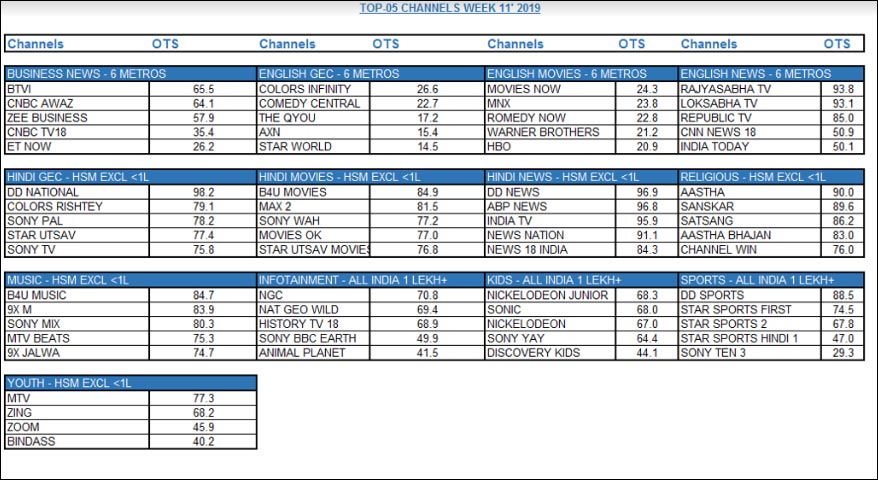
    MUMBAI: Music genre has grown 3.93 per cent with the highest opportunity to see (OTS) in week 11 of Chrome Data Analytics and Media.

    In the Music genre, B4U Music gained the highest OTS with 84.7 per cent in in HSM excluding the less than 1L-market.

    OTS is the actual census-based percentage connectivity of a channel spread across 81 million homes, as reported by Chrome DM, across analogue cable, digital cable and DTH. 

    Kids category garnered the second position in the gainers list with a growth of 3.69 per cent in all India 1L+ market. Nickelodeon Junior gained the highest OTS with 68.3 per cent. On the third position, Hindi movies genre gained 2.55 per cent growth in HSM excluding the less than 1L-market, with B4U Movies observing the highest OTS of 84.9 per cent.

    Hindi news genre marked 1.61 per cent growth in HSM excluding the less than 1L-market, with DD News witnessing the highest OTS of 96.9 per cent, followed by religious category securing fifth position in HSM excluding the less than 1L-market by seeing a growth of 1.40 per cent. Aastha gained the highest OTS with 90 per cent.

  • Analysis: Latest news television trends and consumption patterns

    Analysis: Latest news television trends and consumption patterns

    BENGALURU: The FICCI M&E 2019 report says that 43 percent of the 885 private TV channels in India are ‘news channels’. It further states that news, which commands a 7 percent share of viewership, garnered a disproportionately high share of advertising volumes.

    The FICCI M&E2019 report quotes Zee Media Corporation MD Ashok Venkatramani : “I am bullish on News TV. With the elections round the corner, its consumption can only go up. TV is still the best bet for getting the least cost reach and impact. Regional and hyper local TV would lead growth.”

    Further, according to a Broadcast Audience Research Council of India (BARC) report, after Hindi GEC and Hindi movies, Hindi news is the most watched genre in the country. The report also says that contrary to popular perception, TV viewership is high amongst youth (15-30 years) even in the digital age. Youth contribute 32 percent to total viewership with a 30 percent and 32 percent split between urban and rural India.

    An earlier BARC report says that news events cannot escape the lure of drama. And drama includes elections and election results, deaths of celebrities, high court and supreme court verdicts on celebrities and sensitive issues, major changes such as demonetisation announced by the central government, major public holidays such as Independence and Republic days, terrorist attacks and counter-attacks, etc.

    Until recently, (week 05 of 2019) BARC has been releasing weekly viewership data across a number of genres – in the public domain this has been limited to viewership data of the top 5 channels and programmes for the specific genre for channels that have its watermark. There are cases, such as Hindi GECs, performances across genres, etc., where BARC releases data across the top 10 channels, and there are genres such as Hindi business news which has only 2 channels, or the youth genre which age. BARC has gone dark subsequent to implementation of TRAI’s new tariff order and has stopped sharing viewership data in the public domain.

    Further, until 2018, BARC released viewership data of the top 5 Hindi news channels in the overall or combined Hindi speaking market or HSM (U+R), rural HSM or HSM (R) and urban HSM or HSM (U) and the top 5 English news channels. Since the first week of 2018,  BARC commenced releasing weekly data of the top 5 news channels in Kannada, Malayalam, Tamil and Telugu. Starting week 35 of 2018, BARC went a step further, it also started sharing data for the top 5 News channels in Assamese, Bangla, Marathi and Odisha languages in the public domain. Hence, it must be noted that the findings contained in this report are limited to viewership data of the top 5 news channels in a language or market.

    This report has been created by an analysis of BARC data of top 5 news channels of the respective channel/market starting from week 35 of 2018 and ending with week 5 of 2019 – hence data across 23 weeks in all. 

    It must be further noted that the period under consideration was eventful – the assembly elections to five Indian states were held during this period, hence the average news consumption during the same is likely to be higher than an annual average.

    So, how do Indians consume news across India? Granted that Hindi news genre is a large genre in its markets – more specifically the Hindi speaking market (HSM) across its rural (R) and urban (U) populations. But how much of it does each person in HSM watch? What is the breakup between HSM (R) and HSM (U) viewership of Hindi news? What about news in other languages? This paper looks at news watching trends across 10 languages and 12 markets. BARC has specified the following demographics of the news channels for the data that it releases in the public domain.

    (a)     Assamese News in Assam / North East / Sikkim(U+R): NCCS All: 2+ Individuals,
    (b)     Bangla News in West Bengal or WB (U+R): NCCS All : 2+ Individuals
    (c)     English News All India (U+R) : NCCS AB : Males 22+ Individuals
    (d)     Hindi News in HSM (U+R): NCCS All 15+ Individuals
    (d.1)            Hindi News in HSM (R): NCCS All 15+ Individuals
    (d,2)            Hindi News in HSM (U): NCCS All 15+ Individuals
    (e)    Kannada News: Karnataka  (U+R): NCCS All: 2+ Individuals
    (f)    Malayalam News: Kerala (U+R): NCCS All: 2+ Individuals
    (g)    Marathi News in Maharashtra/ Goa (U+R) : NCCS All : 2+ Individuals
    (h)    Oriya News in Odisha (U+R) : NCCS All : 2+ Individuals
    (i)    Tamil News: Tamil Nadu/Puducherry (U+R): NCCS All: 2+ Individuals
    (j)    Telugu News: Andhra Pradesh or AP/Telangana (U+R): NCCS All: 2+ Individuals

    To arrive at the per capita viewership or consumption, the author has considered the 23 week average number divided by the respective population of the respective market as per BARC India, households and individuals universe estimate – 2018 (BARC Population Estimates 2018). BARC considers HSM or Hindi speaking market as All India without the four South Indian markets. Hence, the author has subtracted the NCCS 15+ population of the four South Indian markets from the All India NCCS 15+ population to arrive at the HSM 15+ population numbers. BARC’s latest universe estimate 2018 was not adopted from week 01 of 2018, hence there could be a variance in the figures calculated in this report.

    In the case of per capita consumption for South India, the author has taken the sum of average weekly impressions of the top 5 channels for each language and then added the four sums to arrive at the total average weekly impressions for South India, this total average has then been divided by the combined 2+ population figures for each of the four languages/six states as per BARC Population Estimates 2018. In the case of English News, the author has calculated the NCCS 22+ Males population by extrapolating the overall male and female ratio and the ratio of the 22+ individuals with the all India population as per BARC individual numbers for NCCS A 22+ and NCCS B 22+. To arrive at the per capita consumption of news on the top 5 channels for the country, the 23 week average viewership of the 10languages has been divided by the 2+ population of India as per the above mentioned BARC Universe estimates. Individual HSM (R) and HSM (U) viewership numbers have not been considered to arrive at the per capita consumption of news on the top 5 channels for the country.

    Overall, Indians consumed a little more than 2.53(2.5339) weekly impressions of top 5 news channels across languages per person across the country during the 23 weeks under consideration. Comparative numbers for calendar year 2018 have not been indicated because of limitations of BARC data for the four of the languages which, as mentioned above were made available only week 35 of 2018 onward.

    Within individual markets, Malayalam news on the top 5 Malayalam news channels in Kerala had the highest per capita weekly consumption at slightly over 3.89 impressions during the 23 week period under consideration. The 52 week per capita average consumption of Malayalam news on the top 5 Malayalam news channels during calendar year 2018 was 3.34, which also was the highest in 8 markets across 5 languages – these were Hindi, the four South Indian languages and English.

    Assamese per capita news consumption on top 5 News channels in Assam / North East / Sikkim was next – at 3.84 weekly impressions during the 23 week period under consideration.
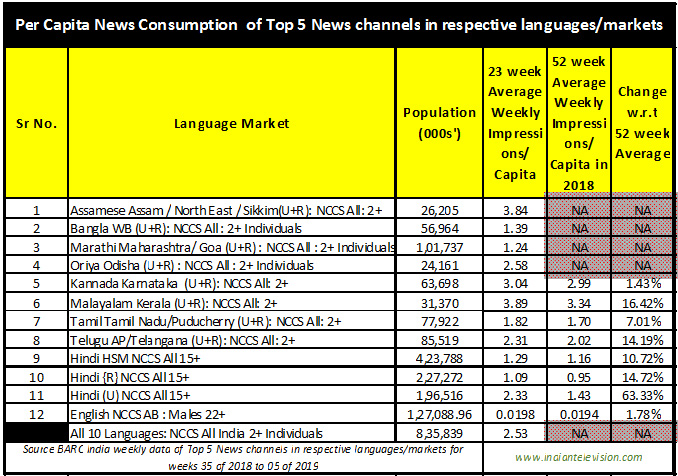
    From the chart above it is quite obvious that normally Indians consume more of regional news of top 5 news channels per capita in their respective regional markets as compared to Hindi news consumption per capita of Top 5 Hindi news channels in HSM. 

    In terms of absolute numbers, though more Hindi news is consumed than in any other language due to its larger population, the per capita consumption is lower than news consumption in regional markets, the exceptions being Marathi news in Maharashtra/Goa and Bengali news in West Bengal.

    Events such as elections result in a spike in news television viewership – as per the chart above, Hindi news viewership in HSM urban markets had a much bigger spike in viewership than other languages during election results week.

    Hindi, English and South Indian news channels performances during 2018 have already been reported by us.

    Here below are the details of performances of the top 5 news channels in the four languages based on analysis of BARC’S weekly lists released since week 35 of 2018 until week 05 of 2019.

    Assamese News in Assam/North East/Sikkim (Assamese region)

    As mentioned above, Assamese per capita news consumption on top 5 news channels in the Assamese region was just behind Malayalam news consumption on top 5 Malayalam news channels in Kerala. 

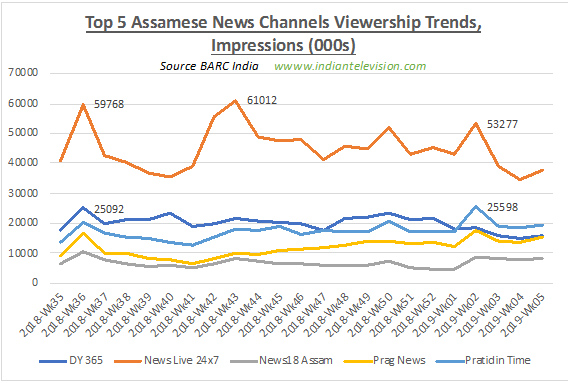
    As in the case of the other regional channels, there was one Assamese news channel – News Live 24×7 whose viewership far exceeded the viewership of other Assamese news channels. There were 5 channels that appeared in all the 23 BARC weekly lists of top 5 Assamese news channels.  Please refer to the chart below:
    Bangla News in West Bengal

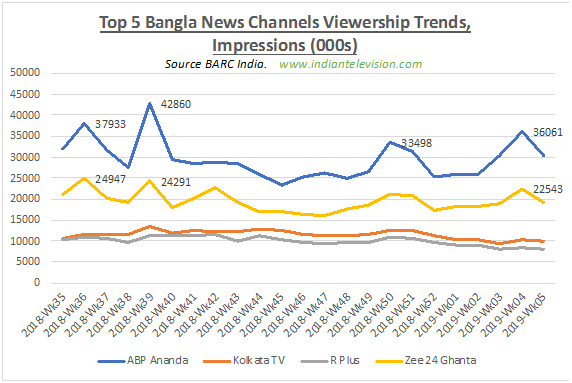
    Bangla News per capita consumption in West Bengal of Top 5 Bangla news channels was the lowest in East India – at just 1.39 impressions per week during the period under consideration. One Bangla news channel from the homegrown Bengali Media group Ananda Bazaar Patrika (ABP) – ABP News topped ratings during all the 23 weeks under consideration in this paper. Four channels were present in BARC’s weekly lists of top 5 Bangla news channels during the 23 weeks under consideration in this paper. ABP News was followed by Zee Media Corporation’s Zee Bangla. Kolkata TV and R Plus were the other two channels that were present in BARC’s weekly lists.

    Besides the above mentioned four channels, two other channels – Bangla Time (15 weeks) and News 18 Bangla (8 weeks) also appeared in BARC’s weekly lists of top 5 Bangla News channels during the period under consideration.
    Oriya News channels in Orissa

    Ten Oriya News channels  appeared in BARC’s weekly lists of top 5 Oriya News channels during the 23 weeks under consideration. They were-DY 365,Kanak News, News Live 24×7, News World Odisha, News18 Assam, News18 Odia    News7, Odisha TV, Prag News    Pratidin Time, Zee Kalinga News, Zee Odisha. None of the ten channels appeared in all the 23 weeks under consideration.

    Marathi News channels in Maharashtra/Goa

    As mentioned above, Marathi. News per capita consumption of the top 5 Marathi News channels in the Marathi market (Maharashtra and Goa) was the lowest among the languages/markets during the 23 weeks under consideration at just 1.24 impressions. Further, in the case of Marathi News also, all the 5 channels were present in BARC’s list of top 5 Marathi News channels during all the 23 weeks under consideration. 

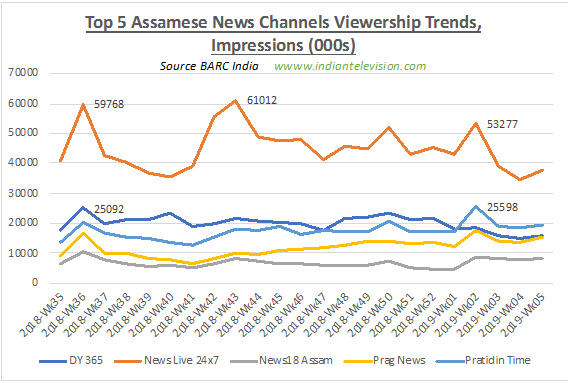
    ABP’s ABP Majha led viewership in the Marathi News space also. Saam TV was next, and was closely followed by Zee Media Corporation’s Zee 24 Taas. Please refer to the chart below for the performance of top 5 Marathi News channels during the 23 week period.

     

  • English movies most benefitted genre in Chrome week 10

    English movies most benefitted genre in Chrome week 10

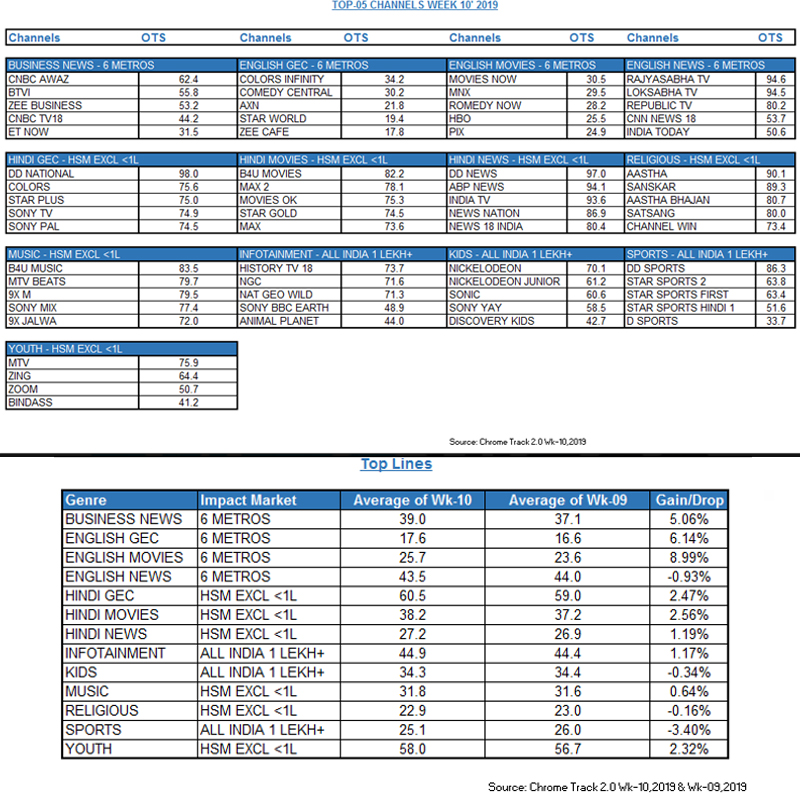
    MUMBAI: With an 8.99 per cent growth, the English movies genre has marked the highest opportunity to see (OTS) in week 10 of Chrome Data Analytics and Media.

    In English movies, Movies Now gained the highest OTS with 30.5 per cent in six metro cities.

    OTS is the actual census-based percentage connectivity of a channel spread across 81 million homes, as reported by Chrome DM, across analogue cable, digital cable and DTH.

    Top 5 channels

    English GECs garnered second position in the gainers list of OTS with a growth of 6.14 per cent in six metro cities. Colors Infinity witnessed the highest OTS of 34.2 per cent. The third position was secured by business news in the six metro cities with a growth of 5.06 per cent, with CNBC Awaz observing the highest OTS of 62.4 per cent.

    Hindi movies genre garnered the fourth position with 2.56 per cent in HSM excluding the less than 1L-market, with B4U Movies being the most benefitted channel in the category that observed the highest OTS with 82.2 per cent.

    Top lines

    The fifth position was secured by the Hindi GECs genre in HSM excluding the less than 1L-market with a growth of 2.47 per cent. DD National gained the highest OTS with 98 per cent.