Category: Terrestrial

  • DD Urdu revamps itself with a bouquet of new programmes

    DD Urdu revamps itself with a bouquet of new programmes

    MUMBAI: DD Urdu has infused fresh blood in its programming with a bouquet of new serials and shows that encapsulate the essence of our heritage and culture and feature relevant societal issues, and now they are set to enchant the audience with their creative brilliance. The step has been taken in continuation of the revamp activity that was initiated on 15th January, 2014. The time band of 6:30 pm to 10:00 pm has been scheduled for 40 new commissioned programmes.


    The shows will cover different genres to appeal to the different brackets of audience. The channel will showcase serial based on the memorable works of Urdu literary stalwart Saadat Hasan Manto, produced by Mukta Arts. Some of the fictions to be aired are based on classic Urdu literature like, ‘Bagh-o-Bahar’.


    The popular genres like thriller, comedy and musical reality shows are also included in this bouquet. DD Urdu has roped in eminent TV personalities as director/producer of the programmes, Sh. Parikshit Sahni is one them for example. A well known name of the music world, Ms. Ila Arun will direct one musical reality show titled ‘Main Khayal Hoon Kisi Aur Ka, Mujhe Sochta Koi Aur Hai’, this one hour reality show is scheduled on every Sunday at 8:00 pm.


    Other music shows based on devotion, ghazal and patriotic lyrics are scheduled in morning and evening like ‘Naghma-e-Marifat’, ‘Sada-e-Watan’ and ‘Junoon-e-Ghazal’, etc. will be televised. Four documentary series on science, painting and Urdu poets, two chat shows (one on marginality issues and other on women discourse), one health show, one cookery show, one travel show, one docu-drama named ‘Hindustan Ki Talash’ written by Hon’ble Minister Sh. Salman Khursheed, one literary programme ‘Aaftab-e-Sukhan’, one programme for children titled ‘Nasha Masiha’ are scheduled to give a fresh look to DD Urdu. Other serials like ‘Akhir Kab Tak’, ‘Aangan’, ‘Firangee’ and ‘Chiraagh’ are also to be aired.


    Adding more flavour to this feast of entertainment, 3 films are being telecast on Wednesday, Friday and Sunday at 2:00 pm, repeat at 10:00 pm. Some in-house programmes are being aired, like, ‘Guftagoo- Walk the Talk’, ‘Mubahisa’, ‘Yaadon Ke Dareeche Se’, ‘Aina-e-Maazi’ and ‘Mushaira’ etc.


    Some in-house programmes on National, Middle East, South Asia, neighbouring countries and international current affairs are also scheduled at 9:30 pm. 10 Urdu news bulletins are also on air.


  • DD, Prasar Bharati sign MoU with Korea’s Arirang TV

    DD, Prasar Bharati sign MoU with Korea’s Arirang TV

    MUMBAI: In September 2012, when Prasar Bharati CEO Jawhar Sircar led the Indian delegation to the General Assembly of the Asia-Pacific Broadcasting Union at Seoul, he called on the then President of  Korea and other dignitaries. Since then the Korean Broadcasting System and Prasar Bharati have on-going partnerships.


    However, a new partnership was sought to be made between the Korean International Broadcasting Foundation, Arirang TV and Doordarshan for which Sircar and CEO of Arirang TV Jie-Ae Sohn renewed correspondence recently in November, 2013.


    And now the two stations have signed a Memorandum of Understanding (MoU) which will allows them to share content. The CEOs from the two stations met in New Delhi on Friday and agreed to an exchange that will foster cultural ties between Korea and India.


    The Korean Minister expressed hope for a deeper cultural understanding between India and South Korea. One of the officials was quoted as saying on the Arirang News website, “Through this exchange of broadcasting and broadcasters, we can jumpstart this cultural exchange between two very strong culturally rich countries.”


    The deal took shape when ministers from both the countries were meeting to sign an MoU on Mutual Recognition of Digital Signature Certificates for Efficient E-Governance/Cross Border Trade Facilitation. Minister for Communications and Information Technology, India Kapil Sibal and Minister for Science, ICT and Future Planning, Republic of Korea Mun-kee Choi were present there.


    Under the agreement, Arirang and Doordarshan aim to make their global channels available on satellite platforms in both nations by 2014. Both parties will even explore co-production opportunities related to matters of mutual interest and share TV programmes in the cultural, educational, scientific, agricultural, entertainment, sports, news and any other possible fields. The MoU will be valid for a period of three years from the date of signature and will be automatically renewed for every following three years, unless terminated by either party by giving a written notice of three months.

    Interestingly, as the MoU was being signed, a documentary produced by Arirang TV was being aired on Doordarshan throughout India. The documentary explains the vision for the “creative economy” that President Park Geun-hye has advocated since the very beginning of her term last February.


  • Republic Day ceremony coverage to have sign language interpreter during DD telecast

    Republic Day ceremony coverage to have sign language interpreter during DD telecast

    NEW DELHI: The live telecast of the Republic Day parade by Doordarshan channels will have an additional facility this year – a sign language interpreter.


    The Information and Broadcasting Ministry (I&B) has issued directions to Prasar Bharati for making a provision for having an inset box on the TV screens during the telecast of the Republic Day Ceremony, through which the sign language anchor/expert could interpret the proceedings of the Republic Day parade on 26 January.


    The telecast will be on DD National, DD Urdu, DD Bharati and DD News. 

    The decision has been taken in the interest of all those who are differently-abled, hearing impaired citizens. I&B minister Manish Tewari received a representation from the National Association of Deaf recently requesting for providing sign language interpreter in an inset box on TV screens during the live coverage of the Republic Day Parade.

  • MTG launches its first free-TV channel in Tanzania

    MTG launches its first free-TV channel in Tanzania

    STOCKHOLM: Modern Times Group (MTG), the international entertainment group, today announced that it has launched its first ever advertising funded free-TV channel in Tanzania under the TV1 brand. The channel is available through Tanzania’s digital terrestrial network, and already reaches up to 30% of the 48 million people in the country.


    TV1 is a general entertainment channel with a mix of locally produced news and entertainment content, as well as international movies and TV series. The channel is focused on a broad, slightly female skewed, target audience of 15-49 year olds.


    TV1 will be MTG’s second African free-TV channel, and follows the launch of Viasat1 in Ghana in 2008. Viasat1 Ghana has grown rapidly since launch, and is now the country’s second largest free-TV channel with a 24% commercial share of viewing in the target audience group. The Ghanaian operation also reported its first quarterly profit already in 2013. Four of MTG’s Viasat thematic pay-TV channel brands are also available on networks in Nigeria, Uganda, Kenya, Rwanda, Tanzania and Mozambique. MTG’s production company Modern African Productions (‘MAP’) also creates a wide range of content for a number of African markets, and will support the launch in Tanzania.


    J?rgen Madsen Lindemann, President and CEO of MTG, commented: “We are proud to launch our second African free-TV channel. We are committed to further expanding our presence not just in Tanzania but also in other fast growing African countries and economies.  We will bring viewers a wide range of local and international shows that will provide top quality entertainment for the whole family.”


    Joseph Hundah, Executive Vice President of the Group’s African operations, commented: “TV1 is our second free-TV channel launch in Africa, and we have benefitted both from our experience of launching a channel in Ghana, and from our presence in Tanzania through our pay channels over the past few years. We have built everything from the ground up to ensure that we have the best possible local facilities, to provide the platform for future growth and, most important of all, to ensure that we deliver the most exciting, relevant and engaging TV experience for our audience.”

  • Satellite & cable pay-TV subs slow down: Study

    Satellite & cable pay-TV subs slow down: Study

    MUMBAI: The satellite and cable pay-TV market is slowing down due to the emergence of new technology platforms.
     

    Net subscriber addition in the global pay-TV market increased by two per cent in the third quarter of the year over the prior quarter, according to ABI Research’s recent pay-TV market data.

    ABI Research practice director Jason Blackwell said, “The global number of pay-TV subscribers reached 692 million in the third quarter of 2010. Pay-TV subscriber growth is holding steady in a number of world regions.”
     

    Pay television markets have experienced many changes due to the entry of a number of new television platforms. These new platforms, such as digital terrestrial TV and online video, are stimulating more competition to the traditional pay-TV services. As a result, there is slower subscriber growth in satellite and cable television services.
     

    The slow growth in subscribers is notable especially in Western Europe and North America where the penetration rate is high. However, satellite and cable TV growth is expected to remain strong in the regions such as Eastern Europe and Latin America.
     

    Pay digital terrestrial television has seen success in countries such as France, Italy and Spain. Italian pay terrestrial television provider Mediaset is the leader in the pay terrestrial TV market. Mediaset added nearly 300,000 subscribers in 2Q-2010 to reach a total subscriber base of 4.4 million.
     

    ABI research associate Khin Sandi Lynn said, “At this moment Western Europe, with a comprehensive 99 per cent of the terrestrial pay-TV market, holds the largest terrestrial television market share”.
     

    There was strong growth in worldwide IPTV subscriptions in the third quarter of 2010, with more than 2.7 million IPTV subscribers added. Global broadband penetration is increasing, as well as the broadband speed. High-speed broadband opens an opportunity for operators to offer IPTV services. Western Europe remains the largest IPTV market, followed by the Asia-Pacific region and North America.
     

    ABI Research expects that the worldwide IPTV subscriber base will exceed 53 million at the end of 2011.

  • China to launch high-definition terrestrial digital TV broadcast in 2008

    China to launch high-definition terrestrial digital TV broadcast in 2008

    MUMBAI: China will launch high-definition terrestrial digital TV broadcasts in 2008. A five-year (2006-2010) guideline on cultural development has been published.

    Media reports inform that China also aims to replace the existing analog cable television with digital cable television in all the cities in its eastern and central regions and most of those in the western area by 2010.”

    A report in Xinhua states that China will adopt a terrestrial digital TV broadcast standard – the mandatory broadcast signal for Chinese broadcasters – on 1 August next year. A study by Research and Markets further notes that China plans to stop the transmission of analogue television by 2015. With the rise of DTV, China has established relevant policies to gradually eliminate analogue TV and enter the era of DTV.

    Though compared with developed countries, China is lagged far behind in the field of digital TV, yet it made rapid progress in 2005; altogether 4.13 million Chinese subscribed digital TV, increasing by over twofold compared to the previous year. Among them, 3.97million were digital cable digital TV subscribers.

    Also, problems can be found in Chinas DTV industry. They are backward standard, difficulties in network consolidation, deficient terminal, immature market, serious shortage of content, deep-rooted receiving habit, want of price system, immature core technology, incomplete DTV industrial chain, need of further probe in business modes and systems. All these factors severely restrict the development of the DTV industry in China.

    It can be seen from the development trend that DTV is bound to substitute for analog TV,. However, as to digital pay TV, China is still exploring a suitable operation mode and there is still a long period of time before its maturity. SARFT (The State Administration of Radio Film and Television) of P.R.C. is always vigorously popularizing DTV in China. The Chinese government, along with channel suppliers, channel integrators and cable network operators is zealous about the popularisation of DTV, offering a fairly good and unique circumstance for the development of digital pay TV.

  • Ofcom seeks additional HD channel on Digital Terrestrial TV

    Ofcom seeks additional HD channel on Digital Terrestrial TV

    MUMBAI: UK media watchdog Ofcom has invited applications from broadcasters for a fifth HD channel on Digital Terrestrial TV. This decision will mean that a new HD channel could join the existing four HD channels broadcast on multiplex B: BBC HD, BBC One HD, ITV1 HD and 4HD.


    Applications are open to commercial Public Sector Broadcasters, which include the Channel 3 licences, Channel 5, Channel 4, and the Welsh Authority. The closing date for applications is 17 October.

  • Ofcom aproves Sky’s request for pay-TV services on digital terrestrial TV

    Ofcom aproves Sky’s request for pay-TV services on digital terrestrial TV

    MUMBAI: UK media watchdog Ofcom has announced that after three rounds of consultation, it has made three decisions: Sky Sports 1 and 2 to be offered to retailers on platforms other than Sky’s at prices set by Ofcom; to approve Sky and Arqiva’s request for Sky to offer its own pay TV services on digital terrestrial TV (Picnic), but conditional on a wholesale must-offer obligation on Sky Sports 1 and 2 being in place, with evidence that it has been effectively implemented; and to consult on a proposed decision to refer two closely related movie markets – for the sale of premium movie rights and premium movie services – to the Competition Commission. 

    Ofcom notes that the pay TV sector has delivered substantial benefits to consumers since its emergence in the early 1990s. More than 12 million consumers now pay to access a greater choice of content, at higher quality, and with a greater degree of control than has historically been available from free-to-air broadcasters. Sky has been at the forefront of this development and has delivered substantial benefits to millions of consumers in the UK.


    Pay TV services have to date been delivered primarily via satellite and cable networks. However, this investigation comes at a time of disruptive change in the way content is distributed. For example, digital terrestrial TV offers the scope for pay TV to be delivered via aerials, and new broadband networks could offer consumers an unprecedented choice of content, and the ability to access that content on demand.


    The ability to provide such services depends not just on technology, but on access to content that consumers want to watch. Live high-quality sports and recent Hollywood movies retain an enduring appeal for many consumers. Access to this content has driven the historical development of pay TV. This will remain crucially important for the development of new platforms and new services.


    For many years Sky has held the exclusive rights to broadcast first-run Hollywood movies and many of the most sought-after premium sports. Ofcom has now concluded that Sky has market power in the wholesale of certain channels including this content. However, the position differs between sport and movies: 
    Sky’s position in sport arises from the unique ability of broadcast TV to reach a large live audience, and Sky’s control of the live broadcast rights for many of the most important sports. This is unlikely to change in the next few years.


    The position in movies is more complex, since there are a variety of ways consumers can purchase movie content, and the importance of linear channels is starting to reduce. Looking forward, Ofcom expects video-on-demand to become increasingly important. However, Sky controls not only all the major linear channel movie rights, but also all of the rights that would be required to develop a subscription video-on-demand service for first-run Hollywood movies.


    Ofcom notes that Sky exploits its market power by limiting the wholesale distribution of its premium channels, with the effect of restricting competition from retailers on other platforms. This is prejudicial to fair and effective competition, reducing consumer choice and holding back innovation by companies other than Sky. In the case of movies, the fact that Sky also owns but barely uses the subscription video-on-demand rights denies competitors the opportunity to develop innovative services. 

    Ofocm has decided to use its powers under section 316 of the Communications Act to ensure fair and effective competition by requiring Sky to offer the most important sports channels – Sky Sports 1 and Sky Sports 2 – to retailers on other platforms: 
    Given that it cannot expect commercial agreement between Sky and other retailers, Ofcom has set a price for standard-definition versions of these channels at a level that should allow an efficient competitor to match Sky’s retail prices. The calculations are based on Sky’s own retail costs, adjusted for scale so as to allow for a market with several competitors rather than a single provider.


    Ofcom has set a wholesale price for each of Sky Sports 1 and 2, when sold on a standalone basis, which is 23.4 per cent below the current wholesale price to cable operators. Most consumers currently buy packages which include both channels, and the wholesale price for the service bundle which applies in those circumstances has been reduced by 10.5 per cent.


    In calculating these prices, Ofcom has taken into account the additional retail revenue generated by Sky from its Multiroom service enhancement, and have also taken into account any associated costs. Other retailers will be free to develop their own service enhancements, including offering Multiroom-type services, by using the same underlying wholesale product at no additional cost.


    Ofcom adds that it has not set a price for high-definition versions of Sky Sports 1 and 2. It has accepted Sky’s argument that high-definition services are a relatively recent innovation, and that pricing flexibility will help promote future innovation. Ofcom just requires Sky to offer contractual terms for supply of these channels on a fair, reasonable and non-discriminatory basis.


    Ofcom says that it has provided guidance on a number of non-price matters such as security, to ensure that the remedy is implemented as quickly as possible. 


    Further Ofcom has decided it would not be appropriate to impose a similar obligation on Sky’s movies channels. Ofcom has expressed concerns over restricted distribution of movies channels, but the main forward looking concern relates to the sale of video-on-demand rights. It says that it cannot adequately address this concern under section 316 (which relates primarily to linear channels). Instead it belieevs in making a reference to the Competition Commission under the Enterprise Act 2002, and as required by statute.


    Ofcom has consented to Picnic, subject to a wholesale must-offer obligation on Sky Sports 1 and 2 being in place, and evidence that it has been effectively implemented. This conclusion is also subject to any movies channels included in Picnic being offered to other DTT retailers. These conditions will allow consumers to benefit from access to Picnic, while also ensuring fair and effective competition.


    Ofcom expects these decisions to deliver substantial benefits to consumers. The most immediate benefit will be felt on digital terrestrial television. 10 million Freeview households will, if they so choose, be able to access the most attractive sports content via their existing aerials, and competition between Sky and other retailers should ensure a wide range of packages, including lower-priced entry-level bundles.


    Improved access to ‘must-have’ content will incentivise investment in new means of distributing content, such as faster broadband networks. In the longer term, this will result in a range of innovative new services for consumers.

  • French football to air on UK terrestrial TV for first time

    French football to air on UK terrestrial TV for first time

    MUMBAI: The UK’s Channel 4 will air French league matches from the middle of this month in a deal with TWI, who will also produce the show.
     

    It will be the first time France’s Ligue 1 (the LFP – Ligue de Football Professionel) is shown on terrestrial television in the UK. And it will bring the French game to a new generation of football fans as C4 did previously with its coverage of Football Italia.

    The action will kick off with a series of Saturday night games shown from 13 November, followed by matches and highlights on Sunday mornings from 9 January.

     
    It will feature games by players like French international and former Manchester United star Fabien Barthez, who now plays with Ligue 1 side Marseille, or ex- Arsenal player Sylvain Wiltord, now with Lyon.

    TWI recently won a four-year deal for the international broadcasting rights to Ligue 1. It also already produces the sports magazine show Trans World Sport, which is shown on C4 on Sunday mornings, and gains a 260 million audience across 131 countries.

  • Analog Terrestrial TV Homes to decline 24 per cent by 2008

    Analog Terrestrial TV Homes to decline 24 per cent by 2008

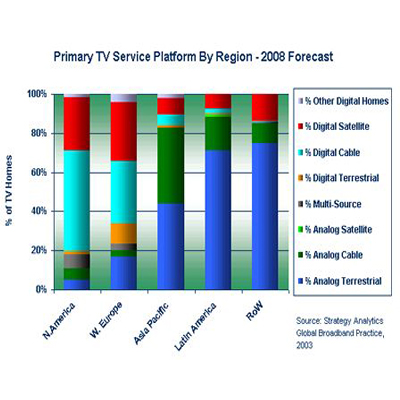
    LONDON : New research from Strategy Analytics, the global analyst and consulting firm, quantifies the steady decline of analog television broadcasting and the progress towards so-called ‘Analog Switch-Off’.
     

    The report, published to subscribers to the Broadband Entertainment Strategies service, shows that 597 million homes worldwide used analog terrestrial broadcasting as their primary TV service in 2002. With the growth of digital television services offered by satellite, cable and terrestrial operators, this number is forecast to decline by 24 per cent to 455 million by 2008.

    North America and Europe will be the most advanced markets in the digital TV transition by 2008, but the majority of homes in the rest of the world will still use analog terrestrial TV as their primary service. Even in the most advanced markets, however, a realistic analog switch-off strategy will have to account for the additional costs of converting hundreds of millions of secondary TV sets and VCRs.

    Analog switch-off is seen as a key policy goal by most governments. Releasing this valuable spectrum could ultimately lead to major new commercial and public revenue opportunities. The report suggests that few, if any, countries will be 100 per cent digital until well into the next decade. Some countries, such as Germany, will instead seek to use analog platforms such as cable as an alternative to terrestrial broadcasting. The report recommends that broadcasters relying strongly or wholly on analog terrestrial broadcasting for access to viewers must consider implementing alternative strategies and distribution partnerships in order to safeguard their long term position.