Category: Sports

  • Sony Six earns highest viewership in 2014

    Sony Six earns highest viewership in 2014

    MUMBAI: Sony Six amassed over 181 million viewers all over India in 2014. The channel saw 40 per cent of its viewership (74.1 million) coming from the youth segment (15-35 years age group), whereas 45 per cent of the total viewers (82 million) were female viewers. Both figures are the highest for any sports channel in calendar year 2014 (Source: TAM, CS 4+, All India).


    Sony was the second most viewed network in terms of total sports viewership, GVMs (gross viewers in millions) by any network. The Sony Network contributed 5,635 GVMs, across all the sports offering in 2014. The figures are cumulative GVMs accumulated by the coverage of all sporting events by the channels within the respective network.


    Sony Six business head Prasana Krishnan said, “It is a proud moment for us, as 2014 has been a defining year for the channel. We have established ourselves as one of the leading sports broadcasters in the country just within two years of our launch. With an exciting line-up for 2015 we hope to carry forward the momentum and serve a diverse brand of sports programming, which has hitherto not been seen on Indian television.”


    The channel began the year by airing the Indian cricket team’s tour of New Zealand, which gave an immediate thrust to its viewership. This was soon followed by the telecast of two of the biggest sporting events of the calendar year in Pepsi IPL and the FIFA World Cup 2014. In terms of other marque properties, NBA witnessed a significant rise in its viewership during the playoffs and the finals of its last season, which concluded earlier this year.


    Besides that they also managed to earn broadcasting rights of events like Australian Open Tennis and African Club of Nations football.


  • Team India’s new World Cup jersey unveiled in Melbourne

    Team India’s new World Cup jersey unveiled in Melbourne

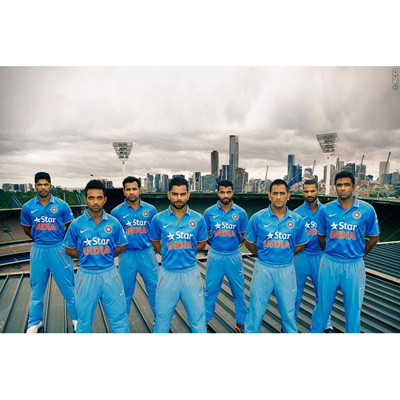
    MUMBAI: The Board of Control for Cricket in India (BCCI) along with the official apparel sponsor Nike has unveiled the new jersey for ‘Team India’ at the Melbourne Cricket Ground. With the tri-series knocking at the door, which will lead the team to the all important World Cup 2015, this effort from BCCI will surely help the cricketers to start fresh.
     
    The new kit has a different shade of blue and is said to be an improvement from the previous version. The improvisation is not limited to colours but also inputs from players were regularly taken in order to make the jersey as comfortable as possible. Additionally, apart from inputs from the Indian cricketers, Team India’s uniform was designed by listening to the voice of the athletes and collecting data on the form and movement of today’s players on the field.


    Following extensive research and athlete driven insights, Nike designers created a new dynamic fit using a unique four way stretch fabric ideal for cricket, enhancing comfort for the players and allowing the body to move naturally within the kit. The Nike Dri-FIT technology and Nike Pro Baselayer helps regulate the player’s body temperature through increased venting and breathability for players to stay focused on their game.


    Besides all, one of the key significance of the kit is its environment friendly quotient. It is made out of 100 per cent recycled polymers, which means one complete kit takes away 33 thrown plastic bottles away from the atmosphere.
     
    “The new Team India uniform is light, comfortable and packed with innovation to help minimise distractions on the field of play and that’s critical when millimeters make a difference between a game winning innings or wicket. 2015 is a massive year for Team India as the best teams in the world compete for cricket’s greatest prize. The Team India jersey truly symbolizes the passion for cricket in our nation; wearing this jersey is a matter of pride for every player,” said Indian cricket team captain Mahendra Singh Dhoni.


    BCCI secretary Sanjay Patel emphasised on the emotional attachments. “This is more than just a jersey; this is the passion of a billion hearts, the colour that unites the entire nation. We are pleased that Nike has used its global expertise to adopt innovative technologies from different sports and craft them to the specific needs of Team India players. The new kit is a perfect testimonial to Nike’s dedication in delivering nothing but the best,” he said.
     
    After a disappointing series in whites, it is time for Team India to conquer new heights and winning the tri-series will be perfect beginning for the team in the new kit.

  • IPL teams keep their ‘core’ intact

    IPL teams keep their ‘core’ intact

     MUMBAI: A total of 123 cricketers including players were retained by the franchises for the 2015 Pepsi Indian Premier season. Five Indian cricketers including Unmukt Chand and Vinay Kumar have been traded during the window for player trade this year. 

    The window for the franchises to extend the player contracts on existing terms for Pepsi IPL season closed on 15 December 2014. 


    The released players now have an option to register for the auction from where they can be picked by any interested club.

    IPL chairman Ranjib Biswal commented, “Teams have the right, at their sole election, to extend player contracts for another season. This allows for teams to make any course corrections to their squads as a way to strengthen their team ahead of the next season. It is a way to balance the need for continuity whilst allowing for churn which is very important from the league’s perspective. The released players will have the option to put their names up for the player auction for the 2015 season.”

    Teams have a total salary purse of Rs 63 crore for the 2015 season (5 per cent increase over the 2014 season purse). The salaries of the players retained will be deducted from this amount. 

    Here are the details of the retained and released players for 2015 season:


    CSK (Retained Players): MS Dhoni, Ashish Nehra, Baba Aparajith, Brendon McCullum, Dwayne Bravo, Dwayne Smith, Faf du Plessis, Ishwar Chandra Pandey, Matt Henry, Mithun Manhas, Mohit Sharma, Pawan Negi, R Ashwin, Ravindra Jadeja, Samuel Badree, Suresh Raina, Ronit More. 


    CSK (Released Players): Ben Hilfenhaus, John Hastings, Vijay Shankar, David Hussey.


    DD (Retained Players): Jean-Paul Duminy, Kedar Jadhav, Manoj Tiwary, Mohammad Shami, Nathan Coulter-Nile, Quinton De Kock, Saurabh Tiwary, Shahbaz Nadeem, Mayank Agarwal, Imran Tahir, Jayant Yadav.


    DD (Released Players): Dinesh Karthik, HS Sharath, James Neesham, Jaydev Unadkat, Kevin Pietersen, Laxmi Ratan Shukla, Milind Kumar, Murali Vijay, Rahul Sharma, Rahul Shukla, Ross Taylor, Siddarth Kaul, Wayne Parnell.


    KXIP (Retained Players): Axar Patel, Anureet Singh, Beuran Hendricks, David Miller, George Bailey, Glenn Maxwell, Gurkeerat Singh Mann, Karanveer Singh, Manan Vora, Mandeep Singh, Mitchell Johnson, Parvinder Awana, Rishi Dhawan, Sandeep Sharma, Shardul Thakur, Shaun Marsh, Shivam Sharma, Thisara Perera, Virender Sehwag, Wriddhiman Saha.


    KXIP (Released Players): Cheteshwar Pujara, Lakshmipathy Balaji, Murali Kartik. 


    KKR (Retained Players): Gautam Gambhir, Andre Russell, Chris Lynn, Kuldeep Yadav, Manish Pandey, Suryakumar Yadav, Morne Morkel, Patrick Cummins, Piyush Chawla, Robin Uthappa, Ryan ten Doeschate, Shakib Al Hasan, Sunil Narine, Umesh Yadav, Veer Pratap Singh, Yusuf Pathan.


    KKR (Released Players): Debabrata Das, Sayan Sekhar Mandal, Jacques Kallis.


    MI (Retained Players): Rohit Sharma, Aditya Tare, Ambati Rayudu, Corey Anderson, Harbhajan Singh, Jasprit Bumrah, Josh Hazlewood, Keiron Pollard, Lasith Malinga, Marchant de Lange, Pawan Suyal, Shreyas Gopal, Lendl Simmons, Unmukt Chand, R Vinay Kumar.


    MI (Released Players): Michael Hussey, Praveen Kumar, Ben Dunk, Pragyan Ojha, Jalaj Saxena, Krismar Santokie, Sushant Marathe, Apoorv Wankhade, Zaheer Khan, C.M. Gautam.


    RR (Retained Players): Shane Watson, Abhishek Nayar, Ajinkya Rahane, Ankit Nagendra Sharma, Ben Cutting, Deepak Hooda, Dhawal Kulkarni, Dishant Yagnik, James Faulkner, Kane Richardson, Karun Nair, Pravin Tambe, Rahul Tewatia, Rajat Bhatia, Sanju Samson, Steven Smith, Stuart Binny, Tim Southee, Vikramjeet Malik.


    RR (Released Players): Amit Mishra, Ankush Bains, Brad Hodge.


    RCB (Retained Players): Virat Kohli, AB deVillers, Chris Gayle, Mitchell Starc, Nic Maddinson, Varun Aaron, Yuzvendra Singh Chahal, Rilee Rossouw, Vijay Zol, Yogesh Takawale, Abu Nechim Ahmed, Harshal Patel, Ashoke Dinda, Sandeep Warrier, Manvinder Bisla


    RCB (Released Players): Albie Morkel, Muttiah Muralitharan, Ravi Rampaul, Sachin Rana, Shadab Jakati, Tanmay Mishra, Yuvraj Singh.


    SRH (Retained Players): Shikhar Dhawan, Ashish Reddy, Bhuvneshwar Kumar, Chama Milind, Dale Steyn, David Warner, Ishant Sharma, Karn Sharma, KL Rahul, Moises Henriques, Naman Ojha, Parveez Rasool, Ricky Bhui.


    SRH (Released Players): Aaron Finch, Amit Mishra, Amit Paunikar, Brendan Taylor, Darren Sammy, Irfan Pathan, Jason Holder, Manprit Juneja, Prasanth Parameswaran, Srikkanth Anirudha, Venugopal Rao.

  • World Kabaddi League features in top sporting properties in inaugural year

    World Kabaddi League features in top sporting properties in inaugural year

    MUMBAI: After its initial season, the Wave World Kabaddi League (WKL) attracted an aggregate reach of just over 101 million individuals as per TAM India in its very first edition placing it among the top five sporting properties in India, claim the organisers.


    This is both in terms of viewers as well as visibility to sponsoring brands. The league, which was telecast live on Sony Six, also garnered 1.5 million views on YouTube with 60 per cent of the views coming in from the diaspora in United States, Canada, UK and as far as Italy. Additionally an estimated 50 million reach was acquired through international feed in Pakistan, Middle East, Europe, US and Canada.


    WKL CEO Raman Raheja said, “We are overjoyed with the response to the WKL in its very first year. The idea of keeping the latter and final parts of the WKL in India, where the sport is extremely popular, also paid rich dividends in terms of TV exposure for the sponsors. We are now looking to a bigger event in the second edition.”


    Repucom, a research company that measures ROI for all sports across the world, gave an interesting comparison of WKL’s sponsored property exposure on TV as compared to other sports. Repucom India analyzed that the 86 matches played during the first season garnered as many as 143 hours of screen exposure, which translated into an hour and 40 minutes of exposure per match.


    The event as a whole received media value worth Rs 301,02,60,323 for 86 matches with an average worth of Rs 3,50,03,027 per match.  Wave Infratech’s media value was put at Rs 135,90,62,603 for all the matches at an average Rs 1,58,03,054 per match.


    Title sponsors, Wave Infratech, earned maximum visibility and ROI with 45 per cent of share compared to all the other sponsors exhibited during the event. Among other main properties, the static board earned 37 hours on screen exposure (18 per cent share compared to other sponsors) and the  Jersey front was the second leading property with 22 hours on screen exposure (19 per cent share compared to other sponsors).


    Repucom South Asia/India director and senior vice president- Joseph Eapen said, “We recommend that teams acquire more sponsors on the team apparels like jersey front, jersey back, jersey side, chest logo and trousers to cash the exposures and value from apparels.”


  • Fan base needs to increase for sports team monetisation: Panel

    Fan base needs to increase for sports team monetisation: Panel

    MUMBAI: India’s evolving sports ecosystem has a lot to offer in terms of opportunities for monetisation. But in order for that to happen, a stronger fan base with long term loyalty to respective teams and better infrastructure like stadiums need to be created. This was the opinion shared at a session on monetisation from sports in India titled ‘The M-Word “Monetisation”- Lessons To Learn,’ which was held at the Australia Business Week in India.
     
    The panelists included, Australian proximity engagement company and Touch Holdings managing director Simon Szewach, Populous senior principal Andrew James and SE TransStadia COO Hiren Pandit. The session was moderated by Victoria University Dean College of sport and exercise science professor Hans Westerbeek.
     
    The discussion began with Westerbeek asking the panelists whether it was worth investing in Indian sports? Pandit shared his knowledge by replying that investment in Indian sports can be seen in two ways; either as an associate with the sport or as a pure business investment. “Is the sport like the Indian Premier League (IPL) large enough for all franchises to make money?” he asked. He added saying that apart from making profits from their respective teams, owners had used their franchises for other better purposes than just receiving ROI. “The UB Group, which owns the Royal Challengers Bangalore uses the team to gain visibility because advertising of liquor brands is not allowed in India,” he informed.
     
    James felt that passion for the sport was the first step necessary for investment, followed by steps to connect with fans. “Currently there is a boom in the UK to build stadiums so that English Premier League (EPL) teams can connect better with the fan base. On the other hand, the Liverpool team has more fans in Indonesia than in the UK.” He opined that it was now necessary to capture this fan base and monetise it. For example Liverpool selling its jerseys in Indonesia and making profits from the same.
     
    Castellino then said that the honeymoon period, whereby sports is only looked in terms of passion, was over. “Sports should now be looked as a business seriously,” he said. He went on to say that it was a challenge to create winning franchises, which could deliver not just during tournaments but also during non-game events in order to pull in fans. Providing an analogy he said Manchester United had 80 per cent of its fan base in different parts of the world and 20 per cent only in the UK! He found that teams should first gather fans of this scale on board and then make money.
     
    Westerbeek then posed a second question: “Famous clubs like Real Madrid and Barcelona are fan membership driven, wherein the profits are directed back towards these clubs. Is the club membership model effective in India?”

    Pandit, relating to the share market, said that India’s population was very large versus the size of investors, which was very small. He also found it difficult to define a “fan” in India due to their fickle nature as they tend to follow only a winning team. He therefore said that India was not ready to have a model where fans could own a team. “India is not a sporting nation but a nation of couch potatoes, who want to lie back and watch a match on television. Single person investors are ready but not 1,000 fans,” he emphasised.
     
    Szewach at this point interjected and said, “Passion for sports drives out when not reinforced through constant messages. There is a need to constantly engage with fans throughout the year.” He lamented about how he found it difficult to purchase jerseys of the IPL franchises in sport shops, even when the event was just a few months away.
     
    Castellino felt that professionalism, which has entered the Indian sports ecosystem now, would help in its growth in the long run.
     
    The discussion then revolved around the role of federations in India and if they were a stumbling block when it came to monetisation of sport entities.

    Pandit opined that most federations were interested in governing the sport rather than promoting it. “It is a complicated situation,” he said, adding that the challenge currently would be to prove to the government that they are only required for the short term and entities can become self sufficient in the long run. “Studies have shown that our stadiums are used only for two per cent of the time and therefore are under utilised. There exists a vicious cycle between grassroots programme and monetisation,” he said.
     
    James recalled his first visit to India 10 years ago wherein he met N Srinivasan and Lalit Modi. He found it shocking how one single Indian player could earn more income versus the revenue generated by stadiums. “It is extremely inexpensive to build a stadium in India versus the cost of building a 500 million pound stadium in the UK,” he said.

    Post the discussion, the panel was seen sharing their thoughts with the audience. They were of the opinion that much more was needed to be done and there were a lot of opportunities for sponsorships for various teams. Westerbeek concluded by saying, “It is about two magic words – ecosystem and opportunities – for the Indian sports market. A lot more concrete definition would come by in the next five years.”

  • Asia’s investment in US Sports makes it an ‘Emerging Giant’: Repucom

    Asia’s investment in US Sports makes it an ‘Emerging Giant’: Repucom

    MUMBAI: Over the past three years, investment from Asia into US sports franchises has been growing consistently. This comes in wake of a report released by sports management company Repucom titled ‘Emerging Giants’, which states that in the past two years, close to $1.1 billion has been invested by Asian businessmen in US Sports franchises.

    All of the US big leagues now have at least one team fully or partially owned by an Asian-born investor. Asian ownership first came to American sport when Japanese company Nintendo bought the Major League Baseball (MLB) Seattle Mariners back in 1992. Ever since the team imported Ichiro Suzuki, who emerged as one of the great players in MLB history, there has been a steady stream of Japanese talent into the US league, drawing the world’s two biggest baseball markets closer to one another. Nintendo remains one of the few corporate owners of US teams.

    According to the report, one of the most well-known Asian investors in US sport is Chinese-born software mogul Charles Wang of Computer Associates became the majority owner of the New York Islanders of the National Hockey League (NHL) in 2004. After failing in his efforts to get a new arena approved for the team in its original suburban New York location, he has decided to move the Islanders to Brooklyn’s Barclays Center for the 2015-16 season as the new arena’s anchor ice hockey tenant. India’s Vivek Ranadive’s investment in National Basketball Association (NBA)’s Sacramento Kings’s is pegged at $ 348 million.

    Major investment in US sports sponsorship has been dominated by three big exporters from the region i.e South Korea, Japan and China and the key industry sectors are  automotive, consumer electronics and sports apparel.

    Recent deals such as India’s Tata Consultancy Services’ decision to sponsor the New York Marathon has been pegged at $ 3.8 million. South Korean automotive brand Kia and their deal with LeBron James has been reported to be around $ five million and Kumho Tires’ deal with the NBA has been pegged at $ 2.6 million.

    South Korean investment has come mainly in the shape of Hyundai, Samsung and Kia. Hyundai invested $8 million into the naming rights of the Hyundai Tournament of Champions on the PGA Tour in 2011 and Samsung’s $33.3 million per year deal with the NBA in 2013 has made the electronics company the league’s supplier of mobile device and televisions. As part of the agreement, referees of games in the NBA as well as the WNBA and NBA Development League will use Samsung tablets alongside the basketball court to review plays. Kia chose another route into US sports by targeting one of the most iconic venues in the country. Their $ seven million sponsorship deal with Madison Square Garden (MSG) in New York gives the company prominent signage in this famous arena, a custom-built display space at the entrance for its cars, tie-ins with the MSG owned New York Knicks (NBA) and Rangers (NHL) and an expanded presence on the MSG regional sports networks. Japan’s Sony Electronics sponsorship and technology agreement with the Barclays Centre in Brooklyn, home of the Nets NBA franchise, is another example of big name property rights purchasing. As part of the deal, 600 Sony professional and consumer HD screens are positioned throughout the arena.

    Besides economic growth, the report mentions the various reasons for the driving trend for investment in sport which are as follows:

    1) Health-The rise in interest and participation in sport is a reflection of efforts to promote health, and companies in the Middle East and Asia are using sponsorships of global sports as a means to engage local consumers with a healthy and active lifestyle message.

    2)  Entertainment- With the growth of television and internet, the appetite for entertainment has surged across the Middle East and Asia. Given the lack of local sports attractions and the time required to build new clubs and franchises, investment in global sports properties is a short-cut to delivering programming that engages audiences.

    3) Growing young population- Brands from the Middle East and Asia are using sponsorships of key global sports to target and engage this youth population.

    4) National Unity- Governments from the Middle East and Asia see investment in sport as a key means by which to promote national unity in what are often markets which have very fragmented sociocultural sub-pockets, domestically speaking.

    5) Social mobility- Encouraging people from all levels of society to follow and engage with sport, offers them a level playing field for social interaction.

  • ICC unveils commercial rights protection programme for Cricket World Cup 2015

    ICC unveils commercial rights protection programme for Cricket World Cup 2015

    MUMBAI: Following a successful partnership during the ICC Champions Trophy 2013 and the ICC World Twenty20 2014, the ICC has continued its engagement of Copyright Integrity International (CII) to work closely with its in-house legal team on the management of a comprehensive rights protection programme for the ICC Cricket World Cup 2015, which gets underway on 14 February, 2015 in Australia and New Zealand.


    Based in Bengaluru, India, CII is a privately-held specialist in online and offline anti-piracy protection services for sports clients. It will provide the ICC with a suite of commercial rights-protection and anti-piracy services and solutions such as online content and broadcast protection, comprehensive trademark and brand protection, and media terms enforcement, in a programme designed to protect the ICC’s intellectual property rights from the threats of piracy, ambush marketing and unlicensed use.


    ICC general counsel Iain Higgins said, “Our commercial partners and sponsors make our events possible and generate significant funding for the global game. The aim of the ICC’s commercial rights protection programme is to maintain the exclusivity of their association with our events. It is vital that those rights are protected so that our partners’ investments can be channelled into the development of cricket throughout our 105 Members.”


    CII head – legal & business affairs Roshan Gopalakrishna added, “It’s a privilege to continue our engagement with a client such as the ICC to manage the commercial rights protection programme for the ICC Cricket World Cup 2015. Our role will include not only the monitoring and enforcement of infringements but also an education programme for the public that will ensure enjoyment of and engagement with the event with due respect to the ICC’s commercial partners and sponsors.”


    The ICC’s legal team has been working hard over the past few months to develop strategies to monitor and combat unlawful association with the ICC Cricket World Cup 2015.


    As part of that programme, it has recently released brand and content protection guidelines for the tournament. Through a series of easy to understand FAQs and illustrations, this document provides companies and members of the public with a useful guide to how they might associate with the event without infringing the rights that have been granted to the ICC’s official partners.


  • Sony Six to telecast Australian Open live from 19 January

    Sony Six to telecast Australian Open live from 19 January

    MUMBAI: Sony Six is set to telecast the Grand Slam of Asia Pacific region, the Australian Open, in India for duration of five years. The channel will exclusively telecast all the matches of the tournament live from 2015 till 2019.  Having shown ATP tournaments earlier, this will be Six’s first entry into broadcasting a Grand Slam event.


    Commenting on the development, MSM CEO NP Singh said, “Over the years, the Australian Open has established itself as one of the most watched tennis grand slams across the world. Going by the strong equity that the sport enjoys, we are committed to expand the distribution of the tournament further and thereby strengthen our position in the market.”


    Six EVP and business head Prasana Krishnan commented, “The tournament is seen as a season opener which sets the context for all tennis competitions that follow during the rest of the calendar year. Needless to say, we are proud to have this prestigious event as part of our bouquet of international sports content.”


    The Open is held annually over the last fortnight of January in Melbourne Australia. First held in 1905, the tournament is chronologically the first of the four Grand Slam tennis events of the year. The tournament features men’s and women’s singles; men’s, women’s, and mixed doubles and junior’s championships; as well as wheelchair, legends and exhibition events. Since 1988, the tournament has been played on hard courts at Melbourne Park.


    Tennis Australia CEO and Australian Open Tournament director Craig Tiley said, “I’m delighted that we are partnering with MSM in India for the Australian Open. MSM presented a compelling proposition and demonstrated a commitment to promote the event and the sport of tennis in India cementing our position as the Grand Slam of the Asia-Pacific.”

  • Sporting entities to evolve by building digital and social assets: GroupM ESP

    Sporting entities to evolve by building digital and social assets: GroupM ESP

    MUMBAI: The year 2014 saw the sports landscape in the country being altered as maiden sports leagues were introduced. But what will be the road ahead for the category? GroupM ESP (Entertainment and Sports  Partnerships) has released its top 10 trends for 2015 to look out for in sports and entertainment marketing.


    The report states that with the rise of leagues across various sporting formats and with increase in co-branded promotions, the opportunities for brands to associate with movies and sports are also increasing. Positioned at the intersection of media and marketing, the study predicted the following for the year ahead:


    1) An increased role and usage of celebrities as digital influencers.

    2) Sporting entities will evolve by building digital and social assets to drive their valuation.

    3) A blurring gap between the entertainment and sports category.

    4) “Associative” to “Associative + Integration + Surround + Social.”

    5) From Advertisers to Sponsors.

    6) New avenues for traditional licensing – for example, branded real estate.

    7) TV fiction characters to be seen as brand ambassadors

    8) Non-cricket sports to help expand the sports business ecosystem

    9) Sports businesses to help build strong grassroots engagement through experiential programs

    10) And finally, music concerts to grow bigger than award shows


    Commenting on the trends, GroupM ESP national director Vinit Karnik said, “As we scale up our practice, 2015 will see a change in the way consumers interact with the sports and entertainment category. Sporting entities will evolve by building digital and social assets to drive their valuation and brands will increase role and usage of celebrities as influencers especially across digital assets.”


    He further adds that celebrities have been using the digital medium extensively – from promoting their movies to inviting fans to attend a social cause – celebs have been making use of the medium in a great way. “With millions of followers, celebrities have the power to influence their fans and effectively get their message forward,” Karnik added.


    He informs that in order to increase the fan base, sporting franchisees and leagues will develop fan following around them by efficient use of the digital medium. “With immense focus on digital rights of sporting leagues, digital video sites will be competing with television broadcasters for eyeballs in the near future,” he concluded.


  • ESPN US to focus more on content, technology, intl business with restructuring

    ESPN US to focus more on content, technology, intl business with restructuring

    MUMBAI: ESPN US and ABC Sports president George Bodenheimer has announced the reorganisation of ESPN’s business functions and executive management into six specific areas.

    The aim is to pursue the company’s primary mission to serve sports fans and for future growth in the areas of content, technology, sales and marketing, the international arena, finance and administration.

    The executive management team reporting to Bodenheimer includes John Skipper, who has been promoted to executive VP content; Chuck Pagano whos is now executive VP technology; Sean Bratches who is executive VP sales and marketing. Christine Driessen continues to serve as ESPN executive VP and CFO. Ed Durso contnues to be ESPN executive VP, administration; and Russell Wolff stays in his position as ESPN Intl executive VP and MD.

    Bodenheimer says, “Changes in our management ranks presented an opportunity to redefine our structure. Aggregating all our creative energies in one division; placing all sales and marketing in one area to sell our growing menu of services; consolidating oversight of all technology; and affirming the centralised management of all international businesses are powerful statements. I am excited about the prospects of this realignment and the people leading these areas. Not only does this reaffirm ESPN as the leading sports media entity, it will strengthen our commitment to serving sports fans.”

    Skipper will now oversee content in all its forms for all ESPN and ABC Sports television, radio, Internet, publishing, wireless, broadband and Enterprises operations. Skipper joined ESPN in June 1997 after several years in the publishing business, including the Disney Publishing Group, which he joined in 1990. He oversaw one of the most successful magazine launches, ESPN The Magazine in March 1998.

    Wolff, along with the support of Driessen, has led initiatives around the world increasing the financial success of ESPN’s international operations. Wolff, who joined ESPN in 1997 managing ESPN’s business interests in the Pacific Rim, is responsible for all of ESPN’s international business initiatives across television, radio, publishing, wireless, broadband, and ESPN Enterprises operations.