Category: Specialised and Niche

  • Winners announced of the first Formats Asia Awards

    Winners announced of the first Formats Asia Awards

    MUMBAI: Formats Asia has concluded another successful event. This year Formats Asia was held during the CASBAA Convention, and saw intense and insightful discussions that dug deep into the issues and matters that are affecting the industry most. The event also celebrated the announcement of the winners of the first Formats Asia Awards.

    The Apprentice Asia (Sony SPE) took the top spot for the ‘Best Use of a Global Format in Asia’ award. It is an engaging show that pits aspiring young Asian entrepreneurs against each other in “the world’s toughest job interview” for a chance to work for Malaysian entrepreneur Tony Fernandes.

    In the ‘Best Original Asian Format’ category, the award went to The Challenger Muay Thai (Imagine Group). The series pits 16 world-class fighters against each other to win the ultimate title of Muaythai World Champion and $ 100,000 in prize money.

    Rounding off the awards in the ‘Best Non-Entertainment Format in Asia’ category was Jobs Around The World (MediaCorp TV). In this the entertaining duo, Bryan Wong and Kym Ng take viewers out of their comfort zone in an educational and cultural exploration of interesting, unusual and often surprising jobs across Asia.


    Formats Asia 2013 ended on a high with a plethora of issues discussed. The programme examined recent developments in China, explored relationships with sponsors and advertisers, investigated types of programming that work well in Asia, and focused on the emergence of drama and factual formats.

    Formats Asia founder and Lightning International CEO James Ross said, “I’m absolutely thrilled at this year’s event. We had some great discussions and debates, we saw a lot of examples of how formats are being localised within Asia, and we celebrated with our first Formats Asia Awards winners. The industry in Asia is really picking up, and judging by the sentiments coming from the sessions, we’ve got a lot of opportunities to capture for our partners, and the entire industry has plenty of business to capitalise on.”

    He added, “Overall, this year’s event focused on the need for creating great content, since ultimately, good material will always capture the imagination and attention of viewers. Broadcasters in Asia are also increasingly realising how formats can make their job easier. Formats are not just great ideas from popular brands. They are a complete “how-to-do-it” package, a proven blueprint that encapsulates the intelligence, insights and experience learned and gained by previous producers.”
  • Music channels see uptick in OTS in week 49

    Music channels see uptick in OTS in week 49

    MUMBAI: From exit polls to winning speeches, week 49 should have been the week of news channels. However, the truth is far from it. According to the Delhi-based Chrome Data & Analytics which keeps a tab on around 73 million TV homes nationally in analogue cable TV, digital cable TV and DTH, it was the week for music.

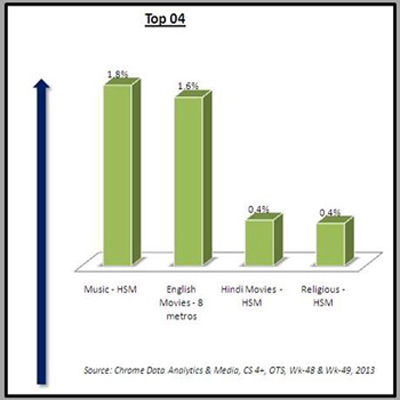
    Yes, you read it right. Music genre was the top gainer with a 1.8 per cent opportunity to see (OTS) gain.  For week 48, in Hindi speaking markets (HSM), the OTS was 47.4 per cent and in the following week reached 48.2 per cent. The music genre recovered what it lost in the previous week.

    Second in line is the English movie channel genre which saw an increase of 1.6 per cent in the eight metros. The year is coming to an end and as most channels air the biggest blockbusters of the year to wrap up the year, one can say that there are a lot of movie fans in the metropolitan cities.

    Next come the Hindi movie channels and religious channels with both seeing an increase of 0.4 per cent in the HSM. Star Gold continued to be the biggest gainer with 97.0 per cent OTS. In the religious genre, Aastha channel rose above all in the category with and OTS of 97.5 per cent.


    As for the bottom four genres, English Entertainment channels saw the biggest drop with 2.5 per cent in the eight metros. Star World topped the chart with 82.0 per cent. Even with elections in five states, the English news channels should have continued to gain but the genre failed to do so and saw a drop of 0.3 per cent unlike the previous week (week 48) where it was the highest gainer. Times Now was the leader in the genre with 88.3 per cent OTS in the eight metros.

    Next were Hindi GECs which dropped 1.0 per cent in HSM. The channel in the genre which saw the biggest drop is Colors; its  OTS was 95.7 per cent in week 49 as compared to 97.3 in week 48.

    The kids’ genre across the country and Hindi news in HSM too saw falls of 1.0 per cent and 0.8 per cent, respectively. Cartoon Network caught children’s attention and ranked number one in the category with 85.9 per cent while ABP News was the highest gainer with 92.7 per cent in the genre.

    The OTS numbers might be music for executives operating in  certain genres, but let’s wait and watch how things unfold for them in the coming week.

    Click here for the full analysis

  • Food Food to ‘Sizzle’ this year

    Food Food to ‘Sizzle’ this year

    MUMBAI: Food Food has had a ‘sizzling’ new makeover. And it’s not just about the tagline.

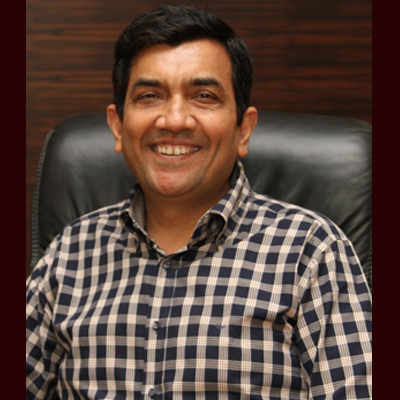
    The Sanjeev Kapoor-promoted television channel has given a fresh tadka to its shows and hosts, including adding 11 new ones to the existing pack.

    Kapoor informs that a team was formed under the guidance of Helios, the ad agency which works closely with and provides creative inputs to Food Food for the repositioning exercise. It took 45 days of brainstorming and dipstick with industry, the in-house team and the audience to finalize the tagline.

    We have to be ahead of the curve and have to be at leader position at all times says Sanjeev kapoor

    “Sizzling is a term that has personality and can be related to food and is ‘Hot’. TV has a sense to it and today, the audience consumes TV with a sense of sight and sound. When we started brainstorming, one thing that became clear was that the tagline had to be relevant to the senses. And ‘Sizzling’ does that perfectly,” says Kapoor.

    ‘Sizzling’ is but a part of the series of changes the channel has undergone. “Sizzling has the attitude. We wanted a personality to the tagline and ‘Sizzling’ has it. The chefs in the shows and also the shows have all undergone a makeover. We have added more lifestyle shows, but the base is still food,” Kapoor points out.

    While existing shows like Out of Africa and Hi Tea will continue to air on Food Food, the channel has come up with new shows such as Sunny Side Up and Becoming along with a couple of health shows. “We will also be launching a new ‘Sizzling’ show, starting January,” Kapoor informs. 

    Additionally, some existing shows have had a name change. “So Sanjeev Kapoor’s Kitchen is now renamed as Cook Smart. Likewise, other shows have undergone a change. Right from the sets to the chef’s styling and the food, everything about the channel has changed along with the tagline,” says Kapoor.

    Kapoor believes the channel has evolved from being ‘Food Food- Khusiyon Ki Recipe’ to ‘Food Food-India Ka Favourite TV channel’ and now ‘Sizzling.’

    Says he: “At Food Food, we have always believed that we have to be ahead of the curve and have to be at leader position at all times. The change in positioning is a reflection of that.”

    Kapoor believes he is in the food business and not the TV business. “We have been fortunate to have registered 85 per cent growth from February 2013 to October 2013,” says he.


    To what does he attribute the growth? It’s not due to a clutch of shows but all the shows telecast on the channel. The other reason is the annual deals and close associations with FMCG companies like HUL and Nestle like: “Helios has been a game changer for us,” he says.

    So has Food Food hiked ad rates? “Well, the current year focuses on taking on board all prestigious clients with offerings which is perceived as a value addition to both advertisers and viewers. Going forward, based on market dynamics, the ad rate may increase,” he informs.

    Food Food, which already caters to Canada through ATN is now targeting US and Africa. “We may close the deal with US by the end of this month. We are also closely looking at Africa,” says Kapoor.

    The channel which has a strong base in the north, is planning to move south however, Kapoor refuses to divulge details. “We have growth plans. But once we are about to close in on the plan, we will discuss it,” he says.

    What’s this year looking like for Food Food? “Newer shows, more upscale positioning, better understanding of viewers and digital proliferation of content is our plan for 2014,” he signs off.

  • Relive India’s 80s with NGC

    Relive India’s 80s with NGC

    MUMBAI: The 1980s was one of the most ‘happening’ decades in the history of India. It wasn’t just in one segment that the country witnessed change. While Indira Gandhi’s assassination was one of the biggest events of the decade leading to communal violence and political turmoil, there were other interesting events like India’s victory in the Cricket World Cup. The introduction of national telecast and colour TV in 1982 was one of the biggest events of the country.

    Debarpita Banerjee says, the 80s was the decade that was responsible for paving the path ahead for a young, middle-class India, with a liberal perspective.

    Now, National Geographic Channel as part of its series The 80s is giving its viewers an opportunity to revive the memories of the 80s with a special feature on India. So far, the series according to the channel officials has got a pretty good response. While the whole series has been received well, the episode titled Tear Down These Walls which focuses on the many literal and cultural walls brought down globally during the decade, has had the highest viewership.

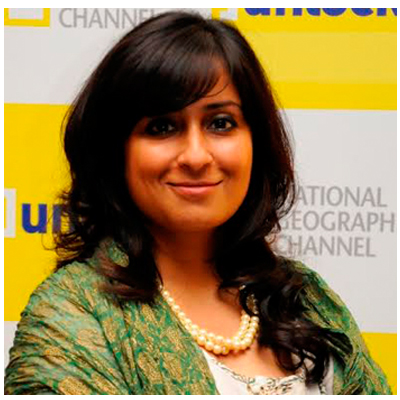
    NGC VP and Fox International, marketing Debarpita Banerjee says that across six weeks, the series has managed to revisit some of the most significant global events of the decade. “What I think genuinely worked was the fact that every viewer could relate to it, in their own personal way. Whether you were an 80s child or not, you are sure to have been left with some or the other lasting impression of the decade,” she says and adds that with a fairly good response to the series, it just made more sense to have one episode exclusively dedicated to India.

    Indira Gandhi and Kapil Dev after India won the cricket world cup

    “The decisions, the tragedies, the fads…this was the decade that was responsible for paving the path ahead for a young, middle-class India, with a liberal perspective. This episode will give the viewer both an analytical, as well as a nostalgic viewpoint of the ‘80s,” she says.

    To make the episode interesting and content-oriented, the channel has got on board many eminent people like established journalists, culturists, film-makers and eminent researchers, such as Vinod Dua, Anurag Kashyap, Mark Tully, Mahesh Bhatt, among others, whose anecdotes and commentary are strung in the feature to give the viewers a better perspective of the era.


    However, since there was a time restriction of just one hour duration, the channel had to make some tough choices in terms of the topics that would be covered. It had to ensure that the focus remains on events that were frontrunners in changing the course of India’s history. “Keeping this in mind, we chose personalities, who are not only stalwarts in their own fields, but served as eye-witnesses, as well as fans of this fascinating decade. Once they got to know that it was the 80s they were to talk about, the rest was easy,” says Banerjee.   

    Rajiv and Sonia Gandhi

    Filmmaker Mahesh Bhatt, who was at the helm of his career during the 80s, recalls the era with a lot of fondness. Talking about the TV set, to which the Indian common man suddenly got an access to, he says: “Well, an Indian suddenly realised there was a way to amuse himself by staying at home…and community viewing – the family. India woke up to this thought that television was consumed by the entire family and that was the beginning of what is called ‘the great television revolution’ which was going to take place with the satellite age. I think the Indian loves to be at home with his family and listen to the stories which his father and grandfather told him, but nuanced in a modern way.”

    However, Ogilvy & Mather executive chairman & national creative director India, Piyush Pandey explains it in a better way. He says: “It’s not that in the late 70’s, people were not watching Doordarshan, but with the coming of colour television and its availability in households, one was very clear that this medium was going to go a very long way. We are a very audio-visual country anyway, we love our movies, we love story telling and we love emotions. TV was the best medium that was just waiting to be unleashed. And, it got unleashed in ’82. I think everyone, every marketer; every advertiser knew that this was the medium that was going to be the most powerful one in the days ahead.”

    The Indian audience was introduced to colour TV in 1982

    Since the episode is packed with many such info and interesting stories from the era, it made more sense for the channel to go all out to promote it and thus it has activated a digital campaign across Facebook and Twitter for the episode. “There is a radio campaign across Delhi, Mumbai and Bangalore as well taking the listeners on a retro ride of ad jingles from the 80s and Mile Sur Mera Tumhara…,” says Banerjee.

    Nokia Lumia 1020 is the presenting partner and Hindware Italian Collection is the co-presenting partner of the series.

  • Vh1 to telecast the 2014 Grammy Nominations Concert Live

    Vh1 to telecast the 2014 Grammy Nominations Concert Live

    MUMBAI: The countdown to music’s biggest night of the year has begun and Vh1 is all set to air it live as it happens. The live event will take place on 7 December and be shown at 8:30 am with a prime time repeat at 8:00 pm. There is a lot of buzz and excitement on Twitter as well and viewers can get involved in the action by tweeting with the hashtag #GrammysOnVh1.


    Setting the stage for the 56th Annual Grammy Awards, the one-hour special will officially kick off the Grammy season by revealing nominations in several categories. This year’s Grammy Nominations Concert will showcase performances by Drake, Robin Thicke, Keith Urban and Macklemore and Ryan Lewis. Rapper-actor LL Cool J will reprise his role as host for the fourth time this year.

  • Zee Khana Khazana gears up for ‘The Urban Cook’ show

    Zee Khana Khazana gears up for ‘The Urban Cook’ show

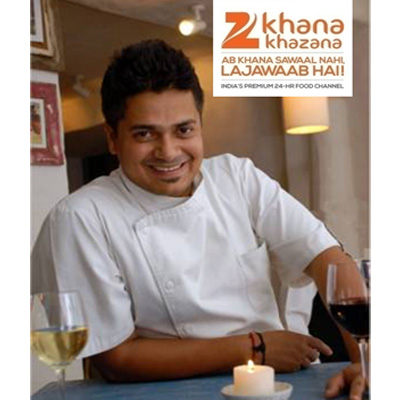
    MUMBAI:  Zee Khana Khazana, a 24-hour food channel, is launching a new show ‘The Urban Cook’. The show hosted by Chef Sabyasachi Gorai will make home cooking quick, simple, comforting and delicious with a recipies designed for the urban audiences who have little time to cook in their day-to-day schedules.

    On the concept of the show, Zee Khana Khazana business head Amit Nair stated: “The urban life style is full of challenges, endless work with very less time. With such action packed days, we may skip cooking and end up munching on quick bites and order out, but doing so regularly takes a toll on both your health and pocket.”


    “Considering all these factors, we at Zee Khana Khazana conceptualized the ‘The Urban Cook’ – an Instructional and entertaining Food Show especially designed for Urbanites. It is a proven fact that cooking is also a stress buster and The Urban Cook will help drive home that point through its method of instruction.  It is sure to hit the right spot with every urbanite in every fast-paced city,” he added.

    The show will premier on 14 December and will air on weekends at 8.30pm, with repeats on Monday to Friday at 10pm.

  • Nat Geo to air docu on air traffic controllers

    Nat Geo to air docu on air traffic controllers

    MUMBAI: Ever wondered about the ease with which we travel by air, without the added concern of traffic or safety? Ever wondered how some of the busiest airports in the world bid farewell and simultaneously welcome thousands of people in the same breath? Ever spared a thought for the person responsible for the safety of millions? Well there’s more to the mere thoughts than meets the eye. National Geographic Channel (NGC) takes its viewers on an eye-opening journey into the world of Air Traffic Control with its half-an-hour special show titled Inside ATC that premieres on 10 November at 6:00 pm.

    National Geographic and FOX International Channels VP marketing Debarpita Banerjee said: “With each of our shows, we try to get our viewer to reflect on the world around them with a fresh perspective – a perspective that challenges them to think more, know more, engage more. With Inside ATC, the viewer gets a never-seen-before insider’s access to the hectic world of Air Traffic Control. With this half-an-hour special, our viewers would catch a glimpse of the time and effort that goes into guaranteeing the safety of all those who are air-bound.”


    Known for its innovative content and programming that inspires viewers to broaden their imagination and think out of the box, NGC, in association with the Airport Authority of India, gives viewers yet another riveting show that captures the world of Air Traffic Control in India. The half-an-hour special coverage tells the story of a dedicated team of controllers, stationed at 80 control towers across India, with a single agenda on their mind – avoiding mishaps at any given point of time, be it in air or on the ground.

    AAI chairman V P Agrawal said: “The Airports Authority of India (AAI) is entrusted with the responsibility of creating, upgrading, maintaining and managing civil aviation infrastructure, both on the ground and air space in the country. With Inside ATC, we are glad to provide viewers a close look at the functioning of the ATC; and showcase the dedication and precision with which these controllers function. AAI is proud to be associated with the country’s leading infotainment channel – National Geographic Channel – to develop and present this special show.”

  • Niche channels to dominate TV in future

    Niche channels to dominate TV in future

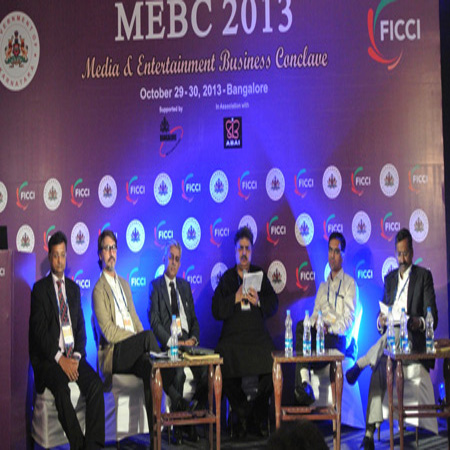
    BENGALURU: At the opening ceremony of the FICCI MEBC (Media and Entertainment Business Conclave) – South, which was held on 29 and 30 October, Ministry of Information and Broadcasting Secretary, Bimal Julka highlighted the fact that digitisation is at a growing trajectory in the country and by the end of the next year we shall all be living in digital homes.

    According to data provided by a FICCI Deloitte report on media and entertainment in south India, television constitutes 56 per cent of the market share with Rs 13,470 crore out of the total of Rs 23,900 crore. Digitisation is going to help the segment grow at a CAGR of 20 per cent in the next four years.

    (L-R) Sugato Banerjee, Raman Kalra, K Subramanian, Pradyuman Maheswari, Srinivasan K A and C R Rajagopal

    While the digital world is changing phenomenally, we wonder how the broadcasting industry is adapting to the change. This, and various other points were discussed in a session on “the broadcasting ecosystem in the digital era” which included BECIL chairman K Subramanian, IBM global services head (media and entertainment) and ED Raman Kalra, Deloitte Coimbatore partner-audit C R Rajagopal, Amagi Media Labs co founder Srinivasan K A and Whats on India COO Sugato Banerjee formed the panelists, while MXM India CEO and editor in chief Pradyuman Maheshwari moderated the session.

    The session kick started with Subramaniam highlighting the humongous task that was undertaken in DAS (Digital Addressable System) phase I to install about 75 lakh STBs and led to nearly 95 per cent digitisation in 38 cities. Five out of 38 are in South India, according to the report. He added that in all this DTH had taken a backseat except for Chennai where the DTH penetration is about 40 per cent and digitisation is lagging due to political turmoil.

    Banerjee also supported it by saying that phase I and II saw DTH take a step back and digital penetrate strongly in Mumbai, Delhi and Kolkata.

    Banerjee also highlighted certain issues that popped up during the process of digitisation. “In a city like Mumbai where people live in buildings, having a cable run through the building is easy. With DTH, the dish needs to be facing the satellite. In places where houses are far away from each other, cost of running the cable from home to home is higher and more efforts are needed. If some of these places don’t even get electricity for hours why would they want to pay for STBs?” he remarked.

    There was a time when there was a scarcity of channels but now they are in abundance. According to Banerjee, there are about 700 working channels in the country but it is unrealistic to have so many channels in the digital arena. The rising number of channels has led to narrowing down of viewership. “Five years ago there was no food channel in the country and now there are five. The long tail will give more choice to viewers and fringe channels have benefitted due to digitisation especially in the urban cities,” said Banerjee.


    At the same time, the growing number of channels will put pressure on its visibility. “Now, the issue would be to bring one’s channel to viewers notice,” said Srinivasan.
    Viewership will be segmented leading to an increase in the number of niche channels.  “Broadcast is a term that doesn’t seem to suit the current scenario. Now it is time to ‘narrow-cast’,” said Srinivasan.

    According to Kalra, their IBM global survey on consumer insight has shown that people don’t want to be categorised in demographics. “Consumers want content tailor-made for them. The biggest challenge in the future will be to get direct content for people and then make them spend for it,” he said.

    At the inaugural session of the event, Film Federation of India president Ravi Kottarakara raised the issue of service tax being a big hindrance on the industry. The same was also brought up by Rajagopal at the session. “Not having enough capital is a challenge for the industry to create things. Taxation needs to be looked into as well as interesting financial modules need to open up,” he said.

    At the same time, there is also the issue of paying for individual channels in future as consumers are used to paying a small amount for a big pack of channels. But Kalra pointed out that a person who could pay Rs 300 for a movie now, as compared to Rs 25 a few years ago, will definitely have the capacity to pay more for TV.

    However, Banerjee chose to disagree and said, “There is a difference between making them pay and the willingness to pay.”

    Although carriage fees will disappear in the digitised world, Banerjee said it will reappear in another form of placement fees as to which channel will appear first. According to industry sources, carriage fees range from Rs 3-5 lakhs. The industry also lacks advertising funding as compared to print. “Print has about 2 lakh advertisers but TV has just 12,000,” said Subramaniam.

    TV consumption on multiple screens is also set to grow. As on March 2013, 143 million users in India were mobile internet users (according to the FICCI Deloitte report). Its analysis report also showed that video consumption had increased from two hours to three hours from 2010 to 2012. “There will be monetisation of content as more connected devices emerge. Only then we will know which genre is being seen and its statistics,” said Subramaniam.

  • Zee Q, Discovery Kids to get competitor

    Zee Q, Discovery Kids to get competitor

    MUMBAI: One more edutainment channel – Da Vinci Learning – is prepping to hit Indian shores next year.

    Come late Q2 or Q3 next year, the children’s entertainment space will see a new player – Da Vinci Learning.

    Launched world-wide on 15 September, 2007 by its parent media company Da Vinci Media GmbH – the edutainment channel – is aired across 29 territories in 15 different languages.

    It takes time to reap results and we will do whatever it takes to reach out to a large number of people, says Mohit Anand

    So what brings it to Indian shores? “The Indian television industry is dynamic and growing, and our philosophy has been to spread knowledge,” replies Da Vinci Learning country manager Mohit Anand, adding that the channel believes today’s children are far more curious and plans to cash in on this quality.

    With at least two other ‘edutainment’ channels – Zee Q and Discovery Kids – launched just last year, won’t it be an up-hill task for Da Vinci Learning?  Anand shrugs off the implication saying: “We believe in learning in a fun way and not many channels do so in the kids’ genre. We are an edutainment channel and today, there aren’t any products which use the TV medium to enhance kids’ desire to learn. And this is what will distinguish us from the rest.”

    With its content a mix of animated and non-animated, not ruling out a documentary-style, everything will be done in a manner so as to attract kids. The channel will target not only children in the age group of 6-14 but also parents since it’s a family-based one.

    With most channels today having regional counterparts or feeds to reach out to the maximum number of viewers, will Da Vinci Learning follow suit?

    “When you study Newton’s Law, do you do it in a regional language or in English?” counters Anand and adds, “Information about the kind of subjects we are talking about, even in vernacular mediums, is primarily in English. Having said that, we are definitely evaluating the need to have regional languages – something we’ve found in the course of our research as well.”

    While Da Vinci Learning will premiere in English and Hindi next year, Anand is quick to point out: “We will not shy away from launching in a regional language if the need arises because we want to reach out to as many people as possible.”


    Otherwise an ad-free channel running on the Pay-TV model, in India however, the channel will incorporate ads.

    Reasons Anand: “The channels have to depend a lot on ad sales for revenue, but with digitisation, the subscription revenues are heading in the right way. Over the years, we will see less dependence on ad revenue. Also, the kids channels might be the third-largest viewed (almost 11 per cent) category but has a way smaller share in the whole ad pie. Hence, with kids becoming key influencers and the channel being uniquely different, there will be advertisers who will want to associate with us.”

    Though the subscription rate hasn’t been decided yet, Anand says: “It will be within the dynamics of the market,” quickly adding, “We still have to decide though whether we will start with a certain subscription charge or decide to go free for a certain period to let viewers know what the channel is all about.”

    To be available on digital platforms, the channel is already in talks with various DTH players.

    Meanwhile, a city-based media planner isn’t too hopeful that Da Vinci Learning will be able to get a lot of viewers if it comes with a subscription rate attached. “It will be able to gather interest in metros and tier II cities at best but overall, it will find it difficult to garner viewers. However, it is good that such a channel is entering the market,” he says.

    Marketing-wise, the channel plans to concentrate on activations as it believes it will be able to capture families in malls, museums and zoos. There will be on-air promotions, print and OOH as well. “Around 90 days prior to the launch, we will start with all the buzz and hype about the channel,” says Anand, adding they are still in talks with creative and media agencies.

    Asked about investment, Anand says apart from the minimum network requirement of Rs 5 crore, which is mandatory for a broadcast license, the channel will do whatever it takes to be successful as it is here to stay. “It takes time to reap results and we will do whatever it takes to reach out to a large number of people,” says Anand.