Category: Regional

  • Muslim Clerics globally feel posting photos of women on Facebook is un-Islamic

    Muslim Clerics globally feel posting photos of women on Facebook is un-Islamic

    NEW DELHI: A Pakistani website quotes Muslim clerics in India agreeing with their counterparts in Pakistan that posting pictures of girls on Facebook is un-Islamic.

    The website moremag.pk says ‘this problem is not just limited to Pakistan where social media has become subject of criticism but Muslim leaders all over the world are somehow trying to establish their writ on social networks where it is virtually impossible to ban anything permanently.’

    It says Muslim clerics in India have shown reservation on posting pictures of girls on Facebook. The viewpoint is divided and according to few, it is un-Islamic to post pictures of girls on Facebook since it becomes a cause of social evils and creates problems for girls.

    Abul Irfan Naimul Halim of Sunni sect said, “There are so many crimes taking place each day. The animal instincts of men are not sparing girls even within the four walls. In such a case posting pictures is extending an open invitation to such crimes.”

    A Shia cleric Maulana Saif Abbas Naqvi also endorses the thoughts of Abdul Irfan. He says that hundreds of Muslims call on helplines asking about if making an account on facebook and twitter is permitted in Islam or not.

    “There is no harm in making accounts on social networks as it is a practice to gain knowledge but posting a picture of women on internet for public without hijab is un-Islamic. Purdah should be practiced if it is important to post a picture”, Maulana Saif added.

    To some, it is better to maintain a physical relation than getting involved in virtual relation because the latter is more deceiving in case one of them is playing with a fake picture.

    But there are few like Ali Nasir Syeed who is of the view that the definition of Purdah should be clear and that there is nothing un-Islamic in posting a picture of facebook or other social networks without hijab.

    To him, coping up with the technological advancement is more important for Muslims today rather than getting lost in vague things.

  • SAB forays into Marathi entertainment with Maiboli

    SAB forays into Marathi entertainment with Maiboli

    Markand Adhikari hopes to replicate the success of his music channel Mastiii

    MUMBAI: Marathi speaking audiences are set to witness a laughter riot on their TV screens. Maiboli is all set to have a silent launch on 8 August. The channel, a product of the SAB group will have a program mix of comedy and music for the Marathi viewing audience. The tagline of the channel is Aapli Aaplya Mansaanchi.

    “Marathi manoos has a very good sense of humour and there is a lot of talent,” says SAB Group vice-chairman and MD Markand Adhikari, speaking about the unusual mix of genres.

    As of now the channel will only be available on cable TV, beamed off Insat 4A, which will reach to the one million plus population towns of Maharashtra such as Pune, Nashik, Aurangabad and one third of Mumbai.

    The comedy will comprise gags ranging from office, contemporary, marital, governance-related that will be in the form of three to five minute skits and interspersed will be Marathi songs. Known faces from the Marathi comedy genre such as Sunil Tawde, Anshuman Vichare, Pradip Patwardhan, Santosh Pawar will be seen on screen. The plan is to first telecast the latest Marathi songs and slowly move on to classics. Interviews of known Marathi actors from film and theatre will fill some of the weekend slots apart from comedy shows.

    The channel will have a program mix of comedy and music for the Marathi viewing audience

    Based on an internal study that the channel had conducted, the FPC has been drawn up in such a way that programs cater to the moods of viewers, depending on the time of the day. The early morning slot has Bhakticha-Thheva with devotional songs, mid-morning has romantic songs under Priteechi Jhul Jhul Gaani; the afternoon slot is dedicated to fast-paced songs with the program Mast madmast while the channel will telecast soothing and calming music at night under Sur Tech Chhedita and Chandne Shimpit Jashi.

    The channel will cater to all age groups, says Anita Varma

    Although, Adhikari says his target viewer is anyone above four years, programming head Anita Varma highlights that there isn’t any specific slot for children but the music will surely appeal to them. “We have humour for everyone and the channel will be liked by all,” says Varma.

    Initial reports were that Maiboli was to be launched last December, but Adhikari rubbishes any hints of there being any delay, saying that the group only started work on the channel six months ago.

    Close to 10 hours of programming is being produced in-house at the SAB studio. Channel promotions are to begin a month after launch. Test runs are currently being conducted.

    Advertisers will be approached after the channel comes on air and even the website will be functional post 8 August.

    “We are trying to replicate the success of Mastiii,” says Adhikari. The Hindi music channel was launched by the same group in 2010. And it has gone on to carve a smart niche for itself amongst viewers.Will Maiboli do the trick too?

  • Mathrubhumi’s Kappa TV perks up Malayalam youth TV market

    Mathrubhumi’s Kappa TV perks up Malayalam youth TV market

    It‘s more than a cuppa coffee that most youth hold in their hands while they lounge about in Café Coffee Days or BruCafes. Kappa TV – the youth focused music channel promoted by the Kozhikode-based Mathrubhumi media group – has chosen to be different from others of its ilk – it has a programming mix in English, Hindi, Malayalam and Tamil. And this, from a group which has its origins in Kerala where Malayalam and English are the main spoken languages. As compared to this, mainline youth channels MTV, UTV Bindass, Channel V, 9XM have been sticking to one lingo – Hinglish.

    Mathrubhumi media group‘s Kappa TV adds some zing to its content with a host of English, Hindi, Malayalam and Tamil programming

    Mathrubhumi TV CEO Mohan Nair says this is but natural and expected from south India‘s first youth centric channel. He explains: “In south India, young viewers are very much into popular cultures which are represented by Hollywood, Bollywood, Mollywood, and Kollywood. Tamil and Malayali youth also tune into English and Hindi songs from Sony Mix, MTV, UTV Bindaas and 9XM. Hence, we decided to have an amalgam of these languages along with Malayalam and Tamil in our programming mix whether it is in the form of music videos we play or the language that is spoken.”

    Estimates are that the Malayalam TV ad market is around Rs 675 crore; while the reach of all Malayalam channels put together is 8.1 million households.

    Music Mojo on Kappa TV is a Malayalam me-too of MTV Unplugged and Coke Studio

    As for the ad rates for Kappa TV, sources say, they hover around Rs 850-Rs 1000 per 10-second spot.

    On the content front, Nair reveals that the channel has six to seven hours of original non-fiction content in Malayalam and English on air daily, with shows being repeated twice. Kappa TV is primarily programmed in Malayalam with 60 per cent being back-to-back music videos rolling out in Hindi, Tamil, Malayalam and English, and 40 per cent being non-fiction shows.

    Among the music-based shows, the channel airs Music Mojo, a Malayalam me-too of MTV Unplugged and Coke StudioAwesome Covers, a remix of songs of different languages; Mood Tapes, a show which captures the mood of the day and invites people across neighbourhoods to sing and compose songs; Bindaas Bollywood, which showcases Bollywood‘s best; and International Chart Busters.

    I Personally, which focuses on celebrity interviews is past of the channel‘s non-fiction portfolio

    Kappa TV‘s non-fiction portfolio includes: I Personally, which focuses on celebrity interviews; Film Lounge, a film review and recommendation show;Creative Chef and Simply Naadan – cookery shows, Street Magic, a magic show and Candid Camera which features celeb photo shoots and style tips from fashion experts. “We have chefs from hotel chain giants like Vivanta by Taj , Crowne Plaza,Holiday Innu and Le Meridien for our show Creative Chef,” informs Nair.

    A large number of celebrities from the south have already featured on I Personally. These include, Kavya Madhavan, Padmapriya, Rima Kallingal, Swathy Reddy, Mahesh Narayanan, Krish, Haricharan, Rashid Ali, Vijay Yesudas, Shyamaprasad, Kamal, Prathap Pothen , Sibi Malayil and also popular directors like Siddhique Prashant Pillai, Mohanlal and Mammootty.

    Creative Chef features some of the chefs from hotel chain giants like Vivanta by Taj, Crowne Plaza, Holiday Innu and Le Meridien

    The channel has also roped in celebrities to host its shows. The show Simply Naadan is hosted by Vishnu; Meghna Nair hosts Tales and Tunes and Sanjeev Nair anchors the show Filmography.

    Despite an array of shows in the kitty, Nair is quick to acknowledge that he needs more to push the bar as far as content is concerned. “We are mulling over experimenting with standup comedy shows, music video festivals, reality shows, short films and a series which would track the career of the top artistes or film personalities,” he notes.

    With a moving target such as the fickle youth whose attention span is hard to retain, Kappa TV has had to go the whole hog: continuous promotion, whether it is print or TV, or the outdoors or direct consumer engagement – both offline and online. It helps that it has very successful publications in-house for print communications and advertising in the shape of the Mathrubhumi newspaper – both in English and Malayalam.

    “We have allocated around 25-30 per cent of our budget each for print and television, 30 per cent for OOH mediums and the rest for digital,” says Nair.

    The channel‘s ad agency Maitri also helps out with its promotional activities and brand integrations. Promos and standups, posters and tent cards for shows likeMusic MojoFilm Lounge and Ragaramiyer can be regularly spotted in railway stations, cinema halls, coffee shops, ice-cream parlours like Baskin Robbins. “We have also tied up with certain Kerala online portals like Metro Matinee for advertising about our channel,” informs Nair. And he also narrates with pride how Music Mojo‘s popularity has seen a spinoff being played out on Club FM – an in-house radio station.

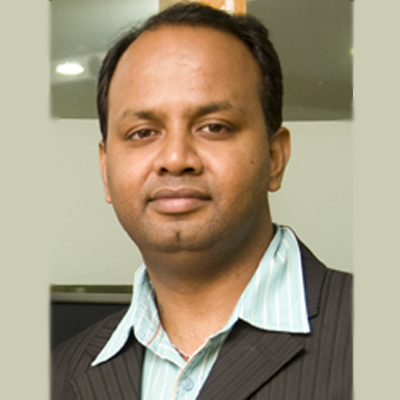
    Mathrubhumi director – marketing & electronic media Shreyams Kumar says the
    channel has ignited the imagination 
    of the young crowd, within months
    of its launch

    “International brands like Lulu, Perfetti, Baskin Robbins and national brands like ITC and Kalyan Jewellers are our current advertisers,” says Nair. “We also have a host of local advertisers like Kalyan Silks,Bhima Jewellers and Pothys Silks under our roof. We are in final negotiation with a whole host of brands including Idea Cellular and Nestle for brand tieups,” affirms Nair.

    The channel is available in almost four million cable & satellite TV homes in Kerala, on DEN, Asianet, Siticable and on select cable TV networks in Karnataka, Tamil Nadu, and Maharashtra. This apart, it is in the process of signing up with almost all the DTH providers nationally, which Nair expects will be done before Onam. It is also available internationally in north America and Europe on IPTV platforms, while it can be seen in the Gulf courtesy E-Vision.

    Kappa TV has also started pushing its content out digitally on YouTube, Facebook, Twitter and Pinterest. Video views on YouTube tot up to about 1.5 million, with some 9,550 odd Twitter followers. Facebook likes add up to some 15,000 plus.

    Definitely not something to crow about, but Nair says the digital push has been on for only four months and is helping build offline traction. “Viewers from India, United Arab Emirates, US, Saudi Arabia, UK, Qatar, Australia, Canada, Kuwait, Singapore, Oman, Bahrain, New Zealand, Germany, Malaysia and Ireland have been watching online versions of our music shows on YouTube. Videos of all our popular shows are updated daily on our YouTube channel”, he reveals.

    The digital initiative is handled by a four member team headed by Kappa TV director marketing and electronic media Shreyams Kumar.

    “Keralites and the wider Malayalee diaspora exposed to best in international entertainment was thirsting for an ethnic mélange. We at the Mathrubhumi sensed this opportunity, and this gave birth to Kappa, our specialty channel. With pulsating music, riotous humour, film review and intimate interviews, all tightly-edited, it has ignited the imagination of the young crowd, within months of launch”, says director – marketing & electronic media Shreyams Kumar.

    “This channel is a landmark achievement, since we have realised our long cherished goal of cross-media synergy. That this has occurred in our 90th anniversary year makes for reloaded pleasure.”

    The group already owns a news channel and a youth channel (both of which was launched in early 2013) under its umbrella. And it has two more licences approved by the ministry of information and broadcasting. One of these is for a general entertainment channel, which it has been planning to launch but has held back on it because of budgetary constraints. “But the desire to have at least one GEC is very much same like any other group,” discloses Nair.

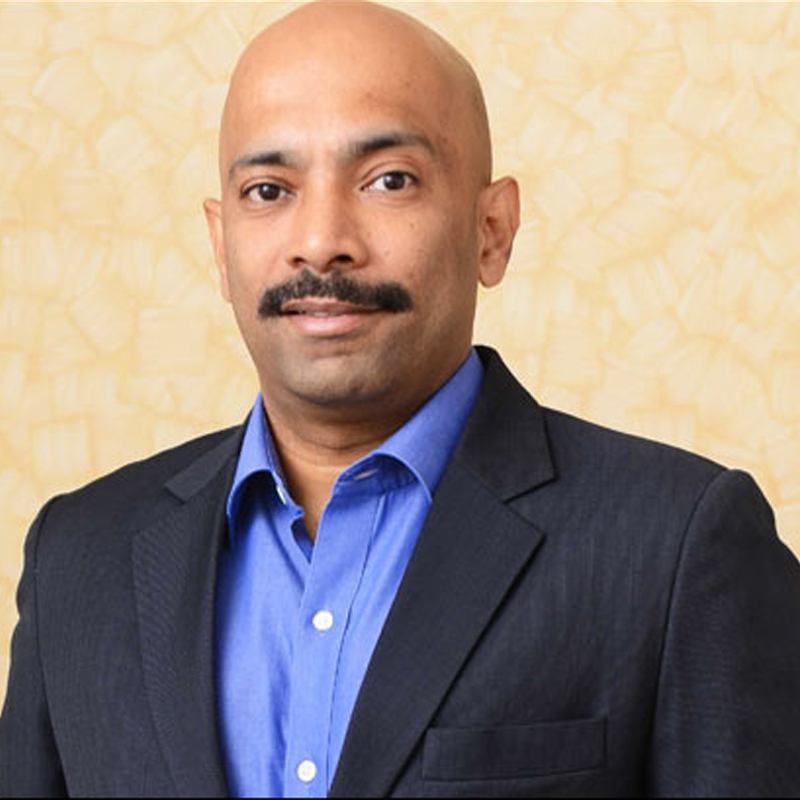
    Mathrubhumi TV CEO Mohan Nair‘s Kappa TV is
    certainly serving some hot ‘cuppa‘ and has left the
    youth wanting for more

    To keep costs low, the group is using the same news channel infrastructure to roll out Kappa TV daily.

    Nair has the right pedigree to successfully steer the Mathrubhumi group‘s TV ambitions. For one, he has print media experience as bureau chief and senior editor of The Economic Times from 1988 to 1999. Then he has the requisite domestic and international TV experience, having worked for six years with Asianet Communications and with Maharaja TV in Sri Lanka before moving to Asianet Communications as COO for six years. He took up the challenge of steering a primarily print group into TV in 2010 and first off the blocks was the Mathrubhumi news channel, followed by Kappa TV.

    And his efforts have won some praise and even the attention of rivals.

    Leading Malayalam network Asianet has taken note of the success that Kappa TV has achieved. Plans are afoot to revamp one of its channels, Asianet Plus. “We are aware of the importance that a youth channel holds and that is why we are revamping Asianet plus for young viewers in the coming two months ,” affirms Asianet, business head, Anup Chandra Shekharan. Sources reveal that this revamp is going to see it emerge as an amalgam of Channel V and Life Ok

    The Sun TV group too has awakened to the potential. Music and movies channel Kiran TV has been converted into a movie channel called Kiran Movies. On the anvil, sources say, is another music channel which is quite likely to be under the Surya brand.

    Now what more could you ask for?

  • ‘Star Pravah is only entertainment channel with 25% of content aimed at males‘

    ‘Star Pravah is only entertainment channel with 25% of content aimed at males‘


    Star Pravah is only entertainment channel with 25% of content aimed at males‘
    Posted on 2 June 2012
     

    Star Pravah had a bad start and had to rework on its programming strategy to keep in pace with rivals Zee Marathi and ETV Marathi. Now having found the right content mix and being aggressive in buying movie rights, the channel leads the ratings chart.

    Launching with culturally rich shows like Raja Shivchhatrapati and Agnihotra, the channel changed track and is now focusing on contemporary content reflecting today’s lifestyle. It is betting big on movies and is willing to pay high prices.

    In an interview with Indiantelevision.com‘s Gaurav Laghate, Star Pravah channel head Nachiket Pantvaidya talks about the channel‘s programming plans and the challenges of the Marathi market.

    Excerpts:


    Q. After joining on 1 April last year, Star Pravah has grown in the Marathi general entertainment genre. What has worked in your favour? 
    From 120 GRPs during the last IPL, we have grown to 250 GRPs today. While the ratings are just a number, we have come a long way because we got the right strategy in place.


    Q. Star Pravah started with a show like Raja Shivchhatrpati and other shows portraying rich Marathiculture. Today, the shows are more on the contemporary day-to-day life. Are you talking of this shift in strategy?
    We believe that whatever the content is, it needs to reflect the society of today. So while we respect the ‘Maharashtrian‘ culture, we are focussed on catering to today‘s generation.

    With the help of our researches and various contact programmes, we have realised that our viewers, staying in whatever part of Maharashtra, are global citizens with big dreams and aspirations. They understand the importance of values versus the changes that are happening in the current economic scenario. With our programming, we are constantly portraying “today‘s Maharashtra”.


    Q. Marathi viewer is equally comfortable with Hindi. And if Hindi GECs are offering same shows, doesn‘t it pose a challenge?
    One of the major challenges is that a Marathi viewer is equally comfortable in watching Hindi general entertainmentchannels, news and sports. So we decided to work not just like a Marathi entertainment channel but an entertainment vehicle. We focus on being concurrent as well as on entertaining our viewers.

    And it is paying also. In the last eight weeks we have been ahead of the Hindi GECs. In the week ended 26 May, we clocked 256 GRPs, highest for the channel so far.


    Q. From programming point of view, what is the thought process behind the shows?
    All our shows are based on unique themes and we promote the idea of positive bright relationships.

    Our shows like Bhandaa Saukhya Bhare (game show between saas-bahu), Devyani, Pudhcha Paaul, Swapnanchya Palikadle, and upcoming Laxmi Vs Saraswati portray today‘s time, today‘s value system and ask relevant questions.

    We have kept the packaging the same… the dresses, attires, setups are still the same, but our approach is very modern.

    Also, we are the only entertainment channel with 25 per cent of the FPC dedicated to the male audience. We decided to have differentiated content, so from 9.30 pm till 10.30 pm we show Lakshya (crime drama) and Anolkhi Disha (supernatural) to cater to the male audience. In future we would also like to create some shows for the kids audience as we are a wholesome entertainment channel.

     
    ‘The ratings of TV premiere of Marathi movies have doubled. We are progressive and aggressive in the film acquisition space and want better production value, for which a better price is justified ‘
     

    Q. What are the other genres you are exploring?
    We would like to explore genres like comedy, thriller and socially relevant shows. We are sticking to our identity and will make sure that we offer the complete package.


    Q. Many times a viewer is not happy with the quality of production. How are you tackling this issue?
    A few of our shows are already being shot in high definition. And Shrabani Deodhar (creative director), at the helm of programming, makes sure our programming quality is no less than the Hindi GECs – at the price of Marathi GECs!


    Q. You have been acquiring a lot of movies. How has it helped the channel?
    We are bullish on acquiring movies as we want to see the Marathi film industry grow. So if you see, we have acquired a major chunk of movies, including all the three national award winning movies.

    We are looking at buying the rights of these films prior to the release. And these films have helped us to aggregate the incremental viewers. With every blockbuster, new viewers come to sample the channel and we promote our other properties.

    We have a good mix of high concept cinema as well as commercial films in our library. For high concept films we are investing in subtitling. We also put advertisements in English dailies so that a non-Marathi speaking viewer can also watch and enjoy good cinema.


    Q But many players say that you are also spoiling the market with such high acquisition prices?
    We want to write the resurgence story for the Marathi film industry. If you see, Maharashtra still has the lowest film acquisition price. If we keep doing hard bargain to acquire good films, it will drag us all down.

    In today‘s time, the ratings of TV premiere of these movies have doubled and we can recover the cost of acquisition. And after all, the price is just any number; we want to be assured of good cinema. We are progressive and aggressive in the film space and want better production value, for which a better price is justified.

    Today, all the big filmmakers in Maharashtra are willing to partner with us as we are expanding their market and trying to make the economic model work for them as well.


    Q. How are you marketing the channel and the properties?
    We know that as a late entrant in the market, we did not have the legacy to fall back on. Thus, we had to make that extra effort to reach out to our viewer. We have very extensive direct connect programmes and activities through which we keep reaching out to them.

    We want to make the viewers realise that we love them, we know their aspirations and we try to meet and talk to them directly. So you will not see many hoardings from our side just announcing a new show; we will reach to the nook and corner of the state and will meet them in person. Our ground connect programme is very strong.


    Q. And how is the response from the advertisers?
    Today we are a big vehicle for the advertisers to put their message across. A big leap of thought for us is that economic and SEC classification is not a geographic concept anymore. The concept of rural and urban is not there. We see rural parts in metropolitans like Mumbai and Pune as well as an urban class in very small towns. We are working closely with the local brands to help give them a global identity.


    Q. How is digitisation going to help you?
    I believe that digitisation will benefit us more than anybody as the inequalities in the distribution business will iron out.


    Q. How is being part of Star India helping you?
    Today Star India has many No. 1 channels in the national as well as regional space. The group has done great in regional with faith that regional could be the new national. The group strength also helps us in leveraging resources.

  • Suvarna scripts a programming turnaround

    Star’s Kannada offering Suvarana is on a roll these days. The channel seems to be on the path to entrenching itself, at least for now, in the number two slot in the Kannada GEC space. The top three positions were for long occupied by the Sun Network’s Udaya TV, the number one player by far; Ramoji Rao’s ETV Kannada at No 2; and Zee Kannada, a relatively newer entrant at the third spot.

    “Suvarna stands for fresh entertainment. Call it fiction or non-fiction or any program for that matter; our approach is to offer differentiated and fresh concepts as programs,” says Suvarana business head Anup Chandrasekharan.

    The channel says that it is attempting through a planned strategy that it calls a ‘Threshold Strategy’ to grow its viewership by attracting the 15-24 age group, which did not consume Kannada television. “We decided that once we had the people to sample our offering through reality shows, we will ensure that stickiness prevails in the form of fiction,” reveals Chandrasekharan.


    “Our reality shows such as ‘Pyete Hidigir  Halli Lifu’ (PHHL), ‘Halli Hyda Pyeteg Banda’ (HHPB) ‘Pyete Mandi Kadige Bandru’ (PMKB) have helped bring in younger and newer audiences – the 15-24 year olds, to Kannada television. To our pleasant surprise we find that even the 25 plus age groups are glued to PMKB during the 8-9 pm time slot,” avers Chandrasekharan.


    “Also to  to attract the youngster, we have NGC programs with a Kannada voice over on air for an hour. We have brought in successful soaps such as ‘Lakumi’, a weekend comedy talk show ‘Maja with Sruja’, mythology shows like ‘Guru Raghvendra Vaibhava’, a weekend horror reality show ‘Shhh’, Tulu language shows, etc., into our programming mix,” informs Chandrasekharan.

    He adds: “To present soaps in a new light and form to Kannada viewers, we have set our own rules for producing. For example, the protagonist has to be in the age group of 15-25, she has to be new to the television. Similarly, new to TV yet experts as directors are introduced. Four out of the six soap directors are from cinema, and have made their debut on the small screen through Suvarna.”

    He clarifies that while reality shows have been bringing in the numbers for Suvarna, the effort has been to reduce the number of hours per week of reality programming. “Contrary to perception, we have only one daily reality show Monday to Friday during the 8-9 pm slot and one weekend horror reality show,” states Chandrasekharan.

    The channel experimented with fresh programming concepts such as the tribal theme series with PHHL in May this year. The show had 10 city girls experience 50 days of village life with one winner for the finale. It immediately followed that with HHPB wherein it took the reverse tack in the show. Eight tribal boys were mentored by eight city girls to find who amongst them survived the best in the city.

    The third and culminating sequel this year to the tribal theme is the currently on air PMKB which has 12 city bred Bangalore youngsters-young men and women in their twenties, to rough it out like tribal folk in a dense forest in Karnataka for 60 days. This is a first by any channel in a forest in India – other forest-theme programs have been shot abroad.

    Another first by the channel in the Kannada GEC space is that the grand finale episodes of the two completed tribal reality show sequels have been aired on a Sunday, with each final episode being over 14 hours in duration. This has helped the channel rake in huge mid week GRPs and a leading position for that period in the Kannada GEC space.

    For bringing in new audiences and to ensure viewership involvement and stickiness, the channel has initiated proceedings to help people indentify and associate themselves with the channel. It has started ‘Ladies Clubs’ in various towns and cities in the state.

    “We have started the Ladies Club initiative to involve audiences, to try and understand its pulse, to find out what is that they want,” explains Chandrasekharan.

    Membership to the Ladies Club has strict and special eligibility conditions. Chandrasekharan says the team has so far met and brainstormed with the Ladies Club members in three cities on weekends. To build continued loyalty, during meetings, Suvarna has also given an opportunity to some of the talented Ladies Club members to display any special skill sets they have on air.

    Suvarna has also focused on high intense innovative activities over print and outdoor to promote its soaps. Its religious story ‘Guru Raghavendra Vaibhava’ has been promoted through activities like projecting the episodes on a giant screen everyday between 6.30 pm and 9.30 pm at Mantralaya temple where thousands of devotees gather. The channel has distributed the Mantralaya Prasadam to 200,000 homes in 10 towns along with information on the show.


    Suvarna claims that it has set a record with the world‘s biggest friendship band as part of its initiative to promote the show ‘Classmates.’ ‘Classmates’ has friendship at schooldays as its core theme. It has also implemented classroom-to-classroom promotions in over 170 colleges in 10 towns.

    These efforts seem have borne rich fruit for the channel. TAM ratings furnished by the Suvarana management indicate that over almost four years (starting from calendar year 2007 to week 48 of the current year) viewership for the Kannada GEC space has shrunk. Suvarana has, however, managed to grow its own numbers by double digits year on year, bucking the overall negative trend.


    As per the chart above, Kannada CS 4+ viewership fell from 4147 in 2007 to 4079 in 2009 and to 4014 till the 48th week of this year, while Suvarna moved from the last position in 2007 with ratings of 84 to 251 GRPs (week 48 of 2010).

    Suvarana’s ten week average GRPs from September 2010 to November 2010 are 335. Thanks to the 14 hour long marathon grand finale on a Sunday of HHPB, the channel reached its peak GRPs for the year at 418.

    To quite an extent the channel has nibbled away numbers from Udaya, ETV, Zee and even Kasturi which stood at number four in 2008 just before Star took a controlling stake in Suvarana.

    In 2007, Udaya’s mean GRPs for the year stood at an unassailable 780. The following year they stood at 637, in 2009 at 545, and during the first 48 weeks of the current year, they were at 502. Comparable figures for ETV Kannada during the same period are 372, 283, 246 and 208 GRPs, while those of Zee Kannada are 85, 209, 194 and 169 GRPs. Kasturi’s figures for the same period are 107, 143, 107 and 96 GRPs.

    “The channel (Suvarana) has been producing quality serials and shows at very low cost. Its reality show cost per episode is one-tenth of what it would cost a national level channel to produce,” informs an industry source who has worked with the channel. The source further informs Indiantelevision.com, “This year the channel should turn the corner and show a very decent profit.”

    “From nowhere Suvarna has come up to a respectable position in the Kannada space,” adds a senior Bangalore-based media executive. “Its programming seems to be working well for it.”
     

  • ‘Regional language content has a huge scope in volume biz’ : UTV Television COO Santosh Nair

    ‘Regional language content has a huge scope in volume biz’ : UTV Television COO Santosh Nair

    UTV Television, one of the foremost television production studios in India, has seen many ups and down in the past. At one stage it was one of the premier TV production houses in the country. Then a clutch of upstarts – Balaji Telefilms, BAG Films, Big Synergy, Sphere Origin, Director‘s Kut, Shakuntalam, and Endemol – came and swept business from under its feet.


    But over the past couple of years, the division of UTV – promoted by Ronnie Screwvala – has been piecing together its story show by show. It began by venturing into the production of Marathi and southern Indian language shows. Then it focused on putting together a slate of Hindi non-fiction shows. The fact that the quantum of fiction shows on its genre sheet all but disappeared did not perturb the pioneer of TV in this country.


    The man helming the division is Santosh Nair, who was earlier in UTV‘s air time sales division. Nair spoke to Indiantelevision.com‘s Gaurav Laghate about the developments so far and the roadmap ahead.


    Excerpts:


    What are the changes you introduced in UTV‘s television content business after taking over as head a year back?
    I joined UTV in May 2005 but was taking care of the airtime sales division down south. Since last year, I have taken over the overall television business.


    We have really worked towards putting together the best creative team. We got back Indrajit Ray as chief creative officer. And we have put the right people at the right place.


    Now we are concentrating on developing show formats. Two major and much talked about formats that our team has developed are – Dance India Dance (season one) and Emotional Atyaachaar.


    Apart from this, I can say a lot of thought has gone into setting the roadmap for the future.


    Was there a need to change the team structure?
    We have different teams looking after fiction and non-fiction content. Both the verticals have their development teams also, which develop home grown ideas. Dance India Dance was part of that, and recently Emotional Atyaachaar was internally homegrown.


    All these separate teams are driven by different individuals.
     
     
    We are seeing a greater focus on non-fiction shows rather than fiction. Why?
    Yes, in the last couple of years, our strategy had been to focus on an area, which was very wide open, that is non-fiction. And now we are the only content company that produces shows in Hindi, Marathi, Tamil, Kannada, Malayalam and Telugu.


    But why was the focus greater on non-fiction shows?
    We wanted to fill the vacuum that was sitting over there in terms of a content delivery vehicle for non-fiction content. I think we have been fairly successful in doing that because in that span of two years, we did only non-fiction.


    We had non-fiction shows like Chhota Packet Bada Dhamaka, Dance India Dance first season (on Zee TV), Ek Haseena Ek Khiladi (Colors) and Cash Cab (Bindass).


    Apart from one long running saga Bhabhi (on Star Plus), we didn‘t have any other fiction to look at.


    But don‘t you think the fiction quotient, what generally is termed as the staple diet, has come down?
    These shows clearly established us as a non-fiction brand. But yes, having said so, people started looking at us as a pure non-fiction content provider. They forgot that we started as a company which delivered great fiction content.


     ‘People started looking at us as a pure non-fiction content provider. They forgot that we started as a company which delivered great fiction content‘


    So how are you positioning yourself now?
    We are focused on growth. 2009-10 has been to cement this entire platform in terms of being looked as both a fiction as well as a non-fiction provider.


    Talking about projects, how many new shows do you have in the pipeline ?
    The second quarter is when we will go all guns blazing. We have many shows in the pipeline; we are starting with a primetime show on ETV Marathi.


    We also have four fiction shows for Hindi GECs including one (Rakt Sambandh, a remake of a Telugu show) for Imagine TV. For the other three shows, I can‘t share the details as we are in the process of signing the LoI. But I can tell you that we are working with the top channels.


    There are also two non-fiction shows, out of which one is the mother of all reality shows. But again I cannot give details right now.


    Are these standalone initiatives or are they being done in partnership with others?
    We have a partnership with UTV Tele Talkies Ltd (UTTL), wherein we have on board Prashant Jadhav, the man behind Kasauti Zindagi… We are working on a fiction show for Imagine TV. It will be on air by end of this quarter.


    We have also been producing Sonu Sweety with Rajesh Berry Entertainment Ltd for Sab.


    And about your recent entry in the regional space…
    In Marathi yes, but for Southern languages our association with Sun has been since the time of the network‘s inception.


    But you were not producing shows for the Sun Network. You were primarily doing airtime sales…
    In the last couple of years, we have moved from being purely an airtime sales outfit to a more of a mix and match of own productions and marketing the same.


    How do you see the growth in regional markets like Marathi?
    In the last couple of years, regional markets have been systematically growing. And if you look at pan-India or Hindi GEC, you will see shows catering to the Marathi audience, like Pavitra Rishta.


    There is huge scope, but only if you do volume business as margins are very less. But yes, it is a growing market and we are looking at it in a serious manner. The Bengal market is also where we are looking to expand, but only after establishing ourself in the Marathi space.


    Coming to your content, you are producing Emotional Atyachaar, which is a bit edgy in nature. How is the response for the show? You are planning a second season also?
    Emotional Atyachaar has really cut the ice with audiences as far as Bindass is concerned. The audiences actually liked it. It has got the channel to a GRP level where it had never reached before. It had also beaten cult shows on competitive channels.


    And talking about Bindass, it is a youth channel, so it is okay to have edgy content. Anyway there is a very thin line. And yes, the second season of Emotional Atyachaar is coming in very soon.


    So you see a change in viewership trends?
    Viewership patterns are definitely changing. People are ready to experiment; they are looking at some kind of differentiation of content and that‘s where you see successes like Sach Ka Saamna and Emotional Atyachaar.


    For example, in the midst of a huge crowd of Hindi GECs, Colors came in. Everyone thought what is this? But they took their punt and it worked. See it is the small differentiator, which will drive the content. Otherwise it is going to be one mundane thing where daily sagas are coming in. So for the daily soaps also that we are working on, we are trying to do something different. The story might remain the same, but it is all about the treatment, how you take it forward. 

     
    You said DID was your format, but the IPR remains with Zee?

    With Hindi broadcasters, what happens is that the IPR remains with the channel. And historically it has been happening this way. But we took a bold stand when we decided to retain the IPR of Shararat.


    But that was a long time back, now all the IP is vested with the broadcaster. It is as simple as that. Emotional Atyaachaar‘s IPR is with Bindass, although it‘s a group company. 

     
    So if you don‘t have IPR, how are you intending to grow? If you see international production houses like Endemol and Frementle, they all retains their IPRs.
    We have already started working on some projects where we can retain IPR as it is going to be the future. We are working on certain finite series, where we will retain the IPR. We will produce it first, before even going to the channel and pitching it.

     
    And how do you intend to fund it?
    We will opt for internal funding. And we will de-risk it by producing four episodes and sampling it to broadcasters.


    In case we have a very solid finite – 13 or 22 – episodic series, then we can think of producing it in full. 

     
    Internationally, we see the syndication model in the television business. It allows producers to take on the risk of production and getting the reward by selling it to various outlets globally. Why can‘t we have such a model here?
    See, in India since we don‘t retain IPRs we cannot have the syndication model. And channels that run repeat content, are mostly low cost in operations.


    And even if some demand comes from international markets, the broadcaster, with the IPR, makes most of the money. 

     
    But with shows on Sun Network you can guard the IP.
    The benefit any company that works with Sun has, is that they can retain their IPR. The model there is completely different – you produce, you market, you pay slot fees. That‘s the benefit with Sun. So you have shows which are running there, which you can remake in other languages. We have a long standing relationship with Sun Network.


    And at the same time you can not produce content for competitors. That‘s the condition Sun has?

    Well, in terms of revenue and feasibility it makes sense to work with Sun as it is the biggest network down south. 


     So apart from the IPR issue, what other challenges are there for a production house?

    We have already seen one big challenge when recession happened. Channels were looking at cutting down expenses including production costs. They want the same product at a lesser cost. So that was the biggest challenge and learning that we got in the last so many years.


    We really had to sit back and think on how to strategise and minimise the cost. Not only in terms of our business but on a macro level also. 

  • Marathi GEC space: Zee Marathi winner in numbers game

    First the good news. The Marathi general entertainment space is expanding. The market is currently estimated to be above Rs 2 billion for 2007-2008. Now the bad news (for the current players). New entrants are eying a share of the pie.

    At present, there are just four players in the space – Zee Marathi, ETV Marathi, Sri Adhikari Brothers Mi Marathi and public broadcaster DD Sahyadri.

    A point of note is that apart from GEC, Marathi broadcast arena also includes three players in news – Star Majha, Zee 24 Taas and new entrant IBN-Lokmat. Additionally, there is Zee Talkies which enjoys a monopoly of being the only Marathi movie channel.

    Backgrounder:

    In the first phase of launches in this space there was DD Sahyadri, Zee Marathi, ETV Marathi, Tara Marathi and Prabhat.
    DD Sahyadri was launched in 1998 followed by Zee Marathi in 1999. Later ETV Marathi, Tara and Prabhat joined the arena between 2001-02.

    By 2003, Tara Marathi and Prabhat channels had gone off air.

    In 2007, Mi Marathi entered the fray.

    Position as of now:

    In the fiscal 2007-2008, If we check the Tam data for Maharashtra market in cable and satellite homes (4+ TG, 1st April 2007 to 29 March 2008), it has clearly been a two-horse race between Zee Marathi and ETV Marathi, as 1st and 2nd respectively. Though ETV Marathi got the better of the ratings in the period June-August 2007, it started losing ground after that and Zee Marathi emerges the clerar winner in the numbers game. (See the table).

    Channel share %
      Zee Marathi ETV Marathi DD10 Sahyadri (Marathi) MI Marathi
    Apr ‘07 51 28 13 8
    May ‘07 45 39 9 6
    Jun ‘07 41 41 12 6
    Jul ‘07 39 43 13 5
    Aug-07 41 43 12 5
    Sep-07 44 39 12 5
    Oct-07 52 36 8 4
    Nov ‘07 45 38 11 6
    Dec-07 48 35 11 6
    Jan ‘08 51 32 11 7
    Feb ‘08 51 32 12 6
    Mar-08 48 33 12 6
    Source TAM:- Market: Maharashtra Mkt TG: CS 4+ years Period: 1 April 2007 to 29 March 2008

    ETV chief producer Manvi admits, “We were on top from June till August in 2007. However, because of some connectivity and distribution issues we have fallen behind. Zee Marathi is doing well and it is not easy, but we are trying hard, to regain the lost position.”

    Among the other players, DD Sahyadri is maintaining its channel share of 12 in the market. However, also ran MI Marathi has not shown any growth and is stuck with an average channel share of 5. MI Marathi, despite having 3,000 hours of content and boasting of strong brand value among Marathi people, has not managed to get significant viewer eyeballs.

    All year performance:

    Zee Marathi is leading in this market with an average of almost 46 per cent channel share. At the beginning of April, it was holding 51 per cent market share, but slid after that to a low of 39 per cent in July, wherein ETV surged ahead. On the back of movies, reality and soaps, Zee Marathi had regained its lead position by September and has remained close to an average of 48 per cent ever since. ETV Marathi, meanwhile, has a channel share of 33 in March 2008. The average channel share of ETV Marathi is around 37 for the fiscal 07-08.

    DD Sahiyadri had average channel share of 11 for the whole year. While 6 per cent went to MI Marathi.

    Content:

    So what is it that clicks with the viewer? Is it a feature film, reality show, or fiction based daily soap?

    From Tam top 100 programmes for the period under review, Marathi feature film Subh Mangal Savadhan has got the highest TRP of 7.85 on Zee Marathi in April. Second and third were reality shows based on comedy (Hasyasamrat) and dance (Eka Pekshya Ek). Event show Swartarang was fourth while ETV Marathi serial Hya Gojirvaanya Gharat made it to fifth in the Top 5.

    Data from the month of march depicts that apart from dance reality show Eka Pekshya Ek, soaps from Zee Marathi like Avghachi Sansaar and Vahini Saheb are also getting an average rating of 5 and 4 respectively in the All Maharashtra Market.

    Zee Entertainment Enterprise Ltd (ZEEL) director (Zee regional channels) Nitin Vaidya told Indiantelevision.com, “Zee Marathi is offering viewers variety with quality and continuity. Viewers are very smart and demanding, so we are offering them a mix of reality and fiction. This explains why we are on top.”

    Talking about content, here it is interesting to note that Marathi soaps do not focus on so much on saas-bahu tussles and kitchen politics like Hindi GECs.

    “Maharashtra is a state of progressive minded people. They don‘t like the typical Hindi saas-bahu sagas. Viewers can see completely different programming on Zee Marathi,” explains Zee TV programming head (till recently Zee Marathi VP) Ajay Bhalwankar.

    That makes sense. But are daily soaps or reality shows the ticket to success? Bhalwankar says, “For Zee Marathi both the genres are working.

    For ETV Marathi however, it is the soaps that are working. Its soaps Char Diwas Sasuche, Hya Gojirvaanya Gharat and Kata Rute Kunala are getting decent TRPs of 4, 3.3 and 2.6 respectively.

    But to be on top, Manvi believes that his channel will have to ramp up its reality quotient. “Reality shows are in. Audiences like to watch dance and music shows rather than fiction. So we are putting emphasise in this genre.”

    Will reality help ETV turn the tide in its favour? Time will tell.

  • Time for global news in Marathi

    With national news broadcasters feeling the need to expand into regional markets, it is the Marathi space that is grabbing their attention.Joining Zee 24-Taas and Star Majha in the fight for the 120 million TV viewers of Maharashtra will soon be IBN-Lokmat, the Marathi news channel from the GBN-Lokmat joint venture (JV) company.

    So, is the Marathi TV news market getting cluttered or will there will be a slice of the cake big enough for them?

    For starters, let us look at the fight between the two existing channels – Zee 24-Taas and Star Majha, the eight-month-old channel from the JV between the ABP group and Star.

    Star Majha is leading the race by far, stepping ahead since its second month of launch (See table for channel share).

    Channel Share 2007 (%)
    Channel Jun Jul Aug Sep Oct Nov Dec
    Star Majha 30 56 56 58 59 63 58
    Zee 24 Taas 70 44 44 42 41 37 42
    Source: TAM Peoplemeter System, Maharashtra Market, CS 15+

    The gap has widened in 2008 with Star Majha enjoying a higher channel share (See table).

    Channel Share 2008 (%)
    Channel WK 1 WK 2 WK 3 WK 4 WK 5 WK 6 WK 7
    Star Majha 70 69 69 65 77 78 75
    Zee 24 Taas 30 31 31 35 23 22 25
    Source: TAM Peoplemeter System, Maharashtra Market, CS 15+

    Zee 24-Taas explains its slip to distribution issues. “In terms of reach, we are less than half of that of Star Majha. There are issues that involve revamping the deals with cable operators,” says Zee 24-Taas news head Ravikant Mittal.

    Mittal, however, claims viewers spend more time on the channel than on Star Majha. “Though our reach is limited, a viewer spends about 33 minutes on our channel as compared to the 26 minutes on Star Majha. We have faith in our content,” he adds.

    In terms of content, Zee 24-Taas claims of being a regional channel with national outlook and an international look, whereas Star Majha says it is a national news channel in Marathi.

    “The reason for our growth is that we know our viewers like to see global news in their mother tongue. That is what we are providing them – world-class news in their own language,” maintains Star Majha editor Rajiv Khandekar.

    IBN-Lokmat is looking at a different positioning. Says editorial director Nikhil Wagle, “Ours will be a global news channel in Marathi language; we are not regional players.”

    IBN-Lokmat is banking on a large infrastructure network to cover the state. Says Wagle, “We will have 13 bureaux spread across the state. We are also going to have the latest technology to support our news flow.”

    Zee 24-Taas has a network of eight bureaux and 30 stringers across Maharashtra while Star Majha has six bureaux. For news outside Maharashtra, both rely on their national news networks.
    The Marathi news channels agree that the needs of the local viewers are different. They cannot be fobbed off with infotainment; what they look for is hardcore news – be it regional, national or international. For informative entertainment, they have the option of tuning in to other Marathi and Hindi general entertainment channels.

    “More competition will prompt us to bring quality to our viewers,” says Wagle.

    As far as revenue is concerned, Zee 24-Taas and Star Majha claim to have roped in a long list of advertisers. Says Mittal, “We have every big advertiser with us. Maharashtra being a big and financially important state, it is natural to see ad growth.”

    Agrees Khandekar, “30 per cent of all the GRPs of national Hindi news channels come from Maharashtra. With the kind of ratings and programming we have, revenue is kicking in.”

    The climate may get spoilt with the entry of IBN-Lokmat. The size of the Marathi TV news market isn‘t big enough, with estimates putting it at under Rs 600 million. Besides the two dedicated satellite news channels, there is ETV Marathi which runs a popular band of news slots and DD Sahyadri.

    The channels, however, feel that the size of the pie will only grow with more entrants. Says Mittal, “The space is not cluttered; it can fit in more players.”

  • Hindi news channels see tough Muqabala

    Hindi news channels see tough Muqabala

    Lights flashed, cameras rolled, news was created and records made. With no sure route to success, the tussle for bragging rights in the Hindi news space aggravated, with ever more bizarre stories being thrown up. In stark contrast, investigative, true journalism could not collect much by way of worthwhile brownie points on the ratings graph-o-meter. 2007 has indeed been an active year for news channels; sting operations, saas bahu stories, khatarnak baba, Nag Nagin Ki Shaadi, and the like ruling the roast.

    IBN7 managing editor Ashutosh says that this year has clearly shown how ratings and TRPs can affect content.

    NDTV Group director Narayan Rao says, “This was a year when the question was asked as to where the advertisers were putting their money: trash channels or genuine ones. From the limited perspective of a news channel, particularly Hindi news, I can see that a large number of them have gone the tabloid way: the sex-and-violence route.”

    Indiantelevision.com’s analysis of Hindi news channels using Tam data (HSM, C&S 15+, all day parts) during the one-year period beginning January 2007 throws up some interesting insights into the genre while the battle among the players intensifies.

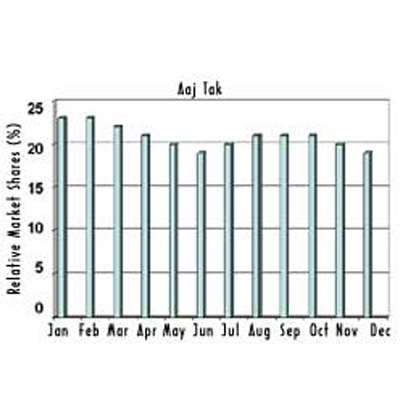
    Refusing to budge from the top position for the ‘golden’ year of Hindi News channels is India Today Group’s Aaj Tak, with an annual average of 20.83 per cent market share. Being the forerunner, it has been consistent in its performance as far as relative market share. Beginning the year with 23 per cent in January, it reached its lowest in the month of June and December with a market share of 19 per cent in both the months. In June it was neck to neck with Star News, but in the month of December it had to finally give way as Star News took over pole position.

    Aaj Tak’s sister concern Tez has also maintained its consistency with an almost constant share of 5 per cent of the market for eight months.

    Aaj Tak news director QW Naqvi says, “As for our channels, it is extremely satisfying that we have retained the number one position despite a virtual dogfight in the TV news market. We are proud to present balanced news content. Though this is a remarkable achievement for Aaj Tak, we are aware of the challenges ahead. A number of new channels coming in the fray and with a growing audience base, it will be our effort to retain our number one position – both in terms of content perfection and market share.”

    A huge attrition seen by Aaj Tak during the year however did not have any direct effect on the score card. Its top rung journalists have made tracks, either to upcoming Hindi news channels or already established ones. Aaj Tak lost its executive editor Punya Prasun Bajpai who switched sides to Samay (then Sahara Samay) as editor-in-chief. Bajpai took along with him a host of other Aaj Tak journalists including anchor and deputy editor Sanjay Bragta and crime bureau chief Nazim Naqvi.

    Aaj Tak executive editor and Mumbai bureau chief Shishir Joshi quit to join Mid Day Multimedia as group directorial editor. Aaj Tak also lost Ram Kripal and Rahul Kulshetra to Triveni Group. While Kripal joined as group editor for their upcoming news channels, Kulshetra will head technical operations.

    With an annual average of 18.08 per cent is News Corp backed Media Content and Communication Services (MCCS)’s Star News, which stands next to Aaj Tak in terms of market share. Star News began the year with 17 per cent market share in January. By mid-year it had picked up 19 per cent. It carved a share of 20 per cent each in the months of September, and October but could not surpass Aaj Tak in the numbers game. December, however, was a good month for Star News as it broke Aaj Tak’s monopoly by getting to the top place with 20 per cent of the market share in its kitty.

    Next in the rung is India TV with an annual average of 13.75 per cent. India TV had 11 per cent in January, but slipped down to 9 per cent in February. From May, India TV joined the race in high spirits with its highest grab of 16 per cent. What followed in the later months was consistence in terms of performance in market share, dabbling between 15 to 16 per cent in the last two quarters of the year.

  • Hindi news channels see tough Muqabala

    Hindi news channels see tough Muqabala

    India TV CEO Chintamani Rao says, “For India TV, it has been a good year. Two years ago we were number six or seven in the news channel category, with a five to six per cent share; today we are number three with a 17-18 per cent share. “


    In 2007, Zee News was not steady in the numbers game starting the year with 13 per cent and ended with 10 per cent. With an annual average of 11.54 per cent, Zee News had its best runs of 14 per cent in the February and April period. From May with 12 per cent.


    It reached it’s lowest ebb of 9 per cent in September. Mid-September, incidentally, was also a time when the channel was headless after Harish Doraiswamy resigned from the CEO’s position, following which MCCS executive vice-president Barun Das was roped in as CEO.


    Global Broadcast News’ IBN7 has an average annual share of 10.5 per cent, opening the account with 9 per cent in January. Though low in its numbers, IBN7 has been consistent, with the figures ranging between 9 to 12 per cent market share.


    Ashutosh says, “About my own channel, we can say that we were bold enough to stand our ground saying. Whatever rubbish is going on the other channels, let them do it, but we shall not do that. I won’t say we have been 100 per cent successful, but very, very successful and I am proud that we are probably the only Hindi news channel that can call itself a news channel.”


    He asserts, “We provoked ourselves to get news in the right perspective. We have been aggressive and this has given us excellent results, maybe not in terms of ratings, but in terms of perception. We have severely shaken up the political establishment repeatedly. “


    Among the news broadcast majors though, it is NDTV India in particular that would like to leave behind 2007 as far as market share is concerned. Its average for the year – a highly disappointing 9.5 per cent. In January it was at 13 per cent, but drastically fell from June on when it stood at 9 per cent. In an attempt to get more eyeballs, NDTV India forayed into fiction by launching its weekly series Bombay Lawyers in July. It got only 8 per cent each in July and August, managed some uplift in September to 9 per cent, but slipped back to 8 per cent again in November and December.


    In August, NDTV India saw a major change in leadership when Dibang stepped down as the managing editor. In his place, senior staffers Sanjay Ahirwal and Manish Kumar were entrusted with the responsibility of overseeing the day-to-day news operations of the channel.


    Narayan Rao says, “In terms of rating you have Aaj Tak at the top and then Star News and some others high up, but in terms of revenue we are still there right at the number two position. Ultimately, no advertiser would like to spend money beyond a point on such shows. So, if there has been an impact on viewership, there is no significant impact on revenues.”


    Punya Prasun Bajpai’s taking over the content, the channel getting a revamp with a fresh look and feel and even changing its name could hardly contribute anything to Sahara’s national Hindi news channel Samay. With an annual average market share of 5.1 per cent, the month-on-month figures have hovered around 4 to 6 per cent.


    Likewise Broadcast Initiative’s Live India re-positioning itself from a views channel to a news channel and its re-christening could not however save it from hitting rock bottom. Soon after being re-launched it was slapped a month’s ban for a sting operation gone horribly wrong. However, it can take solace from the fact that it had 1 per cent market share in January, which has gone up to 4 per cent at the close of the year.


    DD News on the other hand does not have a success story to its credit. DD News has to be satisfied with an annual average of 3.3 per cent of the market share.


    Whatever the figures say though, news broadcasters across the board agree unanimously that there has been a lot of compromise in content.


    Naqvi says, “No doubt, television news industry has grown at such a frantic pace, that it has created certain pitfalls. All out efforts in the past year were made to grab viewership. In this mad race, at times content was compromised and true journalism took a back seat. Compounding this malady, mushrooming news channels tended to water down the impact of many meaningful news reports.”


    Rao says, “If it says that on a certain night some news channel was number one, then more or less it works that way. It is another matter that that news channel was then showing a sex show. But that is for the viewer to decide. If he wants to see a sex show in news, it is his choice.”


    In the same breath news broadcasters also believe that “it is going to be hard hitting, proper investigative journalism that will have to come back to the news channels.”


    2008 would require the Hindi news channel market already flooded with more than 10 channels to accommodate a long list of channels waiting in the wings. B.A.G Films and Media News24 is the first one in the fray, with many others to follow in the year.