Category: News Broadcasting

  • BBC, HBO to co-produce a crime thriller

    BBC, HBO to co-produce a crime thriller

    MUMBAI: The BBC and HBO have started co-production on the crime thriller Five Days.
    Five Days tracks five days following the abduction of an appealing and photogenic young mother, Leanne.

    This five-part drama serial stars Nikki Amuka-Bird, Hugh Bonneville and Charlie Creed-Miles. The story begins one, hot summer day when Leanne is taking her two young children to visit her grandfather.

    She stops to buy flowers at a motorway lay-by but then inexplicably vanishes, leaving her two small children waiting in her car, lost and far from home.

    They set off to find her only to go missing themselves. Their ordeal is captured on CCTV cameras and before long the family’s heart-stopping trauma is not only a complex police investigation but a major news story. As each episode unravels it becomes clear that nobody is quite as they seem.

    Producer Paul Rutman says, “Five Days is a gripping, multi-stranded story about the kind of fascinating crime which holds the front pages of our national newspapers and which terrifies and obsesses us in a compulsion to know more.”

    BBC controller, drama commissioning Jane Tranter said, “It is a privilege to be making such a major piece of drama from the brilliant Gwyneth Hughes, and we are delighted to be collaborating once again with HBO, continuing our strong creative relationship which has seen us working together on many projects, most recently Tsunami: The Aftermath and Rome.”

  • Next-Gen technologies drive growth in consumer telecom market: Study

    Next-Gen technologies drive growth in consumer telecom market: Study

    MUMBAI: As Internet Protocol (IP) technology becomes more pervasive in the telecommunications industry, next-generation services is increasingly driving growth in the consumer market. Although regulatory constraints and dwindling fixed-line revenues are key challenges for service providers, renewed focus on 3G (Third Generation) services, convergence and multimedia should enable them to stay ahead of competition.

    New analysis from global growth consulting company Frost & Sullivan, Service Providers’ Consumer Strategies Revealed in Asia Pacific, reveals that 3G, VoIP (Voice over Internet Protocol) and WiMAX (worldwide interoperability for microwave access) are perceived as key revenue generators for service providers. In fact, most service providers have invested heavily into deploying these technologies, states an official release.

    “Growth in the Asia Pacific consumer telecommunications market will revolve around wireless, IPTV (Internet Protocol television), and other multimedia services,” explains Frost & Sullivan research analyst Aravind Venkatesh. “Moving forward, service providers will continue to leverage on key next-generation technologies such as WiMAX, IPTV and VoIP to offer innovative service packages to customers.”

    Due to declining fixed-line revenues, service providers in developed markets have to consider next-generation technologies such as 3G, wireless broadband access, IPTV and VoIP to drive revenue growth. While service providers in China and India are anxious to deploy 3G services, their counterparts in South Korea, Singapore and Hong Kong are looking at media-rich 3G applications to boost revenues.

    The key challenge for all service providers in the consumer space is to maximize voice revenue and increase ARPU (average revenue per user) in the midst of increasing competition.

    Intense competition and product commoditization have resulted in service providers finding it difficult to increase ARPU and reduce customer churn. Regulatory barriers delaying the deployment of 3G services in markets like India and China have also fettered service providers. Fixed-line service providers face the dual challenge of declining fixed-line revenues and increasing fixed-to-mobile substitution, the release adds.

    “Regulatory barriers and spectrum allocation issues have been major hindrances to the rapid deployment of 3G services in some developing markets in Asia,” explains Venkatesh. “Delays in introducing regulatory frameworks have hampered the launch of innovative services based on new access technologies.”

    Innovative value-added services and lower price points are key differentiators in the fixed-line telephony segment. Fixed-line service providers should add value to their core services by offering bundled applications at competitive prices. Service providers in high growth markets such as India, China, Thailand and the Philippines can also explore new revenue streams by exploiting the largely untapped rural segment.

    The service providers’ consumer strategies revealed in Asia Pacific study is part of the Communications Services subscription. It evaluates the competitive landscape, including key partnerships and alliances, service portfolio and product strategies, and marketing and pricing strategies of seven leading telecom service providers in the region. The study also offers an in-depth analysis of the service providers’ growth strategies in the consumer segment. The leading service providers examined as part of the study are: Bharti Airtel, Chunghwa Telecom, KT, PCCW, StarHub, Telstra and True Corporation.

  • Print coverage influences TV viewership of sports

    Print coverage influences TV viewership of sports

    MUMBAI: This afternoon the National Sports Seminar was held by the The Sports Journalist Federation of India.

    The speakers included Fed Cup coach Enrico Piperno, BCCI executive secretary Ratnakar Shetty, Ogilvy & Mather chairman Piyush Pandey and Tam Media CEO L V Krishnan.

    Krishnan looked at how coverage of sports in the newspapers influences television viewership. “Sania Mirza needs to thank two people – her coach and journalists. The coverage on her has been fantastic. When she played Serena Williams at the Australian Open recently it made front page news. Ratings soared in Andhra Pradesh and Hyderabad.

    “Newspapers educate sports fans on a topic. They are then motivated to go to the television to watch the happenings. A recent event that benefitted in a big way from newspaper coverage was the football World Cup. In 2002 when the event was on the Indian cricket team was playing England at the same time. Cricket won comfortably then.

    “This time there was a 300 per cent jump in the viewership of the soccer World Cup. That is because of the huge newspaper coverage. There was 450,000 cms worth of print coverage which was more than what was seen during the 2003 cricket World Cup. For the common man, media is a seamless medium. They read about a sports event in the newspaper and then they gravitate towards the television.

    “At the same time you need a personality that captures the public’s imagination. Hockey has suffered in this respect. There is no one dominant personality who can give the sport a push as far as visibility is concerned. Soccer on the other hand is filled with famous names. Their pictures in the newspapers create a lot of recognition even in the smaller towns.”

    He also spoke about the effectiveness on advertising in sport. After all it is the one genre where in product placement blends in seamlessly. An example was Pepsi getting involved with a cricket series a couple of years ago. They branded the boundary rope with triangles. It worked well because the camera focus on the boundary rope was high. Replays also helped visibility. “By comparison if a character in a soap is shown drinking a Cola it looks out of place and disrupts the flow of the story.”

    Pandey noted that in India there are two great advertising vehicles Bollywod and sports (mostly cricket). the advantage that a sportsperson has is that he/she is a great body of character. “There is performance which kids aspire for and parents appreciate. There is the power of youth and also physical activity. Unfortunately in India, there is laziness both on the part of the agency and on the part of the sportsperson.

    “They do not sit together. If they did, then the scriptwriter would get a clear idea of what it is the sportsperson can and cannot do. Because there is lack of dialogue you get ads that ridicule a sports person. The Sehwag Ki Ma ads made a great batsman look like a fool. I can also think of just two ads where Sachin Tendulkar’s appeal was used well. One was the Pepsi mask ad. here the fact that he likes kids came through. Also Pepsi wisely did not let him speak,” said Pandey.

    He noted that a lot of great ads use sportspeople in a natural environment. An example is Sampras and Aggasi playing tennis for a Nike ad. At least the company is not using Sampras to sell diapers. It is upto the sportsdperson to also be selective of the kind of creative he/she appears in. Otherwise his/her brand value can go down.

    Shetty spoke about the different ways the BCCI is using money. One way is increasing the pay for domestic cricketers. This enables someone to look at cricket as a career even if he is not in the national side. The BCCI also gives pensions to retired cricketers. It is also looking to give women’s cricket a push.

    Then there is the stadium upgrade project. He admitted that the Wankhede stadium in Mumbai needs a facelift if it is to host matches during the 2011 matches. The BCCI will reimburse the various cricket associations upto Rs. 250 million on their renovating or building stadiums. The BCCI is also looking to create a corpus fund to help other sports. He added that the BCCI is going to inaugurate its head office at the Wankhede stadium in October. It is also looking to build a musuem where visitors can look at artifacts.

  • MIH Group appoints Ashish Kashyap as CEO of India ops

    MIH Group appoints Ashish Kashyap as CEO of India ops

    MUMBAI: MIH, part of the multinational media group Naspers Limited, has appointed Ashish Kashyap as the CEO of MIH’s internet operations in India.

    As the overall head for the company’s operations in India, Kashyap will be responsible for creating an organisation focused on building and operating cutting edge internet and mobile applications, unleashing consumer internet brands and also investing in start up businesses in the Indian online and digital space.

    Kashyap has over 12 years of experience spanning internet, television and radio businesses. Prior to joining MIH-Internet, Kashyap was the country head of Google India (Domestic Operations), wherein he set up the company’s India facing business from scratch. Before joining Google, Kashyap, was the general manager e-commerce at Indiatimes.com, where he was responsible for creating numerous innovations such as airline ticket auctions and tell your price amongst others. Kashyap also has had successful stints at MTV and Times FM.

    MIH Internet (India) head of investments Craig White said, “MIH operates in over 50 countries worldwide wherein we are market leaders. The Indian internet and mobile businesses represent one of the largest global opportunities for us. We see the opportunity from two prisms. First, building unique internet applications and second, investing and seeding entrepreneurial debuts. Ashish brings with him a wealth of industry experience especially in the internet business that will help us set a strong foundation in this dynamic market.”

    “I continue to be passionate about innovating and creating disruptive consumer applications in the internet and mobile space – products and services that would make lives simpler and exciting for the Indian consumer. I am excited to join MIH’s internet business in India at a very interesting time, wherein there is a clear market opportunity on one hand and a very aggressive mandate from MIH in India on the other. I am confident I will be able to fulfil my passions and at the same time drive value for all the stake holders,” added Kashyap.

  • Sony appoints Balaji’s Sikcand as chief creative director; announces other promotions

    Sony appoints Balaji’s Sikcand as chief creative director; announces other promotions

    MUMBAI: Sony Entertainment Television India has appointed Balaji creative head Sandiip Sikcand as the chief creative director of its flagship channel SET. Sikcand will report to SET India COO N P Singh.

    Apart from this new appointment, SET India has also initiated some other organisational restructuring.

    SET India executive vice president ad sales and revenue management Rohit Gupta has been given additional responsibility of the digital, licensing and telephony group. Gupta continues to report to SET India CEO Kunal Dasgupta. Set India VP licensing & telephony Kaushal Modi, who has been reporting to N P Singh, will now report to Gupta.

    The network has also created a new enabling and technical services group, which will be under Anjani Kumar, who has been heading HR and admin functions for the network so far. The new group that Kumar will head comprises human resources, information technology, post production, administration and web and new media activities. Kumar will continue to report to Singh.

    Speaking on the new appointment and restructuring, Dasgupta said, “Sandiip comes to SET with a lot of experience in the creative domain. I am sure he will contribute in the process of driving the creative vision of our flagship channel and take it to new heights. Leading the digital and licensing group will give Rohit an opportunity to further grow and consolidate a new revenue stream for the company that has got huge potential and is the gateway to future. Also, creating the enabling and technical services group under Anjani will help bring in more efficiency into our working system and provide a seamless access to resources across the network.”

    Singh added, “Sandiip’s appointment comes at a time when the network has taken up several challenges and we are sure, with an illustrious career behind him, Sandiip will bring in fresh perspective and creative excellence to the channel. The restructuring also shows our agility to alter structures as per the needs of time and keep moving our best people in the most challenging roles.”

  • Trai’s Open House Discussion in Bangalore and Delhi

    MUMBAI: The TRAI will be holding Open House Discussions (OHD) in Delhi (on 23.2.2006) and Bangalore (on 21.2.2006) on the Consultation Paper issued on 2.1.2006 on issues relating to convergence and competition in Broadcasting and Telecommunications. The details on date(s), Venue(s) and Time of the OHD have already been placed on the TRAI Website www.trai.gov.in.

    2. All interested agencies / individuals are invited to participate. The consultation paper is available on the TRAI Website www.trai.gov.in. A gist of the comments received from stakeholders has been placed on the TRAI website. Issues posed for public consultation will also be available at the venue of the Open House Discussion.

    For any clarification, please contact Shri Rakesh Kacker, Advisor (B&CS), Ph. 011-26713291, Fax No. 011-26713442; E-mail: rkacker@trai.gov.in.

  • Cartoon Network to premier ‘Krishna: The Birth’ on Janmashtmi

    Cartoon Network to premier ‘Krishna: The Birth’ on Janmashtmi

    MUMBAI: Cartoon Network will premiere yet another Indian animation film Krishna: The Birth on 16 August at 2 pm. What’s more, the series will be launched on the occasion of Krishna Janmashtmi.

    Produced by Hyderabad-based Green Gold Animation Studio, the 75-minutes long, 2-D animation movie, Krishna: The Birth traces the birth of Lord Krishna, the avtaar of Lord Vishnu.

    This is Cartoon Network’s second acquisition from Green Gold Animation Studio, the earlier one being Vikram Betal in 2005. This will also the first of the four planned Krishna series to be showcased on Cartoon Network.

    Krishna: The Birth takes the count of local animations acquired and showcased by Cartoon Network to 12, with four of these launching in 2006 itself.

    Turner International India Pvt. Ltd managing director Anshuman Misra said, “We are extremely enthused by the response of our audience to local animations acquired and telecast by Cartoon Network over the years. Airing locally produced shows is one of the cornerstones of the Network’s localisation strategy and helps us contextualise the content for our Indian audiences. With the launch of Krishna: The Birth, the Network reiterates its promise of acquiring and showcasing over four local Indian animation products within this year itself, taking the total tally of home-grown animations acquired by Cartoon Network to 12! I am sure that this absolutely riveting and charming animated version of the birth of Lord Krishna, will be enjoyed by both parents and children, who have grown up listening or watching this enduring tale.”

    PMI Green Gold Animation Pvt. Ltd managing director Rajiv Chilakalapudi added, “We are delighted to be working with Cartoon Network and are thrilled at getting the opportunity to animate a personality such as that of Lord Krishna. Krishna gives us the platform to showcase Green Gold’s Creative and technical strengths in Animation. Since its inception Green Gold has been focused towards the development of original intellectual animation properties with the assistance of powerful digital animation software tools while pushing the boundaries of constant innovation.”

    Debuting as part of Cartoon Network Theatre on 16 August, Krishna: The Birth is the enchanting tale of the miraculous birth of Lord Vishnu in the form of baby Krishna to Vasudev and Devaki. The story is set in an era when the human race was overburdened by the demonic forces of different kings posing themselves as the royal order. Perturbed by this disorder and chaos, the predominating deity of the Earth, known as Bhu Devi, and along with other Gods approached Lord Vishnu for help. Lord Vishnu promised them that he would take birth on Earth as Krishna, who would destroy all evil on the planet before the dawn of Kalyug. Krishna: The Birth’ chronicles the events and incidents accompanying the birth of Lord Vishnu as Krishna.

    The first four parts of Krishna would cover the birth of Krishna, Krishna’s childhood, Krishna’s teenage, and Krishna killing Kansa. The first part of this series, Krishna: The Birth has been worked on by over 100 animation specialists and it took almost a year to make the same, from the stage of pre-production, with production taking six months.

  • Tata Sky launches DTH service; STB price Rs 3999, basic subscription Rs 200

    Tata Sky launches DTH service; STB price Rs 3999, basic subscription Rs 200

    NEW DELHI/MUMBAI: Tata Sky Ltd, the $ 500 million joint venture between Tata Sons and the Rupert Murdoch-owned Star Group, today officially announced its arrival as India’s second DTH platform after Dish TV.

    Tata Sky is kicking of its service in 300 cities at an “introductory” monthly subscription of Rs 200 for the 55-odd channels it presently has on the platform.

    Price: hardware+installation Rs 3,999
    Monthly subscription: Rs 200
    No. of channels available: 55+
    Present area of service: 300 cities
    1st year target: 1 million subscribers
    Investments made till now: over Rs 25 billion
    Most critically, the Tata Sky set top box (supplied by News Corp owned NDS)
    has been priced at Rs 3,999 (inclusive of taxes). This includes installation
    and hardware cost and a full service warranty for one year.

    However, along with the monthly subscription of Rs 200, the Tata Sky offering will be more expensive than rival Dish TV’s package.

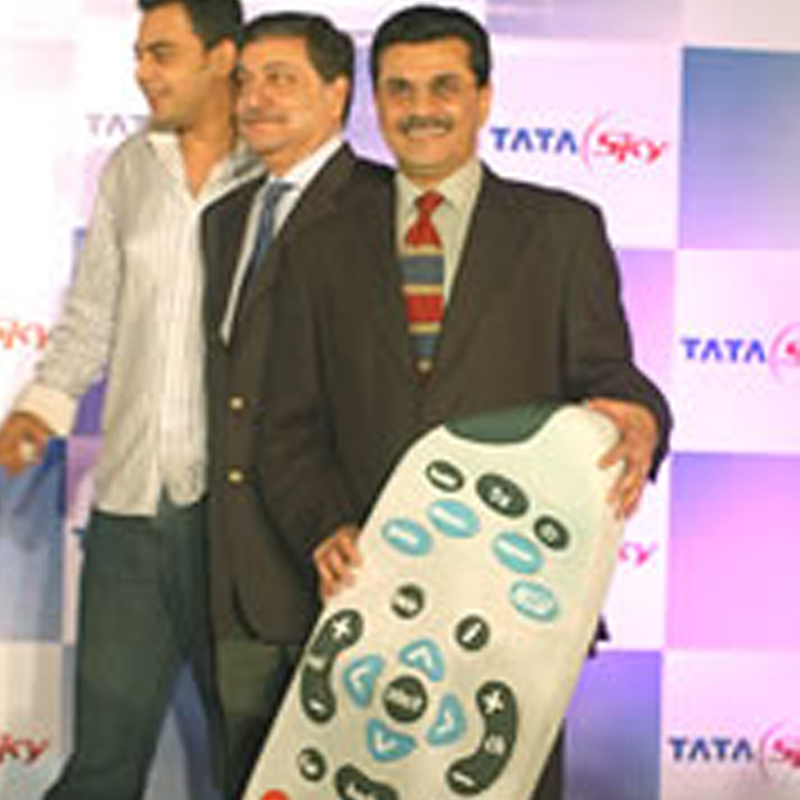
    Tata Sky CEO and MD Vikram Kaushik with Tata Sky chairman Ishaat Hussain
    Click here for a slideshow
    The Subhash Chandra-owned Dish TV is priced at Rs 3,290 (inclusive of taxes). This includes the cost of the STB as well as three months’ subscription. The monthly subscription for the basic Dish TV service of 75 channels is Rs 180.
    Announcing the launch at a glitzy event in Delhi where the likes of cricket commentator Harsha Bhogle rubbed shoulders with Mandira Bedi, Tata Sky MD and CEO Vikram Kaushik grandly proclaimed, “Entertainment will never be the same again.”

    Going on to harp on the state-of-the-art technology and finesse of the service, Kaushik added, “It’s a technological innovation that’ll bring the senses alive.”

    Apart from the many channels on the Tata Sky platform, a conspicuous absentee is the Zee Turner bouquet of over 20 channels as an agreement between Tata Sky and Zee Turner Ltd has not yet been concluded.

    Kaushik admitted that negotiations have not been concluded, but was hopeful that “things would get sorted out soon.”

    Another major absentee is the Sun Network, which dominates the South Indian markets. Tata Sky is, however, not alone in this, since Dish TV does not have access to the Sun channels either.

    “We are offering 55+ channels at the moment and with the passage of time the number of offerings would grow,” Kaushik said.

    The channels presently available on the non-tiered Tata Sky platform include all the channels from the Star (17), Sony Discovery One Alliance (14) bouquets as well as ESPN Star Sports and two channels of NDTV as its key offerings.

    It is worth noting here that it was only this morning that the deal for the carriage of the One Alliance channels by Tata Sky was signed and delivered.

    Confirming this to Indiantelevision.com, SET Discovery president Anuj Gandhi said the pricing terms was similar to the one signed recently with Dish TV.

    One Alliance is being paid around Rs 38 per subscriber by Dish for its channels. The deal is a five-year one that is extendable at the end of it, Gandhi revealed.

    Also available on the Tata Sky platform would be some Doordarshan channels as well the likes of Times Now, Aaj Tak, Headlines Today, etc. Some interactive and specially designed movie channels have also been thrown in as a sop.

    The Tata Sky service, Kaushik claimed in the presence of his company chairman Ishaat Hussain, has been designed to give subscribers “choice, control and convenience” in the way they want to watch television.

    A host of interactive services such as an on-screen programme guide, Actve Sports, Actve Star News, Actve Newsroom and Actve Khabar are also on offer.

    To offer maximum convenience to subscribers, Tata Sky has set up a pan-India distribution network of popular consumer electronic stores and mobile phone outlets for retailing its hardware and prepaid recharge vouchers.

    The pre-paid vouchers come in various denominations starting off with Rs 260.

    The company has also tied up with LG, ITC International Business Division and Indian Oil Corporation as part of its distribution drive.

    “We are looking at ramping up our activity and service over the next three months when the service should be covering the whole of India,” Tata Sky consumer marketing head Vikram Mehra said.

    The company has engaged a field force of approximately 3,000 people who will be complemented by a high-end 24×7 call centre, manned by multi-lingual customer service associates, trained to solve all customer problems.

    But Mehra was not forthcoming on the media campaign that’s about to break “soon”, except to say that it would be a 360 degree campaign using all normal media outlets.

    Tata Sky is an 80:20 DTH joint venture between the Tata Group and Hong Kong-based Star Group.

    The joint venture has invested over Rs 25 billion in the project till now, according to Kaushik, who added the target of 1 million subscribers in the first year is achievable.

    The unveiling of the Tata Sky service finally turns into reality a dream Murdoch has had since 1997 – of having a DTH platform in India


  • Zee to strengthen 8 pm slot with ‘Banoo Main Teri Dulhann’

    Zee to strengthen 8 pm slot with ‘Banoo Main Teri Dulhann’

    MUMBAI: Zee TV is all set to beef up its programming with Banoo Main Teri Dulhann, to kick off on 14 August at 8 pm from Monday to Friday. It replaces the long running soap Tumhari Disha and hopes to gain a strong viewership in the 8-10 pm slot, as it has already acquired popularity with leadout show Jab Love Hua, as well as Kasam Se and Saat Phere in subsequent slots.

    Dulhann, also running along a women centric theme, is about an uneducated village girl Vidya waiting to be swept of her feet by a charming prince. Marriage, however, shatters her dreams as she faces the wrath of her husband and in-laws who belittle her background and education.

    The essence of the show looks at the positivity with which she hopes to rise above these trials and win over her husband. Promising to have a good twist in the story, the show hopes to grip viewers.

    Speaking to Indiantelevision.com on the strategy that has been used to pull in the viewership, Zee TV senior VP programming Ashvini Yardi said, “Based on the lines of a Cinderella story, the theme deals with a reality that most Indian women can identify with. Tumhari Disha came in at a time when Zee did not have the numbers it holds today, hence, we are hoping Dulhann will be able to achieve that.”

    The main characters are played by two fresh faces, Divyanka Tripathi (Vidya) from Bhopal and Kolkata boy Sharad Malhotra (Sagar). The two were contestants from Cine Star Ki Khoj. Nilima Bajpai from Shankuntala Films has handled the production.

    Zee TV businesss head Punit Goenka said, “With Saat Phere, we addressed the issue of the discrimination a girl faces in many parts in India on the grounds of her skin colour. Banoo Main Teri Dulhann will touch upon and deal with the struggles an illiterate village girl has to undergo. If Kasam Se and Saat Phere have struck a chord with our viewers, Banno Main Teri Dulhann will take it further.”

    As Zee TV attempts to capture the 8 pm time band, it will have to face stiff competition from Sahara’s recently launched Sati. Star Plus’ Pyaar Ke Do Naam Ek Raadha Ek Shyaam is also in this time slot but, is yet to deliver numbers. Sony has also planned to launch a new show Hum Mei Hai Visshwas to replace Kaisa Ye Pyar Hai at 8 pm.

    Now, its left to the viewer to decide whether the show will be able to achieve the stronghold it hopes to establish during the prime time slot.

  • Extreme Sports Channel commisions new sports content series

    Extreme Sports Channel commisions new sports content series

    MUMBAI: US based Liberty Global owned Extreme Sports Channel has commissioned two new series for Summer 2006. The Fifa endorsed Euro Beach Soccer League as well as Streetball Extreme: Battle for Europe are being added to Extreme’s schedule as it attempts to grow its portfolio of new and innovative sports content.

    The two new series will go to air on Extreme’s 5 international feeds of the channel from September.

    Radio 1 and 5Live presenter DJ Spoony and sports commentator Natalie Pinkham will be co-hosting the Euro Beach Soccer League in a new six part series.

    According to an official release, the series will see sixteen national teams compete in matches held in France, Spain, Italy, Portugal, Austria, Greece, the Netherlands and Poland. UK production company Gun for Hire have been appointed to produce the series for Extreme.
    The French team, winners of the first Fifa Beach Soccer World Cup in 2005, will be led by French national star and Manchester United legend, Eric Cantona.

    Extreme’s head of programming James Dubern said, “Beach soccer combines the most spectacular aspects of football with awesome locations including a beach in the heart of the Alps! The sport has a huge international following and we’re looking forward to giving it the ‘Extreme treatment’.”

    Extreme is also adding the urban sport Streetball to its roster this summer. The channel has commissioned an 8 x 1 hour series titled Streetball Extreme: Battle for Europe following the UK-based SBX team on a 12 day tour through Europe.

    UK indie Chrome Productions will be capturing all the action as seven British players take on the best Streetball teams in Amsterdam, Berlin, Warsaw, Krakow, Lyon, Barcelona, Lisbon and Paris.

    Beach soccer is one of the fastest growing professional sports in the world and has so far been televised in over 170 countries. The sport was inspired by the football played on the beaches of Brazil and the official rules were created in 1992. Teams consist of up to 10 players and five players are on the sand at any one time. Playing on an uneven surface means that the game is largely improvised, with the ball spending most of the time in the air.

    Streetball has its roots in basketball but with a greater emphasis on style and flair. The sport relies heavily on one-on-one match-ups between attacker and defender with players always looking to find the most innovative, rather than the most direct, ways to score.

    The SBX team has been carefully selected by Tom ‘Con Man’ Connors, a UK-based Streetball pioneer. As well as taking on all-star local teams in each city, the events will feature freestyle demos, live DJs and MC battles in prime European locations including a custom built Streetball court on the beach outside Lisbon.

    The channel had recently provided live coverage of the videogaming competition, The Xbox Cup 2006, and plans to add more videogaming content to its schedule this year, informs the release.