Category: Movie Channels

  • Disney STAR Network to present the world television premiere of ‘Brahmastra: Part One

    Mumbai: Disney star network has announced the world television premiere of the biggest bollywood blockbuster of 2022, ‘Brahmāstra’, across the network. The magnum opus, directed by Ayan Mukerji, features an all-star cast including Amitabh Bachchan, Ranbir Kapoor, Alia Bhatt, Mouni Roy, and Nagarjuna Akkineni. The film will debut on linear TV across the Disney Star network in five languages – Hindi, Telugu, Tamil, Malayalam and Kannada. This larger-than-life cinematic marvel with breath-taking visuals will be aired on both standard and high-definition(HD) channels of Star Gold, Star Maa, Star Vijay, Asianet and Star Suvarna. The movie premiere is slated for 26 March on Star Gold, Star Vijay, Asianet and Star Suvarna and 19 April on Star Maa.

    “Brahmāstra was the biggest Bollywood movie of 2022; it revived the industry and shattered multiple box office records. The movie has all the right ingredients to engage millions of Indian families on linear television. With this simulcast, the movie will also offer unbeatable value to brands associating with this blockbuster by way of its broad-based appeal cutting across languages and demographics,” said Disney Star head network entertainment channels Kevin Vaz.

    Brahmāstra is a critical and commercial success, widely praised for its stunning special effects, engaging story, and top-notch performances by the star-studded cast. With its blend of action, drama, and humour, Brahmāstra is a movie that appeals to audiences of all ages and interests. Set in a fantastical world, the movie takes viewers on an epic journey filled with action, adventure, and drama. The film also explores the ancient mythology of India while incorporating cutting-edge special effects and a heart-pumping soundtrack. With mega hit chartbusters like Kesariya, Rasiya, Deva Deva, and Dance Ka Bhoot, the Brahmāstra music album had lyrics penned by Amitabh Bhattacharya and music composed by Pritam, creating a mellifluous rage amongst listeners worldwide!

    Brahmāstra’ is produced by Star Studios, Dharma Productions, Prime Focus, and Ayan Mukerji. S.S. Rajamouli presented Brahmāstra Part One: Shiva in Tamil, Telugu, Kannada and Malayalam for its theatrical release. With its state-of-the-art special effects, delightful music and top-notch performances, the television premiere of Brahmāstra is sure to be a most awaited event for viewers who have been waiting to see the film in the comfort of their homes with their families.

  • Red FM announces Superhits Marathi Film Festival season four

    Mumbai: Private radio and entertainment network 93.5 Red FM has announced the fourth season of Superhits Marathi Film Festival celebrating the essence of Marathi cinema. The film festival will be hosted at NFAI Phase 1, NFAI Phase 2, and FTII from 17 to 19 March 2023.

    Superhits Marathi Film Festival is a celebration of the oldest film industry of Indian cinema by bringing together the audience and celebrities. During the festival, Red FM will showcase critically acclaimed Marathi movies that have created an impact over the years. The movies will be screened in the presence of the cast and crew of the films, along with masterclasses and panel discussions with industry stalwarts. Marathi film festival is a non-ticketed event that invites Red FM listeners from Pune and across Maharashtra to attend the screenings.

    Speaking on the announcement, RED FM & Magic FM COO and director Nisha Narayanan said, “We at Red FM are elated to be presenting the fourth edition of Superhits Marathi Film Festival. This boutique festival is a testament to Red FM’s vision of being more diverse and inclusive. Over the past many years, the Marathi Film industry has added to Indian cinema with soul-stirring and ground-breaking films. These movies have particularly gained critical acclaim for detailing unique stories of real, human, and believable people along with raw yet gripping narratives. With the ‘Superhits Marathi Film Festival’ we aim to honor the legacy of the industry. As Red FM, we are overjoyed to become the platform that preserves and eternises Marathi films and helps them connect with an even wider audience.”

  • Genre and commercial viability decide the budget, not the actor: Everest Entertainment Founder and CEO Sanjay Chhabria

    Mumbai: This Maharashtra day, Everest Entertainment will give its Marathi audiences a visual treat. The company unveiled the motion poster for their upcoming big-budget Marathi film “Maharashtra Shahir” at a recent event in Mumbai.

    This is the biopic of Shahir Sable, a prominent personality in the Marathi music industry. His extraordinary talent and contribution to Marathi folk music are set to be fascinatingly revealed in the film. The film’s highlight is its exceptional music, which has been composed by the well-known music personality duo Ajay – Atul. Their music has given the film a new dimension, heightening its emotional impact and connecting with the audiences on a deeper level.

    Indiantelevision.com spoke to Everest Entertainment Founder and CEO Sanjay Chhabria who talked about his upcoming movie, the journey of Everest Entertainment, and the Marathi industry.

    Edited excerpts

    On the movie

    We are excited to bring the story of Shahir Sable to the big screen. We hope that this movie will be a fitting tribute to his immense talent and contribution to Marathi folk music. The lead actor Ankush Chaudhari who’s playing Shahir has done an outstanding job. He’s playing a 20-year-old to a 70-year-old. It’s a 9-crore film with music by Ajay-Atul and has 15 songs. We will take the movie to the rural areas where there are great legacies. The Films directed by Shahir Sable’s grandson Kedar Shinde. ‘Jay Jay Maharashtra’ recreated by Ajay -Atul will be a symbolic feature of this film releasing on 28 April, which is a weekend extending upto 1st May i.e. Maharashtra Day.

    On the journey

    Everest has been in the business for 20 years. Our adventure, which began in 2003, has been quite interesting. Along the road, we have picked up a lot of new knowledge and we have expanded our business significantly. We began as a video publishing business, purchasing the home video rights of Marathi films.

    We started content aggregation and now are the largest aggregators to Broadcasters & Digital Platforms.

    Our production journey started in 2008 when I first met Mahesh Manjrekar, and it was at that point that my debut film, 2009’s ‘Me Shivajiraje Bhosale Boltoy’,” was greenlit.

    With that, Everest Entertainment began its production journey in 2009. Between 2009 and 2022, we have produced 25 movies and the journey has been eventful & wonderful.

    In 2013/2014 the company expanded to acquire music rights. We now have a music label as well. Today Everest Entertainment is a company which is into film production, content aggregation, monetising the music ourselves, and we’re working on creating original content for the digital space. We’ve recently ventured into production of Gujarati and Bhojpuri language films.

    On Marathi industry

    I was introduced to the Marathi industry first by renowned producer  Sushma Shiromanee in 2003. My first acquisition for home video were her blockbuster films. I enjoy working with and being among the production community in the Marathi film space. The culture herein is very healthy & creative. The Marathi industry has a very strong and effective theatre community. Over 50 stage dramas that we own the rights to have been converted to video format.

    Everyone I’ve interacted with in the Marathi film industry have been amazing, and I’m an integral part of this industry. People keep asking me, “Why don’t you do Hindi films?” My father was a leading distributor of Hindi films, and my background is in the Hindi industry. But the Hindi film industry is a spoilt industry.

    I can’t relate to the kind of culture, where more money is spent on lead actors than on the making of the film.

    In comparison the Marathi industry is more balanced. We were a niche industry when I first arrived, we are now mainstream. We still have a long way to go as compared to the other regional languages in particular the South Indian cinemas. But we’re making progress.

    On the changes in the Marathi industry

    Here, a significant change has taken place. The quality of filmmaking and writing has improved. We used to make films in 50 lakhs to 80 lakhs back then now we’re producing films with budgets ranging from 3 to 10 crores.

    We have some of the best technicians, directors, writers .. Laxman Utekar, Nagraj Manjule, Aditya Sarpotdar, Sameer Vidwans, Nipun Dharmadhikari are a few examples of talent spreading their wings successfully beyond Marathi !

    Shwaas, Court & now ‘Me Vasantrao’ is among the top ten contenders for the Oscars. It is a testimony to our talent.

    On the thing that attracts you to the Marathi industry

    Purity of thoughts, pristine ideas un-corrupted by commercial compulsions is what attracts me to this industry & it’s talent. It’s like a ride from the big bad city to a picturesque countryside !  We’ve produced some fabulous films (which may not be commercial hits) .. Tukaram, Aajcha Divas Majha, Happy Journey, Amhi Doghi, Ananya are films we’re extremely proud of. The challenge now is the cost of filmmaking has risen & unfortunately we unlike Hindi & the south Indian languages do not have a model in the Marathi language which gives us the luxury to make films directly for OTT or Broadcast.

    Unfortunately today, we have to  rather must consider commercial viability. When a script comes to me, the first thing I have to consider is it’s theatrical potential to aid commercials. Post pandemic, things have changed drastically.

    On the budget of Marathi films now

    A surge in Marathi began with the film ‘Saade Maade Teen’ produced by ZEE, it was  the first film to release like a mainstream Hindi film, this was followed by ‘De Dhakka’ and then ‘Me Shivajiraje Bhosale Boltoy,’ which was the third big hit at the time. This set the tone.

    The distribution and exhibition sectors lacked respect for the Marathi industry or cinema. It has been overcome; we were regarded as the inferior cousins of Hindi or other languages back in 2004 or 2005. That’s no longer the case. Multiplexes have realised & know the potential of Marathi films.

    We still churn out about 75-80 films, sad thing is 30 to 40 of these are unquestionably below par.People today are intelligent enough, and this is true in all languages. There are numerous mediocre products produced.

    We’ve overcome the multiplex challenge today. Pre-digitization, cinema distribution was done with physical 16mm /35mm Prints, which limited our ability to showcase a film wide. As a result, we used to release & exploit film’s territorially – in stages. Gone are  those days and we can release a film in as many as 300 – 400 theatres with 1200 to 1800-2000 shows a single day.

    On the challenges

    One of the most difficult challenges today is the exhibition of trailers in cinemas. There is a ridiculous rule that multiplexes follow, which exhibits Marathi film trailers only with Marathi films and not in Hindi or Hollywood films. As an industry, we must work together to address these types of biases. Marathi trailers should be shown alongside mainstream films.

    Another challenge is lack of stardom ! Actors sticking to one medium ie cinema.

    We have actors in our industry who do Films, Theatre, Digital & dialy Soaps on TV. One can’t gain or achieve stardom if you’re visible in all formats ! Posturing is important for audiences to pay monies & buy a movie ticket !

    On the competition

    We’re not up against Hindi cinema, we are not in competition with anyone. We need to find our own space, create our own recipe. We have made our presence felt. Box Office of hits like Sairaat, Ved is an indicator of our untapped potential

    We’re still thinking & making movies which are primarily in Mumbai & Pune. We need to think wider i.e All Maharashtra & Pan India !. We have forgotten to make films for single-screen audiences.

    On the technology disruption

    Everyone has profited from movie digitization, which is why there are now many big releases. Pre-pandemic, OTT was present as well, but OTT consumption wasn’t.

    Our audiences in the past two years people have now consumed a lot of content on OTT. The standards are high, mediocrity will not be tolerated.

    A movie trailer is the be all or end all, if it does not excite or compel me to go to the theatre, I have other option’s… OTT. I have the option of spending my weekend watching something on one of my multiple subscriptions. In addition to that, there is always cricket in India, or some other sport to be consumed.

    On collaborations

    We syndicate the majority of our films with Amazon and all three big broadcasters as well. We have a great relationship with all of them.

    The OTT players now have five years of data at their disposal, allowing them to understand what works and what doesn’t.

    Amazon began in 2016 and they’ve already completed five years. They’ve had their learnings. They have always been very supportive & bestowed faith in our company.

    On the theatre/ shows occupancy

    Its very important to choose the correct date to release a film & and that responsibility rests with us.One must be very careful when selecting a release date ! this is where many producers go wrong, you can’t be complaining about showcasing after choosing a crowded date !

    The second important thing is the promotional material you generate for a film. There are agencies like Ormax who can help in that area while launching any product, one must support it with aggressive advertising and create that buzz. If the buzz is created, I don’t see why multiplex owners wouldn’t give you a chance. However, if your marketing fails, it will always be a battle with the plexes.

    On the quality of films

    We as an industry should choose quality over quantity; 30 – 40 films better in quality is better than a 100 films. There are a lot of inexperienced filmmakers / money bags who produce films for all the wrong reasons

    Bollywood went wrong when they started making profitable projects rather than great stories. Lucrative forward deals from broadcasters and OTT players spoilt them, there was no hunger in the belly to create good content.

    Time  now is to make films for the box office. As a producer, one must accept that risk. Theatrical success translates into high value Satellite & Digital deals. It’s a by-product of a good theatrical run.

    On the year 2022

    It’s been a mixed bag. Some great successes and a couple of setbacks. PawanKhind, Boyz 3 scored big. Ananya’ a film very close to my heart got a tepid response. There have been a lot of learnings post pandemic.


  • Everything Everywhere All At Once’ streaming exclusively on Sony LIV in India

    Mumbai: After wooing the audiences across the world with its story and performances since its release, “Everything Everywhere All at Once” had a big night at the 95 Academy Awards. The movie bagged a total of seven Oscars, emerging as the winner of the night and one of the most awarded films. The film is streaming exclusively on Sony LIV in India. 

    The multiverse madness comedy-drama led the nominations with 11 mentions, out of which it won some of the most coveted titles like Best Picture, Best Director (Daniel Scheinert and Daniel Kwan), Lead Actress (Michelle Yeoh), Supporting Actor (Ke Huy Quan), Supporting Actress (Jamie Lee Curtis), Best Original Screenplay (the Daniels), and Best Film Editing (Paul Rogers). The landmark film is a breakthrough for Hollywood diversity for its Asian-American themes and predominantly Asian cast. 

    The movie follows Michelle Yeoh’s Evelyn, a laundromat owner who attempts to save the multiverse from its greatest threat with the help of her alternative versions of herself from parallel universes. Evelyn is dealing with her unsteady laundromat business being on the verge of failure, her marriage to a wimpy husband, Waymond (Ke Huy Quan) and broken relationships with her judgmental father (James Hong) and her daughter Joy (Stephanie Hsu), while preparing herself for the impersonal IRS auditor, Deirdre played by Jamie Lee Cutis.

    Among the ten contenders at the Oscars this year, Everything Everywhere All at Once beat Steven Spielberg’s The Fabelmans, Cate Blanchett’s Tár, and the German war drama All Quiet on the Western Front. The film’s other notable wins include a BAFTA award, five Critics’ Choice Movie Awards, two Golden Globe awards and four category wins at the Screen Actors Guild Awards.


  • Vineet Kumar and Gopal Datt revive Manto and Parsai’s stories in Zee Theatre’s ‘Koi Baat Chale

    Mumbai: ‘Koi Baat Chale,’ Zee Theatre’s evocative, literary anthology featuring six stories of iconic writers has almost reached its end. Under the promise of ‘Har Din Naya Drama’, the next two stories are bringing the best of Hindi literature. Directed by Seema Pahwa, these episodes will feature theater exponents Gopal Datt and Vineet Kumar.

    Datt will narrate Harishankar Parsai’s ‘Ek Film Katha’, a satire on run-of-the-mill hindi cinema that hilariously revisits the cliched plot of a gallant hero, a heroine in distress and a villain who wants to nip a love story in the bud. Kumar will narrate Manto’s ‘Mammad Bhai,’ the tale of a Robin Hood-like gangster who is very proud of his dagger and his mustache. One day, however, circumstances force him to give up both and the audience is left wondering if Mammad Bhai will ever be the same.

    The stories are part of Zee Theatre’s promise of ‘Har Din Naya Drama’ and will be premiered at Tata Play Theatre on 19th March at two pm & eight pm.

    Director Seema Pahwa said, “To put together ‘Koi Baat Chale’ with Zee Theatre has been an incredible journey and these two stories end the anthology on a perfect note. ‘Ek Film Katha’ and ‘Hammad Bhai’ reveal how these stories were unique in their own manner.

    Parsai and Manto tapped into popular culture to show us different aspects of society. Gopal and Vineet were the perfect choices as they brought their own touch to these stories. I am sure the audience will really enjoy the little nuances they have brought through their narrations.”

    Datt said, “Parsai’s humor in ‘Ek Film Katha’ is penetrating and relatable. Being a trained theater actor, initially, the film plots did seem a bit far-fetched to me. But when I started narrating, I felt they have a certain enjoyable energy that takes the audience along with it. I enjoyed narrating this story because it reminded me of films from the 80s that we enjoyed despite their flaws, the random song sequences, and the mandatory fight sequences.”

    Kumar said, “What is fascinating about ‘Mammad Bhai’ is that Manto wrote it in 1956, much before Mumbai Noire became popular. ‘Mammad Bhai’ is a gangster and could be the template for similar characters that came much later in our films and OTT shows. He is also a fascinating human even though he is a criminal. Narrating this story was truly enthralling and I am thrilled that Zee Theatre is reviving such timeless stories for the current generation to enjoy.”

  • “The  relevance of IPR in the art & entertainment field is vital”: ProducerBazaar.com co-founder G K Tirunavukarasu

    “The relevance of IPR in the art & entertainment field is vital”: ProducerBazaar.com co-founder G K Tirunavukarasu

    Mumbai : Chennai based startup ProducerBazaar aims to use NFTs and blockchain technology to solve long-standing challenges in the film industry. 

    ProducerBazaar.com director and co-founder  G K Tirunavukaras spoke to Indiantelevision.com about content rights, NFT, technology, and awareness. 
    The platform ProducerBazaar.com is designed as a movie marketplace for producers, creators, and businesses to buy and sell film rights. 
    Among the features available to creators on the site are crowdfunding for film production and leveraging the reach of the blockchain and NFT communities to create a larger, global and national market for regional-language films.

    Edited excerpts

    On the firm and the progress that has been made

    NFT Creator Economy (NCEPL) was incorporated in September 2021 and we initiated the idea in February 2022. It’s just an 11-month-old baby and our journey has just begun. We are doing what we can to understand the marketplace from the perspective of producers and buyers, and slowly the traction has begun to build. In fact, in March last year, we were recognized by Startup India and got pre-seed funding from the Indian government. Parallelly, we started holding discussions with the producers across different states in South India like Kerala, Tamil Nadu, Karnataka, and Andhra Pradesh and by August we had onboarded more than 2500+ films.  

    We also associated with NFDC and started researching the potential of the Indian and Tamil film industry and learnt that there is a huge potential for IPR in India and for building a sustainable creator economy.  

    We also onboarded global buyers, including satellite and OTT players, people who buy Gaming, Metaverse and theatrical rights.  So yes, the interest in our platform is growing and with the input of key advisors MS Bharat who is India’s leading IP strategist and is our legal advisor, Then we have Kameshwaran Elangovan the Co-Founder of the Guardian Link. This is the company that launched Amitabh Bachchan in the NFT space.

    Among our industrial advisors, to name a few we have Suresh Kumar, the father of actor Keerthy Suresh who is also the president of the Kerala Film Chamber of Commerce. We also have Director TS Nagabharna who is part of the selection for the Oscars and also prominent people from the Telugu, Marathi, and Bhojpuri film Industries. 

    On the relevance of IPR and the scope in India.

    Everyone relates IPR with science and technology patents, but there are other key considerations, like copyright and trademark.  India is a country where for the longest time, we considered only doctors and engineers as professionals but now the arts and diverse fields including entertainment are gaining momentum. 

    The relevance of IPR in the arts and entertainment is vital.  IP awareness began to grow in India around 2007-08 and even today when it comes to the creative industries, the awareness is at a nascent stage. To date, when I invite creators to the Film IP Awareness Program, many ask me what exactly is a film IP!

    On the objectives of Producer Bazaar

    We want to imbue values of authenticity, transparency and reaching out the right content to the right audience at the right time, make it more sustainable and also explore global opportunities for a creator.  This is the core vision of ProducerBazaar.com. 

    On comparison with international production houses do we have the same concern with content protection?

    Every country has its own unique way of approaching things. In India, we have more than 1.4 billion people and over 2500 films are produced every year so we should define our own model rather than looking for inspiration elsewhere. But if we were to consider Hollywood, there are strict IP laws. 

    For instance, royalties are not a grey area and someone who may have written just one hit song, will still be getting paid for its play time and use in any shape or form.  In India, we need to protect the talent that is upcoming and also the body of work of those who may have dedicated their life to just creating good content. 

    On the awareness of it or do we still need awareness

    Yes, there is a certain level of awareness among bigger production houses but in the case of upcoming creators who work with skeletal budgets, the path may be arduous and fraught with dangers. Their ideas may get appropriated by someone else or the journey from the pitching stage, to getting funding, making the film and then selling it to bigger entities may be very long and challenging.  Their understanding of IPR  may not really be very firm either.  So we have hosted over 7- 8 IPR events and pointed out the importance of filing IP and the real value behind it. 

    On the transaction over blockchain?

    The movie will be listed on our platform and all the IPRs will be unbundled. There are different types of IPRs available for a film, ranging from theatrical, and audio to digital rights. In digital rights alone, there are three categories. Once the movie is listed in our platform we’ll unbundle the IPRs and then list it in our platform Ex: If a producer already sold 3-4 IPRs like the theatrical rights, and audio rights remaining IPRs are clearly listed in our platform we verify that to whom we are selling once the verification is done the contract which is available will be listed in our platform once the buyer comes in and if he likes the content whatever IPRs he wants to license he can license it. The entire process happens based on blockchain technology.

    On the transparency

    We are legalising the process very clearly and have an SOP ( Standard Operating Procedure ) for the producer once the entire content is properly copyrighted. The legally verified,  copyrighted content then will be listed on our platforms in a transparent, credible way.  For the buyer, credibility is most important. We discuss their requirements and match them with the content they want.  Then the entire contract will be converted via an NFT- Non-Fungible Tokens so that the tracking process is easy.

    On creators connected with you to date

    We have onboarded more than 2500 films to date. The actual number is 5000 but till we legally verify each asset, we cannot list it on our platform. 

    On the opportunities in the NFT movie marketplace

    It is not so much about opportunities as about a standardised structure. Once the film has been listed on our platform, we ensure that the producer gets consistent revenue. For instance, there were no television rights before 1960 and Doordarshan rights came into the picture in early 1970-80. Then came the era of satellite rights in 1990-94 and subsequently internet rights came into the picture in 1998 followed by OTT/ Digital rights in 2008. The point is, if you are a content producer, then there is a huge opportunity for you to turn your work into a well-paying asset. ProducerBazaar can help you earn consistent revenue. 

    Now Metaverse is emerging as another area with immeasurable potential and as a producer, you may not be aware of these emerging opportunities. For both the buyers and sellers, we are streamlining the process and reducing the stress quotient with the support of AI which gauges the requirement of the buyer. We are also facilitating international collaborations. The point is that in the environment of 24×7 streaming, platforms need fresh content so we are helping the OTT players and all kinds of buyers as well as sellers to connect quickly and safely. 

    We oversee and spur a fractional ownership momentum through NFT but it is not that the role for the producer will get reduced. In fact, all stakeholders will benefit.  Fractional ownership is going to be the future of NFT in the movie marketplace.

    On the challenges in blockchain for Indian content creators?

    I feel, there has to be a behavioral change among the creators and buyers where they begin to see online transactions of content as normative. There may be a lot of questions today about what we are trying to do in ProducerBazaar but we have the answers that will clarify and simplify our intent. To give you an analogy, so many of us did not order food from online apps earlier but now that is exactly what everyone does. We may see a similar shift to technology adoption in content transactions too.

    On Indian creators overcoming the hurdles?

    It’s not too late as the convenience, transparency and credibility of what we are trying to do will steer the change.   In fact, I believe that the upcoming new-age visualised creators are ready for it. You never know when what was once unthinkable becomes the norm as when COVID-19 made online education necessary.  

    The pandemic was like a massive global reset so even though at one time, phones were not allowed in schools, now children remained connected to academics through smartphones and other digital devices.  Similar digital transformation will gain momentum in other aspects of life and business transactions. Everything is becoming digitalized now and a creator’s content has to be mainstreamed and visualised for it to be noticed.   I am sure Indian creators will ride this wave and emerge triumphant.

  • Tips Films’ dependence on box office success is continuously reducing: Tips Films MD Kumar Taurani

    Tips Films’ dependence on box office success is continuously reducing: Tips Films MD Kumar Taurani

    Mumbai: “The film industry provides a very good opportunity to scale up operations very profitably and with very low risk,” quoted Tips Films managing director Kumar Taurani during the conference call conducted to announce the company’s quarterly results. He added that Tips’s plan is to scale up to releasing 12 films a year in the coming three to five years.

    “The dependence on box office success is continuously reducing, as the other three rights (music, video, & OTT) contribute a substantial part of the movie’s cost. Going forward, Tips Films very roughly expects its revenue distribution to be 30 per cent from digital rights, 30 per cent from domestic theatrical rights, 15 per cent from satellite rights, 15 per cent from music rights, and 10 per cent from overseas theatrical rights. We will have more clarity on these proportions over the next six to 12 months with more releases,” he stated further.

    He laid emphasis on the fact that the budgeting of a movie is a critical aspect in deciding its profitability. “Hence during this process, we seek the input of key company executives responsible for our major revenue streams, such as music, television broadcast, OTT distribution & marketing, and overseas release. The financial position analysis in these areas is based on all available information, including the screenplay, budget, schedule, director, producer, and principal cast. We currently have three films under production and are close to signing a deal for one of them. We will disclose more details once the deal is finalised.”

    He mentioned that the feature film format of 80 to 180 minutes of character-driven storytelling remains very relevant to today’s audience.

    Historically, movie business revenue was based on satellite rights, video rights, music rights, & domestic and overseas theatrical rights. This revenue distribution saw a disruption in the early 2000s. And music and video rights could not provide adequate monetisation for films for about 15 years, due to technological disruption. The disruption phase he described is now over. “Over the last three to four years, the film industry has seen a drastic change as a result of multiple OTT platforms and the revenue monetisation capability of music rights.”

    When asked about the duration of making a film, he said that pre-production takes two to three months. He said that, but production these days, depending on the film, can be done in 20 to 25 days; just say 100 days; or if there is a very big film, then maybe 150 days. Postproduction takes three to four months, depending on the number of visual effects in the film. If there is a lot of VFX in the film, it will take longer; eight to nine months is also possible; otherwise, two or three months is sufficient.

    When asked about the future of theatres given the OTT competition, he noted that everything will survive. OTT will survive; audiences are different. “Sometimes senior people want to go to the theatre; sometimes they want to watch on OTT. Youngsters are more into OTT. So, again, depending on the quality, which kind of film is thriller or horror, and if it’s a big actor, people will go to the theatre; if it’s a small actor, people will prefer to see it on OTT. So, there are many permutation combinations, but I feel theatre will 100 per cent survive till we make films.”

    Speaking on the balance of focus on theatrical releases versus OTT, he said that if the company likes the stories, then it just acquires them. We sign artists, and then at that time, we understand that this will be an OTT film or a theatrical film. As a result, the fact that we release so many theatrical and non-theatrical OTT films is not a guarantee. So, for the next one or two years, we plan to release at least five films per year, with the goal of increasing to 12 films per year in three, four, or five years. “We should release at least one movie every month, whether it’s OTT, theatrical, regional, or Hindi, so that’s our target for the next three to five years,” he concluded.

  • Colors Cineplex and Colors to premiere ‘Jugjugg Jeeyo’

    Colors Cineplex and Colors to premiere ‘Jugjugg Jeeyo’

    Mumbai: This Diwali, get ready to embrace the double dhamaka of entertainment with the television premiere of the movie Jugjugg Jeeyo on Colors Cineplex and Colors.

    Colors Cineplex is all set to present the premiere of Jugjugg Jeeyo on 22 October at 8 p.m. The film will also be aired on Colors on 24 October at 12:00 p.m.

    Viacom18’s premium movie channel, Colors Cineplex, showcases blockbusters from its vast repertoire of movies, spanning various titles with a mix of Hindi originals and dubbed titles from other languages, consolidating its library of superhit films with a robust addition.

    Directed by Raj Mehta, Jugjugg Jeeyo chronicles the marital issues of two couples from different generations while taking the viewers through a volley of emotions, hilarity, and drama. The movie, set against the picturesque backdrop of Punjab, delves into issues of love and family values. This dramedy, starring Varun Dhawan, Anil Kapoor, Kiara Advani, Neetu Kapoor, Maniesh Paul, and Prajakta Koli, has received widespread acclaim for its high level of entertainment.

    Viacom 18 Hindi mass entertainment and kids TV network head Nina Elavia Jaipuria said, “An out-and-out family entertainer, Jugjugg Jeeyo is one of the most successful movies of the year and it brings us immense pleasure to have its television premiere on Colors Cineplex and Colors. It’s our special Diwali offering of a power-packed dose of entertainment for the viewers. We’re thrilled to showcase a movie that rides on high-octane drama and comedy while capturing the cultural pulse of India.”

    Viacom18 Hindi movies cluster business head Rohan Lavsi said, “After fortifying our presence in the movie space by showcasing acclaimed blockbusters, we are thrilled to present Jugjugg Jeeyo, a perfect family entertainer this Diwali. While the movie has broken numerous records and emerged as a massive blockbuster, we are confident of taking its success on television a few notches higher with its premiere. Premised on family drama and relationships, the film will strengthen our arsenal of content offerings and enhance the variety of our movie library. We hope that the viewers enjoy the world television premiere of one of the most loved blockbusters of the year.”

  • IIFA to pay a special tribute to Amitabh Bachchan on his 80th birthday

    IIFA to pay a special tribute to Amitabh Bachchan on his 80th birthday

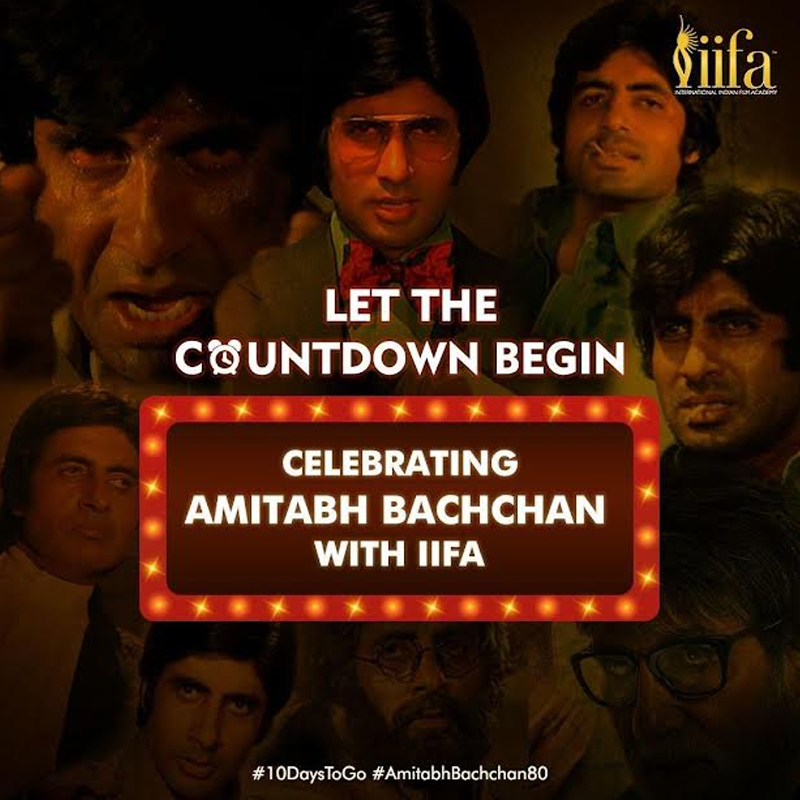
    Mumbai: The International Indian Film Academy (IIFA) this year will celebrate Amitabh Bachchan’s 80th birthday over the next 10 days. The IIFA celebration will consist of polls, quizzes, and trivia highlighting his work and achievements.

    Fans can catch all of this and more on IIFA’s social media handle (@iifa).

    IIFA said that it has never left any opportunity for movie fans to get closer to their favourite stars. Over the past 22 years, IIFA has travelled the world to showcase and highlight the very best in Indian cinema. During this time, through the journey of IIFA, the brand has taken Indian cinema to the world and has been working to bring the world together through cinema and entertainment.

    IIFA added that Bachchan is known as the Shahenshah of Indian Cinema. Bachchan has also donned the hats of a film producer, television host, and occasional playback singer.

    Amitabh Bachchan, who has won multiple awards at IIFA, was also awarded the first ever Bollywood wax figure at Madame Tussauds, which was facilitated, ironically, at the first IIFA in London in 2000. There are so many wonderful memories and moments that IIFA has witnessed with the superstar himself in many editions of the IIFA Weekend. He is currently one of the actors with the most IIFA best actor awards.

  • Zee Bangla Cinema unveils new brand identity

    Zee Bangla Cinema unveils new brand identity

    Mumbai: Zee Bangla Cinema, India’s leading Bengali-movie channel, will commemorate its decade-long journey with a new brand identity. Unveiled in time for the upcoming festive season, the evocative all-new brand identity highlights how movies have the power to make everything magical.

    The channel is about serving a daily dose of magic potion that takes viewers to a world where possibility takes the front seat and reality takes a backseat. Zee Bangla Cinema’s new tagline, “Hok Na Ektu Magic,” echoes this brand purpose.  

    Zee Bangla Cinema’s new identity was revealed during the world television premiere of the blockbuster of the year, “Aparajito – The Undefeated,” starring Jeetu Kamal and Saayoni Ghosh, directed by Anik Datta.

    For today’s evolved audiences who consume a range of genres, Zee Bangla Cinema has also revealed a powerful line-up of star-studded blockbuster Bengali movies that will premiere on the channel through the festive season. Starting 24September, “Notun Cinema Proti Robibaar” will bring world television premieres every Sunday. This first-of-its-kind programming will see the channel achieve a milestone of telecasting world television premieres on every week, rather than only once in a month.

    Commenting on the announcement, Zee Entertainment chief cluster officer – East Samrat Ghosh said, “Bengali cinema has always held a special place in the history of Indian films. From its beginnings in the 1920s, Bengali cinema has achieved global acclaim and popularity. From Satyajit Ray and Mrinal Sen to our contemporary filmmakers today, Bengali cinema has always been a creative powerhouse. It is an honour for us to celebrate this love for cinema and magic on the occasion of Zee Bangla Cinema completing 10 successful years of entertaining viewers. As one of the leading and most-loved channels in the Bangla movie-entertainment category, we cater to the audience’s varied preferences with a special content curation. “Notun Cinema Proti Robibaar” will strengthen our market share as we aggressively widen our movie library and bring the best of movie content for our viewers.”

    Talking about the channel’s revamped brand identity, Zee Bangla Cinema chief channel officer & head of marketing – East, Jalaluddin Mondal said, “As Zee Bangla Cinema completes a decade of passion for Bengali cinema, we decided to celebrate and build on our love for cinema by giving our viewers a brand-new experience. The new brand identity is accompanied by a slew of new initiatives to delight our viewers. A new slot strategy with each slot featuring films curated on the basis of audience demand and the genres they love is just the beginning. The icing on the cake is the most talked about and latest weekend television premieres for the ultimate weekend experience. As we enter a new decade, we will create a Movie++ experience with special music and movie events to cater to the Bengali lover of literature, music, and culture.”

    Talking about the new brand identity, Zee Entertainment chief marketing officer, content SBU Kartik Mahadev said, “Zee Bangla Cinema has always championed the power of cinema as an inspiring and binding medium that creates unforgettable moments of magic around television. Our new brand identity is our way of celebrating this intrinsic bond with every Bengali movie lover. As we complete a decade, we promise to keep bringing the magic of Bengali cinema alive for our viewers in every moment of their lives, as expressed in our new brand thought “Hok Na Ektu Magic!” The design of the new brand identity expresses the ‘Golden Circle of Special’ that curates’ moments of magic every day, brought alive through a vibrant colour play that is nuanced for the category and region. The refreshed design aesthetics will not only enhance the visual appeal but will facilitate intuitive content discovery creating an immersive experience.”

    Zee Bangla Cinema is promoting the new brand identity with a high-octane campaign, which will be promoted through a 360-degree approach across mediums – OOH, print as well as its social media channels including YouTube, Instagram and Facebook.