Category: GECs

  • Twitter will come to resemble TV as per a research

    Twitter will come to resemble TV as per a research

    MUMBAI: Twitter will become more like TV as the rate of typical users posting activities levels off. Research from two professors – Columbia Business School and University of Pittsburgh – believe the rate of social media user posts on Twitter will take a backseat to more TV content-based efforts from corporations and celebrities.


    “Twitter will become less of a communications vehicle and more of a content-delivery vehicle, much like TV,” said Olivier Toubia, the Glaubinger professor of business at Columbia Business School. The study was co-authored with Andrew T. Stephen, assistant professor of business administration and Katz Fellow in marketing at the University of Pittsburgh’s Joseph M. Katz Graduate School of Business and College of Business Administration.


    “Peer-to-peer contact is likely to evolve to the next great thing, but with 500 million followers, Twitter isn’t just going to disappear. It’s just going to become a new way to follow celebrities, corporations and the like.”


    The study examined some 2,500 noncommercial Twitter users where “synthetic” accounts increased the selected group’s followers. Initially, the selected group’s followers increased and their posting rates. However, when that group reached a moderately large amount of followers the posting rate declined significantly.


    Toubia said: “When posting activity no longer leads to additional followers, people will view Twitter as a non-evolving, static structure, like TV.”


    One of the study’s conclusions: noncommercial users will consume content by commercial users: “Twitter is likely to become more of a platform where noncommercial users consume content posted by commercial users, rather than a platform where non-commercial users share content with each other.”

  • Mipcom/MipTV reach out to Mumbai’s content community

    Mipcom/MipTV reach out to Mumbai’s content community

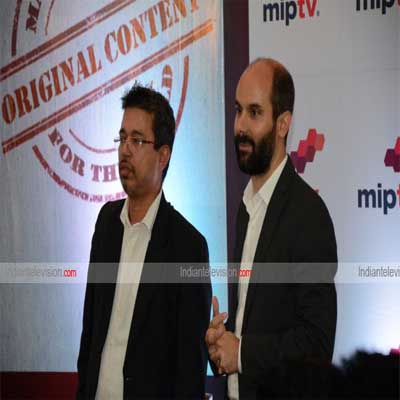
    MUMBAI: The Mumbai leg of Reed Midem’s Mipcom and MipTV road show went off like a dream with an attendance from about 80 professionals from the world of television and digital content. It was addressed by Reed Midem international business development director Ted Baracos, Asia sales manager Paul Barbaro and Indian representative (and indiantelevision.com founder & CEO) Anil Wanvari.


    The theme like the other two venues was “Can Indian content leave its stamp on the world?” But unlike Delhi and Hyderabad, the attendees were primarily professionals from TV and digital content production, broadcast syndication and distribution.


    TV producers were represented by Shyamashish Bhattachharrya, JD Majethia, Sumeet Mittal, Rakesh Paswan, Abhigyan and Mrinal Jha, Sudhir Sharma, Lalit Sharma, Asad Abid, Ram Talkit, Rahul Sarangi and Roopak Saluja. Zee TV, Indiacast, 9XM, Sahara TV, Times Television Network, and Travel XP HD were some of the broadcasters who attended. Independent film producers Imtiaz Barolia and Javed Rahman Khan also attended. Amongst the distributors included Bhupin Chhadva, Yuvamira Dwivedi, Vivek Lath, Ratnakar Kumar, Sanjay Hinduja and Rashmmi Menon.


    Rajjat Barjatya, Sandeep Mehra and Ram Seshan made up the digital players. Education companies Educmedia and Laughing Buddha Entertainment Knowledge were in attendance.


    Extremely interactive, the two hour seminar had all the constituents expressing their views. Broadcasters expressed that the two markets are a must attend for TV professionals and that the two markets help generate substantial business for content syndication for them. “Indian TV shows command about $350 to $700 per half hour,” said one of the broadcasters. “The sticker price of non-fiction shows is about $1,500 and above,” said another. “Films sell at anywhere from $500 to $15,-20,000 depending on the territory,” said a third.


    According to them, Pakistan, Afghanistan, Russian, CIS, Mynamar, Poland, middle east and other east European markets are some of the markets which have taken to Indian content well. Most of the attendees expressed that they would like to see an Indian pavilion come up at MipTV and Mipcom, representing the Indian content creation industry, just like 26 other regions from all over the world are doing, Wanvari said he was in conversation with National Film Development Corporation to set up the pavilion once again this year, while the Animation, VFX, Comic & Gaming Industry of Andhra Pradesh was also in the process of doing the same for this year’s Mipcom from 7-10 October.


    Film producer Javed Khan expressed that Mipcom is very conducive to doing co-production deals. He is currently executing a coproduction film with support from Turkey. “We nearly closed one co-production contract at Mipcom three to four years ago,” he said.


    Creative professional and producer Rahul Sarangi spoke about a non-fiction format developed by him which is going on the floors in four different countries. “Indian broadcasters were not very accommodating of my paper format,” he says. “So I invested about $40,000 and created a nice trailer and one of the overseas format distributors agreed to license it. It will be seen in several countries very soon. Mipcom and MipTV have really helped me realise my ambitions. Now an Indian broadcaster is negotiating to buy the licence for India.”


    The entire room gave a rousing ovation to digital producer Rajjat Barjatya who has generated 1.5 billion views for his 45 odd channels on YouTube. “Indian content can travel and is already travelling through my channels,” he said. “The most popular offering is a video Ba Ba Black sheep which has got 76 odd million views,” he said. “And it is being watched by a German mother and her daughter, an English mother and her son.. it has crossed language and cultural boundaries.”


    TV producers stated that they were totally hemmed in by the fact that they did not have the rights to the content they produce, but they would nonetheless like to attend to expand their horizons. Baracos said the Indian case was not unique. He gave the example of UK independent producer organisation Pact. “The UK market was quite similar to India’s as is Japan. The producers lobbied with industry and government to get their rights back again,” said Baracos. “They were successful with a caveat: they would share revenues with broadcasters on sales they achieved. Today, the UK Indies pavilion is generating close to 30 million pounds worth of deals annually. Everyone is happy: the broadcasters, and the producers.”


    Barbaro highlighted that it is imperative that India builds a brand for itself at international markets. “Korea has done it over years; China is doing it. India needs to do it,” he said. “Today, their content is traveling all over the world. Yes, the government supports their efforts with funds, but the Indian content community needs to awaken the Indian government about the opportunities available and what other governments are doing to help and propagate their culture – and indirectly generate national economic benefits – through markets such as Mipcom and MipTV.”

  • Comcast CEO Brian Roberts extends contract through June 2014

    Comcast CEO Brian Roberts extends contract through June 2014

    MUMBAI: Comcast chief executive Brian L. Roberts has extended his tenure at one of the largest cable company – for at least another year.


    Roberts isn’t planning on going anywhere – despite the seemingly short-term nature of the deal. His father, Ralph Roberts, founded the company half a century ago. What’s more, Brian Roberts’ employment contract had expired last month, according a filing Wednesday with the Securities and Exchange Commission.


    Rather than renegotiate his entire agreement, Roberts simply amended the pact so that it runs through June 2014. He did not negotiate any other modifications to the existing agreement, the filing said.


    This is not the first time Roberts, 54, has extended his agreement beyond its expected expiration. The current agreement took effect 1 January, 2005.


    Roberts last year received a compensation package from Comcast valued at $29 million, up eight per cent from 2011.


  • New commissions for Travel Channel & Food Network U.K

    New commissions for Travel Channel & Food Network U.K

    MUMBAI: Scripps Networks International has commissioned new programming across Travel Channel and Food Network U.K., alongside announcing the launch of Food Network HD in Turkey.


    There are two new commissions for travel channel: Luxury Uncovered and Man Vs World (working title). Luxury Uncovered is hosted by Jenny Powell. She will go behind the scenes to reveal the secrets of service specialists worldwide, from first-class flights to world-renowned resorts.


    Man Vs World features Rob Bell, an engineer, triathlete and adventurer. He puts all of these qualities to the test in a series of unique travel challenges. Bell was recently seen on BBC’s Engineering Greats.


    Food Network’s new commission is Jenny Morris Cooks the Riviera. The series explores the tastes of the Mediterranean, with a particular focus on French and Italian cuisine.


    Scripps UK & EMEA senior VP of content and marketing Nick Thorogood said, “It’s fantastic to create original, dynamic programming relevant to so many of the territories we broadcast to and to showcase both new and established talent.”


    Scripps UK & EMEA VP of commissioning and original content Sue Walton added, “Yet again we have pushed our original programming to the limit. Glamour, danger and fantastic food equaling top-notch entertainment for all to enjoy across our channels.”


    Additionally, Scripps Networks International is bringing Food Network HD to Turkey for the first time. The channel will be fully versioned by August. Through an agreement with D-Smart, Food Network HD will be available to 700,000 subscribers in Turkey.


    “It’s great to see Scripps further expand its global footprint in such an important international territory,” said Scripps EMEA managing director Jon Sichel. “Food Network’s unique lifestyle programming will be an excellent addition to D?Smart’s channel lineup.”
     

  • SingTel appeal over EPL cross-carriage rejected

    SingTel appeal over EPL cross-carriage rejected

    MUMBAI: Singaporean IPTV operator mioTV will have to share its English Premier League coverage with rival platform StarHub after losing an appeal seeking an exemption to the country’s cross-carriage rules for pay-TV content.


    In April, the Media Development Authority (MDA) ruled that SingTel-owned mioTV’s non-exclusive deal for EPL live matches for three seasons beginning this August triggers the “Cross-Carriage Measure,” which took effect in August 2011.


    Under the cross-carriage ruling, pay-TV platforms that acquired any exclusive content on or after 12 March, 2010, must make that programming available through the set-top boxes of other platforms. SingTel subsequently lodged an appeal against the MDA decision with the Minister of Communications and Information.


    “The minister’s decision to reject SingNet’s appeal was made based on the assessment of a number of factors,” a statement from the ministry said. “A key consideration was whether certain clauses in the agreement between SingNet and the Football Association Premier League prevent or restrict or are likely to prevent or restrict the EPL content from being acquired or otherwise obtained for transmission on selected network platforms in Singapore by other pay-TV operators.”


    “The minister considered the qualitative and quantitative effects of these clauses. The minister also noted that the key objectives of the cross-carriage measure include addressing the high degree of content fragmentation and encouraging pay-TV operators to shift from a content-centric strategy to other forms of competition, such as service and content innovation. Pay-TV operators should keep this in mind and continue to provide better value to the consumers. The minister has also suggested that MDA consider providing further guidance on the circumstances that may trigger the cross-carriage measure so that pay-TV operators can provide more certainty to consumers.”


    Customers on both platforms will be able to purchase an EPL stand-alone subscription, granting access to some nine channels, for S$59.90 ($47) a month.

  • BSkyB posts record financial results

    BSkyB posts record financial results

    MUMBAI: Full-year operating profit at BSkyB reached a record ?1.3 billion ($2 billion), up nine per cent from a then-record of ?1.2 billion ($1.86 billion) in the prior fiscal year.


    Revenue for the year ended 30 June, 2013 rose seven per cent to ?7.2 billion ($11.08 billion). EBITDA was up eight per cent, at ?1.7 billion ($2.6 billion).


    The British pay-TV giant added 34,000 TV subscribers in the latest quarter, compared with 20,000 TV sub additions in the year-ago period. Existing customers upgraded to new services at a rapid rate. There was 170-per cent growth in internet-connected Sky+HD boxes, to 2.7 million; a 19-per cent increase in Sky Go users, to 3.3 million; a fivefold increase in On Demand downloads; and 200-per cent growth in Sky Store video rentals. BSkyB’s new NOW TV sports day pass had more than 50,000 individual users purchase a pass in the first three months.


    Looking ahead, BSkyB said it wants to extend leadership in core areas such as original British drama and sky sports, but also to accelerate the take-up and usage of new services, which this year saw a strong response from customers.


    BSkyB chief executive Jeremy Darroch commented, “We have had another very good year of growth, with revenues up seven per cent, operating profit up nine per cent and earnings per share up 18 per cent. The strength of our financial performance is a result of our successful transition to more broadly-based growth and sustained investment to create a better service and wider range of products for customers.”


    “On the back of this performance, we are increasing returns to shareholders with the ninth consecutive rise in the ordinary dividend and we intend to seek approval for a further ?500 million of share repurchases.”


    “Over the course of the year, we added more than three million new paid-for subscription products. We finished the year strongly with 11 per cent organic growth in product sales for the fourth quarter, reflecting good demand in all areas. It was a particularly significant quarter for home communications as good organic growth, combined with the consolidation of the consumer broadband and fixed-line telephony business acquired from O2, delivered well over a million product additions.”


    “In our television business, there has been an excellent response from customers to our new services. We’ve seen an explosion in on-demand and mobile viewing as more people connect their Sky boxes to broadband and watch TV on laptops and mobile devices with Sky Go. Sky Go Extra, our new subscription service, has already attracted more than 150,000 customers in just five months. Customers tell us they get huge value from these services. The benefits to our business are equally strong through take-up of higher-tier packages, expanded revenue opportunities and improved customer satisfaction. We see an exciting opportunity for future growth in this area and we intend to increase investment over the next year to accelerate growth and returns from these new services.”


    “We expect the consumer environment to remain challenging over the coming twelve months. Against that backdrop, we have a strong set of plans that will extend our leadership in core areas – on screen, in home communications and in front-line service delivery; accelerate growth in new services; and improve efficiency to build a bigger, more profitable business for shareholders.”


  • The coming storm?

    The coming storm?

    MUMBAI: The two-week long standoff between IBF, AAAI and ISA finally ended mid-last week as the three constituents came up with a consensus. However, if one goes through it, it clearly appears that the three bodies bought in a forced peace.


    Industry watchers are asking how long before something else flares up. A big question mark still hangs over the ad rate hike which is expected to be made by broadcasters following the imposition of an ad cap by the TRAI. 1 October is not so very far away. Will advertisers, agencies and broadcasters sort out any moves in this direction in a calm composed manner? Or will they get into another round of fisticuffs?


    “Rate hike is a definite thing now. The more important question here is that by how much percentage it’s going to go up by. Channels, of course, can’t increase it at one go and hence, will do it in parts,” says a south Indian media planner, who didn’t wish to be named.


    Even another media planner from the city feels that it is market forces which will define by how much one can charge and how much will one pay. Most agree that with the new TAM viewership metric television viewership per thousand (TVT) coming soon, the channels will try to make the best of it.


    Almost everyone agrees that GECs will benefit when the ad cap comes into play. However, none of them wanted to comment on it. Whereas smaller channels were more than pleased to express what it could do for them.


    Sony Max senior vice-president and business head Neeraj Vyas told indiantelevision.com last week: “It is the biggest blessing that is going to happen to the genre. One needs to understand that the biggest problem for the genre is the time spent, so our time spent was close to around 65 to 68 minutes a week and 122 to 130 minutes for the GECs. Now there are clear reasons, GECs shows you original content everyday; and out here, there are repeats all the time. So now, if ads come down, ad time comes down, a viewer tends to stick on and watch more.”


    He further stated that the time is right for the movie channels to push for higher ad rates. “Traditionally, the Hindi movie channels have been sold at a a very low rate. The correction should have happened years ago, which did not happen. So probably this is the right time to make that switch. It is a survival issue for all.” (Read interview: “Bollywood is not making films suited for home viewing on TV today”)


    Agreeing with him, Food Food channel promoter Sanjeev Kapoor states as a matter-of-fact that someone will have to pay for it. And broadcasters cannot afford to pay, so either the viewers will pay or the brands will. “Fortunately for us, it’s not much of a problem because we are a new channel. In a new channel the inventory consumption is not 100 per cent in the beginning, it builds over time. So we are in a process of building that. And hence, our impact may be lower than others whose inventory consumption may be 100 per cent. However, that doesn’t mean we won’t be affected at all. I think older players, where time for ads is much higher, will be impacted by about 25 per cent. So either the brands will pay or both or it will be a three way split.”


    Even news channels which have filed an appeal with TDSAT regarding the ad cap feel that the only way ahead they can see is through a steep increase in ad rates. Zee News’ CEO Alok Agarwal feels that there could be a 70-100 per cent hike in the genre!


    The only party which will have to shell out money from their pockets is the advertisers. But they are trying to find a silver lining in the dark cloud.


    HDFC Life EVP – marketing & direct channels Sanjay Tripathy asserts, “At this moment there is a lot of speculation going on. Once the ad cap happens, we will be clear on what exactly the scenario will be. To be frank, it will be a demand and supply situation. Popular channels will quite likely get better price increments. The less popular ones will face a tough time. So just let’s wait for the right time and let’s not speculate more on this without knowing any facts.”


    Godrej & Boyce Manufacturing , vice-president (sales & marketing) Kamal Nandi says, “When you say that it would be tough on the advertisers, I would say there is a flipside to it that the TV viewing experience of viewers will improve on account of and less clutter. We are internally speaking to our media partners to develop an ROI to work out the cost vs benefit. Also, because of the reduced number of ads, the possibility of our commercial connecting and being viewed by the viewer at home will be higher.”


    While an industry expert feels that it is a complicated situation and keeping in mind the current economic scenario, it will be difficult to come up with a “solution” soon. “I wish it was simple. But no other country in the world has more than 650 channels that too in various languages catering to a very wide audience. Hence, all parties will have to sit and work on the economics of price, time, volume and content,” he explains.


    So can one expect fireworks again? He laughs and says, “The intelligent channels have already started working out things while others are waiting and will blame it on the market or industry.”


    For instance, the Sun Network announced a hike in ad rates of 19 per cent for its weekday prime time slots in late-May. Then Colors and Star India had said that it was taking up ad rates by 30 per cent and 20 per cent respectively in late May too. Colors CEO Raj Nayak last week told indiantelevision.com that advertisers had responded well to the increase in rates and the channel had managed an average uptick of between 12 and 18 per cent following the hike.


    Another expert from the opposite side of the table says, “It’s a flea market. Anyone can demand whatever they like, of course, depending on the ratings. And whoever is willing to shell out that much will advertise on it or else look for another option.”


    He goes on to clarify, “If by any chance there is a standoff, then I don’t expect collective action from the three associations, as prices are dictated by market forces and intervention is not something that will work.”


    Knowing the hyperactive Indian Broadcasting Foundation, don’t expect it to take things lying down in case advertisers and agencies stonewall broadcasters. Will it be fireworks before Diwali?

  • NGC to air one hour long documentary on the natural calamity in Uttarakhand

    NGC to air one hour long documentary on the natural calamity in Uttarakhand

    NEW DELHI: National Geographic Channel is known for inspiring its viewers and satisfying the innate curiosity through its innovative shows that challenge what we know and how we perceive our world. NGC has created award winning documentaries that capture events with a global impact such as the Indian Ocean Tsunami, Bhopal Gas Tragedy & Hurricane Sandy through shows like “Seconds from Disaster” & “Trapped”. These special documentaries go beyond the headlines, explore deep inside the events leading up to the catastrophe as well its aftermath and humanise the tragedy through personal accounts of survival & loss.


    NGC is now producing a special documentary on the recent natural calamity in Uttarakhand, which will attempt to understand why this happened and how it happened. The documentary would take viewers back to the initial terrifying moments of the catastrophe and also the rescue and evacuation efforts spearheaded by the Armed Forces, with insights from valorous soldiers who rescued thousands of trapped civilians. It would also showcase interviews with experts and scientists who will shed light on the entire disaster. As the nation still struggles to come to terms with the destructive flood that washed away everything in its path, the documentary would track the events as it unfolded.


    Commenting on the documentary, Fox International Channels VP content programming Swati Mohan said, “The floods in Uttarkhand are extremely unfortunate and have once again unraveled our helplessness when faced by nature’s wrath. The mass devastation and destruction caused is appalling. Through this documentary we intend to look into the calamity from multiple points of view. From exploring factors that led to the flood, to looking at the mammoth task of recovery and rehabilitation that lies ahead – the documentary will provide our viewers a deeper and better understanding of the ‘Himalayan Tsunami’.”

  • MipCom, MipTV workshop planned for Hyderabad this evening

    MipCom, MipTV workshop planned for Hyderabad this evening

    MUMBAI: In the words of many a TV sales and acquisition executive. Paris-based Reed Midem’s MipTV, MipCom, Mip Junior, MipFormats, MipCube are absolutely unmissable (if a word like that can be created specially for this purpose).


    Close to 12,000 executives from more than 100 countries, 4000 buyers, 2000 plus exhibitors, hundreds of conferences and keynote speeches and interviews featuring industry global TV broadcast, production, creative, distribution, regulatory leaders are what make all of these a must-attend for the TV ecosystem for decades. A delegation of close to 120 TV professionals from India have been attending each of these markets for the past five-six years.


    An estimate is that close to three billion euros in transactions emanate from these markets annually as executives buy and sell animation shows, drama series, films, documentaries, non-fiction formats, digital content, explore emerging formats such as ultra HD (these days), paper formats, do co-production deals, and so on.


    And to propagate this message further and to connect with India’s vibrant content creation industry, indiantelevision.com CEO and MipTV, MipCom and Midem representative Anil Wanvari has been going on a whistle stop tour covering three of the major broadcast and content ecosystem cities of Delhi, Hyderabad and Mumbai, along with Reed Midem director marketing development Ted Baracos and Asia sales manager Paul Barbaro.


    The Delhi-leg of the road show culminated on 22 July and was extremely well attended by a clutch of animation entrepreneurs, documentary producers, broadcasters, digital content creators, distributors, film producers.


    Says long time Mipmarkets attendee TigerBells Animation founder Vivek Kalyan: “It was fabulous to have an interaction with Ted, Paul, and Anil and learn how we as content creators can further our prospects globally.”


    Adds independent documentary producer Pankaj Saxena: “It’s great that we had such a stimulating workshop. We are looking forward to such future interactions so we can create the right strategy to allow our content to leave a stamp on the world.”


    An interaction with close to 100 content creators and distributors is planned for Hyderabad later this evening. And another one for Saturday 27 July at 7 p.m. in Mumbai.

  • TV related activity on Facebook five times more than on other social networks: Trendrr

    TV related activity on Facebook five times more than on other social networks: Trendrr

    NEW DELHI: A new study shows there is a large amount of TV-related social activity on Facebook – in numbers approximately five times as large as that of all other social networks combined as measured by Trendrr.


    The study follows a new partnership between Trendrr and Facebook that gives Trendrr preliminary access to previously unanalysed Facebook user engagement data relating to television content.


    As part of that access, Trendrr CEO Mark Ghuneim has unveiled a new study that shows “there is a large amount of TV-related social activity on Facebook – in numbers approximately five times as large as that of all other social networks combined as measured by Trendrr”, The size of the activity for one week in May was particularly evident for the chatter on social media networks pertaining to broadcast TV. That activity was seven times as large as all other social media networks combined.


    But the TV-related activity was also enormous for cable programming, which was 4.5 times as large as the other social networks.


    The Trendrr analysis also showed particularly high levels among viewers of dramas and comedies and among Hispanics, which other studies have found to be particularly heavy users of digital and social media.


    “For example, Univision’s finale of Nuestra Belleza Latina had 12 times more activity on Facebook during the on-air window than all other social networks combined,” Trendrr reported.


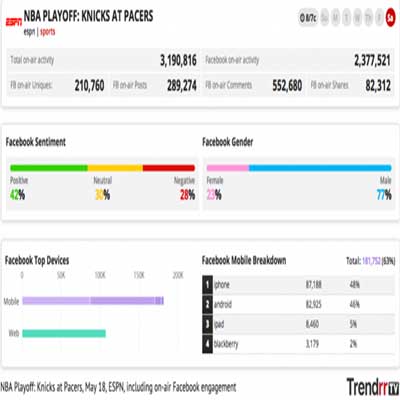
    Trendrr also released data on the NBA Playoffs that showed the Knicks at Pacers on ESPN had three times the number of on-air interactions on Facebook as on all other social networks measured by Trendrr.


    In releasing the results, Trendrr blog noted that “this is the start of an exciting relationship between Facebook and Trendrr. The potential development of an open system for accurate measurement of the entire Facebook platform will provide our clients and the larger Social TV ecosystem with more insights and tools to make better decisions.”