Category: Production House

  • Essel Vision enters into a multi-film deal with White Feather Films

    Essel Vision enters into a multi-film deal with White Feather Films

    MUMBAI: Essel Vision Productions Ltd (EVPL), the creative and production studio of Zee Entertainment Enterprises Ltd (ZEEL), has announced a multi-film deal to make its foray into mainstream commercial Hindi films with writer, director and producer, Sanjay Gupta’s White Feather Films.

    The first film to go on floors in January 2015 is directed by Sanjay Gupta. Titled Jazbaa, it is Aishwarya Rai Bachchan’s comeback film as the dynamic lead protagonist and also stars Irrfan Khan, Shabana Azmi and Anupam Kher. Jazbaa will be Aishwarya’s first film after a gap of 5 years.

     Essel Vision has, in a short span of three years, emerged as a full-fledged state-of-the-art-studio that is a one-stop destination for all in film making, promotions, advertising, distribution and revenue generating streams. It has built a dynamic portfolio of regional cinema in Marathi and Bengali, top rated television shows and is now venturing into Hindi cinema. Wholly owned by ZEE, Essel Vision is backed by the conglomerate’s vast network of channels including its music company Zee Music.

     After being a trendsetter in Marathi and Bangla cinema and associations with the biggest names in regional language cinema, this announcement is a first from amongst a slate of films being made by Essel Vision.
     
    Acclaimed filmmaker Nittin Keni is Essel Vision’s CEO and has produced commercial and critical blockbusters like Gadar: Ek Prem Katha and half a dozen other successful films. On this multi-film deal, Nittin Keni says, “We are delighted to associate with Sanjay Gupta. The first offering Jazbaa is a brilliant script that is full of emotional texture and develops beautifully into a human story for global audiences. The partnership is a perfect fit for both companies and I am confident that together we will be in a better position to deliver compelling, profitable entertaining content to global audiences. Besides the films which we have already locked, we are in talks with several prolific content makers and will soon announce other projects in the pipeline.”
     
    Sanjay Gupta is known for his fast-paced action thrillers which include Kaante, Musafir, Zinda, Shootout at Lokhandwala and the recent blockbuster Shootout At Wadala amongst others. Commenting on their association, Sanjay Gupta, Chairman & MD, White Feather Films says, “It’s a pleasure to associate with Essel Vision on their foray into mainstream Hindi film production after the successes they have had in regional cinema. Having the largest Indian television conglomerate ZEEL backing us is a dream come true for any production house. We, at White Feather Films, could not be happier. Also, for me from doing fast paced action, I’m looking forward to Jazbaa as it’s a gripping, touching and terrifying drama. We have a stellar team, and a great dramatic conundrum that audiences should enjoy.”
     
    After creating an unprecedented record at the recently held 45th International Film Fesival of India (IFFI) in Goa, with four films produced by EVPL selected officially to be screened at the festival, the studio identifies and acquires powerful fresh and intellectual property based ideas and matches them with strong filmmakers to turn them into blockbusters. Essel Vision – Business Head, Akash Chawla says, “This is our first announcement and many more announcements can be expected from Essel Vision in the Hindi film space. Zee is here to make quality & commercially viable films and Essel Vision, as the creative and production arm of Zee, will lead the foray. We will be involved in all aspects right from film production, processing, distribution, exhibition and revenue streams of these films.”  


  • ‘Got Talent’ continues its global domination with ‘Mongolia’s Got Talent’

    ‘Got Talent’ continues its global domination with ‘Mongolia’s Got Talent’

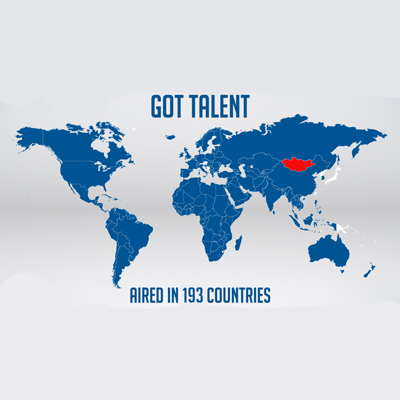
    MUMBAI: The international rollout of the world’s most successful TV format “Got Talent”, took another landmark step today as Syco Entertainment and FremantleMedia announced the commission of Mongolia’s Got Talent by Mongol TV. The news comes after Got Talent creator Simon Cowell’s recent MIPCOM 2014 Keynote session in which he joked about Mongolia being one of the last regions in the world where Got Talent didn’t have a presence. The multi-season deal will see Mongol TV broadcast the first local version of the format in 2015.

    The Guinness World Record-breaking franchise co-produced by Cowell’s Syco Entertainment and FremantleMedia continues its rein as the Most Successful Reality Television Format in history as it travels further around the world with the new version bringing the total number of local versions across Europe, Asia Pacific, the Middle-East, Africa and the Americas to 67 and the total countries in the world to air a version of the format to 193* (see map).

    As well as creating a local version of the format, Mongol TV will acquire season 8 of the ever successful Britain’s Got Talent. These deals were brokered by Haryaty Rahman, VP Sales and Distribution, Asia, FremantleMedia International. The UK version of the show continues to be the UK’s biggest entertainment show and in 2014 the Britain’s Got Talent finale on ITV exceeded 12 million viewers for 7th year in a row!


    Simon Cowell said “Mongolia is one of the last countries in the world to have Got Talent on air so I’m absolutely delighted Mongol TV will be making the show next year. So thank you and Congratulations Mongolia!”

    Cecile Frot-Coutaz, CEO, FremantleMedia added: “Got Talent has become a World Record breaking format because it combines extraordinary acts with great storytelling, capable of transcending geographic boundaries, language and culture. We’re looking forward to working with Mongol TV next year to create a local version of the show, which will – I’m sure – uncover an array of hidden talents from this part of the globe.”

    Nomin Chinbat, CEO of Mongol TV, said “When I heard Simon Cowell at MIPCOM saying that Got Talent had to be in Mongolia, I immediately decided to rise up to the challenge. Mongolians are great entertainers and this format is a great fit for Mongol TV. I now challenge Simon to join us in Ulaanbaatar in September when we launch the series!”

    Got Talent is watched by an estimated 500 million people worldwide has accumulated over 6 billion lifetime views on YouTube. In 2014, the franchise rolled out in six new markets: Afghanistan, Azerbaijan, Cambodia, Iceland, Mexico and Myanmar.


  • Bomanbridge Media announces several deals at ATF

    Bomanbridge Media announces several deals at ATF

    MUMBAI: Bomanbridge Media, a Singapore-based content distribution and production agency, announced multiple program deals for Asia at ATF.  These deals come on the heels of the company’s recently publicized expansion to 3 countries South Korea, Mongolia and India as well as the launch of their first production, international lifestyle and cooking show Haute & Saucy with Kelly Randall Sia


    “Bomanbridge has never been stronger. We come into ATF closing several major deals in the region for hundreds of hours of programming. Additionally, with our new offices in India and Korea and soon Mongolia, we expect to have a record breaking year for sales. Producers trust us to place their programs to the best broadcasters in the region,” said Sonia Fleck, CEO of Bomanbridge Media.

    Deals include:


    TV3 Mediaworks, New Zealand

    Titles sold: It Only Hurts When I Laugh (47 x 30), Life’s Funniest Moments (125 x 30); Hours sold: 86


    TV3 Bec Tero, Thailand

    Titles sold: Nutri Ventures (52 x 30) and other children’s programs; Hours sold: 39  


    Thai Public Broadcasting Service, Thailand

    Title sold: Animal Atlas;   Hours sold: 88


    True Visions (Thailand)  

    Titles sold include: Bump, Chimp Mommy, Gadget GirlzPound Pups to Dog Stars and Village Vets; among others  Hours sold: 63.5


    KBS –Korea

    Superbodies 2 x 1 hour

  • Lionsgate reports 10.9% revenue growth; TV Production profits quadruple: Q2-2015

    Lionsgate reports 10.9% revenue growth; TV Production profits quadruple: Q2-2015

    BENGALURU: Lions Gate Entertainment Corporation/Incorporated (Lionsgate) reported revenue growth of 10.9 per cent to US$ 552.88 million in Q2-2015 (quarter ended 30 September 2014, current quarter) from US$ 498.73 million in the corresponding quarter of last year (Q2-2014).  For HY-2015 (Six month period ended 30 September 2014), Lionsgate revenue fell 6.2 per cent to US$ 1002.26 million from US$ 1068.46 million in HY-2015.

     
    The company’s net income in Q2-2015 after taxes increased 41 times to US$ 20.78 million from US$ 0.51 million in Q2-2014. HY-2015 net income after tax more than quadrupled to US$ 64.04 million as compared to the US$ 14.12 million in HYT-2014.

     
    “We’re pleased that our entire portfolio of businesses contributed to our solid results in the quarter, driven by a particularly strong performance from our television operations,” said Lionsgate chief executive officer Jon Feltheimer.  “It was a quarter in which we extended our franchises into new lines of business, continued to assemble a strong pipeline of new properties with great commercial potential and developed online platforms that enhance our ability to deliver our content directly to the consumer.”

     
    Television Production Segment

     
    Revenue from the company’s Television Production segment more than doubled (increased by 140.7 per cent over Q2-2014) in Q2-2015 to US$ 154.85 million from US$ 64.33 million in Q2-2014. HY-2015 revenue from this segment rose 39.4 per cent to US$ 272.32 million from US$ 195.42 million in HY-2014.

     
    Television production segment’s profit more than quadrupled (increased by 352.3 per cent over Q2-2104) to US$ 13.93 million from US$ 3.08 million in Q2-2014. HY-2015 profit increased 27.7 per cent to US$ 27.63 million from US$ 21.63 million in the corresponding six months of the previous year.

     
    Lionsgate attributes the growth to strong gains in both domestic and international television as well as home entertainment revenue from television production.

     
    Fifty-five episodes and 38.5 hours of domestic television series were delivered in the quarter, including episodes of ‘Manhattan’ , ‘Anger Management ‘, ‘Orange is the New Black’ , ‘Houdini’ , ‘Nashville’ and ‘Mad Men’ , compared to 20 episodes and 11.0 hours in the prior year quarter. Strong international sales of ‘Orange is the New Black’, ‘Nashville’ and ‘Anger Management’ were also reported in the quarter, says the company.

     
    Motion Picture Segment
     

    Lionsgate’s major segment – Motion Picture- reported 8.4 per cent drop in revenue to US$ 398.03 million in Q2-2015 from US$ 343.4 million in the year ago quarter.  HY-2015 revenue from this segment fell 16.4 per cent to US$ 729.94 million as compared to the US$ 873.04 million in HY-2014.

     
    Motion Picture segment reported a 15.4 per cent drop in profit in Q2-2015 to US$ 57.95 million from US$ 68.81 million in Q2-2014. For HY-2015, profit was up 11.4 per cent at US$ 136.68 million as compared to the US$ 122.65 million during the corresponding period of last year.

     
    Within the Motion Picture segment, theatrical revenue declined to US$ 44.9 million with only two wide theatrical releases in the quarter, ‘The Expendables 3’ and ‘Step Up All In’, compared to a prior year quarter that included two wide releases, continuing revenue from the May 2013 release of ‘Now You See Me’ and the record-setting Spanish-language release ‘Instructions Not Included’ from Pantelion Films reveals the company.

     
    The company reveals further that Lionsgate’s home entertainment revenue for the quarter was US$ 164.4 million compared to US$ 209.9 million in the prior year quarter due to strong performances from the Managed Brands slate and ‘Now You See Me’ in the prior year quarter partially offset by the outstanding home entertainment performance of Divergent in the current quarter. Home entertainment revenue from television production increased in the quarter due to gains in digital media revenue.

     
    Bolstered by the pay television window opening for ‘The Hunger Games: Catching Fire’ and the free television window opening for ‘The Twilight Saga: Breaking Dawn – Part 1’ , television revenue included in the Motion Picture segment more than doubled to US$ 69.4 million in the quarter compared to US$ 34.6 million in the prior year quarter.

     
    International Motion Picture segment revenue (excluding Lionsgate U.K.) for the quarter was US$ 75.6 million compared to $US 88.7 million in the prior year quarter with three wide release titles in worldwide release compared to five in the prior year quarter. Lionsgate UK reported revenue of US$ 37.3 million in the quarter increased 38 per cent compared to the prior year quarter.

     
    Lionsgate is a global entertainment company with a diversified presence in motion picture production and distribution, television programming and syndication, home entertainment, family entertainment, digital distribution, new channel platforms and international distribution and sales.

     
    Lionsgate currently has more than 30 television shows on over 20 different networks spanning its primetime production, distribution and syndication businesses, including such critically-acclaimed hits as the multiple Emmy Award-winning ‘Mad Men’ and ‘Nurse Jackie’, the comedy ‘Anger Management,’ the broadcast network series ‘Nashville’, the syndication success ‘The Wendy Williams Show’ and the critically-acclaimed hit series ‘Orange is the New Black.’

     
    Its feature film business has been fuelled by such recent successes as the blockbuster first two installments of ‘The Hunger Games’ franchise, ‘The Hunger Games’ and ‘The Hunger Games: Catching Fire’, the first installment of the ‘Divergent’ franchise, ‘Now You See Me’, ‘John Wick’ , ‘Warm Bodies’ , ‘The Possession’ , ‘Sinister’ , ‘Roadside Attractions’, ‘A Most Wanted Man’, Lionsgate/Codeblack Films’ ‘Addicted’ and Pantelion Films’ Instructions Not Included , the highest-grossing Spanish-language film ever released in the US.

     
    Lionsgate says that it handles a prestigious and prolific library of approximately 16,000 motion picture and television titles that is an important source of recurring revenue and serves as the foundation for the growth of the Company’s core businesses.

     
    Epix is an American hybrid premium cable and satellite television network, and subscription video on demand service that is operated by Studio 3 Partners LLC, a joint venture of Viacom (specifically its subdivision Paramount Pictures), Metro-Goldwyn-Mayer and Lions Gate Entertainment. Viacom handles operational support for the channel, including marketing and affiliate services, through its Viacom Media Networks division. The television channel features theatrically released motion pictures, documentaries, concert and comedy specials, and boxing and mixed martial arts matches. TVGN is an American cable and satellite channel that is joint venture between CBS Corporation and Lions Gate Entertainment.


    Click here to read the earning release of the company


  • Sri Adhikari Bros reports 21.4%higher revenue, 19.9% higher PAT in Q2-2015

    Sri Adhikari Bros reports 21.4%higher revenue, 19.9% higher PAT in Q2-2015

     BENGALURU: Sri Adhikari Brothers Television Network Limited (SAB TV) reported 21.4 per cent y-o-y growth in Total Income from Operations (TIO) in Q2-2015 to Rs 22.01 crore from Rs 18.13 crore in Q2-2014 and a 11.1 per cent growth from Rs 19.81 crore in Q1-2015. Year to date, during HY-2015, the company reported growth of 20.7 per cent to Rs 41.83 crore from Rs 34.65 crore in HY-2014.

     PAT for the current quarter increased 19.9 per cent to Rs 2.73 crore (12.4 per cent of TIO) from Rs 2.28 crore (12.6 per cent of TIO) in the corresponding year ago quarter and was 3.9 per cent more than the Rs 2.63 crore (13.3 per cent of TIO) in the immediate trailing quarter. For HY-2015, SAB TV reported 31.4 per cent growth in PAT to Rs 5.4 crore from Rs 4.11 crore in HY-2014.

     SAB TV’s total expenditure (TE) in Q2-2015 at Rs 18.24 crore (82.9 per cent of TIO) was 18.3 per cent more than the Rs 15.42 crore (85 per cent of TIO) in Q2-2014. In HY-2015, TE at Rs 35.07 crore was 14.2 per cent more than the Rs 30.70 crore in HY-2015.

     The company’s production/direct (production) expense in Q2-2015 at Rs 14.07 crore (63.9 per cent of TIO) was 27.1 per cent more than the Rs 11.07 crore (61 per cent of TIO) in Q2-2014 and 7.5 per cent more than the Rs 13.09 crore (66.1 per cent of TIO) in Q1-2015. For HY-2015, SAB TV’s production expense was 24.9 per cent at Rs 27.16 crore (64.9 per cent of TIO) in HY-2015 than the Rs 21.75 crore in HY-2014.

    SAB TV’s interest/finance cost (interest) Q2-2015 at Rs 1.06 crore (4.8 per cent of TIO) was more than double (2.4 times) than the Rs 0.44 crore (2.4 per cent of TIO) in Q2-2014 and more than 2.8 times the Rs 0.38 crore (1.9 per cent of TIO) in Q1-2015. Interest cost in HY-2015 at Rs 1.43 crore (3.4 per cent of TIO) was 65.2 per cent more than the Rs 0.87 crore (2.5 per cent of TIO) in HY-2014.


    Click here to read the unaudited financial statement


  • BBC One commissions ‘The A Word’

    BBC One commissions ‘The A Word’

    MUMBAI: Ben Stephenson, BBC Controller: Drama Commissioning has announced the commission of The A Word, a six part drama series to be co-produced by Fifty Fathoms Productions, Tiger Aspect Productions and Keshet UK.

    The A Word is based on the Keshet International and July August Productions’ series and drama format which was written and created by Keren Margalit. The A Word has been developed and written for BBC1 by Peter Bowker (Marvellous, Occupation, Blackpool).

    The A Word is the story of the Scott family who work and love and fight like every other family. Then their youngest son is diagnosed with autism and they don’t feel like every other family anymore. They realise that if their son is ever going to communicate, they are going to have to learn how to communicate themselves.  It’s a funny and thought-provoking series about parenthood and childhood and what it is like to have a child who fails to fit the mould.

    The A Word will be Executive Produced for Fifty Fathoms and Tiger Aspect by Patrick Spence and Peter Bowker. Executive Producers for Keshet are Sara Johnson, Avi Nir and Keren Margalit. Lucy Richer will Executive Produce for BBC One.

    Peter Bowker said, “I loved the original series and wanted to honour its spirit while writing something new.  We have the opportunity here to make something funny, tough, realistic and inventive about contemporary family life and autism. In a society where imperfection increasingly comes with blame attached it seems timely to look at how autism is regarded both within a family and the wider community – and to give some insight into how that experience might be for the child on the autistic spectrum.  It’s a drama full of ideas – about parenthood, about disability, about communication, about community – and will emphatically engage an audience whatever their experience of the subject”.

    Sara Johnson, Head of Drama and Co-productions at Keshet UK, added, “The A Word is so close to our hearts at Keshet, Keren Margalit’s original version is a beautiful series and a story which we are so proud and excited to share with the world. We couldn’t be happier to have found the ideal partners to do this in the brilliant Peter Bowker, along with Fifty Fathoms under the capable lead of Patrick Spence, and the perfect home on the BBC1 platform.”

    Filming will commence in summer 2015.  Further production and cast credits will follow.  A TX in early 2016 is currently anticipated.


  • MGM Holdings revenue down, income up in Q3-2014

    MGM Holdings revenue down, income up in Q3-2014

    BENGALURU: MGM Holdings Inc (MGM) reported 4 per cent drop in revenue to US$ 233.47 million in Q3-2014 from US$ 242.90 million in Q3-2013. Income for the period rose 72 per cent to US$ 28.59 million in Q3-2014 from US$ 16.59 million in Q3-2013.


    Here below are edited excerpts of MGM’s financial report for the quarter ended 30 September 2014.


    MGM says that as expected, revenue was lower due to the significant revenue it generated from its franchise film, Skyfall, which began its worldwide pay television and SVOD distribution in the prior year’s third quarter. This was largely offset by revenue performance in several areas in the current year’s third quarter, including higher revenue from MGM’s home entertainment distribution business, led by the worldwide distribution of RoboCop, plus higher revenue from its successful new television content and incremental revenue from previously released film content.


    Theatrical Revenue


    MGM’s Worldwide theatrical revenue was US$ 6.5 million for the three months ended 30 September 2014, an increase of US$ 3.9 million as compared to US$ 2.6 million for the three months ended 30 September 2013.


    Theatrical revenue for the current year’s third quarter primarily included international revenue for Hercules from certain territories where MGM controls the distribution rights. However, it did not recognise a substantial portion of the worldwide theatrical revenue for If I Stay, Hercules and 22 Jump Street, which are accounted for on a net basis after deduction of theatrical advertising and other related distribution costs. Net revenue from co-produced films is classified as other revenue from film and television content (see below). In comparison, theatrical revenue for the prior year’s third quarter primarily included the tail-end of the international theatrical distribution of The Hobbit: An Unexpected Journey.


    Home Entertainment


    Worldwide home entertainment revenue was US$ 41.7 million for the three months ended 30 September 2014, an increase of US$ 7.3 million as compared to US$ 34.4 million for the three months ended 30 September 2013. Home entertainment revenue increased in the current year’s third quarter due to the worldwide home entertainment distribution of RoboCop, which commenced in June 2014, plus the continued international distribution of The Hobbit: The Desolation of Smaug. In comparison, MGM did not have a significant home entertainment release in the prior year’s third quarter, which primarily included revenue from the continued international home entertainment distribution The Hobbit: An Unexpected Journey and Skyfall worldwide. The company says that it is also keenly focused on strategies to maximise home entertainment revenue for its library, including targeted promotions such as the MGM 90th anniversary promotion in the current year. In addition, it has a steady pipeline of new film and television content that continues to generate home entertainment revenue, including recently released titles such as The Hobbit: An Unexpected Journey internationally, Carrie, Skyfall and its successful television series, Teen Wolf and Vikings, which have performed well in both physical home entertainment and EST.


    Television Licensing


    Worldwide television licensing revenue was US$ 150.6 million for the three months ended 30 September 2014, a decrease of US$ 15.2 million as compared to US$ 165.8 million for the three months ended 30 September 2013. Television licensing revenue was lower in the current year’s third quarter primarily due to significant revenue from Skyfall in the prior year’s third quarter, including its domestic pay television premiere on Epix and its initial pay television and SVOD availabilities in several territories internationally. The prior year’s third quarter also included the initial international television licensing of The Hobbit: An Unexpected Journey. Partially offsetting this decline was higher revenue from new television content in the current year’s third quarter, which primarily included MGM’s continued international television licensing of three successful current television series, Teen Wolf, Vikings and Fargo. In addition, MGM says that it generated revenue from several new film releases, including the initial international pay television and SVOD availabilities of The Hobbit: The Desolation of Smaug, the domestic pay television premiere of Carrie on Epix, and VOD revenue for RoboCop.


    Other Revenue


    Other revenue from film and television content was US$ 13.6 million for the three months ended 30 September 2014, a decrease of US$ 10.7 million as compared to US$ 24.3 million for the three months ended 30 September 2013. Other revenue primarily included net revenue for MGM’s share of the distribution proceeds earned by its co-production partners for co-produced films for which its partners control the distribution rights in various distribution windows, including theatrical, home entertainment, television licensing and ancillary businesses. Net revenue from co-produced films is impacted by the timing of when a film’s cumulative aggregate revenues exceed its cumulative aggregate distribution fees and expenses. The decrease in the current year’s third quarter primarily reflected a higher number of titles moving through first-cycle distribution windows for which MGM record’s revenue on a gross basis as opposed to a net basis.


    Ancillary Businesses


    Total revenue from MGM ancillary businesses, which include MGM branded television channel operations, interactive gaming, consumer products, music performance and other revenue, was US$ 21.1 million for the three months ended 30 September 2014, an increase of US$ 5.3 million as compared to US$ 15.8 million for the three months ended 30 September 2013. This increase was primarily due to the timing of revenue from MGM branded television channels.


    Click here to read the full financial report

  • Marketing costs and independent films, an uneasy mix, says Rahul Puri

    Marketing costs and independent films, an uneasy mix, says Rahul Puri

    How many of us actually watch small films? Films that perhaps don’t have the big star cast or the big directors. Maybe there are films that don’t have the backing of big studios and will rely heavily on word of mouth from the target group, referring it to peers. How many of us really go to the theatre, pay Rs 250+ and watch these films?


    I doubt the answer to my question is, many, if we are being honest. The reality is that in spite of most of us moaning about the quality of storytelling in films, we generally base our film watching decisions on factors like star cast and the amount of marketing visibility. The small films usually lack these ingredients and therefore, they are not top-most in the minds of the viewers when it comes to choice for consumption. And this is usually despite the potential of their story.


    Forgive me for this roundabout way of getting to the point. There is a huge issue of marketing films in our business and the smaller, independent films (the films a lot of people laud as ‘good cinema’) usually ends up with the short end of the stick. An old time distributor would call these films ‘art-house’ or say they aren’t commercial and therefore, they can’t be marketed well. But there is a distinction between something that is targeted to a niche and something that is completely unmarketable.


    One of the large issues that our business has to address over the next few years are niche films and how we deal with them and create a viable business model for them. The West has art house theatres and a thriving independent circuit including channels, festivals and markets where films out of the mainstream can find a way to be commercial in nature.


    India has to find a way to resolve this issue too. We have many terrific films that don’t make it to theatres and therefore, we deprive our audiences of seeing some really great films. Look at the films that win National Awards. How many of us actually see them outside their home state? Would it not make sense for the rest of the country to see them? Are these stories that wouldn’t resonate with other Indian audiences? I can’t say the answer is yes for sure but in general it has to be true.


    Marketing costs and promotional expenses is one of the main bone of contention here. A film is considered impossible to release if it can’t justify a certain spend on marketing and promotion. The absolute amount of this figure has grown over the years thanks to increase in prices of media as well as the growth of media outlets and platforms. Today a film is deemed to have had a poor release if it doesn’t do the latest reality shows, launch a motion poster at a 5 Star hotel or do an eight city tour for press and promotion. All this, plus traditional forms of advertising and other marketing tools costs money. Lots of it. Where do little, independent films get this money from?


    Moreover, if a small film does get this finance, how do they decide what is actually effective and what is not? Marketing campaigns have a template to them these days and all agencies try to enforce this upon producers stating previous successes or competitors spend. This sometimes is relevant but mostly it’s about consuming the all important inventory that most of the agencies, channels and platforms need to exhaust in order to enhance profitability. Whether it’s needed, effective or even useful for a particular film is secondary at times. Thus, a small film is over burdened making it more unprofitable thus perpetuating the cycle that these films are generally a huge risk.


    So what’s the solution? Well, better and more innovative marketing planning, campaigns and execution. Most of which is probably available and there are agencies and marketing gurus out there capable of delivering. It will just take a producer or a studio the gumption of saying no to the herd mentality and giving it a real shot. The filmmakers really deserve it.

  • Mukta Arts revenue, loss down in Q2-2015

    Mukta Arts revenue, loss down in Q2-2015

    BENGALURU: Mukta Arts Limited (MAL) reported lower Total Income from Operations (TIO) of Rs 23.95 crore in Q2-2015 versus the Rs 24.99 crore in the immediate trailing quarter and almost a fourth of the Rs 85.16 crore in the corresponding year ago quarter.


    The company also reported lower loss in Q2-2015 at Rs 0.03 crore versus a loss of Rs 24.62 crore in Q1-2015 and a nominal PAT of Rs 0.16 crore in Q2-2014. TIO in HY-2015 was Rs 48.93 crore, less than a third of the Rs 156.60 crore in HY-2014. The company has reported y-t-d a loss of Rs 24.65 crore versus PAT of Rs 0.91 crore in HY-2014.


    The company’s financial statements indicate that its income from operations include Rs 3.5 crore relating to certain rights in Q2-2015. MAL’s other income includes Rs 1.19 crore, the proceeds of a keyman insurance policy.


    Notes:  100,00,000 = 100 Lakhs = 10 million = 1 crore


    Let us look at the other figures reported by the company


    MAL total expenditure (TE) in Q2-2015 at Rs 23.74 crore was 52.3 per cent lower (less than half) the Rs 49.74 crore in Q1-2015 and 71.9 percent lower (less than a third) of the Rs 84.61 crore in Q2-2014. HY-2015 TE at Rs 73.48 crore was 52.6 per cent less than the Rs 154.95 crore in HY-2014.


    Distributors/producers share in Q2-2015 was less than a fourth at Rs 5.74 crore of the Rs 23.04 crore in Q1-2015 and 1/13.6 times the Rs 78.21 crore in Q2-2014. Distributors/producers share in HY-2015 was Rs 28.78 crore, for HY-2014, it was Rs 143.15 crore.


    Amortisation of tangible assets including film rights (amortisation expense) in Q2-2015 was Rs 9.26 crore versus the Rs 19.5 crore in Q1-2015 and the Rs 0.37 crore in Q2-2014. HY-2015 amortisation was Rs 28.76 crore, in HY-2014 it was Rs 0.42 crore.


    During the current quarter, the company commenced its cinemas at Sangli and Hyderabad. Its Theatrical Exhibition segment’s revenue in Q2-2015 was Rs 8.11 crore as compared to the Rs 6.32 crore in Q1-2015 and the Rs 3.52 crore in Q2-2014. For HY-2015, revenue from Theatrical Exhibition segment revenue rose to Rs 14.43 crore from Rs 7.2 crore in HY-2014. The segment reported operating profit of Rs 0.07 crore versus an operating a loss of Rs 0.14 crore in Q1-2015 and an operating loss of Rs 0.24 crore in Q2-2014. Operating loss for HY-2015 at Rs 0.7 crore was lower than the Rs 0.16 crore in HY-2014.

  • “Govt. doesn’t recognise the importance of cinema”: Subhash Ghai

    “Govt. doesn’t recognise the importance of cinema”: Subhash Ghai

    Born to a dentist father in Delhi, Subhash Ghai entered the film industry in 1970 after attaining his diploma from Film and Television Institute of India (FTII). The film director, producer and screenwriter, known for his works predominantly in Bollywood has given notable films like Kalicharan (1976), Karz (1980), Hero (1983), Meri Jung (1985), Karma (1986), Ram Lakhan (1989), Saudagar (1991), Khalnayak (1993), Pardes (1997), Taal (1999) and Black & White (2008).


    In 2006, he set up his own film institute Whistling Woods International in Mumbai. The institute trains students in filmmaking: production, direction, cinematography, acting, animation. Ghai has done brief cameos in his directorial ventures.


    Mukta Arts managing director Rahul Puri spoke to Ghai to know about changing times, new vertical of the business, the market scenario and much more.


    Excerpts:


    Tell us about the differences in the film industry today from when you joined? How has the influence of branding and other media (like television and digital) changed the way that the film industry is perceived now?


    The main difference in the film industry is that now it has become broad in terms of media, technology, and communication from what it was in 1970s. Earlier in 70s, films were the only mass media to entertain people whereas today there is a huge growth in terms of content and reach in television, radio, digital and social media, which has taken entertainment to a different level. Nowadays, branding has become ‘THE’ thing for today’s generation. A sports man, a fashion designer or a chef, everyone has turned themselves into brands and tell me who hasn’t? Film industry might be only one dimension of the entertainment world, but it still holds a major importance and impact in media.


    The film industry continues to be iconic yet the size and scale of the industry is comparatively smaller than many others. Is the mindspace the industry occupies today in terms of influence and marketing justified? 


    No. The film business is a showmanship and a business we term as ‘Showbiz’, which influences all other industries like television, digital, music, events, fashion, and festivals with a big dividend. So, if you have a look at the film business in the theaters, it is very discouraging. But on the other hand, we are also involved in other aspects of media business such as satellite rights, music, events, branding, franchising that brings more money than theater business. Henceforth, marketing has become a bigger gamble to attract initial draw towards theaters and even to other aspects of media. 


    Where do you see the film industry reaching in the next decade? Will this growth/change come from new content or new delivery platforms (digital/theatres/mobile)? Where is the best hedge for risk in the industry today?


    Film industry always survived because of its bigger frame images in cinema halls. Cinema experience is a social bonding for people, it is a collective gathering, it is an event, a festivity! It can cover many weekends if the movie is really brilliant, and to create its presence such films run in maximum theaters. And now with the changing technology and improving higher standards, we will see a drastic change in theaters with 180/360 angle big screens to draw audiences from their homes. 3D, 4D and 5D theaters, mobiles, big watches and so on, the digitisation will bring Rs 100 crore to Rs 200 crore on first day of release in theater and television screens simultaneously. Content will be improvised accordingly, and more fantasies genre will be touched upon as I firmly believe that ‘a child in a man will never die’.


    People talk about a new type of content coming into to Indian films. Is this a hype? Are we actually telling newer stories or is the format of our storytelling changing but the core remains the same?


    Content keeps developing with time. Film content will soon adapt the following and some of which are already taking place such as:

    1.     Real life issues/biopics
    2.     Super star fantasies in mainstream style treatment
    3.     Science fiction
    4.     Animation – mythology/kids fantasies


    India has a lot of rich content in terms of stories in its heritage; soon, maybe by 2015, it would dominate internationally with its content. Though, it is said that there are only 36 plots in human drama, Shakespeare and Mahabharta says it all.


    There is a trend today about remakes. Some of your own films are being remade. How do you feel about that and do you think the remake trend is causing original content to suffer?


    Honestly, if you ask me I think nothing is original. Art itself is an imitation of universal existence and its various versions thereafter. A film like Aurat in 1940 was made Mother India in 1957 which was remade as Dewaar in 1975. We all should look at remake as an adaptation, transformation, inspirations of same plot which touched millions of hearts and souls… and the adaptation from a different filmmaker’s perspective makes the content looks fresh. Every remake comes with new packaging as ‘old wine in a new bottle’, but only classic stories will be repeated like our epics which are evergreen.

    What is the key to being successful in the content creation business? There are so few people who are able to sustain it. What do you attribute your success to?


    According to me the key factors are – develop your skill for the business, do market research, have a talent for ideation and innovation! My quest is to observe life and to present current and old dishes in new plate and that is my strength.


    You are very active on social media platforms. What do you feel is the benefit of this media and is it really something that will revolutionise marketing of entertainment?


    My only personal factor in being active in social media is to connect with the people I do not know as it widens my horizon and I can express directly to them. So we talk about our work to people and take feedback from strangers too, it develops your skill to improve as well. Such open platforms are good ways to communicate.


    What are your hopes from the new government, both at the centre as well as in Maharashtra. The film industry, as mentioned, is iconic in brand and has a lot of brand value but this doesn’t always deliver incentives to the industry from the government. Do you think this will change?


    Unfortunately, the government at the center or state level has never recognised film industry what it deserves, they don’t share the vision as it can be powerful media to influence people. It’s a major device to develop a culture in children of tomorrow. With the government, it’s not only the financial issue; it’s the issue of recognition of ‘importance of cinema’ that the government needs to look into. Please study what American cinema has done to its own country and how it has influenced other major countries and India is nowhere close to it, yet. Cinema speaks about your country, culture and brings tourism and business.


    The government has set up a new Skills Ministry. Given your involvement with education at Whistling Woods, what do you think will be the benefit of this to the film industry?


    This is the first positive step taken by the new government, which brings big hope to fulfill my dream to see India to be known as the ‘Big Think Tank’, an ‘ideator’ rather than just a doer. Whistling Woods has been doing this since its inception in 2003. If you look at most of our alumni, they all are actively working towards bringing a new change in cinema and media industry.  They are doing brilliant in their respective cinema and media jobs. I only hope and wish that government should be able to recognise this soon.