Category: Fiction

  • Banijay finalises pricing of notes offering for Endemol Shine acquisition

    Banijay finalises pricing of notes offering for Endemol Shine acquisition

    MUMBAI: The Banijay Group has announced the successful pricing of a notes offering as part of a €2.378 billion (equivalent) financing through Banijay, Banijay Entertainment S.A.S. and Banijay Group US Holding, Inc.

    The financing package comprises:

    –   €575 million senior secured notes due 2025, which priced at par and have a coupon of 3.500 per cent per annum (the “Euro Senior Secured Notes”);

    –   $403 million senior secured notes due 2025, which priced at par and have a coupon of 5.375 per cent per annum (the “Dollar Senior Secured Notes”);

    –    €400 million senior notes due 2026, which priced at par and have a coupon of 6.500 per cent per annum (the “Senior Notes” and together with the Euro Senior Secured Notes and Dollar Senior Secured Notes, the “Notes”);

    –    €453 million term loan B facility, which bears interest at a rate of EURIBOR plus 3.75 per cent per annum, with a customary margin ratchet mechanism with a 0.0 per cent EURIBOR floor (the “EUR Term Loan B”);

    –   $460 million term loan B facility, which bears interest at a rate of LIBOR plus 3.75 per cent per annum, with a 0.0 per cent LIBOR floor (together with the EUR Term Loan B, the “Senior Facilities”); and

    –   €170 million (equivalent) multicurrency Revolving Credit Facility, of which €75 million (equivalent) would be available prior to the closing of the acquisition of the Endemol Shine group (the “Endemol Shine Acquisition”).

    The proceeds of the financing will be used in a two-step financing transaction.

    On the date of issuance of the Notes, the proceeds of the Euro Senior Secured Notes will be used to redeem Banijay’s existing senior secured notes due 2022, repay in full Banijay’s existing senior credit facilities, refinance the consideration payable for the previously announced acquisition of The Natural Studios Limited, fund cash on balance sheet, which is intended to be used as part of the financing of the Endemol Shine Acquisition, and pay fees and expenses in connection with the refinancing.

    On the date of completion of the Endemol Shine Acquisition, the proceeds of the Dollar Senior Secured Notes and the Senior Notes, together with equity contributed by certain of Banijay’s shareholders, amounts drawn under the Senior Facilities and the portion of the cash proceeds of the offering of the Euro Senior Secured Notes remaining on balance sheet, to acquire the Endemol Shine group, refinance certain existing indebtedness of the Endemol Shine group and pay the fees and expenses incurred in connection with the transactions.

    The closing of the sale of the Notes is scheduled to be completed on 11 February 2020, and is subject to customary conditions. The consummation of the Endemol Shine Acquisition is subject to the satisfaction of certain conditions, including clearance by the antitrust authorities.

  • Banijay Asia partners with The Natural Studios to explore action-adventure genre

    Banijay Asia partners with The Natural Studios to explore action-adventure genre

    MUMBAI: Banijay Asia and The Natural Studios have announced their partnership to bring high-octane content to the Indian and Southeast Asian markets. The collaboration will bring scripted and non-scripted content in adventure and thrill genre on television as well as OTT platforms soon.

    Banijay Asia CEO & founder Deepak Dhar says, “At Banijay Group and Banijay Asia we constantly look at pushing new trends into the market. In the last 17 – 18 months we already produced almost close to 25 shows in this market. Now we are constantly looking at new genres and content and given the evolving content landscape, we have got into a new partnership with Bear Grylls’ company National Studios to enter the new genre which is more adventure and thrill-based content. We are looking at pushing a full slate of ideas under this partnership.”

    The partnership will bring out both scripted and non-scripted content in the action-adventure genre. “Right now, the content landscape is changing so much with the SVOD players, I think a partnership with Bear Grylls in the adventure-thrill space will bring out both scripted and unscripted content,” informs Dhar.

    With the new partnership, the company’s target audience would be youth. “Action and thrill content is something that the youth enjoys and it’s possibly for the SVOD space because a lot of youth are watching SVOD content. It’s a very organic fit and I am excited to develop content along with Bear Grylls,” he adds.

    The group partnership is the first for The Natural Studios, a JV launched with Bear Grylls and Delbert Shoopman in October 2019. Combining Grylls and Shoopman’s expertise in the adventure space with Deepak Dhar-led Banijay Asia’s extensive territory knowledge, the united operation will create and build the high-octane genre in the subcontinent. With work already underway on a development slate of projects in India and Southeast Asia, they hope to announce their first green-lit title in the coming weeks.

    The Natural Studios Co-CEO Delbert Shoopman comments, “Conversations with Deepak followed almost immediately after launching the JV. Together we all could see the potential of venturing into a new space in India and Banijay Asia’s knowledge and contacts have been invaluable in making it a reality. Already, the response from the market has been positive and we are all looking forward to working together to establish a new genre and original IP.”

    “In 20 months, we have made Banijay Asia into a credible and creative content driver, which delivers high- quality content to clients across the board. The partnership with The Natural Studios came at the perfect time, as we look to create and bring new genres into the country and the region. Adrenaline-fuelled projects have been relatively unexplored with huge potential on the horizon, and with Bear and Delbert, we are confident we have what it takes to turn this genre into a must-have for buyers in Asia and around the world,” Dhar comments.

    In a short span of 20 months, the content creation group has produced 25 shows -spanning languages, platforms and audiences across television and digital with 600+ hours of content and 14 shows on air and 8 in production right now.

    Over the months, Banijay Asia has collaborated and devised strategic partnerships with the talents who are best in their business like Salman Khan’s TV, MS Dhoni’s Dhoni Entertainment Pvt Ltd, Group M’s Motion Content Group, Talpa Global and Wavemaker to create content across television and web platforms for Indian and South-East Asian audiences.

    “Including original scripts and adaptation of international formats is always the first step to expand and create something new as well as unique. Additionally, building meaningful strategic alliances with A-listed talent to not only expand the business but also ensure a quality product. In addition to that, advertiser-funded programmes like the one with GroupM is a great step as it has the potential for massive revenue. We are looking at Singapore, Indonesia, Philippines, Thailand and Malaysia in terms of expanding,” says Dhar.

  • Shashi Sumeet Productions eyes regional market and digital in 2020

    Shashi Sumeet Productions eyes regional market and digital in 2020

    MUMBAI: Back in 2015, Shashi Sumeet Productions was featured in the ‘Limca Books of Record’ for running back to back shows in primetime slots on various Hindi GECs. Now, the company is aiming to create a similar trend in the regional space. It has already made its move by entering Kannada, Telugu and Bangla markets this year and going forward in 2020 the company will also produce shows for Telugu and Malayalam markets.

    The company is all set to launch a new Bengali show Ki Kore Bolbo Tomay on 16 December at 10 pm on Zee Bangla. Ki Kore Bolbo Tomay is the second Bengali show from the production house after Asha Lata which was aired on Sun Bangla. It also launched Kannada show Nanu Nanna Kanasu on Udaya TV and Telugu show Abhilasha on Gemini TV.

    Ki Kore Bolbo Tomay is a love story about a strange relationship that converts into a beautiful one gradually. It will be aired from 16 December at 10 pm on ZEE Bangla.

    The vision for 2020 is to focus on Hindi GEC, regional and digital.

    Shashi Sumeet Productions founder Sumeet Mittal informs, “In 2020 we will be entering the Tamil and Malayalam spaces as well. I am in talks with the other south channels,” says Mittal.

    “Right now the idea is to be present on every platform. If we are able to handle Hindi GEC, regional and digital well, we will have multiple avenues and platforms for revenue,” Mittal opines.

    All the shows that are created, have a two-pronged approach. Even though they are created primarily for TV, they should appeal to digital audiences as well. OTT-exclusive original shows will commence from next year. Earlier it had produced a series called Untag on VOOT in 2016.

    In Hindi GEC, the production house has launched its new show Shubharam for Colors on 2 December. “Shubharam has the potential to be a longer running series because the characters are very relatable and we could see lovely characters like Raja and Rani in real life also,” he expressed.

    Speaking on his journey, Mittal says, "I am happy because we could create various stories. I always wanted to create different stories which we could enjoy making rather than going to the audience and asking for response.”

    He concludes, “If I talk about our shows like Diya Aur Bati Hum, Punar Vivaah, etc. we tried to make shows different than regular shows. The storytelling was not regular. So as a maker we always try to create a different set of stories, whether it works or not. We will always try to make new kinds of stories.”

  • Pixel Pictures to produce two fiction shows for Tamil and Telugu markets in 2020

    Pixel Pictures to produce two fiction shows for Tamil and Telugu markets in 2020

    MUMBAI: Pixel Pictures began its journey in 2013 by producing a reality game show in Kannada. In a span of five years, the company has secured international rights to produce content in Kannada and Malayalam languages as well. The company, which started with the production of Takadhimita Dancing Star, which is an adaptation of BBC's Dancing With The Stars, soon brought in shows such as Super Minute (the Kannada adaptation of Endemol Shine’s Minute to Win It), Made For Each Other, Super Talk Time, Family Power, Halli Haida Pyatege Banda and Takadhimita etc.

    After strengthening its footprint in unscripted content for Kannada and Malayalam markets, Pixel Pictures is planning to produce fiction content for Tamil and Telugu markets too. The company will be launching two fiction shows in 2020 and will also focus on creating contents for kids in the regional market.

    In an interaction with Indiantelevision.com Pixel Pictures founder and CEO Prashanti Malisetti reveals, “Over the years, as the team grew bigger, our hunger for storytelling became stronger, and the need to aggressively venture into fiction has led us to acquire adaptation rights of close to 20 drama series from Asian content creators and authors to produce for TV, OTT and feature film formats.”

    She further says, “In 2020, our focus is to create and develop gripping stories, in the fiction/scripted segment that may be adapted into different languages within India. The target is to create and produce two new fiction formats, in the regional languages in addition to our non-fiction business.”

    97 per cent of India still owns single TV sets in every household, which shows, co-viewing is high in the country. Despite that, there isn’t enough programming that caters specifically to kids, Pixel Pictures plans to explore that segment in 2020.

    “Our current focus is on the under-12 category of kids content. We see immense potential in that space. With the growing popularity of OTT platforms and catch up TV, the need of the day is to create disruptive content that makes appointment viewing exciting for the TV viewer. Owing to our learning during the multiple adaptations of international formats, we are presently working on creating original formats (scripted and unscripted) with international standards for the Indian viewer, with immense faith, that this content will be adapted by other countries in the near future,” Malisetti informs.

    Apart from that, the company is also working on non-fiction format which is under development that deals with Psychedelia in a game show. The format is designed to bring out an array of experiences to the contestant, including changes of perception, altered states of awareness variation in thought process etc. 

    Briefing on her vision for 2025 Malisetti says, “Popular for our expertise in adapting international formats for regional viewers, we have made our mark in Kannada and Malayalam television industry as the preferred production house for non-fiction programming and televised events. The 1000 hours of content production is a good milestone to celebrate the team’s passion towards the growth of Pixel. The vision is 6500 hours of content production by 2025, in multiple regional languages for TV, and OTT platforms.”

    Witnessing 25 per cent revenue growth in 2019, the company aims to hire local, region-specific talent and drive them to create disruptive and relevant content in both scripted and unscripted segments, for TV and OTT platforms.

  • Director’s Kut Productions’ Rajan Shahi on exploring new genres, spin offs and challenges of running daily shows

    Director’s Kut Productions’ Rajan Shahi on exploring new genres, spin offs and challenges of running daily shows

    MUMBAI: Director’s Kut Productions is known for producing family drama shows like Jassi Jaisi Koi Nahi, Sapna Babul Ka… Bidaai, Yeh Rishta Kya Kehlata Hai. But this year the company tried its hand in the comedy genre with the show Baavle Utaavle for Sony SAB. Going forward in 2020, the company will be focusing on exploring new genres on television. It will produce two new shows which will be different from family dramas.

    In an interaction with Indiantelevision.com, Director’s Kut Production founder Rajan Shahi spoke on his journey, challenges, long running shows, competing with OTT, its YouTube channel First Kut Productions, and plans for 2020.

    Edited Excerpts:

    You started your career as an assistant director in 1993 and now you run a successful production house. How do you look at your journey from director to producer?

    I started my journey in 1993 and I was working as an assistant director and I started my career as a director in 1999. I started directing many weeklies and dailies and my first weekly Jassi Jaisi Koi Nahi was a very big hit. Then I started directing many different shows on many different channels. Some of them were Maika, Betiyan Ghar ki Laxmi, and many more.

    While working as a director, I realised that there was a disparity between what is being shot and what has been delivered to the audience. Therefore, I believe that there should be a one man vision behind every show.

    Sapna Babul Ka… Bidaai gave me a big strength and foothold in the industry. The show continued for 3 years as a top-rated show and Rishta coming in 2009 strengthened my production house. After that we were known as people who do fewer shows but with continuity and content.

    Major changes you observed in the television industry over a decade.

    The transition that I saw between the weeklies and dailies were that dailies need more management and creativity. Slowly the time was going where producers would just be financers. Even the channels wanted something creative from the producers and the entire management of the show, who clears the cheque and who talks creatively should be ideally one person which becomes a very cohesive type of a force.

    Challenges

    The first challenge was turning the weeklies to dailies because so much of output is needed and managing things was the big challenge. Another was to keep ourselves abreast with the latest technology and creative ideas. Yeh Rishta Kya Kehlata Hai is an ideal case study for the television industry because over these 11 years of shooting the society, economics and the social fabric of the country have undergone many changes. The aspiration of the youth, the changing dynamics of a family relationships ‘Yeh Rishta…’ has seen all that.

    How did you succeed in running Yeh Rishta Kya Kehlata Hai for such a long time?

    In this digital world the show has gone through different genres different market so how does that show survive all these years is basically due to the fact that we kept reinventing and recreating ourselves. These two are my biggest mantras and my biggest learning. Today a maker also has to understand the market, the dynamics of the economy because all that is interdependent. Today, people want to watch what they can relate to in real life.

    Now-a-days a very good element has come across is the value of research. Rishta has covered so many social issues, family issues which relate to the real life. Five years ago, the rituals and customs were very different. Keeping up the quality of today’s aspiration or today’s desires and the emotions of the society is such, whenever we do any track we do a lot of research on it. For example when we wanted to show episodes on divorce we contacted top 10 lawyers to know the kinds of problems faced. So there has to be an outreach and serious study. Earlier we used to dictate our audience on what we want to show them but today our audience dictate us on what they want to see.

    Role of social media

    Social media has tremendously helped us grow. Earlier we could only rely on the channel's person for the feedback on the show. So there was a problem of loss in translation but today from the director to actor everyone is aware about the performance of the show through social media. We get to know about the reaction, aspiration and the needs of the audience immediately. Now we don’t have to rely on somebody for that. It has become a direct connection with the audience. With new portals coming up we don’t want anything or anyone to come between us and our consumers. Obviously consumers are king and that is the thing we follow. We also try to fulfill their wants not completely but at least understand them and cater to them accordingly.

    How does technology impact the production cost?

    There are two types of technologies, one is what we use in shoot and other one is from what we create. We have to use technology very well to make our product of international standards. Yes money is invested in upgrading the entire set-up but it helps in the future as we can’t use the same technology from past to future. Yes technologies help in connecting the audience And it has become a tool to make our product more appealing in the eyes of the audience.

    Brief us on the need to create the spin-off show Yeh Rishtey Hai Pyaar Ke.

    On 16 March 2019 we made a new show Yeh Rishtey Hai Pyar Ke and we were more concerned about the spin off of the show. We always see the spins occurred while making of the show and especially the negative spins of it. A lot of spinners have not work and very few were successful. And on television many few shows are becoming brand names. Broadcasters and capitalisers really want to invest on brand names and recreate the success of the mother show. So we decided to create a spin off because we were convinced with the story and not just to make for the sake of making.

    Therefore from 9.30 pm to 10.30 pm are both my shows. Though the roots are the same of both the shows but Yeh Rishtey Hai Pyaar Ke is becoming an independent show itself. So that 1 hour slot is very important for me because it has recreated my journey of 1 hour slot few years back with Bidaai and Yeh Rishta. Both the shows got the ratings of first and second for 2 years in the primetime slot.

    Tell us about your YouTube channel First Kut Productions

    We have our own YouTube channel called First Kut Productions. It has different quirky kind of content like Love Sex Vaigra, Guddu Beds Guddan, we also made a short film – Kharonch. It was a platform built to raise the standards of our production on OTT. We wanted to create something new and we got many writers, directors, from outside to get new stuff in the production.

    Plans for 2020

    Exploring different kinds of genres have also become very important, so we will focus on that. Recently we made a show for Sony SAB, Baavle Utaavle. We had never made a comedy show before and this year I made it. So having different types of genres and different platforms OTT and many more are my focus.

    How do you look at long-running shows?

    It is a success, not only for me but also for the entire Indian television industry. In today’s time where shows don’t work, it is a chaotic market with the worst stability whether it could be actors, producers, technicians and the whole team who makes the show and for a show to have 3060+ episodes, it's a remarkable achievement for the Indian television industry.

    Pros & cons of long running shows

    There are only pros of having a long running show because in the market where we don’t have any long running shows, we are the only one ruling the hearts of Indian television because we have continuity and a base line. It has hardwork of the content of 1600 hours. There are no cons for me, it’s good to have a long-running show, instead of cons I would say there are challenges. The only challenge was to keep the team together.

    Do you think there would be any long running shows in future by you or any other producers?

    Every maker of the show wants the show to run long. I feel that there would be only few shows that would be able to go such a long or would be able to sustain the demand of the consumer. This is what we have done for 11 years with our show.

    New shows in 2020 from Director’s Kut Productions

    Of course we will be coming with the new shows in the future. We are planning to do something out of our comfort zone in future. We are also working on 2 new shows that would be coming out that is not the family genre what we have been known for.
  • Eros Now partly assuages Eros International’s syndication declines

    Eros Now partly assuages Eros International’s syndication declines

    BENGALURU: Eros International Plc (Eros) reported 49.1 percent decline in aggregate revenue to $23.1 million for the quarter ended 30 September 2019 (Q2 2019, quarter or period under review) as compared to the corresponding year ago quarter’s $63.4 revenue. Eros explains that lower revenue was mainly due to lower syndication revenue for Q2 2020, which was partially offset by increase in revenues from the Eros Now business. “Our Eros Now business continues to ramp up and grow its paid user base worldwide, supported by one of the largest libraries of Indian movies, along with its unparalleled market position and brand name,” says a statement by Eros.

    In Q2 2020, the Eros film slate comprised 11 films of which 11 were low budget as compared to 17 films in Q2 2019, of which four were medium budget and 13 were low budget. In Q2 2020, the company’s slate of 11 films comprised two Hindi films and nine regional films as compared to the same period last year where its slate of 17 films comprised five Hindi films and 11 regional films and one Tamil/Telugu regional film.

    Operating adjusted EBITDA declined to less than a third (declined by 2.53 times)  y-o-y to $7.8 million in Q2 2020 as compared to $27.5 million in Q2 2019. Eros claims that the decrease in Adjusted EBITDA was on account of increase in administrative costs due to expected credit loss expense accounted as per default method under IFRS 9.

    Gross profit for the period under review declined 38.7 percent y-o-y to $15.5 million from $25.3 million in Q2 2019. Eros reveals that the decrease was mainly due to lower amortisation, marketing, advertising and distribution costs for Q2 2020 which was partially offset by increase in administrative cost.

    The company reported a lower operating loss of $13.6 million for Q2 2020 as compared to an operating loss of $261.9 million in the year ago quarter.

    The company says that cost of sales decreased by 55.6 percent to $16.9 million in Q2 2020 compared to $38.1 million in Q2 2019. Eros says that the decrease was mainly due to lower amortisation costs. Administrative cost increased by 72.2 percent in Q2 2020 to $29.1 million compared to $ 16.9 million in Q2 2019. The increase was mainly due to increase in expected credit loss accounted as per default method under IFRS 9.

    For Q2 2020, Eros’s net finance costs increased by 866.7 percent to $2.3 million, compared to $(0.3) million in Q2 2019 mainly due to increase in finance costs and reduction in interest income on account of unwinding of credit impairment loss.

    Eros says that as of 30 September 2019, Trade Receivables decreased to $189.8 million from $196.4 million as of March 31, 2019 after considering expected credit loss reserve upon adoption of new accounting standards during the period.

    Company speak

    Excerpts of a statement made by the company:

    “This quarter we generated $32.3 million of top-line revenue and $7.8 million in adjusted EBITDA. Our Eros Now business continues to ramp up and grow its paid user base worldwide, supported by one of the largest libraries of Indian movies, along with its unparalleled market position and brand name. As of 30 September 2019 our Eros Now OTT platform reached 23.5 million paid monthly subscribers and 177.7 million registered users, increases of 81percent and 39 percent, respectively, over the same period last year. This represents net additions of 4.7 million paid subscribers and 23 million registered users during the first half of Fiscal Year 2020. Eros Now currently garners viewership from over 150 countries around the world. Eros has a strong slate of films and original series scheduled for release over the coming quarters, and we expect this to help drive continued growth in our Eros Now business as well as box-office revenue.

    “For the full fiscal year 2020, we are reiterating our consolidated revenue guidance in the range of $200-220 million, and Adjusted EBITDA of $80-$95 million. We have a healthy balance sheet with net debt of $112.6 million and $99.4 million of cash and cash equivalents.”

  • Production rakes in numbers for Balaji Telefilms; Alt Balaji numbers up

    Production rakes in numbers for Balaji Telefilms; Alt Balaji numbers up

    BENGALURU: One of the most successful television content production houses in India, the Shobha Kapoor and Ektaa Kapoor-led Balaji Telefilms Ltd (Balaji) reported more than double standalone profit after tax or PAT (up 117.6 percent) y-o-y for the quarter ended 30 September 2019 (Q2 2019, quarter or period under review) as compared to the corresponding year ago quarter Q2 2019. Standalone revenue from operations increased 58.7 percent y-o-y in Q2 2020. Though it has yet to become profitable, Balaji’s OTT platform ALTBalaji operating revenue increased 40.8 percent y-o-y at Rs 20.11 crore during the period under review as compared to Rs 14.28 crore in Q2 2019. The company reported an operating loss for ALT Balaji at Rs 28.71 crore for Q2 2020 as compared to an operating loss of Rs 23.23 crore for Q2 2019.

    Balaji’s Standalone PAT for Q2 2020 and Q2 2019 was Rs 15.50 crore and Rs 7.12 crore respectively. The company incurred a lower consolidated loss in Q2 2020 at Rs 10.73 crore as compared to a consolidated loss of Rs 15.44 crore in Q2 2019. Standalone EBITDA almost quintupled (increased by 389.5 percent y-o-y in Q2 2020 to Rs 30.83 crore from Rs 6.30 crore.

    Standalone operating revenue for Q2 2020 and Q2 2019 was Rs 179.35 crore and Rs 119.07 crore respectively. Consolidated operating revenue in Q2 2020 increased 57.4 percent y-o-y to Rs 187.46 crore from Rs 119.07 crore.

    Though Balaji produced more programming hours during the quarter under review at 210.5 hours as compared to 193 hours in Q2 2019, lower realisation per hour in Q2 2020 at Rs 0.36 crore as compared to Rs 0.40 crore in Q2 2019 resulted in a revenue decline according to the company’s investor presentation. Revenue from the company’s television business declined 1.9 percent y-o-y to Rs 75.6 crore in Q2 2020 as compared to Rs 77.1 crore in Q2 2019.

    Consolidated operating revenue in Q2 2020 increased 57.4 percent y-o-y to Rs 187.46 crore from Rs 119.07 crore. Revenue from commissioned programmes declined 4.7 percent y-o-y to Rs 84.29 crore from Rs 88.42 crore. Operating profit  for Commissioned Programmes segment almost doubled (up 98.4 percent) y-o-y to Rs 25.89 crore from Rs 13.05 crore.

    Revenue from Films segment almost quadrupled (increased 270.7 percent) y-o-y in Q2 2020 to Rs 93.89 crore from Rs 25.33 crore. Films segment reported operating profit of Rs 16.25 crore as compared to an operating profit of Rs 1.32 crore in Q2 2019.

    Company Speak

    Balaji Telefilms managing director Shobha Kapoor said in the investor release, ”This quarter we created good, compelling and entertaining content across all our business verticals and this has resulted in a very strong financial performance. Apart from driving the top line, we remain focused on cost-saving measures that allow us to leverage economies of scale in content production, yielding an improved bottom line. We will continue to focus on growing the business profitably and utilising our existing cash reserves prudently, as we have been doing.”

    Let us look at the other numbers reported by Balaji

    Consolidated total income for Q2 2020 at Rs 192.63 crore was 53.2 percent higher y-o-y as compared to Rs 125.76 crore. Consolidated total expenses for the period under review increased 37.3 percent y-o-y to Rs 192.58 crore from Rs 140.22 crore.

    Consolidated cost of production declined 5.9 percent y-o-y in Q2 2020 to Rs 92.76 crore from Rs 98.57 crore. Consolidated marketing and distribution expenses in Q2 2020 more than tripled (up 233.6 percent) y-o-y to Rs 37.22 crore from Rs 11.16 crore. Consolidated employee benefits expense in Q2 2020 declined 50.1 percent y-o-y to Rs 6.53 crore from Rs 13.08 crore. Consolidated other expenses in Q2 2020 increased 96.2 percent y-o-y to Rs 20.56 crore from Rs 10.48 crore.

  • Banijay to acquire Endemol Shine in $2.2 billion deal

    Banijay to acquire Endemol Shine in $2.2 billion deal

    MUMBAI: Now that’s what we call a mother of an acquisition. French production company Banijay Group  – which is headed in Asia by Deepak Dhar – has announced that it will acquire the Walt Disney: Appollo Global Management-owned Endemol Shine Group at a sticker price of $2.2 billion.

    A press release stated that the deal will encompass Endemol Shine’s 120 production labels with an estimated 66,000 hours of scripted and non-scripted programming together with over 4,300 registered formats. Upon completion of the acquisition, Banijay Group will own almost 200 production companies in 23 territories and the rights for close to 100,000 hours of content. The merged entity will have around 100,000 hours of content, making it the largest non-US production outfit. Total pro-forma revenue of the combined group is expected to be approximately $3.3 billion for the year ending 31 December 2019.

    Parleys for a deal between the two have been going on for more than 18 months now. The asking price early on was a humungous $4 billion, which lead to other interested parties like talent agency Endeavor and ITV losing interest quickly.

    The acquisition will be financed through a capital increase of Banijay Group and committed debt financing, which includes a committed full refinancing of Banijay and Endemol Shine’s existing financial debt, supported by Deutsche Bank, Natixis and Société Générale. Endemol Shine’s respective debt was approximately $486 million ($539.5 million) and $1.83 billion ($2 billion) as of December 2018. Postclosing, the combined group will be held by LDH (67.1 per cent ) and Vivendi (32.9 per cent).

    LDH is a holding company controlled by Financière LOV (52 per cent), Banijay chairman Stéphane Courbit’s investment arm. LDH has the following other shareholders: the Italian Group De Agostini with 36 per cent  of the capital, and Fimalac, the investment company of Marc Ladreit de Lacharrière, which will own 12 per cent of the capital through a reserved capital increase dedicated to the financing of the Endemol Shine acquisition. In addition to a direct investment in LDH, Fimalac will reinforce its long-term partnership with Financière LOV by increasing its stake in Financière LOV from 5.75 per cent to 8.4 per cent.

    The press release stated that: “Boosting Banijay Group’s scripted credentials and further building its reputation as a go-to provider of high-quality unscripted IP, the combined catalogue is expected to include some of the world’s best known brands and formats such as Black Mirror, Versailles, The Millennium Trilogy, Peaky Blinders, Big Brother, MasterChef, Survivor, Temptation Island, Wife Swap and The Island. Furthermore, with a significantly broader brand portfolio, and larger creative platform, the combined group will be in an even stronger position to create, nurture and drive fresh IP for both linear broadcasters and new players.”

    “Endemol Shine brings an incredible array of industry-leading talent, globally-renowned brands and high-quality creative content. Combining the resources of these two companies will instantly strengthen our position in the global market, and our capabilities across genres will further define us as a go-to provider of first class IP worldwide. Welcoming the Endemol Shine brands and talents to our existing business will signal enhanced opportunities in the marketplace, and we are all excited by what the future holds for the combined entity,” said Banijay CEO Marco Bassetti.

    “At Endemol Shine, we have continually inspired and entertained audiences around the world, a testament to every single person across the Group. This deal takes us into a whole new and exciting chapter and into a new enhanced global content house with many opportunities ahead,” added Endemol Shine Group CEO Sophie Turner Laing.

    The merger – when it is approved by the authorities  – is likely to lead to a rationalisation of manpower at both the groups.

    In India, Endemol Shine is amongst the top three production companies by revenue and is headed by CEO Abhishekh Rege. The overseas merger will probably result in him once again reporting to his former Endemol Shine India boss Deepak Dhar who has since gone on to set up Banijay Asia. The latter has been on an overdrive and in a very short span of time has emerged as amongst the top 10 producers in India. The Rajeash Kamat, Paul Aiello-headed Emerald Media group is one of the equity owners in Endemol Shine India.

  • BBC Studios signs licensing deal for Mastermind with Bangladesh’s Duronto TV

    BBC Studios signs licensing deal for Mastermind with Bangladesh’s Duronto TV

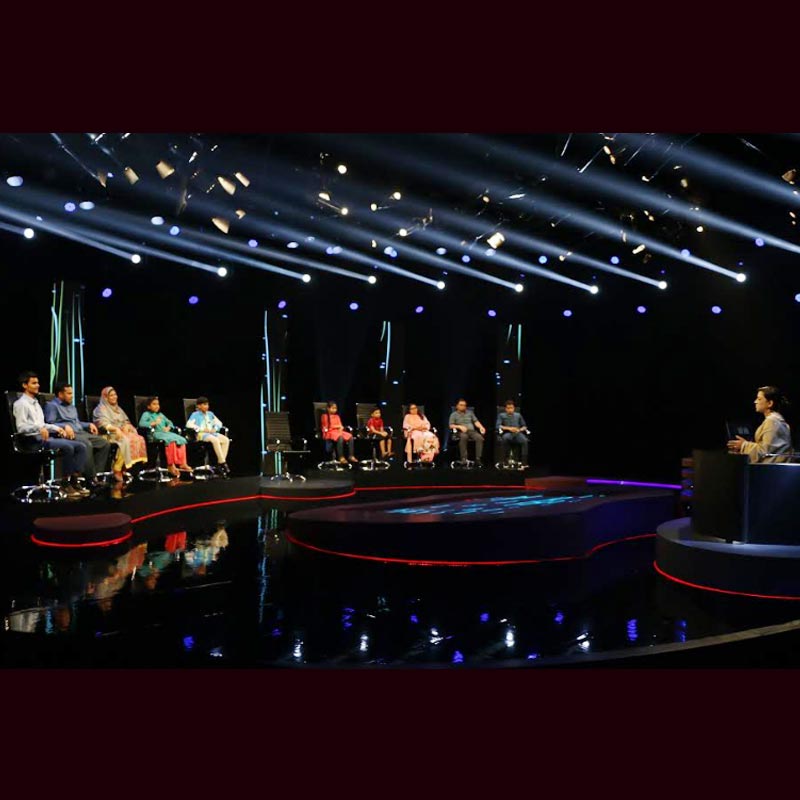
    MUMBAI: BBC Studios today announced a licensing deal with Duronto TV, a premier television channel for children in Bangladesh, for its iconic British TV game show, Mastermind. The local version of the international quiz show will be titled Mastermind Family Bangladesh and will be produced by Duronto TV. The show will premiere on 13 October 2019 and will play from Sunday to Thursday at 8.00 pm on Duronto TV.

    Mastermind Family Bangladesh will have 64 families from across the country competing for the title. The show will be directed by Sundija Siddique and hosted by former BBC journalist Nobonita Chowdhury.

    Mastermind was broadcast for the first time in 1972 in the UK. The long-running quiz show has as its distinct prop an imposing black chair in which contestants sit and attempt to answer a series of challenging questions. The show is immensely popular not only in the UK but across the world; it is broadcast in various forms in Australia, New Zealand, India, Ireland, Russia, Turkey, and many others.

    Ron Crasto, Vice-President and Business Development, BBC Studios India, said: “We are excited to partner with Duronto TV to create the local version of Mastermind. We hope that the Bangladesh audience will support and love the series in the manner it has been in the UK, India and many countries.”

    Abhijit Chowdhury, Director, Duronto TV said: “We are elated to bring the first-ever knowledge-based quiz show to our audiences. It is a pleasure to work with BBC Studios on this very exciting project.” 

  • Banijay Group’s Deepak Dhar on adapting shows for OTT, regional foray and digital dynamics

    Banijay Group’s Deepak Dhar on adapting shows for OTT, regional foray and digital dynamics

    MUMBAI: Deepak Dhar, who has witnessed the evolution of reality shows from close quarters, recently also worked on India’s first digital fashion reality show. Despite his expansive knowledge in the field, Dhar humbly depicts himself as a fresher in the game of digital reality show as what works on television will not necessarily work on streaming platforms.

    Back in 2018, ex- managing director of EndemolShine India Deepak Dhar partnered with Paris-based independent content creation company Banijay Group to expand its operations to India and South East Asia. Under the guidance of Dhar, the production house has already created a number of shows both for broadcasters and streaming platforms. After having a strong start in the cluttered market, Dhar thinks there is a long way to go. Aftrer launching Myntra Fashion Superstar, the format of the show developed together by Monia S Pinto, Banijay Asia team and Wavemaker teamBanijay Asia CEO and founder spoke to Indiantelevision.com.

    Edited excerpts of the interview:

    You have seen the evolution of reality shows in India when you were associated with EndemolShine India. How different is the experience of the first digital fashion reality show?

    I have been doing reality since the evolution of reality television. But now I think the time is to unlearn first and then to learn the new tricks of the digital or the web game. Obviously, what works on the TV and linear space, does not work on the streaming side of the business. So from that perspective, I am quite a fresher and newcomer because you are constantly either learning or unlearning from what one has done in reality TV in the last 10-15 years. We had to craft this show in a very different manner for it to be consumed on our platform.

    What was your target audience for the show?

    The show is streaming on the Myntra app. The target audience is largely, I would not say just youth but, anybody who really samples the Myntra app and anybody who is conscious about what they want and at what price they want. Its a very large audience there that is consuming a lot of e-commerce platforms and I think thanks to Myntra we got an opportunity to keep them engaged.

    How efficient is the influencer-driven content strategy to target consumers as it is gaining more prominence with time?

    It is. I think this whole social media influencer theory is coming from the fact that there is so much time spent on social media and thanks to that there are celebrities and influencers who are influencing trends and patterns, the way content needs to be consumed and curated. The fact that we spend so much time on mobile phones, I think there is a huge captive audience there.

    Are you looking at more digital reality shows?

    Yes, clearly. But it is not that we are looking at digital reality shows and are not looking at linear traditional reality shows. We are producers who are right in the middle of doing a lot of good TV content and a lot of new media and digital content as well. So, we are servicing both sides of the game.

    It has been more than one year for Banijay Asia’s journey in the Indian market. How was your experience? Have you been able to fulfill your initial target?

    We have taken off to a very strong start. Having said that, this is only a start, there is a long way to go. But the fact is we have done Arrived for YouTube, we have done Kapil Sharma Show, Nach Baliye , Roar of the Lions for Hotstar, Hostages for Hotstar, Parchayee for ZEE5. All these for a 12-14-month-old company, I think is a decent start. I think we can do a lot more and we will for sure.

    You have already worked with Hotstar and ZEE5. What are your plans with international players, especially Netflix and Amazon Prime Video?

    As you can see, our portfolio is extremely diverse. We do a lot of stuff for TV and OTT, both non-fiction and scripted. Our development strategy is considerably diverse and balanced. From that perspective, we are an all-round studio working for Hotstar, ZEE5, Netflix, Amazon, ALTBalaji or across the board. For me, the excitement lies in the fact that we can develop all kinds of content and there are takers for it as well. Who would know a docu-drama like Roar of the Lion, MS Dhoni would come on board and take it to Hotstar. These are signs of changing times. Having said that, we have a very balanced strategy to be across all platforms, not just on two.

    How does your pipeline look for the rest of the financial year?

    A lot of scripted and unscripted projects are lined up. The OTT business will see some different projects while some conventional ones for the traditional side of the business.

    Are you focusing equally on broadcasters?

    That is our strategy. We are here servicing the broadcast side of the business. We are doing a big scripted show on TV as well which we will announce soon.

    Is there any particular demographic in your mind while you are producing shows for OTT platforms?

    I would say largely a lot of the youth is consuming OTT content. Having said that, we have broken that myth with Hostages because that show went really wide. My mother-in-law came and said, “Deepak, finally you made a great show.” I asked which one? She said Hostages. I was surprised to know she watched Hostages as she is an avid viewer of daily soaps and music realities. She watched an entire show in one night. It gives me one trend inside the home that youths are not the only who are watching OTT platforms.

    What’s your plan to foray into the regional market?

    We have a strategy and development plan for that. Very soon, we will hear some announcements again. We have a different strategy for the regional market because one kind of strategy would not work in various different markets. Tamil and Telugu would be the first because those are the big ones. Because you have to stagger your plan, you can’t go to five-six markets together. Obviously we will be taking one step at a time.

    You have been associated with the industry for a very long time. How has the OTT boom worked for content creators?

    You know there used to be like five networks and they had a certain way of creating content. They had their certain demographic, they knew their audiences very well and would create more audiences too. But now the entire ecosystem has opened up overnight. It is not just five broadcasters, there are ten OTT players. The kind of content they are looking for is very different from traditional content. As a content creator, I see that is a very big opportunity and not in terms of the number of shows but kind of shows also. Just another thought from what my mother-in-law told me. Earlier it used to take seven to eight months which used to last two to three years or as long as possible. It took me six-seven months to make Hostages and she consumed it overnight; the shelf life is over. That just tells me the kind of opportunities that lie.

    What are the main challenges of content creation in the ecosystem currently?

    I would not see these as challenges but as more opportunities. The pipeline needs to be working twice as more furiously because stories are getting consumed in one night, characters are becoming relevant or irrelevant in one night, you need to create more and more content, you need to have the right set of creative entrepreneurs and you need to constantly look for them.