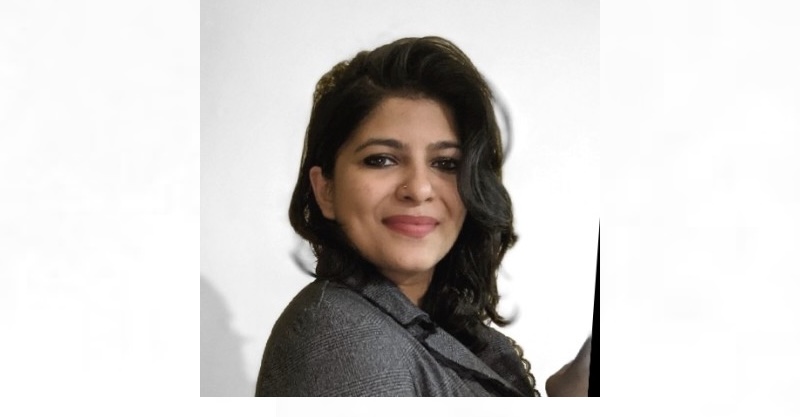
MUMBAI: Phenomenal-Ent has announced the appointment of Mrinalini Khanna as partner, effective February 2025. Khanna brings extensive experience in content development and strategy across television, digital and live entertainment sectors.
Prior to joining Phenomenal-Ent, Khanna served as vice president of originals at Lionsgate India from August 2021 to December 2023. She previously held senior positions at Endemol Shine India for over a decade, including vice president and associate vice president roles, where she spearheaded content strategy and development for various entertainment channels.
Khanna’s career spans multiple facets of the media industry, including a stint as a writer for Miditech, where she contributed to the award-winning children’s programme “Galli Galli Sim Sim”. Her work on the show earned a Gold Plaque at the 44th Chicago Film Festival in the Education for Child Audience category.
Her expertise includes creating original intellectual property, adapting international formats for Indian audiences, and developing content strategies for general entertainment, youth, and specialty channels. She has also worked extensively on brand communication through branded content initiatives.
MUMBAI: Bodhitree Multimedia Ltd (BSE: BTML; NSE: BTML), a leading Indian content creation and media production company, has announced its unaudited financial results for the third quarter ending 31 December 2024.
The company posted a consolidated revenue of Rs 50.47 crore, marking a 19.6 per cent increase from Rs 42.17 crore in the corresponding quarter last year. The consolidated profit before tax (PBT) reached Rs 4.31 crore, up 9.9 per cent from Rs 3.92 crore in Q3 2023, whilst the profit after tax (PAT) grew by 22.2 per cent to Rs 3.03 crore, compared to Rs 2.48 crore in the same period.
On a standalone basis, the company witnessed remarkable growth, with revenue surging 57.7 per cent to Rs 38.50 crore from Rs 24.42 crore in Q3 2023. The standalone PBT nearly doubled to Rs 2.85 crore, showing a 99.3 per cent increase from Rs 1.43 crore. The standalone PAT demonstrated exceptional growth of 139.8 per cent, reaching Rs 1.99 crore compared to Rs 0.83 crore in the previous year’s quarter.
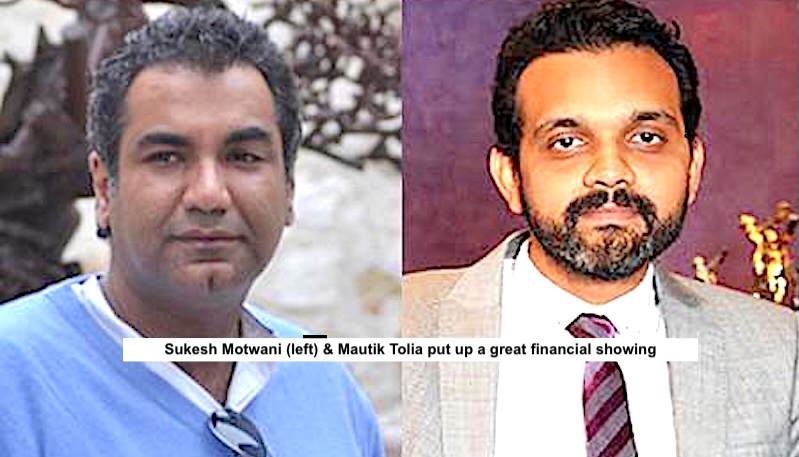
Bodhitree Multimedia chief executive Mautik Tolia, chief executive of Bodhitree Multimedia, attributed the strong performance to the company’s focus on premium content production and strategic partnerships. “Shows like Gunaah have been instrumental in driving our success,” he said, expressing confidence in the company’s growth trajectory.
Founded by Tolia and Sukesh Motwani, Bodhitree Multimedia has produced over 3,000 hours of content across more than 50 shows for major broadcasters and OTT platforms. The company specialises in various genres including drama, thriller, horror, comedy and lifestyle programming, operating primarily on a business-to-business model.
The company’s services span production, direction, writing, dubbing, mixing, subtitling, content editing and localisation for television, films and digital platforms.
MUMBAI : The NDTV Profit Conclave, a premier business event, is coming to Mumbai on 18 February 2025. With the theme ‘blueprint for Viksit Bharat 2047,’ the event will unite leading corporate and political figures to chart India’s journey toward becoming a developed nation by its 100 year of independence.
The conclave will serve as a key platform for dialogue on inclusive growth, sustainability, governance, and youth empowerment, reflecting India’s commitment to long-term economic transformation. Industry stalwarts and policymakers, including Piyush Goyal, CS Setty, Raamdeo Agarwal, Ridham Desai, Anish Shah, Dipali Goenka, Nadir Godrej, and Ashishkumar Chauhan, will lead discussions on manufacturing, AI, banking, investment, and sustainability.
Live coverage will be available on NDTV Profit’s tv & digital platforms from 10 am on 18 February. Attendees can register online, with entry granted on a first-come, first-served basis.
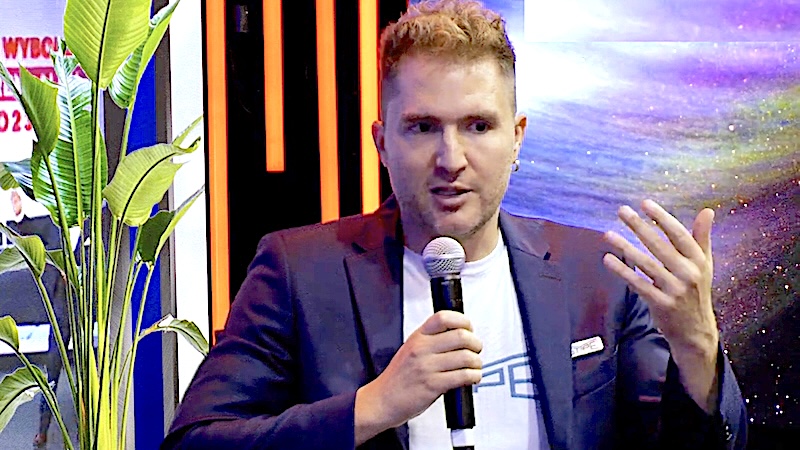
MUMBAI: Stype Cajic, the founder of Stype, is a 40-year-old trailblazer who has built a global media tech empire from the ground up. His journey began with a simple idea while still a student—developing autofocus technology for camera cranes. What started as a project in his parent’s house bedroom has now evolved into Stype, a company with a team of over 200 people.
Since its inception in 2011, Stype has made a name for itself by providing state-of-the-art tracking solutions for VR, AR and MR (mixed reality) productions, as well as movie previsualisations. From the optical camera tracking system RedSpy 2.0 Fiber, used by the world’s biggest broadcasters like BBC, Fox, and MTV, to the innovative StypeKit mechanical tracking solution for cranes and jibs, Stype’s products are now a staple in the industry. The company’s latest breakthrough, Follower, takes talent and object tracking to new heights, enabling real people to seamlessly interact with virtual elements in AR.
In this interview, Cajic shares his insights into the evolution of his company, the technological innovations that have shaped the company’s success, and his vision for the future of media tech. Excerpts:
What inspired you to develop Automatic aiming for camera cranes?
The idea came when a friend was building camera cranes and struggled with controlling the camera using a joystick. I thought, why not automate the process so the camera could track objects on its own? This led to the development of the first prototype, which proved the concept could work.
My background in shooting music videos against green screens also played a key role, as creating dynamic, realistic backgrounds was challenging with static shots. This led me to realise that the encoders used for automatic aiming could also track the camera’s position in 3D space, improving virtual backgrounds. Initially, we developed the system for my friend’s crane, naming it “Aim Crane,” but it took off when we adapted it into a universal kit that worked with popular cranes like the Stanton Jimmy Jib and Cammate.
How did you land your first major client?
Our big break came when we tested the system successfully in Lebanon – an AR project for a Ramadan TV show. This project helped me make necessary innovations in the software side of the workflow, particularly data conversion and lens calibration. The success of this project gave us a foothold in the industry.
Though we shared our work online, it didn’t initially lead to business until we received an unexpected email from Fox Sports Australia. They had ordered a Japanese tracking system for their AR-enhanced broadcast, but it wouldn’t arrive in time. After finding our online posts, they decided to try our system, even though it was much cheaper. We agreed to a trial, and I flew out to their studio. Despite some initial technical issues, I used a data logic analyser to tweak our system to work with theirs, and after a few adjustments, it worked perfectly. Fox Sports was impressed, especially with the auto-aiming feature, which solved problems they had with camera operators. The system not only improved their AR broadcasts but also enhanced the quality of their camera shots. The first unit we sold to them is still operational 13 years later.
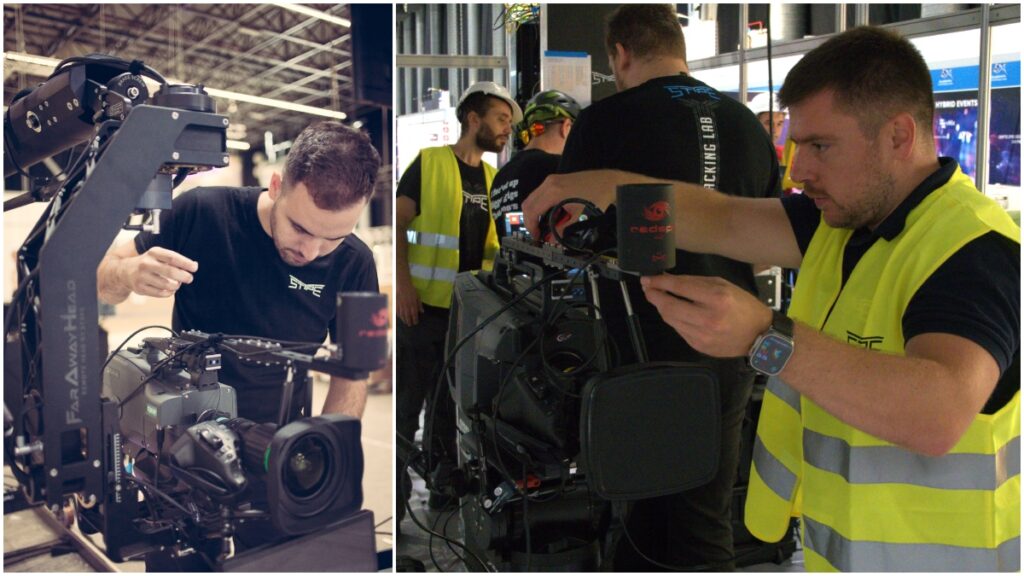
Stype’s RedSpy
What options were available on the market when you began developing an automatic aiming system for cranes?
When I started, I was studying electrical engineering and computing while also working as a video editor, mainly on music videos. It was a fun way to learn during my college days. A friend of mine, who ran a video company, began building camera cranes, but he and his team struggled to control the camera using a joystick—especially with a crane arm stretching five to six metres. It takes years of experience to master that kind of precision.
Drawing on my background in programming, I decided to create a device to automate the process, making crane operation easier, even for less experienced users. After some research, I realised there were no existing products like this on the market. Encouraged by my friend’s enthusiasm, I ordered components, incorporated the project into my college coursework, and eventually developed a prototype by the time I was around 22.
The first prototype worked brilliantly. For example, you could programme the crane to keep a flower perfectly centred in the frame while swinging the arm—producing smooth, professional shots that amazed everyone who saw them.
Interestingly, another benefit emerged from my experience shooting music videos against green screens. Back then—over 20 years ago—we’d rent films from video stores, find suitable backgrounds as inspirations, and painstakingly modify them in Photoshop to repurpose the scenes. However, these backgrounds were static, lacking the depth and dynamic feel of 3D environments. I wanted to move the camera and have the background shift perspective accordingly.
While developing the automated aiming system, I realised the same encoders used to track crane movements could output the camera’s 3D position. This “side feature” turned out to be transformative, opening up new creative possibilities—not just for us but potentially for others in video production. Eventually, this functionality became the core strength of the product, enhancing both camera control and visual effects.
StypeKit and Human Crane setup
How do your camera tracking solutions differ for sports studios, music video production, and esports?
Our hardware solutions have been utilised across various production sectors, including sports, music video production, and esports. Initially, we started with mechanical tracking systems for cranes, such as the StypeKit, which provides auto-aiming and AR data output. Over time, we expanded into optical tracking products like RedSpy and Follower.
For OBs, concerts, arenas and sports, mechanical tracking systems are often preferred because they are reliable, self-sufficient, and don’t depend on external markers, making them ideal for large, dynamic environments like stadiums. In controlled studio spaces, RedSpy is the go-to solution, offering the most precise camera tracking available. Its infrared camera system uses retroreflective markers to ensure flawless tracking, with no drift or wobble, which is essential for high-quality virtual graphics. One key feature was its unobtrusiveness: the infrared LEDs blinked so briefly they were practically invisible, yet the tracking remained flawless. RedSpy’s reliability allows production teams to focus on the creative aspects of their shows instead of worrying about camera tracking performance. This is what has made it the world’s most popular camera tracking system.
StypeKit and RedSpy both have been honoured with an Emmy Award.
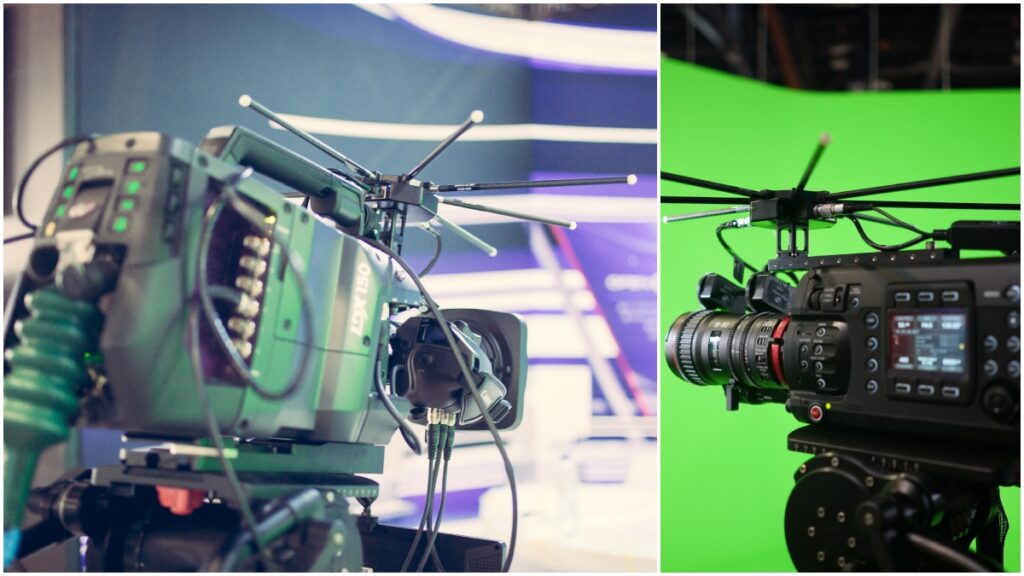
Follower, our newest addition, is another optical solution, goes beyond just tracking cameras. It’s similar to a motion capture system and can track people and objects in real-time. Follower is designed for interactive 3D elements, allowing real-time tracking of objects, people, or even props, making it ideal for interactive broadcasts or performances. Unlike other motion capture systems, Follower can handle the complex demands of high-quality AR and virtual content in live environments. It’s also used in LED volume environments, where traditional tracking systems might struggle with precise tracking when complex foreground graphics are involved.
Follower Spyder
What innovations have you introduced in your software solutions?
On the software side, we have consistently pushed the envelope. After recognising the need for advanced chroma keying, we developed StypeLand, a software tool for Unreal Engine that includes a 3D difference-based chroma keyer called GreenKiller. This keyer surpasses others on the market by refining edges, enhancing shadows, and even keying through transparent objects—features that earned us an Emmy Award.
We also lead in XR solutions, offering photorealistic XR sets with LED volumes and set extensions. Our system ensures seamless transitions between virtual and real environments by automatically adjusting colour shifts across LED panels. This innovation, which is the only one of its kind on the market, earned us another Emmy, recognising our work in XR technology for Fox Sports in Los Angeles.
In total, we’ve won multiple Emmys, both for our technical contributions and for our cutting-edge software solutions. These accolades reinforce our commitment to delivering the most precise and the most reliable technology to the media production industry.
Are your solutions compatible with other suppliers, or do clients need to use your complete end-to-end system?
Our solutions are designed to integrate with other systems. Our hardware camera tracking portfolio is fully compatible with any software manufacturer that requires high-quality camera tracking. We’ve ensured that integration is straightforward, making it easy for clients to incorporate our technology into their existing workflows.
On the software side, we operate almost like a standalone company, which means our virtual graphics and XR solutions can support any other camera tracking system on the market. Compatibility has always been a focus for us, ensuring flexibility for broadcasters and studios with diverse setups.
While some clients prefer the simplicity of having a single point of contact for their entire studio solution, we also work with those who already have existing camera tracking or software in place. They don’t need to replace their current systems—whether they require just camera tracking or software integration, our solutions are fully compatible with others.
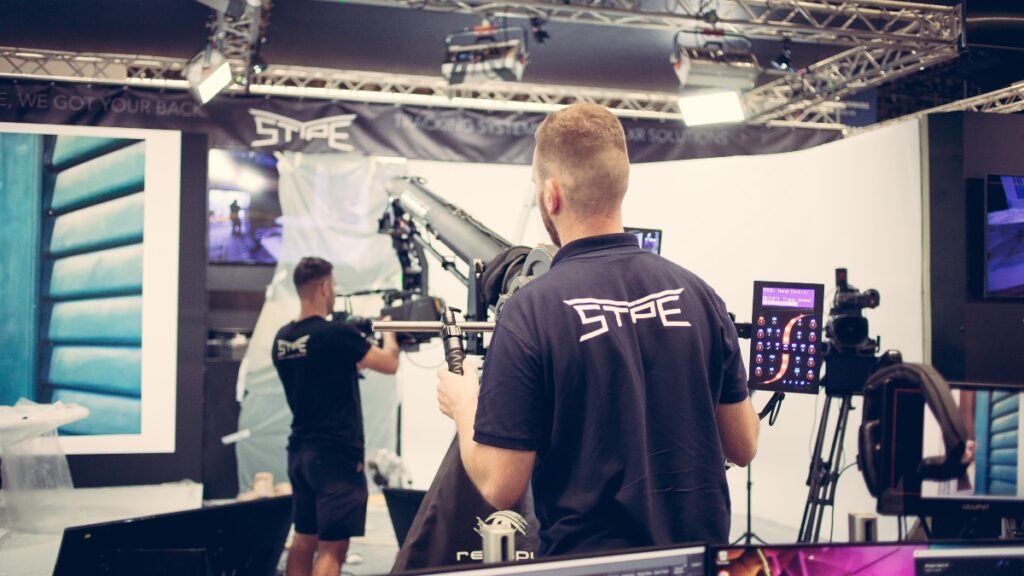
StypeKit main console
How does your technology compare to Zero Density’s solutions?
Our hardware product line is fully compatible with Zero Density, ensuring seamless integration for users. However, when it comes to software, we believe our solutions not only meet but exceed the performance of Zero Density’s offerings.
While Zero Density initially gained more installations by being the first to introduce an Unreal-based workflow, the landscape is shifting. During the period they advanced their software, we concentrated on perfecting our RedSpy camera tracking technology. Now, with both hardware and software offerings, we’re setting new industry standards.
Although software wasn’t our original focus, once we entered the market, we were determined to deliver the best possible solutions. A prime example is our chroma keyer, GreenKiller. When compared to Zero Density’s keyer, GreenKiller consistently delivers superior results—a fact many of our clients have attested to.
How is the Indian market responding to your products? Have you done many installations, and do you see India evolving into a global virtual production hub like Korea or the US?
The Indian market is one of our largest, with over 40 installations across the country. Our biggest client in India is Network18, but we’ve also worked with major broadcasters like Star Sports, Sony, Times Now, India News, and many others. In addition to broadcast and news networks, we’ve collaborated with several film studios and cinema production houses across the country.
While India’s market is vibrant and full of creative potential, it comes with unique challenges, particularly around budget constraints. Unlike regions like the US or Korea, where large-scale LED volume installations are more common, India leans heavily towards AR and green screen setups, which are more cost-effective. However, this hasn’t limited the ambition or creativity we see from Indian clients—they are eager to explore new technologies and make the most of what’s available.
Interest in our products grew significantly after our success with projects in Australia, and it has continued to expand ever since. Even for products like StypeLand, there’s considerable demand in India. Despite budget limitations, the market remains dynamic, with broadcasters and studios pushing the boundaries of virtual production in innovative ways.
Installation of Follower
With generative AI products like Sora becoming increasingly lifelike, how do you see AI impacting the AR products you deliver? Are you also using AI and machine learning within your company to improve your products?
Generative AI, like Sora from OpenAI, opens up tremendous possibilities for the AR space. When creating virtual shows, hardware and software are just part of the equation. One of the biggest investments often lies in designing virtual environments, which requires extensive work from virtual architects and designers. AI can significantly reduce these costs by automating the creation of intricate details within virtual environments—something that would typically take an enormous amount of time. This will accelerate the adoption of virtual production by making content creation more efficient and accessible.
Within our company, we’re actively exploring AI and machine learning to enhance our products. For example, in our StypeLand product, we’re experimenting with AI to optimise certain features. Looking ahead, AI will play an even more prominent role in the next generation of our products, as we continue to explore how it can enhance both performance and efficiency.
Where do you see Stype going from here?
Looking ahead, Stype is focused on expanding its portfolio with several new camera tracking products. As you’ve likely noticed, we’re continually enhancing our camera tracking solutions. We’re also diving deeper into the robotics space, similar to how we developed the StypeKit.
StypeLand has become a major growth driver for us, and its improvements are ongoing. We’re constantly refining it, adding new features that help us stay ahead of the competition. One of the latest advancements we introduced is a playlist-based system for StypeLand, which integrates with newsroom control systems using multiple protocols. This update fills in some of the gaps that were missing before.
What’s especially exciting is how StypeLand has evolved from being a tool for AR and green screens to a full-fledged solution that TV stations are now using as a central part of their workflow. It’s become more than just a piece of software—it’s now an essential tool for broadcasters.
Our aim is to continue offering a comprehensive suite of solutions that meet the needs of modern TV stations, and that’s the direction we’re taking Stype in.
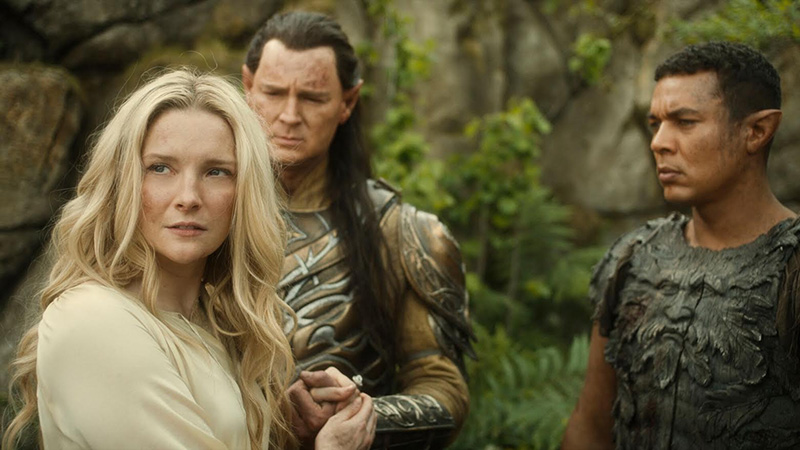
MUMBAI: Middle-earth is calling once more! Prime Video has confirmed that The Lord of the Rings: The Rings of Power is returning for a third season, with pre-production already underway. Filming is set to begin this spring at Shepperton Studios in the UK, marking a new chapter in Amazon’s most-watched fantasy saga. With over 170 million viewers worldwide, the series remains a powerhouse for Prime Video, driving record-breaking new subscriptions.
Returning to shape the next season’s visual spectacle is Charlotte Brändström, now stepping in as an executive producer and director, alongside Sanaa Hamri and new addition Stefan Schwartz. Brändström, known for her work on The Witcher and The Man in the High Castle, directed multiple episodes in The Rings of Power’s first two seasons. Hamri, a veteran of The Wheel of Time and Empire, is back after directing several episodes in Season Two. Schwartz, whose credits include The Boys, Luther, and The Walking Dead, joins the directorial lineup for the first time.
“The Rings of Power continues to captivate audiences worldwide, and we’re thrilled that a third season is underway,” said Amazon MGM Studios head of television Vernon Sanders. “The creative team has an extraordinary vision for what’s to come, and we can’t wait to delve even deeper into the legendary tales that shaped Middle-earth.”
The Rings of Power has become a defining title for Prime Video, boasting one of the platform’s biggest debuts and consistently drawing massive global engagement. Seasons one and two have been lauded for their epic storytelling and cinematic visuals, with both receiving certified fresh ratings on Rotten Tomatoes.
The series is helmed by showrunners and executive producers J.D. Payne and Patrick McKay, with Lindsey Weber, Justin Doble, and Kate Hazell also onboard. Brändström joins the executive producer ranks, ensuring continuity in the series’ grand vision.
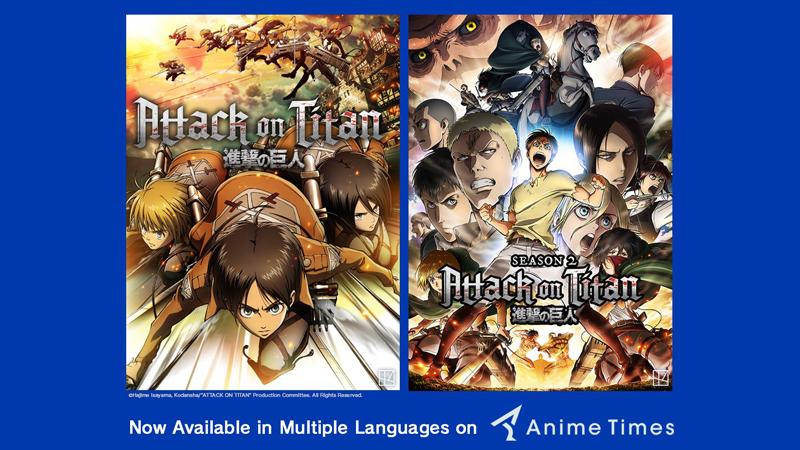
Anime Times Company, formed by 13 content rights holders, including leading Japanese publishers and anime studios such as Avex Pictures, Kodansha, Shueisha, and Shogakukan, is committed to delivering high-quality anime experiences to fans worldwide. As part of our ongoing efforts to enhance accessibility in India, we are excited to announce new language options for one of the most iconic anime series, Attack on Titan.
Starting February 12, Attack on Titan Season 1, currently available in English and Hindi dubs, will expand its language offerings to include Telugu, Tamil, and Kannadadubs. Additionally, on February 14, Attack on Titan Season 2 will debut its Hindi-dubbed version, allowing more fans across India to enjoy this legendary series in their preferred language.
Looking ahead, Anime Times remains dedicated to further expanding its multilingual lineup, ensuring that not only Attack on Titan but also a wide range of other beloved anime titles become available in more regional languages.
Currently Available & Upcoming Hindi-Dubbed Titles on Anime Times: • SPY×FAMILY • Rent-a-Girlfriend • The Junji Ito Collection • FAIRY TAIL 100 YEARS QUEST • DAN DA DAN • Re:ZERO -Starting Life in Another World- Season 2 & 3 • Sword Art Online
Stay tuned as we continue expanding our anime library with more local-language dubs, bringing the best of Japanese animation closer to Indian audiences.
■Overview of “Anime Times” available via add-on subscription on Prime Video in India Add-on Subscription Name: Anime Times Launch Date: December 12, 2023 Subscription Price: Available as an add-on subscription to Prime members for INR 69 per month, with a special offer of INR 39 for the first month!
MUMBAI: Balaji Telefilms Ltd has announced its financial results for the third quarter and nine months ended 31 December 2024.
Financial Highlights * The group reported revenue of Rs 93.2 crore in Q3 FY25, with consolidated nine-month revenue at Rs 386.8 crore. * EBITDA profit for 9M FY25 stood at Rs 5.3 crore, driven by operational excellence and strategic cost rationalisation, particularly in the digital business (ALT Digital). * Profit before tax for 9M FY25 was Rs 0.5 crore. Television Segment * The TV business remains the company’s core, contributing Rs 194.2 crore in revenue for 9M FY25. * EBITDA for 9M FY25 was Rs 26.8 crore. * Balaji had four shows on air during the quarter across major broadcasters, producing 640 hours in 9M FY25, with realisation per hour at Rs 29.14 lakh. Digital Business (ALT Digital) * Cost rationalisation efforts improved performance, with ALT Digital’s EBITDA loss narrowing by 18 per cent in Q3 FY25 to Rs 6.9 crore from Rs 8.4 crore in Q2 FY25. * Subscription revenue stood at Rs 13.32 crore for 9M FY25, with 7.34 lakh subscriptions sold, including 3.93 lakh renewals. * ALT Digital launched 20 new shows in Q3 FY25, totalling 46 shows in 9M FY25. * The platform has over 167 shows live, and content consumption reached 17.41 billion minutes with 1.74 billion views. * ALT is expanding into the AVOD model and has an order book of Rs 343 crore for web series across major OTT platforms. Film Business * The Sabarmati Report, released in Q3 FY25, received positive reviews but underperformed at the box office. * Earlier releases in H1 FY25 included LSD 2 (April 2024) and The Buckingham Murders (September 2024), both later released on Netflix. * The company has a strong pipeline, with Vrushabha (starring Mohanlal) in post-production and Bhoot Bangla (starring Akshay Kumar, directed by Priyadarshan) in production. * A new project, Vvan, in collaboration with TVF and starring Sidharth Malhotra, is in development. Fundraising Initiative * Balaji Telefilms raised Rs 130.67 crore through an equity issue to promoters and foreign investors. * A total of 1.78 crore shares were allotted at Rs 73.17 per share, approved by the board on 7 February 2025. * The funds will be used to scale the movie business, explore music retention and distribution, enhance the digital content business, and strengthen the financial structure.
Group CEO and CFO Sanjay Dwivedi stated, “This successful capital raise underscores the confidence of our promoters and foreign investors in the company’s growth plans. The funding will reinforce our commitment to shareholder value and strengthen our balance sheet.”
Merger Update * The board approved a draft composite scheme of arrangement on 30 May 2024 for the merger of Balaji Telefilms Ltd, ALT, and MFPL.
* The Bombay Stock Exchange (BSE) and National Stock Exchange (NSE) granted no-objection certificates, and the company filed an application with the National Company Law Tribunal (NCLT) on 27 January 2025 for approval.
* The merger aims to consolidate content production, eliminate redundancies, enhance financial capacity, and streamline compliance, leading to improved returns and efficiency.
Managing director Shobha Kapoor stated, “With a strong focus on profitability, operational streamlining, and cost rationalisation, we are confident in our growth trajectory across television, films, and digital platforms.”
MUMBAI: It’s a giga merger. Two of India’s leading brands fusing into one.
Can the branding, the logo, and brand ident that emerge be any less?
The brands in question are; Jio and Disney+Hotstar, both very well-known of their own accord. One a leader in providing mobile telephony services which runs a streaming platform called JioCinema; the other a leader in streaming, the best in its class. Both have tremendous recall value and have customers running into hundreds of millions.
A tough ask for any one to find a solution that would do justice when they unite – where the sum of the united two will be greater than the sum of both as individuals .
One simple possibility was calling it JioHotstar. Quite simple right?
And that’s what JioStar, the joint venture formed by the merger of Viacom18 and Star India, decided upon. The birth of JioHotstar will see the demise of both JioCinema and Disney+ Hotstar.
It will have a reach of 500 million users and will offer 300,000 hours of content including films and shows from major Hollywood studios including Disney, NBCUniversal Peacock, Warner Bros. Discovery HBO, and Paramount, alongside Indian entertainment across 10 languages.
“At the core of JioHotstar is a powerful vision—to make premium entertainment truly accessible to all Indians,” said Jiostar chief executive digital Kiran Mani. The platform will offer free content to all viewers, with premium subscription plans starting at Rs 149.
Jiostar chief executive entertainment Kevin Vaz emphasised the platform’s commitment to digital-first content, while sports chief executive Sanjog Gupta highlighted its enhanced sports viewing features, including ultra-HD 4K streaming and AI-powered insights. JioHotstar will also have a new segment called Sparks which India’s digital content creators can call their home.
There was some debate in media circles on what the back end of the new service will be. Would it be the JioCinema one or would it be Disney+ Hotstar’s? At the time of writing, folks within JioStar had confirmed to indiantelevision.com that it was indeed Hotstar’s tech stack that was being used to power the JioHotstar app as it proved to be more superior on several fronts. The main ones being: ability to handle high concurrency of users, serve high end, high quality 4K videos, even at low bandwidths, the tech innovations in terms of vertical video and interactivity that it supported. AI-powered insights, real-time stats overlays, multi-angle viewing and range of ‘culture’ and ‘special interest’ feeds — ensuring fans enjoy deeper, more immersive access to the sports they love.
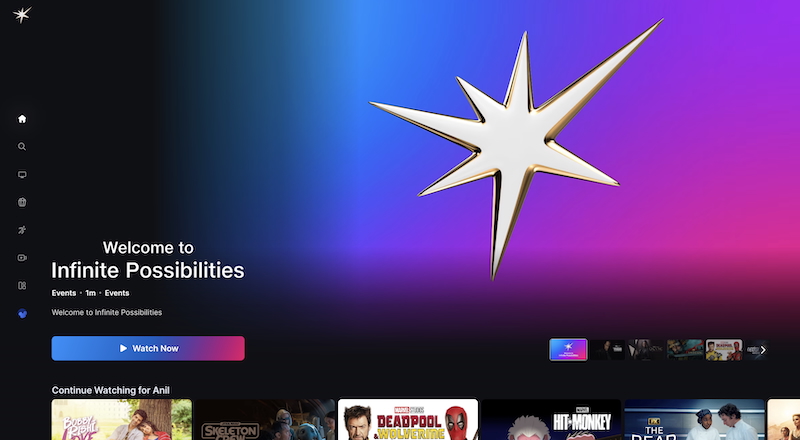
The logo itself is a standout and can have several interpretations. Here’s two: a star doing a Swan Lake like dance; a heavenly body arms open wide ready to embrace one and all. Clearly, for those who have been so used to seeing the Disney Star and existing JioCinema logos, it will take some getting used to. The font for the brandname is sans serif, which fits well with the star burst.
JioHotstar’s new brand identity created and developed by venture3 embodies its vision for boundless entertainment. The Big Bang’ symbolises the dawn of a new era, while the Ripples radiate outward, representing energy, transformation, and innovation. The background colours are tetradic (psychedelic) with bright pinks, mauves , indigos and blues being thrown in for good measure and are eyecatching and hypnotic. Step one of the battle to attract viewers won! And the tagline carries with it a lot of promise: Infinite possibilities begin here! Existing JioCinema and Disney+ Hotstar subscribers will be able to transition seamlessly to the new platform.
The service will stream major sporting events including ICC tournaments, IPL, WPL, Premier League and Wimbledon, alongside entertainment content in multiple Indian languages.
MUMBAI: The Association for Sports Industry Professionals (Asip) has appointed Shuchi Kulshreshtha as head of partnerships and communication. Kulshreshtha joins from Skyesports, where she served as head of business development and strategy.
A Columbia University alumna, Kulshreshtha brings extensive experience in sports management, having previously led business operations at multiple organisations. She had a significant tenure with Rajasthan Royals as project leader for women’s cricket and new ventures, and has held positions at Mobile Premier League (MPL) and Big Bang Media Ventures.
Her early career included stints with the Women’s Sports Foundation and the US Open, where she worked with IBM Watson on digital initiatives. Kulshreshtha will oversee Asip’s partnership development and communication strategies in her new role.
MUMBAI: Warner Bros. Discovery is dialing up the entertainment quotient with the launch of five brand-new free ad-supported streaming television (FAST) channels from Warner Bros. TV on Samsung TV Plus. This move promises a whirlwind of gripping storytelling, heart-pounding crime, mouth-watering food journeys, adrenaline-fueled adventures, and the most extreme jobs you’ve ever seen—all without spending a penny.
With streaming becoming the go-to for audiences, these channels are curated to offer premium entertainment across Samsung Smart TVs and mobile devices, ensuring viewers can binge-watch their favourite genres wherever they go.
A channel for every passion
House of Crime – True crime fanatics, brace yourselves. This Hindi-language channel delivers nail-biting crime dramas and investigative series that will keep you on the edge of your seat.
Foodie Hub – Calling all food lovers! From sizzling recipes to behind-the-scenes kitchen drama, this Hindi-language channel serves up everything from street food gems to Michelin-starred magic.
Wild Flix – Animal lovers, rejoice! This Hindi-language channel is your passport to the untamed wonders of the animal kingdom, featuring awe-inspiring zoo stories and heroic animal rescues.
Wheel World – Car and bike enthusiasts, start your engines. This English-language channel is a high-octane paradise packed with restoration stories, thrilling rides, and the best garages in the business.
XXtreme Jobs – If you think your job is tough, wait till you see this. This Hindi-language channel dives into the world’s most dangerous professions, featuring fearless individuals tackling mind-blowing challenges daily.
Commenting on the launch, Warner Bros. Discovery head of distribution and eurosport- south Asia, Ruchir Jain said, “At Warner Bros. Discovery, we are passionate about curating diverse and high-quality entertainment for our audiences. With connected TVs on the rise, we’re excited to expand our presence on Samsung TV Plus through these new channels. Our partnership with Samsung will enable us to bring our viewers the very best of WBTV—compelling storytelling, fresh perspectives, and truly global flavours.”
With a strong focus on Hindi programming, these channels are expected to captivate both regional and urban audiences, delivering engaging content in their preferred language.
Samsung TV Plus India head of partnerships & business development, Kunal Mehta shared the excitement, stating, “We’re thrilled to welcome Warner Bros. Television to Samsung TV Plus. As a leader in FAST, we are committed to bringing top-tier content to our audiences. This partnership expands entertainment choices while delivering even more value and access to our viewers—and opportunities for advertisers.”
With the rapid adoption of connected TVs and the rise of digital streaming, the FAST model has gained massive momentum. According to recent advertising trends, the global FAST market is expected to reach $18.7 billion by 2027, with viewership surging by 150 per cent in the last three years. In India, connected TV adoption has seen a 40 per cent year-on-year growth, making it a prime market for ad-supported streaming content.
Streaming giants are increasingly shifting toward FAST to leverage higher ad revenues, increased viewer engagement, and deeper market penetration. This launch by Warner Bros. Discovery aligns perfectly with this evolving landscape, offering premium, ad-supported entertainment to a rapidly expanding audience.
As streaming habits continue to evolve, advertisers are seeing a 25 per cent increase in engagement rates on FAST platforms compared to traditional TV ads. This shift highlights the growing appeal of free, high-quality content paired with targeted advertising strategies.
The future? With this new launch, Warner Bros. Discovery and Samsung TV Plus are making premium entertainment more accessible than ever. Whether it’s the thrill of a mystery, the joy of a gourmet dish, or the awe of an untamed jungle, these new channels promise a content buffet like no other.

 Follower Spyder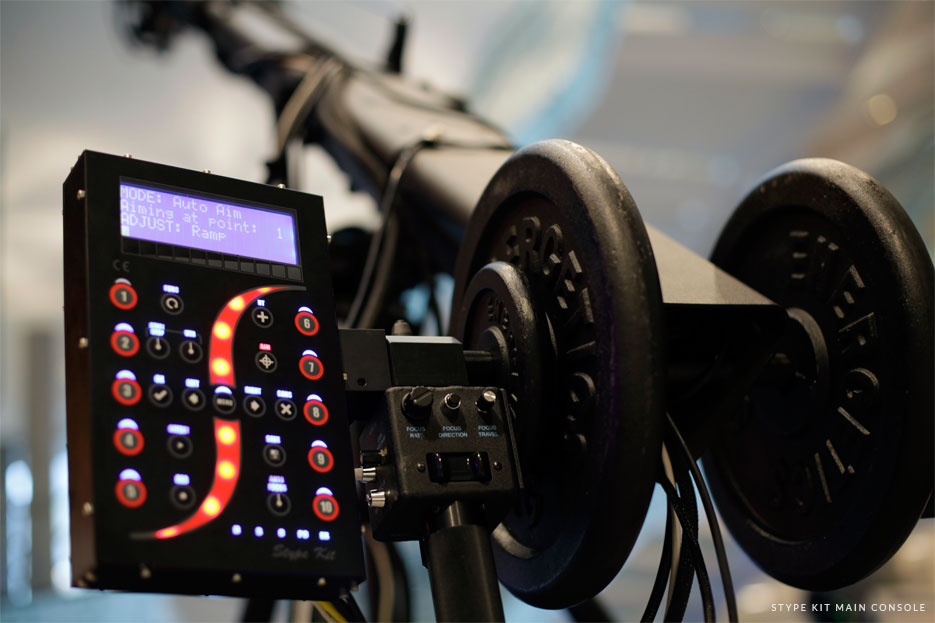



 Existing JioCinema and Disney+ Hotstar subscribers will be able to transition seamlessly to the new platform.