Category: Television

  • Jio Studios wraps ‘Paan Parda Zarda’, promises to spice up streaming wars

    Jio Studios wraps ‘Paan Parda Zarda’, promises to spice up streaming wars

    MUMBAI: If you thought digital dramas were starting to taste bland, Jio Studios is here to shove a mouthful of Paan Parda Zarda down your streaming queue. Imagine mixing action, drama, and intrigue, sprinkling it with gritty central Indian flavours, and serving it hot with an ensemble cast that’s spicier than your grandma’s masala chai. Hungry yet?

    Jio Studios, alongside Reliance Entertainment and Dreamers and Doers Co., has officially wrapped filming its ambitious new web series, Paan Parda Zarda. And, boy, does this sound like a blockbuster recipe.

    Starring an array of talent including Mona Singh, Tanvi Azmi, Tanya Maniktala, Priyanshu Painyuli, Sushant Singh, Rajesh Tailang, and Manu Rishi, this series isn’t just packed—it’s stuffed to the gills with acting chops. Set against the vivid and raw backdrop of central India, the series promises to be a high-voltage narrative filled with compelling characters and edge-of-the-seat drama.

    Directing the chaos (and hopefully keeping actors in line) are industry veterans Gurmmeet Singh, famed for gritty dramas like Mirzapur and Inside Edge, and Shilpi Dasgupta. Supporting this powerful duo are filmmakers Mrighdeep Singh Lamba (Fukrey franchise) and Suparn S Varma (Sirf Ek Bandaa Kaafi Hain, Family Man, Rana Naidu). The writing team is equally stacked with talent, featuring the Dalal brothers, Hussain and Abbas (Bambai Meri Jaan, Farzi, Brahmastra), alongside Radhika Anand and Vibha Singh.

    “With its grand scale, gripping screenplay, and a stellar team at its helm, Paan Parda Zarda is poised to be a game-changer in the digital entertainment space,” says Jio Studios. No biggie, just casually promising a digital spectacle.

    Produced by Jyoti Deshpande and Namit Sharma, Paan Parda Zarda is readying itself to invade screens globally. And let’s be honest—who doesn’t love a good cinematic takeover?

    This one promises to leave viewers more hooked than the cliffhanger at the end of your last binge-session.

  • “The future depends on how we will balance AI and ML with ethical considerations:” Emmy sound design winner Cory Choy

    “The future depends on how we will balance AI and ML with ethical considerations:” Emmy sound design winner Cory Choy

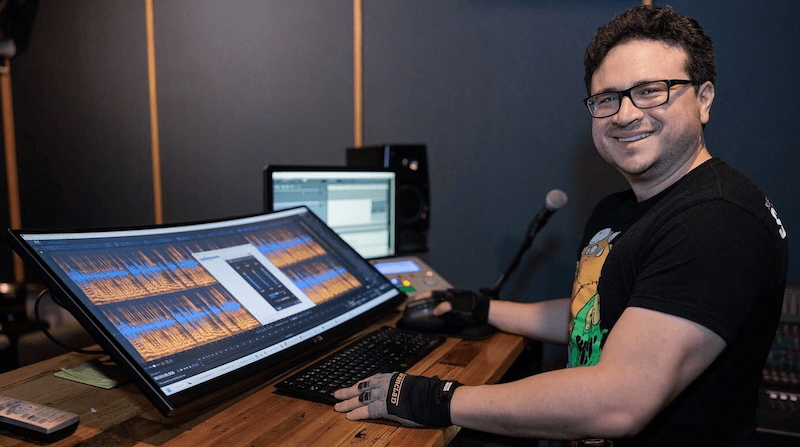
    He is an award-winning sound guy. Sound as in reliable; sound as in to do with audio. Cory Choy and his boutique sound studio Silver Sound Studio, located in the heart of New York City, have made a name for themselves, which is the envy of many others.

    Silver Sound boasts an Emmy award-winning team of on-location sound recordists in New York and Los Angeles. Choy himself picked up the lovely golden lady for his work mixing the sound for a show Born To Explore. 

    His studio provides recording, design, edit, restoration and mix services and has worked with all sorts of people all over the globe including, but not limited to: ABC, NBC, Vice, Comedy Central, ESPN, Disney, Google, Microsoft, CNN, MTV, FOX, Netflix, Apple, Shudder and Spotify.

    In a wide-ranging interview, the Emmy Award-winning sound artist, engineer and studio owner discusses the evolution of audio technology, creative freedom, and the intersection of art and social responsibility. Here are the key insights from his conversation with Indiantelevision.com group CEO and publisher Mishaal Wanvari.

    On what sparked his interest in sound design. 
    It was an inevitability rather than a decision. Both my parents were musicians – my mother wrote plays and operas, while my father combined music with computer programming. One of my earliest memories is watching my mother’s opera being performed at the Kennedy Center. But it was my father who showed me how technology could amplify creativity. He connected a Midi output from the game Monkey Island through a Casio keyboard, making it sound like a full orchestra. He connected a midi through a keyboard with a massive and professional instrument sound bank– which was far superior to the stock soundcard midi instruments. That early demonstration showed me how technology could be used to bring people together… the midi experience taught me that looking for a unique solution and setups can bring great power and creates experiences far beyond what people expect.

    On the evolution of sound editing tech during his career.
    I started at the very end of physical tape editing, where you had to physically cut and splice tape together. There was no undo button – once you made a cut, you had to live with it. The transition to digital audio workstations was revolutionary. Suddenly, all your tape was right in front of you, you could cut anywhere, and if you made a mistake, you could simply undo it.

    The economics were equally transformative. In 2006, a professional Pro Tools system cost around $10,000 – might as well have been a million to me at the time. But then Dell provided affordable, powerful hardware, and I discovered Reaper, which cost just $60. With a $2,500 Dell computer and Reaper, we were competing with studios using much more expensive equipment. Reaper vs. Avid – every single line of code in reaper is very well thought through with a small team, it is very efficient, and the entire program is designed to empower the user not restrict it. There is more freedom and there are more possibilities in Reaper than any other program I have ever used.

    On his Emmy Award win and on his experience thereafter.
    We won it in 2016 for the programme Born to Explore. One of our most impressive achievements was capturing crystal-clear dialogue from a host 200 feet away on a lake, using a highly directional Sanken CS-3E microphone. The water’s surface actually helped carry the sound. What made it special for us was that we won it in a category that is extremely competitive.

    On his Aisha win at the Tribeca film festival.
    It’s a fascinating story that began with an intern application. Fayshyo Aluko, a Nigerian poet with no sound experience, applied for an internship. When I asked why she wanted to work in sound, she simply said she wanted to explore sound design. I gave her a poem I’d written about a Palestinian girl, inspired by my own daughter’s questions about human rights.

    What Fayshyo brought to it was extraordinary – she incorporated traditional Nigerian storytelling techniques, using an oil drum beat as a metaphor for both footsteps and heartbeats. Her first-ever sound design piece won at the Tribeca Festival. It went on to win a Signal Award and an Anthem Award for human rights work.

    On the industry’s relationship with technology.
    The accessibility of technology has been revolutionary. When I started, a gigabyte of storage was massive – Pro Tools required one gigabyte just to install. Compare that to Reaper, which was just two megabytes. The difference? Avid spent their programming efficiency on creating paywalls – $50 here, $100 there, some plugins over $5,000.

    But now, with affordable computers and software, small studios can compete with anyone. Though the challenge isn’t doing the work – it’s finding it. If you’re not in the elite class, convincing someone from that class to work with you is the real challenge.

    Cory Choy

    On what’s next for sound design and sound mixing.
    We’re at an interesting inflection point with AI and machine learning. The technology is incredibly powerful, but we need to consider the ethical implications. For instance, voice cloning technology could be used for scams or misinformation. The wealth gap in computing power also means some will have access to these tools while others won’t.

    The future of our industry will depend on how we balance these technological capabilities with ethical considerations. It’s not just about what we can do, but what we should do.

    AI is both enabling and potentially corrupting. It’s incredible for tasks like analysing a voice and removing unwanted noise, but it also raises ethical concerns. We can now make someone sound like they’re saying something they never said, with their exact voice. While that’s exciting from a creative standpoint, it’s concerning from an ethical one.

    I have mixed feelings about the cloud-based AI tools emerging in our industry. Tools like Eleven Labs are incredibly powerful, but they raise important questions about access and control. What happens if these services suddenly become restricted based on geography or politics? It’s similar to the wealth gap we’re seeing in computing power – those with access to unlimited energy and graphics cards will have more capabilities than others.

    What’s fascinating is watching how different regions approach these challenges. Chinese engineers, for instance, are often outwitting their American counterparts with fewer resources. It’s not just about having the most powerful tools – it’s about how creatively you use what you have.

    On the way forward for small studios in a competitive market.
    The tools have never been more accessible, but the challenge is standing out in an increasingly crowded space. There are billions of talented people in the world, everyone has something unique to bring to the table, and the competition is fierce while resources are limited.

    However, I believe independent studios have an advantage in being more nimble and able to take creative risks. The key is finding your unique voice and the audience that resonates with it. It won’t be the easiest path, but if you really want to be in this space, you absolutely can make it work.

    And yes, the model has changed completely. At Silver Sound, we’ve evolved from a partnership to a more focused operation. The pandemic really took a chainsaw to the industry in 2020 – many partners and staff left, and we weren’t sure we’d survive. But then I met our current studio manager and latest engineer, both in their 20s, and it gave us new direction.

    Now our mission is to help develop new talent while remaining economically sustainable. We want to create things that make both us and the world better, but in a way that supports everyone financially. It’s about finding that balance between artistic integrity and commercial viability.

    The hardest part isn’t doing the work – it’s finding it. If someone gives me a project and appropriate funding, we can create something extraordinary. The challenge is breaking through that class ceiling where elite-level clients don’t trust smaller studios with significant projects.

    That said, I believe boutique studios have advantages in today’s market. We can be more responsive, take creative risks, and maintain closer relationships with clients. The key is finding clients who value that personal touch and creative freedom over the prestige of a large studio name.

    On his feature film.
    Sound and music are integral to my film Esme, My Love – you really won’t understand the movie without them. We made it for $135,000 total, yet people think we spent £3 million. That was only possible because we had Silver Sound as a home base. It’s now being dubbed into Spanish and Portuguese, with Korean potentially next. 
    It’s still an independent gem – not widely known in the United States or globally – but I’m proud that it got distribution. You can find it on Amazon and Tubi. We spent six years working on it, ensuring it didn’t feel like something just slapped together.

    On his approach keeping in mind the technical versus creative aspects of sound design.
    Technical precision is only a means to an end – creative decision-making is everything. If you don’t have the technical ability to execute your creative vision, then you need to improve technically. The more technical ability you have, the better you understand what’s creatively possible. They feed off each other.

    We offer two modes at Silver Sound: we can either help someone achieve their vision to its highest level possible, or we can work with them to create a vision from scratch. People come to us because they know our technical work is solid, but we provide a creative aspect that many other companies can’t match.

    On how technology vendors have evolved in service.
    I’m particularly grateful to Dell, and this isn’t just corporate speak. In New York City, their ProSupport service has been invaluable. When a computer breaks down in a professional studio, having a skilled repair technician on-site within 24 hours is extraordinary. Finding a reliable repair person independently could take a month.

    However, I’m watching carefully how technology companies position themselves during these challenging times. We need companies that empower creators rather than restrict them. The best technology partners understand they’re enabling creativity, not just selling hardware.

    On what excites him most about the industry’s future. 
    The democratisation of technology has opened up incredible possibilities. When I started, the barrier to entry was hundreds of thousands of dollars. Now, with a decent computer and some affordable software, talented creators can produce professional-quality work.

    But what really excites me is seeing how younger generations approach these tools. They’re not bound by traditional workflows or assumptions. They’re combining technologies in ways we never imagined, creating new forms of storytelling. The challenge will be maintaining high creative standards while embracing these new possibilities.

    On advice for aspiring sound designers.
    Do what you love, but understand the economic realities. Unless you join a large company, it’s not an easy path financially. You can live a good life as a sound mixer and designer, but if you’re independent, you need to be a business person as well. If that’s not your strength, find a business partner who can handle that aspect while you focus on the creative work. The competition is fierce and resources are limited, but if you truly want to be in this space, you absolutely can make it work.

    On his belief that media has social responsibility and his willingness to remind it of it.
    Many companies are afraid to take moral stances for fear of alienating potential clients. This year, I’ve made a conscious business decision to openly oppose fascist movements in America. Yes, we might lose some potential clients, but I believe we’ll attract more of the kind of clients we want to work with. You can be moral and ethical, but if you can’t feed your family, it’s no good. However, I don’t want to survive in a way where my soul isn’t surviving.

     

  • NDTV stalwart Sonia Singh ends three-decade affair with Indian news giant

    NDTV stalwart Sonia Singh ends three-decade affair with Indian news giant

    MUMBAI: In a bombshell announcement that’s sent shockwaves through India’s media landscape, NDTV’s editorial director Sonia Singh is to call it quits after a 32-year relationship with the broadcaster.

    The network confirmed yesterday that Singh, a senior management heavyweight and one of the most recognisable faces in Indian television, has handed in her notice “due to future career plans.”

    NDTV will bid farewell to Singh on 30 April, ending her three-decade stint at the network that began way back in September 1992 when India’s television landscape was still in nappies.

    Singh, who sports an impressive CV featuring a Master’s in English Literature from the prestigious St Stephen’s College, where she topped her class and ranked second in Delhi University, has been no mere talking head during her lengthy tenure.

    The brainy broadcaster also moonlit as a visiting fellow at Cambridge Judge Business School and sits on the Global Advisory Council of the World Woman Foundation.

    Her academic credentials include scooping an Italian government scholarship to study at the University of Perugia and nabbing the UK’s coveted Chevening Scholarship for a journalism course at Cardiff University – proof that there’s more between her ears than perfectly coiffed hair and teleprompter skills.

    As journalist Singh has grilled prime ministers and movie stars with equal aplomb.

  • Relevent scores big: agency nets lucrative UEFA club competitions deal worth billions

    Relevent scores big: agency nets lucrative UEFA club competitions deal worth billions

    MUMBAI: In a stunning transfer move, UC3 has announced that American agency Relevent has won the prized global marketing and sales rights for UEFA men’s club competitions from 2027 to 2033.

    The six-year partnership, which followed what sources describe as a fierce bidding war, will see Relevent take the reins from long-standing partner Team Marketing, ending a three-decade relationship that has transformed European club football into a commercial juggernaut.

    Relevent, a part of billionaire Stephen Ross’s commercial empire, sweet-talked its way to victory after entering an exclusive negotiation period with UC3 in February. The agency, which already handles UEFA’s media rights in the US, will now build a dedicated company focused solely on squeezing every last euro from the Champions League and its less glamorous siblings.

    UC3, the joint venture between UEFA and the European Club Association (ECA), went weak at the knees over what it described as Relevent’s “innovative, dynamic and forward-looking vision” for the competitions.

    “We believe that this deal will help us remain at the vanguard of an ever evolving and changing landscape,” gushed UC3 co-managing director Guy-Laurent Epstein, carefully avoiding any mention of the eye-watering sums surely involved in the arrangement.

    The deal encompasses the marketing and sale of commercial rights for the UEFA Champions League, UEFA Europa League, UEFA Conference League, UEFA Super Cup, UEFA Youth League, and UEFA Futsal Champions League.

    Relevent will handle media rights, sponsorship, licensing, account management, and “associated services”—corporate speak for the myriad ways in which modern football extracts cash from fans and brands alike.

    UC3 co-managing director Charlie Marshall spoke of “driving a step change” and “taking us to the next level,” suggesting the new partnership aims to squeeze even more revenue from competitions that already generate billions each season.

    The switch marks a brutal end to Team Marketing’s 30-year relationship with UEFA’s club competitions. The Swiss-based agency, which helped transform the European Cup into the commercial behemoth now known as the Champions League, will continue managing the current 2024-27 cycle before being unceremoniously substituted.

    In the corporate equivalent of a perfunctory pat on the back after a crushing defeat, UC3 offered its “thanks to Team Marketing for the strong partnership over the past three decades,” before swiftly moving on to praise its new American suitor.

    The agency switch comes on the heels of UEFA’s controversial new competition format, which replaced the traditional group stage with a “league phase” featuring more matches—a change that critics suggest was driven primarily by commercial rather than sporting considerations.

    Relevent chief executive & co-founder Danny Sillman described the UEFA competitions as “some of the most iconic and historic properties in global sports,” promising to “deliver on the potential for growth with fans and commercial partners around the world”—a statement that will likely send shivers down the spines of match-going supporters already priced out of the modern game.

    Industry insiders suggest the bidding process was fiercely competitive, with several global agencies vying for what remains football’s most lucrative commercial property. The sales process for the 2027 to 2033 cycles is expected to kick off by summer 2025, giving Relevent ample time to prepare its pitch to broadcasters and sponsors.

    While financial details of the arrangement remain under wraps, the deal undoubtedly represents one of the most valuable commercial partnerships in global sport, with billions potentially at stake over the six-year term.

  • Amidst troubled VFX times, powerhouse Cinesite attracts Rs 1,800 crore investment

    Amidst troubled VFX times, powerhouse Cinesite attracts Rs 1,800 crore investment

    MUMBAI: In a spectacular turn of events that’s left industry insiders cheered up, London-based visual effects powerhouse Cinesite has secured a jaw-dropping $215 million (over Rs 1,800 crore) cash injection – a dazzling ray of hope amidst the storm clouds gathering over the VFX landscape.

    The much-needed financial boost comes just as the industry witnesses the dramatic implosion of once-mighty rivals. VFX titan MPC and its parent company Technicolor crashed and burned last month, while Jellyfish Pictures is currently gasping for air as it scrambles to find a buyer.

    “Money shots still matter in Hollywood,” quipped one industry observer, noting the financing was spearheaded by NatWest Corporate Bank, with Barclays and Santander also splashing the cash. Shareholder Gryphion helped sweeten the pot…..more on AnimationXpress.com

    To read the full story on our sister publication AnimationXpress please click here.
     

  • Tech Maven Kinnari Dave gets business head role at Shemaroo

    Tech Maven Kinnari Dave gets business head role at Shemaroo

    MUMBAI: Tech and product evangelist Kinnari Dave has bagged the business head role at  Shemaroo Entertainment after a steady three-year climb through the ranks.

    The digital diva, who previously served as deputy vice president of product and innovation, has been handed the keys to the kingdom just as the entertainment giant battles fierce headwinds in the streaming wars.

    Dave’s elevation comes after nearly six years with the legacy entertainment powerhouse, where she’s been busy transforming dusty catalogues into digital gold. 

    Before joining Shemaroo’s executive ranks, Dave spent over four years as product head at Hungama, another entertainment platform that was once the darling of the pre-Netflix era. Her digital pedigree stretches back to 2013 when she was part of the startup team at Indus OS, India’s homegrown mobile operating system that dared to challenge Google’s Android dominance.

    The tech veteran’s career has taken her through the trenches of mobile gaming at Mobile2win and even a stint flogging digital cameras for Olympus—back when people still bought dedicated devices to take holiday snaps.

    Dave’s promotion signals Shemaroo’s doubling down on digital transformation as traditional entertainment companies scramble to remain relevant in an increasingly crowded streaming marketplace. With skills spanning from AWS architecture to the nebulous realms of Web3 and generative AI, Dave represents Shemaroo’s bet on a tech-first future.

  • Sponsorships yielding better results during IPL – CrispInsight’s eDART-IPL24 study

    Sponsorships yielding better results during IPL – CrispInsight’s eDART-IPL24 study

    MUMBAI: A new research report has revealed that throwing cash at just traditional TV spots during the IPL might not be the most effective way to go if an advertiser wants to hop onto this high impact property.

    The eye-opening study from CrispInsight’s eDART-IPL24, in partnership with Kadence International, suggests brands would be better off plumping for sponsorships and stadium branding rather than just splurging on conventional commercials  alone without any connect with what’s going on in the game or or in the studio.

    “Sponsorships and strategic brand placements are proving to be just as powerful, if not more, than traditional advertising in high-impact events like IPL,” declared CrispInsight founder Ritesh Ghosal, who’s clearly not one to mince words.

    Despite over 100 brands scrapping for eyeballs during last year’s tournament, only a handful – Jio, Tata Group, Slice, BKT, and Paytm – aced it with top-of-mind recall. The kicker? None relied on just traditional telly commercials to make their mark.

    The report exposed a gaping disconnect between GRP (gross rating points) spend and actual brand recall. While Dream11 led the pack with a 37.7 per cent recall from 1,730 GRPs, some big spenders found themselves caught behind – gutka brand Vimal splashed out on 3,016 GRPs but limped home with a measly 2.4 per cent recall.

    “IPL is one of the most competitive advertising platforms,” noted Aman Makkar of Kadence International. “Standing out requires more than just high ad spends.”

    With IPL ad rates now requiring the GDP of a small nation, savvy marketers are discovering that non-FCT strategies – team sponsorships, on-screen placements, and stadium branding – keep brands in the spotlight long after the commercials fade to black.

    As the 2025 season looms large, the message is crystal clear: it’s not about how much money you throw at the IPL – it’s about where you pitch it.

  • JioHotstar shatters streaming records with ICC Champions Trophy 2025

    JioHotstar shatters streaming records with ICC Champions Trophy 2025

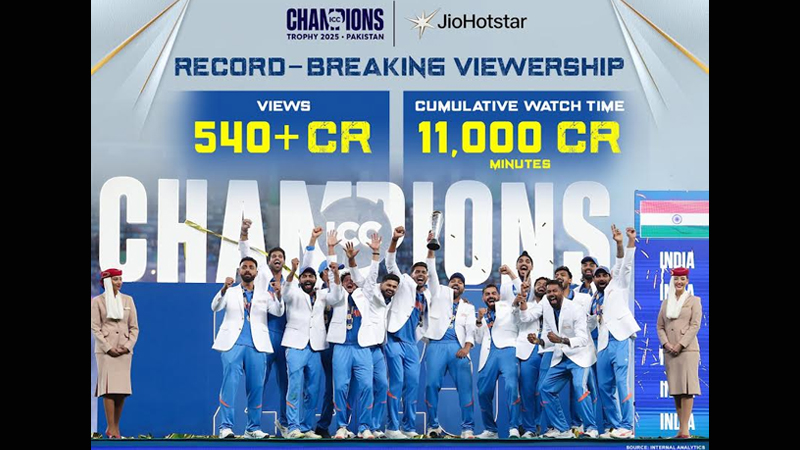
    MUMBAI: The ICC Men’s Champions Trophy 2025 tournament  wasn’t just battle for the top honours—it was a digital juggernaut. With a staggering 540+ crore total views and a cumulative watch time nearing 11,000 crore minutes, JioHotstar cemented its status as India’s go-to streaming platform for high-octane sports action.

    India’s historic victory over New Zealand in the final drove an eye-watering 124.2 crore views, while peak concurrency hit an all-time high of 6.12 crores. If digital cricket fever wasn’t real before, it certainly is now.

    JioHotstar didn’t just stream a tournament—it revolutionised the viewing experience. For the first time, an ICC event was streamed live across 16 feeds in nine languages, including English, Hindi, Marathi, Haryanvi, Bengali, Bhojpuri, Tamil, Telugu, and Kannada.

    Innovations like four multi-cam feeds, an Indian sign language stream, audio descriptive commentary, and the intuitive Maxview vertical feed ensured accessibility like never before. Whether on a big screen or a mobile device, fans experienced cricket like never before—anytime, anywhere.

    JioHotstar’s massive reach didn’t stop at just views. The India vs Australia match drove the platform’s highest-ever single-day new subscriptions, proving that more people than ever are ditching cable and going digital for their sports fix. With over 80 per cent penetration in wifi-enabled CTV households and Hindi-speaking regions leading the charge, JioHotstar’s influence is undeniable.

    JioStar CEO – digital Kiran Mani highlighted this milestone, stating, “The overwhelming response to the ICC Men’s Champions Trophy 2025 marks a leap toward the billion-screen opportunity, where seamless access and immersive engagement are now the expectation, not the exception. This moment is a testament to our commitment to making high-quality experiences accessible to all and transforming digital consumption in India.”

    JioStar CEO – sports Sanjog Gupta echoed this sentiment, “The Indian team’s campaign in the ICC Men’s Champions Trophy 2025 was more than just a victory—it was a demonstration of Cricket’s influence on the collective consciousness and culture of the country. With peak concurrency of 6.12 crores for the final, JioHotstar became the digital heartbeat of this celebration, amplifying the power of shared experiences.”

    The sports streamer’s  record-breaking tournament success was powered by a stellar lineup of sponsors, including Dream11, Pernod Ricard India, Beam Suntory, Kohler, Birla Opus, Vodafone Idea, ICICI Direct, LIC Housing Finance Limited, Eicher Motors, and Indira IVF. With brands eager to ride the digital sports wave, JioHotstar is proving to be an unmissable advertising platform.

    JioHotstar’s record-smashing ICC Men’s Champions Trophy 2025 viewership underscores its vision of unlocking Infinite Possibilities. From casual fans to die-hard cricket enthusiasts, the platform has united India through seamless, category-defining sports experiences on an unprecedented scale.

    And if this is just the beginning, imagine what’s coming next.

  • CID goes to toon town: Sony YAY! brings teenage sleuths to the small screen

    CID goes to toon town: Sony YAY! brings teenage sleuths to the small screen

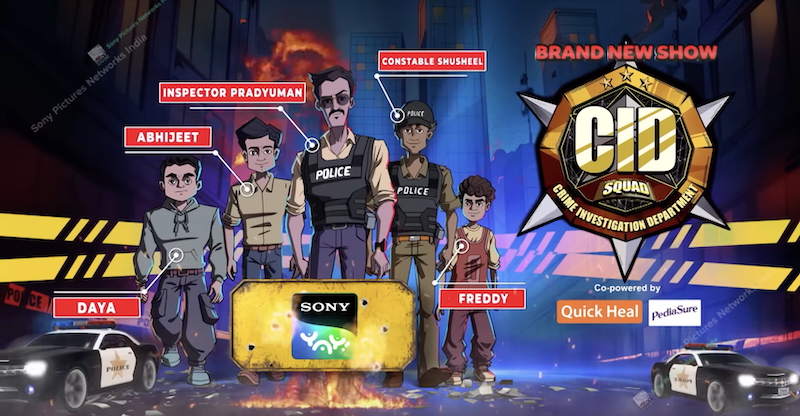
    MUMBAI: Move over Inspector Pradyuman, there’s a new investigative squad in town – and they’ve barely finished their homework in their high school notebooks! Sony Yay! is set to unleash its animated blockbuster CID Squad on 17 March, giving India’s beloved crime franchise a cheeky teenage makeover.

    In a plot twist that would make even Dr Salunkhe raise an eyebrow, the series transforms our favourite sleuths into a band of tech-savvy teenagers. Gone are the days of Daya, darwaza todo! – this new Daya is more likely to break firewalls than doors, reimagined as a gutsy young coder with a knack for digital detective work.

    The fresh-faced crew includes 16-year-old Abhijeet, whose sharp memory would put a supercomputer to shame, and young Fredricks bringing the laughs while keeping the team’s spirits high. Meanwhile, Inspector Pradyuman, now a sprightly 25-year-old, leads this band of teenage crime-fighters with the same signature style – just with fewer grey hairs.

    “This isn’t your grandmother’s CID,” quips  Sony’s kids and animation business head. Ambesh Tiwari. “We’re targeting the first Cartoon Network generation who’ve grown up to be parents. They get animation, and they’re ready for something revolutionary.”

    Ambesh Tiwari

    The series, produced by Toonz Animation with a dash of European flair from Ireland’s Telegael studio and music composers  Gigi Meroni and Saveiro Rapezzi, promises to tackle thoroughly modern mysteries. 

    Forget about missing jewels – these young detectives are cracking cases involving self-driving cars and artificial intelligence, with a helping hand from Dr Salunkhe, now re-imagined as a mechanical wizard running a scrap shop.

    With 26 episodes in the bag, each running 22 minutes, the show will hit the screen in six Indian languages – Hindi, Telugu, Tamil, Malayalam, Bangla, and Marathi.

    “Think of it as ‘Sherlock Holmes meets Teen Titans’, but with a distinctly desi flavour,” Tiwari says with a grin, adding that the audience for the show is going to cross national boundaries and go way beyond India.  

    “The intent is to create a global property which will be syndicated across the world, with India being a sizable market. It may even be acquired by a major OTT platform where primarily adults will watch it. CID is a massive IP, and we want to take it forward in a new format.” 

    He reveals that CID Squad  is only the first step that Sony is taking in its animation journey in India; the idea is to create many more properties once it  turns out to be hit that it is expected to become.  
     
    “Look at Pixar – its IPs like Toy Story have thrived for decades. Animation requires one major global hit, and it can generate revenue for 20 to 30 years. CID Squad is our first step towards creating such properties. The investment in this project is substantial, but we expect to recover it soon,” he elucidates. 

    Sponsors have already hitched on the CID Squad  van and are taking a ride with inspector Pradyuman’s  investigating crew: Quickheal and PediaSure are a couple of the brand names that have popped up on the promo as co-powered by partners. 

    And if you’re still wondering whether this new squad can fill the original team’s shoes, Sony Yay! is quite sure they can and is betting big on it. After all, when you’ve got teenage detectives, cutting-edge tech, and a dash of nostalgia, who needs a broken door?

  • JSW Indian Open serves up a smash as India’s first PSA Copper event

    JSW Indian Open serves up a smash as India’s first PSA Copper event

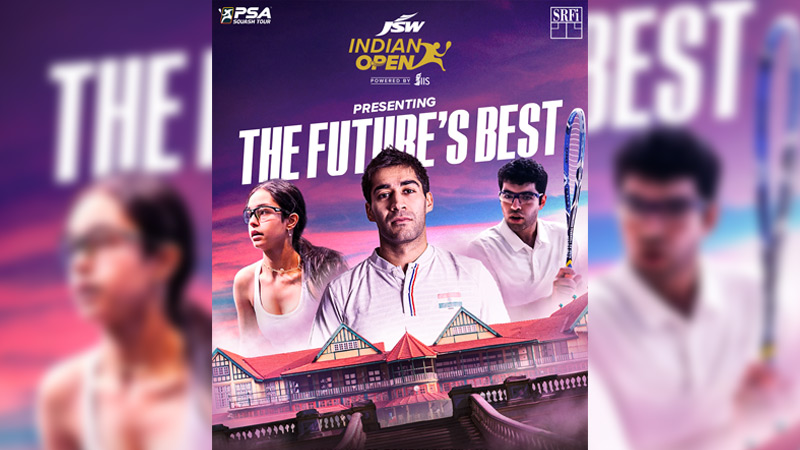
    MUMBAI: Squash fever is set to grip Mumbai as JSW Sports announces the JSW Indian Open, India’s first PSA Squash Copper event, scheduled to take place from 24-28 March at Bombay Gymkhana. This landmark event will bring together India’s top squash players, including Ramit Tandon, Velavan Senthilkumar, Veer Chotrani, Anahat Singh, and Akanksha Salunkhe, alongside global talent from Egypt, Canada, Malaysia, and Japan.

    With squash making its Olympic debut at the 2028 Los Angeles Games, JSW Sports is making a bold statement with this tournament. Parth Jindal, Founder, JSW Sports, highlighted the event’s significance:
    Speaking on the tournament JSW Sports founder Parth Jindal said, “With squash set to make its Olympic debut at the 2028 Los Angeles Games, now is as good a time as any to give the sport the fillip it needs. The JSW Indian Open is a statement of intent from Indian squash, and we are excited to give some of the best Indian and global talent a platform through this tournament.”

    India No.1 Ramit Tandon, who is also represented by JSW Sports, said, “It’s always special to compete at home, and having a PSA event like the JSW Indian Open in India is a huge boost for the sport. The level of competition is right up there, and it’s a great opportunity for Indian players to test themselves against the best. With squash making its Olympic debut at LA28, events like these are crucial in building momentum and inspiring the next generation.”

    PSA CEO Alex Gough welcomed the return of a PSA tournament to India, calling it a significant step for the sport’s growth. “Hosting world-class events on home soil not only helps Indian players compete at the highest level but also strengthens the squash ecosystem,” he said. He also emphasized the role of such tournaments in expanding the sport’s reach. “By bringing elite competitions to India, we are creating a pathway for young players to develop, grow the fan base, and ensure the sport continues to thrive.”

    India’s women number 2, Anahat Singh also shared her excitement about the tournament, saying, “Bringing a top-tier PSA event to India is a game-changer for players and fans alike. Competing against top international players pushes us to be better, and it’s an amazing opportunity to grow. With squash making its Olympic debut at LA28, events like these are key to building excitement and inspiring young players to dream big.”

    With a prize purse of 40,000 dollars the JSW Indian Open marks the return of a major squash tournament to India after a six-year hiatus, the last being the CCI International in 2018. The competition will unfold across Bombay Gymkhana’s indoor courts, with the quarterfinals, semifinals, and final set to be played on a full-glass outdoor court, offering fans a thrilling spectacle. As the countdown begins, Mumbai is set to witness a squash showdown like never before, with India stepping up to the global stage in style.