Category: Television

  • Avaya provides converged communication network for Fifa

    Avaya provides converged communication network for Fifa

    MUMBAI: With 64 matches over 31 days, mobility will be critical to maximise productivity and efficiency for journalists, Fifa employees and volunteers at the World Cup. Avaya is building a converged communication network that will enable the estimated 15,000 media covering the tournament, to provide the most up-to-date information and images to fans, giving those in attendance and at home the closest to real-time Fifa World Cup experience to date.

    It will also give Fifa personnel and volunteers who will be working the event, the mobility they need to make them more productive.

    Avaya head of IT for Fifa Mike Kelly said, “With billions of fans watching around the globe and the media using our networks to transmit photos and information instantly — we cannot compromise on performance. We require our employees to be easily contactable whenever and wherever we need them. Avaya’s solutions will help us to redefine how our employees and stakeholders can work around the World Cup.”

    The media covering the 2006 Fifa World Cup will require up-to-the-minute and accurate information to satisfy the public’s need for near-instantaneous information through online portals, broadcast and other media. A series of wireless local area networks (WLAN) in some of the stadiums, will give the press complete mobility within these environments.

    Photographers capturing game time action and analysts transmitting match statistics can now use their approved devices such as wireless laptops to reach Avaya Wireless Access Points from anywhere in the stadium — without having to move from their match position.

    Photographer John Sibley of London based Action Images said, “I have specialised in football photography since 1991, and one of the great things about covering Fifa competitions is the way that technology has made me much more efficient. Historically, photographers covering the Fifa World Cup used conventional film cameras. The film then had to be taken to the stadium’s media centre, developed, scanned and uploaded — taking up to 45 minutes. Now, with digital cameras I can transfer images straight to my laptop and transmit them directly over Fifa’s network. Now, this can take less than 60 seconds and fans can see photographs in near real time.”

    In addition, the converged communication network that Avaya is supplying for the Fifa World Cup will incorporate key mobility features such as Extension-to-Cellular that will maximise productivity and efficiency of Fifa employees, volunteers and executives working at the World Cup.

    In order to ensure smooth running of the 31 day 2006 Fifa World Cup Germany competition, it is especially critical for members of the Fifa and Avaya staffs to remain in constant contact. In order to reduce the time spent trying to find and contact people, Avaya integrated and installed the Avaya Extension-to-Cellular application which allows individuals to be reached on a single telephone number, wherever they are.

    For example, office calls can be automatically routed to any mobile device along with key capabilities like conferencing and transferring. Furthermore, if the call cannot connect it will return to the office voicemail — meaning it is no longer necessary to have multiple mailboxes.

    Fifa personnel will also have a single interface to access their voicemails, emails, directories and more, allowing them to check, store and manage them from any phone or laptop with Avaya’s Modular Messaging.

    Since becoming a Fifa World Cup partner in 2001, Avaya has worked with Fifa to help bring the excitement of the world’s most popular sport to an estimated accumulated global audience of 30 billion fans. Avaya has already provided converged communication networks for the 2002 Fifa World Cup, 2003 Women’s World Cup and the Fifa Confederations Cup 2005.

  • Ubisoft and Touchstone team up to create ‘Lost’ game

    Ubisoft and Touchstone team up to create ‘Lost’ game

    MUMBAI: Video game publisher Ubisoft has inked a long-term worldwide licensing agreement with Touchstone Television to develop and publish a video game based on Lost.

    Developed by Ubisoft’s Montréal studio and scheduled to hit retail shelves worldwide in 2007, the game will be offered for home and portable consoles as well as PCs.

    “We are delighted to work with Bryan Burk, one of the biggest producers in Hollywood and with Touchstone Television. That they have chosen us for the adaptation of the cult series Lost is the best homage that a producer can make to the creativity of Ubisoft,” said Ubisoft CEO Yves Guillemot.

    “This deal is another example of how truly powerful the Lost brand is. We are excited to work together with Ubisoft to create a gaming experience that will allow fans to further immerse themselves into the mysteries and intrigues of the series,” said ABC Entertainment and Touchstone Television senior vice president business development Bruce Gersh.

    “The creative appeal of Lost transcends borders with its character driven stories and addictive mysterious mythology. It’s not enough for fans worldwide to just watch Lost, the game is a wonderful opportunity to organically extend this creative phenomenon into an interactive consumer experience,” said Touchstone Television executive vice president Julia Franz.

    “Many of us on Lost have been hardcore gamers for years and the chance to work with Ubisoft, a company behind some of our favorite titles, has excited us to no end. With the ability to tell new interactive stories within the Lost universe, we’re giddy to be developing a game that, once completed, will be as engaging and fun to play as it is to create,” said Lost executive producer Bryan Burk.

  • ON World predicts 100 mn mobile VOIP users by 2011

    ON World predicts 100 mn mobile VOIP users by 2011

    MUMBAI: On the basis of a new study, ON World’s director of research Mareca Hatler says services such as VOIP, video, music, radio, news and instant messaging coupled with mobile devices such as a WiFi enabled iPod and the ubiquity of broadband will result in 100 million consumer mobile VOIP users in 2011.

    “The PC industry has found an ideal services model and this is the ‘real time Internet,’” she says.

    ON World interviewed 100 key technology influencers in several consumer markets as well as electronic retailers and discovered that 35 per cent were interested in VOIP combined with mobile entertainment devices.

    “Convergence between the PC and Telecom industries has been the ‘mantra’ for the last several years. Skype, Google, device makers such as Apple, and municipal mesh infrastructure providers such as Tropos are creating the ‘real time Internet’ without them,” says Hatler.

    The studies conducted reveal that the PC industry will ship more than two times as many mobile VOIP devices per year as the Telecom industry in 2011. Real-Time Internet Services WiFi enabled mobile entertainment devices will make up 36 percent of all mobile VOIP devices sold in 2011. This will be driven by the popularity of Apple’s iPod as well as products such as Nokia’s Internet Tablet 2006 bundled with GoogleTalk.

    These Mobile VOIP devices need infrastructure which Skype provides, with its 100 million PCs using their peer-to-peer telecommunications platform. Peer-to-peer technology not only takes advantage of efficient Internet routing, it saves Skype billions of dollars of infrastructure investment, the study adds.

    Thus, ON World predicts that by 2011 Skype will have 25 per cent of the world’s VOIP users and $1.2 billion in voice service revenues.

  • Mainland China, Taiwan’s exports of broadband products up 55% in 2006

    Mainland China, Taiwan’s exports of broadband products up 55% in 2006

    MUMBAI: Mainland China and Taiwan are expected to export over 54 million broadband communication products in 2006 worth over $2 billion — up 55 per cent year-on-year according to Global Sources’ China Sourcing Report: Broadband Communication.

    Mainland China is expected to ship 22.3 million units in 2006, while Taiwan is projected to export 31.8 million units. Report publisher Mark Saunderson said, “Broadband device manufacturing in mainland China and Taiwan relies heavily on exports. In 2006, sales of broadband products are expected to reach about $2.4 billion, with exports accounting for at least 85 per cent, or more than $2 billion.”

    Despite growing demand, manufacturers say export prices will fall in 2006.

    Among Taiwan makers, 64 per cent expect prices to fall between 10 and 20 per cent. Among mainland China makers, 84 per cent said prices will remain stable or drop by up to five per cent in the months ahead.

    The survey also shows:

    Taipei and Hsinchu are the main manufacturing hubs in Taiwan
    Shenzhen and Dongguan are the key production centers in mainland China

    Taiwan makers are developing voice and multimedia over DSL/cable products, while Mainland suppliers are focusing on faster speed and extended transmission distances

    Makers serve brands and customers worldwide including Dell, Fujitsu, Italy Telecom, LG, Linksys, Lucent, Siemens and Thomson

    China Sourcing Report: Broadband Communication examines manufacturing, technology and pricing trends for cable and digital subscriber line (DSL) modems, gateways, routers, optical networking equipment and related products. It profiles 27 leading suppliers in mainland China and Taiwan, with specifications for 72 best-selling export products.

  • Britannia launches Marie Gold Doubles

    Britannia launches Marie Gold Doubles

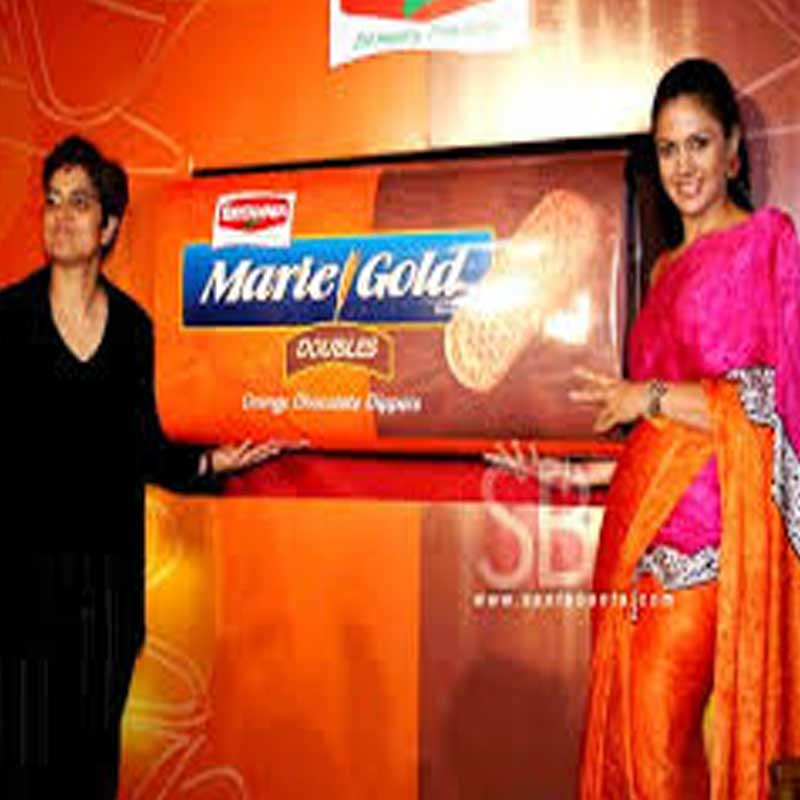
    Mumbai: May 23rd, 2006: Britannia Industries Ltd, today announced the launch of ‘Marie Gold Doubles’ – an unique three layered Marie in a delightful double taste of orange and chocolate. This innovative double taste has been created through a unique technology that enables a layer of chocolate to be embedded between two layers of orange

    MarieGold doubles is unique in several other ways too.

    ” An unusual finger shaped biscuit, not round
    ” Attractive sleeve packaging for the first time in the biscuit category

    Its Crisp, Light, Healthy and Delicious!

    Marie Gold, one of Britannia’s oldest and flagship brands, now offers this exciting and new variant targeted at young and old alike. Marie is one of the fastest growing biscuit sub category and Britannia already has significant presence in it with a nearly 50% share of market. Marie Gold has been predominantly eaten with tea. The unique and exciting taste of Marie Gold Doubles will however, make it an ideal snack for non-tea / beverage drinking occasions too.

    Speaking at the launch of Marie Gold Doubles, Ms. Richa Arora, General Manager & Head of Marketing and Innovation, said, “At Britannia, we constantly endeavour to delight our customers with high quality, innovative products. Marie Gold Doubles is the result of extensive efforts of our Marketing and R&D teams. We are confident it will strike a chord with consumers & add significantly to Britannia’s Image”.

    After formally unveiling Marie Gold Doubles, Ms. Mandira Bedi, Actor & TV Host said, “I am delighted to be associated with one of India’s leading companies “Britannia” and the launch of ‘Marie Gold Doubles’. Marie Gold Doubles is light, tasty & a healthy eat and is the perfect snack to munch on for people like me who are constantly on the move, juggling two things at the same time, be it balancing my personal and professional life or hopping from one shoot to the other, entertaining or travelling. I am sure its unique taste & shape will make it a favourite across the country”.

    Marie Gold Doubles, introduced in a 150gms pack of 30 biscuits, is priced competitively at Rs.15/-. The attractive sleeve packaging gives it a premium look and enhances the distinctiveness of the offering

    Marie Gold Doubles will be available in all leading stores across the country and will be supported by an exciting communication programme across all consumer touchpoints.

    About Britannia:

    Britannia is the Market leader in the organized biscuit and bakery product market in India and has always been the pioneer in product innovation. Biscuits contribute to nearly 90 % of Britannia’s total turnover. Britannia is synonymous with ‘biscuits’ and Brands like MarieGold, Good Day, 50-50 and Tiger have become a household name in the country.

    For Further Information:
    Saritha Prem / Amit Gidwani
    Madison PR
    saritha@fort.madisonindia.com
    amit@fort.madisonindia.com

  • Tata Sky begins publicity, trade activities

    Tata Sky begins publicity, trade activities

    MUMBAI: Aasman se seedhe aapke ghar (straight to your home from the sky). This could well be the tag line for Tata Sky’s proposed DTH service, slated to be launched June-July 2006.

    So what’s new? Well, Tata, “India’s most trusted company”, and Star, “India’s No. 1 entertainment company,” feel the people of India should be told that the two entities have “come together to change the way in which television is watched in India.” And, Tata Sky has started the process of telling the tale of world’s “most advanced” DTH service — one must admit quite engagingly so.

    The 40-slide presentation being made by Tata Sky to the trade affiliates, on the other hand, has upset the cable fraternity. At one place, to hammer home the point that cable operators get eliminated in a DTH service, some funny lines have been used (cablewallah to consumer: I don’t have electricity, you can’t watch TV or I fight with the channel for non-payment, you pay the price — here goes the cricket match) that presumably have not gone down well with cable ops of Mumbai.

    The text points out that a consumer need not “suffer a poor quality cable service” as he has the right to choose channels he wants to watch and pay only for those. “Could you ever imagine a choice like?” the text eggs on a consumer, who’s then told after sales service means “problems are no problems.”

    Apart from the high quality programming and DVD-type visual experience, free onsite installation of the hardware and maintenance under warranty are thrown in as added sops.

    For the gaming freaks, Tata Sky promises a personal games parlour where new games will be made available periodically for the whole family at no extra cost.

    The presentation also goes to list step-by-step the installation process and how the digicomp is compatible with most varieties of TV sets.

    Unstated however, are the costs involved for a consumer, which is also an indication that the various packages, probably, are still being worked out.

  • CBS Corp to sell Paramount Parks to Cedar Fair for $1.24 billion

    CBS Corp to sell Paramount Parks to Cedar Fair for $1.24 billion

    MUMBAI: CBS Corporation will be selling its Paramount Parks operation to Cedar Fair, L.P. for $1.24 billion in cash. The transaction is subject to customary conditions, including regulatory and other approvals, and is expected to close during the third quarter.

    The company announced its intention to divest Paramount Parks on 26 January.
    “We’re very pleased with the value we received from the sale of this terrific asset. I want to thank the management and employees of Paramount Parks for their contributions to the parks division and to CBS Corporation,” said CBS Corporation president and CEO Leslie Moonves.
    Commenting on the new deal, Cedar Fair LP chairman, president and CEO Dick Kinzel said, “The five properties we are acquiring fit very well with our existing parks and there is very little overlap.”

    The company said that, the combined operations will generate almost $1 billion in annual revenue from about 25 million customers.

    CBS, which inherited the theme-parks after splitting from parent Viacom Inc. in December, said that it would sell the resorts because they did not fit with its broadcasting focus. This acquisition however, will boost Cedar Fair to become one of the world’s largest regional amusement park operators. Paramount Parks will remain in full operation throughout the divestiture process, informs an official release.

    Paramount Parks’ assets include Great America, Carowinds, Kings Island, Kings Dominion and Canada’s Wonderland.

  • Prasar Bharati financial rejig awaits GoM nod

    Prasar Bharati financial rejig awaits GoM nod

    NEW DELHI: A group of ministers (GoM) looking into a possible financial restructuring of pubcaster Prasar Bharati to boost its revenue generation capacity has said no final decision has been taken on various options.

    On Thursday, Prasar Bharati, which manages Doordarshan and All India Radio, made a presentation to the GoM highlighting its plus and negative points, including possible ways to augment revenue generation that is lagging far behind annual expenses incurred.

    While confirming that a presentation was made to the GoM, Prasar Bharati CEO KS Sarma told indiantelevision.com that it was made clear to him that the ministers would look into the issue before taking the package to the Cabinet for a final approval. Sarma added amongst the many options presented before the GoM were levying a one-time cess on TV and radio sets in the country and tapping the capital market.

    These options, Sarma said, were in line with a report prepared by a panel, headed by information and broadcasting secretary, set up to look into the financial restructuring. The report is now being studied by the GoM.

    Asked whether the GoM and then the government are likely to okay the financial restructuring of Prasar Bharati during his tenure, which ends 30 June 2006, Sarma replied in the negative, hinting that the issue is likely to take more time.

    Amongst the options, as has been reported by indiantelevision.com last year, is also one that envisages the government holding equity in the pubcaster against assets, which will facilitate a capital restructuring of the financially beleaguered Prasar Bharati or Broadcasting Corporation of India.

    A government official added that media reports on financial restructuring of Prasar Bharati were “premature.”

    In the meanwhile, reports on levying a cess on TV and radio sets to give a fillip to Prasar Bharati revenue has almost set the cat the pigeon with stiff opposition coming from consumer electronics manufacturers.

    However, present I&B minister Priya Ranjan Dasmunsi’s predecessor Jaipal Reddy had been against levying a cess on TV and radio sets. His justification: the cost of collecting this cess from all over the country would be more than the actual amount collected.

    British broadcaster BBC is partly funded through this mode where Englanders pay a nominal amount at the time of buying of a TV or radio set. A recent proposal of the Tony Blair government to hike this amount has been widely resisted British citizens.

  • ‘DD Sahyadri has been successfully exploring the pubcaster’s autonomy to unleash useful information’

    Another tranquil evening is setting in the imposing Prasar Bharati complex, situated at Mumbai‘s upscale Worli area.As I enter the DD Kendra Mumbai (DD Sahyadri) office, an eerie silence accompanied by that unmistakable government office aura surrounds me. The staff has slowly started packing their bags, and walking through the vacant corridor, I wonder if that terrible traffic jam has cost me my appointment with the Kendra director Mukesh Sharma.

    Meet the man though and any notions that he oversees a culture of ennui are dispelled. Sharma has just come off major brainstorming session with his key officers. As I am ushered into the spacious cabin, Sharma displays no signs of the fatigue. Over a cup of black tea, that Sharma himself prepared, he switches on the cheerful chat. He has been running the show at the Mumbai Kendra in this fashion since the last six years and the way DD Sahyadri evolved during this phase says it all.

    In the course of the conversation, the former filmmaker‘s uninterrupted journey of six years as DD Sahyadri director is unveiled frame by frame.

    A UP-ITE COMES TO MUMBAI TO LEAD DD‘S MARATHI DRIVE

    I have come all the way from Lucknow to Mumbai to head DD Sahyadri. There was a bit of apprehension in my mind when I took up the assignment. Reason, obviously the language and cultural barriers. To think like a Maharashtrian when it comes to conceptualising and ideating programming sounded a difficult proposition. However, I solved the situation successfully by following the strategy of ideating quality programmes and then banking on the local team to do the job perfectly.

    I also realised that, I could use my film background to my advantage in this position. Being a filmmaker and producer myself, I think in the same wavelength that my producers think and that came as a huge bonus. My career background helped me to interact with my clients in a better way and overall it helped a lot to increase the Kendra‘s productivity.

    THOSE EARLY DAYS

    When I joined on 4 May 2000, DD Sahyadri was in a terrible state then. Poor connectivity, substandard programmes and low grade technical infrastructure had placed us lowest in the Marathi channel chart, behind ETV Marathi, Alpha Marathi (now Zee Marathi), Tara Marathi and Prabhat. I wanted to change this.

    I started with the connectivity issue. The issue was discussed with the cable operators and the DD Public Relations (PR) machinery was effectively used to improve the relationship with all concerned. Within six months, we were seen, heard and known. DD Sahyadri discovered its own identity and that made a huge difference. I have never sold the channel as Doordarshan. I always marketed it as Sahyadri.

    To improve the programming, I did a SWOT (Strengths, Weaknesses, Opportunities & Threats) analysis of the channel and identified my target group (TG) as citizens and not consumers. I decided to run Sahyadri like a real public channel. To reach out to the masses, phone-in programmes were conceptualised. This was something new in those times. I realised that, DD Sahyadri‘s USP should be, ‘a channel that reaches the masses and empowers them — especially women — through its programmes‘.

    PROGRAMMING LANDMARKS

    Our first ever phone-in programme Hello Sakhi, has completed six years as a daily show now. So, I can say, DD Sahyadri has about 1500 hours of women empowerment programming unleashed in Maharashtra. The programme gives expert advice on issues such as legal, career, education and health and the programme was first its kind when it was introduced in 2000. Even phone-in programmes were a rare affair then, whether on DD or satellite channels.

    Then came Hello Doctor in 2001, again targeted at the masses. We also kicked off the Navratna Awards, which felicitates nine talented Maharashtrians, in the same year. Another award property Navjot Sahyadri Che was initiated in 2002 in association with Unicef. Then in 2003, we introduced Lux Hirkani Awards to honour ‘women of substance‘. As an appreciation towards our achievements in establishing event properties, Prasar Bharati asked us to produce an award show Prerna Puraskar and then New Year programmes for the national network. The New Year programmes are produced at a cost of about Rs 2.5 million and we record a profit of about Rs 7.5 million out of it.

    Since Mumbai is the hub of Indian cinema, I brought the entire Films Division from Delhi to Mumbai. The division has now become a significant player in Prasar Bharati‘s revenue plans as it functions in harmony with the DD marketing division in Mumbai.

    Overall, DD Sahyadri launched about 25 programmes during this six-year period. These cut across all the programming genres such as talk shows, game shows, events, musicals and soaps. I would say, DD Sahyadri gave a significant contribution to television in its infancy by introducing such diverse genres to the masses and the huge success these shows recorded underlines their popularity.

    REVENUE REALISATIONS & FUTURE PLANS

    Some time back, I realised that, DD Sahyadri was wasting its air time during the breaks between programmes. We used to simply display some message on the screen informing viewers about the next programme coming up. I introduced five minute programmes in these ‘lazy‘ slots and started telecasting programmes such as Hasnavari Gheu Naka (Jokes Apart). The popularity of the programme attracted advertisers and now the five minute slot has 1.5 minutes bought by advertisers.

    In 2005, Prasar Bharati introduced the Self Financing Scheme (SFS) successfully in the national channel. The logical extension of the scheme has been to regional channels and DD Sahyadri was chosen as the first regional Kendra to implement the scheme. The SFS scheme gives DD the power to market its shows and earn the returns, while producers are paid a fixed amount for their work.

    The system delivered very well for DD Sahyadri in the 2006 fiscal. We recorded revenues of Rs 280 million in the 2005-2006 fiscal, which comes to about 28 per cent of the Kendra‘s revenue. By marketing our shows in-house, we could triple our returns. As we move towards a 100 per cent implementation of the system, DD Sahyadri is targeting revenues of about Rs 300 million in the 2006-2007 fiscal,

    On 2 October 2006, on its 35th birthday, DD Sahyadri will activate a complete switchover from the sponsored to commissioned model for its show slots. We will bring all our programmes under SFS by marketing them ourselves. Presently, sponsored programmes constitute about 20 per cent of our schedule and from 2 October onwards, there won‘t be a single sponsored programme in our line up. Right now the plan is in the initial phase of implementation and we are working towards achieving the goal.

    DIRECT TO HOME (DTH) & DD SAHYADRI

    According to a study conducted by Tam recently, about 2.5 million DTH boxes were sold in the country. The study showed Zee had the maximum number of DTH customers in Rajasthan, while DD‘s DTH is most popular in the rural areas of Maharashtra. That is a testimony to DD Sahyadri‘s strong hold over the masses in the All Maharashtra market.

    DD Sahyadri has also taken an active part in marketing the DD DTH. In fact, I presented a DD DTH connection to Sachin Tendulkar during the Navratna Awards ceremony.

    DOORDHARSHAN IS AGEING

    On the lack of young talent in Doordarshan: Since 1992, DD hasn‘t made any fresh recruitment. The average age of DD employees is now 55 years. We have no new generation backing us. The government must look at this with all the seriousness required.

    SETBACKS

    Overall, DD Sahyadri – during my tenure – didn‘t have to backtrack from any of its major initiatives. However, one programming initiative did let us down. Inspired by the national network‘s successful 11 pm Bioscope experiment, where a movie is telecast over three days on DD1 part-by-part, we started a similar initiative for the 8 pm slots on Monday, Tuesday and Wednesday. But it didn‘t appeal to the viewers and we were forced to pull it off.

    PARTING SHOT

    As the DD Sahyadri director, I have been trying to do this balancing act of selling the channel as well as contributing to society. Through our various properties which are targeted at the common man of Maharashtra, DD Sahyadri has been successfully exploring the pubcaster‘s autonomy to unleash useful information. As a responsible broadcast official, I am working towards an effective broadcast policy in a digital multi-channel era in the context of social education.

  • Manic Monday: Media scrips join Sensex free fall

    Manic Monday: Media scrips join Sensex free fall

    MUMBAI: It was truly a Manic Monday for Dalal Street. For the second time in the indices’ history (the first being on 17 May, 2004), trading was suspended at the BSE this morning. The Sensex fell by a whopping 1111.70 points in the morning trade below 10,000 to settle at 9,826.91.

    However, it recovered substantially to close at 10,482 down 457 points. The NSE Nifty, on the other hand, closed at 3081 down 166 points. Media stocks, like the predominant market sentiment, were on a downslide.

    In order to avoid pandemonium in the market, Sebi chief M Damodaran asked people not to go by rumours but to take informed decisions. According to him, Sebi was in touch with the RBI and there were no liquidity problems.

    Among the entertainment and media stocks, one company that managed to beat the heat on the bourses was Times Group company Entertainment Network India Ltd (ENIL), which operates the Radio Mirchi brand. The company’s stocks opened at Rs 239.85 and closed higher at Rs 241.10, thus registering a marginal gain of 0.63 per cent.

    The biggest loser today was Prannoy Roy’s NDTV Ltd. The stocks of NDTV opened at Rs 220 today and closed at Rs 190, weaker by 13.64 per cent. Mid-Day Multimedia, on the other hand, recorded a drop of 11.82 per cent and closed at Rs 61.15 (previous close Rs 69.35).

    Pritish Nandy Communications shed 10.14 per cent to close at Rs 45.65 from its previous close of Rs 50.80. Hinduja TMT; which on Friday 19 May took the deepest plunge, going down by Rs 48.30 to close at Rs Rs 701.75; today dropped 3.10 per cent to close at Rs 680.

    Sahara One Media and Entertainment Ltd and BAG Films both shed around eight per cent in today’s bloodbath. TV Today Network was weaker by 7.76 per cent to close at Rs 81.45 at the end of the day’s trade. K Sera Sera also lost 7.45 per cent and ended the day at Rs 36.05. Television Eighteen shed 5.18 per cent (down Rs 32.95 from yesterday closing at Rs 603.20).

    Company
    Last Traded Price
    Previous close
    Change
    Per cent change
    Adlabs Films
    Rs 267.30
    Rs 271.45
    Rs -4.15
    -1.53
    BAG Films
    Rs 9.63
    Rs 10.54
    Rs -0.91
    -8.63
    Balaji Telefilms
    Rs 139.95
    Rs 147.00
    Rs -7.05
    -4.80
    Cinevistaas
    Rs 21.45
    Rs 22.55
    Rs -1.10
    -4.88
    ENIL
    Rs 241.10
    Rs 239.60
    Rs 1.50
    0.63
    ETC Networks
    Rs 37.65
    Rs 38.50
    Rs -0.85
    -2.21
    Galaxy Ent
    Rs 251.15
    Rs 260.95
    Rs -9.80
    -3.76
    Gemini Comm
    Rs 420.00
    Rs 433.30
    Rs -13.30
    -3.07
    Hinduja TMT
    Rs 680.00
    Rs 701.75
    Rs -21.75
    -3.10
    Jain Studios
    Rs 27.60
    Rs 29.00
    Rs -1.40
    -4.83
    K Sera Sera
    Rs 36.05
    Rs 38.95
    Rs -2.90
    -7.45
    Mid-Day Multimedia
    Rs 61.15
    Rs 69.35
    Rs -8.20
    -11.82
    Mukta Arts
    Rs 42.95
    Rs 45.20
    Rs -2.25
    -4.98
    NDTV Ltd
    Rs 190.00
    Rs 220.00
    Rs -30.00
    -13.64
    Pritish Nandy
    Rs 45.65
    Rs 50.80
    Rs -5.15
    -10.14
    Sahara One Media
    Rs 324.00
    Rs 354.00
    Rs -30.00
    -8.47
    Saregama
    Rs 241.65
    Rs 254.05
    Rs -12.40
    -4.88
    Sun TV
    Rs 1159.55
    Rs 1192.35
    Rs -32.80
    -2.75
    TV Eighteen
    Rs 603.20
    Rs 636.15
    Rs -32.95
    5.18
    TV Today
    Rs 81.45
    Rs 88.30
    Rs -6.85
    -7.76
    UTV
    Rs 176.00
    Rs 183.55
    Rs -7.55
    -4.11
    Zee Telefilms
    Rs 228.20
    Rs 229.60
    Rs -1.40
    -0.61

    In the vicinity of the one – five per cent loss incurred by companies were the likes of Mukta Arts (-4.98 per cent), Cinevistaas (-4.88 per cent), Saregama (-4.88 per cent), Balaji Telefilms (-4.80 per cent), Jain Studios (-4.83 per cent), UTV (-4.11 per cent), Sun TV (-2.75 per cent), ETC Networks (-2.21 per cent), Adlabs Films (-1.53 per cent).

    Media major Zee Telefilms had a relatively quiet day at the bourses, closing at Rs 228.20 down a minimal -0.61 per cent from yesterday’s last traded price of Rs 229.60. On the Nifty, meanwhile, Zee ended the day at Rs 227.40, down 1.22 per cent from yesterday’s close of Rs 230.20.

    The big question on every market punter’s mind at the moment seems of course to be just how low will low go. When will the “market correction” bottom out is something no one seems to be able to hazard a guess on currently.