Category: Television

  • All India Radio scores among ABU Prizes 2006 finalists

    All India Radio scores among ABU Prizes 2006 finalists

    MUMBAI: The finalists of the ABU Prizes 2006 programme categories have been selected. Out of a total of 211 entries for its radio and TV categories, All India Radio has made it into two final spots in the Children and Youth sub category for Made for Each Other and in the Documentary sub category for I Take the Responsibility.

    However, India did not feature among the TV finalists for the ABU Prizes this year. The TV categories include drama, entertainment, children, youth, news, documentary, and sports.
    There is also a Special Jury Prize which is awarded to programmes targeting broadcasters from less developed countries which showed creativity despite the limited resources available. While the categories for radio are drama, infotainment, children and youth, news, documentary, external broadcasts and the Special Jury Prize.

    The pre-selection of the awards were held last week and among the other finalists, NHK-Japan, RTPRC-China, IRIB-Iran and RTHK-Hong Kong lead the nominations with five each. NAB-Japan has four programmes on the shortlist, while Korean broadcasters KBS and EBS have three finalists each, informs an official release.

    The shortlisted candidates for TV drama are Bride from Hanoi (SBS-Korea), McLeod’s Daughters (Nine Network-Australia), The Dance of Passion (TVB-Hong Kong), and The Ice Wall (NHK).

    For radio drama, the finalists include At the Very Beginning (RTHK), Haru’s Dairy (NHK), Weekend 2006 (ARD/BR-Germany) and Iran Through the Passing of Time (IRIB).

    The ABU Programme department head, Tatsuya Nakamura, said, “Each year, the jury members observed an improvement in the quality of the programmes submitted, which made it more difficult to select the finalists for each prize.

    “For instance, we had very good TV documentaries. It was hard for the juries to select only four finalists. There were plenty of heated discussions among jury members as the shortlists were being drawn up.”

    The total entries this year has set an all-time record for the awards since it was introduced in 1964. The winner in each category will be announced at the 43rd ABU General Assembly which will be held in Beijing from 7 to 9 November, adds the release.

  • AIR’s B Singh acting CEO of Prasar Bharati; Mandloi  officiating Doordarshan DG

    AIR’s B Singh acting CEO of Prasar Bharati; Mandloi officiating Doordarshan DG

    NEW DELHI: Director-general of All India Radio, Brijeshwar Singh, has been given additional charge of looking after pubcaster Prasar Bharati as its chief executive.

    He succeeds Navin Kumar whose term as DG Doordarshan and acting CEO of Prasar Bharati ended on 23 August 2006.
    A 1975 batch Indian Administrative Service officer of Tamil Nadu cadre, Singh has been heading All India Radio since February 2004.

    Under his stewardship, All India Radio clocked an impressive 70 per cent revenue growth during 2005-06, even while keeping intact its focus on public service programming.

    AIR earned Rs 2.7 billion in revenue during 2005-06.

    Singh’s keen interest in classical music enabled AIR to bring out quality CDs under the brand name Akashvani Sangeet, deriving rare content from the archives of All India Radio.

    An active participant in broadcasting issues, Singh is also the
    vice-president of the Commonwealth Broadcasting Association.

    Prasar Bharati is not having a regular CEO since K S Sarma stepped down on June 30, 2006 on attaining the age of super annuation.

    A regular CEO will be appointed by a three-member high level committee headed by the Vice President of India.
    MANDLOI ACTING DIRECTOR-GENERAL OF DD

    Meanwhile, LD Mandloi, the senior most deputy director-general of Doordarshan, has been named as the officiating director-general (DG) of the television pubcaster.

    Mandloi, a programming side person, unlike his bureaucrat predecessors, will look after day-to-day functioning of Doordarshan till a full-time DG is appointed.

    According to sources in the government — despite autonomy through an Act of Parliament, Prasar Bharati still remains an extension of the establishment — 17 applications have been received till now for the post of Doordarshan DG.

    However, a regular DG of DD can only be selected once a full-time CEO of Prasar Bharati is in place.

    After former information and broadcasting secretary Bhaskar Ghose in the late 1980s and early 1990s, DD has seldom had a full-time DG.

    Ghose, father-in-law of CNN-IBN chief editor Rajdeep Sardesai, presently is the chief executive of Lok Sabha TV, an initiative of the Speaker of Lower House of Parliament. The channel is dedicated to airing proceedings of the Lower House, apart from other serious programming.

  • Will Smith is the date doctor in HBO- Blockbuster of the month ‘Hitch’

    Will Smith is the date doctor in HBO- Blockbuster of the month ‘Hitch’

    AIRDATE: FRIDAY 25th AUGUST AT 9:00 PM

    STARRING: Will Smith, Eva Mendes

    Meet Alex Hitchens (Will Smith), New York City’s greatest matchmaker. Love is his job and he’ll get you the girl of your dreams in three easy dates, guaranteed! And that’s exactly what happens when Albert Brennaman wins the heart of gorgeous society heiress Allegra Cole. So when tabloid columnist Sara Melas (Eva Mendes, Once Upon A Time In Mexico) decides to uncover the secret behind the tubby schlub’s success, she’s shocked to discover that Hitch, the charming young man she’s seeing, is the legendary date doctor himself. Exposed in a front-page scoop, it’s now up to Alex to save Albert and Allegra’s relationship as well as his own

    For further information, please contact:

    Manisha Manchanda, HBO Asia
    Tel: 0124 – 4028888
    E-mail: manchanda_manisha@hboasia.com.sg

    Vivian Castelino, CMCG India
    Tel-: 022 24450991-6
    Email: vivian.castelino@cmcgindia.com

  • Samsung targets 70% growth in digital media business

    Samsung targets 70% growth in digital media business

    MUMBAI: Samsung India is aiming to achieve a 70 per cent growth in its digital media business this year. The digital media business, which is a new thrust area within the company’s audio video portfolio, includes products like digital still cameras, digital camcorders, digital audio players (MP3 players) and DVD players.

    “We plan to grow our digital media business by launching wow, aspirational products like the NV Series as well as by creating new product segments like the 6-in-1 multifunction camcorders within the digital camcorder segment,” said Samsung India deputy managing director R. Zutshi.

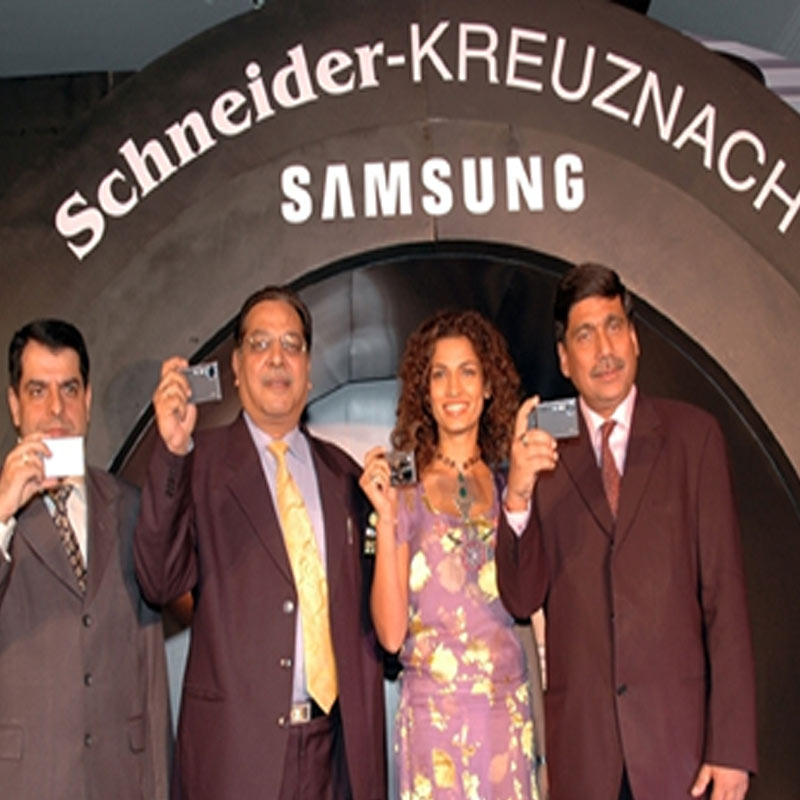
    (L to R) Samsung India general manager audio – video business Rajiv Kenue; director sales Pradeep Tognatta; model Kamal Siddhu; deputy managing director R Zutshi at NV -Series digital camera launch
    The Samsung ‘NV’ series in digital still cameras launched today comprises NV10: the world’s first 10 mega pixel digital still camera (DSC); NV7: slim camera with 7x zoom; and NV3: world’s first camera with MP3 and stereo speaker in-built functionality.

    In addition to the NV Series, Samsung has also launched three more products in the DSC category — Digimax i6: the world’s first camera with portable media player feature in a digicam; Digimax L-85: the world’s first HDMI camera and Digimax L60: a six mega pixel camera with MPEG4 VGA recording (30fps movie clip).

    With the introduction of the new DSC range, Samsung has 11 DSC models priced in the range between Rs 8,990 and Rs 49,990.

    “Our strategy to grow our DSC business is to help the existing analogue consumers to upgrade to Digital Still Cameras on the strength of our aspirational products and attractive pricing. We will also be enhancing our channel presence for this category by tapping both the existing CE Channel as well as strengthening our presence in the photographic channel,” said Samsung India director sales Pradeep Tognatta.

    Samsung is targeting a 400 per cent volume growth in its DSC business this year.

    Samsung India also announced its foray into the fast growing DVD camcorder category by launching its VP-DC 163i and VP-DC 565wi DVD camcorders with optical zoom.

    MS-11, the ultra compact memory player from Samsung represents a new segment within the existing digital camcorder category with its 6-in-1 functionality – webcam, storage, camcorder, digital still camera, MP3 player and voice recording functions.

    Samsung India has priced its VP-D363i Digital camcorder model at an introductory price of Rs 17,990. With the introduction of the new digital camcorder range, Samsung has eight digital camcorder models priced in the range between Rs 17,990 to Rs 39,990. Samsung is targeting a 200 per cent growth in its camcorder business this year.

    The company is also strengthening its Plasma lineup by launching its Q7 series of Plasma TVs in 106 cm (42″) and 127 cm (50″) screen size segments. These HD ready Plasma TVs are differentiated on account of their FilterBright technology for sharper, deeper and brighter display in any lighting condition; Smooth Motion Driver for clear and smooth image even in fast moving scenes and their 13-bit processing capability for an amazing display of 549 billion colours.

    With the launch of these new Plasma models, Samsung now has a lineup of four Plasma models in 42″ (2 models), 50″, and 63″ screen sizes, priced in the range between Rs 99,000 – Rs 700,000.

    Samsung India is expecting to grow its audio video business (AV) by 50 per cent in the July – December 2006 period based on its range enhancement in key AV product categories like flat panel TVs and digital media products, enhanced channel presence and awareness creation through Samsung Dream Home Roadshows.

    Zutshi added, “Our considerably enhanced sales infrastructure coupled with our new product launches should help us successfully optimize our festival sales in the second half of this year.”

  • Busch Entertainment Corp & Sesame Workshop expand partnership

    Busch Entertainment Corp & Sesame Workshop expand partnership

    MUMBAI: Busch Entertainment Corporation (BEC), the family entertainment subsidiary of Anheuser-Busch Companies, Inc., has signed a long-term agreement with nonprofit educational organisation Sesame Workshop to create fixed Sesame Street-themed attractions in four of its U.S. parks — SeaWorld California in San Diego, SeaWorld Texas in San Antonio, Busch Gardens Africa in Tampa, Fla., and Busch Gardens Europe in Williamsburg, Va.

    Also as part of this agreement, Sesame Workshop has agreed to extend BEC’s license to feature Sesame Street characters in Sesame Place, the company’s Langhorne, Pa. park. Sesame Place, is a theme park based on Sesame Street that was opened in 1980. Most recently, Sesame Place opened ‘Elmo’s World,’an all-new land with three new rides themed after the popular red furry monster.

    In addition, the Sesame Street characters will make periodic appearances at SeaWorld Florida in Orlando beginning in 2007, informs an official release.

    “Sesame Workshop and Busch Entertainment both aim to bring families fun and interactive experiences. We commend Busch Entertainment for their 26 years of partnership with Sesame Place and we look forward to extending this commitment through new Sesame Street locations in SeaWorld and Busch Gardens parks that will transform the entertaining and educational features of the television series into memorable experiences for families across the country,” said Sesame Workshop president and CEO Gary E. Knell.

    BEC president and chairman of the Board Keith M. Kasen said, “Over the past 26 years we have come to appreciate just how well known and loved the Sesame characters are and the kind of connection guests can make with them in a theme park setting like Sesame Place. The deal we are announcing today allows us to offer these kinds of experiences at SeaWorld and Busch Gardens. These parks combined play host to more than 19 million people each year.”

    Kasen also added that the partnership with Sesame Workshop will enhance BEC’s long tradition of delivering high-quality family entertainment to its guests with attractions at SeaWorld and Busch Gardens that will include family rides, water elements, live character shows, 4-D film attractions or character dining programs. These Sesame-themed attractions will begin in the next several months as part of the deal, which establishes BEC as the exclusive U.S. theme park partner of Sesame Workshop.

    “We will provide our guests with attractions that showcase wonderful characters like Ernie and Bert, Big Bird, Elmo and Oscar the Grouch, and do it in a way that fits with the unique themes of our SeaWorld and Busch Gardens parks.” Kasen said.

    Plans call for the first Sesame-themed attraction to open in 2008. However, the terms of the agreement were not disclosed, adds the release.

  • ‘Acting is  self-expression but you also add something to it’

    ‘Acting is self-expression but you also add something to it’

    Be it as a historical character of a bygone era or today’s contemporary women, actress Mrinal Kulkarni has etched a place for herself with selective, yet substantial roles.

    In the past, Mrinal has portrayed the daring young Maratha queen Ramabai, in Swami, and Devi Ahilyabai Holkar, a legendary queen of Indore who left an lasting impression as a good administrator after looking after her kingdom for nearly 44 years, in Sanjay Khan’s Great Maratha. She also played central roles in Meerabai andNoorjahan.

    Mrinal’s initial tryst with television was pure chance, where talent met opportunity. It was during a college annual gathering that Shrikant Moghe, an eminent actor-director (Marathi) spotted Mrinal while she was performing. He immediately offered her the role of Ramabai. Mrinal was only 17 then.

    Acting apart, Mrinal continued her studies and went on to pursue a Masters in Linguistics from Poona University. Soon after graduating she married her long time friend and it was goodbye arc lights for the next three years.

    She marked her second coming in television with Great Maratha. She has also acted in a few Marathi movies, the more recent being Jodidar, a social film that dealt with the marital relationship where she plays a double role, not of twin sisters separated in childhood, but of two modern women.

    Currently, Mrinal is doing a range of roles and is seen on all the main Hindi channels – Khel (Sony), Son Pari(Star Plus), Sambhandh (SabeTV), Draupadi (Sahara) and will soon be seen again on Zee, which is set to show re-runs of Hasretein, Sparsh and Teacher from August-end.

    While in Son Pari – a fantasy serial for children – she plays fairy godmother, in Sambhandh she enacts the role of women who drifts away from her husband and children in pursuit of success. In Khel she plays a daughter eager to seek love from her estranged father who is a successful businessman and unaware that she is his daughter. However, it is in Draupadi that Mrinal has full scope for histrionics as she essays a complex character (wife of the five Pandavs) from the woman’s perspective.

    Indiantelevision.com’s correspondent Harsha Khot met the actress to get a glimpse of what Mrinal Kulkarni is like.

    Excerpts from the interview:

    What pulled you back into acting?
    My son was just two years old when I received a call saying Sanjay Khan was keen to meet me regarding a role in a historical serial. Being with my family meant more so I wasn’t too keen on acting and informed them accordingly. But after much insistence we met. Despite my reservations, he casually asked if given a choice to essay Ahilyabai Holkar and Mahaji Scindia’s wife which character would I prefer to do. Ahilyabai Holkar I replied without a second thought because I had already played Ramabai and did not want repeat the role.

    He seemed quite impressed with the answer and right away asked me to do the role. The shoot was at Jaipur in Rajasthan and with a two-year old son I was very reluctant to sign on. He assured me that all the comfort on the sets would be looked after, especially as regards my son. So after much persistence I agreed to do the role. And it was while doing Great Maratha that the I felt a fresh spark for acting.

    Did your background help?
    Both my parents are professors at Poona University. And my grandfather was a novelist. Being born into a culturally rich background, acting, singing, dance and painting, among others, were inculcated as things one should know.

    ‘Today, even the scripts gets changed at times, so what eventually matters is a good banner, and good team spirit and rapport between a good director, writer and yourself.’

    What do you look for before agreeing to do a role?
    As an artiste I look forward to doing a variety of roles. But with so many channels, almost everything has already been shown. When a production team approaches me with a story idea of a new serial, they always say that they have got something new. But often I feel that the different role that they promise is not possible all the time. Almost all the themes have been explored and there is very little room left to do something new and different. So now what matters is how differently the serial is treated, how it is portrayed. Today, even the scripts gets changed at times, so what eventually matters is a good banner, and good team spirit and rapport between a good director, writer and yourself.

    It gets very dicey when the writer or director gets changed. So I strongly feel that one has to be sincere regardless of other things and be dedicated and put in good effort.

    When I take up a role I don’t mind the length of the role as long it is significant enough. For instance I portrayed a slightly aggressive character of “Asmita” in Hasretein, a serial based on a Marathi novel calledAdhantari. The book has just a brief mention of “Asmita”. It only mentions that her husband, despite her being beautiful and very attractive, falls in love with another women. This role was to span 10-12 episodes only. Yet I took it up.

    What is your approach to essaying a character?
    In the initial stages, a rough outline of the character is sketched. If I know how the character is going to develop I just have to match it. There are quite a few changes made in the character, as per the channel’s demands, as per the popularity demands, an actor may want to leave, so you have to adjust accordingly and prepare for any changes.

    No doubt it requires thinking. But if you grow as an artiste it comes naturally to you. It comes from observing people around you, talking to them and how you perceive things. To portray a victim of rape, it needn’t at all mean that you get a taste of it to project it as close and realistically as possible.

    So as you grow you become more observant and receptive. Suppose you notice someone’s peculiar ways and mannerism it gets stored in your mind. Later on you pick and choose what is suitable while sketching out a character. You have to give it a try. It may work or it may not.

    For instance the whole team was so excited about Jootha Sach. We had to wear white wigs and unglamorous make-up. Since most of us were from theatre this experiment was very exciting. The serial begins with us at a ripe old age and then takes a leap back to our youth. We thought audiences would really like it since it was so different but no, it didn’t go down well at all (laughs). So such things too, happen.

    ‘Acting is a never-ending process. You should never get contented.’
    _________

    What is your approach to essaying a given character? Do you do any sort of research or homework before you come on the floor?
    Yes. While portraying Draupadi I felt the need to read up about her. The character is from Mahabharat, an epic written by Maharishi Vyas. Every line is said in context to something and has a meaning, especially the scene when Draupadi gets married to five men. She never wanted to marry five men. She was so beautiful and intelligent herself. She was called sarva kala parangat a multi talented girl. Why would such a gifted person want to marry five men. It really isn’t a joke to marry five men!

    Since the Mahabharat is originally written in Sanskrit it was not possible to read through it but there are translations which were of immense help. I went through Pratibha Rai’s Draupadi, and there are various other books written on the Pandav’s so that I could get an idea of what their personality was like. I also read up on Krishna who plays a major role on Draupadi’s life. Then there are a few books written in Marathi. So I try and find out what people had to say.

    Then for Meera my director had asked if I believed in God. I told him that I didn’t believe in God but I believe in humanity. I mean devotion to humanity is understandable, but devotion to an idol for nearly 50 years I just could not relate to. So we went to the Rajneesh Ashram (in Pune). Rajneesh has devoted eight cassettes only to Meera. Each cassette’s duration was one-and-a-half hours long. I was taken aback by the level of Meera’s devotion to Krishna.

    In Dr Babasaheb Ambedkar, I was playing a role of a person (DR Ambedkar’s second wife) who is still alive at 83. I was so excited and had so many questions to ask but I hardly got to speak to her. Still, I thought I portrayed the character well and was very happy with it. But when Mrs Ambedkar saw the scenes she was unhappy with it and so most of the scenes that I thought were good had to be chopped. I was a little upset about it … but it’s okay.

    Like in Sparsh we had a bound script which was very helpful. But again every time getting a script in advance is not important. Acting should not be rigid but a natural and continuous process. Once you get the feel of the character then all you need is to get the dialogues in hand. Like for instance even now I haven’t been able to imagine what must have gone through Draupadi’s mind while going to each of her husbands … it’s no joke.

    But television has got it’s own limitation. No matter how poor a background the character comes from the sets are shot in a bungalow. If the location shown is a bank even then it has to be shot in a bungalow simply because you need space for the camera to move properly. So these things have to be taken into consideration. Acting is a never-ending process. You should never get contented.

    ‘When I portray a character people should feel that yes this is what must have happened.’

    What does acting mean to you?
    Acting is self-expression but you also add something to it. You add people’s views to it. This is a borrowed knowledge that you give to people, it is not something you have experienced. When I portray a character people should feel that yes this is what must have happened. It is said that an actor lives many characters in one life. It is much more dramatic. The time gap shrinks on the screen. Say the age of the character sketched ranges over 20 years, and this has to be shown within a span of a year. To essay these 20 years you have to match the emotions or draw the emotions from real life.

    So in this process you grow as a person a little more. You tend to get more sensitive, and I believe this is a major plus point.

    Commercially Hasretein was very popular. But I really had to struggle with the character. Since “Asmita’s” character was negative. She was beautiful yet her husband neglects her and goes for another women, so she seeks vengeance. Pulling hair, passing negative marks was part of that character which I would find very amusing and funny and would often tell my director that this really isn’t the way to show “Asmita”. It was very hard to portray, because I played something that didn’t belong to me but I could portray that. But then the character got a tremendous response, and it was stretched over 200 episodes and people enjoyed watching it.

    Meera was very close to my heart somehow. Even though while playing the role I would often have to assure myself “this is not happening to me.”

    Any good director that you’ve worked with?
    Ved Rahi. He is a Kashmiri poet and writes beautifully. He has a literature background.

    The thing about directors who are also writers is that there’s depth in them, in the way they perceive the characters. And it always helps working with a director who is also a writer because they are very clear about the character that is to be portrayed. Ravi Rai and Imtiaz Khan are also good directors.

    What qualities in a director bring out the best in you?
    I need assurance. I need to be told whether or not the character I play is on the right path. Otherwise I begin to feel uneasy. On the sets there has to be a common connectivity that binds everything together. To avoid people, co-actors, or anything from meandering from the main storyline there should be someone with a sharp mind to keep a tab on things. It is like everything is bound with a rope so in case someone meanders, the director can spot it and set it right. Working with such a director certainly helps.

    Any work that you weren’t happy with?
    There are a few projects that I felt were my mistakes. Fortunately most of them wound up very early. It so happens that when you get the outline of a story and a good character. It excites you. But… when the script comes to you there is something amiss … further on with changes and other things it is all very hotchpotch but by then it’s too late to walk out.

    But all that matters is do your work properly and sincerely, yet learn to be sound. Even a God like Ram made mistakes.

    Have we seen the best of Mrinal as yet?
    I don’t know. But there is much more work to do. I have been very keen that I shouldn’t repeat any role – get-up wise, script wise and looks wise. One serial, one get-up. Like for Sparsh I have cut my hair while forDraupadi it’s two hours of make-up being done. So you should experiment with yourself wherever possible.

    What kind of roles wouldn’t you want take up?
    No bar at all. But I want to do a completely non-glamorous role.

    Any fine actress on television?
    Shefali (Shah) is good. She is not seen enough though, I don’t know why, but she is good. Then Pallavi Joshi, Renuka Sahane, a lot of new faces on television act well, I just don’t know their names. They are very sensitive. Pallavi is a good actress but somehow I feel her talents are yet to be explored properly.

    What inspires you?
    Good work, as in a good painting, a book… it gives you a high.

    About your role in Marathi film Jodidaar? How was your experience playing a double role?
    The script was very neat and clear which helped a lot. Both characters were contemporary. I was very keen to do it. While one character is a divorcee and a mother of a child, the other has a family and at the same time works.

    What is lacking in the second woman was since she a working mother and also had to do household chores she had an unkempt look about her. While the other women was fairly well off and since she had enough time in hand to take care of herself, the husband is attracted to her.

    You’ve acted in Marathi and Hindi serials, did you have to work on you voice?
    I had to work on my Hindi. The thing about people speaking in Marathi and Punjabi is they tend to have a heavy accent. So to get the Hindi pronunciation right I approached Mr Khan, a professor in Poona University, and requested his help to get my diction right. For two months I would read aloud for two hours each day. That helped me. Till date nobody ever has had a problem with my pronunciations.
  • Qualcomm single-chip solution doubles talk time

    Qualcomm single-chip solution doubles talk time

    MUMBAI: Qualcomm Incorporated, a leading developer and innovator of Code Division Multiple Access (CDMA) and other advanced wireless technologies, has introduced the QSC1100 single-chip solution.

    The QSC1100 solution doubles talk time compared to currently available CDMA2000 handsets, in addition to supporting features such as downloadable polyphonic ringtones and color displays.

    The QSC1100 is designed to enable CDMA2000 handsets that break new industry price barriers for emerging markets worldwide, according to an official release.

    Addressing the dramatic subscriber growth anticipated in emerging markets around the world, the QSC1100 solution features multiple technologies to dramatically improve network capacity by up to 100 percent.

    “The QSC1100 enables our handset manufacturing partners to further extend their offerings in emerging markets by introducing compelling, attractive devices at new price points,” said Qualcomm CDMA Technologies president Dr. Sanjay K Jha. “Working with all levels of the wireless ecosystem, Qualcomm is able to meet a common goal of accelerating time to market for a wide variety of new handsets with differentiated features and superior user experiences.”

    The release adds that the QSC1100 solution’s integration of baseband modem, RF transceiver, power management and system memory into a single chip reduces the number of discrete components required, reduces bill-of-materials costs and delivers board-area savings of more than 50 percent. Manufacturers can now offer smaller and sleeker designs at significantly lower price points and benefit from reduced development time for quicker time to market. The QSC1100 solution offers a wide range of features to deliver a superior user experience, including:

    · Voice/SMS and support for downloadable polyphonic ringtones and wallpapers

    · Up to twice the talk time of CDMA2000 handsets in the market today

    · 65nm process technology for enhanced performance and cost effectiveness

    · Multiple frequency operation, including 450MHz, 800MHz, 1900MHz and 2100MHz

    · Multiple technologies that allow network operators to prioritize voice capacity or improve network capacity by up to 60 percent, or double the capacity within the same spectrum with the additional implementation of four-way receive diversity at the base station:

    – Fourth Generation Vocoder: a core voice codec suite giving network operators the flexibility to prioritize voice quality or network capacity

    – Qualcomm Linear Interference Cancellation: including pilot and traffic interference cancellation

    · Support for color displays and speakerphone

    The QSC1100 solution is expected to sample by the second half of 2007. For more information about Qualcomm ’s’ single-chip products, visit www.cdmatech.com/singlechip.

  • GBN to fund Rs 708 million for Hindi news expansion and repayment of debt

    GBN to fund Rs 708 million for Hindi news expansion and repayment of debt

    MUMBAI: Global Broadcast News Ltd (GBN) will use a major part of the proceeds of its proposed Rs 1.05 billion initial public offering (IPO) for funding expansion into the Hindi news genre and repaying debt.

    The company plans to pump in Rs 458.50 million in the Hindi news genre while Rs 250 million will be towards loan repayment. GBN, a TV18 Group company, manages English news channel CNN-IBN and Hindi channel IBN7.

    On 25 July, GBN had entered into a share subscription cum shareholders agreement with the members of the Gupta family, BK Fincap Private Limited and Jagran TV Private Limited to subscribe to 76,485 equity shares, or 49 per cent, of the issued capital of BK Fincap for a total consideration of Rs 680 million. BK Fincap is the holding company of Jagran TV Limited which owns and operates the Hindi language news channel, Channel 7.

    Out of the total consideration of Rs 680 million, GBN has already paid Rs 336.5 million. GBN is also under a contractual obligation to infuse Rs 115 million in BK Fincap before 31 December, 2006. So GBN will have to make a balance investment of Rs 458.50 million. “We propose to fund the entire expenses for the project through equity, which will be utilised from the net proceeds (0f the IPO),” the company said in its draft red herring prospectus filed with the Securities & Exchange Board of India (SEBI).

  • Star News-A C Nielsen survey says 63% in Gujarat want ‘Fanna’

    Star News-A C Nielsen survey says 63% in Gujarat want ‘Fanna’

    MUMBAI: As Fanaa is all set to release tomorrow across the nation expect in the state of Gujarat, where the film exhibitors are hesitating to screen it till he tenders an apology for his recent anti-Narmada project statements.

    Admits all this Star News in collaboration with A C Nielsen conducted a survey in Ahmedabad, Vadodara and Surat to ascertain the common man’s views on the issue. The findings indicate that 63 per cent of people in Gujarat want to watch the film and also prefers Aamir as a reel life hero as against a real life hero.

    But away from the hum drum of the politics of ‘water’, what does the ‘aam junta’ in Gujarat really want? The survey indicated some findings:

    * 63 per cent of people in Gujarat want to watch the film and only 33 per cent said they would not, 4 per cent said don’t know

    * 52 per cent of the people do not agree with the BJP’s appeal to boycott the film, 40 per cent subscribe to BJP’s statements, 8 per cent were undecided

    * 55 per cent of the respondents feel that Aamir’s statements on Narmada were inappropriate, 32 per cent felt it was appropriate, 13 per cent are undecided

    * 40 per cent of the people said that they do not want the Bollywood star to act like the Rang De Basanti hero in real life, 36 per cent vouch for him and 24 per cent were undecided

  • BBC announces programming strategy around 9/11 anniversary

    BBC announces programming strategy around 9/11 anniversary

    MUMBAI: UK pubcaster the BBC has announced that it will mark the fifth anniversary of 9/11 by special reports and programming.

    9/11 – The Twin Towers airs next month on BBC One. It tells the 11 September 2001 story through the testimonies of survivors, victims’ families, emergency workers and city officials. Stanley Praimnath, a banking executive, recalls how he saw a plane heading towards his office window. Amazingly, he survived, but Melanie de Vere, a 30-year-old British publishing executive helping to host a conference in the Windows on the World suite of the North Tower, was not so fortunate.

    A Path to 9/11 will be aired on 12 and 13 September on BBC Two, starring actor Harvey Keitel, traces the origins of the 9/11 attacks, drawing on the findings of the 9/11 Commission Report. On 9/11 itself, BBC News bulletins and BBC News 24 will feature live reports from Ground Zero in New York, with packages from Jeremy Cooke.

    BBC World will co-present from New York with Katty Kay. Peter Marshall will be reporting for BBC Four’s The World and BBC Radio Five Live’s The Mayo Show will be in Manhattan with reports from Peter Allen in Kabul.

    Other BBC Radio News outlets will feature live reports from the British Memorial Garden in New York.

    On the BBC News website, Stephen Evans – who was in New York on the day in 2001 – will give an overview on how the city has changed since then, how the upstate town of Warwick has coped, what US Muslims feel about the attacks today, and the health effects on those who cleared the dust from the city.

    The site will feature reports on how the rest of the world has changed since the attacks and Peter Taylor will be analysing the current state of play in the ‘war on terror’ and his series on Al-Qaeda will be shown in September on BBC TWO.

    There will also be graphics showing the collapse of the Twin Towers and a guide to the four hijackings that took place on 9/11. BBC World Service has three shows – Have Your Say, a two-hour co-production with WBUR, Boston (9 September); A Very American Witch Hunt: 9/11 Stories presented by Michael Buchanan (8 September); and Assignment with Stephen Evans.

    In addition, BBC World Service is sending extra correspondents to the US including Rob Watson, Defence and Security correspondent, who will be in Washington to report on the ‘war on terror’.