Category: Technology

  • Domestic STB manufactures felt the pinch of Covid since January: Amit Kharbanda

    Domestic STB manufactures felt the pinch of Covid since January: Amit Kharbanda

    KOLKATA: The Covid2019 pandemic has hurt most businesses in India since the beginning of March. But the set top box (STB) manufacturers felt the pinch of crisis even before that, from January itself, MyBox Technologies managing director Amit Kharbanda said. Although the company ended up having six months of zero sales, it continued R&D in the interim for new products.

    Kharbanda explained that there are a decent amount of components that come from China, even for normal electronics products. As China went into shutdown from January, MyBox faced a shortage in components for manufacturing. He added that it has impacted all domestic STB companies.

    Furthermore, domestic STB companies have been struggling since ASEAN came into effect a couple of years ago. Big cable and DTH operators that used to buy products from domestic companies, switched to importing from ASEAN. Kharbanda emphasised that the competition in this space is not between Indian STB manufacturers but with the international players. In these challenging circumstances, MyBox has been able to survive as it tends to do R&D all the time whether it is with Google or Amazon, he stated.

    While the business environment was already tough for the players, the cash flow went for a toss post-Covid, Kharbanda added. The company had to cut down on its expenses. “Bankers started questioning the business model. It took time to get that issue streamlined and convince them, finding the right way of optimising the funding and everything. Now as all of that has been settled, we are hoping from this month onwards or next month we should start shipping. At the end of this year, we should at least come back closer to our quantities which we were shipping last year,” he said. MyBox sold 40 crore boxes in FY20.

    However, he mentioned that they kept up R&D during the lockdown. Some product launches including the android box, Alexa Solution have been delayed but the company has added new features during the period. Now as the business is opening up, it will release those products one by one.

    “We have been working on some very interesting solutions. One of these was the Android OTT box which we have tried to make valuable for ISPs. There are a lot of small ISPs in India. They can actually utilise the OTT box and give it as a package to their consumers. There is good ARPU source they can make on,” Kharbanda added.

    Talking about overall opportunities for STB manufacturers, Kharbanda said that India still has millions of TV unpenetrated households. Moreover, there is scope for old box replacements and new hybrid boxes. Even post-Covid, there has been a major demand for TV sets. But it does not translate into a huge benefit for domestic STB manufacturers as the large operators buy from international players, he rued. 

    Although the large DTH operators recently undertook ‘Make in India’ route for STB production, the move is more directed at getting foreign vendors here to assemble and sell rather than buying products from homegrown manufactures. However, he shared that MyBox is working closely with the government of India to push STB manufacturing here. Moreover, the ministry of commerce is also working on the issue and the ministry of information and broadcasting (MIB) is in talks with operators for boosting domestic manufacturing. Kharbanda is optimistic that these endeavours will give a much-needed nudge to the growth of STB manufacturers in India.  

  • Guest Column: Combatting sophisticated streaming piracy, from the dark web to Lazada

    Guest Column: Combatting sophisticated streaming piracy, from the dark web to Lazada

    GURUGRAM: Synamedia’s piracy investigators have verified a disturbing trend in India and South East Asia. Research both on the dark web and open internet by the company’s anti-piracy experts shows that illegal streaming of over-the-top (OTT) services using stolen subscriber credentials is now well established, with both local and international OTT video services being targeted.  And the growing popularity of premium streaming services, such as those of live sports, makes this an increasingly lucrative business for pirates.

    Fortunately, there are a number of ways that legitimate OTT providers can combat content theft without impacting genuine subscribers.

    Hacking tools are rife on the dark web

    Synamedia’s expert team found that pirates are using the dark web and Telegram to exchange and sell software that allow OTT accounts to be hacked, as well as selling subscribers’ stolen credentials to each other. Both generic credential cracking tools and configuration files tailored to specific OTT platform offerings are available.

    Investigation also revealed that dealers are selling thousands of illegally obtained credentials for the most popular Indian OTT platforms in bulk, on closed e-commerce sites popular with pirates.

    Pirates can also buy leaked credentials that have been taken from well-publicised, large-scale account breaches such as those suffered by major airlines, content providers and hotel chains. The re-use of these credentials for OTT piracy relies on poor security awareness, where people use the same username and password across multiple accounts, even after data breaches have been made public.

    Validated login credentials may then be sold in bulk to other dealers or offered free of charge to pirates to establish credibility. For example, we found that thousands of one South East Asian OTT platform’s credentials were being sold in bulk for approximately $1 per credential.

    Pirates are posing as legitimate businesses

    Pirates are increasingly posing as legitimate businesses as their levels of sophistication increase. Blatant examples of pirates selling illegal subscriptions to consumers on social media platforms such as Facebook, Telegram, and WhatsApp are rife. Pirates are also posing as legitimate platforms on popular Asian e-commerce sites such as Lazada, Shopee and my24hrshop.com, where some even use the real OTT providers’ logos and branding to confuse consumers.  

    These pirates are typically charging consumers between a half to one fifth of legitimate subscription fees, with premium services that include live sports packages and new movies attracting the highest rates.

    They are also offering a wide range of payment options including bank transfer, credit card and online payment. Dealers on some platforms accept PayPal and crypto-currency payments to hide their identities.

    Some credentials are being used to feed long-established illegal re-distribution from piracy networks. In this case, the pirate operator typically takes out legitimate OTT subscriptions, and takes advantage of credentials sharing to repackage and offer this content for sale as an illicit subscription service.

    Combatting streaming piracy

    These illegal streaming services compete head-on with legitimate OTT services, stealing revenues and devaluing content. There is an urgent need to disrupt these pirates’ ecosystems with a more forensic, inference-based approach designed to help drive up legitimate revenues and reduce consumers’ reliance on illegal streams.

    Legitimate providers don’t just have to contend with the lower subscription fees charged by pirate services. Pirate operators also often offer a greater choice of channels, more flexible packaging options, and contract free subscriptions – things that many consumers find more convenient, even if morally they know it is wrong.

    This point was discussed in a research report on global sports piracy recently published by Synamedia. The report concluded that an important element in the fight-back is for legitimate streaming providers to adopt more flexible solutions and services that offer sports fans more appealing themes, mixes of access and payment models. This would make it easier for sports fans to choose legitimate services over pirate streams.

    Adopting technologies and approaches that can demonstrably move the anti-piracy needle are vital. For example, Synamedia’s new intelligence-first security model makes it possible to measure the efficacy and Return on Investment of anti-piracy initiatives. Using these advanced technologies, solutions and services that draw on a blend of human and digital intelligence, a detailed picture can be built of the pirate ecosystem, crack the criminal mind-set and – working closely with law enforcement agencies – ultimately shut down pirates’ businesses. This hard data can help Synamedia customers not only protect revenues, but also negotiate fair content licence terms such as sports rights and ensure compliance.

    With streaming piracy an increasingly existential threat to the industry, there is no time to lose.

    The writer is head of sales – India at Synamedia. The opinions expressed here are his own and Indiantelevision.com may not subscribe to them.

  • DVB to showcase future of media delivery at DEMOS 2020

    DVB to showcase future of media delivery at DEMOS 2020

    GENEVA: DVB, a consortium of the world’s leading media and technology companies working together to design open technical specifications for digital media delivery, will host DVB DEMOS 2020, an all-day online event on Thursday, 26 November. The event will bring the industry together to witness the future of media delivery. Fifteen different exhibitors will participate in DEMOS 2020, showcasing products and services based on the latest generation of internet-centric specifications from DVB, comprising DVB-I (including DVB-DASH), DVB-MABR and DVB-TA.

    "In recent years, DVB's focus has shifted to addressing the challenge of fragmentation in IP-based media delivery technologies," said Emily Dubs, head of technology at DVB. "DVB DEMOS is the first time we'll bring together such a broad cross-section of vendors, all using our next-gen specifications. The aim is to showcase how hybrid and broadband delivery can benefit from the reliability and robustness that defined the success of digital television while opening up new possibilities for innovative services."

    Technology demos followed by one-on-one meetings with vendors

    DVB DEMOS will kick off with a live stream featuring a series of short technology demonstrations, viewable on the DVB DEMOS 2020 web page and on DVB's YouTube channel. Attendees also have the opportunity to book appointments for more in-depth demos and discussions in private online meeting rooms. Exhibitors will include ATEME, Broadpeak, Dolby, DTVKit, ENENSYS Technologies, Google, Harmonic, Kineton, OnScreen Publishing, OTT Broadcast, Sofia Digital, TPV Technology, Unified Streaming, Verance and Viaccess-Orca.

    DVB DEMOS will show how DVB-I serves as a common media layer across a variety of delivery channels, providing end users with a seamless experience. Another key highlight will be how DVB-DASH and DVB-MABR enable scalable low-latency streaming on par with broadcast services. The first solutions based on DVB-TA will also be exhibited, showing how targeted advertising opens the door to new revenue streams for broadcasters. Additionally, attendees will get a first-hand look at how broadcast services can be easily integrated within IP-based platforms.

    Many of the demos will bring into play collaboration between the exhibitors, illustrating the interoperability that is a cornerstone of DVB's approach. Different combinations of streams, service lists, clients and players will be highlighted to show how a standards-based ecosystem increases the possibilities for innovation.

    DVB DEMOS 2020 is free to attend. Registration is required to join the afternoon session and to book appointments with exhibitors.

    DVB DEMOS will start at 10:00 CET on 26 November. To see the full DVB DEMOS schedule, visit https://dvb.org/demos2020. For more information about DVB, visit www.dvb.org.

  • Need tougher penalties to deliver knockout blow to piracy: Synamedia EVP

    Need tougher penalties to deliver knockout blow to piracy: Synamedia EVP

    For over 30 years, Synamedia has helped service and content providers around the world to deliver, protect and monetise video content. More than 200 top satellite DTH, cable, telco and OTT operators, broadcasters and media companies arm themselves with Synamedia's secure and advanced solutions. The video software provider company recently published a report that sets out an evidence-based approach to fight sports piracy. Indiantelevision.com got in touch with Sue Couto, executive vice president and general manager of Asia Pacific and Latin America at Synamedia, for insights on the changing landscape of video content consumption, as well as the company’s long-waged war against piracy, and what needs to be done to deliver a knockout blow to this menace.

    How would you summarise what has been happening in the pay-TV market in India over the last few months?

    Unsurprisingly, pay-TV and OTT viewing increased considerably after the Covid2019 lockdown at the end of March, with OTT taking the lion’s share but DTH services also performing well.  

    According to research from BARC, weekly viewing minutes increased by 43 per cent across all services during lockdown. There was a strong uptick in the number of OTT service activations for players like Disney+Hotstar, SonyLIV and Zee5, with viewers bingeing on new releases and existing on-demand content. Meanwhile on DTH platforms, users consumed reruns of top soap operas that aired to fill the gaps left in linear schedules by the lack of new releases and live sport.

    Fast forward and the pent-up demand for live sports boiled over as the postponed IPL got under way in Dubai. The first match was watched by 400 million viewers across broadcast and OTT channels, buoyed by a flurry of new subscriptions to sports channels.

    On a less positive note, streaming pirates had a good lockdown reaching India citizens and the Indian diaspora. With no live sports to bring in money, many turned to illegally streaming Hollywood and Bollywood movies showing on OTT platforms due to the movie theatres being closed. Mulan was pirated as soon as it was released, according to our anti-piracy intelligence team.

    The success of the streaming pirates over the last six months underlines the urgent need for the industry, technology vendors and governments to work together to combat this threat.

    Synamedia is the leading provider of video solutions in India to the pay-TV industry. Can you give an overview of your activities in India and how you plan to grow your business here?

    India is a strategic market for us, and the business outlook remains good. Recognized for our innovation in areas such as set-top box security and combating streaming piracy, we have a team of 1,000 R&D professionals based in Bangalore and recently appointed industry veteran Deepak Bhatia as general manager and head of sales for India.

    The video landscape is rapidly changing, with global OTT players and well-established local OTT platforms disrupting the market with enticing streaming services. Traditional DTH pay-TV providers are ramping up to compete by, for example, offering their own OTT services and becoming aggregators for third-party streaming platforms. We have a long and successful track record of supporting pay-TV operators in India, and we are currently helping them with this transition.

    For example, our video platform helps operators to embrace IP and a hybrid model, add OTT services and move to the cloud at their own pace, without any subscriber disruption and while protecting investments in set-top boxes.

    We are also seeing strong traction for our anti-piracy solutions and services and our new Iris addressable advertising solution.

    Security – and especially the growing and existential threat from streaming piracy – is a major issue. Live sport is a particular hot button. How are you helping customers to combat this threat?

    Streaming piracy is growing because the barrier to entry is low and the return on investment very high. Earlier this year we published our ‘Charting Global Sports Piracy’ report which shows the scale of the problem. The global study of 6,000 sports fans found that 50 per cent of sports fans in India who watch illegal sports streams were willing to pay for pirated content, depriving content owners of significant revenues.

    Shutting down pirates’ businesses is becoming harder because they have sophisticated operations, use the latest technologies, and use legitimate payment systems and cloud providers to host their services. Which is why we launched a new intelligence-first security model that is laser-focused on eradicating streaming pirates’ businesses and protecting legitimate providers’ revenues.

    The approach combines digital and human intelligence to zero in on the increasingly sophisticated streaming piracy underworld. It provides forensic insights into the minds, motivations and behaviours of pirates, and their infrastructure and business models, for a more powerful, targeted anti-piracy response. Significantly, the hard data we are gathering makes it possible to move away from the traditional ‘best-effort’ cost model to one that proves the efficacy and ROI of any anti-piracy spend for the first time.

    As well as introducing a redesigned counter-piracy operations center – Synamedia EverGuard – the center of Synamedia’s intelligence and analysis platform, we have enhanced our Streaming Piracy Disruption (SPD) managed service. Also, part of the portfolio is CSFEye, our credentials sharing and fraud detection solution.

    Shutting down pirates requires the industry and governments, regulators and law enforcement bodies to work together. Technology alone will not stem the tide without law makers bringing in tougher penalties, for example. We hope to see the government in India and elsewhere mandate the use of technologies such as watermarking – in the same way that the government mandated conditional access technologies in the past. 

    In August you announced a new addressable advertising solution, Iris. Can you describe Iris and explain why you believe it is a gamechanger?

    Synamedia Iris is our addressable advertising solution for pay-TV providers, broadcasters, OTT and hybrid service providers. It helps the TV industry combat the erosion of ad revenues to digital platforms and generate new income from advanced TV advertising. And it builds on our long track record in the targeted advertising space: we have worked with media and digital agencies for over 10 years, including Sky in the UK on the development of the AdSmart platform.

    One unique feature is that Iris works on one-way set-top boxes, making it an attractive proposition where broadband coverage is often patchy and one-way set-top boxes are still popular. Using innovation our Iris team has overcome the challenges of one-way and hybrid networks, opening up considerable revenue-generating opportunities for customers.

    An end-to-end solution, Iris removes the friction points that characterize piecemeal addressable advertising products. It supports unified campaign management, delivery, and measurement to multiple screens across apps and live, linear and catch-up services. This simplifies the execution for service providers helping them to merchandise their inventory efficiently and minimize operational costs.

    Harnessing data from multiple sources, Iris enables sophisticated audience insights and anonymized household, user and device-level profiles that can be checked against an advertiser’s desired characteristics. Combining the most effective advertising screen available with the precision of digital campaigns, Iris provides cross-platform ad measurement to exploit all forms of video inventory in a single campaign. Big brands and new advertisers can reach their target audiences cost effectively without wasting impressions, while consumers enjoy a more relevant viewing experience, and service providers boost income.

  • Skyworth and 3SS partner to create Netflix-ready platform

    Skyworth and 3SS partner to create Netflix-ready platform

    KOLKATA: 3 Screen Solutions (3SS), a leading provider of software solutions for set top boxes (STB) and multiscreen entertainment, and Skyworth Digital, leading manufacturer of connected home products and solutions, announced that they have integrated their technologies to create a new STB platform optimized to enable faster android TV service launches with world-class viewing experiences.

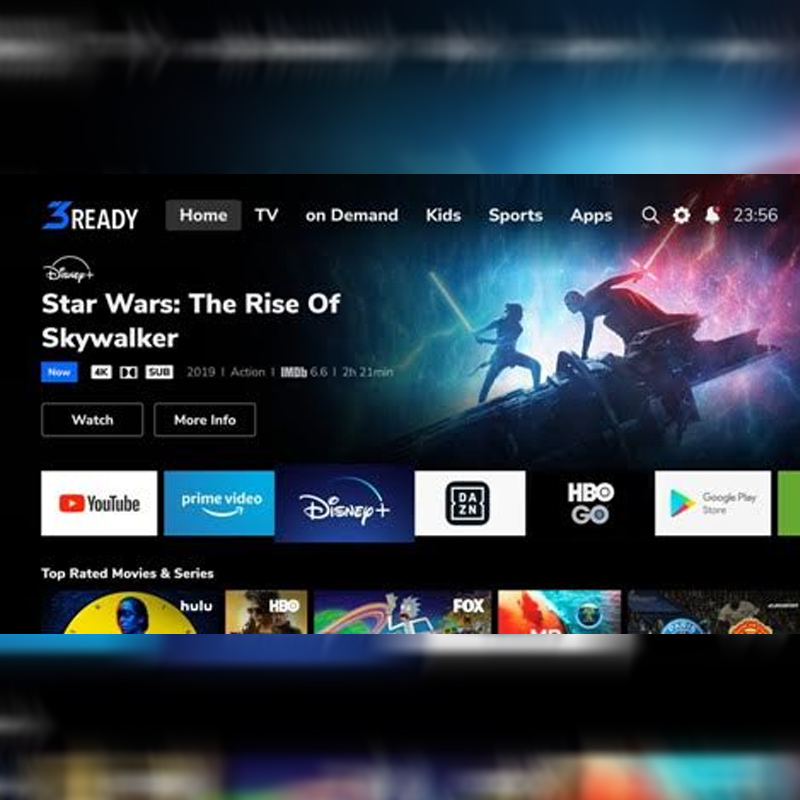
    The Skyworth HP40A STB (with embedded Amlogic chipset) and middleware are now pre-integrated with 3SS’ 3READY Custom Launcher to create a powerful end-to-end android TV solution.

    The partners’ fundamental aims for this pre-integration are to help operators more rapidly and easily secure Netflix certification and to smooth the journey to becoming a super-aggregator.

    Skyworth is a leading partner in the Netflix Scaling Program, which Netflix created to help OEMs (original equipment manufacturer) including STB providers to obtain technical pre-certification. By choosing Netflix-ready hardware, an operator’s Netflix certification can be fast-tracked, and the process of reaching commercial agreement with Netflix can potentially be eased. With these Netflix compliance elements in place early, operators have the opportunity to accelerate the introduction of their new android TV services to the marketplace.

    In parallel, as part of multiple android TV deployments, 3SS’ 3READY Custom Launcher – at the heart of the 3READY product framework, now driving the UX in more than 10 million homes – has successfully received Netflix UI certification.

    “With Skyworth’s and 3SS’ hardware+middleware+launcher pre-certified platform combination, Netflix, the aspiring operator, and ultimately subscribers, can all be confident of a high-quality experience including Netflix viewing,” commented Srithar Bala, head of Video Solutions & Services, Skyworth Digital.

    Furthermore, with 3READY Control Center, the Netflix launch points – namely, the locations within the UX where Netflix is to appear – can be configured to align with the specific terms of the operator’s Netflix agreement. This can further shorten time to market.

    Access to Netflix is one of the pre-eminent drivers behind the growing popularity of the android TV solution among service providers, as is the shift to super-aggregation. As the scale of a super-aggregator’s reach grows, however, particular attention and management is needed to ensure that all subscribers get a seamless experience on an ever-increasing population of devices – an assurance and high standard that Netflix strongly insists on.

    With the Skyworth+3READY-pre-integrated reference hybrid STB hardware platform, operators can get to certification more quickly, and 3SS’ android TV-centric custom launcher is ready for the operator to tailor and brand for their DVB-S, -T, -C, IPTV and/or OTT services. “With certification by Google, Netflix and other content partners all taken care of even before unboxing, operators can get a significant head-start as they plan and launch their Android TV products,” Bala added.

    Skyworth and 3SS are collaborating to deliver a hybrid Android TV project for an as-yet-undisclosed European operator which will launch soon.

    “Through pre-integration, by choosing the Skyworth+3SS platform, service providers can benefit from a proven solution and earlier service launches with minimized technical integration cost and risk,” said 3SS managing director Kai-Christian Borchers. “The service launch process is further accelerated by Netflix and other pre-certifications. The result is that operators can differentiate earlier, and start earning revenues faster, with their next-gen Android TV offerings,” he added.

  • Guest Column: Streamline Set-top-box, CAS specifications and save subscribers hundreds of crores

    Guest Column: Streamline Set-top-box, CAS specifications and save subscribers hundreds of crores

    Broadcast pay-TV in India is based on globally developed standards that enabled the fast and affordable deployment of innovative services, and intense competition. During the Covid2019 crisis, broadcast pay-TV cable and DTH platforms continued to provide consistent quality of service to all subscribers.

    In contrast, over-the-top (OTT) video streaming services required concerted interventions by broadcasters and mobile network operators to reduce video quality, bitrates, and reduce congestion. While Indian regulation of OTT video services has been very light touch, Indian broadcast pay-TV regulation has grown in complexity and cost since DTH services began in 2003. Not only are DTH and cable operators expected to divert time and resources into jumping through ever more convoluted regulatory hoops, but these additional costs would ultimately be borne by subscribers.

    Beyond India, the costs of over-regulation in various sectors have increasingly been recognised and challenged. In India, the rise of broadband internet penetration has provided direct access to new, large, well-funded foreign and local OTT players that are lightly regulated. The result is increased competition, which better serves subscribers and viewers than over-regulation.

    Read more news on TRAI

    Particularly effective measures taken elsewhere to reduce regulatory burdens have been to mandate:

    overall cost-benefit analysis for justification of all new regulations and changes, and

    sunset dates before which all regulations must be reviewed to ensure they are still justified, otherwise they automatically expire.

    Indian regulators would do well to adopt similar measures, both in policy and in practice, and save Indian subscribers hundreds of crores. The capex alone spent to support existing interoperability measures on DTH STBs have exceeded Rs 600 crore.

    TRAI’s bundling and pricing controls on content – both distribution and retail – have been widely critiqued. Also pernicious are its technology regulations – most recently its recommendations on set-top-box interoperability measures (10 April 2020) and mooted changes to the technical compliance framework for Conditional Access Systems (CAS) and Subscriber Management Systems (SMS) (Consultation Paper of 22 April 2020). Both are rooted in decades-old competition concerns, predating the internet age and massive advances in basic and digital literacy.

    The set-top-box (STB) regulations in particular fail to recognise that pay-TV operators are not in the business of providing devices, but of services. To the extent they are not prevented by regulation, broadcast pay-TV operators differentiate their service offerings with unique combinations of content

    and user experience, also VAS, and customer support.

    Read our coverage on set-top boxes

    The level of “interoperability” TRAI’s measures would enable – video and audio from one pay-TV platform to be able to be seen and heard via an STB owned by a competitor – were questionable in 2003, when STBs were relatively costly compared to dishes and installation, and the content and user experiences almost unknown without a service subscription. 

    In 2020, almost anyone can preview videos on the pay-TV providers’ websites, via search engines, or online review sites and make well-informed choices. Pay-TV operators must meet a plethora of regulated quality of service criteria in addition to bundling and pricing criteria. And for those who remain too cautious to commit, STB rental is available from all pay-TV operators.

    Unfortunately, TRAI has not performed a cost-benefit analysis on STB interoperability recently, if at all. Costs of interoperability to be borne by all subscribers are quantifiable in terms of capex and opex for each pay-TV operator platform and delays to other road-mapped innovations, which could bring greater benefit to more subscribers. If there is any benefit of TRAI’s recommended interoperability measures, it has never been quantified, nor even systematically estimated, at least not publicly. The capex alone spent to support existing interoperability measures on DTH STBs has exceeded Rs 600 crores, just for the common interface sockets. The benefit to subscribers and viewers has been zero for this white elephant, that all have paid for and none have benefited from. And at the end-of-life, the extra plastic and metal from these STBs are destined for reprocessing or landfill.

    The choice of USB port-based interoperability makes the TRAI recommendation appear simple. The simplicity of “plug and play” devices to the user hides huge amounts of standardisation and pre-integration work between USB hosts (STBs) and clients (USB dongles). Content and revenue security and subscriber privacy requirements, plus a history of USB malware exploits targeting embedded systems, make for a large development overhead to support TRAI’s recommended measures without compromising security.

    India-unique security requirements also need India-specific standardisation and pre-integration. Costs will again be borne by all existing and future Indian broadcast pay-TV subscribers, for no obvious benefit to any. The existing technical compliance framework for CAS and SMS was meant to ensure minimum content security performance, functionality, and features across platforms and maximum real choice for subscribers, as more content would be made available to each platform complying with this framework.

    Although it has not entirely met its objectives, specific incremental changes to the existing framework are preferable to establishing a new framework. Increased auditing capability is needed – especially more technical expertise – to minimise delays and reduce the number of spurious compliances reported. There is also the need to augment, revise and tighten the security parameters within the framework in line with global developments, to schedule future periodic revisions, and to provide a mechanism for urgent out-of-schedule revisions to address exceptional situations. But there is no need to constitute a brand-new framework from scratch.

    In summary, TRAI’s recently recommended set-top-box interoperability measures and mooted changes to the technical compliance framework for CAS and SMS threaten to disrupt a sector facing increasing external competition from lightly regulated OTT video and fierce internal competition. Costly, resource-diverting, and time-consuming changes to broadcast pay-TV now, due to redundant early 2000’s concerns, should be avoided. In regulating the most dependable, differentiated, and diversely available pay-TV services, take great care, and first, do no harm!

    For further details, please refer to Synamedia’s responses to the relevant TRAI consultations:

    https://www.trai.gov.in/sites/default/files/Synamedia_19122019.pdf and here:

    https://www.trai.gov.in/sites/default/files/Synamedia_04062020.pdf.

    (The author is Synamedia India Sales head Deepak Bhatia. The views are personal and Indiantelevision.com may not subscribe to them.)

  • Synamedia launches new anti-piracy model and new cloud managed service

    Synamedia launches new anti-piracy model and new cloud managed service

    KOLKATA: Synamedia has launched a new intelligence-first security model laser-focused on eradicating streaming pirates’ businesses and protecting legitimate providers’ revenues. This data-led model helps to measure the efficacy and ROI of anti-piracy initiatives. The video software provider has also launched Synamedia VN Cloud, a managed service for its entire video network portfolio.

    The new approach combines digital and human intelligence to zero in on the increasingly sophisticated streaming piracy underworld that is threatening the media industry. It provides unparalleled forensic insights into the minds, motivations and behaviors of pirates, and their infrastructure and business models, for a more powerful, targeted anti-piracy response.

    It is already fueling technology innovations across Synamedia’s security portfolio, helping customers protect revenues, negotiate fair content license terms such as sports rights, and ensure compliance. 

    “Video piracy is becoming an existential threat to the media industry because the barrier to entry is low and the return on investment very high. Eradicating these businesses is made more difficult by the fact that they have sophisticated operations, are well organized, and make extensive use of the latest technologies,” Synamedia security SVP Yael Fainaro said .

    VN Cloud will to offer end-to-end video network functionality on any public, private or hybrid cloud, and breaks new ground by delivering the high availability customers demand on a single platform for both broadcast and OTT.

    VN Cloud gives operations teams the insight, agility and flexibility to effortlessly deploy and manage multiple workflows and deliver outstanding quality of experience on any device, anywhere, with seamless failover, while controlling costs.

    It lowers the barriers to launching new services by allowingservice providers, content owners and broadcasters to quickly test new services anywhere in the world, with support for lab-in-the-cloud, pop-up and disaster recovery events.

    Customers can deploy an OTT service in the cloud using a pay-as-you-use cloud model then, once established, move it on-premise. The Workflow Portal’s dashboards provide transparency about costs for hybrid, on-premise and public cloud, allowing users to easily move workloads to balance OPEX and CAPEX, as well as controlling the cost of public cloud to support disaster recovery.

    Dashboards provide visual representations of each end-to-end media processing workflow, flagging up any problems and changing channel line-ups easily in near real-time using drag and drop. Further improving availability, VN Cloud is the industry's first solution to adopt a single channel fault domain approach, ensuring any issues are isolated to the impacted channel.  

    “Our managed service proposition allows service providers, content owners and broadcasters to reinvent themselves by delivering broadcast quality services with the cost control and flexibility of the cloud. As we designed VN Cloud, we focused on providing total control of complex, hybrid workflows from scene to screen while managing costs and with the insurance policy of cloud-based disaster recovery,” Synamedia video network SVP and GM Julien Signès said.

    VN Cloud combines all the elements of a video network workflow in a cloud-native format using microservices. Its containerized video processing stack means that each function, such as encoding, is fully isolated and managed on a per-channel basis. Workflow support includes: the PowerVu portfolio for secure content distribution, low latency ABR, broadcast, Connect inter-cloud connection and ATSC 3.0.

  • Fastway Transmissions signs up as a key Synamedia Converged Headend customer in India

    Fastway Transmissions signs up as a key Synamedia Converged Headend customer in India

    KOLKATA: Synamedia, the independent video software provider, announced its partnership with the fifth largest multi-system operator in India, Fastway Transmissions. Fastway is the first provider in India to go live with Synamedia’s Converged Headend solution. The deployment will allow Fastway to bring together its video service and IP workflows to deliver a broadcast-quality viewing experience on any screen for its millions of subscribers, managed through Synamedia Video Network Service Manager.

    The Synamedia Converged Headend solution will simplify and optimize Fastway’s video workflows, resulting in cost and operational efficiencies while allowing Fastway to increase the volume of content it delivers over its existing networks. Converged Headend features the industry’s broadest functionality in a single solution including: acquisition and multiplexing, encoding, transcoding, ad insertion, packaging, content protection, origin services, and reliable IP transport.

    Fastway is one of the first large operators in India to transition to a software-centric video processing platform. The  Converged Headend solution will be deployed on premise and is designed to be easily extended to the cloud, or a hybrid environment in the future.

    Fastway will use Synamedia virtualized Digital Content Manager (vDCM)  to boost the monetization of its content investments and accelerate the trial and launch of new channels and services in the future. The operator already uses Synamedia solutions for broadcast, security, IP delivery and STB software.

     Fastway Transmissions Group CEO  Prem Ojha commented, “Deploying a Converged Headend Solution is an important technology investment as we set out our ambitious plans for new services and subscriber growth. This resonates with our strategy to enhance our customer service experience on an ongoing basis and will act as a catalyst for the growth of our video and triple play subscribers. The Synamedia team not only solved our technical challenges, they were able to look several steps ahead to ensure we have the best building blocks in place for the future.”

    “The pace of change in the Indian pay-TV industry is relentless and competition is intense. With Converged Headend, Fastway will benefit from a single workflow for both cable and IP streams , making it possible to quickly adapt to local market needs with new services.  This more streamlined, efficient infrastructure will deliver operational efficiencies, cut costs  and give subscribers a high-quality viewing experience on any screen,” Synamedia APAC and Latin America executive vice president and general manager Sue Couto said.

    Synamedia’s video network portfolio powers premium quality broadcast and broadband video for more than 1,000 operators worldwide and 100 million daily viewers. Its video distribution, processing and delivery services and solutions create compelling live multi-screen experiences, enable software-defined video processing and unify operations. The award-winning portfolio also touts a cloud-ready, converged broadcast and broadband end-to-end ATSC 3.0 offering and low latency solutions for live video. Its virtualized DCM features live transcoding to multiple bit rates and formats, scalable video functions and best-in-class video quality all aimed to deliver infinite entertainment. 

  • DE-CIX India expands  its Internet Exchange points of presence

    DE-CIX India expands its Internet Exchange points of presence

    KOLKATA: The leading carrier and data center neutral Internet Exchange (IX) operator on the Indian sub-continent, DE-CIX India, announced the expansion of its Internet Exchange points of presence (PoPs) at Mumbai, Delhi and Chennai to meet the increased demand in internet usage and bandwidth capacity posed by Covid2019. In addition to its fifth PoP in Mumbai introduced last month, DE-CIX has now deployed new PoPs within STT Telemedia DC's (Tata Communications) in Chennai and Delhi.

    DE-CIX India interconnects around 250 networks and is the only Open-IX certified IX in India connecting the ISPs, Content Delivery Networks, Cloud Companies, OTTs and other network providers, along with educational institutes in the connected networks. Additionally, DE-CIX India has launched its DirectCLOUD service at DE-CIX Mumbai, to enable customers to access the DE-CIX Cloud Exchange and connect to global cloud services, including those provided by Microsoft Azure, Google Cloud, Oracle Cloud, and Amazon Web Services.

    “Interconnection is the key to adoption, acceleration and growth of the Internet in any country. Data centers today, are the warehouses of the digital economy, providing a home not only for the data itself, but also for the platforms and applications that have become so ubiquitous in the modern world. The new PoPs will attract additional clients with low-latency edge requirements and help them cost-effectively extend their reach through access to a global network platform that reaches hundreds of networks around the world. By offering interconnection solutions that are powerful, flexible, and scalable, we can meet the rapidly growing connectivity needs of global clients across all verticals,” DE-CIX India national sales senior vice president Sudhir Kunder says.

    DE-CIX India has now increased its geographical presence with a total of 10 Data Centers in India. With five PoPs in Mumbai, two in Delhi, two in Chennai, and one in Kolkata the firm has largely increased its ability to offer new connectivity options. The IX is now located at Tata Communications in Bangla Sahib and Tata Communications in GK1 in Delhi and, at Bharti Airtel Santhome and Tata Communications in Chennai and Kolkata. Beginning with Web Werks DC 2 in Mumbai it expanded to other locations in the city such as GPX DC1, Netmagic DC5, STT Mumbai (Tata Communications) and Sify.

  • Synamedia introduces Iris – a new addressable advertising solution

    Synamedia introduces Iris – a new addressable advertising solution

    KOLKATA: Independent video software video provider Synamedia introduced Iris, a sleek new addressable advertising solution. Iris will create addressable advertising opportunities for pay-TV and broadcasters as well as OTT and hybrid service providers to unlock new revenue streams. As demand for more targeted TV advertising increases, they can use Iris to help create compelling advertising propositions that reach specific TV audience segments of any size and makeup across all services, devices and screens.

    An end-to-end solution, Iris delivers faster time to value by removing the friction points that characterise piecemeal addressable advertising products. From a single platform, Iris supports unified campaign management, delivery, and measurement to multiple screens across apps and live, linear and catch-up services, overcoming one-way and hybrid broadcast/OTT challenges. This simplifies the execution for service providers and broadcasters, helping them to merchandise their inventory more efficiently while also minimizing operational costs and boosting income.

    Harnessing data from multiple sources, Iris enables sophisticated audience insights and anonymised household, user and device-level profiles that can be checked against an advertiser’s desired characteristics. Combining the most effective advertising screen available with the precision of digital campaigns, Iris provides cross-platform ad measurement to exploit all forms of video inventory in a single campaign. Big brands and new advertisers can reach their target audiences cost effectively without wasting impressions, while consumers enjoy a more relevant viewing experience, and service providers and broadcasters boost income.

    Synamedia has a long track record in the targeted advertising space, having worked with media and digital agencies for over ten years and collaborated with Sky on the development of the AdSmart platform.

    “With Iris, the TV industry can finally combat the erosion of ad revenues to digital platforms and achieve its long-held ambition of generating new income from advanced TV advertising. Our end-to-end solution with its unified campaign management capability makes it easy for customers to drive new revenues from their inventory – even over more challenging one-way and hybrid networks – and offer established and new advertisers an alternative to the increasingly wild west world of online advertising,” Synamedia VP Advanced Advertising and Data Scott Kewley said.