Category: Year Enders

  • Hindi GECs flirted with formats, sensed OTT challenge

    Hindi GECs flirted with formats, sensed OTT challenge

    MUMBAI: When it came to content, OTT platforms captured the zeitgeist of 2018. Premium digital video content was relentlessly rolled out by the likes of Amazon Prime, Netflix, ALT Balaji, Hotstar, Voot and Zee5, keeping the audiences hooked at all times. Naturally, the band of programmers at some of India’s biggest broadcast networks felt the heat as a new wave of content competition hit India. Heads of Hindi GECs pulled out all stops in order to stay ahead of the game and keep their viewers happy. Thankfully for them, the cord-cutting trend, prevalent in several countries, didn’t turn to India. However, the sheer scale and quality of OTT content audiences were exposed to this year should be a cause for worry entertainment channels.

    ‘TV isn’t dying, in fact, both TV and OTT is growing simultaneously,’ was a line often heard this year. That’s perhaps the reason broadcasters remained confident that daily soaps, fiction and non-fiction shows on TV would continue to command viewership numbers.

    The advent OTT players increased the overall demand for content. While Indian broadcasters put out over 100,000 hours of content annually across formats and languages, newer entrants continued to pump in more cash per episode (though for much smaller quantities of content) and tried to snap up the best available talent. 

    The overall cost of content rose by almost two to three per cent of the broadcasters’ top line. With OTT companies refusing to take their foot off the pedal, broadcasters have no choice but to pay up. However, if their bid for quality programming fails to generate higher viewership which can be monetized better, broadcasters may not pursue quality, and stick to current cost metrics.

    As far as content consumption was concerned, regional content too made its mark this year. While Hindi language consumption remains the country’s preferred choice, growth was fastidiously led by regional content. Backing this up with some facts, it was reported that the daily tune-ins on TV by the HSM led to 68.4 per cent, whereas in the South market it led to 78.3 per cent. Simultaneously, the advertisement expenditure in FY18, Hindi GECs declined by nine per cent as compared to an increase of 5.4 per cent in on regional channels. 

    It was also a year of full surprises for the Hindi GECs, especially on the leadership front. Top-notch industry executives decided to call it quits including veteran Colors CEO Raj Nayak who dropped the bombshell of his Viacom18 exit after a distinguished seven-year stint with the media and entertainment conglomerate. Another prominent personality Discovery India and South Asia head Karan Bajaj also called it a day. Industry insiders believe the bespectacled Bajaj timed his exit to perfection, stepping aside when it mattered most. Both of them haven’t hinted at what gigs they are likely to take up next. Another heavyweight – Deepak Rajadhyaksha – who was heading Zee TV, turned to Viacom18 with his mantle being handed over to the broadcaster’s English cluster head Aparna Bhosle.

    The GECs also flirted with formats and played around with show timings in an attempt to infuse life into programming. Here's a quick recap of how some of India's most-loved Hindi GECs tried to stay ahead in a cluttered segment.

    Colors

    Having a stronghold in the mythological and fantasy drama genre, it revived Naagin for season three giving it an 8 pm slot on the weekend. Another supernatural drama Tantra by Swastik Productions was aired on weekdays at 11 pm. Rashmi Sharma Telefilms’ Vish Ya Amrit: Sitaara, a supernatural thriller, was given the weekday 10.30 pm slot.

    Two leading ladies of not just Viacom18, but the entire industry, added more feathers to their caps. Manisha Sharma, who was in charge of Colors, was elevated as the chief content officer – Hindi mass entertainment. She heads both Colors and Rishtey. Kids’ cluster head Nina Jaipuria’s portfolio further expanded to include both kids TV network and Hindi.

    The channel reshuffled its programming line-up post the launch of historical saga Dastaan-E-Mohabbat Salim Anarkali, Monday-Saturday at 8.30 pm, by replacing the drama series Udaan which was shifted to 7 pm slot. Internet Wala Love, which aired at 7 pm was moved to 6.30 pm time band while Savitri Devi College and Hospital, which aired at the 6.30 pm slot was called off.

    After a two year hiatus, Colors came back with the launch of season 8 of reality show India’s Got Talent, to be shown on weekends at 10 pm. The show was planned to replace horror anthology television series, Kaun Hai? That was produced by Contiloe Pictures and was scheduled to air every Friday to Saturday at 10.30 pm. Also, another home-grown reality show Entertainment Ki Raat season 2 was given the weekend 9 pm slot, promoted from its debut season slot of 10.30 pm. The show was replaced with the reality show Rising Star produced by Optimystix Entertainment. Bigg Boss 12 was also launched but with a new time-slot at 9 pm.

    Sony

    Hindi GEC Sony Sab started a new weekend slot titled ‘Sab Ka Weekend Plan’ with two new shows India Ke Mast Kalandar – Atrangi Hain Ye!and Namune. The channel aired the former show every Saturday and Sunday at 8 pm whereas the latter was at 9 pm. The Kapil Sharma Show is all set to make a comeback after a hiatus of more than a year. The channel had stopped airing fresh episodes of the show from September 2017.

    Taking Colors’ Bigg Boss 12 head-on was Sony’s tentpole show Kaun Banega Crorepati (KBC) season 10 at 9 pm. Following that, the channel launched two fictional drama Patiala Babes and Ladies Special post-KBC. The channel pulled the plug on Yeh Pyaar Nahi Toh Kya Hai, which was aired at 9.30 pm, following poor ratings.

    The network also announced that Sony Pictures Network India’s (SPNI) newly launched content production arm Studio NXT will focus on creating premium, high investment content that can also travel outside India. Headed by Sony Entertainment Television (SET) EVP and business head Danish Khan, the content studio began its journey with Kaun Banega Crorepati (KBC) season 10 which was co-produced with Big Synergy.

    The channel is experimenting with new shows and formats in the time slot starting 8.30 pm. The channel aired comedy-drama Main Maike Chali Jaungi, replacing Dus Ka Dum and Zindagi Ke Crossroads. Dus Ka Dum aired on Monday and Tuesday while Zindagi Ke Crossroads aired from Wednesday to Friday.

    Zee

    Zee TV’s primetime offering included Manmohini, produced by LSD Films, every Monday to Friday at 7.30 pm. &TV launched a live singing reality show for kids Love Me India and fantasy show Vikram Betaal ki Rahasya Gaatha. Zee TV launched a new fiction show named Tujse hai Raabta on 3 September, weekdays at 8.30 pm, produced by Full House Media.

    ZEEL elevated Aparna Bhosle as the business head of its flagship Hindi GEC Zee TV. Bhosle headed the premium and FTA GEC cluster. The move comes in the wake of Deepak Rajadhyaksha’s exit from the company. He was the deputy business head at Zee TV. Rajadhyaksha joined Viacom18 as business head of Colors Marathi and Colors Gujarati.

    Zee also took three of its shows abroad for a remake, in collaboration with African countries – Punar Vivah, Dance India Dance and Pavitra Rishta.

    Ending the year 2018 on a high note, &TV opened doors of endless opportunities for makers to experiment with content. Supernatural ruled the roost this year for the channel, progressive concepts and live reality remained at the top of the list. From launching its first live reality show for kids to introducing supernatural in a new style, &TV presented its khaas andaaz with not one but many pieces of content that were rolled out. The channel launched shows like ‘The Unconventional Saas (Perfect Pati)’, ‘Love with supernatural twist (Laal Ishq)’,’ Reliving childhood stories (Vikram Betaal Ki Rahasya Gatha)’, ‘ The mysterious Daayan (Daayan)’, Kids Live singing with ‘Love Me India’ and ‘High Fever… Dance Ka Naya Tevar’.

    Star

    Star India signed a multi-season, multi-year deal with Talpa Media for The Voice franchise, comprising The Voice and The Voice Kids. The new series will be produced by Banijay Asia, a Banijay Group company.

    Star Bharat’s socio-thriller Kaal Bhairav Rahasya returned for a second season featuring new mystery and folklore. Star Bharat launched a mythological show Radha Krishn airing Monday to Friday at 9 pm, replacing political drama Saam Daam Dand Bhed. The show was produced by Swastik Productions who have had several successes in the genre including Shani, Mahakali, and Porus. It also announced the launch of a new finite fiction show that narrated the story of firebrand freedom fighter Chandrashekar Azad in about 110 episodes, produced by Anirudh Pathak.

    The main GEC Star Plus launched a new show Karn Sangini at 7 pm. The show replaced channel’s reality show Sabse Smart Kaun. With Karn Sangini, the channel is dealing with the new genre of mytho-romance. Produced by Shashi and Sumeet Mittal, the show narrated the never-seen-before tale of a royal princess Uruvi who chose her love and stood by it against all odds.

    Discovery Jeet

    Despite heavy promotions in its launch stage, Discovery Jeet didn’t quite manage to grasp the pulse of the audience.

    Jeet entered the Hindi GEC sweepstakes on 12 February with five hours of daily programmes, out of which three hours were original programming, with content available in Hindi, Tamil, and Telugu. The channel launched with a distribution blitzkrieg to more than 100 million households and signed up Netflix as the exclusive global OTT partner.

    Despite the network’s best effort, the channel failed to rate. Initially thought of a challenger to the existing GEC order, Jeet fizzled out without much of a fight.

    According to Broadcast Audience Research Council data week 9, the channel garnered 6096 impressions (000s) in the 7 pm to 11 pm time slot, while it secured 15908 impressions (000s) for the whole day’s viewership. Currently, the channel airs syndicates content dubbed in Hindi.

    Overall, almost all channels heavily swapped shows for one another in order to keep audiences steady and growing. Unlike earlier years, when channels relied on primetime shows for years, times are changing and audiences are picky and broadcasters realise that.
  • A year when OTT onward march & TRAI tariff issue hogged limelight

    A year when OTT onward march & TRAI tariff issue hogged limelight

    MUMBAI: 2018 could have been easily dubbed as the Indian year digital or OTT, with its chaotic growth continuing and multi-million dollars being poured into programming by global and local players, however, the new tariff and regulatory regime for the broadcast and cable sector occupied as much mind space.

    Though these are early days for a sure shot business model for digital space emerging as players continue to experiment with AVOD, SVOD and combination of several other models, there’s no denying OTT has more than a foot inside the door in India.  

    According to a report by market research firm Media Partners Asia, online video revenue, comprising net ad spend and subscription fees, will grow at an 18 per cent CAGR across Asia Pacific between 2018 and 2023, climbing from $21 billion 2018 to $48 billion by 2023. While China will account for the lion’s share of industry value, with more than 60 per cent of Asia Pacific online video revenue and more than 75 per cent of direct-to-consumer SVOD subs by 2023, other big markets by revenue would include India, Japan, Australia, Korea and Taiwan.

    So, though traditional pay TV is not dead yet and will continue to grow in India as the saturation point is still far from over (BARC India estimates there are about 197 million TV homes in India over 100 million still to be covered), traditional media players have realised OTT and other forms of digital delivery of video — professional or user generated — will continue to grow and put pressures on ARPUs and other numbers as more Indians take to smartphones and devises with broadband infrastructure slowly improving and cost of data plummeting in the short term.

    The inroads into India in 2018 made by Chinese mobile companies have been impressive while raising fears of tracking and data misuse too.

    “With 160 million shipments of smartphones in 2019, apart from being the only market to grow in this sector, India will also be the most potential market for global content creators,” Zeel MD Punit Goenka tweeted last week. This observation is testimony to traditional media players waking up to the competition from OTT platforms for eyeballs.

    The growth of online platforms also means the continued search for both original and library content too will grow as it did in 2018. Not only global players like Netflix and Amazon announced big-budget investment in original content starring leading Hindi film stars like Shah Rukh Khan and Saif Ali Khan, local companies too have upped the ante realising the potential of the digital space. Star India’s digital arm Hotstar claimed 100 million viewers for the IPL cricket and ZEE5 has come out with some refreshing non-fictional programming.

    If online video distribution is growing in India, so has the demand for content regulation. Even as Indian policy-makers struggle to understand the business model(s) for digital players, the cry for regulation to suit Indian sensibilities (or lack of it) too has increased. Netflix Indian original Sacred Games is still fighting out a legal case, while informal warnings have gone to other Indian OTT platform too to tone down edgy programming being streamed.

    Bouncing amongst several government organisations (MIB, TRAI and Meity), the issue of online content regulation was a hotly debated topic in India with a large section of the industry pushing for self-regulation like those prevailing for TV content.

    If not in 2018, some sort of content regulation for online video will definitely come. The only thing that matters is whether in 2018 or it will be post general election in 2019.

    The action in the online video segment and its delivery mode was catalysed by the arrival of Reliance Jio that has expanded from just being a player to becoming a behemoth in a short period of time, handing out services at comparatively low prices. The rollout of Jio Giga fibre network in 2018 has sharply woken up legacy distribution players, including telcos who went on a partnership spree to source content.   

    And, if the regulators in India struggled with the issue of online  content, TRAI’s new tariff regime, proposed first quarter 2017, continued to cast a shadow in 2018 with confusion relating to some aspects (like a 15 per cent cap on discounts to consumers for TV channels) lingering on like a unfinished record playing out discordant notes. While TRAI has sought clarification from the Supreme Court on the discount issue (the next hearing is sometimes in January 2019), it has simultaneously cracked the whip on broadcasters and distribution platforms to fall in line with its new tariff regime by end of the present year.

    The formulation of a new telecom policy or the National Digital Communication Policy 2018 could also be said to be a milestone as India stopped just short of creating a mega communications regulator overseeing the realms of TV broadcast, online and telecoms, depending on having increased synergies amongst these segments and their regulatory regimes.

    Increased mergers & acquisitions seen in 2018 would continue consolidating the market and players. But such activities also raised doubts on possible creation of monopolies. Disney takeover of most of the media businesses of Rupert Murdoch’s 21st Century Fox, including Asia biggie Star, played out in India too even as Mukesh Ambani’s Reliance Industries and its various arms went on a shopping spree buying sizable stakes in content makers (Balaji Telefilms, Eros, for example), distribution platforms (Hathway, DEN Networks) and other media assets. That Subhash Chandra-founded Zee too is looking for an investor spiced up the mergers and acquisitions space.

    Channels continued to be launched in 2018 with almost all networks rolling out new offerings in regional languages – a trend which began over 2016 and 2017. Colors Tamil, Sony Marathi, Star Sports 3, Zee Keralam were unfurled for viewers by the major players. What's keeping broadcasters buoyant is the annual expansion in advertising continues unabated at about nine to 10 per cent annually. 

    While legacy media players (like cable TV, MSOs/LCOs, DTH) in India have started a fight for survival and improved bottomlines in the aftermath of online’s growth, the #MeToo effect in 2018 did not leave the media and entertainment untouched.

    Though #MeToo in 2018 more impacted the advertising and film segments with some big names becoming casualties, the ripple effect in the broadcast sector was low. But the movement has opened up a can of worms in the Indian media, entertainment and advertising segments.

    The industry is on tenterhooks in an election year, wondering whether the BJP or NDA will make a comeback in April-May 2019 or yield to the Congress. Will the policy regime continue or will there be changes? These are questions that seem to be creasing many a brow. 

    But on the whole, will the trends continue in 2019? Of course, yes as it too promises to be quite a roller-coaster.

  • The year M&A changed the face of the media and entertainment industry

    The year M&A changed the face of the media and entertainment industry

    MUMBAI: The emergence of numerous streaming platforms and convergence between technology, media, and telecom companies shook the core of the media and entertainment business globally. Giant tech and telco players, on the back of their direct customer reach, started taking content creation and distribution a lot more seriously. Rapid change in content consumption pressurised traditional players to invest more in technology and focus more on the B2C model. The ongoing flux brought the industry on the brink of instability, leading to consolidation in the form of mergers and acquisitions.

    In the last couple of years, the nature of competition in the global ecosystem has witnessed a gradual swing. Organisations like Netflix, Amazon Prime and Google have brought a structural shift forcing traditional players to rethink their approach to content and distribution. Legacy brands upped the ante to attract and retain more consumers even through cross-border deals. PwC India partner Raman Kalra points that everybody in this world of media disruption is trying to be relevant in reach and scale, the two critical factors that are driving deals. To corroborate his thesis, he highlights the AT&T-Time Warner deal where the former, with a huge reach, wanted to scale up its content play with the collaboration.

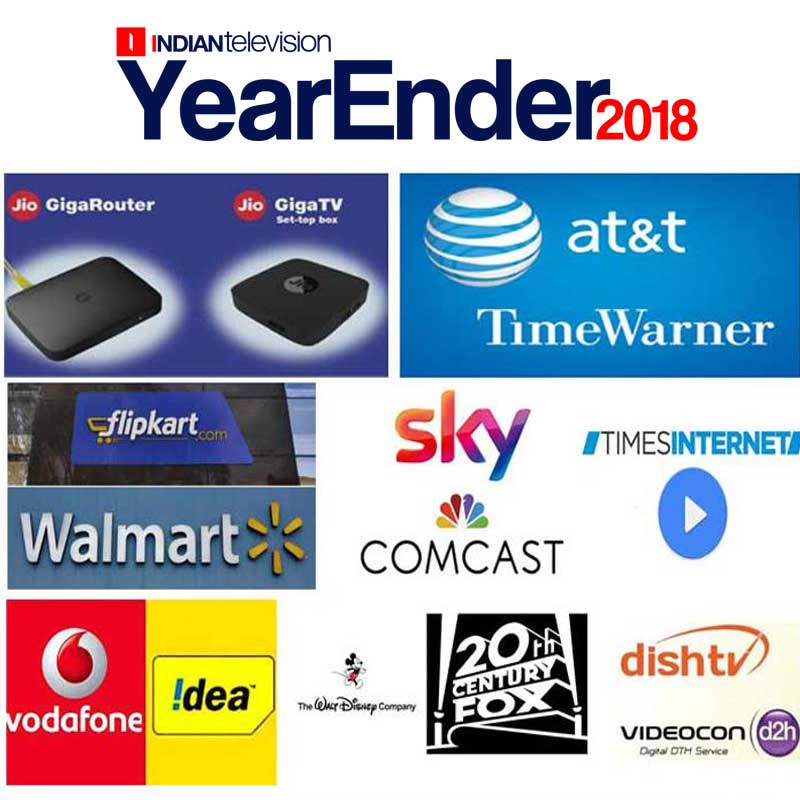
    Closer to home, billionaire Mukesh Ambani’s RIL rode the TMT convergence wave better than most. India’s richest man started the year with a bang, intensifying TV18’s stake to 51 per cent by acquiring 1 per cent of Viacom18’s equity from Viacom Inc. for a cash consideration of $20 million. The RIL-owned Jio Infocomm also acquired a controlling stake in two large MSOs – DEN and Hathway – building ammunition for its FTTH’s foray. That’s not all, RIL also pocketed a small but significant five per cent stake in Eros International.

    E&Y media and entertainment advisory services partner Ashish Pherwani expects more deals to materialise in 2019.

    “Especially technology-driven deals because so many changes are happening in that space, and consolidation, led by inbound investments. There are three types of deal. One type of deal is happening in order to build efficiency and scale in the business, led by cost pressures. Another type of deal is around relevance and market share – to get a bigger slice of the market to monetise a larger base of consumers.  The third type of deal which is happening is basically technology driven – for access to technology that could drive competitive advantage in the digital future. Hence, the three reasons market share, efficiency, technology are driving the deals,” he adds.

    There were other interesting deals struck through the year that are likely to reshape the media and entertainment business going forward.

    Birth of the world’s second largest DTH company

    The Indian market wasn’t exempted from the global merger frenzy. The coming together of two large DTH operators – Dish TV India and Videocon d2h – was finally concluded this year, creating the largest DTH service provider in the country with a subscriber base of about 29 million. Apart from leveraging their individual strengths, it was expected that the combined entity would benefit from economies of scale. One of the biggest attractions for Dish TV as the acquirer was Videocon’s significantly higher average revenue per user (ARPU). Significantly, the combined entity’s ARPU was Rs 207 in the second quarter as opposed to Dish TV’s standalone ARPU of Rs 144 pre-merger. The deal also helped Dish TV position itself better when it came to negotiating with broadcasters.

    Decks cleared for FTTH warfare

    From formally launching FTTH service Jio GigaFiber to acquiring majority stakes in two large MSOs to speed up the rollout, the Mukesh Ambani-led Reliance Jio was definitely the centre of attention in 2018. Reliance Industries Ltd (RIL) made an investment of Rs 2,290 crore for 66 per cent stake in Den and Rs 2,940 crore for 51.3 per cent stake in Hathway. It will save RIL the cost of reaching out to customers as well as making the last mile connectivity easier in its ambitious bid of seizing control over India’s wired broadband business. With the launch of its telecom service, RIL gave rise to what many call ‘digital democratisation’. As the Jio juggernaut marked its entry into India’s multi-billion-dollar cable TV and DTH businesses, traditional players eyed the development with a healthy mix of scepticism and optimism.

    Rivals joined hands

    The Indian telecom sector this year saw the marriage of two giant companies, creating the country’s largest telecom company. In the month of August, Vodafone India and Idea Cellular completed the merger after getting approval from National Company Law Tribunal (NCLT). The consolidation of India’s telecom sector was a direct result of Jio’s relentless pricing war. Post the Idea-Vodafone deal, India’s telco business now comprises of just three players. Analysts expect the combined entity to yield better coverage than before as it would have access to a more robust ecosystem of cellular towers. COAI also believes that as competitive pressures drive consolidation, customers and the industry stand to benefit from the greater stability and better networks which will emerge. Surprisingly, a few years ago, the Indian telco sector had 13 operators.

    Bansals became billionaires

    Walmart gained a strong foothold in India’s this year as it completed its much-talked-about $16 billion acquisition of the country’s largest e-commerce company Flipkart. Poster boys of India’s start-up community Sachin and Binny Bansal became billionaires in a big win for Indian talent and home-grown businesses. Despite protests from traders across the country, as the deal could potentially harm their business, the Competition Commission of India (CCI)’s green signal came earlier this year. The biggest e-commerce deal globally bolstered Walmart’s repertoire in its war with Amazon internationally. With India being one of the most attractive retail markets in the world, a strong play here is bound to further boost the American behemoth in a rapidly changing environment.

    Times Group joined the streaming sweepstakes

    With almost major broadcasters and media companies trying to grab a slice of the hottest piece of the M&E business – OTT, the Times Group too jumped on the bandwagon. To get a stronger foothold in the space, Times Internet invested over Rs 1,000 crore to acquire a majority stake in video playback app MX Player. According to media reports, the company will introduce a streaming service within the app. The large cross-border deal which surprised the industry will definitely help Times Internet in the OTT race thanks to the huge base and popularity of MX Player in south Asian countries. With over 30 OTT players vying for consumers’ attention in India, the game has just begun with enough opportunities for new platforms. Earlier in the year, MX Player content head Gautam Talwar had told Indiantelevision.com that like many other OTT platforms, MX Player too wants to tap into the millennial audience. It wants to cater to users with 50,000 to 100,000 hours of premium curated licensed content along with a high focus on originals, he further added. 

    The telco takeover

    Giant wireless carrier and telco AT&T’s acquisition of content powerhouse Time Warner is just one example of how the lines between distribution companies and content creators are blurring. With the $85 billion deal, the telco gained ready access to the content pool of CNN, HBO, and Warner Bros.

    “Under the terms of the merger, Time Warner Inc shareholders received 1.437 shares of AT&T common stock, in addition to $53.75 in cash, per share of Time Warner Inc.1 As a result, AT&T issued 1,185M shares of common stock and paid $42.5B in cash,” said AT&T providing the financial details of the deal.

    Though the deal was first announced in 2016, it had to negotiate past several subsequent legal hurdles. The Donald Trump-led US Department of Justice (DOJ) even filed a lawsuit against AT&T and Time Warner to block the proposed merger. Following a six week trial, a US district court approved the deal without any conditions on 12 June and also urged the government to not seek any stay. The main argument of the US administration was that the merger would hand over too much power to AT&T, making the market less competitive.

    A once-in-a-lifetime deal

    Another blockbuster deal that came through this year was the $71 billion acquisition of 21st Century Fox assets by Disney. After a long and sustained bidding war with Comcast, the Mouse House got its hands on much of the Murdoch empire. “Combining the 21CF businesses with Disney and establishing new ‘Fox’ will unlock significant value for our shareholders,” 21st Century Fox executive chairman Rupert Murdoch said. The shareholders of both the companies approved the deal immediately, with foreign approvals and regulatory reviews now the final procedural hurdle.

    Disney is now in pole position to take on streaming giants like Amazon and Netflix with its OTT Disney+. The company has also already indicated its desire to stop licensing content to Netflix by ending the deal in favour of its own B2C service. Moreover, Disney now has majority control of Hulu, Endemol Shine Group and Star India, making it the most powerful content owner in the world. The reaction to the growth of OTT services has clearly shown that joining forces with rivals and competitors is not unacceptable anymore to survive in the market.

    Second time lucky

    After a failed attempt to buy 21st Century Fox, US cable giant Comcast won the bid for European entertainment biggie Sky. The former sealed the deal for a controlling stake in the British broadcaster with a winning bid of $40 billion. Analysts said that Comcast and Sky would become the biggest private sector provider of pay TV in the world with 52 million customers. Given the vast reach and growing customer base of Sky in Europe, Comcast took the step to expand its international business with it losing ground in the domestic market. This deal was a direct effect of cord-cutting as Netflix’s growth in the US has posed a major threat to the likes of Comcast. According to an analysis from Ampere, post the media mega-mergers of Comcast/Sky and Disney/Fox, two in every 10 dollars spent on content worldwide will now be spent by these two entities.

    The merger madness from 2018 is likely to continue in 2019, as corroborated by experts we spoke to. Not only would it be interesting to track which companies opt for consolidation, but 2019 will also give us a sense of how the deals from 2018 take shape and play out.

  • Media and entertainment industry: hindsight 2018, foresight 2019

    Media and entertainment industry: hindsight 2018, foresight 2019

    MUMBAI: The Indian media and entertainment industry continued to be robust in 2018, aided by the domestic consumption story remaining strong, as well as the impact of one-time events such as demonetisation and GST progressively fading away. The sharp increase in digital access and consumption, with continued investments by telecom operators on 4G and content, was a major growth driver in the sector. Digital video has seen an explosion in terms of consumption, with 250 million online video viewers out of 450 million broadband users in FY18, and platforms already looking at adding the next 250-300 million online video viewers in the next three to four years. However, despite the rapid growth of digital media, India remains one of the unique markets in the world where traditional media continues to grow.

    TMT Convergence – the rise of ecosystems

    The media and entertainment industry in India started witnessing a structural shift in FY18 with convergence across telecom, media and technology (TMT) companies beginning to take shape. While the telecom and technology companies are building competencies to offer content directly to consumers through acquisitions and partnerships, traditional broadcasters and media companies have started building platforms to reach the end consumers directly. One of the recent examples in this space includes the acquisition of two traditional cable companies by a major telecom player. 

    In addition the competition, the industry has also been witnessing collaboration within the TMT ecosystem. Effective bundling of content by telecom players has ensured that the distribution ceases to be a challenge, allowing standalone content players to focus heavily on original content. 

    The advent of 4G and the rise of TMT ecosystems has resulted in the surge in online video consumption with the number of video and entertainment app downloads witnessing a 5x increase from September 2016 to June 2018 and the data usage on these apps increasing by 25x during the same period.

    Despite the industry seeing rapid growth in the consumption of digital media, monetization has lagged behind till now, with AVOD models still dominant and SVOD not seeing significant traction. Introduction of third-party digital measurement, compelling content across languages and an effective micropayments infrastructure are factors which could help monetization in the near future.

    The growing emphasis on rural and regional markets

    With the viewership of regional language (non-Hindi and non-English) content on television close to 40-45 per cent of the overall consumption, the industry is increasingly looking at rural and regional language markets as the key to success. Additionally, while the rural internet penetration stands at less than 20 per cent (as of June 2018), it presents a considerable upside to organizations who have already started developing local language digital content. 

    Key focus areas for the regional and rural markets in the past year have included – continued digitization across phase 3 and 4, increased focus of broadcasters through the launch of language sports channels and adaption of popular reality shows into local languages, inclusion of rural into measurement metrics through BARC and a focus on digital regional content. 

    Data Analytics – moving from ‘good to have’ to ‘must have’

    Increasing digital consumption is resulting in the availability of large consumer data sets which the industry is trying to collect, integrate, analyze and derive value from. Organizations across the value chain are investing heavily in data analytics around areas such as content creation, customer acquisition, pricing, distribution, and content management.

    Implementation of the TRAI tariff order – a game changer

    With TRAI’s tariff order getting the green light from the Hon’ble Supreme Court (effective 29 December 2018), broadcasters have started to publish Reference Interconnect Offers (RIO) and MRPs of their individual channels. The tariff order is expected to bring in the much-needed transparency ensuring equitable distribution of revenue across the players in the value chain. 

    However, the pricing strategies are at an early stage with some leading broadcasters having priced their flagship channels closer to the cap of INR 19 while some of the niche channel broadcasters are seeing a reduction in MRPs and bouquet prices. Further, the outcome of the ongoing litigation over the 15 per cent discount condition on bouquets may also fundamentally impact the strategies of the stakeholders. With only a few days to go for the implementation deadline, consumer education is expected to be a major challenge for distributors. 

    Looking ahead, the media and entertainment sector is expected to continue seeing growth on the back of growing digital access and consumption, strong domestic (particularly rural) demand supported by GDP growth and growing penetration into non-urban and regional user base across media sectors.

    The author is partner and head (media and entertainment) for KPMG in India

  • 2017’s Top India TV industry leaders – Part I

    2017’s Top India TV industry leaders – Part I

    MUMBAI: The year 2017 threw up myriad conundrums and dilemmas for the men and women who are the showrunners of India’s media and entertainment (M&E) sector, which is expected to grow at a compound annual growth rate (CAGR) of 13.9 per cent, to reach USD 37.55 billion by 2021 from USD 19.59 billion in 2016, outshining the global average of 4.2 per cent.

    It was a rocky year, one during which everyone’s mettle was tested. First, there were the aftereffects of demonetisation. If that wasn’t enough, the Goods and Services Tax was unleashed in the second half of 2017. This sent everyone into a tizzy. Business targets went awry as executives grappled with the changes they had to deal with. Net results: industry growth numbers dipped. Despite this, the resilience of the industry and media leaders was never in question.

    Like in the past, we decided to list down—not in any particular order—the top 20 senior leaders from the television industry who, we believe, made noteworthy moves in 2017.  Of course almost every professional in the business deserves to be lauded in these rapidly mind-numbing-confusing-as-hell changing times—for even just hanging in there.  Forget about doing well. However, a list has to be selective and we took upon ourselves to do so. We hope you will appreciate our initiative. Read on for the first installment in our year-ender series featuring six of India’s top TV industry leaders and their achievements in 2017.

    public://Mukesh-Ambani1.jpg

    Mukesh D Ambani

    Disruption. That’s what the D in his full name stands for, apart from his entrepreneurial father’s name Dhirubhai. And clearly that’s what the chairman of Reliance Industries did in 2017. He shook old established players in the telecom sector by giving away wireless data access for free through Reliance Jio–a process he started just as 2016 was ending–quickly adding more than 100 million subscribers.

    The old guard yelped, blocked calls to their networks, but he plodded on through the year, fought them out in courts, and had his way. In the process, he forced them to rework their business plans and models.

    The entry of Jio has forever changed the way the telecom industry prices services for customers. The cheap data has also changed the way Indian viewers are consuming their video content.  Probably, forever.

    Since the launch of Jio more than 200 crore hours of video and around 10 GB data per capita per user per month are being consumed every month by just Jio subscribers. The number for the 375 odd million internet users will be much higher than that. Apart from wireless delivery of video, Ambani also has plans for distribution by fibre to the home (FTTH). If leaked pricing plans are to be believed, he is likely to totally upset the economics of the cable TV ecosystem, too.

     Jio has also invested in content companies such as Alt Balaji, partnered with Hotstar, and appointed Siddharth Roy Kapur Films to curate content for its VOD services. And Ambani already owns close to 38 TV channels under the Network18 group, and has a joint venture with Viacom that gives it a clutch of channels amongst which figures the leading Hindi GEC Colors and other entertainment channels in many languages. Ambani has more disruption plans up his sleeves. At the Viacom18 tenth anniversary celebrations in Mumbai he said he has not paid attention to the video content business under that group company. But he added that the teams there were going to see a greater involvement from his side. That should give a lot many in the TV business sleepless nights.

    public://Uday_Shankar.jpg

    Uday Shankar

    This journo turned media CEO clearly stands head and shoulders above almost every TV and media industry executive in the country. Over the years, his bold, brazen and, at times, out of the box moves have seen what was once a smallish TV network expand into the leader in the media and entertainment landscape—of course, the foundation had been laid some his predecessors and the promoters, the Murdoch family, gave ample support to this ‘jewel’ in the crown of the parent company that’s now known as 21st Century Fox and is seeking regulatory approvals in the US to merge with Disney. 2017 was no different for Uday.

    The year saw Uday getting appointed as the Asia head of Fox – of which Star India is an offshoot. But before that he betted big by coughing up USD 2.55 billion on sewing up the all-media rights for the world’s top cricket property – the Indian Premier League. Many have scoffed at the audacious price he has been willing to pay for that property; something which they did when Paul Aileo and Peter Chernin picked him to run Star India around a decade ago after Peter Mukerjea’s departure.

    But Uday proved the nay-sayers wrong in every way.  He is likely to do it again. And again. Under Uday’s leadership, the India business has firmly established itself as a world-class asset with durable businesses across entertainment, sports, satellite distribution and OTT. Now he has set his eyes to do the same with Fox Asia.

    public://Jawahar_Goel.jpg

     Jawahar Goel

    The third of the four Goel brothers who nourished Essel Group (Zee and Dish TV’s parent), along with the eldest sibling Subhash Chandra, Jawahar Goel, or JG as he’s popularly known as in the industry, has always been a street fighter—and a smart one at that. Historic boardroom battles in New Delhi’s Lawrence Road-based Essel House in the 1990s, notwithstanding (Zee had three JVs with Rupert Murdoch’s Star TV then), JG is regarded as a go-to-man in the industry by most people because of his understanding of the complexities and nuances of the various segments of the media industry. A tech-savvy person, his tablet is the holder of many secrets and strategies.

    2017 saw him getting into the limelight if, for a bit, in stops and starts. In late 2016, he announced what seemed like a mother of a merger with rival Videocon d2h–the process of regulatory clearances for the same took up most of 2017. Everyone expected the going to be smooth and the final clearance came from the ministry of information and broadcasting at close to the end of the year. And then came the announcement in the last week of December 2017 that the merger was being delayed because of technical glitches. And those glitches became clear in early 2018: JG had instructed his investment bankers and lawyers to relook the deal in the light of the fact that the Videocon group was defaulting on loans and whether any action by the government or financial institutions would have an impact on the valuation of Videocon d2h. The market has interpreted this to mean that JG is back at his best: he is striking a further hard bargain or that he has decided to not do it all.

    JG also set the cat among the pigeons in the year by alleging in letters to the TRAI, IBF and the MIB that if the rights of the IPL were awarded to Star India by the BCCI it would tantamount to a monopoly. Nobody heeded him and the rights still went to Star India. That still did not stop JG: he then appealed to the courts that Star’s pay TV service Life OK should not be allowed to go FTA as Star Bharat. Once again, the courts did not agree with him.

    2018 will be an interesting period for him. He will have to come clean on whether Dish TV is going ahead with its merger with Videocon d2h or not.  And if not then what is the course, he and his CEO—a top notch professional who ran Hero Honda—Anil Dua are going to do with the firm going forward. It’s over to the man.

    public://Arnab-goswami2.jpg

    Arnab Goswami

    You can hate him, you can love him, but you just can’t ignore him—no matter how one tries doing the last. Republic TV—Arnab’s new baby—before its debut whipped up a political storm with BJP politician Subramaniam Swamy questioning use of the word `republic’ for a commercial venture and his former employers Times TV Network dragging him to court over who owned the copyright over the phrase ‘the nation wants to know.’

    But Arnab loves a slugfest; he got into a public brawl with Times TV on ratings, distribution practices with the latter taking him to court. For a moment it looked like the News Broadcasters Association and even the ratings body had got polarized with those for and against Republic or those for Times TV. So much so that Arnab called it names. But finally sense prevailed as the dust settled and Republic took up membership of the association.

    Republic TV continued to be a hot topic of discussion throughout 2017 with its line of editorial stand and shows, which some critics dubbed as absolutely partisan and non-journalistic. However, despite widespread criticisms Republic TV not only managed to lead the ratings game amongst the TV news channels, but also succeeded in dividing the news fraternity at one time over audience measurement numbers.

    That it continues to lead a life on the edge of ethics and non-ethics — and thrive — speaks volume of the Arnab charm and his brand of opinionated journalism. With Republic TV expanding into VR programming and also spreading wings outside Indian shores ( it debuted in the Middle East last year), 2018 would be an interesting period of evolution of this news venture backed by some of the staunchest supporters of  PM Modi and his government.

    public://Smriti_Irani.jpg

    Smriti Irani

    For many years, Smriti Irani along with Ekta Kapoor and Star India contributed to the rise and rise of Indian television thanks to the hugely popular Kyuunki Saas Ki Kabhi Bahu Thi, a series in which Smriti played the role of a dutiful Indian daughter in law, who had sanskaar yet was willing to stand up for herself when she was wronged. 

    Now, 17 years later, Smriti sits over the entire broadcast sector as India’s TV content regulator as  the minister of information and broadcasting, a position none of the executives or professionals in Indian television even envisaged she would one day hold.

    Smriti acted quickly following her appointment: she put a halt to the process of e-auctions of DD’s free-to-air direct-to-home platform DD FreeDish.  She even stopped the privatisation of time slots on national broadcaster DD National and even said not yet to two productions (one by Gajendra Singh and the other by Balaji Telefilms), which had got the go ahead. That did not augur well for at least Singh as it allegedly caused him grievous losses.

    Then, under her watch, her ministry has been demanding that the world’s most valued cricket league the IPL is of national import and that Star India needs to share its feed with pubcaster DD, something which the Fox group company sees as not fair. Additionally, the ministry has also raised the fees for live uplinking—a move which many see as targeted at making things dearer for Star India as it cover test cricket in six languages in 2018.

    Smriti also left her stamp on this year’s IFFI, which was probably the most glamorous in its history with A-list Bollywood stars winging it to Goa. Her ministry lifted the bar for the festival in terms of scale and quality.

    She also clamped down on steamy condom commercials, which were flooding channels on TV channels during the day. Broadcasters were ordered to telecast such ads only between 10 pm and 6 am.

    public://Shashi Shekhar Vempati.jpg

    Shashi Shekhar Vempati

    Shashi Shekhar Vempati has quite a few creds to his name. One of them being that he is youngest executive to be the CEO of pubcaster Prasar Bharati and the other being that he is the first private sector manager called on to run the behemoth. And 2017 put all his managerial skill sets to the test.

    When he joined, there were plans already in place to grow DD Free Dish, to study if there was opportunity in the kids’ space for it and check out if a gasping DD National could be given fresh oxygen and survive the hectic competition in general entertainment television.

    Shashi slammed the brakes on all growth plans, heeding to the orders of the powers that be (read his new I&B boss Smriti Irani). Under his watch, the e-auctions of DD Free Dish, the selling of slots to private producers were called off. He also told DD director general Supriya Sahu to dive deeper into DD Kids and not rush into it. And he spent a large part of the year studying what DD was all about and what he could do and not do at the organisation. 

    This apart, Shashi has been focusing his energy on two fronts: one on sports and the second on DD’s News outreach and ensuring that the pubcaster relays the right messaging of a nation, which is being watched by the world.  India is predicted to become a global power— one of the most important consuming countries globally in the not, too, distant future.

    Most people saw the Supreme Court’s endorsement of the Delhi High Court verdict, which disallowed Doordarshan or DD from sharing the live feed of cricket matches of ESPN and Star India with cable operators as a setback. But not the new kid on the block; Shashi saw it as an opportunity.

    During an interview with www.indiantelevision.com, Vempati said that the decision forced away complacency at the pubcaster where earlier many changes and additions were either being implemented either too slowly or not at all. Prasar Bharati now had a reason to make DD Sports a go to destination for viewers and would help in promoting DD Free Dish and DD terrestrial to larger audiences across many more cities than the 19 in which DD’s terrestrial signals are available, and to switch DD Free Dish to MPEG-4.

    Shashi said that the verdict has created an avenue for making DD Sports the place for cricket. Earlier, cricket and other sports were being aired on DD National. Now they would be aired on DD Sports. The court’s verdicts’ would prevent cable operators from pushing their own ads while blanking out DD National signals during matches. In future, through DD Sports, there would be a separate feed for cricket and there would be no need to blank out an important channel like DD National.

     Shashi will be watched through the year in 2018. He has plans to harness new technologies such as in-built digital tuners in some television models, DVB through dongles and mobiles and plugging into hotspots that are DVB ready. He feels that DTT is a new viewership base and is a new way for advertisers to connect with viewers.

  • Guest Column: Tech trends & their ability to change the game in 2018

    Guest Column: Tech trends & their ability to change the game in 2018

    Whether you’re a fan of technology or merely sifting through the massive puddle of everyday innovations, you can’t help but wonder at the developments that lie in the future. The world we live in has changed from “is it possible” to “how better can it get” with smartphones and technology changing the way consumers purchase and utilise services.

    Although several e-commerce companies were successful in coping up with the changes in tech trends in 2017, it’s now time to look ahead and strategise to tackle the upcoming challenges of 2018.

    Here are some of the key trends in the e-commerce and technology space that might be a game changer in 2018:

    Cryptocurrencies and blockchain

    The use of cryptography in currencies to create alternative digital assets is the latest trend everyone is talking about and it would be interesting to see how it changes the scenario of asset development in 2018. Bitcoin, being the most notable crypto currency, has become a global phenomenon but at the same time a lot of people are still trying to understand its impact better. 2018 could focus on the creation of the next level of software and products based on the concept of blockchain across various industries, including cybersecurity, healthcare, financial services and more for a larger impact across the globe.

    Interactive content

    In 2018, too, brands need to continue to dive into creative storytelling to drive conversions and differentiate. With Facebook’s recent announcement of prioritising friends over publishers, brands are more likely to adopt interesting content strategies that drive shareability to stay competitive. While original content is the key, curated content in the forms of recommendations, reviews and expert opinions along with outstanding video content will make the audience come back.

    Improved and better use of artificial intelligence (AI)

    In 2018, use of machine learning and artificial intelligence is expected to broaden horizons and move ahead of just automating our daily activities. The use of AI for personal interaction, self-perception and brain simulation and understanding and predicting consumer behaviour better could be one of the biggest trends of 2018. It would be interesting to see how many leading digital brands leverage the power of machine learning to unlock its potential.

    Voice search and personalisation

    It has been reported that approximately 40 per cent of millennials have used a voice assistant prior to making a purchase. Furthermore, with precise utilisation of the voice search feature with developed preference for local languages and accents, consumers and ecommerce retailers both are bound to reap its benefits this year. The well-informed user of 2018 need not be taught about what is right and what is wrong. The changing trends rather induce the brands to focus on personalised experiences instead. Helping the users to do the same things in a better manner and easing the reach of what users want is what would define the trend of customisation in 2018.

    The author is the CEO of Gadgets 360. The views expressed are personal and Indiantelevision.com may not subscribe to them.

  • 2017 for infotainment and lifestyle channels

    2017 for infotainment and lifestyle channels

    MUMBAI: The infotainment and lifestyle genres can’t compete with GECs when it comes to ratings but that doesn’t dampen the spirits of channel heads. New shows are constantly launched to engage the tight community of viewers that channels in the category command.

    According to Broadcast Audience Research Council (BARC) data, the lifestyle genre managed to grab more attention than the infotainment genre in 2017. There was a 15 per cent growth in the year 2017 as compared to the previous year. Infotainment genre had garnered 17.6 million impressions in the year 2016, whereas in 2017 the ratings increased to 20.2 million impressions. In 2016, the lifestyle genre had 4.2 million impressions and in 2017 it had 5.2 million impressions. Lifestyle segment grew by 24 per cent, which is more than the infotainment segment’s 15 per cent growth.

    Discovery managed to hold on to its strong position with an effective programming line-up. Sony, in partnership with BBC, launched Sony BBC Earth. The latest entrant in the market fared quite well whereas the other infotainment channels fought steadfastly, refusing to give an inch away.

    In the lifestyle category, food is what got Indian audiences drooling with Living Foodz giving others a hard time in displacing it from the throne. 

    Let’s delve into what infotainment and lifestyle channels did last year and see how they entertained audiences.

    INFOTAINMEN

    Discovery

    Discovery Channel India had enough shows lined-up for the whole year. The channel premiered Christiano Ronaldo– The world at his feet and Sleeping Giant– An Indian football story, as well as Taking Fire- live from Afghanistan-a story of a band of brothers deployed to defend one of the US’ farthest fling outposts at the gateway to one of the deadliest places on earth: the mouth of the Taliban-held Korengal Valley in Northeast Afghanistan.

    The channel aired a special short capsule feature series highlighting the work done under Namami Gange programme during Independence Day. A four-episode series Breaking Point: Commando School Belgaum gave viewers a glimpse of the thirty-five days gruelling course that the officers must undergo to be a part of India’s elite commando force. The series has been produced by Sparkle Works Films.

    HistoryTV18

    History TV18, a JV between TV18 and A+E Networks, came up with OMG! Yeh Mera India by Krushna Abhishek again-the third season showcasing another set of unique stories from across India such as an orphanage for animals like leopards, jackals, crocodile and porcupines, a barber who cuts and styles hair by igniting it with a gas lighter and a physically challenged ace-cyclist.

    The network also launched Serial Killer Earth was a 10-part series that explored mother nature while Barbarians Rising was an epic saga of the fall of the Roman Empire. History TV18 also launched a weekly video series– BossWomen to tell stories of Indian women, with an aim to collaborate, create and celebrate positive, inspirational, lesser-known, role model worthy women of India.

    Sony BBC Earth

    Launched in March 2017, Sony BBC Earth came up with many shows—Taj Mahal, Eiffel Tower, Big Ben, Sydney Harbour Bridge, Monumental Challenge etc. Also premiered were Spy in the Wild and three other shows—Extreme Mountain challenge, Extreme River challenge and-Deadly 60- Pole to Pole featuring Steve Backshall.

    LIFESTYLE

    Living Foodz

    The channel partnered All Things Nice, a wine and spirits consultancy, for the fifth edition of celebrating India’s finest to recognise the winners of the Indian Wine Consumer’s Choice Awards 2017 in association with lifestyle partner Living Foodz.

    Utsav-Thalis of India takes viewers on a journey across 18 cities and offers a peek into India’s rich culinary heritage. The show explores each region and unravels fascinating anecdotes about its people, the regional delicacies, local ingredients. 

    Another show that grabbed eyeballs during the year for the channel was Femme Foodies. Conceptualised in-house by Living Foodz, the show is based on the unique concept of ‘gourmet on wheels’.  

    FYI TV18

    This year, FYI TV18 launched a wedding-based show My Big Bollywood Wedding, exploring behind the scenes settings of the traditional and modern in today’s ‘Bollywood’ wedding culture amongst Indian – Americans. Small Budget Big Makeover featured the stories of different families across India and each makeover unravelled the story behind the change.

    TLC

    The network owned by Discovery Communications, focussing on educational and learning content, premiered a bold new short-format series The Poetist,— aiming to give a platform to leading female artists from across sections of society to use their art to express and stand up for what they believe in.

    Travelxp

    The network opened a window in 2017 for the viewers of Slovakia Czech Republic and Germany, through its fully localised launch on Slovak Telekom. Travelxp is already fully localised in Serbian and Croatian apart from the primary English feed.

    Viewers weren’t short of new shows to pick from this year. Let the appetite keep growing in 2018 as well.

  • 2017 was a regulatory roller coaster and the ride continues

    2017 was a regulatory roller coaster and the ride continues

    NEW DELHI: The year 2017 for the media industry certainly couldn’t be called easy from the point of doing business despite efforts and claims by the federal government that significant progress had been made in the regard.

    The downside of demonetisation of high-value currency notes not only continued to be felt well into 2017, but the introduction of the GST (goods and services tax) in July and its compliance added to the woes as it increased paperwork and investment in human resources for the entire media sector. The cascading effect of the tax and monetary policies on the general economy of the country had a telling effect on the media and entertainment industry as companies, big and small, struggled to keep up with compliance (and sliding revenue) and changing guidelines owing to teething problems.

    2017 began with broadcast and telecoms regulator TRAI’s new set of guidelines relating to tariff, QoS and inter-connection, issued in the second half of 2016, being challenged by one of the biggest broadcasting companies (in terms of reach and revenue), Star India, and its ally Vijay TV in a Chennai court. Separately, two other DTH companies filed a similar challenge in a Delhi court.

    Over a year later, the regulator’s guidelines-touted to be an effort in creating fair ground rules for all stakeholders leaving them free to take commercial decisions-remain in suspended animation as the Chennai court is yet to deliver its final verdict till the time of writing this piece though the arguments and other legal processes have been completed.

    And, then Ministry of Information and Broadcasting (MIB) got in Smriti Irani as minister, a person with a background in the media and TV industry and as someone with strong views on issues. The sudden cancellation of a programming contract to Balaji Telefilms, awarded by pubcaster Doordarshan after a tendering process, could be cited as Irani’s aggressive stand on matters relating to her ministry and the media sector. Ditto for Doordarshan’s parent company Prasar Bharati deciding suddenly during the year not to renew contracts of some private sector TV channels that rode piggyback on DD’s free-to-air DTH platform Free Dish. The latter case is now being debated at the disputes tribunal.

    Over the 12 months in 2017, the MIB came out with a series of regulations, ranging from advisories on condom ads (the flip-flop was surprising) to a sharp hike in processing fees for clearances without clear definitions on some matters to the dos and don’ts of covering sensitive developments, all of which have left most industry players uneasy.

    A section of the industry also feels that the government has cleverly fired the gun, at times, keeping it on the shoulder of TRAI. Even while the regulator is in the process of wrapping up a consultation on various points of ease of doing business in the broadcast and cable sector, towards the fag end of the year, the MIB requested the regulator to examine whether TV channel permissions to beam into the 183-odd million TV homes in the country could be auctioned and the entry-level threshold increased-all aimed at arresting the spiralling number of applications seeking permissions to start a new channel. If legislated, it would be a sort of first where TV channel permissions, and not spectrum, would be auctioned.

    Another directive causing concerns for broadcasters is an MIB order making provision for processing fees on account of change of satellite, channel name/logo, language of channel, category of channel, mode of transmission, teleport, teleport location and change in the category of a channel from a GEC to a news channel for temporary uplink of a live event. The regulation stipulates that a processing fee of Rs 100,000 would have to be paid by a TV channel if seeking temporary uplink permission for, say, a cricket match. Nothing wrong in putting an amount to undertake processing.

    But what is troubling the TV channels is that the fee of Rs 100,000 is for each channel. So, for example, if a broadcaster having four sports channels proposes to telecast live a test cricket match for five days, then the amount for processing of temporary uplink permission by MIB would be Rs 100,000 each for five days for each of the four sports channels (100,000x5x4). That, stakeholders point out, is quite a large sum of money for a five-day match telecast in different languages over several TV channels.

    The MIB also, for the first time, introduced new categories of channels, namely regional and national. As per the extant uplinking and downlinking guidelines of 2011, however, all the licences, whether it is an Assamese or a Tamil language channel, are for pan-India channels and can be distributed throughout India. In fact, many broadcasters obtain multi-language permission for their channels to be able to run in multiple language feeds. The ministry later had to come out with clarifications defining what constitutes a national channel and what is a regional channel, which makes things a bit more complicated in sharp contrast to the federal government’s claim of having created a more conducive business environment in India, a senior executive of a broadcast company opined. What’s more, some experts pointed out, it was surprising that the MIB took the decision on re-classification of TV channels because such policy decisions would ideally need to be ratified by the federal cabinet of ministers.

    The TRAI, however, was banking on its ground rules for the broadcast and cable sectors to herald a new era that is not to be–not at least in 2017. But the regulator’s earnestness to hold a dialogue with stakeholders cannot be faulted despite questions being raised on some of its consultation papers; the one on STB inter-operability, for example. The TRAI should be lauded for upholding principles of net neutrality, in general, and giving thumbs down to content availability in a walled-garden environment, while in the US the FCC is preparing ground to dismantle net neutrality regulations that claimed to be protecting consumer interest.

    What comes out quite clearly in the year of disruptions and a clear change in the ways media, especially TV news, functions is that the thin line blurred between ethics and the dance-on-the-unethical-side-while-remaining- technically-correct.

    The all’s-fair-in-love-and-war thinking was written all over the audience measurement controversy that broke out involving a new news channel that debuted with a bang and the incumbents of the news genre in 2017. Accused by a section of news channels of using dual LCN or frequency strategy to increase sampling and snacking to up audience ratings, the new news channel hit back saying all other players too had sometime used the same strategy. Subesequently, the regulator had to step in directing stakeholders to desist from using practices that were not allowed in the TRAI’s books.

    Such instances-apart from the now-contested TRAI directive barring use of the `landing page’ by TV channels-highlight one thing: if the industry craves for a light-touch regulatory regime, restraint and maturity is needed from the industry, too. For example, despite the TRAI cracking the whip on dual LCNs, many TV channels, including the not-so-new-news-channel-on-the-block, were repeatedly accused by competition of continuing to use the dual LCN strategy throughout 2017.

    If the TRAI-and the government-hoped its guidelines and advisories would reduce litigation in the broadcast and cable sectors, the dream is yet to be fulfilled. The website of broadcast and telecoms disputes tribunal TDSAT states there are approximately 800 cases (in both sectors) still pending till 22 December 2017 if statistics from January 2017 were considered. The high pendency was despite the fact that TDSAT disposed of hundreds of other cases in 2017.

    The broadcast and cable industry would hope that 2018 would be less challenging, at least from the point of view of regulations. Some issues (like the consultation paper on uplink/downlink of TV channels, online video piracy and lack of any guideline for M&As for the media sector), however, continue to rankle even as we all enter 2018, not to mention that a proposal to review DTH guidelines, involving issues like rationalising revenue sharing with the government and renewing of licenses have been seemingly put in the cold storage by the government.

  • Guest column: Digital outlook for 2018

    Guest column: Digital outlook for 2018

    MUMBAI: The year 2017 is behind us and, as we peek into 2018, there is so much to look forward to. The digital landscape is so dynamic and ever-evolving that an annual trend-spotting article would be unfair. But still there are key areas where digital is heading and I can safely say that 2018 is going to be a year of technology and innovation. 2018 is also the year of the dog, according to the Chinese calendar, and brands and agencies who remain loyal to their technological prowess and who are open to newer territories will emerge as differentiators in the cluttered space. 

    Consolidated big data

    Data is going to the king going forward. Empirical evidence suggests that with exhaustive consumer behaviour and spending patterns, marketers can position their brands accordingly. This, coupled with improved data analysis and research, can improve customer experiences and journeys, personalise marketing initiatives and make the whole experience meaningful and convenient.

    AI will lead the way

    If AI were added to the mix, it becomes a formidable weapon in interpreting data. The data is useless unless there is an intelligent way of analysing it. And AI does that precisely. 2018 will be the year we will see this going mainstream. AI will help to not just optimise customer experiences but also reduce marketing investments by finally removing the subjective nature around the question of what worked and what didn’t.

    Focus on visual search  

    The latest mobile phone from Google has a feature called Google Lens. This was used by Nokia also few years ago but Google is now backing it with their redoubtable AI technology. For instance, Google Lens will help users learn all about a retail outlet by simply pointing their phone camera at it.  The search could throw up discount coupons, too, leading to direct footfalls. Visual search can be leveraged by retail and travel brands. As the feature matures, we will see use cases across the spectrum. 

    Algorithms will keep evolving

    Machine learning will make algorithms much smarter and we will see marketing models changing. 2018 may just be the year that will define the direction marketing automation will take in years to come.

    Blockchain and IndiaChain

    Blockchain was the buzzword of 2017. Blockchain was used by Bitcoin but the scope is not limited to cryptocurrencies only. In lay man’s terms, blockchains are encrypted and secured distributed ledgers of economic transactions. On the same lines, NITI Aayog has an ambitious plan to develop its own blockchain called IndiaChain. The idea is to build a distributed ledger system that makes data manipulation virtually impossible through verification by other stakeholders in the network. Not just across the nation, once operational, IndiaChain will also be the largest blockchain in the world. What’s in it for marketers? Well to start with, Indian fintech companies will benefit a lot from IndiaChain. It will allow them to leverage this network to their advantage. This will speed up contract enforcements, minimise fraudulent transactions, increase transparency and precision in operations.

    Talk and search

    Back in 2016, when Google introduced its new assistant and messaging platform, there were quite a few eyebrows raised. The question was, in the cluttered messaging environment, was this any different? Well to be fair, Google has answered its detractors. The Google Assistant can engage in a two-way conversation with the user and this has been possible because of Google’s language-processing algorithm. With the rise of voice-driven search assistants from Amazon and Apple, spoken search-terms will be the norm.

    The author is founder and CEO of Tonic Worldwide. The views expressed are personal and Indiantelevision.com may not subscribe to them.

    Also Read :

    India ad spend to grow by 12.5% in 2018: DAN report

    Industry applauds Sam Balsara as he turns 67

  • Content segmentation defines English entertainment, movies in 2017

    Content segmentation defines English entertainment, movies in 2017

    MUMBAI: It was the year of HD for English entertainment in India. Add to it, the bump up in the number of movie premieres and series that you could now see in better quality. Increased adoption of HD set top boxes encouraged broadcasters to go for HD.

    Content segmentation has emerged as a big success for English entertainment and movies channels. Consumers today are evolved in their choices, they are abreast of the latest titles and keep track of their favourite stars and directors.

    Times Network, with seven movies channels, garners one-third of the English viewership in India. It launched a channel named Movies Now 2 in 2016 and in July 2017 it was rebranded to MNX. In its inaugural week, MNX topped the chart with 2814 impressions (000s) sum. MNX was unveiled with the telecast of its first big bang movie- Mad Max Fury Road on 15 July 2017. 

    Times Network EVP & head- entertainment cluster Vivek Srivastava said, “2017 has been a busy and exciting year for Times Network’s English entertainment channels. We have maintained leadership of existing brands and successfully launched new brands and created lively consumer proposition. Movies Now has maintained leadership in the category. MNX has been the most successful launch from the cluster, maintaining a very healthy lead above HBO. MN+ and Romedy Now continue to maintain a high share of mind in their respective categories.”

    Zee Entertainment Enterprises Limited (Zeel) and Sony Pictures Television (SPT), in October 2017 announced that they have entered into a first pay features deal bringing a range of premium films to Indian audiences.

    As part of this, Zee will have the first access to Sony Pictures releases over the next few years. The new pay one deal marks the first between SPT and Zee Entertainment Enterprises in India and includes blockbusters as Spider-Man: Homecoming, Blade Runner 2049, Baby Driver, The Emoji Movie and Life, among others.

    In September, Zeel launched a new English channel named &Privé HD with the tagline ‘Feel the Other side’. &Privé HD also introduced a unique technology on its social platforms – the world’s first twin screen trailer. This distinctive technology enabled viewers to experience the other side of cinema with the help of a second device in a fun and engaging manner.

    For the premiere of Moonlight, the channel created a larger-than-life installation of a gun on a rainbow coloured platform, and for the premiere of Pelé, &Privé HD paid an ode to the legendary footballer with a magnificent installation of a life-size goal post with the numbers 1281 made out of multiple footballs depicting the total number goals Pelé scored. In December 2017, the channel celebrated the master storyteller, Steven Spielberg’s 71st birthday with a festival of some of his most notable films – Bridge of Spies, Amistad, Catch me if You Can, The Terminal, Super 8, etc.

    Branded content is being added to channels to increase the viewership pie. The addition of subtitles has enabled Indian viewers to follow the flow of American, British and other unfamiliar English accents. Thus, viewership is impacted positively, and hence, English SLS (same language subtitling) became the norm on all English language TV networks.

    Star World has an interesting line-up of new shows for 2018, including season two of the American Crime Story which features prominent international stars such as Penelope Cruz and Ricky Martin, and season one of the American supernatural sitcom Ghosted.

    Sony Pix will bring an assortment of movies like the 2017 American erotic romantic drama Fifty Shades Darker, The Fate Of The Furious, which is the eighth instalment of the car-based action franchise, Despicable Me 3, a 3D computer-animated action comedy about mischievous minions and Gru, and the musical comedy Pitch Perfect 3.

    In October, Disney launched a GEC Disney International HD Disney. The English GEC has 100 per cent exclusive and original content and caters to the age group of 14-25 years. According to Disney India country head Abhishek Maheshwari, kids grow out of animation after 14 years.

    The year ended with a blockbuster deal where the Walt Disney Company acquired 21st Century Fox’s film and television studios for $52.4 billion. After the acquisition, 21st Century Fox will separate the Fox broadcasting network and stations, Fox News channels, Fox Business Network, FS1, FS2 and Big Ten Network into a newly listed company ‘Fox’.

    With one merger out of the way, the big studios remaining are Warner Bros, Universal, Viacom’s Paramount, Sony Pictures and The Weinstein Company.

    The English movies TV channel market in India is worth Rs 4.5-6 billion and the viewership of English content on HD channels is on the rise. In 2015, India had five million HD STBs, which saw a 160 per cent increase over the past three years. Today, India has around 10.8 million HD STBs.

    “English movies have always been about smart acquisition and smart scheduling. Consumer segmentation will dial up the next level of growth for the cluster in 2018. Social media has played an important role, getting consumers closer to their content. As long as the platforms have a distinct offering and stay true to their content, viewers will be there”, Srivastava added.