Category: Specials

  • Why ‘Satyamev Jayate’ chose the Sunday morning slot

    Why ‘Satyamev Jayate’ chose the Sunday morning slot

    MUMBAI: The much popular social awareness show on Star Plus ‘Satyamev Jayate’ (SMJ) not just had the backing of a star presence but also had broadcaster Star’s faith in it.  So much so that Star Plus was willing to give the show a primetime slot.


    Speaking at indiantelevision.com’s The Content Hub, SMJ director Satyajit Bhatkal revealed the detail about SMJ’s original positioning. “We had the option of choosing any slot. In fact Star wanted us to take primetime on Friday, Saturday or Sunday,” he said.


    The idea behind this was to fish when the fish is in the pond, the tactic that fiction shows depend on. But denying this offer, it went ahead with the Sunday morning slot. “We were assured that Sunday morning was a graveyard hour where viewers don’t come,” said Bhatkal.


    SMJ wanted a clear space and appointment viewing for itself when a person isn’t surfing between channels. “We wanted the viewers to take the trouble to wake up and sit in front of the TV, preferably with family, with the specific objective of watching SMJ which is also a limited offering,” he added.


    He was also aware that their unusual way of pushing the show was a nightmare for both the promotion and sales team but according to Bhatkal, it has succeeded in bringing viewers which is visible both by ratings as well as social media.


  • The Content Hub: Segmented channels predict good future for themselves

    The Content Hub: Segmented channels predict good future for themselves

    MUMBAI: The Indian television industry is undergoing a sea change in terms of the content that is being created, both on television and online, long as well as short format. With an increasing need for dynamic creators and scriptwriters, Indiantelevision.com’s first edition of The Content Hub aims to bring together writers, creators, producers, artistes and broadcast executives to discuss with those involved in the content creation process.


    Opening the session was Indiantelevision.com founder, CEO and editor in chief Anil Wanvari, who spoke about how current Indian shows run for more than 1000 episodes while the audience and time spent on digital is shooting up. “We need to create engaging content by rethinking whether we need a time shift, seasonal shows, social programmes or younger producers,” said Wanvari.


    The first session dealt with the risk taking broadcasters of the industry in which Madison World chairman Sam Balsara spoke to Epic Television Networks CEO Mahesh Samat and Reliance Broadcast Network Tarun Katial.


    Balsara started off the session by asking the two about their attempts to disrupt content in the traditional general entertainment channel (GEC) space. Samat said that over the years, the GECs have seen a very few changes and it is only in the last two or three years, due to some impact of digitisation, there has been a little shift.  He compared the current television industry scenario to the film industry where earlier only one type of movies were produced due to single screens and now due to proliferation of multiplexes there is a variety.


    Balsara said that every GEC has the type of content that Epic is trying to segment into its channel. “I am told that people watch shows, not channels?” he questioned. To this Samat took up the example of the US where in the last 25 years all the channels that have come up are segmented. To this, Katial said that the top three GECs could afford to do general content while channels beyond that have to think differently. “Truly there are only three GECs in India- Star Plus, Zee TV and Colors while Sony is largely crime and similar to that is Life OK. Sab is segmented for comedy and so is Big Magic. A lot of our growth has come from geography segmentation,” said Katial.


    Balsara pointed out that the time where people in India will pay to watch good content is still very distant, so what will be a viable model? Katial said that he doesn’t feel there is space for niche segmented content because the investment needs to be if not more then as much as what a Hindi GEC can put with also a good amount of distribution cost. “Abroad, large GECs are terrestrial and free to air. Here to create content that needs to fill three hours daily can hamper the economics and to reach 50-60 GRPs you have to play the lowest common denominator game. When you segment and get to 15-20 GRPs, no Madison will pay you the ER,” he pointed out.


    Balsara with his years of experience said that ad revenue is limited due to limited viewership because while segmented channels ask for lakhs of rupees, GECs have a CPRP of about Rs 20000 to Rs 25000. “Why would a brand buy something at five times the cost if it is available at one fifth the price?” he questioned.


    The way forward according to Katial is actually the viewership but if original content needs to be created then high investment is needed. “Channels such as FoodFood and Discovery have content with limited cost and limited distribution (restricted to urban areas) but for original content the P&L gets to Rs 300 crore,” said Katial. Answering Balsara’s question of high a-la-carte rates of channels, Samat said that a certain amount of reach and GRPs are needed before the channel can be made affordable.


    “10 years ago people laughed at DTH and look at how things are now. So subscription isn’t far off. If you make the right content with limited episodes, syndication will get you money,” highlighted Samat. He added that current long format shows don’t allow syndication.


    Balsara highlighted the language difference between English and Hindi wherein English papers command high ad revenue while English channels are almost inconsequential. To this Katial said that English papers create influence while English channels sell products. “The English viewer is hooked to other screens but not set for standard TV viewing format,” he stated.


    With several growing mediums, Balsara asked if today content is created with only TV in mind to which Samat said, “We are developing content ‘forever’ that can make money even afterwards. More than screens, we should now look at longevity.”


    In response to Balsara’s question of adapting several international formats Katial said that there is no shame in legally doing so since it has a success track record. “When you put Rs 1 crore or Rs 2 crore behind such shows, every management wants to see it has worked before and so do advertisers,” he said. Samat said that the option of creating or adapting a format lies totally on the economics of the channel.

  • The Content Hub: Broadcasters are averse to experimenting with content

    The Content Hub: Broadcasters are averse to experimenting with content

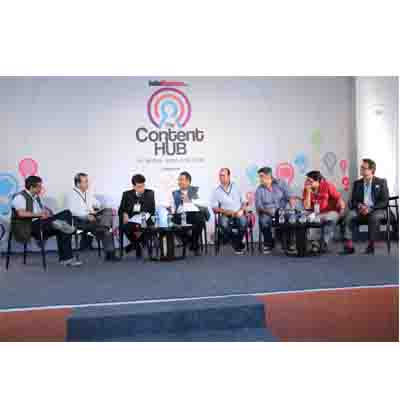
    MUMBAI: The first edition of Indiantelevision.com’s The Content Hub saw a full panel of broadcasters, producers and writers discussing how to change the dynamics of TV content. Moderated by Bodhi Tree Multimedia director Sukesh Motwani, the panel consisted of Doordarshan ADG West Mukesh Sharma, Zee TV business head Pradeep Hejmadi, Cinevistaas producer Siddharth Malhotra, Shashi Sumeet Productions co founder Sumeet H Mittal, Satyamev Jayate director Satyajit Bhatkal, Viacom18 head of content regional network Sanjay Upadhyay and writer Purnendu Shekhar.


    Motwani started off by asking whether the only model of monetising was through having daily soaps with the 23 minute per episode limitation? Upadhyay responded to this saying that some efforts have been made to break away tried to break away. “For instance, Viacom18, we have attempted to do this with our regional shows with one hour shows run twice a week,” he said. “What we found with this is that the audience’s addiction level isn’t as good as a daily because they are so used to dailies. At the same time, economics do play a big role.”


    Motwani further queried if broadcasters could experiment with hour long episodes during weekdays while restricting certain genres to only weekend? Hejmadi  pointed out that it isn’t easy to do dailies, as people generally think. “There is a need for change, yes. But the manner of migrating the audience is also needed. Some people have tried that but even then there is a thought process that broadcasters don’t encourage innovation,” he said.


    On the other hand Malhotra said that when the 9pm-10 pm time band became successful, the economics improved and after that no one even tried to experiment with hour long episodes. Upadhyay clarified that though the broadcaster makes an effort, the pressure on them is heavy. Shekhar lamented that broadcasters are scared of losing loyal audiences by introducing short stories that conclude in four episodes from Monday to Thursday.


    In most shows, the characters drive the shows and shows are scripted accordingly. Hejmadi pointed out that it takes to build characters and promote them amongst viewers to develop stickiness, hence having limited episode shows – like say which run from Monday to Friday does not really work, thanks to the attention deficit among Indian veiwers.  even suggested that producers should comHee with their own research insights that they should show broadcasters.


    Public broadcaster Doordarshan, on the other hand,  tends to look at art, culture and of course  literature for inspiration. Sharma said that this was mainly due to them having a different mandate. “For us the universe isn’t between 7pm to 11pm. We also do events such as every second Sunday is a ‘mothers’ day’ where we bring mothers and daughters to talk about them and this makes good money. But we don’t interfere with producer whether or not a show makes money.”


    As to Motwani’s question of whether there can be different shows for ‘India’ and ‘Bharat’, Upadhyay said, “Honestly, we don’t try hard enough because we don’t have patience. We shift goal posts depending on hits.”


    With a few shows having big names backing them such as Saraswatichandra and Everest, he also went on to say, “The noise that comes out of big shows may amortise costs in a shorter time.”


    While format shows are slowly losing audiences in India, the TV community needs to look at other metrics than simple TVTs and TRPs,  opined Satyemev Jayate director Bhatkal. “We chose the graveyard slot – Sunday morning  – when no one is really watching television to do the show,”he said. “We wanted to reach those viewers who don’t generally watch television, we wanted to encourage appointment viewing. People who would take the trouble  to switch on their sets at that early hour. And we apparently did, if we look at the buzz that SMJ generated online. And this is what sellers of channels also need to do, show the media buyers and planners the  volumes of social media data. In six episodes, we had billions of impressions and we were trending worldwide,” he said.

  • “You should never underestimate the power of good writing”: Namit Sharma

    “You should never underestimate the power of good writing”: Namit Sharma

    MUMBAI: Utilising his 15 years of experience across genres, he has created great programming for Zee TV. From broadcasting to content generation, it’s an amalgamation of several aspects.


    Here we are talking about Zee TV’s programming head Namit Sharma who with his creative thoughts has bought some best ideas to the table. For ‘The Content Hub’, indiantelevision.com had a quick chat to get his views on today’s story-telling and the power of story writers.


    According to Sharma, our stories are universal and emotion driven. “Of course”, comes a prompt reply from Sharma when asked whether Indian content has the ability to travel international. “It all depends on who’s selling it and who’s buying it.”


    He cites the example of MIPCOM, the global market for entertainment content across all platforms. “At MIPCOM, there are Latin American companies selling Telenovelas which get bought by Indian companies. The difference between what we do here and what they do there is, they market them better,” he says.


    According to him, the channel’s current offering Jamai Raja can easily travel internationally. On the contrary, he feels that a concept like Satrangai Sasural won’t be accepted abroad because it is culturally very sensitive.


    Finding good script writers is difficult in every genre and one needs to keep building talent pool that they want to work with.


    “We will never arrive at a time when we say ‘Oh! We are happy with the amount of good writing talent we have’. We will always be hungry for more. We will always keep on looking and creating,” he emphasises.


    He believes that one should never underestimate the power of good writing. “A lot of people look down upon GEC shows and the quality of writing on it, but what they don’t realise is that it takes equal effort to write these shows as it takes to write intelligent shows.” The GEC shows talk to the masses, more than the biggest Bollywood blockbuster.


    He believes that Indian content shifting its paradigm can mean different things to different people. “It depends on which viewer is asking the question. For some it might be ‘when they will only do crime thrillers’ or ‘stop doing saas-bahu soaps’ or ‘produce only love stories’. For us as broadcasters, the only relevant questions come from the audience. So we are happy to listen to their questions and answer them and that’s the crux of what we do,” says he.


    Zee TV was a pioneer in creating seasonal shows when it launched two seasons of Choti Bahu and Punar Vivaah. He feels that there must be seasonal shows, but nobody should be forced to do it because it is a fad or a trend. “One should do seasonal shows because they want to do it. Every story has its own destiny and fate and nobody should really judge somebody else’s work in the field of writing specifically with one uni-dimensional filter,” signs off Sharma.

  • Inaugural mipcancun a hit

    Inaugural mipcancun a hit

    MUMBAI:Television acquisition executives from across Latin America and international distributors praised the inaugural MIPCancun Latam TV Buyers Summit saying its one-to-one meeting format made for efficient business.


    40 buyers from 14 Latin American countries came to Cancun to do business with 33 sales companies from Canada, Finland, France, Germany, Italy, Japan, the Netherlands, Mexico, Romania, Russia, Spain, Turkey, the United Kingdom and the United States.


    Distributors included industry heavyweights such as A+E Networks, FremantleMedia, BBC Worldwide, Fuji Television Networks, and Viacom International Media Networks.


    Reaction from the TV buyers to MIPCancun was upbeat. Construir TV’s Alejandra Marano from Argentina says “I’ve discovered 30 new distributors here in Cancun and am definitely closing acquisitions deals. What’s really great here is that everyone is more relaxed than at big events and really interested in my channel’s needs.”


    International distributors also expressed enthusiasm for the new event. “I am very pleased about all the new buyers we are meeting here in Cancun and the efficiency of the event’s 1-to-1 meeting formats,” notes Sheila Aguirre, SVP of Content Distribution and Format Sales at FremantleMedia International, one of the first companies to sign up for the event.


    “MIPCancun offers a very different style from other major events for the TV industry – more intimate, more private, with lots of occasions for encounters with buyers outside my busy pre-scheduled appointments. Also, I’m meeting people here who don’t attend any other market,” reports Iowanka Sanchez Sprehe, Sales Manager of Global Screen GmbH from Germany.


    MIPCancun’s opening conference revealed stats from Eurodata showing the progressive growth of pay-TV in Latin America and the continued popularity of fiction as the region’s dominant genre.


    “We’re delighted with the extremely positive reaction of buyers and distributors alike to the events’ 1-to-1 format and consider MIPCancun a resounding success in terms of the high level of satisfaction expressed by its inaugural participants,” says Laurine Garaude, Director of Reed MIDEM’s TV Division. “MIPCancun confirms the growing importance of the Latin American market and the enthusiasm among international distribution companies to spend quality business time with channel buyers from across the region.”

  • “A few new writers haven’t even read literature”: Purnendu Shekhar

    “A few new writers haven’t even read literature”: Purnendu Shekhar

    MUMBAI: Many have been vocal about women and their rights, but only a few have been able to bring in the change.

    One man through his writing is doing just the same. He can even be categorised as someone who has been instrumental in shaping how daily soaps show a woman’s role in and outside her house. Telling the stories of women in shows like Astitva- Ek Prem Kahani and Saath Phere on Zee TV and Balika Vadhu on Colors is none other than Purnendu Shekhar.

    For ‘The Content Hub’, indiantelevision.com spoke to Shekhar, who comes with a belief that to be a good storyteller, one needs to first understand his/her family especially the women who run the house and their lives.

    When he joined the TV industry, it was dominated by highly dramatised melodramatic series like Kahani Ghar Ghar Ki. He tried to cut out of that tradition by bringing in realism through Astitva – Ek Prem Kahani.

    According to him, if cinema is predominantly male dominated, it is the TV, which represents the female. “In most cases, television serials are known for the women characters in it,” says Shekhar. As he always makes the central character emotionally strong and vibrant, he has chosen only female protagonists, so far. He puts them in difficult situations, and sees how they cope up.

    Six and half years and still running strong, Balika Vadhu today is considered as one of the longest running show on television. Was it a tough nut to crack? Agreeing to it, Shekhar says that in today’s scenario where new channels are mushrooming every now and then; there are tons of stories being told on television. “With every channel narrating stories on a daily basis, sometimes the idea doesn’t remain new anymore,” says Shekhar.

    A writer’s biggest task is how he moulds different storylines and characters together without losing the essence of the plot. “That’s the challenging job. It’s not easy to narrate or churn out new/ fresh ideas on a daily basis. More than the idea, how you approach a story is the biggest challenge.”

    He cites the example Astitva where he had used certain elements that viewers had already seen in Balaji’s shows, but what was different, was the approach. He goes on to say that writers don’t create anything new, but repeat what has already been told on television by good old writers and present it to the viewers with twists and modifications. “In today’s time, if any writer says I create original, then I am sorry I disagree with them.  Writer’s job is to observe what the good old television writers have done and follow their footsteps, but with twists and turns keeping in mind today’s culture, values and traditions. We all borrow thoughts.”

    He adds, “We have the same plot but it changes with time and characters bring in the freshness. For my shows, nobody felt that I had used the same storyline because the presentation and the way it was approached was quiet different.”

    With daily soaps, a writer has to work under tremendous pressure to keep the story and characters interesting. Shekhar highlights that dialogues are very important in any TV series as they take the maximum share of a character’s social existence.  

    When asked how he keeps the freshness alive and comes up with ideas for a story, he credits his observation power and memory. It was his own childhood experiences that motivated him to write a script on child marriage; giving birth to Balika Vadhu. According to him, for a writer, anything can trigger an idea; sometimes what he observes in the surroundings makes a story and sometimes memories can germ it.

    He sits with his team of writers, guides them, and even solves problems if a series stops working. He further states that the toughest job at times is to change or modify a certain plot or a track and still makes sense of it. “There can be many reasons to it, at times a track fails to click with the audiences or the similar track starts running on some other show, so here comes a writer’s skills and expertise to deal with the situation and go strong with the storyline without losing its essence.”

    He agrees that it is a difficult task to get good story tellers on-board. “I get to see very less talent or pool of writers who have read literature and have done some great work in the past. They lack knowledge skills and are not well-equipped with what the audience requires.”

    Shekhar further highlights that because of this shift, the life of a television show is also going down. “If we see today, the new shows don’t run for long like the older ones. Today, shows like Yeh Rishta Kya Kehlata Hai on Star Plus, Uttaran and Balika Vadhu on Colors have seen the life span of more than six years. What about the rest?” Shekhar asks.

  • In the online medium, the audience is the king, say digital stars

    In the online medium, the audience is the king, say digital stars

    MUMBAI: Over the past few years, the media landscape has taken a dramatic shift. It is a whole new virtual world and the rise of ‘YouTube generation’ has enabled talents to gain large followings online. From music to comedy, there are compelling opportunities for people to show their skills on the world wide web. The future of story-telling is evolving and the online sphere has proven to be a great platform for talents to find their own voices. So, what is it about crafting content online that attracts numerous talents?

    “It is an opportunity for us to work with the creative freedom and aesthetics that mainstream media doesn’t allow,” say the talents of the popular YouTube channel, Enna Da Rascals.

    Explaining their reasons to take on the virtual world, the group elaborates, “We started off as a theatre company and all of us work in films. It felt like a logical extension to move towards online content.” The channel, which has over 27,000 subscribers and 1,000,000 views on YouTube, includes names such as Pooja Devariya, Venkatesh Harinathan, Rajiv Rajaram and Yohan Chacko.


    The creators of another popular channel, SnG Comedy, boasting over 80,000 YouTube subscribers and 5,000,000 views tell us a comparable story. “With the kind of comedy we do, there were only two ways to get ourselves out there – stage and YouTube. The stage, while truly gratifying, does not have the reach and the ability that YouTube has.”


    More and more people are relying on their smartphones and tablets to watch content online. Whether it is a tip on how to look good or how to cook a dish, chances are that we would go online for instant solutions.  “People like to be spoon fed. They are lazy to answer their own questions,” says make-up artist and hair stylist Elton Fernandez, who has over 8000 subscribers and 300,000 views on his YouTube channel.  According to Fernandez, the audience today wants specific content and answers to their precise requests.  

    This can be deemed true for the current generation which particularly has a short attention span and is constantly looking for diverse entertainment. According to Enna Da Rascals, people are inherently opinionated and content which polarize people and make them think about their perspectives do well.  

    SnG Comedy, comprising Karan Talwar of BollywoodGandu, Varun Thakur, Aadar Malik, Brij Bhakta, Neville Shah and Kautuk Srivastava, believes that the audience today wants real and original content.  “There are no fixed formulas. It all depends on your originality and how the audience can relate with your content,” they say.

    So, how do these talents create good content online?

    “With us, there is no strategy really. We do stuff that we like. We prefer to get our humour and ourselves out there,” answers SnG comedy.

    Make-up artiste and hair stylist Mrinalinee Mukherjee who has recently started a YouTube channel, feels that it is vital to be true to one’s art and share the expertise of a subject to the best of their ability. She says, “Making good videos, teaching new things and reaching out to them are some ways to keep the audience interested.”

    Fernandez tries to keep his content simple and does things that are actually achievable in real life. “The viewers should not feel that what I am doing is rocket science. It should not be intimidating for them to try,” he adds.

    However, according to Enna Da Rascals, there is a downside to having creative freedom online. The content created is up and there for everyone to judge. “With a film or a play, you can market or sell it to a specific audience. Here, the content is for everyone to see. Finally, you realize in this medium, the audience is king. You can’t rig the press, the counts or juries. What you see is what you are,” they say.

    Budget is also a common concern for all these talented online celebrities. There is a cost attached to making videos with no fixed returns. So, do they then compromise on the quality of their content?
    Enna Da Rascals feels that this is where engagement with brands come in handy. “Sometimes brands can help you create videos with a much larger design.  If we’re feeling ambitious and the content is something the audiences may enjoy, we’ll need the support of a brand to make it happen.”

    With the advent of multi-channel networks, talents are also being able to find support financially. SnG comedy which comes under Culture Machine Digital Video Entertainment Company says, “Culture Machine has been pivotal. They’re really the money. They are the ones who selflessly invested actual capital to help us grow as a channel. They believed in our style and brand of comedy. They’ve pulled all stops to help and assist us.”

    Adding to that, Enna Da Rascals states, “It’s nice to know that someone has your back looking at the monetary side of things. Also, they provide insights on which videos have the potential to do well.”

     
    Despite of all these, the perks of being a digital star are endless. A digital footprint contributes in getting live gigs and recognition. For SnG Comedy, it has helped them in the sales of their stage shows. Having a channel online has added to their brand equity when they are pitching for a live act.  “People know us,” they say.

    For Fernandez, he feels it is nice to be recognised by a specific target audience and creating content online is a long term business for him.


    Such is the case with Enna Da Rascals who believes that they have been successful in attracting the attention of various brands. According to them, the online world is definitely preferred amongst the young tech savvy consumers. “Don’t be surprised if you find yourself choosing the online industry over the main industry,” they conclude.


  • “The biggest idea can come from somebody you are not looking at”: Ajit Thakur

    “The biggest idea can come from somebody you are not looking at”: Ajit Thakur

    MUMBAI: It is the only channel, which has never shied away from experimenting; from mythology to drama, from thriller to comedy, it has done it all. The soon-to-be three-year-old channel from the Star Network’s stable, Life OK, has always been riding high on success.

    For ‘The Content Hub’, indiantelevision.com spoke to the channel’s EVP and GM Ajit Thakur to understand his views on how Indian content has shifted its paradigm and challenges that he faces while spotting new talents.

    According to Thakur, more than the concepts the channel is always looking out for fresher talent. “We are looking at people from Bollywood and advertising to come to us with different concepts. Also, we want to explore more genres. Currently, with Pukaar we are not only exploring action genre but also have got on board film director Vipul A Shah. In the future, we would love to do a lot more of comedy, thrillers, spy stories and a mythology.”

    He believes that with both television and Bollywood growing at a tremendous speed, the demand for the same writers has increased over the years, making the task different. “We can all either wait for those people to come on board or can develop our own talent. Therefore, we have hired a lot of new writers.”

    For shows like Mahadev and Savdhaan India, the channel has in-house writers. According to him talent spotting and retaining that talent is a big challenge as well. “One might be available today but he/she will get busy after six months. Plus, one cannot depend on established talent. So, we have to develop our own talent,” says Thakur.

    He goes on to say that though Indian content has the ability to travel abroad; it will take some time because currently, the industry is not investing enough on production to scale it up. “Production quality will take another five to seven years to enter international market. But the interesting concepts will take lesser amount of time,” he says while adding that our shows are currently travelling to the Middle East and South Asia because of Indian diaspora, but for a show to have the scale for it to be sub-titled and aired in America, it will take time.

    Is Indian content shifting its paradigm? According to Thakur, it is but slower than one would like it to. “Our viewers are evolving fast but at the end of it our cultural context is important too. As a country we are very different, so it’s not that our viewers are not evolving but they are evolving within the paradigm of Indian society where families are important and cultural values are important.”

    He adds, “I think we have to take pride in the kind of stories we tell, but we need to produce them at the scale, which the international markets can look up to.”

    Thakur has two best practices when it comes to sparking off changes in the thought and creation process of content. One, it is very important to have the right insights on which one wants to work on. “One should know who your target is whether you are a TV channel, filmmaker or a digital platform. I think very often we are making a mistake of not looking at who we want to target at, carefully. Who is your core TG? Is it urban India or rural India? Is it men or women? Is it young families or joint families? It is an important factor which many a times we overlook.”

    Second, once you are clear about the TG then instead of trying to do many things, one must focus on one thing they are good at. “If you are developing one genre, develop a number of dramas, be the best at it rather than trying to do everything. And once you know that this is the target group and this is the kind of audience you want to target, then go ahead and find multiple story tellers. Never think that the current best lot is the one that will take it to the next level. Probably the biggest idea will come from somebody you are not looking at,” concludes Thakur.


  • “Seasonal shows can break the monotony”: Sumeet H Mittal

    “Seasonal shows can break the monotony”: Sumeet H Mittal

    MUMBAI: The television industry has grown by leaps and bounds, believes the co-founder and director of Shashi-Sumeet Mittal Productions, Sumeet H Mittal.

    As part of Content Hub, indiantelevision.com spoke to Mittal who, along with his wife Shashi Mittal, has produced many successful shows like Sajan Ghar Jaana Hai, Diya Aur Baati Hum and Punar Vivah amongst others, to find out his perspectives on the changed television content.

     “Up and until five years ago, our industry was at a nascent stage when compared to the television industry of other countries. However, things have changed. A lot of that has to do with the global exposure we receive in India today, which drives evolution of mindsets and hence, the demand for progress in concepts and ideas as well,” he says.

    Mittal highlights that today, the audience no longer accepts a basic plot as they want to be stimulated with depth and complexity. He feels that a script writer needs to be able to create that while keeping the interest of the audience.

    According to him, the content shown on television also needs to be in line with the viewer preferences and demands. “There is a need today for differentiated content and everyone is working towards providing just that. Our shows like Diya Aur Bati Hum and Punar Vivah are strong examples of shows that are different from the usual,” he says.

    Mittal feels that seasonal shows can break the monotony.  He adds, “We did two seasons of our cult hit – Punar Vivah, and both were received very well by the audiences. I strongly believe a story should only be told till it holds merit and not be stretched just for the sake of it. That is cheating your audiences.” He also stresses that unless a broadcaster and producer work hand-in-hand, a show will not be successful.

    When asked if Indian content has the potential of going international, Mittal says, “Some of the more popular television serials are already being sub-titled in different languages such as French, German and even English and are being broadcast around the world.”

    He states that today there are a lot more schools and institutions teaching the budding writers to develop the skill to create great original scripts. “Hear them out with an open mind. You never know who has a super idea with a potential to be turned into a great script,” he signs off.

  • “The line between social and digital video are blurring very fast”: Saket Saurabh

    “The line between social and digital video are blurring very fast”: Saket Saurabh

    MUMBAI: From the most imaginative chefs to awe-inspiring musicians, from comics who find humour in almost everything to discerning fashionistas who are on the top of trends, from celebrities to the kid next door, there is one talent based digital entertainment network which is home to everyone.


    Here we are talking about #fame, a part of ‘TO THE NEW Ventures’, an end-to-end digital services network specialising in ‘SMACK’ services – social, mobile analytics, content and knowledge.


    The essence of the business is to work with emerging and established talents and create digital content and communities with them. Creating exclusively digital content with emerging established talents, #fame focuses on a few strategic genres which include food, fashion, music and comedy.


    As part of indiantelevision.com’s ‘Content Hub’ series, we will also feature content creators in the digital space.


    According to #fame CEO Saket Saurabh, video is the new text and talent is the most powerful currency in the digital age. “We are in two businesses, one in the talent business and number two in the content business. With talent, our value addition is that we help the talent create, curate, promote, distribute and monetise content. We deliver audiences world class digital entertainment which is not available elsewhere in any other platform where they can engage.”


    How does #fame pick up talent? From talent management programs to partnership and crowd-sourced platforms, #fame has done it all. The digital entertainment network has multiple strategies of picking up talent. It has its own talent management program and process through which it discovers across digital platforms with the help of its team and analytics to identify the talent which it believes has the potential to grow.


    Secondly, it also works with a number of platforms. It works with one of the crowd sourcing platform called Blogmint, a blogger market place which has close to 4,000 bloggers registered on it across areas like food, fashion, technology space and etc.


    In terms of the content creation process, the company is a mix of in-house and production houses network. “It is no different. It is very much like how a television network functions. We create some of the content in-house and rest we work with production houses. At the end it depends on the genre, format and category,” reasons Saurabh.


    While today characters on television become famous and house-hold names, does digital have that power to create powerful characters? “Absolutely,” comes a quick reply from Saurabh. He believes that digital is a very intimate medium and the way audiences can connect and engage with talent on digital; it can never be matched by any other medium. Citing few examples, recently the network launched a new channel in the food space with Maria Goretti who is a well-established VJ and Comedy Kid of #fame with Saloni who won a comedy reality show – Chhote Miyan. “So these are already established people in their own space and they see great power in digital,” he says.


    The company has worked with a number of emerging talents as well. There is a great comedian – Sikandar Sidhu who has a huge following already in a span of just two-three weeks. “People can now comment, like, dislike and that is what the talent wants: instant feedback and that kind of engagement.”


    One of the visions that Saurabh had when he launched #fame was that he wanted to reach out to 50,000 content creators in the subsequent three years and have over 5,000 channels in six countries. “In digital, the medium allows content creators and networks like ours to reach out to important niches within alternatives and cater to specific interests. We want to be Asia’s premier talent led digital entertainment network. We are working towards achieving that,” he says.


    Youth being a fickle audience and with a short attention span, what is #fame’s strategy to keep them engaged? Saurabh believes that the video durations have to be economical because digital consumption most of the times is happening on mobile and people are consuming content no matter where they are. “And in that kind of consumption context, it is important that you provide content to a consumer which is easy to sample and enjoy it. That is why duration cannot be long.”


    On an average the duration of the video clip ranges from 3 – 5 minutes depending on what kind of content it delivers. He says that the beauty of digital is that it allows audiences to sample byte sized content.


    However, Saurabh feels there are challenges in everything. But more than a challenge, he calls it a good problem. According to him the good problem is that digital video will be the biggest rival of digital in general going forward. “I often say that video is the new text. Any kind of digital content will increasingly use video as its language. The fact that digital video will be the driver and one of the fastest growing segments within digital it is fairly clear.”


    He is confident that growth is definitely going to be there in terms of usage, brands realising the power of digital video, users and communities. “I think the good problem is that while there is complete consensus on the fact that this is the biggest growth opportunity media has seen in the last two years, not all partners or stakeholders agree to the speed of that growth. Sometimes, this makes things slower than it should because people have different views on how fast it will grow. However, no one doubts the fact that it is going to grow. I think that poses some challenge for us and for the entire industry.”


    Today digital represents 10-12 per cent of advertising. The fact is that digital will be the driver medium. People are coming up with the digital first plan where digital meets the idea or brands vision and television or print ads surround it. “Those things have started to happen. There are brands, partners and talents who have understood that but obviously different people move at different speed.”


    Today, digital is too large and diversified to talk about at one go. He feels that we need to talk about social and digital video differently. According to him, digital is not one medium anymore and one needs to talk about it in a focused and calm manner.


    He feels that social is increasingly becoming the video leg and the lines between social and digital are blurring very fast and that’s where the biggest opportunity lies. As per statistics, digital video content has been the fastest growing segment in digital in the last four years. It grew at 56 per cent CAGR whereas social grew at 45 per cent.


    How does #fame work with brands? The company works with them on what they call – Impact properties. Recently the company announced the property of School of Style with Karan Johar for fashion vertical. For its music vertical, the company partnered with Pritam for Web Singer. “Lot of Impact properties that we call as tent poles attract a lot of attention from brands.” The company is also involved in branded content where it helps to create digital video content. It also works with brands for channel management where #fame manages its digital video assets. According to a media analyst, the company’s substantial portion of revenue comes from brands.


    Moreover, the digital entertainment network makes inventory revenues on digital video platforms and generates revenue through syndication partners who work with revenue shares with the company. “We also monetise content in terms of what we do with the talent. If there is a talent whom the brand wants to reach out to or an opportunity arises, we create monetisation through that,” concludes Saurabh.