Category: Specials

  • IDOS 2016: OTT  advertising vs TV advertising

    IDOS 2016: OTT advertising vs TV advertising

    GOA: Is Online Video (read: OTT) advertising eating into TV’s share? That was the question posed  by the final session of IDOS 2016 held in Goa’s Leela Hotel. The obvious consensus answer from the panelists was a big “no” – and it does not take a genius to reach that conclusion.

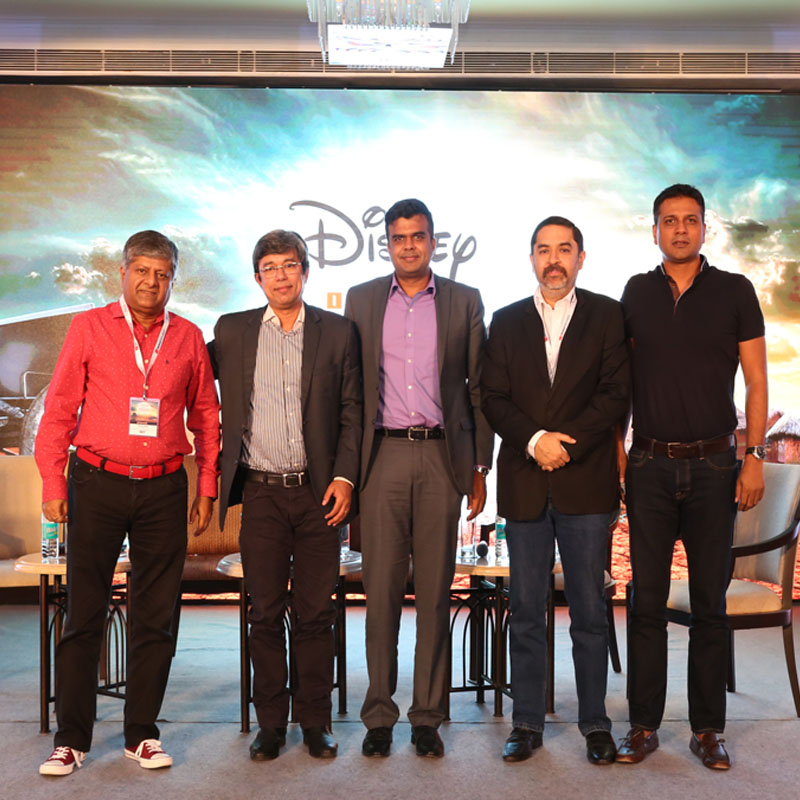
    On the panel were IPG Media brands CEO Shashi Sinha, Sony Pictures Network India (SPNI) digital head Uday Sodhi, Starcom India Group CEO, Mallikarjun “Malli”  Das and Eros Now business head Zulfiqar ‘Zulfi’ Khan.

    “Digital advertising accounts for about eight to nine per cent of total ad spends,”  said Malli. “Most of this goes towards Google, Facebook. Two to three per cent is going towards digital video, and that too most of it is going towards You Tube.  It’s early days yet for the OTT players to have any revenues of significance.”

    “Google has played a pioneering role –  the educational and evangelizing approach that it along with YouTube took visiting advertisers and agencies to explain to them the efficacy of using it  platform,” said Zulfi. “The OTT industry is too nascent and new, and has a lot of work to do.”

    Sinha pointed out that the disparity in CPMs between television and online IP video is drastic. “Television is being sold on a cost per rating point (CPRP) basis in India today. In most countries, it is on a CPMs,” he said. “The CPMs even for TV are very low, and for online video, even lower. Airtime on television has become a commodity as there is plenty of inventory, but networks have large enough audiences to present to advertisers.”

    public://IMG_5444.jpg

    Added Malli: “Television also has a reliable currency – BARC – to measure what’s happening to their spends – the reach, the viewership. Which makes all of us in the media and advertising community secure. We can buy across a network and aggregate audience.”

    The panelists agreed even though the OTT players are providing very specific – in fact a surfeit of data, enough confidence has yet to be built in among the advertisers. “There’s fragmentation in the OTT community. There are too many platforms,” said Sinha. “And you can’t aggregate enough audiences of significance to allow us to take CPMs up here.”

    Sodhi agreed that OTT video platforms had managed to build an active audience of about 70 million. He said: “China’s tipping point for OTT to significantly impact TV ad spends came when the number of users crossed 200 million.  India has to grow. SonyLiv has around around 10 million. Good and stable bandwidth and right pricing  of data are the issues to be dealt with to expand the OTT user base,” Sodhi said.

    Malli believed that the audience of 70 million is large enough. “The Times of India has a seven and a half million readership and there is thousands of crores going into the paper.”

    Both Malli and Sinha stated that agencies have started presenting media plans which, include TV plus and online video. “That’s a great improvement over earlier. We are putting in money behind online video. But it’s left to the OTT- owner – the broadcaster – to show it as OTT ad spend or TV ad spend. However, to be fair, the sector will grow when FMCGs start putting in their faith behind digital online video,” revealed Sinha.

    Then what is holding the ecosystem back? “Most of the robust OTT platforms are backed by the broadcasters,” revealed Sinha. “The leadership is fearful their targeted revenue objectives from television might get impacted if they start shifting the focus more toward digital video advertising. This leadership has to take a hard call.”

    He pointed out that BARC – of which he is a technical committee member – is gearing up to measure online video consumption and become the second country in the world to do so.

    “We are ready to launch online video measurement  by March 2017. Relevant data is going to be provided by some of our partners in the ecosystem to allow us to provide effective measurement numbers. However, the signal has to come from the broadcast community,”  he quipped.

    Zulfi pointed out that Eros Now has around a  million subscribers – split between India and overseas – paying Rs 49 a month for its Bollywood movie service.

    However, his view that today snacking was the primary form of consumption of digital video, was countered by Sodhi, who stated  that the SonyLiv audience was sticking around for  around for 16-22 minutes per session.

    They all agreed that there is a bright future for digital video advertising. But, none wanted to hazard a guess as to when will it happen. “I have no clue when will the inflection point come,” Sinha said. “It is now.”

    Malli too said that he had no clue about it. “Although the stage is set, I can’t predict when a significant migration to digital will happen — in one, two or three years from now.”

    Sodhi revealed that almost 70 million users are being added to the digital video consumers pie every year. “Within two to two and a half years we will have 200 million users,” he predicted. “And that will be a number no one will want to ignore. The advertising tap will flow and flow then.”

  • ‘Broadcasters could consider different pricing for rural-urban subscribers’

    ‘Broadcasters could consider different pricing for rural-urban subscribers’

    When DEN Networks promoter Sameer Manchanda set up the national MSO in 2007, one of the key professionals on his team, which was led by CEO Anuj Gandhi, was the cable TV veteran S.N. Sharma. The trio quickly ramped up the company and took it to national level status.  Gandhi then moved on in 2010 to join Network18. And, Sharma who was the president (operations), was promoted as the CEO a year or so later.

    He continued with the company, expanding it nationally, and seeing it through the first two phases of digitization before departing in 2015 to get on board India’s biggest and most funded  startup  — the Mukesh Ambani-backed Reliance Jio.  A former McKinsey professional Pradeep Parameswaran was roped in to lead the company in his place.

    Sharma, meanwhile, at Jio, worked on planning and building the team for company’s foray into cable TV along with another cable TV veteran K. Jayaraman.

    Then, in July 2016, Sharma made a sudden about-turn and decided to return to DEN Networks, a move that raised the eyebrows of many but cheered many in the trade. For he is known for his relationships and his deep understanding of how cable TV should be run in the Indian context.

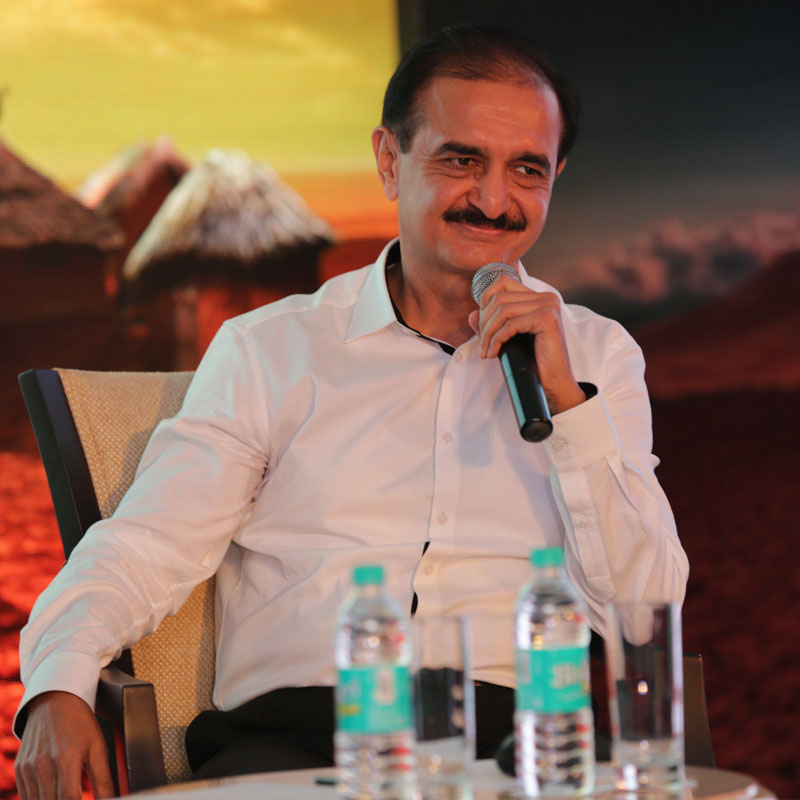
    Sharma was one of the key notes at indiantelevision.com’s Eleventh India Digital Operators Summit 2016 which concluded over the weekend at the Leela Hotel in south Goa. He had a one-on-one conversation with Indiantelevision.com Founder, CEO  & Editor in chief Anil Wanvari. Read on to get some insights into what is going on at DEN and with Sharma. Excerpts from the conversation:

    Why did you leave DEN in the first case, join Reliance and then why did you choose to come back?

    Having been into the cable industry for over 20 plus years, I thought, let me do something else. And, that’s why I moved to Reliance. Basically, I wanted to roll out fibre to the home (FTTH) over there. It would have been a great experience and learning (I thought). And it was, indeed. I learnt a lot in the short span of one and a half year. It was a wonderful learning that I brought in to my personality.

    But then, there was a call from my previous employer DEN, my friend Sameer.  I am one of the co-founders of DEN Network. And, I requested my employers at Reliance if I could leave. And they were kind enough to let me go back. It was more of an emotional decision than a professional one. All my learnings that I have had  at Reliance, I am
    sure, will help me learn to drive DEN in a better manner,in a positive direction in time to come.

    What are the challenges you are facing?

    The challenge as we all know is primarily monetization.  We started seeding boxes in 2010, now it is 2016. DAS came in 2012. And “hote hote” (by and by) it became 2013. Phase I and II happened quickly.

    There is a lag in monetization. Of course, we all can understand and you will appreciate that an industry which evolved since 1990, almost 30 year old industry, it  takes time for things to change. And, we took tiny, baby steps to monetize it.  But now, the time has come the boxes seeded in 2010 have almost lived their life and new technology is coming in. So my prime task is to see to it that we augment the process of monetization.

    The other challenge that I face immediately which I am working very aggressively on is to reduce the cost. We all know that Phase III digitization got into  a confused state, with boxes having got seeded, and the courts intervening.  Analogue signal has also been taken away from many of us. The MIB says 93 per cent  of digitization has happened. So the monetization process also has to start. But, in the bargain, we have already incurred some expenditure.  And unless I start recovering my revenue, the journey will be difficult.

    This time, in a short span of one and a half month, I addressed my cable TV partners, my business partners and my associates in a very transparent manner. We had a discussion – a whole day discussion wherein I shared with them my experiences with the telco. I shared with them the upcoming technology. I told them there is a change. The technology is not going to spare them.  We all used to think that last mile …last mile. But, my subscriber is not bound by last mile. My biggest threat today is the handset that I carry. The viewing habits are changing. Technology is bringing other alternatives. For the same viewer  who used to be watching their services. It is high time they realized it and accepted this change. And, they all agreed. I was surprised. It was a very open, frank and to-the-point discussion. I told them if we are willing to change, if we are willing to adopt, life will be there for us, otherwise the journey is going to be difficult. Everybody is cooperating. We hope to see a very good upside as far as collections are concerned.

    Third is making the LCOs, our partners realize the pains we are going through.  And, make them see the technology.

    And fourth is we have started conducting sessions with cable TV operator to sensitise them with the consumers. Like the regulator also said: Don’t force things on the consumer. He is in no mood. So the approach has to be friendlier than earlier. We have to change the face of our representative visiting the home of the subscriber. The
    presentation of our package has got lost.  We brought in a digital set-top box, we invested in that. But, we forgot in the process that we had not changed our face to the consumer. The cable TV operators accepted that we need to bring in a lot of ethics and discipline in that part.  You will see our representatives wearing uniforms. Uniform could be ours or the LCO’s.  It has to be in a presentable form. Today, if you are visited by a courier boy, the way he  is approaching is different.

    I am sure the cable TV operators will comply.

    Where are you reducing costs?

    Our priority early on was to penetrate the market, you increase your reach and when you penetrate certain areas, those can be reached through fibre or through links from telcos. After some time, you realize that you have spent an X amount in reaching an area and you have seeded 50 boxes. It does not make sense to you. So, you need to make a quick decision. You retract, you save money on that. Or you go to another MSO who is reaching the same area  and he has done it using a different pipe. And, he has 50,000 subscribers. So, I would tell him, why don’t we share the pipe. That process (of sharing)  has already started.  Then, we have started sharing the infrastructure also in another manner, in terms of content. If a competitor has a pipe serving more subscribers in the same area than I have less or vice-versa, I am open to sharing the pipe with the competitor. This is helping reduce costs. We have started sharing local content with cable operators. The cable operator has local content with him. So, instead of spending separately on the same content, we have started sharing that content too. Then, there are usual steps — reduction of manpower, to hire on a temporary basis, and cutting down the day-to-day expenses.

    Where are you getting your maximum margins?

    You see we have largely been a phase III player.  We have seeded 5.5 million in phase III, and 3-4 million are to go in phase IV. Of the 13 million subscribers, we have seeded 9-9.5 million. My upside will come from revenues of phase III boxes, which were yielding Rs 10-20. We have already crossed a milestone of Rs 40- 45 revenues, By December-end, it will touch  Rs 75 plus — that is a 45 per cent growth. Phase I is likely to give us 15-20 per cent.

    Who is going to get you this money – LCOs or the customer?

    You see the mood is set.  In the exercise, baby steps were taken to augment phase I revenues. It took us four years.  Phase III customer is also aware.  All studies and research show us is that the  buyingcapacity is there,  paying capacity is there too. HD is another example.  Around 70 per cent of TVs are HDTVs going into to Phase III
    areas. As it is for me to perform and deliver, I need my costs to be under control.  On the whole, we have also become very cost-conscious. We want our pie of the revenue.

    The cable sector has been bashed red and blue and cable TV bottomlines are stained with red ink? When will it turn around?

    You will see by Q3 end there should be an upside.

    You are very strong up north. Are you strengthening that or are you expanding into newer territories?

    As of now, my focus is to strengthen where we are. I have 13 million subscribers, I am happy to be limited where we are. As we start seeding boxes, it might go to 15 million as we deliver. I want to have a positive bottomline. I want a fair share of revenue. I want to move towards an era where sharing of revenues has be settled. As of now, there is always a dilemma, am I to stand by the TRAI that cable operators should get 35 per cent of revenue. The fact of the matter is that today we are receiving 35 per cent, and he is getting 65 per cent.

    I am very much focused that let’s first  set it right. It will take time and over few months. But, I see that over the next 12 months, this will move towards 50:50. And then, as we move forward, and add more values in the system, I am sure the operator will also get to earn  more through us if he wants to stay with us and be part of the journey.  If he says, he does not want to do broadband with, that’s his choice. If that arises, then we might go direct or we have leave that with him. I am very focused that instead of spreading thinly, focus where you, monetize it well. Settle a good business model. A good business case.  Business will follow.

    LCOs’ insecurity is less than earlier. Your comments.

    You can’t help it. Even MSOs. Nobody is secure. Times are changing. We have to adapt. You can’t ignore the technolgy. If I don’t change, just because my fellow LCO has not, and even I don’t, that’s a folly. Today, in  a matter of time, we started broadband. We have tested a broadband formula. We have close to 125,00 subscribers. We did this with a focused mind in Delhi and Kanpur. To test how the technology behaved, how the arithmetic works here. Now we find that, with 15-17 per cent of penetration, the project is breaking even. Now, anything added into it, is your upside.  The LCOs who are willing to work with us are very happy as they march around with us. And also, there is a learnin that the normal consumer is consuming 40 GB of internet at a speed of 10 mbps at a price of Rs 800. Broadband consumption is rising fast, 5 GB has gone to 10, and 20 GB has gone to 40 GB. Putting in everything into perspective, the cost is Rs 10 per GB.  Next year, I am sure it will be 100GB. And the speed will touch 50 MBPs. In such a scenario, if  I don’t move, somebody else will move.

    You must be happy Goldman Sachs invested but it was a discount to its earlier price, actually a deep discount What’s the way forward on the investment?

    It’s a subjective analysis . But, you should say that this proves that there is strength in the business model of DEN.

    On broadband there will be an increased investment going in. And besides broadband, we are incorporating OTT and value added services.

    So what’s the way forward on the pay TV market, with 31 December coming up?

    We are looking at it wholly. The boxes are going at a good speed. We are not really pushing. My focus is on getting Phase I, II III right. Once that business model is set in place, everything will also.  It is a matter of time, the  pull should come from the consumer, from the LCO. If he is willing to work with me. In the earlier case, in Phase I and II, we were subsiding the boxes. Today, it is a pure business case. This my product. You want to do business with me, please do.

    How can broadcasters assist the process of digitization till the tariff order comes out?

    There was a time when broadcasters used to have dual pricing policy. For rural, it was lower, and for urban, higher.  Now, that we have invested and are investing, all of a sudden  they have foregone  that policy of theirs, which they were following in analogue, and still they are following in some places even today. The moment we seed STBs in phase III, they start charging digital rates. I would urge broadcasters too relook at this.
  • ‘Broadcasters could consider different pricing for rural-urban subscribers’

    ‘Broadcasters could consider different pricing for rural-urban subscribers’

    When DEN Networks promoter Sameer Manchanda set up the national MSO in 2007, one of the key professionals on his team, which was led by CEO Anuj Gandhi, was the cable TV veteran S.N. Sharma. The trio quickly ramped up the company and took it to national level status.  Gandhi then moved on in 2010 to join Network18. And, Sharma who was the president (operations), was promoted as the CEO a year or so later.

    He continued with the company, expanding it nationally, and seeing it through the first two phases of digitization before departing in 2015 to get on board India’s biggest and most funded  startup  — the Mukesh Ambani-backed Reliance Jio.  A former McKinsey professional Pradeep Parameswaran was roped in to lead the company in his place.

    Sharma, meanwhile, at Jio, worked on planning and building the team for company’s foray into cable TV along with another cable TV veteran K. Jayaraman.

    Then, in July 2016, Sharma made a sudden about-turn and decided to return to DEN Networks, a move that raised the eyebrows of many but cheered many in the trade. For he is known for his relationships and his deep understanding of how cable TV should be run in the Indian context.

    Sharma was one of the key notes at indiantelevision.com’s Eleventh India Digital Operators Summit 2016 which concluded over the weekend at the Leela Hotel in south Goa. He had a one-on-one conversation with Indiantelevision.com Founder, CEO  & Editor in chief Anil Wanvari. Read on to get some insights into what is going on at DEN and with Sharma. Excerpts from the conversation:

    Why did you leave DEN in the first case, join Reliance and then why did you choose to come back?

    Having been into the cable industry for over 20 plus years, I thought, let me do something else. And, that’s why I moved to Reliance. Basically, I wanted to roll out fibre to the home (FTTH) over there. It would have been a great experience and learning (I thought). And it was, indeed. I learnt a lot in the short span of one and a half year. It was a wonderful learning that I brought in to my personality.

    But then, there was a call from my previous employer DEN, my friend Sameer.  I am one of the co-founders of DEN Network. And, I requested my employers at Reliance if I could leave. And they were kind enough to let me go back. It was more of an emotional decision than a professional one. All my learnings that I have had  at Reliance, I am
    sure, will help me learn to drive DEN in a better manner,in a positive direction in time to come.

    What are the challenges you are facing?

    The challenge as we all know is primarily monetization.  We started seeding boxes in 2010, now it is 2016. DAS came in 2012. And “hote hote” (by and by) it became 2013. Phase I and II happened quickly.

    There is a lag in monetization. Of course, we all can understand and you will appreciate that an industry which evolved since 1990, almost 30 year old industry, it  takes time for things to change. And, we took tiny, baby steps to monetize it.  But now, the time has come the boxes seeded in 2010 have almost lived their life and new technology is coming in. So my prime task is to see to it that we augment the process of monetization.

    The other challenge that I face immediately which I am working very aggressively on is to reduce the cost. We all know that Phase III digitization got into  a confused state, with boxes having got seeded, and the courts intervening.  Analogue signal has also been taken away from many of us. The MIB says 93 per cent  of digitization has happened. So the monetization process also has to start. But, in the bargain, we have already incurred some expenditure.  And unless I start recovering my revenue, the journey will be difficult.

    This time, in a short span of one and a half month, I addressed my cable TV partners, my business partners and my associates in a very transparent manner. We had a discussion – a whole day discussion wherein I shared with them my experiences with the telco. I shared with them the upcoming technology. I told them there is a change. The technology is not going to spare them.  We all used to think that last mile …last mile. But, my subscriber is not bound by last mile. My biggest threat today is the handset that I carry. The viewing habits are changing. Technology is bringing other alternatives. For the same viewer  who used to be watching their services. It is high time they realized it and accepted this change. And, they all agreed. I was surprised. It was a very open, frank and to-the-point discussion. I told them if we are willing to change, if we are willing to adopt, life will be there for us, otherwise the journey is going to be difficult. Everybody is cooperating. We hope to see a very good upside as far as collections are concerned.

    Third is making the LCOs, our partners realize the pains we are going through.  And, make them see the technology.

    And fourth is we have started conducting sessions with cable TV operator to sensitise them with the consumers. Like the regulator also said: Don’t force things on the consumer. He is in no mood. So the approach has to be friendlier than earlier. We have to change the face of our representative visiting the home of the subscriber. The
    presentation of our package has got lost.  We brought in a digital set-top box, we invested in that. But, we forgot in the process that we had not changed our face to the consumer. The cable TV operators accepted that we need to bring in a lot of ethics and discipline in that part.  You will see our representatives wearing uniforms. Uniform could be ours or the LCO’s.  It has to be in a presentable form. Today, if you are visited by a courier boy, the way he  is approaching is different.

    I am sure the cable TV operators will comply.

    Where are you reducing costs?

    Our priority early on was to penetrate the market, you increase your reach and when you penetrate certain areas, those can be reached through fibre or through links from telcos. After some time, you realize that you have spent an X amount in reaching an area and you have seeded 50 boxes. It does not make sense to you. So, you need to make a quick decision. You retract, you save money on that. Or you go to another MSO who is reaching the same area  and he has done it using a different pipe. And, he has 50,000 subscribers. So, I would tell him, why don’t we share the pipe. That process (of sharing)  has already started.  Then, we have started sharing the infrastructure also in another manner, in terms of content. If a competitor has a pipe serving more subscribers in the same area than I have less or vice-versa, I am open to sharing the pipe with the competitor. This is helping reduce costs. We have started sharing local content with cable operators. The cable operator has local content with him. So, instead of spending separately on the same content, we have started sharing that content too. Then, there are usual steps — reduction of manpower, to hire on a temporary basis, and cutting down the day-to-day expenses.

    Where are you getting your maximum margins?

    You see we have largely been a phase III player.  We have seeded 5.5 million in phase III, and 3-4 million are to go in phase IV. Of the 13 million subscribers, we have seeded 9-9.5 million. My upside will come from revenues of phase III boxes, which were yielding Rs 10-20. We have already crossed a milestone of Rs 40- 45 revenues, By December-end, it will touch  Rs 75 plus — that is a 45 per cent growth. Phase I is likely to give us 15-20 per cent.

    Who is going to get you this money – LCOs or the customer?

    You see the mood is set.  In the exercise, baby steps were taken to augment phase I revenues. It took us four years.  Phase III customer is also aware.  All studies and research show us is that the  buyingcapacity is there,  paying capacity is there too. HD is another example.  Around 70 per cent of TVs are HDTVs going into to Phase III
    areas. As it is for me to perform and deliver, I need my costs to be under control.  On the whole, we have also become very cost-conscious. We want our pie of the revenue.

    The cable sector has been bashed red and blue and cable TV bottomlines are stained with red ink? When will it turn around?

    You will see by Q3 end there should be an upside.

    You are very strong up north. Are you strengthening that or are you expanding into newer territories?

    As of now, my focus is to strengthen where we are. I have 13 million subscribers, I am happy to be limited where we are. As we start seeding boxes, it might go to 15 million as we deliver. I want to have a positive bottomline. I want a fair share of revenue. I want to move towards an era where sharing of revenues has be settled. As of now, there is always a dilemma, am I to stand by the TRAI that cable operators should get 35 per cent of revenue. The fact of the matter is that today we are receiving 35 per cent, and he is getting 65 per cent.

    I am very much focused that let’s first  set it right. It will take time and over few months. But, I see that over the next 12 months, this will move towards 50:50. And then, as we move forward, and add more values in the system, I am sure the operator will also get to earn  more through us if he wants to stay with us and be part of the journey.  If he says, he does not want to do broadband with, that’s his choice. If that arises, then we might go direct or we have leave that with him. I am very focused that instead of spreading thinly, focus where you, monetize it well. Settle a good business model. A good business case.  Business will follow.

    LCOs’ insecurity is less than earlier. Your comments.

    You can’t help it. Even MSOs. Nobody is secure. Times are changing. We have to adapt. You can’t ignore the technolgy. If I don’t change, just because my fellow LCO has not, and even I don’t, that’s a folly. Today, in  a matter of time, we started broadband. We have tested a broadband formula. We have close to 125,00 subscribers. We did this with a focused mind in Delhi and Kanpur. To test how the technology behaved, how the arithmetic works here. Now we find that, with 15-17 per cent of penetration, the project is breaking even. Now, anything added into it, is your upside.  The LCOs who are willing to work with us are very happy as they march around with us. And also, there is a learnin that the normal consumer is consuming 40 GB of internet at a speed of 10 mbps at a price of Rs 800. Broadband consumption is rising fast, 5 GB has gone to 10, and 20 GB has gone to 40 GB. Putting in everything into perspective, the cost is Rs 10 per GB.  Next year, I am sure it will be 100GB. And the speed will touch 50 MBPs. In such a scenario, if  I don’t move, somebody else will move.

    You must be happy Goldman Sachs invested but it was a discount to its earlier price, actually a deep discount What’s the way forward on the investment?

    It’s a subjective analysis . But, you should say that this proves that there is strength in the business model of DEN.

    On broadband there will be an increased investment going in. And besides broadband, we are incorporating OTT and value added services.

    So what’s the way forward on the pay TV market, with 31 December coming up?

    We are looking at it wholly. The boxes are going at a good speed. We are not really pushing. My focus is on getting Phase I, II III right. Once that business model is set in place, everything will also.  It is a matter of time, the  pull should come from the consumer, from the LCO. If he is willing to work with me. In the earlier case, in Phase I and II, we were subsiding the boxes. Today, it is a pure business case. This my product. You want to do business with me, please do.

    How can broadcasters assist the process of digitization till the tariff order comes out?

    There was a time when broadcasters used to have dual pricing policy. For rural, it was lower, and for urban, higher.  Now, that we have invested and are investing, all of a sudden  they have foregone  that policy of theirs, which they were following in analogue, and still they are following in some places even today. The moment we seed STBs in phase III, they start charging digital rates. I would urge broadcasters too relook at this.
  • Eleventh IDOS to commence in Goa today

    Eleventh IDOS to commence in Goa today

    GOA: The 11th Indian Digital Operators Summit (IDOS 2016) is slated to be flagged off today evening – 30 September — at south Goa’s prestigious Hotel Leela. India’s largest gathering of India’s broadcast, distribution, investment, technology players and the regulators is happening at a time when the industry is grappling with issues related to the government mandated digital addressable system (DAS) which seeks to digitize India’s 100-million viewer strong cable TV ecosystem.

    While two phases of DAS have been progressing gradually, the third phase has been stalled awaiting a decision from the Delhi high court. The logjam despite, the countdown to the fourth phase deadline of 31 December 2016, has commenced.

    It’s challenging times for the whole video distribution ecosystem. OTT live streaming and VOD platforms, telco companies are all marching into what was traditionally a broadcaster, cable TV operator’s or DTH or HITS operator’s turf. And, though they are yet to come up with robust business models, some of them have deep pockets. DTH players, on the other hand, are beginning to bear the fruits of their early investments in delivering quality, transparent services across India.

    Churn rates are stable, and, in fact, the subscriber numbers for many of these players are rising.

    A large part of the smaller cable TV community — especially in phase III and phase IV – is fragmented, undercapitalised and is fearful for its future and, in some areas, is resisting digitisation. Larger MSOs have brought in some organization to the ground in phase I and phase II over the past few years and will continue doing so as the years pass by, even in the interiors. Niggling issues such as interconnection and tariff agreements, carriage fees with broadcasters continue to seek resolution.

    Free to air DTH services such as DD FreeDish serve the needs of some of the viewers in the heartlands. And HITs platforms are waiting on the sidelines and are hoping to plug the infrastructure gap for delivering video signals to the undercapitalized cable operators in the phase III and phase IV areas.

    The regulators, the Telecom Regulatory Authority of India and the ministry of information and broadcasting, are seeking to put in place a regulatory framework which would fuel DAS nationally, keeping everyone’s interests in mind.

    “It is against this backdrop that IDOS 2016 is being held,” says Indiantelevision.com founder, CEO & editor in chief Anil Wanvari.

    “Over the years it has proved to be a fertile ground for moving the needle on distribution further. We hope this year’s DAS will also help in supporting the progress.”

    Among the major speakers at IDOS are: DEN Networks CEO SN Sharma, Prasar Bharati CEO Jawahar Sircar, Hathway Cable CEO Jagdish Kumar, Times Television Network CEO M.K. Anand, Sony Pictures Networks India executive vice president and head – digital business, Uday Sodhi, Indusind Media CEO Tony D’Silva, Walt Disney Co India vice president Nikhil Gandhi, Asianet Satellite Communications president & COO G.

    Sankaranarayana, India Cast EVP Amit Arora, Ortel Communication CEO Bhibhu Rath, CastleMedia executive director Vynsley Fernandes, Reliance BIG TV business head Vivek Garg, GTPL COO Shaji Matthews, Akamai head of mobile strategy Vijay Kolli and regional vice president, media sales Sid Pisharoti, Chrome Data CEO Pankaj Krishna, and TRAI adviser Sunil Kumar Gupta.

    The conference will end on 1 October late evening.

    Among the partners who have come forward to support IDOS 2016 are:
    Walt Disney Co India (Title Partner); Discovery India (Summit Partner), Elemental and Hathway (Associate Partner), Akamai Technologies (CDN Partner), Friends MTS, Sony Pictures Network and Zee Distribution Networks (Support Partners), SES (Name Badge Partner), and IndiaCast (LanYard Partner).

  • Eleventh IDOS to commence in Goa today

    Eleventh IDOS to commence in Goa today

    GOA: The 11th Indian Digital Operators Summit (IDOS 2016) is slated to be flagged off today evening – 30 September — at south Goa’s prestigious Hotel Leela. India’s largest gathering of India’s broadcast, distribution, investment, technology players and the regulators is happening at a time when the industry is grappling with issues related to the government mandated digital addressable system (DAS) which seeks to digitize India’s 100-million viewer strong cable TV ecosystem.

    While two phases of DAS have been progressing gradually, the third phase has been stalled awaiting a decision from the Delhi high court. The logjam despite, the countdown to the fourth phase deadline of 31 December 2016, has commenced.

    It’s challenging times for the whole video distribution ecosystem. OTT live streaming and VOD platforms, telco companies are all marching into what was traditionally a broadcaster, cable TV operator’s or DTH or HITS operator’s turf. And, though they are yet to come up with robust business models, some of them have deep pockets. DTH players, on the other hand, are beginning to bear the fruits of their early investments in delivering quality, transparent services across India.

    Churn rates are stable, and, in fact, the subscriber numbers for many of these players are rising.

    A large part of the smaller cable TV community — especially in phase III and phase IV – is fragmented, undercapitalised and is fearful for its future and, in some areas, is resisting digitisation. Larger MSOs have brought in some organization to the ground in phase I and phase II over the past few years and will continue doing so as the years pass by, even in the interiors. Niggling issues such as interconnection and tariff agreements, carriage fees with broadcasters continue to seek resolution.

    Free to air DTH services such as DD FreeDish serve the needs of some of the viewers in the heartlands. And HITs platforms are waiting on the sidelines and are hoping to plug the infrastructure gap for delivering video signals to the undercapitalized cable operators in the phase III and phase IV areas.

    The regulators, the Telecom Regulatory Authority of India and the ministry of information and broadcasting, are seeking to put in place a regulatory framework which would fuel DAS nationally, keeping everyone’s interests in mind.

    “It is against this backdrop that IDOS 2016 is being held,” says Indiantelevision.com founder, CEO & editor in chief Anil Wanvari.

    “Over the years it has proved to be a fertile ground for moving the needle on distribution further. We hope this year’s DAS will also help in supporting the progress.”

    Among the major speakers at IDOS are: DEN Networks CEO SN Sharma, Prasar Bharati CEO Jawahar Sircar, Hathway Cable CEO Jagdish Kumar, Times Television Network CEO M.K. Anand, Sony Pictures Networks India executive vice president and head – digital business, Uday Sodhi, Indusind Media CEO Tony D’Silva, Walt Disney Co India vice president Nikhil Gandhi, Asianet Satellite Communications president & COO G.

    Sankaranarayana, India Cast EVP Amit Arora, Ortel Communication CEO Bhibhu Rath, CastleMedia executive director Vynsley Fernandes, Reliance BIG TV business head Vivek Garg, GTPL COO Shaji Matthews, Akamai head of mobile strategy Vijay Kolli and regional vice president, media sales Sid Pisharoti, Chrome Data CEO Pankaj Krishna, and TRAI adviser Sunil Kumar Gupta.

    The conference will end on 1 October late evening.

    Among the partners who have come forward to support IDOS 2016 are:
    Walt Disney Co India (Title Partner); Discovery India (Summit Partner), Elemental and Hathway (Associate Partner), Akamai Technologies (CDN Partner), Friends MTS, Sony Pictures Network and Zee Distribution Networks (Support Partners), SES (Name Badge Partner), and IndiaCast (LanYard Partner).

  • MIP China Hangzhou to be held in May next year

    MIP China Hangzhou to be held in May next year

    PARIS: Reed MIDEM, the organiser of MIPTV/MIPCOM, has launched MIP China Hangzhou, the first ever MIP in China. The new event is designed to foster content development between Chinese and international production companies, as well as provide an intensive educational forum for Chinese media professionals to learn more about international TV markets and trends.

    MIP China Hangzhou will run May 23-25, 2017, in Hangzhou, the lakeside city that hosted the G20 Summit in September 2016.

    MIP China Hangzhou is organised in partnership with China Media Management Inc (CMM-I), the official representative for MIPTV/MIPCOM in China, and Zhejiang MegaMedia, organiser of the Zhejiang Provincial pavilion at the MIP markets in Cannes.

    MIP China Hangzhou will combine two formats into one event. The Partnership Forum will bring together leading executives from up to 40 international television production and distribution companies with 40 senior level Chinese media executives for pre-scheduled, 1-to-1 meetings devoted to forging partnerships for global content development and production.

    The attendees of the Partnership Forum will also have the opportunity to visit production studios based in and around Hangzhou – a major production and media centre in China that is home to companies such as Alibaba, Huace TV & Film.

    The second element of the event will be a gold-standard professional training conference to share best practices in creating international TV and online hits, international distribution, and to explore content development in new entertainment sectors such as Online Video and Virtual Reality. 150 delegates are expected to attend the conference.

    “MIP China Hangzhou will provide a much-needed platform for international programme professionals to meet with their counterparts from companies throughout China,” notes Dong Yue, Hangzhou mayor’s representative.

    “Cross-border content development is more than ever a strategic choice for entertainment production companies looking to capture local and global audiences,” adds Reed MIDEM chief executive Paul Zilk.

    Founded in 1963, Reed MIDEM is an organiser of professional, international markets that are essential business platforms for key players in the sectors concerned. Reed MIDEM is a division of Reed Exhibitions, the world’s leading event organiser, with over 500 events in 43 countries.

  • MIP China Hangzhou to be held in May next year

    MIP China Hangzhou to be held in May next year

    PARIS: Reed MIDEM, the organiser of MIPTV/MIPCOM, has launched MIP China Hangzhou, the first ever MIP in China. The new event is designed to foster content development between Chinese and international production companies, as well as provide an intensive educational forum for Chinese media professionals to learn more about international TV markets and trends.

    MIP China Hangzhou will run May 23-25, 2017, in Hangzhou, the lakeside city that hosted the G20 Summit in September 2016.

    MIP China Hangzhou is organised in partnership with China Media Management Inc (CMM-I), the official representative for MIPTV/MIPCOM in China, and Zhejiang MegaMedia, organiser of the Zhejiang Provincial pavilion at the MIP markets in Cannes.

    MIP China Hangzhou will combine two formats into one event. The Partnership Forum will bring together leading executives from up to 40 international television production and distribution companies with 40 senior level Chinese media executives for pre-scheduled, 1-to-1 meetings devoted to forging partnerships for global content development and production.

    The attendees of the Partnership Forum will also have the opportunity to visit production studios based in and around Hangzhou – a major production and media centre in China that is home to companies such as Alibaba, Huace TV & Film.

    The second element of the event will be a gold-standard professional training conference to share best practices in creating international TV and online hits, international distribution, and to explore content development in new entertainment sectors such as Online Video and Virtual Reality. 150 delegates are expected to attend the conference.

    “MIP China Hangzhou will provide a much-needed platform for international programme professionals to meet with their counterparts from companies throughout China,” notes Dong Yue, Hangzhou mayor’s representative.

    “Cross-border content development is more than ever a strategic choice for entertainment production companies looking to capture local and global audiences,” adds Reed MIDEM chief executive Paul Zilk.

    Founded in 1963, Reed MIDEM is an organiser of professional, international markets that are essential business platforms for key players in the sectors concerned. Reed MIDEM is a division of Reed Exhibitions, the world’s leading event organiser, with over 500 events in 43 countries.

  • IBC 2016 scores another triumph

    IBC 2016 scores another triumph

    The 49 th edition of IBC 2016 held at Amsterdam’s RAI convention centre between 8-13 September 2016 resulted in streets, hotel lobbies, trams, restaurants, bars, cafes, and even the infamous red light district brimming over with techies and business executives.

    Statistics released by the IBC office reveal that 55,796 professionals attended the six-day exhibition-cum-conference, coming from 160 countries. 668 more attended this year compared to 2015. 435 speakers took part in more than 100 sessions including keynotes and panel discussions during the IBC conferences.

    On the exhibition side, 1,800 exhibitors set up tent in the RAI with stands. 249 of them were newbies to the trade show.

    One important addition to the feature areas in the exhibition was the IBC IP Interoperability Zone, an initiative to push forward open standards in new connectivity. Supported by AIMS and the IABM and working with AES,AMWA, the EBU, SMPTE and VSF, IBC created a dedicated exhibit which demonstrated verified technical progress in IP interoperability and featured the award-winning VRT-EBU LiveIP studio which was used for IBCTV’s production at this year’s show.

    IBC chief executive Michael Crimp was thrilled to bits. Said he: “IBC really is the only forum that attracts a global audience, the most comprehensive exhibition, and the best thought-leaders to spark the debate. Above all else, it is about bringing people together to share knowledge and to do business. It is clear, from the buzz around the whole show, that this has been a great year.”

    It probably had a record participation this year from India too. Specific numbers were not available but they definitely were in excess of 300. CTOs of broadcast majors, cable ops roamed the aisles trying to get to grips the technological upheaval the world of television. OTT, cable TV is going through. Dish TV’s Jawahar Goel, Tata Sky’s Harit Nagpal, Videocon d2h Himanshu Patil were spotted meeting their tech suppliers. GTPL’s Anirudh Singh Jadeja was checking out the latest in STBs and billing solutions.

    Among the major Indian exhibitors figured: Media Guru, Amagi, Wasp3D, Canara Lighting, Tata Elxsi, and Prime Focus Technologies.

    Media Guru’s Sanjay Salil said he had back to back meetings with clients which kept him on his toes throughout the six days.

    According to Goel, the transformation of the industries towards the cloud,IP and streaming services is going to change the way everyone in traditional television delivers and creates content. In the process, this is going to put pressure on vendor pricing – especially those who are continuing to work in the old linear television broadcast ways.

    Amongst the key trends noticed were the increasing shift towards augmented reality, virtual reality filming equipment, processing and VR and AR video delivery. Ultra HD, HDR, OTT platforms and app development and deployment were some of the major key words heard during the six days.

  • IBC 2016 scores another triumph

    IBC 2016 scores another triumph

    The 49 th edition of IBC 2016 held at Amsterdam’s RAI convention centre between 8-13 September 2016 resulted in streets, hotel lobbies, trams, restaurants, bars, cafes, and even the infamous red light district brimming over with techies and business executives.

    Statistics released by the IBC office reveal that 55,796 professionals attended the six-day exhibition-cum-conference, coming from 160 countries. 668 more attended this year compared to 2015. 435 speakers took part in more than 100 sessions including keynotes and panel discussions during the IBC conferences.

    On the exhibition side, 1,800 exhibitors set up tent in the RAI with stands. 249 of them were newbies to the trade show.

    One important addition to the feature areas in the exhibition was the IBC IP Interoperability Zone, an initiative to push forward open standards in new connectivity. Supported by AIMS and the IABM and working with AES,AMWA, the EBU, SMPTE and VSF, IBC created a dedicated exhibit which demonstrated verified technical progress in IP interoperability and featured the award-winning VRT-EBU LiveIP studio which was used for IBCTV’s production at this year’s show.

    IBC chief executive Michael Crimp was thrilled to bits. Said he: “IBC really is the only forum that attracts a global audience, the most comprehensive exhibition, and the best thought-leaders to spark the debate. Above all else, it is about bringing people together to share knowledge and to do business. It is clear, from the buzz around the whole show, that this has been a great year.”

    It probably had a record participation this year from India too. Specific numbers were not available but they definitely were in excess of 300. CTOs of broadcast majors, cable ops roamed the aisles trying to get to grips the technological upheaval the world of television. OTT, cable TV is going through. Dish TV’s Jawahar Goel, Tata Sky’s Harit Nagpal, Videocon d2h Himanshu Patil were spotted meeting their tech suppliers. GTPL’s Anirudh Singh Jadeja was checking out the latest in STBs and billing solutions.

    Among the major Indian exhibitors figured: Media Guru, Amagi, Wasp3D, Canara Lighting, Tata Elxsi, and Prime Focus Technologies.

    Media Guru’s Sanjay Salil said he had back to back meetings with clients which kept him on his toes throughout the six days.

    According to Goel, the transformation of the industries towards the cloud,IP and streaming services is going to change the way everyone in traditional television delivers and creates content. In the process, this is going to put pressure on vendor pricing – especially those who are continuing to work in the old linear television broadcast ways.

    Amongst the key trends noticed were the increasing shift towards augmented reality, virtual reality filming equipment, processing and VR and AR video delivery. Ultra HD, HDR, OTT platforms and app development and deployment were some of the major key words heard during the six days.

  • Ang Lee and the art of 4KHD 3D 120 fps film-making

    Ang Lee and the art of 4KHD 3D 120 fps film-making

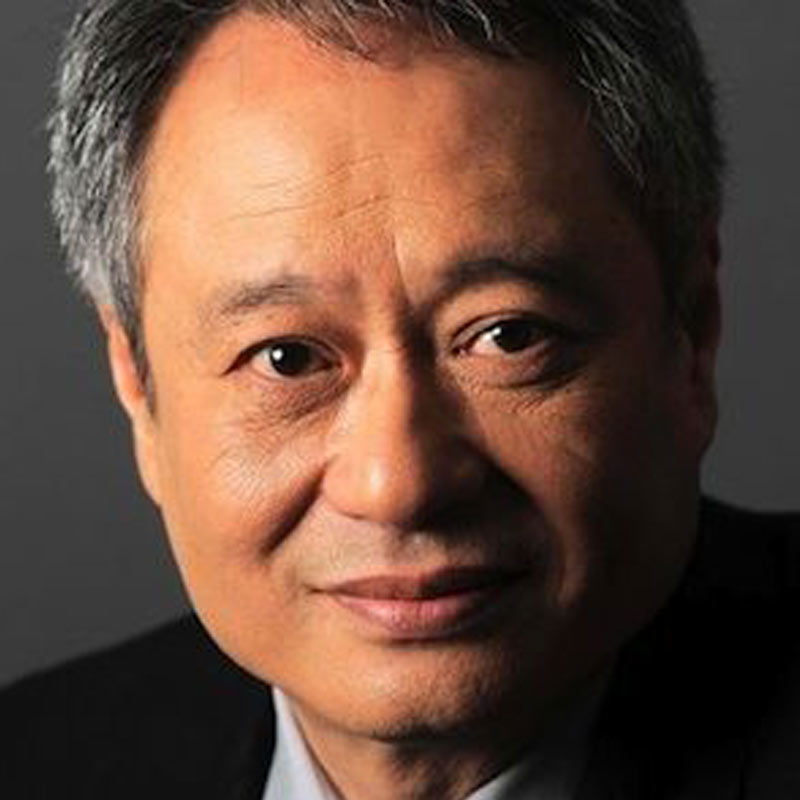
    AMSTERDAM: Ang Lee is an auteur par excellence. His films Crouching Tiger Hidden Dragon and The Life of Pi bear testimony. Lee is open to pushing technology to mount a magnificent tale. Lee was at the IBC here to talk about his latest film Billy Lynn’s Long Halftime Walk.

    What’s different about his latest work is that it has been shot in 4K HD 3D and at a 120 fps frame rate under the Tristar banner for a 11-November release in the US. It is the highest frame rate that a film has been shot at so far, and has been filmed at a budget of $ 46-48 million. The film has been shot on the Sony 4K F65 by two-time Oscar-winning cinematographer John Toll.

    Otherwise, it’s based on Ben Fountain’s 2012 novel by the same name. It follows Billy Flynn, a 19-year old soldier (played by newcomer Joe Alwynn) and his unit who survive a battle in Iraq to return to the U.S. for a promotional tour culminating with a halftime-show appearance at a Thanksgiving football game.

    Lee has said that his film is a story of a young man “learning his place in the world, and of the special brotherhood among men at arms, the depths of their bonds, and the sacrifices they make.”

    Sony’s TriStar and Britain’s Film4 are partnering with Jeff Robinov’s Studio 8 for the film.

    Lee disclosed during his key note that it was a challenge to film at 120 fps 4K HD 3D.

    “We had to really light up everything differently. I wanted realism for this film. I wanted the expressions to be real, and not acting. But, everything was magnified,” he stated. “If the actors overacted or made some awkward facial movements, it became larger than life.”

    “I am a guinea pig for the studio,” he confessed. “Since the day I began this film, everyday has been crazy. I was seeing what was being shot at 120 fps 4K in 60 fps 2K monitors, and it was a challenge. I kept telling my heads of departments that they are not good enough. Because, even I am not good enough while working with this new format.”

    While Lee was greeted with applause, some stated that the clip which was screened looked very much like “video” and did not look like cinema.

    To this Lee, responded, “Please give us a chance. It is a baby, and we are pioneering something. Directing this film has been very humbling for me as no one has tread this path before, shooting in 120 fps 4K, HD, 3D.”

    Lee chose to shoot at these frame rates because it would allow the studio to be able to experiment with various frame rates below — right from 60 fps to 24 fps to 48 for releases in different territories because of the availability — or lack of 4K HD 3D 120 fps projectors – in theatres in different parts of the world.

    “I am not saying 24 fps 2D is not good enough,” he pointed out. “But, it is about making a difference and taking a leap forward in technology and in art.”

    Lee ended by saying he would continue pushing the boundaries on technology in cinema. He would like the equipment makers to come up with smaller cameras, better sensors.