Category: IBC

  • IBC 2025: Media moguls and tech titans converge as Amsterdam buzzes with AI ambition

    IBC 2025: Media moguls and tech titans converge as Amsterdam buzzes with AI ambition

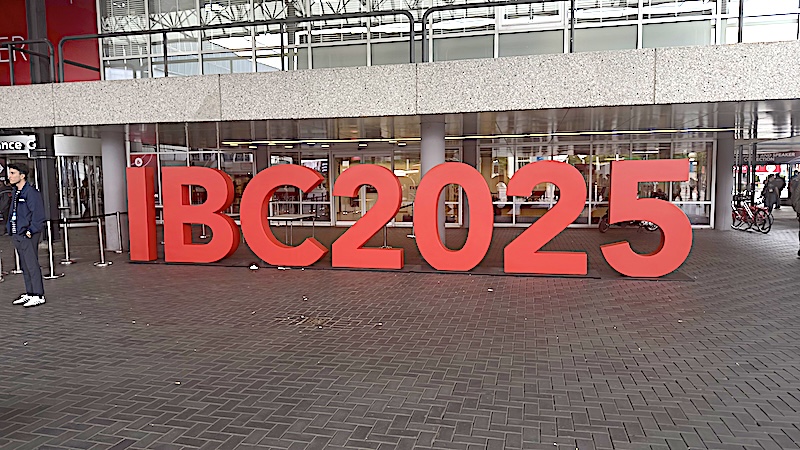
    AMSTERDAM: Amsterdam’s RAI convention centre became the epicentre of media’s digital revolution last week as 43,858 industry professionals descended on IBC2025, the world’s largest broadcasting and entertainment technology show. From global media giants to plucky start-ups, 1,300 exhibitors and 600 speakers gathered to chart the future of an industry in the throes of transformation.

    The event’s success reflects an industry caught between disruption and opportunity. Visitors from 170 countries—from veteran broadcasters to streaming insurgents—came seeking answers to questions that keep chief executives awake at night: how to harness artificial intelligence without losing the human touch, and how to stay relevant as viewing habits fragment across countless platforms.

     IBC chief executive Michael Crimp declared the event had “delivered real business outcomes” with “overwhelmingly positive feedback.” 

    What struck him most, he said, was the prevailing “sense of optimism and purpose”—a notable sentiment in an industry more accustomed to existential dread.

    The debut of Future Tech in Hall 14 captured much of this optimism. Here, punters could witness live demonstrations of generative and agentic AI, immersive media experiences, and cloud-native workflows. France Télévisions showcased a 5G-enabled aircraft, whilst others explored private networks and sustainable innovation—all buzzwords that would have seemed like science fiction a decade ago.

    “We’re witnessing a pivotal moment of innovation,” said Tata Communications global business leader Brijesh Yadev. The hyperbole may be familiar, but the underlying sentiment rings true: the industry is scrambling to reinvent itself before others do it for them.

    This urgency was palpable in the quality of conversations on the show floor. Gone were the days of casual networking; exhibitors reported “more strategic” discussions focused on “future-looking solutions” and “next-phase investments.”

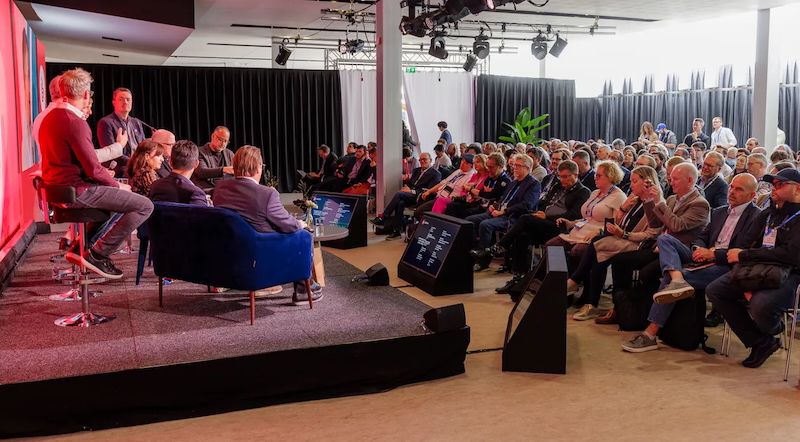
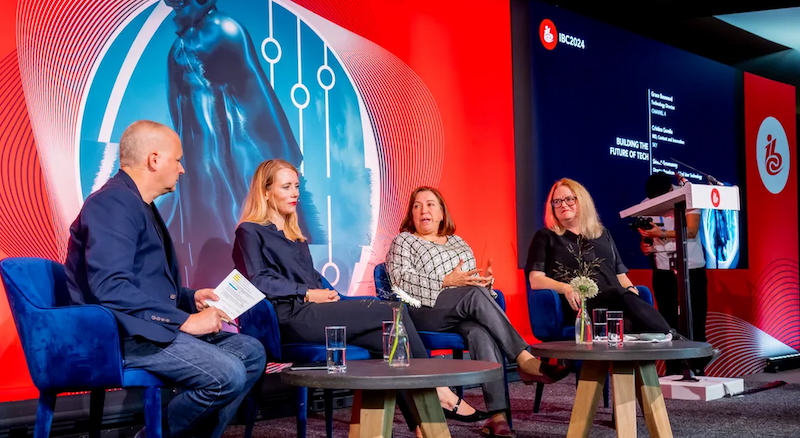
    The conference programme reflected these concerns, with packed sessions on AI, new business models, and sustainability. Icons like Thelma Schoonmaker, the Oscar-winning editor who worked with Martin Scorsese, provided creative inspiration alongside more prosaic technical papers on practical innovation.

    Perhaps most tellingly, the industry is finally acknowledging that technology alone won’t save it. IBC2025 emphasised people and talent, with initiatives focused on skills development and inclusion. 

    The show floor itself told the story of an industry in flux. Established giants like Amazon Web Services, Microsoft, Sony, and Samsung rubbed shoulders with newcomers such as Baron Weather, Momento, and Remotly. Each hall showcased advances in production, distribution, and streaming—the building blocks of tomorrow’s entertainment ecosystem.

    For all the talk of transformation, IBC2025 proved that some things endure. The event remains the world’s essential meeting place for media professionals. In an increasingly digital world, the value of face-to-face connection—and the deals that flow from it—appears undiminished.

    Whether this optimism translates into sustainable business models remains to be seen. But for four days in Amsterdam, at least, the industry felt confident about its ability to shape its own destiny rather than have it shaped by others.

  • “Indian broadcasters need to look at solutions not just products to get real value” – Ross Video’s David Ross

    “Indian broadcasters need to look at solutions not just products to get real value” – Ross Video’s David Ross

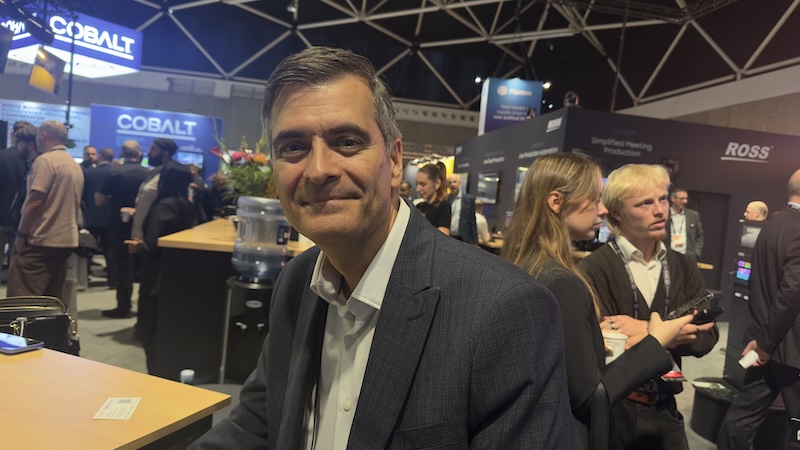
    At around 10 am on 12 September, long before the espresso machines hit their stride, Hall 8 of Amsterdam’s RAI convention centre throbbed with an unexpected chant: “Go Ross Go!” The source was not a marketing stunt but the chairman and chief executive himself. David Ross, head of Ontario-based Ross Video, stood shoulder-to-shoulder with his crew on the IBC show floor,  voice carrying across the cavernous hall. While rival executives do their glad-handing from glassy suites, David prefers to start the day in the trenches, rallying the troops like a regimental captain before battle.
    Engineering and enterprise run in his circuitry. He began programming at the age of nine, scooped up national engineering prizes as a teenager and left university with a computer-engineering degree heavy on business. Before joining the family firm in 1991 he cut his teeth at the CBC and Electrohome, fiddling with projectors and video-effects units. From product manager to head of R&D, then president in 2004 and chief executive two years later, his climb was brisk and unshowy at Ross Video.
    The numbers are anything but modest. Under his watch Ross Video has posted roughly 15 per cent compound growth every year since 1991—without a single downturn, recession or not. He owns more than four-fifths of the company yet has kept it employee-friendly, structuring it as an ESOP and keeping private equity at bay. The mantle of respect is heavy: an honorary doctorate from the University of Ottawa, fellowships from Canada’s Academy of Engineering and from the Society of Motion Picture and Television Engineers, and a trophy cabinet of industry awards.
    For all the laurels, David remains a kinetic learner. He trades ideas with fellow chiefs through TEC (Vistage in America) and gulps down management audiobooks while pounding out marathon miles. It is this mix of technical curiosity, fiscal discipline and boyish gusto that has made Ross Video one of broadcasting’s quiet powerhouses.
    When Indiantelevision.com founder and editor in chief Anil Wanvari caught up with him at IBC, the conversation roamed from the science of sustaining perpetual growth to the sheer pleasure of building kit that makes television sparkle—proof that the man leading the cheer is also the engineer behind the magic. Excerpts from the tete a tete:

    On what’s exciting him about IBC 2025.
    To start off we just bought a company. And we just had some fun with it. We are talking about, you know, peanut butter goes with jelly, movies go with popcorn and you know video goes with audio. So we bought Lama (Lean and Mean Audio) – a company that does audio entirely software-based in the cloud and on-prem. It’s quite a comprehensive feature set. It’s also got automix and things like that. They did 16,000 streams of audio for the Paris Olympics where they needed to match up commentators with crowd noise – and to have it automatically set up. They were doing hundreds and hundreds of them a day.  We are going to sell what we have and over time we are going to do more with it.

    On whether Ross Video’s acquisition streak is going to continue. 
    Lama was our twenty second acquisition. Acquisition number 23 is almost done. We can’t talk about that, But watch this space. We also do organic growth. If all we were going to do is grow through acquisition, we would not have 500 people in R&D like we do today. So that’s a major investment, especially when you consider that Ross Video is only about 1500 people. One in three are designing new products. And also considering we have our own manufacturing in-house. That  is a major commitment to new product development.  But we look at everything that is adjacent to- complimentary to – what we do. Everything has to connect with what we do in multiple ways.

    The first robot I actually bought was in house, and we bought it out. It was the Furio, which is on tracks. I did that around 2011 or so. It was a bit of a shock when I came back and said: “Stop everything. Let’s start building robots.” Then we did Cambotics three months later, and then we did an organic product, which was SkyDolly and and just last year, we launched Artimo, which was an organic product based upon acquisitions. So, how much is acquisition? How much is organic? It kind of gets all blurred after a while, because we’re doing brand new innovations, but because we are already in the market. Now we have that technology that we brought in house. You’re going to see the same sort of thing again, with Lama, you know, bringing in audio in house. Great. What’s next? That’ll be organic,

    On whether Ross Video will consider outsourcing production to cheaper locations such as India or China
    What we make in our industry is generally not interesting to make in India or China. They want to make a million of something. We make hundreds or thousands of something. Very, very complex products at lower volumes than the mass market. There’s a lot of enhancements and back and forth of R&D. It all makes sense to have all of that in-house. It might be more expensive for us to do the manufacturing in China as there’s a lot inefficiencies in working with an outside company and also it’s just not interesting to them. Our factories are designed to make studio robotics or routers or production switchers.
    On the product gaps in the company’s portfolio and how will Ross fill those.
    We’re already in broadcast, we’re in sports and live events, we’re in OB vans, we’re in mega churches, we’re in government, we’re in corporate, high end type production. We’re already in stadiums that’s actually our biggest market. What else can we do? I know there’s there’s other adjacencies. So I can’t quite tell you where our gaps are. You could say that we’ve got a great portfolio, and we can create some really great end-to-end solutions. I can also tell you that there’s 1000 companies that aren’t part of Ross; they do stuff that we don’t do. So you could say that we’ve got a thousand gaps. In other words, lots of opportunity in the future.

    On how long can the motivated and family like culture continue at Ross Video now that it is expanding aggressively.
    I think I enhanced it a little bit coming forward from what my father John had put in place. You know, there was a day when I had to move from the Iroquois in Canada  location, where we really started, and to Ottawa, an hour north. And not being in the factory, things started to go wrong, and culture started to change. And I’d hear stories about people not working well together and so on. That was only when we were around about 75 people, and I thought to myself  how are we going to get to 100 people and keep the culture? It’s already falling apart, so we sat down and wrote up the Ross Video code of ethics. We wrote down the Ross Video culture. We put it in everybody’s, you know, walls or their cubes and their offices, their home offices. We put it on the website. It sits on the doors of our meeting rooms. Here we live it. And when you do that, it’s a culture that can extend potentially indefinitely, because I’m already not in every location, but we’re able to bring people on. They understand what it is. We got a lot of people that live this culture and love it. And people who don’t match that culture, that don’t respect each other, that don’t help each other, that aren’t focused on customers, that sort of thing. They don’t last very long at Ross Video, sometimes they self-select and out they go. They just don’t fit. So how big can we go? I know, as big as you want.

    On how Ross Video deals  with a market like India where price plays a very important role in closing a deal and negotiations can be endless as compared to other countries.

    Well,  the thing is I am unaware of a major manufacturer of routers or production switchers or sports analysis tools or robotics out of India. We’re competing with the same players, for the most part, in India that we do with in the rest of the world. So really, the question is figuring out the right solution for the job and sharpening your pencil for India is but in the end, you know, it’s the same products. So I would love to be able to discount our products to 90 per cent but then it would be cheaper for us to just shovel money and not sell products, because we’d have been losing money on everything we sell.

    So, so from the point of view of price, I think India, like everybody else as well, does have certain minimum requirements for what they want. I mean, I was looking at a bid from Doordarshan just yesterday, actually,  “they didn’t just say we would need a production switcher. We want the lowest price.” They had, you know, a couple of dozen criteria the product. Before you can bid, you must have all of these high end features. And if you qualify for that, then we want to see the best price. So it’s not just a race to the bottom.

    These features are important to our customers in India like everywhere else, because they provide value. And I think what we need to start doing in India as well, like we have been doing everywhere else, that is not just talk about a product, its features and its price, but also the ecosystem and the solution that we provide.

    For example, you know, OverDrive works really well with our Carbonite production switchers. Carbonite production switchers work really well triggering XPression graphics. XPression graphics work really, really well with our with our weather system Raiden. Xpression workflows work really well with Voyager, which ties in sports analysis, which talk  to our instant replay systems and so forth. So you can see there’s a thread that goes through everything that we do that also has value. And I think if one of the things you have to have a conversation with locally is discuss the system that you want, the solution that you want, and not just bid for individual products. Because I think if India continues to just look at one product at a time, some features and a price, they’re missing out on unlocking real value and real savings in workflow and efficiencies.

    On whether Ross Video will consider serving the individual creator community at some stage.
    I’m going to say only at the highest end, yeah, one of the most important things when you have a company of any sort is the path to market. How are you going to be communicating with a market, and how are you going to service that market? Ross Video is very intentionally set up to have a close relationship with its customers. When somebody comes onto our booth in an exhibition, we know who they are, we know what they need. We understand their company, their needs. We often know the person, even have a relationship with that person, maybe over many years.

    When you’re talking about the creator community, and you say there’s a million creators out there, we can’t do that. That is a different type of a sale. It’s a sale where it’s about marketing, it’s about lead generation. It’s about no price negotiation. It’s about clicking and buying it on a website. We’re not set up for that. And also it’s about a larger mass market.

    And in the mass market as well is that’s where you have to build in millions at a very, very low price, very little customisation, if any. That’s not what we do either. We do more expensive products. That’s what our factory is set up to do. And we have, we would say, a more expensive but more intimate connection with our customers. When the creator community, you know, gets to a certain point, if you have one that’s making it, you know, has a lot of eyeballs, therefore making a lot of money, they want to transform from to a more professional look, and they want to create a studio, then we’re there for them. So we don’t need to move into the content creator business to be able to get to the billion dollars in revenue from the 500 million we have now, but to get to $2 billion in revenue, maybe, maybe that’s next. But right now, I think the way we want to leverage our customers and our brand and our go to market and our manufacturing capability and our design expertise, more so to be able to double the size of the company.

    On the role that AI is playing at Ross Video and in its products.
    AI is a really, really big topic. It’s everything like it’s interesting inside the company. You could say there’s inside, there is outside the products, and then there’s many types of AI as well. Inside the company, there’s AI everywhere. Pretty much everybody that wants chatgpt gets an enterprise copy of it inside of Ross video, so we’ve got like, 1000 copies of chatgpt running at any given time. We’re using it, developing our software. We’re using it developing our manuals. We’re using it to drive our website, our manuals. We’re using it writing our specifications, our market research, internal communications. We’re using it everywhere, and that’s on purpose, because I want to make sure that all of our employees, in all ways, become very, very familiar with AI and be able to get more ideas of how can it affect workflows and get that comfort.

    Now, inside of Ross Video, we have something called Ross Research Labs, and that is different and separate. Ross Research Labs is different and separate from all the product groups. So we got, you know, R and D team for production switches, another for routers, another for graphics, another for robots and so forth.

    Ross Research Labs is there for all of the different groups. So for example, recently, they were using AI to do player tracking for our Piero system, our sports analysis system, and be able to make sure that when one player goes through another player and comes out the other side, it doesn’t suddenly get identified as a new player. It can track them properly they had to go through we actually worked with universities to figure out the very best algorithms to be able to make player tracking work.

    We also take a look at the pitch, say for cricket or football or something like that, where we can look at that, and we can now use AI to calculate where the camera is that’s taking that image and what the zoom setting is on the lens and everything else, and understand where it is. The camera is in a three dimensional space, so we can overlay graphics with it. That was another thing that came out of Ross Research Labs.

    Another thing that we’re doing is Ross voice control. So this is speech to text, but we have examples of major broadcasters. I’ll say that that I’ve done hour long productions where the presenter is speaking, controlling the graphics, running maps and creating all these animations behind them. There is no one in the control room following this and pressing any buttons. It is all speech to text. That text goes into an engine that then drives through an API our products to be able to do the production. And when we did it, there was only one time that somebody had to reach in and press a button over a one hour or two hour production, which is just amazing, and it was running faster than  any human operator could could run in real time.

    There’s another thing that we’re just starting to work with as well, which we’re starting to do in stadiums where we’re doing closed captioning, basically, but for the big screen. So people who can’t hear that, or maybe the crowd is too loud they want to hear what a commentator said. We’re actually putting that up on the screen. We can also do it in real time. Translations. We’ve compared that to human translators, and we’re faster by like, five seconds, and more accurate as well. So that’s another use of AI that we’re starting to roll out, and that came out of some of our other R and D teams. There’s more going in that direction. The next side of things as well. Oh, of course, our Artimo, you know, has all sorts of facial tracking and body tracking and things like that for our cameras to be able to keep talent centered in a production quality way, but there’s more

  • IBC 2025 brings the future of media to Amsterdam

    IBC 2025 brings the future of media to Amsterdam

    AMSTERDAM: Amsterdam’s RAI convention centre will become the global capital of media and technology from 12–15 September when IBC 2025 opens its doors to broadcasters, streamers, studios and tech firms from around the world.

    The show will run 10:30–18:00 on opening day, 09:30–18:00 across the weekend and close at 16:00 on Monday. Organisers have built the edition around the theme of innovation, with a newly minted Future Tech hub in Hall 14. Here visitors can test emerging tools such as artificial intelligence, cloud-native production workflows, augmented reality, virtual sets, immersive audio-visual formats and sustainability-driven hardware.

    A three-day conference, from 12–14 September, features more than 300 speakers drawn from major broadcasters, global streaming platforms, technology vendors and creative studios. Panels will probe platform evolution, revenue models, AI integration and the next wave of interactive storytelling. JioStar’s Prashant Khanna is one of the headlined speakers being featured at IBC this year. 

    Elsewhere, the IBC Innovation Awards will celebrate cutting-edge deployments, while the Accelerator Media Innovation Programme offers collaborative trials of experimental tech. Free-to-attend theatres and showcase stages promise continual demos and debate on content delivery, rights management, talent development and the fast-changing business landscape.

    Beyond the exhibition floor, organisers are pitching IBC 2025 as a working laboratory: a place where engineers, producers and executives can handle new kit, swap ideas and chart the next phase of global media transformation.

  • IBC honours Thelma Schoonmaker with top award as Globo and EBU team recognised

    IBC honours Thelma Schoonmaker with top award as Globo and EBU team recognised

    AMSTERDAM: IBC has named legendary editor Thelma Schoonmaker as the recipient of its highest accolade, the International Honour for Excellence. A three-time Oscar winner and lifelong collaborator of Martin Scorsese, Schoonmaker will also appear in a fireside chat at the Rai Amsterdam on 14 September, free for all attendees.

    Two other major honours were announced ahead of the IBC Innovation Awards. Globo will receive the IBC Special Award, recognising a century of media innovation and leadership in Brazil. Meanwhile, a Swiss team from the European Broadcasting Union and HEIG-VD will take home the best technical paper award for groundbreaking research on artificial intelligence in trusted news.

    This year’s awards highlight both sides of the media equation: Schoonmaker’s enduring commitment to the art of editing, Globo’s forward-looking broadcasting strategy, and the EBU-led team’s pioneering work applying AI to journalism. Winners will be formally recognised at the IBC Innovation Awards ceremony on 14 September in Amsterdam.

  • IBC2025 conference lines up global media heavyweights and bold ideas

    IBC2025 conference lines up global media heavyweights and bold ideas

    LONDON: IBC 2025 has pulled back the curtain on a turbocharged conference programme packed with power players from across the global media, entertainment and tech ecosystem. From 12 to 14 September at RAI Amsterdam, the three-day summit promises to tackle media’s defining challenges—AI disruption, fragmentation, collapsing business models, and the war for attention.

    Top brass from Netflix, Walt Disney Studios, Paramount Global, Snap, TikTok, YouTube, Roku, TelevisaUnivision, PGA Tour, kweliTV and India’s JioStar are among the featured speakers. Industry provocateur Evan Shapiro will headline with a data-fuelled keynote, while seasoned commentator Mike Darcey closes the show with a sharp take on rights, economics and the shape of future broadcasting.

    “This year’s agenda is urgent, imaginative and provocative,” said IBC head of content Sally Watts. “We’re bringing together disruptors and legacy leaders to map the media universe as it shifts beneath our feet.”

    The conference kicks off with a heavyweight CTO roundtable featuring Avi Saxena (Warner Bros. Discovery), Simon Farnsworth (ITV) and Phil Wiser (Paramount). Big tech meets broadcast in sessions like YouTube’s Pedro Pina in conversation with Channel 4’s Grace Boswood, and Snap’s Jorrit Eringa alongside execs from Yahoo, Sky, Sling TV and A1 Group dissecting the future of content collaboration.

    TikTok’s Rollo Goldstaub will explore how short-form video is rewriting the rules of sports engagement, while Netflix’s Victor Marti and Vancouver Media’s Migue Amoedo offer a behind-the-scenes look at storytelling innovation.

    In a major AI-focused session, ABC’s Damian Cronin unpacks how the broadcaster is embedding machine learning into its core workflows. Meanwhile, DeShuna Spencer (kweliTV), Brad Danks (OUTtv), Rajat Nigam (JioStar India) and others weigh in on what’s next for the streaming wars.

    ‘MovieLabs – Leading the Vision’ sees Disney, Sony, Warner Bros. and Paramount map the road to 2030 for content creation, moderated by MovieLabs president Richard Berger. Sunday’s schedule spotlights Fremantle’s Jens Richter on global distribution in a post-peak TV world, while PGA Tour execs reveal how they deployed live AR shot-tracking across all 18 holes — winning a Sports Emmy in the process.

    In the closing session, Mike Darcey, now managing director at Tide End Consulting and former News UK boss, breaks down how rights, economics and regulation must evolve to fit the new media order.

    Beyond the main stage, the IBC Technical Papers Programme offers 10 peer-reviewed sessions delving deep into bleeding-edge R&D across 5G, 6G, AI, immersive formats and content authentication. Topics include:
    * AI in speech, postproduction and curation
    * Provenance, privacy and content trust
    * Wireless tech advances from 5G to 6G
    * IP Studio 2.0 and live production
    * Sport tech, AR, avatars and AI-enhanced streaming

    Registration is now open at show.ibc.org.

  • IBC2024 to champion real-world AI applications for the global media industry

    IBC2024 to champion real-world AI applications for the global media industry

    Mumbai: IBC2024 has unveiled a host of exciting new show features and speaking sessions to showcase real-world artificial intelligence (AI) advances across the IBC Conference, the IBC Accelerator Media Innovation Programme and the show itself, including the new AI Tech Zone, powered by EBU. AI innovators and media and entertainment (M&E) companies will be able to learn, network, collaborate and unlock business opportunities driven by new AI use cases throughout the event, which takes place in the RAI Amsterdam on 13-16 September.

    “The media industry is ready to look beyond the AI hype and focus on real-world applications that deliver tangible benefits for businesses and consumers,” said IBC CEO  Mike Crimp.”IBC2024 will showcase an array of hands-on demos and use-case-driven discussions — reflecting M&E’s demand for a grounded conversation on how AI is impacting our sector today and in the long term.”

    “AI spend in media is set to reach $13 billion by 2028. It is influencing every element of the content value chain but businesses need more clarity around where and how it can be harnessed most effectively,” said Maria Rua Aguete, Omdia’s Senior Research Director, Media and Entertainment. “Spotlighting high-impact use cases and collaborating to overcome adoption challenges will be key to unlocking AI’s transformative potential for the media industry.”

    The new AI Tech Zone, powered by EBU, brings together emerging AI providers, established producers, content creators and innovators looking past the tried and true to re-imagine media creation and operations from the ground up. The zone will be presented by headline sponsor AWS and partner, NVIDIA, fueling hands-on AI demonstrations. Dell Technologies has been announced as a platinum sponsor with partner, NVIDIA. The AI Tech Zone Stage will be sponsored by Wasabi Technologies, while the AI networking zone – sponsored by DOT Group and IBM – will empower the IBC community to engage directly with some of the most innovative players pioneering AI for M&E.

    EBU head of media fundamentals and production Hans Hoffman said: “The AI Tech Zone is a must-attend for show attendees. We are now moving on from ‘future potential’ discussions to seeing how practical AI applications in the workflow can enable public service operators, broadcasters and other media organisations to generate real value. Visitors to the AI Tech Zone will witness firsthand how AI is shaping a smarter, more efficient media world.”

    An array of sessions on the AI Tech Zone Stage will spotlight groundbreaking AI advances across areas including content authenticity, intelligent media storage, accessibility, mixed reality and creativity in production while sharing critical insight into regulation and policy developments. AI thought-leaders taking to the stage include zone sponsors and representatives from AI Caramba!, BBC Studios, Eluvio, EPFL, Fraunhofer, IBM Aspera, Ina, KBS, Liverpool Football Club, PacGenesis, RTVE, Univeristy of Seoul, VIDEO.TAXI, and YLE News Lab. The full AI Tech Zone Stage schedule is available here.

    Alongside sponsors, AI Tech Zone exhibitors will showcase pioneering AI technologies ranging from automated video editing and music-audio separation to advanced data analytics and business optimization to content provenance tracking and fast and secure cloud storage. Exhibiting companies include AI4ME, AudioShake, Blu Digital Group, Brai, CheckSub, Deepdub, Eleven Labs, Eluvio, EU Project X Reco, Globant, HP (Z by HP), Imaginaro.ai, ITTIAM, Magnifi, Media Monks, MobiusLabs, PacGenesis, Scenery, Schweizer Radio und Fernsehen, Seagate Technology, Tabsons, The Weather Company, V-Nova, Vera.AI, Video.Taxi, Videolinq.ai, VionLabs, and Zaibr.

    AI-focused sessions and thought-leaders will feature across all show floor theatres and at the IBC Conference, where AI will be one of the primary themes explored — with keynotes from industry visionaries charting the evolution of AI in media and presenting new strategies to harness AI for creative workflows. The conference will also spotlight a number of AI in Action case studies, unveiling how generative AI and new data frameworks are already transforming live sports fan experiences and enhancing business operations for major broadcasters including ITV, Olympic Channel, and Sky. The full IBC Conference agenda is available here.

    Meanwhile, a number of companies across other exhibition halls will showcase new AI product launches and technologies for the first time at IBC2024, including Ateliere Creative Technologies, Backlight, Cinegy, Evergent, farmerswife, HAND, IMAX, InSync, ioMoVo, Media Excel, MediaKind, nxtedition, Operative, Periphery, Pixotope, Profuz Digital, Telestream, Telos Alliance, and Vubiquity.

    Another IBC-first is the introduction of the AI Media Production Lab within the IBC Accelerator Media Innovation Programme, exploring a series of specific AI concepts to improve creativity in storytelling, deepen non-biased audience feedback and engagement, and power real-time predictive analytics to personalise live sports viewing. The three project strands, ‘Generative AI in Action’, ‘AI Audience Validation Assistant (AAVA), and ‘Changing the Game: Predictive Generative AI’ are being driven by Champions including Al Jazeera, BNNVARA, Channel 4, EBU, Evangelische Omroep (EO), IET, ITV, Paramount Global, Rai, Verizon Business, Vodafone, World Freestyle Football Association, Yle, and Zwart. Technology participants include Magnifi, Plan 9 Labs, Pluxbox, Respeecher, RKG Creative, Somersault, and Xansr Media.

    Each project strand will be showcased with proof-of-concept demonstrations in Hall 3 at the Accelerator Zone and on the Innovation Stage.

    Find out more about AI at IBC2024 here

  • Disney Star India  shortlisted for IBC2024 Innovation Awards

    Disney Star India shortlisted for IBC2024 Innovation Awards

    MUMBAI: Disney Star India is in the running for this year’s IBC2024 Innovation Awards which are to be held on 15 September at 18 hours. The category for which it has been shortlisted is the social impact award for its work with India Signing Hands through which it brought the IPL 2024 coverage to almost 67 million hard of hearing and 34 million visually impaired fans on Star Sports.

    Late last month, the IBC announced the finalists for the IBC Innovation Awards which celebrate and honour collaborative initiatives leading to ground-breaking solutions that address real-world media, entertainment and technology industry challenges. This year’s awards bring together under one roof IBC’s innovation and social impact awards to create a unified celebration of industry advances, with five categories now being judged: content creation, content distribution, content everywhere, social Impact, and environment & sustainability.

    “This year’s entries once again showcased the global reach and appeal of the IBC Innovation Awards with projects of the highest quality received from six continents,” said chair of the 2024 IBC Innovation Awards jury Fergal Ringrose. “Meanwhile, constantly evolving delivery methods and audience consumption patterns demand that content producers around the globe must innovate dynamically in order to stay relevant and competitive in the modern media and entertainment technology ecosystem. I would like to sincerely thank our panel of judges for their diligence and ability to adapt, as we brought our three content categories together with environment and sustainability and social impact this year for our new-look IBC Innovation Awards.”

    Former news anchor Sasha Qadri is set to host the awards in the auditorium complex at the RAI on Sunday.

    This year’s finalists in the Content Creation category include:

    * The National Football League (US), ESPN, Disney/Pixar and Beyond Sports for creating the first fully animated, real-time NFL alternative broadcast set in the Toy Story universe.

    * Olympic Broadcasting Services and partners for live broadcast production with more than 200 smartphones contributing video for the Paris 2024 Opening Ceremony and a sea-based 5G network for sailing competitions in Marseille.

    * Aspire for working with Vislink and FocalPoint VR to develop a virtual reality over RF wireless solution for the inaugural season of Aspire’s Abu Dhabi Autonomous Racing League (A2RL).

    The organisations named as finalists in Content Distribution are:

    * Claro for creating a new approach to pay TV in Brazil, integrating streaming channels and applications, delivering entertainment to consumers with a complete pay TV offer.

    * NBCUniversal Operations and Technology for its pioneering project to transform the way its TV channels are delivered to consumers worldwide.

    * The National Hockey League (Canada and US) in partnership with Verizon, AWS, Zixi, Vizrt and Evertz, for producing a 5G and Edge compute framework for assembly, control and delivery of live broadcast.

    The Content Everywhere finalists are:

    * LaLiga for working with Play Anywhere and Ease Live to enable true fan interactivity for itself and its worldwide broadcast and streaming partners.    

    *Red Bull Media House for bringing together real-time GPS tracking, data management and advanced visualisation to transform viewing experience across live broadcast, web widgets and AR mobile app.

    * Franceinfo (France Télévisions) for working with PimpMyCompany to aggregate text/audio/video/photo messages from various platforms and broadcasting them live on air.

    Apart from Disney Star, the  Social Impact finalists are:

    * CultureQ for a new technology platform developed by indigenous-owned tech company Kiwa Digital that enables indigenous peoples globally to revitalise their language and culture at scale, while retaining sovereignty

    * Sesame Workshop for its Watch Play Learn Distribution Hub which allows government agencies and aid organisations to preview and request videos for children in crisis settings.

    The Environment & Sustainability finalists are:

    * France Télévisions for reducing CO2 emissions by 300 tons via a pioneering 100% glass-to-glass cloud production and private 5G network.

    * GreeningofStreaming for addressing growing industry concerns about the energy impact of the streaming sector, with international reach and over 30 member organisations.

    * Anton/Bauer for Salt-E Dog which harnesses the power of sodium chemistry to enable sustainable television production practices.

    The Innovation Awards ceremony will also feature the presentation of the IBC International Honour for Excellence, which goes to an individual or organisation that has made an outstanding impact in the industry, and the best technical paper, with all papers being presented at the 2024 IBC Conference that runs 13-15 September in the auditorium complex of the RAI.

  • IBC 2022: EditShare to showcase cloud and hybrid media workflows

    IBC 2022: EditShare to showcase cloud and hybrid media workflows

    Mumbai: The technology leader, EditShare on Wednesday announced that it will use IBC2022 to showcase how its latest technologies boost quality and efficiency for production & post production. Demonstrations will show how remote working and the cloud can interwork to give creative artists seamless and secure access to the tools they rely on.

    EditShare chief revenue officer Said Bacho commented, “The post industry is changing, in part reflecting the changes enforced by the pandemic, and in part because creative talent is looking to shift the work/life balance.”

    “What we now present is an ecosystem where editors and other post artists can choose their preferred tools, and work where they like, when they like, without it in any way compromising their creativity or limiting the quality, even as we move to 4k and higher resolutions, and to HDR.”

    Central to this development is the ability to use EditShare storage spaces and FLOW workflow tools to synchronise projects across the popular NLE platforms, including Media Composer, Adobe Premiere Pro and DaVinci Resolve.

    The company said that the latest release of core FLOW software allows complex projects to be moved as needed between EditShare media management and whichever edit environment the creative team needs to use.

    EditShare’s FLEX software solutions that enable out-of-the-box cloud and hybrid workflows will get its first showing in Amsterdam during IBC.

    Further, Editshare added that FLEX reflects the powerful business trends in post today, including the migration to a “work anywhere” environment, with ready access to content wherever the creative staff need to be. In adopting cloud storage and processing, it also meets the move towards an OpEx financial model, with the cloud hosting and storage fees flexing to reflect the level of business.

    EditShare’s EFS Multi-Site will also be on the booth for the first time this IBC.  

    Multi-Site allows users with multiple locations to leverage built-in file acceleration to synchronise project storage between EFS clusters in different facilities. This ensures that users have ready access to content, wherever they choose to work. FLEX Cloud Sync extends the capabilities of Multi-Site to cloud storage, providing added flexibility in access as well as security in archiving.

    The company added that for news and sports fast turnaround editing, FLOW supports direct ingest of NDI contribution feeds for immediate editing. Working in conjunction with the Helmut orchestration platform from MoovIT, IBC will see demonstrations of practical high-pressure editing operations linking EditShare storage with Adobe software.

    Content security and availability is vital to professional users, and EditShare has added new hardware and software in this area.

    The new EFS 60NL nearline storage provides 60 drive bays and nearly 1PB of storage in just 4U of rack space.  This offers secure storage for large amounts of content which is needed but not immediately worked on, ready to be transferred to the online servers with virtually no delay. The 60NL is also the first hardware platform to utilise the new EFS capability for erasure coding-based storage goals, eliminating the need for hardware based RAID.

    Rolling updates to EditShare’s FLOW software platform ensure that the latest raw formats from popular camera systems like RED and Blackmagic Design are accepted, with LUTs imposed in real time, both on full resolution material and on proxies, boosting remote working using intelligent proxy management.

    “IBC has always been very important to EditShare, a real opportunity to exchange ideas with our users and partners from around the world,” Bacho added. “The whole team is excited to be returning to Amsterdam, seeing our users and partners face-to-face, and discussing the creative and operational challenges they encounter and how EditShare can provide proven solutions today and into the future.”

  • IBC19, Amsterdam: ‘Red Bee Media builds hybrid media cloud environment with Cisco and 7fivefive’

    IBC19, Amsterdam: ‘Red Bee Media builds hybrid media cloud environment with Cisco and 7fivefive’

    MUMBAI: Red Bee Media has been working with Cisco and 7fivefive to create a sophisticated media centric hybrid cloud environment, designed to streamline media production, playout, media processing and distribution services for global broadcast customers.

    As one of the world’s leading managed services provider, Red Bee is creating a next generation media environment with cutting edge-technology including the Cisco Unified Computing System (UCS) and cloud software.

    “The Media landscape has changed forever and this cloud platform, with best of breed software coupled with our own micro services will allow us to significantly change the way managed services are offered in the market.”, says David Travis, Chief Product & Technology Officer, Red Bee Media. “It allows for commercial and technical flexibility while addressing the cost challenges all our customers are facing. Our work together with 7fivefive and Cisco is a showcase of innovation with the creation of a hybrid cloud architecture that is truly unique in the media industry.”

    Cisco UCS  provides a unique network architecture with cloud-like behaviour on-premise with an end-to-end hardware stack with superior performance and security to manage today’s network demands, and into the future. 7fivefive is the consulting and integration partner leading project implementation. With this new hybrid cloud media solution Red Bee can offer enhanced speed and performance across its portfolio of solutions including:

    ·         Access services

    ·         Channel origination

    ·         Content origination, production and post production

    ·         Content enrichment and distribution

    ·         Media management

    ·         OTT Streaming

    Dave Ward, senior vice president, CTO of Engineering and chief architect, Cisco, says: “Red Bee is marking a milestone in the industry’s quest to transition to IP and virtualized media data centres for simpler, faster networking. Our work together with 7fivefive created a cloud-powered network with the flexibility and security Red Bee needs to scale quickly and adapt to the demands of the media and entertainment landscape.”

    Red Bee Media will be showcasing its new cloud-ready platform at IBC in Amsterdam with its ‘Leaders in Live’ demonstration featuring Live football utilizing pure software defined services all in IP. You can see the demo at 11.00 Friday, 16.00 Saturday and 13.00 Sunday on the Red Bee Media Booth (14.D26).