Category: IDOS

  • VBS 2018: New tariff regime dominates discussion on Day 2

    VBS 2018: New tariff regime dominates discussion on Day 2

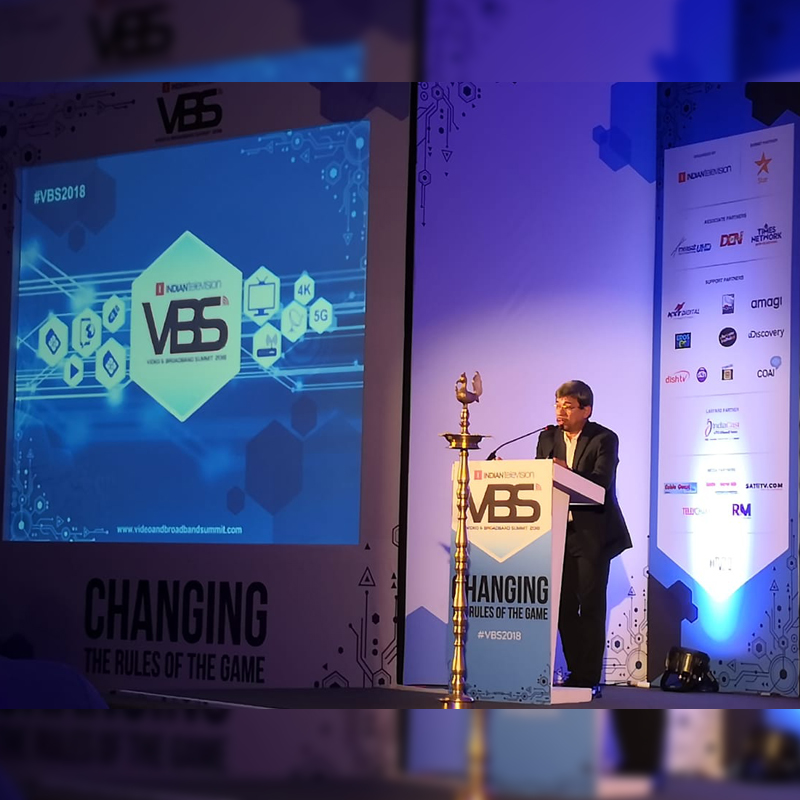
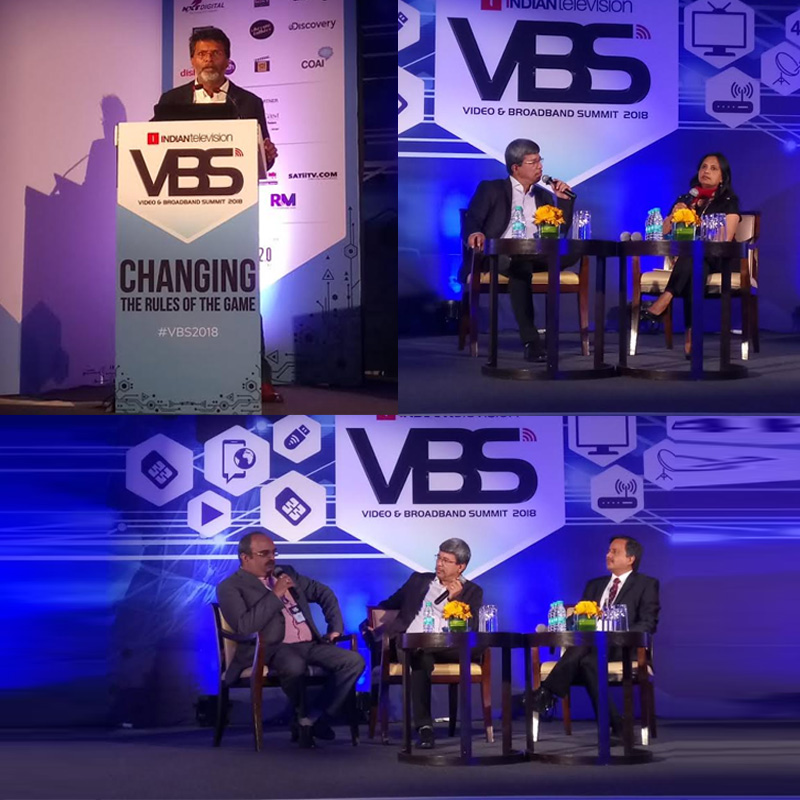
    GOA: The second day of the Video and Broadband Summit started with a keynote speech from Times Network MD and CEO MK Anand where the media veteran shared his insights on how to keep playing when the game itself changes.

    “Media Business is primarily about distribution of content to serve consumers needs profitability. If that remains the core purpose, the why to keep playing becomes clear,” Anand said in the beginning. While everyone is talking about disruptive forces, he said coping in the media business is highly dependent on keeping up with changes in distribution technology. He also spoke about how Times Network dealt with such issues.

    Anand’s visionary speech was followed by a fireside chat between Indiantelevision.com founder and CEO Anil Wanvari and Sony Pictures Networks monetization strategy and consumer insights head Saurabh Yagnik. Analytics, big data and content were the focus of the session.

    Doordarshan additional director general Mr.Sunil talked about DD Free Dish, the major force in distribution of satellite television in a presentation. While a huge number of consumers across India use Free Dish, he said its user base is expected to grow by 40 million by 2020. He was also part of a fruitful discussion on the future of pay-TV with Travelxp CEO Prashant Chothani in a session moderated by Anil Wanvari.

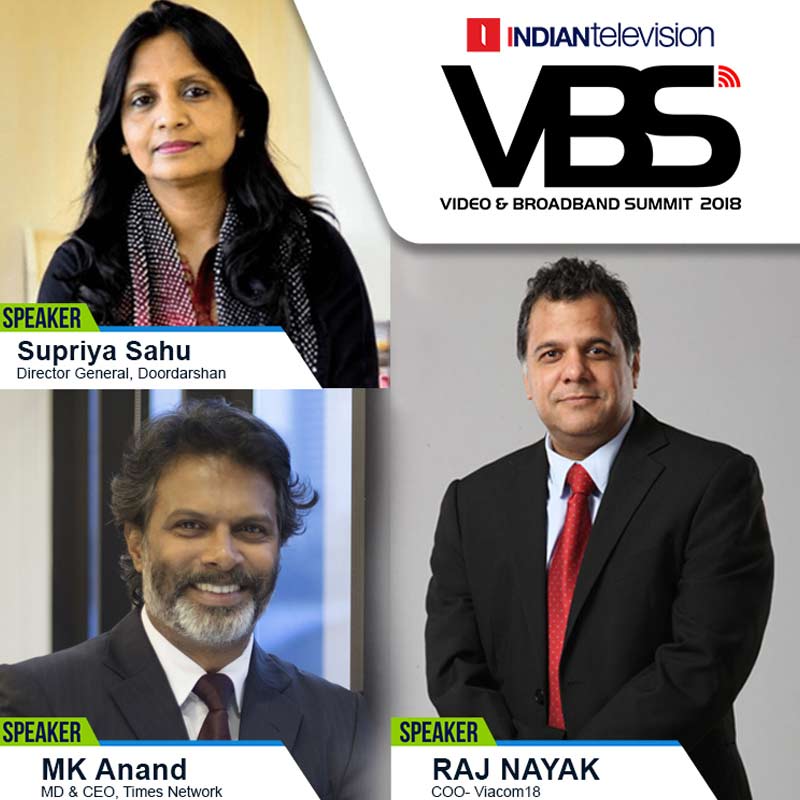
    Following that engaging session, Doordarshan director general Supriya Sahu highlighted the evolving role of the public service broadcaster in a fireside chat with Anil Wanvari. She said there should not be comparison between a private broadcaster and pubcaster as the latter’s mandate is totally different.

    While the first evening witnessed a lively discussion on monetization of TV, the second day dealt with the ‘big advertising hangover’. Viacom18 Hindi mass Entertainment Ad Sales head Simran Hoon, TAM India CEO LV Krishnan, Prashant Chothani were part in the panel.

    The second half of the day focused on the new tariff order, the next biggest disruptor in the complex industry, and evolving models in the cable industry. Talking about the disruptors in the distribution industry, KCCL CEO Shaji Mathews said technology has been the enabler, not the driver. In another session, IMCL CEO Vynsley Fernandes said on a positive note that if LCOs, MSOs come together magic can be made.

    More interestingly, TRAI secretary Sunil K Gupta interacted with audience via Skype. Gupta answered questions of local cable operators who seemed to be really concerned about the new regime. He informed the audience of how TRAI is taking initiatives to make consumers aware of the upcoming change.

    BARC India CEO Partho Dasgupta, another media veteran who has witnessed the ups and downs of the industry spoke about the digital matrix measurement in India. “Data protection is of utmost importance in the age of GDPR policy compliance and Srikrishna (SPDI) committee regulations. BARC is keen to ensure the consumer data is protected in our suite of products,” said Dasgupta.

    The last session of the day focused on the e-gaming scene in the country as Nodwin Gaming content head Gautam Virk explored the possibilities about how e-gaming could usher in the next wave of content consumption. Talking about possible potential partners he said, “It is easier to work with OTT platforms because they are more updated with the technology.” He also reaffirmed e-gaming is to stay here and is not a short term trend.
     

  • VBS 2018: Media & entertainment industry leaders address pressing issues on Day 1

    VBS 2018: Media & entertainment industry leaders address pressing issues on Day 1

    GOA: Rapid advance in technology and infrastructure, entry of disruptive forces and changes in consumption habits have led the Indian media and entertainment industry to major conversion. The interesting developments are attracting international players to invest in the market, with traditional domestic players adopting new strategies for growth. Where the industry is heading in the next few years is something everyone wants to know.

    To seek answers for several concerning questions, Indiantelevision.com brought together industry doyens on the first day of the Video and Broadband Summit. The conference dedicated to industry issues has been supported by esteemed broadcasters, technology companies as well industry bodies. All the speakers agreed that the VBS platform is the perfect stage to discuss relevant issues as well as to gain new insights while sharing their experience.

    Indiantelevision.com founder and CEO Anil Wanvari set the tone for the day with his welcome speech. He spoke about how demonetisation and GST put pressure on business in last couple of years. He also highlighted how the burgeoning OTT industry is throwing new challenges to traditional TV, cable and DTH operators along with the new tariff order that is likely to reshape the trajectory of the sector. He also added how a disruptive force like Jio FTTH is fueling the transformation.

    The first session moderated by Anil Wanvari was about the future of digital delivery platforms where Tata Sky chief content officer Arun Unni, PwC India partner Raman Kalra and One Take Media founder and CEO Anil Khera participated. As the influence of video and broadband has become unmistakable now, Tata Sky recently rolled out a broadband service. While he was asked about how it stands out, Unni said customer centric nature of the business makes their service different. While broadband and telco players are throwing a challenge for distribution, Khera thinks India still has potential for DTH and cable growth owing to almost  90 mn households still unpenetrated by TV. Kalra said while pay-TV and OTT platforms will stay together, there will be a constant battle among players to stay relevant to consumers with proper content.

    In a fireside chat with Anil Wanvari, COAI director general Rajan Mathews spoke about various issues in the telecom industry. He said consumer choices are changing rapidly today, hence the model which is working at present, may get disrupted in future. He also spoke about the high cost of utilizing satellites in the country despite them being produced and launched at very low cost. Talking about 5G, he said it will take a while to be rolled out and added that it would be focusing on education, health, traffic management, smart cities and agriculture.

    Anil Khera who has now ventured into the value-added service space after spending considerable time in the DTH industry, explained the importance of this vertical and how DTH players are utilizing it.

    Another engaging session where audience also took an active part in the discussion, was about monetising TV in times of transition. ZEEL chief growth officer Ashish Sehgal, KMPG India media and entertainment partner and head  Girish Menon and TAM India CEO LV Krishnan spoke on the issue. “Only thing TV can't do is engagement which digital platforms allow but you cannot build your brand without TV,” Sehgal made a very important comment.

    The eventful day ended with a fireside chat between Viacom18 COO Raj Nayak and Anil Wanvari. Nayak shared glimpses of his inspirational journey in the industry and Viacom18 where he was the brainchild of several successful endeavors. Talking about the future, he said it will belong to those who can create content which is compelling. Moreover, he also said content cost is not going down but it's going up across broadcasters. Giving the example of Netflix’s change of fortune with House of Cards, he added that for changing the trajectory of the business, delivering two-three golden nuggets every year are enough.

    For more insights stay tuned for the updates from the second day of video and broadband summit 2018!

  • Video and Broadband Summit to focus on technology, media and telco convergence

    Video and Broadband Summit to focus on technology, media and telco convergence

    MUMBAI: The last two years have witnessed major transformation in entertainment and media industry in India and abroad. Entry of digital platforms, rapid rise in internet users, and disruption in the telecom industry have worked as catalysts. With the emergence of a new media, consumers are getting more attention than ever before.

    During this flux, Indiantelevision.com is bringing together stalwarts from the industry on a platform that dissects the various issues at the heart of the technology, media and telco confluence. The initiative is called Video and Broadband Summit (IDOS in its earlier avatar) at Grand Hyatt, Goa between 28-29th November. Leaders from DTH, cable and broadband, broadcast, regulatory bodies, technology segments will discuss the state of the industry, address issues and find solutions.

    Zee Entertainment Enterprises Ltd chief growth officer Ashish Sehgal, Times Network MD and CEO MK Anand, Viacom 18 COO Raj Nayak, Doordarshan director general Supriya Sahu among others will share their valuable insights on the state of the ecosystem, chalking out an agenda for the future.

    The focus of the summit will be on the topics such future of digital delivery platforms and Pay-TV, monetization of TV, unlocking the potential of 5G, and most important of all the new tariff regime.

  • IDOS 2017: OTT is here to stay but may not replace pay TV

    IDOS 2017: OTT is here to stay but may not replace pay TV

    NEW DELHI: The over-the-top (OTT) medium is here to stay and cannot be put down, but the television medium will continue to survive in the face of this challenge in India.

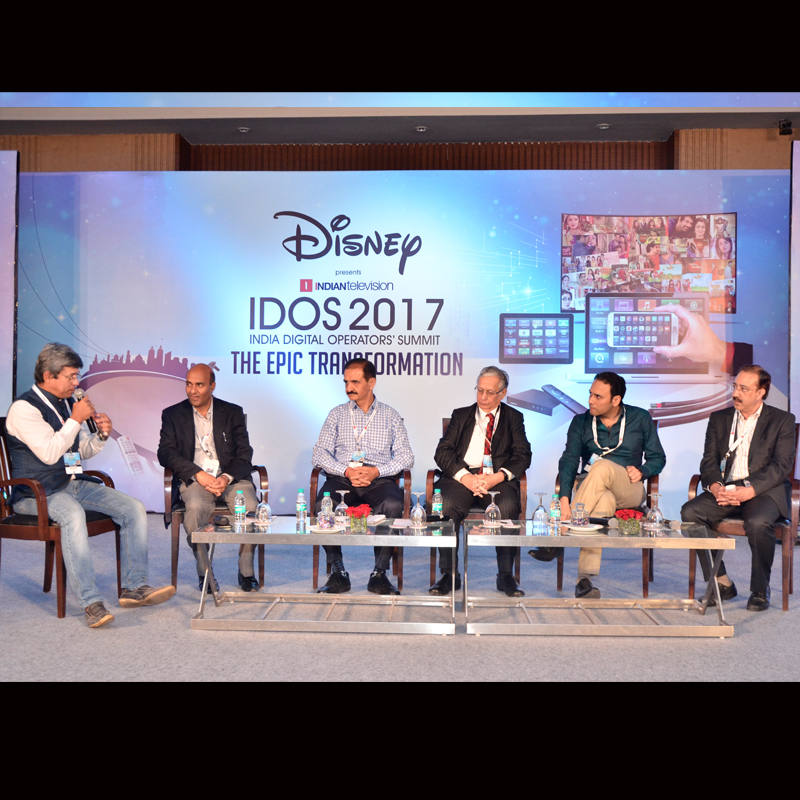
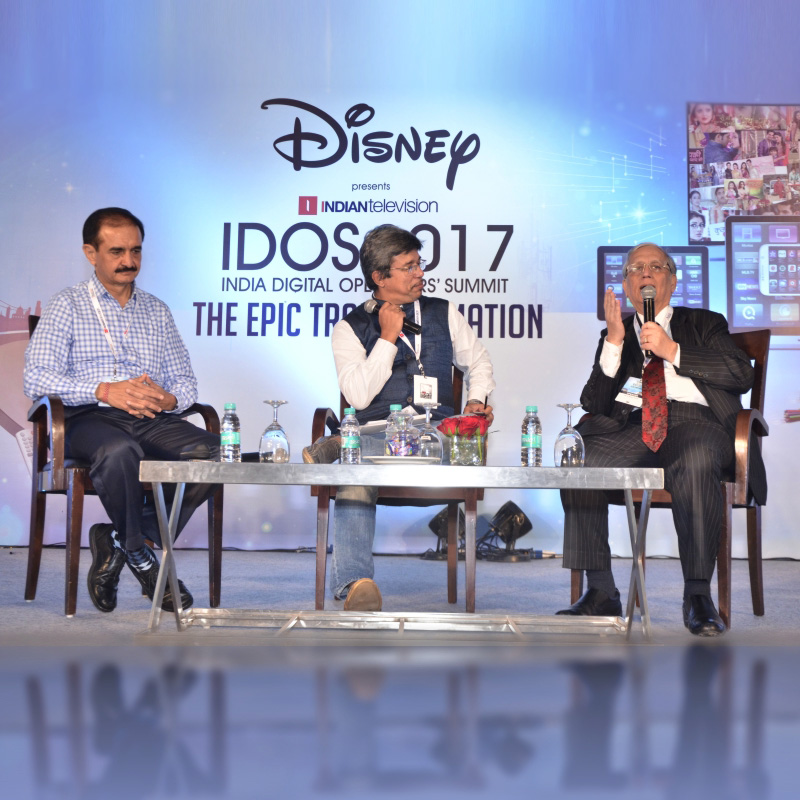
    The stressful life of today and the relationship built by the local cable operator are other reasons for the survival and well-being of the television medium. These were some of the views expressed at a discussion on the OTT Challenge to Pay TV at the Indian Digital Operators Summit organised by indiantelevision.com and moderated by the latter’s founder, CEO and editor-in-chief Anil Wanvari.

    Viacom 18 Digital Ventures’ senior vice-president and head of marketing Akash Banerji said that OTT would fundamentally change the scenario but admitted that “we over-estimate the short term, and under-estimate the long term.” He felt that the impact of OTT on pay TV may begin to show some change by 2020-21, but not immediately.

    Clearly, he said, some disconnect with the cable operators had led to the growth of OTT. Secondly, OTT was providing the content relevant to the individual viewer. Thirdly, he said that Viacom 18 was for the first time indulging in a B2C model where the consumer had the last word. He, however, admitted that the long-term survival of OTT lay in the medium moving to a subscriber-based scenario.

    Shaji Mathews, who has recently joined as the CEO of Kerala Cable Communicators in Kochi, said that OTT was no challenge, and (on the contrary) it would augment TV. He was confident that wired technologies will continue to dominate even as wireless technologies attempt to make inroads.

    He also felt that there was no level playing field for OTT at present, and so growth will take time.

    DEN Networks CEO S N Sharma said that the MSOs had entered the field of OTT in an attempt to provide a platform to various OTT players only to reach the consumer, realising that the consumer habits are changing. DEN had made inroads as far as fee-to-air OTT was concerned, and was only amalgamating the OTT players. The aim was to move with technology.

    Ashok Mansukhani of Hinduja Media Group admitted that OTT was a gigantic disruptor of the entire value chain but felt it would take some years to make inroads.

    Vynsley Fernandes of CastleMedia felt that the growth of OTT would largely depend on who has the TV remote in the home.

    Sisir Pillai of Lukup Media was confident that whatever the medium, it would survive if it had adequate content.

  • IDOS 2017: Tech needed to integrate different media in a single box

    IDOS 2017: Tech needed to integrate different media in a single box

    NEW DELHI: With the scenario changing to that of a multi-screen era, the need of the hour is to create a single technology that can deliver all systems into the home.

    This was the general view of CastleMedia’s Vynsley Fernandes and Rahul Nehra, the founder of Kalpin and national secretary of Society of National Telecommunication Engineers, in a panel on soft solutions for set-top box hardware at the Indian Digital Operators Summit organised by Indiantelevision.com whose founder and CEO Anil Wanvari moderated the discussion.

    Fernandes felt that the STBs of today should be like home media gateways that could help operate OTT, tablets or laptops, SD and HD TV, gaming and even radio. The aim was to have master devices that could operate all media.

    He regretted that the failure rate of the present STBs which were mostly of Chinese origin was very high – seven to eight million failed every year.

    The cable industry had learnt its lesson the hard way whereas the direct-to-home STBs were more porous and met the needs of the DTH industry.

    With more options which included complicated technologies like virtual reality, Nehra said, there was need for more sophistication. He said there were no STB manufacturers but the demand for TV remained high, thanks to the cable operators.

    But, he said, work had begun in this direction and a pilot project near Hyderabad was almost ready to prepare hardware for the software. He said consumers wanted HD at the rate of SD and so newer technologies had to be found.

  • IDOS 2017: Television is growing and will continue to do so, says BARC’s Partho Dasgupta

    IDOS 2017: Television is growing and will continue to do so, says BARC’s Partho Dasgupta

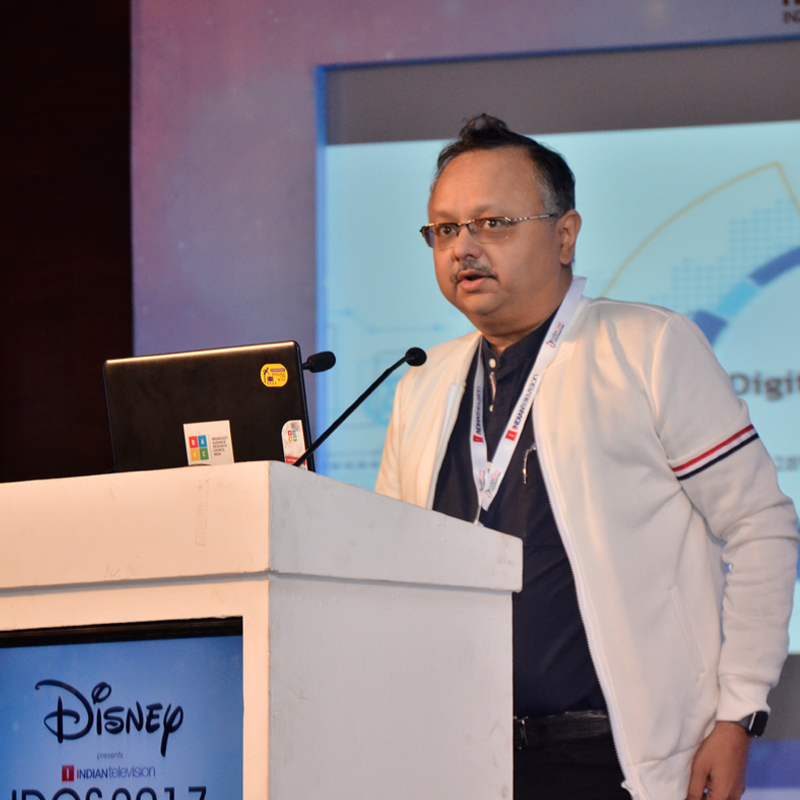
    NEW DELHI: Broadcast Audience Research Council (BARC) India CEO Partho Dasgupta sounded a positive note at Indiantelevision.com’s 13th Indian Digital Operators Summit (IDOS 2017) in New Delhi’s The Lalit on 28 September 2017. Dasgupta stated that the video distribution ecosystem will have place for all types of DPOs – DTH, cable TV, OTT, terrestrial, free to air and even FTTH.

    “India’s cable TV operators have been pretty resilient over the years,” said he. “There is a lot potential for them to distribute video in India. TV has till now reached around 64 per cent of the Indian households. Thirty-six per cent is still left. A 100 million households are still not connected with TV. Even if 50 million more were to get connected, that’s a lot of potential for everyone. Multiple players and multiple digital formats will exist,” he said.

    He explained that India is one of the few countries where around 40 (television) channels are being added (as per MIB permissions) every year. “The launches are happening because there is potential in the market,” he said.

    He pointed out that TV viewership is seeing growth like never before. “It spurted by 25 per cent to 27.0 billion impressions in 2017, from 22.4 billion impressions in 2016,” he stated. “Even the daily average time spent (ATS) has grown by 16 per cent from three hours seven minutes in week 41 2015 to three hours thirty-seven minutes in week 36, 2017.”

    Dasgupta exclaimed that Doordarshan’s FreeDish is emerging as a potent force. “Free TV with 80 channels is being watched in rural areas. For them, the fact that some of the programmes are repeats does not matter because viewers are watching them for the first time.”

    He highlighted that there is a lot of excitement around flat TVs, HD TV, 4K TV, but the reality in the Indian marketplace is that 86 per cent of TVs are CRT (cathode ray tube) sets. “There is movement upwards expected in this area too,” he added.

    Dasgupta was of the view that the new millenials are watching some TV but they are also consuming video on their handheld devices. “However, OTT has some way to go because of bandwidth issues in India,” he pointed out. “Though the situation could change soon with dropping bandwidth prices and quality. And, we are getting ready with our measurement of multiscreen viewing which will include handheld devices.”

    He stated that future of television looks healthy, as almost every genre is showing growth in terms of viewership. “GEC has expanded 12 per cent since the beginning of the year,” he elaborated. “News and movies have also grown. Hindi movies grew by 60 per cent in 2017 over week 41 of 2015; Hindi news by a whopping 93 per cent in 2017 over week 41 of 2015.”

    For TV industry professionals, that should surely come as good news.

  • IDOS 2017: Cable TV sector needs more collaborative broadcasters, say MSOs

    IDOS 2017: Cable TV sector needs more collaborative broadcasters, say MSOs

    NEW DELHI: Even as the multi-system operators and cable operator are doing their bit to aid digitisation, broadcasters need to participate more in the process which officially has been completed. They need to be more transparent and supportive of the distribution platform operator — in this case the MSO and cable TV operator — and not be like a tax collector always asking for more.

    This was the general view of both, S N Sharma of Den and Ashok Mansukhani of Incable in a discussion in ‘The Indian MSO: Redefining the raison’etre’, who also said it was only now that the MSO was beginning to monetise almost five years after digital addressable system was first launched.

    Furthermore, the broadcasters were still free to fund the business as they wanted, and, as Sharma put it, there are only two laws that control the broadcaster – the Programme and Advertising Codes and the Cable Television Networks (Regulation) Act 1995. Thus, there is virtually no regulation for the broadcaster, Sharma said.

    Both, Sharma and Mansukhani agreed that MSOs and even LCOs had put in a lot of effort to get DAS off the ground — that too in a period of four to five years, which is unprecedented globally.

    “The DAS regulation was brought in for transparency and to allow everyone to have a fair share of the huge subscription revenues that viewers were paying to watch cable TV,” said Sharma. “But, the sad part is that broadcasters are constantly asking for rate increases of 24 per cent or so without even asking if it were possible,” added Mansukhani.

    They said that it would be better if the broadcasters were to communicate rate increases to viewers and invest in promoting that, rather than expecting MSOs who are just about recovering from the hangover of the huge investments they have put into DAS as well as getting robust systems and processes in place. “Also, we are not equipped or have the creative mindset to communicate this effectively for all channels,” agreed both Sharma and Mansukhani.

    Rather than going to courts to stall the TRAI tariff order, they said, broadcasters could collaboratively work with the DPOs to take DAS on to the next level. “Neither the government nor the regulator has been able to do anything,” they said.

    “We have our own troubles, recouping our investments to bring back profitability into the cable TV sector, as well as dealing with piracy and leakages which broadcasters take time to check and stop because they have procedures to follow,” said Sharma.

    Mansukhani disagreed with Indiantelevision.com founder, CEO and editor-in-chief Anil Wanvari that the cable TV sector will not be in a position to manage complicated skinny a la carte bundles for the millions of customers that it serves. “Our backends are ready,” he said. “Our SMS, billing and KYC of the customers is in place,” he said. “We are just waiting for the (court) order to come through.”

    He opined that the industry would ultimately survive the changes, and he was also confident that the cable industry was ready to adapt to any new technology.
    To a question about monetisation, Sharma said the MSOs were not beginning to reap the monetary benefits of Phase I. Even the DTH industry was beginning to break even only now, more than a decade after it was launched.
    Mansukhani said he was happy that the Hinduja’s headend in the sky (HITS) NXTDigital was reaching 1.5 million consumers. But, the need was to break even as early as possible and “giving a dividend to my shareholders.”

    But, he stressed the need to keep the dialogue open with the LCOs who are the ones dealing with the consumer. Consumer connect has to continue. He regretted that the level playing field that he had hoped to get from the government has never came.

    Both Mansukhani and Sharma agreed that, though the government had not made a difference between the urban and rural viewers, this was necessary if there has to be penetration in rural areas. Otherwise, they would go to Doordarshan’s FreeDish.

    Sharma said his company was soon launching a device that would not be internet-based and could be used for all gadgets including mobiles, TV, tabs, and so on.

    Mansukhani said that it was clear that the MSO will have to graduate from being a TV MSO to a multi-screen MSO.

  • Friend MTS announces major initiatives at IDOS 2016

    Friend MTS announces major initiatives at IDOS 2016

    GOA: Friend MTS (FMTS), a leading digital piracy containment technology and service provider, announced here at IDOS 2016 that India would be strategic to its plans over the coming years.

    Industry stalwarts from the broadcast and cable industry, spanning all segments of cable, OTT and DTH, at IDOS 2016 acknowledged the opportunity and challenges in a digital world, including that online and digital piracy is a growing menace that needs to be addressed and tackled sooner rather than later.

    The participation of FMTS at IDOS 2016 highlights this very fact as India goes digital and Indian content, its owners and creators not only surge ahead, but also grapple with digital downsides like online piracy.

    FMTS EVP Paul Hastings said, “We have engaged with almost all the stakeholders in India, ranging from broadcasters to DTH operators to OTT players to Films and Television Guild. There is recognition across the board that the next generation piracy containment service based on forensics-global identification- monitoring and takedown from FMTS will be a game changing offer to the Indian market”.

    Friends MTS’ South Asia partner Rahul Nehra added, “FMTS anti-piracy service offerings will help content owners realize substantially higher revenues and we will be working relentlessly with all stakeholders, including the government, film associations across regions and Indian Broadcasting Foundation to prepare, prevent and profit from this digital revolution.”

  • Friend MTS announces major initiatives at IDOS 2016

    Friend MTS announces major initiatives at IDOS 2016

    GOA: Friend MTS (FMTS), a leading digital piracy containment technology and service provider, announced here at IDOS 2016 that India would be strategic to its plans over the coming years.

    Industry stalwarts from the broadcast and cable industry, spanning all segments of cable, OTT and DTH, at IDOS 2016 acknowledged the opportunity and challenges in a digital world, including that online and digital piracy is a growing menace that needs to be addressed and tackled sooner rather than later.

    The participation of FMTS at IDOS 2016 highlights this very fact as India goes digital and Indian content, its owners and creators not only surge ahead, but also grapple with digital downsides like online piracy.

    FMTS EVP Paul Hastings said, “We have engaged with almost all the stakeholders in India, ranging from broadcasters to DTH operators to OTT players to Films and Television Guild. There is recognition across the board that the next generation piracy containment service based on forensics-global identification- monitoring and takedown from FMTS will be a game changing offer to the Indian market”.

    Friends MTS’ South Asia partner Rahul Nehra added, “FMTS anti-piracy service offerings will help content owners realize substantially higher revenues and we will be working relentlessly with all stakeholders, including the government, film associations across regions and Indian Broadcasting Foundation to prepare, prevent and profit from this digital revolution.”

  • IDOS 2016: OTT  advertising vs TV advertising

    IDOS 2016: OTT advertising vs TV advertising

    GOA: Is Online Video (read: OTT) advertising eating into TV’s share? That was the question posed  by the final session of IDOS 2016 held in Goa’s Leela Hotel. The obvious consensus answer from the panelists was a big “no” – and it does not take a genius to reach that conclusion.

    On the panel were IPG Media brands CEO Shashi Sinha, Sony Pictures Network India (SPNI) digital head Uday Sodhi, Starcom India Group CEO, Mallikarjun “Malli”  Das and Eros Now business head Zulfiqar ‘Zulfi’ Khan.

    “Digital advertising accounts for about eight to nine per cent of total ad spends,”  said Malli. “Most of this goes towards Google, Facebook. Two to three per cent is going towards digital video, and that too most of it is going towards You Tube.  It’s early days yet for the OTT players to have any revenues of significance.”

    “Google has played a pioneering role –  the educational and evangelizing approach that it along with YouTube took visiting advertisers and agencies to explain to them the efficacy of using it  platform,” said Zulfi. “The OTT industry is too nascent and new, and has a lot of work to do.”

    Sinha pointed out that the disparity in CPMs between television and online IP video is drastic. “Television is being sold on a cost per rating point (CPRP) basis in India today. In most countries, it is on a CPMs,” he said. “The CPMs even for TV are very low, and for online video, even lower. Airtime on television has become a commodity as there is plenty of inventory, but networks have large enough audiences to present to advertisers.”

    public://IMG_5444.jpg

    Added Malli: “Television also has a reliable currency – BARC – to measure what’s happening to their spends – the reach, the viewership. Which makes all of us in the media and advertising community secure. We can buy across a network and aggregate audience.”

    The panelists agreed even though the OTT players are providing very specific – in fact a surfeit of data, enough confidence has yet to be built in among the advertisers. “There’s fragmentation in the OTT community. There are too many platforms,” said Sinha. “And you can’t aggregate enough audiences of significance to allow us to take CPMs up here.”

    Sodhi agreed that OTT video platforms had managed to build an active audience of about 70 million. He said: “China’s tipping point for OTT to significantly impact TV ad spends came when the number of users crossed 200 million.  India has to grow. SonyLiv has around around 10 million. Good and stable bandwidth and right pricing  of data are the issues to be dealt with to expand the OTT user base,” Sodhi said.

    Malli believed that the audience of 70 million is large enough. “The Times of India has a seven and a half million readership and there is thousands of crores going into the paper.”

    Both Malli and Sinha stated that agencies have started presenting media plans which, include TV plus and online video. “That’s a great improvement over earlier. We are putting in money behind online video. But it’s left to the OTT- owner – the broadcaster – to show it as OTT ad spend or TV ad spend. However, to be fair, the sector will grow when FMCGs start putting in their faith behind digital online video,” revealed Sinha.

    Then what is holding the ecosystem back? “Most of the robust OTT platforms are backed by the broadcasters,” revealed Sinha. “The leadership is fearful their targeted revenue objectives from television might get impacted if they start shifting the focus more toward digital video advertising. This leadership has to take a hard call.”

    He pointed out that BARC – of which he is a technical committee member – is gearing up to measure online video consumption and become the second country in the world to do so.

    “We are ready to launch online video measurement  by March 2017. Relevant data is going to be provided by some of our partners in the ecosystem to allow us to provide effective measurement numbers. However, the signal has to come from the broadcast community,”  he quipped.

    Zulfi pointed out that Eros Now has around a  million subscribers – split between India and overseas – paying Rs 49 a month for its Bollywood movie service.

    However, his view that today snacking was the primary form of consumption of digital video, was countered by Sodhi, who stated  that the SonyLiv audience was sticking around for  around for 16-22 minutes per session.

    They all agreed that there is a bright future for digital video advertising. But, none wanted to hazard a guess as to when will it happen. “I have no clue when will the inflection point come,” Sinha said. “It is now.”

    Malli too said that he had no clue about it. “Although the stage is set, I can’t predict when a significant migration to digital will happen — in one, two or three years from now.”

    Sodhi revealed that almost 70 million users are being added to the digital video consumers pie every year. “Within two to two and a half years we will have 200 million users,” he predicted. “And that will be a number no one will want to ignore. The advertising tap will flow and flow then.”