Category: Ficci Frames

  • Regional audiences are not second class

    Regional audiences are not second class

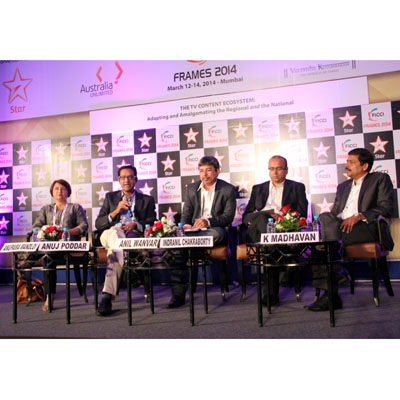
    MUMBAI: Two big regional broadcasters and two big production houses got together to discuss ‘TV content ecosystem: Adapting and amalgamating the regional and the national’ at FICCI Frames 2014. The session started with a keynote by Asianet Managing director K Madhavan and was followed by a discussion among panelists that included Viacom18 regional channels EVP Anuj Poddar, Fremantle India MD Anupama Mandloi and BIG Synergy COO Indranil Chakraborty on the opportunities in the regional entertainment space. The discussion was anchored by indiantelevision.com Founder, CEO and editor-in-chief Anil Wanvari.


    Madhavan started off by predicting that in three years, the ad revenue coming from regional channels will be equal to that of the national channels. He also highlighted that the biggest problem for regional broadcasters is carriage fees.


    “The regional market is about Rs 5,000 crore in terms of advertising revenue and we are the second largest in ad revenue as well as viewership after the Hindi GEC genre,” said Poddar. He also stated that there is a misconception that regional means language while it actually is a reflection of the culture. “Even Hindi television has its stories based on regions – for instance Ballika Vadhu was based in Rajasthan but adapted for national Hindi television.”


    Chakraborty said BIG Synergy entered the regional space five years ago and found that the regional audience was considered as second class as against the Hindi GEC audience. But that mindset is changing. “The word ‘adaptation’ is wrong. You need to redefine content to make it relevant to that audience,” he said. 


    He said he was happy that regional viewership that TV channels generate is getting its due in terms of ad rupees. “Earlier, regional TV channels had higher share of the overall  national viewership but the advertising expenditure on them was much less than that share. In 2013, ad expenditure on regional has gone up and and share of viewership is matching with share of advertising if you check out the latest Ficci report.”


    Added Poddar:  “This change clearly shows that advertisers and media agencies have understood the value of regional television and are willing to pay more for air time as they get targeted viewers. Even the coming elections are seeing a large amount of political advertising expenditure being shifted towards regional TV.”


    Regional channels seem to have taken the 12 minute ad cap very happily. “Sun raised its ad rates by 60 per cent and we (Asianet) raised it by about 20 per cent,” said Madhavan. He revealed that while earlier the ad rates of regional channels were one tenth of a national (read Hindi GEC) player, today they are up to about  25 per cent.


    The good part about regional television is that budgets for shows are rising, explained Chakraborty. An example of this is the regional adaptation of Kaun Banega Crorepati, which saw its budget going up 10 times as compared to what was being invested in other regional non-fiction shows.  This happened at a time when the Hindi version was being subject to budget cuts.


    As far as regional contributing to national and vice-versa in terms of show concepts, formats and storylines is concerned, Wanvari cited several instances where this has taken place in the Indian context.


    Said he: “Dance India Dance that super franchise from the Zee Entertainment stable began from Dance Bangla Dance produced for Bengali audiences. Today it has spawned several sub-franchises – Dance India Dance Lil Champs, Dance India Dance Super Moms, Dance Maharashtra Dance. Similarly with Big Boss which began on Colors and has since then been produced on its sister ETV channels in  Bengali and Kannda. KBC gave birth to editions on Tamil, Telugu, Malayalam on the Star network even as it aired in Hindi on Sony Entertainment TV and in Marathi on ETV Marathi. Ballika Vadhu was remade by the Network 18 group in Tamil, Telugu and Kannada, even as Uttaran has been remade in Marathi.”


    Wanvari pointed out that the reverse has also happened with shows from regional television being adapted to Hindi TV. “The Telugu soap Shravanti came on air as Dil Se Di Dua Saubhagayvati Bhava; Tami serial Kolangal was remade as Maayke Se Bandhi Dor; Tamil soap Thirumathi Selvam gave birth to the long running Pavitra Rishta; Idhayam turned into Dil Se Diya Vachan; Telugu show Ratha Samptamai  resurfaced as Rakht Sambandh; Bengali series Khela as Badalte Rishtey Ki Dastaan and then of course  the Ravi Ojha produced super successful show Sasural Genda Phool which emerged from the Bengali series Ogo Bodho Sundari,” highlighted Wanvari.


    He went on to further state that Star India has been working on reaching out its Hindi productions  to regional audiences, by dubbing shows such as Satyamev Jayate, Mahabharat and Mahadev in other languages such as Tamil, Telugu, Bengali, Marathi, and Malayalam and airing them on its regional language channels under the Asianet group and Star Pravah.


    “Taking a national product to regional is called revenue optimisation,” said Chakraborty talking about dubbing of national shows to regional languages.”For an adapted  show to work it needs to be locally adapted to suit the culture. “


    Poddar emphasised that it is not enough to dub regional shows, regional adaptations of Hindi national shows requires a lot of research and localisation to suit  cultural tastes and emotions. “When we had to remake Ballika Vadhu which is about a child bride for our Kannada channel, we looked around for a district in Karnataka where child marriage is prevalent and based our story there as the rest of the state does not have it as a practice as it is in Rajasthan. Also the pacing of the storyline in the Kannada version was faster.  Similarly, for the Marathi adaptation of KBC we went for a couple participant concept in the show and had Sachin Khedakar host it. “


    Chakraborty highlighted that there are benefits which accrue from Hindi show adaptations to regional languages and the other way around too. “Initially, we had to instill best practices and skillsets we had picked up while producing the Hindi version when we decided to go regional. Now the best practices and skillsets we got while producing the regional shows are being brought to Mumbai and  instilled in our crew while producing the Hindi version.”


    Fremantle Media India MD Anupama Mandloi confessed that her production house – which produces the successful formats Indian Idol and India’s Got Talent – has not yet taken the plunge into regional television but it is something which would be of great interest to her. “We have the experience of producing an international format and localising it in several countries, languages, cultures,” she said. “And we have done it successfully. We would like to  make some further inroads in regional television soon.”


    Madhavan added that Star Plus’ show Satyamev Jayate had realised the potential of regional which is why it was dubbed in so many languages and regional stars were roped in to promote it. He pointed out that Mahabharat dubbed in different languages has not proved as popular as Mahadev. But he revealed that even then the show has been a profit generator for his network. 


    “Simulcast is driven by commercial imperatives as a business model,” said Poddar.


    When prompted by Wanvari as to why don’t regional channels add subtitles to their shows, he said it is an option he is willing to consider.

  • Arnab Goswami’s brand of journalism is infotainment, says NDTV’s Vishnu Som

    Arnab Goswami’s brand of journalism is infotainment, says NDTV’s Vishnu Som

    MUMBAI: Sensationalism vs old style journalism: The debate on highly opinionated journalism vs plain reporting of events as a journalist can be unending. But when it comes to highly capital intensive television journalism, the debate boils down to viewership and its monetisation.
     
     
    Times Now Editor-in-Chief Arnab Goswami’s brand of aggressive journalism, some call it sensationalism while the man himself describes it as passionate journalism, was the subject of a panel discussion on ‘The Big Fight For Primetime’ at FICCI Frames 2014.
     
     
    NDTV Editor Vishnu Som, when prodded by BBC Global News Senior Anchor Jon Sopel, said “An editor’s job is to provide news. I believe Arnab does infotainment.”
     
     
    Som though admitted that the issues taken up by Goswami are valid but his style and way of presenting is different. “We cannot be aggressive beyond a point. I don’t think it is for journalists to define news. You just report it,” said Som.
     
     
    News that does not get the eyeballs is not good enough content from the monetisation point of view. “If it does not get good ratings, it is not good content. It is all about viewers. That connect has to be there. If not, it cannot be monetised,” said Zee Media group CEO Bhaskar Das, claiming Goswami’s primetime show advertisement slots sell for Rs 25,000 per 10 seconds, while it could be Rs 20,000 for NDTV and is barely Rs 2,000 for Zee News.
     
     
    Arnab has made himself a brand and he has been rewarded for it, said Das, who was with the Times of India group when Times Now was launched.


    MCCS India CEO Ashok Venkataramani said brand building is equal to the charge of your slots and once you have built a brand, the ad slot charge can be higher than what the ratings demand. “The best way to get advertising revenue is by stopping TRPs. My Hindi and Marathi and Bangla channels don’t get high revenue because of ratings but because they are premium channels.” MCSS owns ABP group of news channels.


    NDTV’s Som said, “We dont believe in TAM. We have done five studies to know that we are the number one channel and people may disagree. What the advertisers are looking at right now is corrupted data  (in the form of TAM ratings).”
     
     
    The news television industry is heavily dependent on advertising revenues and the quality of journalism is directly impacted by the revenue flow. “If advertisers cut rates, we can’t do good journalism,” Som said.
  • Can social media be a useful tool this election?

    Can social media be a useful tool this election?

    MUMBAI: The largest democracy of the world is set for the “big fight”. The General Elections are just a month away. The biggest challenge in front of the parties: to woo the public/voters who have have grown in more ways than one, thanks to the social media and the availability of information on the finger tips.


    The requirements of the political parties to win the voters confidence: more than just promises. And thus, they are doing everything possible to grab the voters’ attention – from being present on news channels and spending big moolahs on advertising, the political parties are doing everything to be actively involved with the voters on the social media.


    And if elections and social media both have become so big, the FICCI Frames 2014 could not have missed having a session on the raging topic. Thus, “Internet and Democracy: Interloper or Catalyst?” – a session that discussed if internet is a mere communication tool and an intruder into our privacy or is it an unparalleled minefield of education, community-building and a catalyst for social and economic change.


    Anchored by BBC Global News senior anchorperson Jon Sopel, the session saw panelists President Obama’s campaign PR expert Roger Fisk, Google India public policy and govt relations head Chetan Krishnaswamy, NDTV.com managing editor and NDTV director of strategy Suparna Singh, NowFloats.com founder Ronak Samantray, Harvard University Berkman center for internet & society Mike Best.


    Sopel brought to the fore the examples of Egypt and Libya because of which established social media as a tool for gaining freedom and ending the misery.


    Fisk elaborated on Obama’s election campaign, which is termed by many as the first political campaign in history to truly exploit the power of the social media to spread the word, garner support and engage people. “My experience in social media is that it helps amplify human nature. It lets people have dialogue with each other. Social media opened up the political campaign to people and gave them a chance to be part of the campaign – up, close and personal.”


    But cut to homeland and Singh didn’t sound optimistic about social media and politics, at least not in the present edition of the elections. She thinks it can become a catalyst of change, but we are one election away from it. “There is only limited exchange of opinion of social media today and is mostly crowd-based anger,” she remarked as she spoke of the recent incidents in Delhi between AAP and BJP supporters. “The #ViolentBJP and #NaxalAAP trended a week ago but if we take a closer look into such trends we will see how we are losing on an opportunity of using the social media well. People on twitter don’t want to listen to others but only want others to hear what they want to say. There is just too much noise.”


    Nonetheless, no one can deny the fact that the internet has become an important part of people’s lives today and social media is also a major part of it. On the growth of the internet, Krishnaswamy says that since 2000, internet has seen a tremendous growth in India. He predicts that by the end of this year, there will be 250 million users and believes that by the 2020 there will be half a billion internet users. “The most interesting part of it is that the next 100 million users will come from non-English speaking sections of our society,” he says while adding that language content has increased by 57 per cent in the recent past and hence, it shows how center of gravity is shifting.


    “The urban voter is using a lot of time online and looking at choices. And if a politician has an online presence, he/she is seen as more dynamic than others by these voters,” points out Krishnaswamy.


    Taking a cue from here, Singh adds, “Social media is also helping new political parties like AAP and independent candidates, who don’t have huge advertising or PR expenditure, to spread their word among people as well as interact with them.”


    The discussion concluded with the thought that social media is more than a communication tool but it hasn’t been exploited completely. Changes are needed before it can be used as an important tool, especially during elections.

  • Dolby brings home cinema quality sound

    Dolby brings home cinema quality sound

     MUMBAI: Like all previous editions of the annual convention, FICCI FRAMES 2014 too is as much about the progress of the industry as it is about the success stories of individual companies that set up booths during the event.


    Indiantelevision.com stumbled upon one such booth by Dolby Digital, which has been participating in FICCI FRAMES for the past four years. “We have been coming down to FICCI Frames for the past four years with a booth, and it has certainly worked well for us and helped us meet our current partners, key decision makers and stakeholders. It’s a great place to network,” said Dolby Laboratories head of marketing Ashim Mathur.


     Not so long ago, Dolby Digital collaborated with HBO’s two niche offerings – HBO Hits and HBO Defined – to provide them with the best in sound technology.


    “The association with HBO is great for us as their two new channels are really gaining some traction among viewers for their offering of 100 per cent ad-free content. Dolby traditionally has been known for cinema and the collaboration fits perfectly into our scheme of things,” said Mathur about their association.


    Currently, Dolby is the go-to surround sound experience for nearly 20 channels and caters to all possible genres of content, including movies, music, general entertainment and sports.


     It all started with Star Plus, recalled Mathur and added, “We came on board the whole HD and surround sound bandwagon with Star Plus nearly four years back, which was our first asli HD channel with Dolby surround sound.”


    Dolby has been associated with television shows as well, the most recent being the high-octane thriller 24 on Colors. “The mode of communication from our side was simple; we had to showcase it to people. We did a lot of on-ground activation with Colors at cinema theatres, by playing a visual inside and we gave the demonstration to explain the difference in surround sound experience with Dolby,” said Mathur. For Colors HD, 24 was the first show with Dolby surround sound.


     The company has also collaborated with brands the likes of LG during the last ICC World Cup, where it had its products on display at nearly 200 LG-branded stores across the country. “The campaign that we had was simply to bring the in-stadia cricket experience home and it was a grand success,” beamed Mathur.


    The secret behind Dolby’s success is that it believes in providing the best experience to its customers and partners alike. Thus, the home of surround sound technology associates with retailers and ensures that customers get to experience its products before bringing them home. Dolby uses experiential marketing by giving demonstrations in malls and retail stores to attract customers’ attention.


     “The idea is to give customers the experience and explain the difference between mono and surround sound, and also the difference between standard definition (SD) and high definition (HD),” said Mathur.


     Currently, Dolby has its 5.1 surround, 7.1 surround and the Dolby Atmos – which is used in cinema theatres. The company continues to strive for better technology coupled with the core marketing strategy of bringing the best cinematic experience home.

  • Television…. will remain eternal

    Television…. will remain eternal

    MUMBAI: Television will continue to be a dominant medium notwithstanding the emergence of new means of consuming content. New mediums of content delivery are likely to change viewing habits, but more importantly are likely to increase the time spent on watching the stories that are delivered and also provide more opportunities to content creators.


    Rather than fragment television viewership, new mediums of content delivery would open up new opportunities for content creators as well as platform providers.


    To drive home this message, India’s largest broadcaster Star India COO Sanjay Gupta pointed out that 10 years ago the topic of discussion was that newspapers are dead. The fact is that in the last 10 years the size of the newspaper industry has doubled.


    The topic now is ‘Television is Dead’ but like the newspaper industry television will continue to grow, said Gupta, participating in a panel discussion on “Television is Dead – Long Live Television” on the second day of FICCI Frames 2014.


    Fundamentally, new mediums provide new avenues to carry content and to tell stories, Gupta said underlining that there will be greater opportunities with the digital medium opening up.


    IndiaCast Media Distribution Group CEO Anuj Gandhi said, “Fundamentally, we as a nation are a daily soap market. In India daily soaps sell.”


    IndiaCast distributes a multitude of content but in the global markets it has found demand for its serial 24, based on an American thriller series in a real-time format, and not for the Indian staple daily soaps. IndiaCast is mandated to drive domestic and international channel distribution, placement services and content syndication for TV18 Broadcast, Viacom18 and A+E Networks I TV18.


    Celestial Tiger Entertainment CEO Todd Miller echoed the prevalent view. He said, “It is still the living room that is the bulk of our business.” Celestial Tiger is a Hong Kong-based diversified media company that focuses on Asian consumers.


    TELEVISION TO TRANSFORM


    Television as a medium is expected to undergo a transformation from being a linear gadget to a multi-functional smart device. The reinvention of television will allow it to not only survive but blossom despite the onslaught of new mediums of content delivery.


    Effective use of the mobile as a means of content delivery is still a distant given the bandwidth constraints. “For me the biggest challenge is bandwidth. 3G and 4G will change consuming patterns. It will still be sports and news that will be largely consumed on mobiles,” said IndiaCast’s Gandhi.


    There have been so far no serious efforts at making differentiated content. With 3G and 4G, there would be real efforts at making meaningful content.


    Star India’s Gupta said Star Sports’ tie-up with Vodafone has shown there is deep desire among consumers to view content on mobile, even though not at huge costs but by spending smaller amounts.


     “Millions are coming in to check content on Vodafone. They may not want to spend in small amounts,” Gupta said.


    Consumers will seek more and more stories, different stories with the rise of the digital medium of content delivery.  The broadcasters as they now exist and the new means of content delivery and the new content creators would be collaborating rather than working at cross-purposes.


    IndiCast’s Gandhi reiterated that TV Everywhere in the digital era will still remain largely confined to shorter duration content.


    CHANGING DYNAMICS


    Almost 50 per cent of Olympics was watched on mobile. This suggests there is great opportunity to deliver what the consumer wants.


    “We can’t wish it away. Dynamics are changing fast. The distinction between the content creators and platforms is blurring,” said Gupta.


    Industry players expect disruptions to happen but are wary as history shows an outsider has most of the time been the disruptive force.


    New mediums will provide new platforms for content. The broadcasters may go downstream to business to consumer model and the distributors may move up the chain to be the content producers.


    In the US, the average time spent watching television is six hours. In India the average time spent is three hours and the new mediums are seeing an increase in the time spent watching television content.


    Celestial Tiger’s Miller said, “Most of the innovation that comes is from Telcos and DTH.”


    Media Partners Asia executive director Vivek Couto, anchoring the panel discussion, said, “Precedents have already been set for digital deals in the US.”


    Gupta, however, said the cap on prices of television content is hindering creation of quality content. “People are willing to spend. We have 2.5 million HD customers, which is likely to rise to 8 million by the end of this year,” he said.


    The whole ecosystem of story-telling is set for a transformation aided by improved delivery platforms and more creative content creation, and a dominant part of the viewership would still be on television.

  • “Grow sports first, before thinking of monetizing from it”

    “Grow sports first, before thinking of monetizing from it”

    MUMBAI: Looking at its entertainment quotient, cricket is the sport that comes closest to Hindi movies. However, not just cricket but the entire gamut of sports and how to better monetise this ecosystem formed the subject of a panel discussion on day two of FICCI FRAMES 2014, the 15th edition of the annual convention.


    The panel was constituted by NBA India MD Yannick Colaco, Star India president sports Nitin Kukreja, Dempo Group chairman Srinivas Dempo and cricket presenter Gautam Bhimani.


    “If I had Rs 10 lakh, I would put nearly Rs 9.3 lakh in cricket and the remaining amount in other sports,” said Bhimani, at his quirkiest best. He began by drawing attention to two things – the fight for visibility between cricket and other sports and how to take the million dollar baby i.e. cricket, to an even higher level.


    Colaco expressed the view that before monetizing any sport, it had to be built from the ground up. “There are a lot of opportunities but we need to build and grow a sport before actually thinking of monetizing from it,” he said. Once the sport was popularized, money would follow in time.


    Echoing similar thoughts, Dempo said, “Football in India is an approximately Rs 150 crore market. Even the I-League, which has around 14 teams, is only about Rs 10 crore in size and these are all operating expenses without any returns.”


    According to recent statistics by TAM, the reach of a Barclays Premiere League is nearly 27 million as compared to that of the I-League at 6.5 million. “There is a lot of cash burn that takes place and football is currently running in the nation only because the people running it are passionate about the game, but this needs to change,” said Dempo.


    Kukreja brought in the business angle and said, “We also need to look at numbers and return of investment (ROI), which is the most important proposition for a sports broadcaster. The existence of the price cap regulation is a hurdle and with foreign exchange soaring by 50 per cent in recent history, there is only so much that a broadcaster can do.”


    Not only is money not flowing to broadcasters and federations as it is supposed to but complete monetization is not possible due to the existence of the public broadcaster. “Earlier, the idea was to reach homes which were not lucky enough to have cable and satellite and only had terrestrial TV sets, but things have changed now, and yet, we have to continue sharing rights with the public broadcaster, which deters us from monetizing to the best of our ability,” said Kukreja.


    While there are opportunities to invest in other sports, there is a need for proactive participation from sporting federations as well.


    According to Colaco, “A regulatory framework needs to be put in place to make things work more smoothly. India is still developing as a sports market and there are limitless possibilities.” Citing the example of NBA, he said, “The kind of coverage and following that the sport there is incredible. There is a great following and coverage across school, college, and finally, the national teams.” Reason being the sport is promoted at the grassroots level and people are encouraged to inculcate the spirit of sportsmanship from a very young age.


    “I really can’t understand the rat race to start various leagues in India, to the extent there is even a Kabbadi league that is on the cards. I have no problems with leagues, it’s only great for the game, but the problem is to sustain the noise and hype created for such events with ample amount of content to follow as well. That is something that the federations need to ponder upon,” said Colaco.


    Adding to this, Kukrjea said, “IPL works because it’s an experience, it brings families together, it is packaged very slickly and this is how various leagues work around the globe. The point that Colaco made rightly is the number of days that a sport is on – there is 300 days of cricket, but there are only 70 days of hockey and maybe 100-odd days of badminton. So the real question is do we have the required content that can keep fans engaged like we have in cricket?”


    Thanks to the kind of ad revenues that cricket generates, it ends up receiving a lot of flak. For instance, a mega cricket event like the World Cup earns anywhere close to Rs 8-9 lakh for a 10 second spot as compared to a big-ticket NBA event which sells for a meager Rs 2,500 for the same 10 second spot.


    Elaborating on this, Kukreja said, “Sports is ideally a distribution revenue-driven market but cricket, for reasons best known to the stakeholders, is ad-driven. And a marquee event like the World Cup can’t be compared to any other event in India, where, if there are 10 channels to choose from, numbers one to nine will have live cricket and number ten will have highlights of some live match.”


    Speaking of the lack of excitement around the U-17 football world cup coming to India in 2017, Dempo said, “I really can’t believe that there is no buzz around such a big event and that the buzz will start only a year prior to the live action. The media needs to come together and ensure this gets proper coverage. I am sure it will work as a catalyst for the sport of football in the nation, but the national side really needs to pull up its socks, because I have seen Mexico and Brazil play and I fear we stand nowhere unless we really push ourselves against the wall.”


    In a similar vein, Kukreja spoke of the premature death of Formula One in India. “The sport has a lot of potential and is the pinnacle for the sport of driving, but the entire buzz that was created around the Buddh International Circuit died down after just one race,” he said.


    Colaco pointed out that there was ample infrastructure available for sports like basketball and football but the problem was lack of participation in these sports.


    On the subject of how the popularity of a certain sport is sometimes higher than that of the other simply because of the buzz around it, Colaco said, “Basketball is a hugely popular sport in the US but pales in comparison to NFL in terms of viewership. However, the social media buzz created by basketball is twice that of NFL.”


    With nearly 3,000 basketball matches every season, they see a huge turnout with ticket sales higher than 90 per cent. “The most important thing for the game of basketball is the experience and the way the game is played; this sport is very fast and is played in small quarters with loads of action, along with mid-session performances and celebrities often seen at the matches,” said Colaco.


    Speaking on behalf of the broadcasters, Kukreja said, “We will continue doing our bit to help promote and get the right exposure for other sports apart from just cricket, but it’s also important that the different federations along with the government come together to help push and cultivate a sporting culture in the country.”


    Bhimani reiterated Kukreja’s views by drawing a parallel with cinema. Just like there are independent film makers and art house directors vying for screens, sports other than cricket too deserve the right push and visibility in the market.

  • M&E industry can grow much more than it is right now: Sanjay Gupta

    M&E industry can grow much more than it is right now: Sanjay Gupta

    MUMBAI: Star India CEO Sanjay Gupta while talking during the final session of day one at the 15th edition of FICCI Frames 2014 — “Talking Numbers: Hard Facts about M &E’s Economic Contribution” — said that it seems that “as the media and entertainment (M&E) industry we have really forgotten how big we truly are, we are not just about showbiz. I believe we are undervaluing ourselves and instead of being a $15 billion industry we should be somewhere around $ 60 billion (that is, four times).”


    Gupta thinks that the industry has a potential to grow at the rate of 15 per cent, but it is rather doing just a shade below five per cent. “The industry, comprising of the stakeholders and the regulators, is having a very myopic view on how can we all come together to serve the consumer with what they want,” he remarked.


    He also brought to the fore the hurdles that a new player in the market can come across. “If I want to introduce a product which is of superior quality than what other products are offering, I have regulatory restrictions on the pricing not to mention the pressing taxation on the content,” he said.


    The session, which was anchored by Motion Picture Association (MPA) India MD Uday Singh, brought up many major points about the contribution of the M&E Industry in the country’s economy and the hurdles that need to be overcome to improve the numbers.


    Besides Gupta, the panel comprised Viacom 18 Media group CEO Sudhanshu Vats, Disney India MD Siddharth Roy Kapur and Aditya Birla Group chief economist Dr Ajit Ranade who underlined the improvements that need to be brought in regulations, infrastructure, cutting down on piracy and much more.


    It was Viacom 18 Media group CEO Sudhanshu Vats, who called attention to the issues associated to digitization. He said: “With an expected growth of 21 per cent in subscription revenues and 15 per cent in advertising revenue by the end of phase three and four of the digitisation, the future for the M&E industry looks bright. But the pressing issue that needs to be addressed is though 40 odd cities have been seeded with boxes are they also addressable?”


    However, he thinks the future is bright for subscription driven markets with the oncoming of 100 per cent ad free channels like HBO Hits and HBO Defined.


    The panelists also discussed the contribution of the three major players in the Indian movie business — Hindi, Tamil and Telugu cinema — that contribute nearly 43 per cent, 19 per cent and 14 per cent respectively to the total revenue generation from the film industry. Singh remarked that with nearly 1.8 million people working in this industry, it is certainly one of the important contributors to the GDP of the country.


    Disney India MD Siddharth Roy Kapur said: “As far as the film industry is concerned, the three major areas of concern are creativity, infrastructure and piracy. Once we as a community get together and address these perils, I am sure the world will become a much happier place.”


    According to Kapur, the top 10 box-office hits contribute to nearly 50 per cent or more to the overall collections from the film sector alone, and the top seven male stars contribute to 45 per cent of the year’s overall box-office collections.


    Singh also brought up the topic of distribution and ARPUs (Average Revenue Per User), stating that with better addressability and packaging the ARPU will witness a substantial rise.


    Aditya Birla Group chief economist Dr. Ajit Ranade concluded the discussion with some mind-numbing numbers and facts. “The industry is currently going through a rapid transformation and the contribution to the overall GDP will see improvement in coming time but we need to take into account that the government is always struggling with a fiscal deficit, thus reducing taxation is not the final resolution.”


    “The right way forward is to move towards a micro payment format where the consumer pays for all the facilities he/she uses this will reduce a lot of disparities and only go onto strengthen the growth of the market and further contribute to the economy,” he concluded.

  • FICCI FRAMES 2014’s theme is “Media and Entertainment: Transforming Lives”

    FICCI FRAMES 2014’s theme is “Media and Entertainment: Transforming Lives”

    MUMBAI: FICCI FRAMES 2014 (March 12 -14, 2014, Mumbai) will be a landmark event marking the 15th chapter of the convention which has always been an unparalleled platform for the exchange of ideas and knowledge between individuals, countries, conglomerates.

    As in previous years, the world’s media & entertainment industry will be in full attendance at FRAMES 2014 with nearly 2000 Indian and 600 foreign delegates, encompassing the entire sector. FRAMES 2014 will have plenary and parallel sessions on a broad spectrum of issues covering the entire gamut of media & entertainment like Films, Broadcast (TV & Radio), Digital Entertainment, Animation, Gaming, Visual Effects, etc. over a period of three days.

    The theme of FRAMES 2014 will be “Media and Entertainment: Transforming Lives” with the aim being highlighting the role of media and entertainment as a vehicle for social change.

    The convention will discuss reforms and regulatory endeavours along with working on ideas on socially meaningful and quality content. The inaugural keynote will be by FCC Commissioner, Mr Ajit Pai who will touch upon content in the regulatory landscape in the US. Mr Raghav Bahl, Controlling Shareholder and Managing Director of the TV 18 Group will make the theme keynote address on Media and Entertainment as  a Vehicle for Social and Economic Change. Mr. Aroon Purie , Chairman India Today Group,  to give a Keynote on The Print Industry: Surviving All Odds in the digital era . Justin Osofsky, VP – Media Partnerships, Facebook will talk on Establishing Social Networks as the Primary Online Forum for Public Conversations .

    Apart from the core theme, FRAMES 2014 will focus on the key avenues for monetising the sector such as Talking Numbers: Hard Facts about M &E’s Economic Contribution; TV 3.1: Content, Strategies and the Future of Broadcast; De-bottlenecking the Regulatory Hurdles, The Changing Dynamics of the Film Exhibition Landscape.

     Stakeholders and thought leaders such as Uday Shankar , CEO , Star India Pvt. Ltd & Chairman FICCI Entertainment committee , Mr. Karan Johar , Chairman , FICCI FRAMES , Mr. Punit Goenka , MD& CEO , Zee entertainment Enterprises Ltd. , Mr. Sudhanshu Vats , Group CEO Viacom 18 Pvt. Ltd. , Mathieu Bejot Executive Director , TV France International , Roger Fisk, Presidential PR Guru from President Obama’s electoral campaign; Jim Egan, CEO, BBC Global News, Andrew Lack, Chairman, the Bloomberg Group; Bill Livek , CEO Rentrak ,  Kim Dalton, Chairman, Asian Animation Summit; Hiromichi Masuda, Vice Chairman Business Committee, The Association of Japanese Animations,Todd Miller, the CEO of Celestial Tiger Entertainment (A Lionsgate joint venture) and former head of Sony Pictures Television, are slated to speak at FRAMES 2014.

    FRAMES  2014 has been planned with a some off-the-cuff sessions to broaden the conventional boundaries of the summit. Sessions such as “Internet & Democracy: Interloper or Catalyst? ” ., “The Film that Changed My Life”; The Indian Electronic News Media: On Fine Balance?” promise to be intellectually stimulating and thought-provoking.

    A discussion specific to attracting the influx of private equity for the sector has been planned and film funding is a subject which will be deliberated upon. A Producers’ Masterclass wherein acclaimed producers like Andy Paterson and Guneet Monga will discuss the overarching role of a producer in taking a film from start to finish. Masterclasses with acclaimed Hollywood VFX supervisors such as George Murphy , Oscar winner and Chief Creative Officer, Reliance Media works , Jon Cowley and Ben Murray  of Prime focus world are also in the offing. The cinema exhibition sector will be dealt with at a very interesting session Cinema Advertising & Alternative Models: The Changing Dynamics of the Film Exhibition Landscape. Creative sessions on “The Past Present and Future of Good Cinema: Film-making for a Cause” and “Cuts so Deep: Are we Sacrificing Creativity at the Altar of Morality” will focus on meaningful cinematic content.

    Australia to be the partner country and Karnataka is the “Partner State” at FICCI FRAMES 2014 . Mr. Srivatsa Krishna , Secretary Deptartment of IT , BT & S and T , Govt. Of Karnataka will touch upon how Karnataka has been doing much to promote growth and development of its M&E industry

    An innovative feature of FRAMES 2014 will be the FICCI-INK Salon, an exclusive by-invite only daily hour-long session with speakers from the Indian part of TED talks. The BAF award show and networking evenings will as usual be the hallmarks of the after-hours.

    Media and entertainment’s role in public consciousness as an umbrella which shapes and sustains opinion and juxtaposes fact with utopia is an objective which FRAMES 2014 intends to reinforce.

  • M&E industry need to grow at more than 12%

    M&E industry need to grow at more than 12%

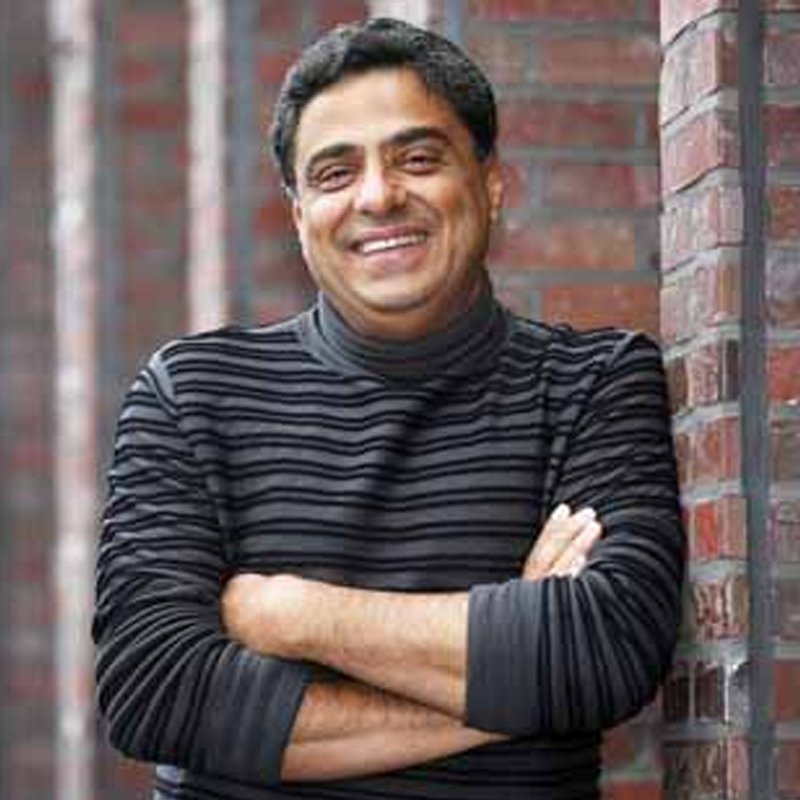
    MUMBAI: The Media & Entertainment industry needs to get its act together to grow at a rate of more than 12.5 per cent to be on par with other sunshine sectors, said The Walt Disney Company India MD Ronnie Screwvala.

    Srewvala said the India M&E sector has success written all over it provided the industry comes out of its complacency. He also said that innovation and disruption will be the norm.

    "The industry is projected to grow at 12 per cent. However this growth is not enough as other sunshine sectors are growing at a much faster pace," said Disney India‘s head honcho.

    Screwvala was convinced that India has the creative talent that would help it take the next big leap.
    He also said that digitisation will change the dynamics of the broadcast industry. The early results of digitisation has been encouraging, he said.

    The benefits of digitisation will only trickle down after two to three years.

    "We have been waiting for digitisation for 20 years and it has finally happened," he said in a closing keynote address at Ficci Frames.

    Joining debate with the industry on ratings system, Srewvala said the solution for a robust television ratings agency lies within the industry. The fact that almost 70 per cent of television households are outside the current ratings system is a matter of concern, he added.

    On an optimistic note, he said that TAM is now covering more homes than it was covering earlier.

    New media is a huge opportunity for the industry. However, the key is to find the right business model. India is one of the biggest mobile phone markets, which is also encouraging.

    A Rs 1,000 crore blockbuster is not out of reach in future, he asserted.

    Print, unlike other markets, is still growing in India at a healthy pace. The India DTH market is the biggest in the world. However, monetisation remains a concern.

    On the contentious issue of censorship, an optimistic Screwvala said that India‘s track record is still commendable. The need, though, is to take it to the level of matured democracies.

    Regional market‘s, he said, had shown phenomenal growth and are the future growth markets. Understanding consumer will also be key to growth.

  • Govt  firm  on Phase 2 deadline, claims 60% digitisation in 38 cities

    Govt firm on Phase 2 deadline, claims 60% digitisation in 38 cities

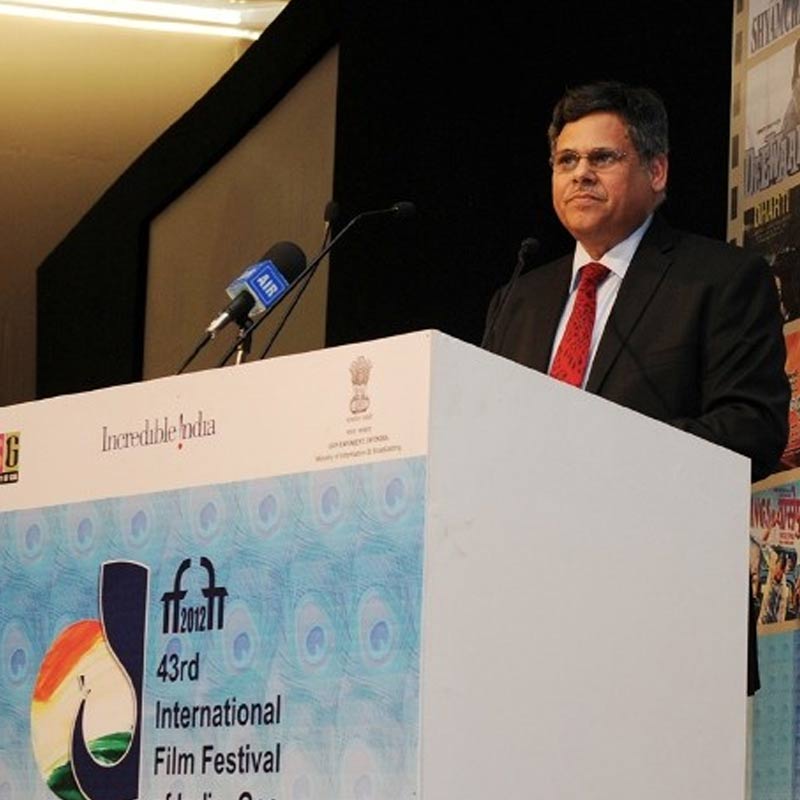
    MUMBAI: The Information & Broadcasting secretary Uday Kumar Varma has asserted that the government is firm on 31 March deadline.

    Giving a keynote at the Valedictory session of Ficci Frames, Varma said that the second phase of digitisation is on track with 60 per cent of households already going digital.

    "Digitisation is happening smoothly. We have achieved 60 per cent digitisation in the second phase. Subsequent to 31 March, the process will be irreversible," Varma said.

    Out of the 38 cities that are going digital in the second phase, as many as 10 cities have achieved 75 per cent digitisation.

    Four cities have been slow in implementing digitisation, Varma added. These include Ranchi, Srinagar and one in Tamil Nadu, where the state government is vehemently opposed to digitisation.

    "Out of 16 million STBs that are to be installed, 10 million have already been installed while six million are yet to be installed. However, we are confident that these will be installed within the deadline period," Varma asserted.

    Varma also said that the industry needs to keep the spirit of alignment to take the digitisation to its logical conclusion. However, he hastened to add that digitisation is still an incomplete task as even in phase 1 only set-top box (STB) has been installed and other aspects like Subscriber Management System (SMS) and billing are yet to be put in place.

    Digitisation, Varma said, will correct the aberrations of business model in the broadcasting industry and usher in an era of transparency.

    He also said that the role of state government is important for effective implementation of digitisation.

    He reiterated that the government can step in to provide guidelines for an independent television audience measurement system should the industry ask for it.

    "We need a robust and healthy ratings measurement agency," he said.