Category: Ficci Frames

  • Discovery to showcase Indian content across the world, to further strengthen local programming

    Discovery to showcase Indian content across the world, to further strengthen local programming

    MUMBAI: The flagship Discovery Network is all set to optimise the content programming and channels under its stable, even as the network foresees a growth in India’s GDP in the year 2016 and plans to broaden its portfolio in the nation.

    The network is re-focusing on expanding its scale in India by coming up with better programming line-up, catering to the regional market and by going local using the local talent available in India.

    Discovery Communications, which launched in India back in 1995 with only one channel, has now grown into a conglomerate with as many as 11 channels in five languages. The leader in the factual entertainment genre, Discovery roughly has 550 advertisers on board with approximately 275 million cumulative households across India.

    The company’s portfolio in South Asia comprises Discovery Channel, Animal Planet, TLC, Discovery Science, Discovery Turbo, Discovery Tamil, Discovery Kids, Investigation Discovery, and three high-definition channels namely Discovery HD World, Animal Planet HD World and TLC HD World.

    “No other market in the entire world has shown a growth like India. We want to become a multi-genre platform and want to grow as a media company. With the fresh content line-up, we are broadening our portfolio from what it looks like and are targeting the local audience”, said Discovery Networks International president J B Perrette.

    The network believes that the strong brands under them are extremely powerful and are doing economically well for them.

    Discovery Networks is also considering launch of its over-the-top (OTT) platform in India soon once the bandwidth stabilizes and once 4G gets in place in the country. The network is dependent on the response from the market rather than following one particular model.

    The network already has two direct-to-customer OTT products offering in Europe – Dplay and Eurosport – which are doing exceptionally well for them. “The consumption of video content is rapidly increasing in Norway. The country has proved to be a beneficiary market for us”, added Perrette.

    Known for providing high quality content to its viewers across the nation, Discovery is embarking on a very ambitious content production programme with $2 billion global investment. “We are seeing enormous traffic in India. This year, we have invested $2½ billion on our content programming globally to provide good quality shows on our flagship channels”, added Perrette.

    As it is not a platform only for documentaries, the network will bring new non-fiction genres like sports, kids, non-organic fiction, etc to India. For the first time, the network will broadcast shows produced in India to the rest of the world.

    “Over the years we have increased our local productions in India, and will continue to invest in content to better serve our viewers and clients. Some of the local programmes also find resonance around the world, just like the global content which is viewed in India,” Perrette said.

    Targeting the younger generation at large, the network plans to providing content across all its platforms in an easy, simple, accessible way providing various options of entertainment.


  • KPMG-FICCI: TV industry to touch Rs 1,09,700 crore by 2020

    KPMG-FICCI: TV industry to touch Rs 1,09,700 crore by 2020

    MUMBAI: If 2015 was a good year for media and entertainment industry with a growth rate of 12.8 per cent taking it to Rs 1157 billion,(RS 1,15,700 crore) with advertising revenues touching Rs 475 billion (Rs 47,500 crore), 2016 promises to be even better. Estimates show that the industry is to touch  Rs 1315 billion by this year end, with television alone commanding Rs 617 billion (Rs 61,700 crore). And the industry stalwarts project even rosier tidings for 2020.

    As per KPMG- FICCI Indian Media and Entertainment Industry Report 2016 that was released on 30 March at FICCI Frames 2016, the sector is projected to grow at a CAGR of 14.3 percent to be valued at Rs 2260 billion (Rs 2,26,000 crore) by 2020, with advertising revenue touching a whooping Rs 994 billion (Rs 99400 crore) at a CAGR growth of 15.9 per cent.

    Television continues to thrive:

    While 2015 saw the growing stress on the need to transport from traditional media to digital options, the current report reassures the continued importance and relevance of television as a medium, which is projected to grow at a rate of 15.1 CAGR between 2015- 2020, and touch Rs 1,09,760 crore by 2020, out of which Rs 364.5 billion (Rs 36,450 crore) will be contributed by advertising revenue. TV ad revenue is expected to touch Rs 210.3 billion (Rs 21,030 crore) by the end of 2016. On the other hand, subscription revenue for broadcasters is expected to grow at a CAGR of 15 per cent between 2015- 2020, to Rs 733 billion (Rs 73,300 crore). Subscription revenues for TV is estimated to have grown at 13 per cent to reach Rs 361 billion (Rs 36,100 crore). While the figures show a positive growth in advertising revenues, a delayed digitisation process would slow down the subscription growth.

    Digital, the fastest growing medium:

    Digital Advertising will continue to grow at a high CAGR of 33.5 per cent, the highest growing medium of all. The evident shift would be towards mobile and video advertising backed by the opening up of bandwidth in the country by 2020. The report estimates that by 2020 digital advertising will touch Rs 255.2 billion  (Rs 25,520 crore) and contribute 25.7 percent of the total advertising revenue.

    Impact of BARC India ratings on Television:

    There are no two opinions about the fact that roll out of BARC ratings was a major event that changed the face of the industry, and perhaps its rules as well.  The implementation of BARC was a major theme in 2015. While inclusion of rural markets and increase in sample size led to a reshuffle of rankings in the ratings of TV channels, particularly highlighting the viewership of FTA channels, there was no immediate impact on ad budget allocations among channels or genres. Going forward, sustained trends in ratings could lead to advertisers re-thinking their ad spend mix and broadcasters their content strategy.

    Paid C&S penetration of TV:

    The number of TV households in India has increased to 175 million (17.5 crore), at 62 percent growth rate. The figures are estimated to touch 200 million (20 crore) by 2020, with paid cable and satellite subscriber base growing to 174 million (17.5 crore) and command a lion share of 87 per cent of total TV households. However, when considering distribution, challenges in improving addressability, increasing monetisation continues to plague the industry, the report foretells. Meanwhile, competition in the TV distribution space is expected to intensify with Reliance Jio coming in the cable TV business.

    ARPU continues to back DTH growth:

    As per industry observations shared in the report, DTH has seen an ARPU growth of 10 per cent in 2015, driven by price hikes,  and increased HD feed penetration which constitutes 15 percent of the total subscriber base in the sector. This trend is expected to rule the sector in the upcoming years as well, with average ARPU of HD subscriber estimated to grow to 1.5 to 2 times that of a non HD subscriber. The report also hints at a growth in demand and adoption of 4K STBs, though lack of enough 4K content could be a disadvantage to this growth.

  • KPMG-FICCI: TV industry to touch Rs 1,09,700 crore by 2020

    KPMG-FICCI: TV industry to touch Rs 1,09,700 crore by 2020

    MUMBAI: If 2015 was a good year for media and entertainment industry with a growth rate of 12.8 per cent taking it to Rs 1157 billion,(RS 1,15,700 crore) with advertising revenues touching Rs 475 billion (Rs 47,500 crore), 2016 promises to be even better. Estimates show that the industry is to touch  Rs 1315 billion by this year end, with television alone commanding Rs 617 billion (Rs 61,700 crore). And the industry stalwarts project even rosier tidings for 2020.

    As per KPMG- FICCI Indian Media and Entertainment Industry Report 2016 that was released on 30 March at FICCI Frames 2016, the sector is projected to grow at a CAGR of 14.3 percent to be valued at Rs 2260 billion (Rs 2,26,000 crore) by 2020, with advertising revenue touching a whooping Rs 994 billion (Rs 99400 crore) at a CAGR growth of 15.9 per cent.

    Television continues to thrive:

    While 2015 saw the growing stress on the need to transport from traditional media to digital options, the current report reassures the continued importance and relevance of television as a medium, which is projected to grow at a rate of 15.1 CAGR between 2015- 2020, and touch Rs 1,09,760 crore by 2020, out of which Rs 364.5 billion (Rs 36,450 crore) will be contributed by advertising revenue. TV ad revenue is expected to touch Rs 210.3 billion (Rs 21,030 crore) by the end of 2016. On the other hand, subscription revenue for broadcasters is expected to grow at a CAGR of 15 per cent between 2015- 2020, to Rs 733 billion (Rs 73,300 crore). Subscription revenues for TV is estimated to have grown at 13 per cent to reach Rs 361 billion (Rs 36,100 crore). While the figures show a positive growth in advertising revenues, a delayed digitisation process would slow down the subscription growth.

    Digital, the fastest growing medium:

    Digital Advertising will continue to grow at a high CAGR of 33.5 per cent, the highest growing medium of all. The evident shift would be towards mobile and video advertising backed by the opening up of bandwidth in the country by 2020. The report estimates that by 2020 digital advertising will touch Rs 255.2 billion  (Rs 25,520 crore) and contribute 25.7 percent of the total advertising revenue.

    Impact of BARC India ratings on Television:

    There are no two opinions about the fact that roll out of BARC ratings was a major event that changed the face of the industry, and perhaps its rules as well.  The implementation of BARC was a major theme in 2015. While inclusion of rural markets and increase in sample size led to a reshuffle of rankings in the ratings of TV channels, particularly highlighting the viewership of FTA channels, there was no immediate impact on ad budget allocations among channels or genres. Going forward, sustained trends in ratings could lead to advertisers re-thinking their ad spend mix and broadcasters their content strategy.

    Paid C&S penetration of TV:

    The number of TV households in India has increased to 175 million (17.5 crore), at 62 percent growth rate. The figures are estimated to touch 200 million (20 crore) by 2020, with paid cable and satellite subscriber base growing to 174 million (17.5 crore) and command a lion share of 87 per cent of total TV households. However, when considering distribution, challenges in improving addressability, increasing monetisation continues to plague the industry, the report foretells. Meanwhile, competition in the TV distribution space is expected to intensify with Reliance Jio coming in the cable TV business.

    ARPU continues to back DTH growth:

    As per industry observations shared in the report, DTH has seen an ARPU growth of 10 per cent in 2015, driven by price hikes,  and increased HD feed penetration which constitutes 15 percent of the total subscriber base in the sector. This trend is expected to rule the sector in the upcoming years as well, with average ARPU of HD subscriber estimated to grow to 1.5 to 2 times that of a non HD subscriber. The report also hints at a growth in demand and adoption of 4K STBs, though lack of enough 4K content could be a disadvantage to this growth.

  • FICCI Sports Committee to pitch for raise in sports budget allocation to FM

    FICCI Sports Committee to pitch for raise in sports budget allocation to FM

    NEW DELHI: Sports infrastructure is to get industry status in a bid to scale up the availability and accessibility of sporting facilities in the country.

    Making this announcement, Sports Secretary Rajiv Yadav from the Youth Affairs and Sports Ministry said there was a dire need to increase the budgetary support to the Sports Ministry to enable it to enhance the allocation of funds to upgrade up sports development in the country, especially in small towns and district level towns.

    “The Union Government’s budget for sports was a measly Rs 835 crore,” he said.

    The move to give industry status has been hailed by the sporting community and administrators as it will enable corporates to avail of concessional finance for creation of sports infrastructure on a par with international standards.

    Addressing Turf 2015-16, the seventh edition Global Sports Summit organised by the Federation of Indian Chambers of Commerce and Industry (FICCI) with the support of the Ministry, Yadav urged the FICCI Sports Committee to make a strong pitch to the Finance Minister to raise the allocation for sports in the ensuing budget.

    Yadav said that planning for sports required enlargement of the catchment area for spotting and grooming talent. In this context, he said that his ministry was inspired by the sports ‘khel mahakumbh’ organised annually by Gujarat. It had therefore decided to scale up the National School Games beginning from the fiscal year 2016-17.

    Former cricket captain Kapil Dev pointed out that the onus of providing playgrounds in schools rested with the Government and recommended at least 40 per cent of the land for schools should be earmarked for playgrounds. He also underlined to need to reduce customs duties on sporting equipment to enable import and provide top quality sporting gear to sports persons.

    FICCI Sports Committee chairman and Star India president and head – sports Nitin Kukreja said there is a need to first recognise the importance of sport for the country, then nurture the economic opportunity that the various leagues and events have thrown up, and get India to play by providing access to facilities already available and by making sport a compulsory part of school curriculum – and match all of this with an ambition.

    FICCI DG Dr. Arbind Prasad said that for making India a sporting nation, there is a need for parallel sports both for excellence and grassroots development. FICCI, he said has been proactive in suggesting policy formulation and was working closely with the Sports Ministry and the Sports Authority of India on policy interventions to achieve sports objectives. “We should compare the sports budget of our country with other countries which are leading in sports and give financial security to sports persons to bring about a visible change,” he said.

  • FICCI Sports Committee to pitch for raise in sports budget allocation to FM

    FICCI Sports Committee to pitch for raise in sports budget allocation to FM

    NEW DELHI: Sports infrastructure is to get industry status in a bid to scale up the availability and accessibility of sporting facilities in the country.

    Making this announcement, Sports Secretary Rajiv Yadav from the Youth Affairs and Sports Ministry said there was a dire need to increase the budgetary support to the Sports Ministry to enable it to enhance the allocation of funds to upgrade up sports development in the country, especially in small towns and district level towns.

    “The Union Government’s budget for sports was a measly Rs 835 crore,” he said.

    The move to give industry status has been hailed by the sporting community and administrators as it will enable corporates to avail of concessional finance for creation of sports infrastructure on a par with international standards.

    Addressing Turf 2015-16, the seventh edition Global Sports Summit organised by the Federation of Indian Chambers of Commerce and Industry (FICCI) with the support of the Ministry, Yadav urged the FICCI Sports Committee to make a strong pitch to the Finance Minister to raise the allocation for sports in the ensuing budget.

    Yadav said that planning for sports required enlargement of the catchment area for spotting and grooming talent. In this context, he said that his ministry was inspired by the sports ‘khel mahakumbh’ organised annually by Gujarat. It had therefore decided to scale up the National School Games beginning from the fiscal year 2016-17.

    Former cricket captain Kapil Dev pointed out that the onus of providing playgrounds in schools rested with the Government and recommended at least 40 per cent of the land for schools should be earmarked for playgrounds. He also underlined to need to reduce customs duties on sporting equipment to enable import and provide top quality sporting gear to sports persons.

    FICCI Sports Committee chairman and Star India president and head – sports Nitin Kukreja said there is a need to first recognise the importance of sport for the country, then nurture the economic opportunity that the various leagues and events have thrown up, and get India to play by providing access to facilities already available and by making sport a compulsory part of school curriculum – and match all of this with an ambition.

    FICCI DG Dr. Arbind Prasad said that for making India a sporting nation, there is a need for parallel sports both for excellence and grassroots development. FICCI, he said has been proactive in suggesting policy formulation and was working closely with the Sports Ministry and the Sports Authority of India on policy interventions to achieve sports objectives. “We should compare the sports budget of our country with other countries which are leading in sports and give financial security to sports persons to bring about a visible change,” he said.

  • FICCI demands infrastructure status for broadcast industry in pre-budget memo

    FICCI demands infrastructure status for broadcast industry in pre-budget memo

    NEW DELHI: The Indian broadcast, cable and direct-to-home (DTH) sectors have been demanding a infrastructure status for the industry as well as seeking all benefits and incentives available for the infrastructure industry including the availability of finance at a concessional rate.


    To this effect, the Indian Broadcasting Foundation (IBF) had earlier this month urged the Union Government to grant “Infrastructure Status” to the broadcasting industry.


    Now, making this demand, the Entertainment Wing of FICCI has said in a pre-budget memorandum to Finance Minister Arun Jaitley that the sector should be allowed tax concessions as per Section 80-IA of the Income Tax Act.


    The digitisation process and the deployment of set top boxes (STBs) are heavy capital oriented and thus require huge investments, which may force various amalgamations and thus they should be allowed to set off accumulated losses and unabsorbed depreciation allowances to be carried forward as per Section 72 A of the Act, the industry body said.


    Parity with Manufacturing Industry under Section 72A of the Act


    It also said that the disparity between the service and the manufacturing sector is very adversely affecting the growth and consolidation of the Service sector.


    The tax benefits under Section 72A of the Act in respect of amalgamation or de-merger (carry forward and set off of accumulated loss and unabsorbed depreciation allowances) are currently limited to industrial undertakings or a ship, hotel, aircraft or banking. The definition of industrial undertaking should be widened to include service industry, broadcasters and content production companies.


    Rationalisation of Indirect taxes


    The rate of taxes, which range from 30 – 70 per cent, especially the entertainment tax imposed by the states, over and above the service tax, are punitive in nature, FICCI said, adding that such punitive level of taxation incentivises unhealthy practices, such as piracy, revenue leakage on account of under reporting of revenues, etc. It is important that the overall taxation level is brought down for the sector as a whole.


    State Entertainment tax legislations levy high taxes on the subscription earned by cable operators and DTH operators. The non-availability of credit of central taxes against the state taxes and vice versa increases the tax burden on the entertainment industry. In addition to this, the Central Government has levied service tax at 14 per cent on the transfer of copyrights, which is already being taxed as ‘goods’ under the various state VAT legislations.


    Payment for Content Production


    FICCI said there is ambiguity since the tax authorities have been adopting a view that the payment towards production of content is in the nature of fees for technical services and subject to tax at the rate of 10 per cent under section 194J of the Act whereas Explanation III to section 194C of the Act clarifies that payments made towards a contract, concerning broadcasting and telecasting including production of programmes for such broadcasting or telecasting, would fall under the definition of ‘work’ for the purpose of section 194C of the Act.


    It suggested that to avoid difference in positions adopted by the tax payer and tax department on applicability of relevant section and to mitigate resultant litigation and hardship, a clarification may be issued regarding appropriate classification of content production services and applicability of relevant section for withholding of taxes.


    Carriage Fees/Placement Charges


    FICCI has demanded that the Government should provide a clarification that the payments made towards carriage fees are not in the nature of royalty or fees for technical services and TDS is required to be made on such payments as per section 194C of the Act.


    It said that the tax department is contending that since cable operators are providing technical services, payments made towards placement of channels is subject to TDS under section 194J of the Act.


    Broadcasters pay placement or carriage fee to the cable and DTH operators to place their channel in prime bands, which in turn enhances the viewership of the channel. Such charges are paid under a contract merely for placing the channel on agreed frequency bands.


    Deduction of tax at source under Section 194H on the “15% agency commission”


    FICCI recommended a clarification that no taxes need to be deducted at source by broadcasters on the “15 per cent agency commission” as mentioned in the invoice raised by broadcasters to advertisement agency or advertisers.


    FICCI said the 15 per cent agency commission mentioned by broadcasters in its invoices for ad airtime sale raised on ad agency or advertisers is merely a presentation in the invoices and not a real transaction. Neither the broadcasters nor ad agency recognises the same as revenue or expense. It is customary in nature, as is also evident from the fact that even on the invoices raised directly on advertisers; the said 15 per cent agency commission appears.


    Broadcasters are not supposed to make any payments towards 15 per cent agency commission mentioned in the invoice, as there is no agreement or arrangement to pay such the commission with ad agencies or advertisers. In fact, broadcasters do not make any payment in respect of the said commission mentioned on the invoices.


    At the outset, FICCI said that the Indian media and entertainment industry grew from Rs 918 billion in 2013 to Rs 1026 billion in 2014, registering an overall growth of 11.7 per cent. The industry is estimated to achieve a growth rate of 13 per cent in 2015 to touch Rs 1159 billion. The sector is projected to grow at a healthy CAGR of 13.9 per cent to reach Rs 1964 billion by 2019.


    As per FICCI, television clearly continues to be the dominant segment but strong growth had been posted by new media sectors. Gaming and digital advertising recorded a strong growth of 22.4 per cent and 44.5 per cent compared to the previous year.


    The benefits of Phase I and II of cable digital addressable system (DAS) rollout, and continued Phase III rollout are expected to contribute significantly to strong continued growth in the TV sector revenues and its ability to invest in and monetise content. The sector is expected to grow at a CAGR of 15.5 per cent over the period 2015-2019.


    Tax Exemptions for Radio Broadcasting


    While noting that radio is anticipated to see a spurt in growth after rollout of FM Phase III licensing, FICCI asked the Government to consider providing tax holiday of five years for new capital investment in Phase III; reduce customs duty on capital equipment for radio broadcasting to four per cent; and consider service tax exemption for billings to service recipients covered in the negative list.


    Tax Holiday for five years for setting up of new screens


    Noting that the film sector had shown a minimal growth of 0.9 per cent in 2014 over 2013, FICCI said there had been an increase in piracy, since the number of screens for viewing films had not increased in proportion to the increase in number of films and the number of people viewing these films.


    FICCI said that it was essential to extend the benefit to cinema owners in terms of 80-IB of the Act to multiplexes constructed after March 2005 to encourage the set-up of multiplexes and thereby improve the density of cinema houses in the country. This will encourage setting up of new screens in India and help in improving screen density.


    Reduction of prescribed time limit under Rule 9A and 9B


    FICCI suggested that the existing period of 90 days before end of the financial year (under Rule 9A and 9B of IT Rules) is suitably reduced to grant relief to assessees whose feature films have incurred losses and have been released for exhibition in the last quarter of the financial year.


    Under Rule 9A of the Income Tax Rules, if a film producer sells all rights of exhibition of his feature film, the entire cost of production is allowed as a deduction in computing the profits and gains of such previous year.


    However, if the film producer does not sell all rights of exhibition of his film, it is released for exhibition on a commercial basis at least 90 days before end of the financial year and the film producer is eligible to claim deduction of the entire cost of production. Otherwise, a feature film is released for exhibition on a commercial basis within a period 90 days before end of the financial year and the producer is eligible to claim deduction of cost of production only up to a ceiling limit and any excess cost of production is carried forward to the next financial year. This ceiling limit is the amount of revenues generated by the feature film in the financial year.


    In certain cases where not all rights of exhibition of a feature film are sold and it is released for exhibition on a commercial basis within 90 days before end of the financial year, the feature film performs poorly and it is exhibited only for a short duration. Consequently, the film producer may not recover costs. In such cases in view of the prevailing IT Rules, the film producers are unable to claim a deduction of entire production cost and, the loss is to be carried forward to the next financial year. Accordingly, such film producers are unable to claim losses in the year the feature film is released for exhibition despite no further scope of income. A similar situation exists in the case of expenditure of distribution rights in view of Rule 9B of IT Rules.


    Exemption of Service Tax on major inputs/input services


    FICCI recommended that major inputs / input services that are used in relation to theatrical rights in movies, be exempted from service tax. Since the major inputs/input services used in relation to revenue earned from theatrical rights are taxable, the CENVAT credit of service tax paid on such inputs/input services is blocked in the supply chain due to applicability of CCR. Eventually such taxes result in increase of the cost of production thereby defeating the purpose of providing an exemption on the output service.


    Re-instatement of the Service Tax exemption on Transmission of digital cinema


    FICCI also recommended reinstating the exemption to digital cinema service distributors, as it existed earlier under notification 12/2007 ST of 1 March, 2007, which had been rescinded with the introduction of the negative list.


    Service tax on transmission of digital cinema is a direct cost to the producers since the same is in relation to theatrical exhibition of cinematograph film (which is an exempt service with effect from 1 April, 2013) and hence no credit can be availed of such service tax.


    Clarity on export status of post-production services


    FICCI asked for clarity on the inclusion of post-production activities in the exclusion to this Rule. Alternatively, the second proviso to the Rule 4(a) of the POPS Rules be re-worded.


    Given the various technological advances in the Indian film industry, many Indian entities are hired by foreign producers for carrying post production activity. For such activities, the content is temporarily imported into India (either physically or electronically) and re-exported after completion of service. Post-production activities, which may be performed in India, do not find explicit mention in the proviso that carves out exceptions to the performance based rule in POPS Rules.


    Service Tax exemption to on-screen advertising in cinemas


    The industry body said on-screen advertising in cinemas and multiplexes should be exempted from levy of service tax.


    After 1 October, 2014, the negative list of services was amended and on-screen advertising within cinemas is liable to service tax.


    The on-screen advertising within cinemas caters to advertisers with small businesses, with limited resources. For large advertisers, on-screen advertising is a secondary medium of advertising at best and they have a small contribution to onscreen advertising within cinemas. The on-screen advertising forms an important source of revenue for the exhibitors, which are already reeling under the pressure of multiple taxes. Re-instatement of service tax on such revenue will only increase their tax burden.


    Applicability of Service Tax on food and beverages sold within Cinemas


    The food and beverages (F&B) sold in theatres during movies are subject to VAT under local state laws and the same is paid by the exhibitors. But with effect from 1 April, 2011, restaurant services became taxable whereby services rendered by any air-conditioned restaurant serving alcohol were made liable to service tax and later with effect from 2013 the condition of serving alcohol was withdrawn. However, it is still not clear whether the sale of F&B by cinema halls and multiplexes is covered in this service.


    Unlike restaurants, there is no seating arrangement, no cutlery is provided and no waiter serves F&B and hence there is no element of service involved in any meaningful manner.


    FICCI said levy of service tax is intended on “restaurants” rendering certain services and is not intended on sale of food, beverage and snacks from candy counters in cinema theatres.


    Service Tax exemption on entry to award functions, musical performance etc.


    The Union Budget of 2015 had amended the negative list of services and effectively withdrawn the unconditional service tax exemption, which was granted to tickets for award functions, music events, sports events etc. With effect from June 2015, service tax is payable when the consideration for admission to entertainment events such as award function, concert, pageant, sporting event etc. is more than Rs 500 per person.


    However, FICCI said payment for admission to any event is already liable to a high state entertainment tax and levying of a service tax of 14 per cent over and above the high rates of entertainment imposes a high burden on the entertainment sector.


    The industry body asked for a clarification to specify that the value of ticket for the purpose of levy of service tax on such admission (where the ticket price is more than Rs 500) should be the value excluding Entertainment tax. It also wanted clarification on if service tax is payable, the same should be computed on a value exclusive of Entertainment tax and accordingly no service tax should apply on entertainment tax amount.


    Customs Duty exemption on film equipment under the ATA Carnet


    The ATA Carnet permits duty free temporary admission of goods into a member country. The list of exempted products covers filming equipment too. However, there is no Customs Notification in order to exempt the import of filming equipment from the levy of Customs Duty, on the lines of the ATA Carnet.


    FICCI recommended that Customs Duty should be exempted on film equipment under ATA Carnet. The film production equipment is very expensive and not easily available in all countries because of which the film producers are compelled to temporarily import the same on lease for the purpose of producing the film. In absence of a customs notification to exempt filming equipment, the ATA Carnet duty exemption benefit cannot be extended to import of filming equipment.

    These imports significantly increase the burden of tax on the film producers.


    Proposals for Animation, Gaming and VFX Industries


    FICCI also made some recommendations for the Animation, Gaming & Visual Effects (VFX) industries.


    It asked for a 10-year tax holiday for the Animation, Gaming, and VFX industries; and removal of withholding tax on revenues accruing from sales of mobile games in non-India markets as well as removal of withholding tax on the development contracts given to mobile game developers outside India.


    FICCI also asked for removal of withholding tax paid by expats working in India for Indian mobile game development companies.


    The Minimum Alternate Tax (MAT) applicability for units undertaking animation work in SEZ should be withdrawn to encourage export of animated contents.


    The industry body wanted restoration of STPI advantage scheme for AVGC or ITES for another 10 to 20 years and cover/encourage exports as well as IP creation.


    To promote domestic gaming market, excise duty on local manufacture should be brought down to nil (similar to film and music industry). This will enable CVD to be brought to zero also. The effective reduction in taxes would be around 15 per cent. Import duty on consoles (gaming hardware) to be brought down to zero per cent to increase the installed base to enable the local developer ecosystem to flourish.


    There should be a provision of 50 per cent reimbursable MDA (Market Development Assistance) for travel and registration fees to international market events.


    The Government should extend support under Market Development Assistance (MDA) activity for Indian companies to exhibit by setting Indian Pavilions in the world markets. What is needed is to help bringing local production companies to international markets, collect and disseminate information and support creating the infrastructure needed for a healthy media market to develop.


  • FICCI demands infrastructure status for broadcast industry in pre-budget memo

    FICCI demands infrastructure status for broadcast industry in pre-budget memo

    NEW DELHI: The Indian broadcast, cable and direct-to-home (DTH) sectors have been demanding a infrastructure status for the industry as well as seeking all benefits and incentives available for the infrastructure industry including the availability of finance at a concessional rate.


    To this effect, the Indian Broadcasting Foundation (IBF) had earlier this month urged the Union Government to grant “Infrastructure Status” to the broadcasting industry.


    Now, making this demand, the Entertainment Wing of FICCI has said in a pre-budget memorandum to Finance Minister Arun Jaitley that the sector should be allowed tax concessions as per Section 80-IA of the Income Tax Act.


    The digitisation process and the deployment of set top boxes (STBs) are heavy capital oriented and thus require huge investments, which may force various amalgamations and thus they should be allowed to set off accumulated losses and unabsorbed depreciation allowances to be carried forward as per Section 72 A of the Act, the industry body said.


    Parity with Manufacturing Industry under Section 72A of the Act


    It also said that the disparity between the service and the manufacturing sector is very adversely affecting the growth and consolidation of the Service sector.


    The tax benefits under Section 72A of the Act in respect of amalgamation or de-merger (carry forward and set off of accumulated loss and unabsorbed depreciation allowances) are currently limited to industrial undertakings or a ship, hotel, aircraft or banking. The definition of industrial undertaking should be widened to include service industry, broadcasters and content production companies.


    Rationalisation of Indirect taxes


    The rate of taxes, which range from 30 – 70 per cent, especially the entertainment tax imposed by the states, over and above the service tax, are punitive in nature, FICCI said, adding that such punitive level of taxation incentivises unhealthy practices, such as piracy, revenue leakage on account of under reporting of revenues, etc. It is important that the overall taxation level is brought down for the sector as a whole.


    State Entertainment tax legislations levy high taxes on the subscription earned by cable operators and DTH operators. The non-availability of credit of central taxes against the state taxes and vice versa increases the tax burden on the entertainment industry. In addition to this, the Central Government has levied service tax at 14 per cent on the transfer of copyrights, which is already being taxed as ‘goods’ under the various state VAT legislations.


    Payment for Content Production


    FICCI said there is ambiguity since the tax authorities have been adopting a view that the payment towards production of content is in the nature of fees for technical services and subject to tax at the rate of 10 per cent under section 194J of the Act whereas Explanation III to section 194C of the Act clarifies that payments made towards a contract, concerning broadcasting and telecasting including production of programmes for such broadcasting or telecasting, would fall under the definition of ‘work’ for the purpose of section 194C of the Act.


    It suggested that to avoid difference in positions adopted by the tax payer and tax department on applicability of relevant section and to mitigate resultant litigation and hardship, a clarification may be issued regarding appropriate classification of content production services and applicability of relevant section for withholding of taxes.


    Carriage Fees/Placement Charges


    FICCI has demanded that the Government should provide a clarification that the payments made towards carriage fees are not in the nature of royalty or fees for technical services and TDS is required to be made on such payments as per section 194C of the Act.


    It said that the tax department is contending that since cable operators are providing technical services, payments made towards placement of channels is subject to TDS under section 194J of the Act.


    Broadcasters pay placement or carriage fee to the cable and DTH operators to place their channel in prime bands, which in turn enhances the viewership of the channel. Such charges are paid under a contract merely for placing the channel on agreed frequency bands.


    Deduction of tax at source under Section 194H on the “15% agency commission”


    FICCI recommended a clarification that no taxes need to be deducted at source by broadcasters on the “15 per cent agency commission” as mentioned in the invoice raised by broadcasters to advertisement agency or advertisers.


    FICCI said the 15 per cent agency commission mentioned by broadcasters in its invoices for ad airtime sale raised on ad agency or advertisers is merely a presentation in the invoices and not a real transaction. Neither the broadcasters nor ad agency recognises the same as revenue or expense. It is customary in nature, as is also evident from the fact that even on the invoices raised directly on advertisers; the said 15 per cent agency commission appears.


    Broadcasters are not supposed to make any payments towards 15 per cent agency commission mentioned in the invoice, as there is no agreement or arrangement to pay such the commission with ad agencies or advertisers. In fact, broadcasters do not make any payment in respect of the said commission mentioned on the invoices.


    At the outset, FICCI said that the Indian media and entertainment industry grew from Rs 918 billion in 2013 to Rs 1026 billion in 2014, registering an overall growth of 11.7 per cent. The industry is estimated to achieve a growth rate of 13 per cent in 2015 to touch Rs 1159 billion. The sector is projected to grow at a healthy CAGR of 13.9 per cent to reach Rs 1964 billion by 2019.


    As per FICCI, television clearly continues to be the dominant segment but strong growth had been posted by new media sectors. Gaming and digital advertising recorded a strong growth of 22.4 per cent and 44.5 per cent compared to the previous year.


    The benefits of Phase I and II of cable digital addressable system (DAS) rollout, and continued Phase III rollout are expected to contribute significantly to strong continued growth in the TV sector revenues and its ability to invest in and monetise content. The sector is expected to grow at a CAGR of 15.5 per cent over the period 2015-2019.


    Tax Exemptions for Radio Broadcasting


    While noting that radio is anticipated to see a spurt in growth after rollout of FM Phase III licensing, FICCI asked the Government to consider providing tax holiday of five years for new capital investment in Phase III; reduce customs duty on capital equipment for radio broadcasting to four per cent; and consider service tax exemption for billings to service recipients covered in the negative list.


    Tax Holiday for five years for setting up of new screens


    Noting that the film sector had shown a minimal growth of 0.9 per cent in 2014 over 2013, FICCI said there had been an increase in piracy, since the number of screens for viewing films had not increased in proportion to the increase in number of films and the number of people viewing these films.


    FICCI said that it was essential to extend the benefit to cinema owners in terms of 80-IB of the Act to multiplexes constructed after March 2005 to encourage the set-up of multiplexes and thereby improve the density of cinema houses in the country. This will encourage setting up of new screens in India and help in improving screen density.


    Reduction of prescribed time limit under Rule 9A and 9B


    FICCI suggested that the existing period of 90 days before end of the financial year (under Rule 9A and 9B of IT Rules) is suitably reduced to grant relief to assessees whose feature films have incurred losses and have been released for exhibition in the last quarter of the financial year.


    Under Rule 9A of the Income Tax Rules, if a film producer sells all rights of exhibition of his feature film, the entire cost of production is allowed as a deduction in computing the profits and gains of such previous year.


    However, if the film producer does not sell all rights of exhibition of his film, it is released for exhibition on a commercial basis at least 90 days before end of the financial year and the film producer is eligible to claim deduction of the entire cost of production. Otherwise, a feature film is released for exhibition on a commercial basis within a period 90 days before end of the financial year and the producer is eligible to claim deduction of cost of production only up to a ceiling limit and any excess cost of production is carried forward to the next financial year. This ceiling limit is the amount of revenues generated by the feature film in the financial year.


    In certain cases where not all rights of exhibition of a feature film are sold and it is released for exhibition on a commercial basis within 90 days before end of the financial year, the feature film performs poorly and it is exhibited only for a short duration. Consequently, the film producer may not recover costs. In such cases in view of the prevailing IT Rules, the film producers are unable to claim a deduction of entire production cost and, the loss is to be carried forward to the next financial year. Accordingly, such film producers are unable to claim losses in the year the feature film is released for exhibition despite no further scope of income. A similar situation exists in the case of expenditure of distribution rights in view of Rule 9B of IT Rules.


    Exemption of Service Tax on major inputs/input services


    FICCI recommended that major inputs / input services that are used in relation to theatrical rights in movies, be exempted from service tax. Since the major inputs/input services used in relation to revenue earned from theatrical rights are taxable, the CENVAT credit of service tax paid on such inputs/input services is blocked in the supply chain due to applicability of CCR. Eventually such taxes result in increase of the cost of production thereby defeating the purpose of providing an exemption on the output service.


    Re-instatement of the Service Tax exemption on Transmission of digital cinema


    FICCI also recommended reinstating the exemption to digital cinema service distributors, as it existed earlier under notification 12/2007 ST of 1 March, 2007, which had been rescinded with the introduction of the negative list.


    Service tax on transmission of digital cinema is a direct cost to the producers since the same is in relation to theatrical exhibition of cinematograph film (which is an exempt service with effect from 1 April, 2013) and hence no credit can be availed of such service tax.


    Clarity on export status of post-production services


    FICCI asked for clarity on the inclusion of post-production activities in the exclusion to this Rule. Alternatively, the second proviso to the Rule 4(a) of the POPS Rules be re-worded.


    Given the various technological advances in the Indian film industry, many Indian entities are hired by foreign producers for carrying post production activity. For such activities, the content is temporarily imported into India (either physically or electronically) and re-exported after completion of service. Post-production activities, which may be performed in India, do not find explicit mention in the proviso that carves out exceptions to the performance based rule in POPS Rules.


    Service Tax exemption to on-screen advertising in cinemas


    The industry body said on-screen advertising in cinemas and multiplexes should be exempted from levy of service tax.


    After 1 October, 2014, the negative list of services was amended and on-screen advertising within cinemas is liable to service tax.


    The on-screen advertising within cinemas caters to advertisers with small businesses, with limited resources. For large advertisers, on-screen advertising is a secondary medium of advertising at best and they have a small contribution to onscreen advertising within cinemas. The on-screen advertising forms an important source of revenue for the exhibitors, which are already reeling under the pressure of multiple taxes. Re-instatement of service tax on such revenue will only increase their tax burden.


    Applicability of Service Tax on food and beverages sold within Cinemas


    The food and beverages (F&B) sold in theatres during movies are subject to VAT under local state laws and the same is paid by the exhibitors. But with effect from 1 April, 2011, restaurant services became taxable whereby services rendered by any air-conditioned restaurant serving alcohol were made liable to service tax and later with effect from 2013 the condition of serving alcohol was withdrawn. However, it is still not clear whether the sale of F&B by cinema halls and multiplexes is covered in this service.


    Unlike restaurants, there is no seating arrangement, no cutlery is provided and no waiter serves F&B and hence there is no element of service involved in any meaningful manner.


    FICCI said levy of service tax is intended on “restaurants” rendering certain services and is not intended on sale of food, beverage and snacks from candy counters in cinema theatres.


    Service Tax exemption on entry to award functions, musical performance etc.


    The Union Budget of 2015 had amended the negative list of services and effectively withdrawn the unconditional service tax exemption, which was granted to tickets for award functions, music events, sports events etc. With effect from June 2015, service tax is payable when the consideration for admission to entertainment events such as award function, concert, pageant, sporting event etc. is more than Rs 500 per person.


    However, FICCI said payment for admission to any event is already liable to a high state entertainment tax and levying of a service tax of 14 per cent over and above the high rates of entertainment imposes a high burden on the entertainment sector.


    The industry body asked for a clarification to specify that the value of ticket for the purpose of levy of service tax on such admission (where the ticket price is more than Rs 500) should be the value excluding Entertainment tax. It also wanted clarification on if service tax is payable, the same should be computed on a value exclusive of Entertainment tax and accordingly no service tax should apply on entertainment tax amount.


    Customs Duty exemption on film equipment under the ATA Carnet


    The ATA Carnet permits duty free temporary admission of goods into a member country. The list of exempted products covers filming equipment too. However, there is no Customs Notification in order to exempt the import of filming equipment from the levy of Customs Duty, on the lines of the ATA Carnet.


    FICCI recommended that Customs Duty should be exempted on film equipment under ATA Carnet. The film production equipment is very expensive and not easily available in all countries because of which the film producers are compelled to temporarily import the same on lease for the purpose of producing the film. In absence of a customs notification to exempt filming equipment, the ATA Carnet duty exemption benefit cannot be extended to import of filming equipment.

    These imports significantly increase the burden of tax on the film producers.


    Proposals for Animation, Gaming and VFX Industries


    FICCI also made some recommendations for the Animation, Gaming & Visual Effects (VFX) industries.


    It asked for a 10-year tax holiday for the Animation, Gaming, and VFX industries; and removal of withholding tax on revenues accruing from sales of mobile games in non-India markets as well as removal of withholding tax on the development contracts given to mobile game developers outside India.


    FICCI also asked for removal of withholding tax paid by expats working in India for Indian mobile game development companies.


    The Minimum Alternate Tax (MAT) applicability for units undertaking animation work in SEZ should be withdrawn to encourage export of animated contents.


    The industry body wanted restoration of STPI advantage scheme for AVGC or ITES for another 10 to 20 years and cover/encourage exports as well as IP creation.


    To promote domestic gaming market, excise duty on local manufacture should be brought down to nil (similar to film and music industry). This will enable CVD to be brought to zero also. The effective reduction in taxes would be around 15 per cent. Import duty on consoles (gaming hardware) to be brought down to zero per cent to increase the installed base to enable the local developer ecosystem to flourish.


    There should be a provision of 50 per cent reimbursable MDA (Market Development Assistance) for travel and registration fees to international market events.


    The Government should extend support under Market Development Assistance (MDA) activity for Indian companies to exhibit by setting Indian Pavilions in the world markets. What is needed is to help bringing local production companies to international markets, collect and disseminate information and support creating the infrastructure needed for a healthy media market to develop.

  • FICCI elects Harshavardhan Neotia as president

    FICCI elects Harshavardhan Neotia as president

    NEW DELHI: Ambuja Neotia Group chairman Harshavardhan Neotia took over as the president of the Federation of Indian Chambers of Commerce & Industry (FICCI) at the conclusion of the Chamber’s 88th Annual General Meeting.


    Neotia was conferred with the Padma Shri by the President of India in 1999 for his outstanding initiative in social housing.


    Additionally, Zydus Cadila – Cadila Healthcare chairman and managing director Pankaj R. Patel has been elected as senior vice president, whereas Edelweiss Group chairman and CEO Rashesh Shah has been elected as vice president.

  • HD, premium channels, VAS help increase ARPUs for DTH: FICCI-KPMG

    HD, premium channels, VAS help increase ARPUs for DTH: FICCI-KPMG

    The growth of average revenue per user (ARPU) in the Direct To Home (DTH) sector continues, even as digital cable is still struggling to roll out channel packages. As per the FICCI- KPMG 2015 report, due to sustained increase in ARPU, the sector had a healthy revenue growth despite a muted subscriber addition in 2014.


    In 2014, DTH operators saw an increase of around 12 to 15 per cent in ARPUs. While some of the ARPU increase was driven by DTH operators’ ability to continue to push price hikes (there was a price increase in April 2014 of an approximate eight to nine per cent), the more promising trend is that DTH operators were able to increase collections from customers by providing additional services such as High Definition (HD) channels, premium channels and other value added services (VAS).


    As phase III and IV of digitisation draws near, the battle will be closely contested by MSOs and DTH operators. In phase I and II, DTH operators managed to gain 20 to 30 per cent of the subscriber base converting to digital. Two factors, namely an inherent technology advantage and stronger balance sheets, will give DTH players the bonus advantage to take on MSOs, especially the smaller players, in the year ahead. However, in order to gain a bigger piece of the pie, they will have to re-jig their channel packages, in sparsely populated areas so that it becomes affordable for subscribers in Phase III and IV.


    Dish TV’s sub-brand Zing is all set to tackle digital cable players at the regional level. The brand addresses various linguistic needs of subscribers and offers regional specific channels as part of all available packs, while the other channels can be added based on the customer’s choice. It has been launched West Bengal, Tripura, Odisha, Maharashtra, Telangana and Andhra Pradesh.


    When one compares Zing’s package prices, they are cheaper than those of digital cable. For example, the base package of Zing costs Rs 99 per month versus Rs 220 per month for digital cable. Its mid level package carries a price tag of Rs 249 versus Rs 270 per month for digital cable. Besides the content, even the advertising and other marketing activities are done in the regional languages, while customer support services will be at the local level through trade partners, similar to the cable TV model.


    While digital cable operators are still grappling with securing their business model right, DTH operators have focused on increasing monetisation by providing additional value to their subscribers either through innovative services or STBs, such as those with unlimited recording and technology revolution like 4K.


    According to the report, there are four million HD subscribers, accounting for 10 per cent of all DTH subscribers, while 15 to 20 per cent of incremental subscribers in 2014 were HD subscribers. HD adoption continues to drive ARPU growth for DTH players with the average ARPU of a HD subscriber at an approximate 1.5 to 2x the ARPU of a non-HD subscriber.


    Compared to 6.5 million units of panel television sets (LCD, LED and plasma TVs) sold in 2013 in India, eight million units were expected to be sold in 2014, of which 55 per cent was expected to have been HD panel TV sales. The share of HD and 4K TV sales is expected to further increase over the next five years, reaching 80 per cent by 2019. While HD adoption will continue to be a key growth driver for DTH ARPUs over the next few years, adoption of 4K STBs is expected to pick up in India, though lack of 4K content can be a major problem.


    Currently only Videocon d2h and Tata Sky offer 4K services. Live sports action is expected to be one of the enablers of HD adoption, with the recently concluded ICC Cricket World Cup 2015, likely to be a key trigger in 2015.


    All major DTH operators namely Tata Sky, Dish TV, Videocon D2H and Airtel Digital have launched ‘TV Everywhere’ apps on mobiles and tablets through, which subscribers can watch live TV, catch up TV and video on demand (VoD) for an additional monthly fee. While there are several players along the media value chain who have launched online platforms for on-demand content to capture the surging viewer base, DTH operators have a key advantage in monetising these viewers through their ‘TV Everywhere’ apps, given their already existing payment relationships with subscribers.

  • IPL is the largest reached sports event in 2014: FICCI KPMG Report

    IPL is the largest reached sports event in 2014: FICCI KPMG Report

    The global sports industry is estimated be worth of $600 – $700 billion. Revenue generated from the industry is estimated at $80 billion globally and is growing at Compound Annual Growth Rate (CAGR) of 6.5 per cent over 2009 to 2014, which includes revenues from media rights, sponsorships and ticketing.

    The market for advertising in sports in India was estimated at Rs 41 billion in 2013 growing at a CAGR of 14 per cent from Rs 21 billion in 2008. It consists of on ground advertising, team sponsorship, athlete sponsorship and media ad spends on sports. Licensing and merchandising contribute Rs 2 billion to the industry in India. Gate revenues make up another revenue stream but its contribution to the sports market in India is relatively low compared to media ad spends and sponsorship.

    Sporting events have been popular throughout history, and have gained greater viewership with bigger stadiums and TV broadcasting of domestic and global events. Annual sports viewership in India reached 276 million in 2014. But the sports genre accounts for only 2.4 per cent of total TV viewership and 4.3 per cent of AdEx (Advertisement Expenditure) revenue in the Indian TV industry, much smaller than the general entertainment genre.

    The median age in India is around 27 years and around 64 per cent of the population is expected to be in the working age group by 2020. This provides a large and growing target segment for sports in India. Moreover, an increase in percentage of middle class and rich households (households with annual income greater than Rs 2,00,000) from 6.1 per cent in 2001-02 to 14.5 per cent in 2009 -10 has increased the number of people with an appetite for sports consumption. The middle class alone is expected to increase to 41 per cent of the population by 2025. There has also been an increase in the average share of educational and recreational activities in the annual household consumption and it is estimated to increase from five per cent in 2005 to nine per cent by 2025.

    A good start to non cricket sports is one interesting to look at the growth of sports other than cricket in India. Many sports have grown well over the last half decade. A survey on the popularity of sports in the Indian online community reports that while 85 per cent of respondents followed cricket in some manner, an estimated 44 per cent followed tennis, 41 per cent followed football (soccer) and 32 per cent followed badminton. With economic development, sports viewership in a country usually moves from single sport to multi sport. Africa and the Indian subcontinent have been traditionally dominated by football and cricket respectively. However, with greater economic development, India is seeing a growth in other sports as well. 

    League formats have helped in increasing popularity of sports Globally

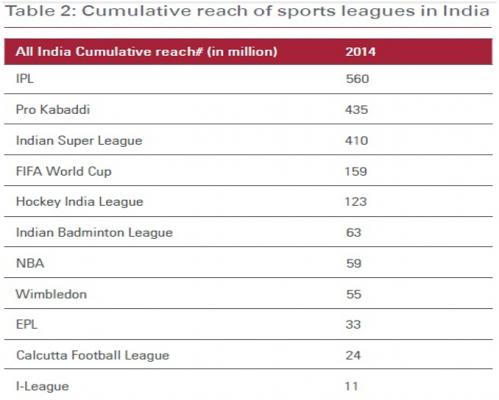
    The leagues system has served as an important way for companies to enter the sports sector. A sports league creates several opportunities for private companies in domains such as league management, franchisee, broadcasting and sports videos production houses, advertising, sports infrastructure such as multipurpose venues, player management, licensing and merchandising. One of India’s most successful leagues in terms of viewership and revenues has been the Indian Premier League (IPL), which is based on the English Premier League (EPL) format. The league was launched in 2008 by the Board of Control for Cricket in India (BCCI) with eight city franchisees. Though it is still small in comparison to some of the biggest leagues of the world, it has been able to achieve success in a short span of time, which other mature leagues could not manage to do. The evolution of IPL as a brand is an example of successful product innovation, which effectively combined entertainment and sports. The Twenty20 (T20) format of IPL has made the sport more popular and convenient to watch for cricket enthusiasts. The success of the IPL, which is estimated to have had a viewership of 191 million people and ad revenue of Rs 8 billion in 2014 has led to the creation of several other league-format sporting events, such as the Indian Badminton League, Hockey India League and the recently launched Pro-Kabaddi League. The inaugural season of football’s Indian Super League has been fairly successful as well. Cumulative reach of Pro Kabaddi League was 435 million compared to 560 million for IPL in 2014. Football’s Indian Super League was close with 410 million cumulative reach. The new domestic sports leagues however require significant management efforts over a period of time to get established and be successful. 

    Viewership refers to sum of weekly GVTs, which is a factor of number of viewers and frequency.

    IPL leads the cumulative reach chart amongst sporting events held in 2014

    Cumulative reach refers to the number of individuals within the target group who viewed the tournament over a certain period of time, including duplication.

    Ecosystem to support sports development in India

    However, in order to sustain the growth in sports and sports-related businesses, a flexible regulatory and policy framework that is able to realise synergies between various segments of sports needs to be developed. This in turn requires the sports ecosystem and its stakeholders to be recognised under the purview of a dedicated industry of sports which can provide impetus to an organised and professional business environment for sports in India.

    Sports Broadcasting in India

    There has been a surge in the number of sporting events broadcast in the past few years. These events include tournaments and leagues played at state, national and international levels. Several international tournaments and leagues played at the regional or global level are now telecast in India bringing in a larger and much diverse audience. Males form around 60 to 65 per cent of viewers and are expected to continue to be the main target segment. However, the number of female viewers has been increasing. About 57 per cent of the viewership of ISL and 53 per cent of the viewership of Pro – Kabaddi League was made up of women and children. Broadcasters are supplementing the sports with other entertaining and informative pieces to make the program more inclusive.

    Getting to the right content mix

    With the rise in number of sporting events, sports channels are covering several sporting events in their annual calendar. It consists of a mix of marquee events from domestic and international leagues, major tournaments along with minor domestic leagues and tournaments.

    Star Sports has revamped itself with uniformly branded eight channels to showcase a variety of domestic and international sports both cricket and non – cricket and in English as well as Hindi. While international cricket matches featuring India will make up 65 per cent of Star Sports 1, Ranji matches, university and women’s cricket and international cricket matches not featuring India will form 50 to 60 per cent of content on Star Sports 2. This will enable Star to nearly double its cricket content, which is the major revenue driver for sports channels in India. Star Sports 4 will feature other sports, which include international football (soccer), European soccer leagues, badminton, tennis and Formula-1 racing.

    The new Indian leagues, which include hockey, badminton and soccer, will be telecast on Star Sports 1 to 3 to reach a larger audience. Such a strategy enables Star Sports to increase its cricket content as well as broadcast non – cricket sports, which are seeing increasing traction. There is also an increasing trend towards multi-sports channels, as the viewership of different sports are increasing and sports channels are vying for TV rights across sports. Star has seen a shift from having a cricket specific channel in its cluster to multi-sports channels. It enables Star to broadcast both international and domestic cricket content simultaneously as well as gives it flexibility to show different sports across different channels. This can be attributed to the large investments made by Star to purchase rights for domestic and international cricket, football, tennis, badminton etc.

    On the other hand, Neo has rebranded its cricket specific Neo Cricket to Neo Prime on account of reduced live cricket properties and surge in volume of several sports.

    Ten however, has sports specific channels with Ten Cricket for cricket, Ten Action for football and Ten Golf for Golf broadcasting. Availability of sufficient single sport media rights and a definite viewership base for that particular sport drives the presence of sports specific channels. This helps advertisers to target a specific audience, for example luxury products have tied up with Ten Golf. Although, digitization and lower costs of distribution make single – sport channels more viable than before, it can take some time to evolve in India and reach the popularity of golf and tennis channels in some developed countries.

    Regional language boost to broadcasting

    Another strategy to target a specific audience is the language of telecast. Hindi and other regional languages increase the audience reach for sports as English has a limited audience. Star Sports 3 replicates Star Sports 1 in Hindi. In 2014, it telecast the domestic football league – Indian Super League in five languages. Its regional TV channels were used to telecast the league in Bengali, Kannada and Malayalam apart from English and Hindi broadcasts. During FIFA World Cup 2014, Bengal accounted for half the country’s viewership mainly because of regional language feed by Multi Screen Media (MSM) on its Bengali general entertainment and film channel Sony Aath. Hindi broadcast of the Pro Kabaddi League on Star Gold also helped take the cumulative reach to 435 million for the event. Other than using regional sister channels for feed in local languages, sports channels may spin off separate regional language sports channels if the demand picks up.

    Revenue and Profitability model

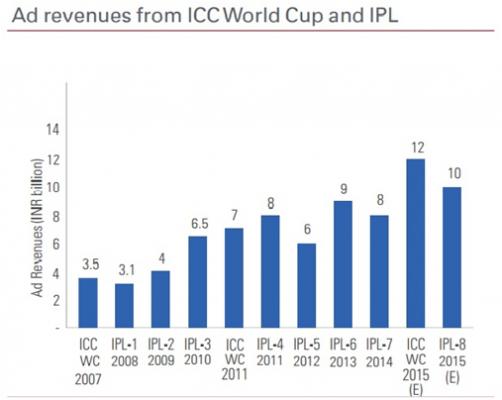
    Sports industry is still an ad driven revenue model. Media spends on sports, most of which is on TV, increased from Rs 11.5 billion to Rs 22.5 billion over 2008 to 2013 at a CAGR of 14 per cent. In mature markets, subscription is the main revenue driver for sports channels, contributing nearly 60 to 90 per cent of the revenues. However in India, advertisements still account for nearly 60 per cent of the revenues of sports channels, mainly driven by cricket, which is the largest revenue spinner and accounts for nearly 80 to 85 per cent of the total television sports media revenue. Non-cricket sports provide live sports content around the year, which gives advertisers a regular touch-point to their target segments. Revenues from advertisements in any year vary depending on the tournaments and series held during the year. Cricket mostly forms the peaks whereas the troughs are being evened out with non–cricket sports and non-live cricket content. In 2011, ad spends on TV for cricket was estimated to have crossed Rs 20 billion. In 2015, ad spends from the ICC World Cup and IPL 8 alone are expected to be around Rs 22 – 25 billion. Ad revenues for non-cricket sports are only a small fraction of cricket revenues. In 2013, ad revenues from Indian Badminton League and Hockey India League were Rs 0.9 billion and Rs 0.7 billion respectively.

    Key challenges facing the spurt of non-cricket leagues in India includes:

    • Poor investor confidence

    For instance the Indian Badminton League (IBL) suffered a loss of Rs 25 crore in the opening season in 2013 owing to investors pulling out casting doubt on the return of IBL with its second season. However, despite no play in 2014, the IBL is set to return in 2015.

    • Lack of industry status

    Provision of industry status could lead to an organized sports industry leading to higher available capital, newer sports businesses, additional revenue streams for stakeholders making leagues commercially viable ventures.

    • Lack of a culture for sports

    Sporting leagues in India are designed to last just a couple months every year. However, many major sporting league seasons in the world last for longer durations every year. Sporting leagues need to become year round (or at least three – four months a year) ventures. Apart from the benefit of a longer engagement with viewers (allowing the building of a larger fan base and culture for the game), this also touts the idea of sport becoming a year round profession furthering the advent of sports businesses.

    Revenue model in leagues

    Major sources of revenue for any league come from media rights, sponsorships and revenue from franchisees. Share of franchisee consideration in IPL has increased from 30 per cent in 2010 -11 to 37 per cent in 2012- 13 with a corresponding decrease in the revenues from sponsorship rights. Income from media rights and other sources have nearly the same share in 2012-13 as in 2010- 11.

    Major Sources of revenue for a League Franchisee

    Major sources of revenue for any league franchisee are share of the central revenues, local revenue and performance revenue.

    • Share of central revenue

    This includes a percentage of the revenue to the league from media rights and central sponsors like Pepsi in the IPL. In India, media rights are a major revenue sources both for the league and the franchisees. Channels are expected to further increase the subscription revenue for sports channels.

    • Local revenue

    Local revenue for a franchise entails revenue from match day ticket sales (gate revenue) and commercial revenue that includes funds from franchise sponsors, merchandise sales and revenue generated from membership with the franchise club if any. However, revenue from franchise sponsors makes for a majority of the commercial revenue. Sports merchandise sales is a fast growing segment with Rs 2 billion in retail sales in 2013. Moreover, contribution of gate revenue to overall revenue of franchises is low due to inexpensive ticket pricing, especially in non-cricket leagues. This is in contrast to leagues abroad where gate revenues are a significant contributor to a franchisee’s revenue.

    How can leagues be further popularised/ monetized?

    Some of the critical success factors of a league in India are identified below:

    • Players

    Involvement of top players of the world creates interest in the viewers and increases the quality of the game. The IPL is a successful example of the same. On the other hand, I-League is struggling to attract top players resulting in poor viewership.

    • Marketing

    An effective marketing campaign is another critical factor in making the league popular. Again, the involvement of various celebrities as brand ambassadors or owners in the IPL contributed to generating larger viewer interest in the league. In fact, the marriage of the Indian entertainment industry and cricket has aided in making IPL a commercial success.

    • Governance framework

     It is seen that leagues, which are run with the support of the approved federation have been able to sustain. The ICL failed due to lack of support from BCCI and World Series Hockey (WSH) is facing similar troubles due to non-recognition of the founding federation as the official national sports federation of hockey itself.

    • Stadium Infrastructure

    Quality of stadium infrastructure improves the viewing experience, hence increases the level of interest in the sport. It is important to create supporting infrastructure like restaurants, bars, fast-food chains, merchandise, stores, books and music stores, etc. to develop stadiums into popular entertainment spots for the family. Hike in ticket prices subsequent to rise in viewership, organizing multiple sporting events and entertainment shows wherever possible can help monetise stadium infrastructure.

    • Fan base

    An effective strategy to increase a franchisee fan base is engagement of respective franchises with local community. This helps generate greater TV viewership, increase attendance of matches and sale of merchandise. Performance of national team or players at international level increases the interest in the game, hence the league.

    League timing

    The tournament should be held at a time when there is no clash with international tournaments that could divert a significant section of the viewers, many players are available and weather is suitable for holding matches. The length of games and timing of matches (conducive for family viewing) are also important factors to consider, both having further helped significant viewership of the IPL. Other factors may include spectator friendly broadcasting such as better viewing angles and broadcasting in Hindi and English.