Category: Ficci Frames

  • FICCI-BAF Awards 2024 recorganize of animation excellence on the global stage

    FICCI-BAF Awards 2024 recorganize of animation excellence on the global stage

    Mumbai: FICCI-BAF Awards is the most coveted Animation Awards and has grown in stature ever since the launch of FICCI-BAF Awards in 2014. BAF (Best Animated Films) recognises and celebrates the exceptional work done by the Animation studios and encompasses the work done in the arena of Animation, VFX and Gaming domain.

    Over the years, the FICCI-BAF Awards has transformed into a global platform, attracting high-calibre submissions from talented individuals and teams worldwide. The most recent edition of the FICCI-BAF Awards, held in March 2019, witnessed an impressive participation of nearly 400 entries spanning across 12 different countries.

    The FICCI-BAF Awards initiative is being co-presented by Intel, hosted by state Maharashtra and is being supported by the implementation partner Reskilll.

    The FICCI-BAF Awards has been a transformative experience for all of us involved and this ceremony is a celebration of the hard work, dedication, and perseverance of the organisations who took their time out and nominated themselves.

    FICCI-BAF Awards

  • Role of skilling, education in media and entertainment sector critical in realizing vision of Viksit Bharat: Secretary, Skill Development & Entrepreneurship, GoI

    Role of skilling, education in media and entertainment sector critical in realizing vision of Viksit Bharat: Secretary, Skill Development & Entrepreneurship, GoI

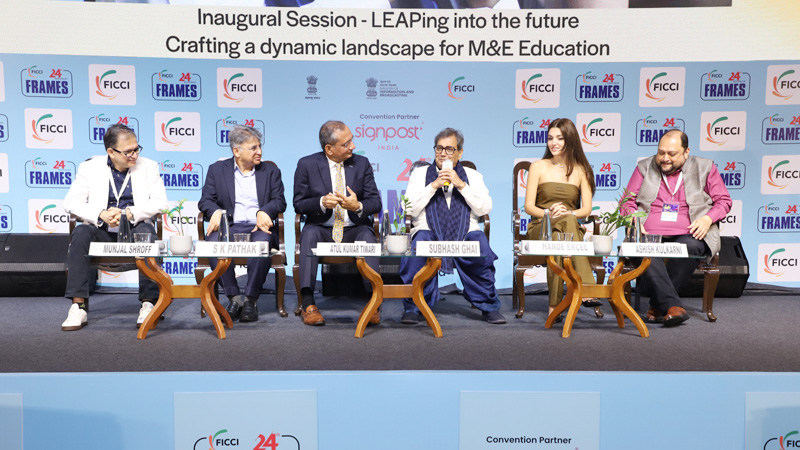
    MUMBAI: Govt of India, secretary, ministry of skill development & Entrepreneurship Atul Kumar Tiwari said that the Indian media and entertainment sector is growing rapidly and there is immense potential for skilling in this sector. This sector has been growing with a CAGR of over 13 per cent in the last few years and employes 30 lakh people directly and 55 lakh indirectly. Skilling combined with education and scaling can help India achieve the vision of Viksit Bharat 2047, there by supporting the GDP as well as establishing the prowess in India’s soft power, he added.

    Addressing the session on ‘LEAPing into the Future’, at FICCI FRAMES 2024, Tiwari said that in order for India to prosper, there is a need for creating a mass awareness about skilling. The New Education Policy (NEP) along with all government policies focuses on skilling. All sectors of the economy are recognizing that skilling is going to be a game-changer for India. With our country’s demographic advantage, having the youngest and the world’s largest number of working-age individuals, skilling will lead to a significant enhancement in productivity and employment. We have the youngest population in the world, largest number of working population and skilling them will lead to a great deal of enhancement in productivity and employment along with competitiveness, he noted.

    Tiwari also emphasized spreading awareness on ‘LEAP – Leveraging Education to Accelerate Progress’, which is the need of the hour. That nothing is more creative than making a film. The government, he said, is working to identify and bridge the skilling gap through policy initiatives along with industry and academia collaboration. “There is a need for us to identify the opportunities and create awareness among people, especially in tier 2,3 cities to attract more talent,” he emphasized.

    He further stated that the M&E sector has experienced a remarkable transformation with the advent of the internet, revolutionizing entertainment consumption. The dynamics of content creation have shifted, leading to a buzzing M&E landscape that not only entertains but also promotes and preserves cultural heritage, added Tiwari.

    He also stated that the Indian media and entertainment sector not only provides support to nation’s GDP but also promotes tourism, increase in cultural exchanges and strengthens India’s soft power.

    Whistling Woods International (WWI) filmmaker & founder and chairman Subhash Ghai highlighted the role of education and skilling in media and entertainment sector. He added that we are currently relying on memory-based education rather than skill-based education. It is crucial to develop skill-based education in the country, noted Ghai.

    FICCI, secretary general SK Pathak said, “In the 25 edition of FICCI FRAMES in 2025, we will identify the transformational changes required in the media and entertainment industry, focusing on the initiatives needed for India in 2030.”

    Ashish Kulkarni, chair, FICCI AVGC-XR Forum and Founder, Punnaryug delivered the vote of thanks.

    Hande Ercel, Turkish actress was also present during the inaugural session.

  • “Every medium, whether it’s TV or OTT, offers unique opportunities to resonate with diverse audiences”: Siddharth Kumar Tewary

    “Every medium, whether it’s TV or OTT, offers unique opportunities to resonate with diverse audiences”: Siddharth Kumar Tewary

    Mumbai: The panellists delved into the evolving landscape of transmedia storytelling, where narratives seamlessly traverse different mediums to create a rich and immersive experience for audiences. The discussion was explored around successful case studies, examining how storytelling techniques and plotlines can be intricately woven across films, books, and gaming platforms to engage audiences on multiple levels

    Speaking at the panel, Swastik Productions founder and chief creative director Siddharth Kumar Tewary said, “Deciding to tell the Mahabharat story isn’t a one-day affair; it’s a journey of over five years. I believe we should respect its timeless essence guiding our modern adaptation, as we embark on a profound exploration, embracing the evolving language and sources of our rich history. We as storytellers meticulously research for decades, spanning from academia to ancient texts, ensuring authenticity. Every medium, whether it’s TV or OTT, offers unique opportunities to resonate with diverse audiences. There are a lot of great stories and it’s a great time to create a synergy across mediums where we create our own Bharatverse while staying true to our cultural ethos. Be it adapting from book to screen or harnessing technological advancements in web series, clarity and authenticity guide our every step. Our guiding principle is to have clarity in the message, understand the characters playing crucial roles behind the story, and have a deep understanding of the narrative’s soul. In this age of evolving family dynamics, our goal is to inspire core Indian values in a contemporary, yet authentic manner. Each character’s role is pivotal, and each emotion is sacred. We delve into the depths of the text, owning its essence, and sculpting it for the screen. Through meticulous reading and interpretation, we breathe life into the pages, ensuring each adaptation resonates with the spirit of the epic.”

  • Streaming is seeing phenomenal growth in India: Prime Video India’s Sushant Sreeram

    Streaming is seeing phenomenal growth in India: Prime Video India’s Sushant Sreeram

    Mumbai: In a highly engaging panel curated on the opening day of FICCI FRAMES 2024 titled ‘Reinvent: Navigating the Future of the Media and Entertainment Industry’, Prime Video India country director Sushant Sreeram delved into the dynamic landscape of the streaming industry in India, exploring growth trends while highlighting Prime Video’s business and content commissioning strategy.

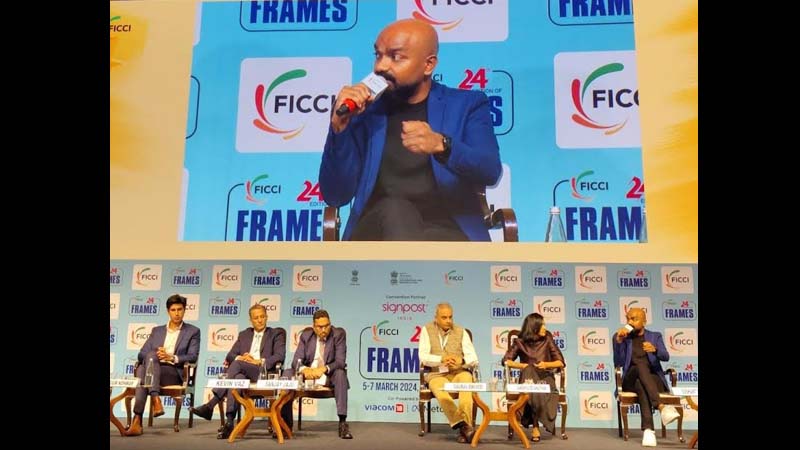
    Moderated by Ernst and Young partner Ashish Pherwani the panel began with a keynote from Ministry of Information and Broadcasting secretary Sanjay Jaju.  In addition to Sushant Sreeram, the panel saw the participation of industry leaders from multiple M&E sectors, including Prasar Bharti CEO Gaurav Dwivedi, FICCI Media and Entertainment Committee chair and Viacom18 CEO – broadcast entertainment Kevin Vaz; FICCI Media and Entertainment Committee co-chair and Meta India VP and head Sandhya Devanathan; FICCI Media and Entertainment Committee co-chair and Warner Bros Discovery general manager – India & South Asia Arjun Nohwar, and Signpost India chairman & managing director Shripad Ashtekar.

    Responding to a question on key trends across SVOD, TVOD and AVOD business models, Sushant said, “Streaming is seeing phenomenal growth in India. It has, in fact, become a dominant use-case for internet in the country, and a large part of that growth is coming from outside the metros.  We have about as many people streaming content in India, as those watching linear TV. This is a very significant inflection point for the video streaming industry in India.”

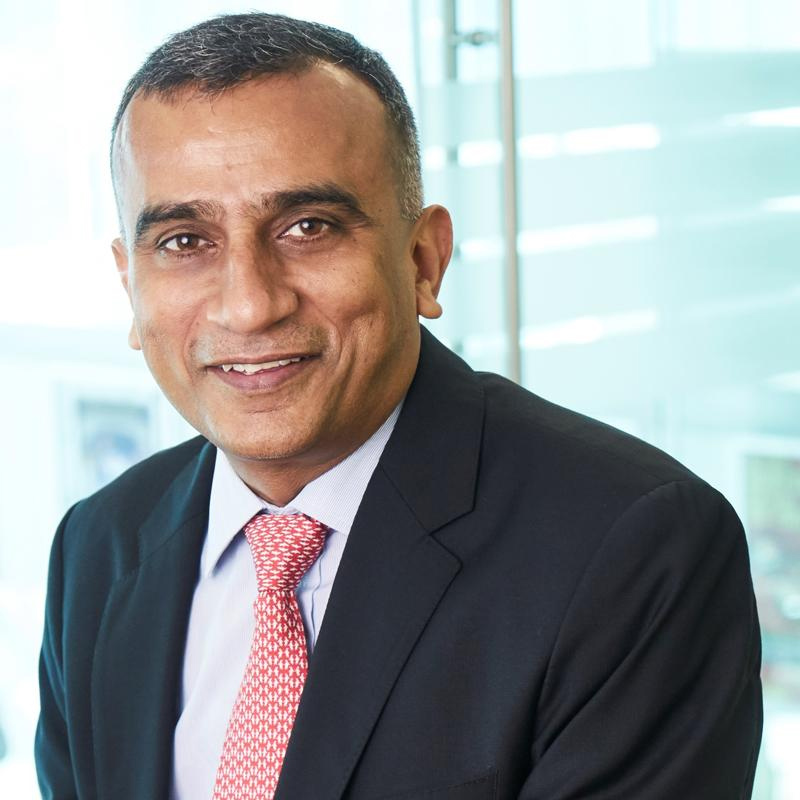
    He went on to share, “Another key point to note is that there is no one single customer for streaming, our customers sit across the spectrum of accessibility, affordability, and the languages in which they prefer to consume entertainment. Therefore, our strategy for building solutions for India has always been to focus on “AND” solutions, rather than making choices between “this” or “that”. That is exactly why Prime Video’s entertainment hub – where all the different VODs come into play, continues to do incredibly well. In fact, India is one of the frontrunners on new customer adoption for Prime Video globally. Also, our Channels proposition, where consumers get access to content from popular streaming services with add-on subscriptions, has grown well, with more than 20 partners on the service. Further, our Movie Rentals service where consumers – both Prime members and those who aren’t yet Prime Members, can rent movies ala carte, is seeing great consumer uptake across the country. Mini TV, Amazon’s free ad-supported service, also posted steady great growth in 2023. When we think about how to serve India, we prioritize what is important for customers – great value, great selection, and convenience. It is true for what we do at Amazon overall and the same holds true for Prime Video as well.”

    Responding to a question on the cost of content, Sushant spoke about the fact Amazon and Prime Video is invested for the long-term in India. Elaborating on the same, he said, “It is important to place this in context – our investment thesis is built on developing this category over a fairly long period of time. That’s the time horizon that we operate with for all our investments at Amazon, and the same holds true for Prime Video. The second is that we want to create a category of great cinematic storytelling and we know that consumers value that. We realized that creating an ecosystem across the board, not just the service, but creators and the technical ecosystem is an investment that is well made.”

    He went on to add, “The other thing about our investment thesis is that we look at it through the lens of how we bring in customers to enjoy this multi-benefit proposition for Prime, which is a unique proposition for customers and Prime Video is a part of that. That changes how customers evaluate what is value for money, and that gives us the impetus to continue to make investments. And finally, we want to make all the great stories that we can, but we realize that we can’t make all of them. We’re therefore always excited about the collaborations that we can forge, with creators, Channel partners and studios to build out a true video entertainment marketplace. The fact that Prime Video has close to 100 projects right now in various stages of production and development is a clear indication that there is appetite for great stories in the country!”

    To wrap up the highly engaging session, each participant was asked their Mantra for 2024, to which Sushant replied, “For us, it’s still Day one!” Day one is both a culture and an operating model that puts the customer at the center of everything Amazon does. Day one is about being constantly curious, nimble, and experimental.

  • FICCI FRAMES 2024: From playgrounds to pixels: Evolution and emerging trends in kids entertainment

    FICCI FRAMES 2024: From playgrounds to pixels: Evolution and emerging trends in kids entertainment

    Mumbai: The discussion traced the trajectory of this evolution, examining the impact of technology on content consumption, educational aspects, and the evolving preferences of young audiences. Emphasising the fusion of entertainment and education, the panel delved into the latest trends, such as interactive media, augmented reality, and immersive storytelling, offering valuable insights for creators, educators, and parents alike. The panel aimed to unravel the past, present, and future of kids’ entertainment, navigating the fascinating intersection of play and pixels.

    The moderator of the panel was Powerkids Entertainment CEO Manoj Mishra.

    “The essence of our content has remained consistent since the beginning. While storytelling and content creation have seen minimal alterations, there was a notable shift when I entered the industry. Initially, we relied heavily on foreign content, merely dubbing it for local audiences. However, over time, we began crafting our narratives that resonated more deeply with our audience, particularly children. The fundamental stories haven’t changed; it’s the platforms that evolve continually, and our adaptability has allowed us to broaden our horizons.” : Viacom18 kids TV network business head Anu Sikka.

    “In the future, animation will undeniably continue to hold a prominent position, Drawing insights from diverse channels, including online platforms like Netflix, and learning from the successes of digital endeavors, whether on Netflix or other platforms, we’ve adeptly tailored these achievements to suit the Indian landscape.”: Warner Bros Discovery head, kids network Uttam Pal Singh.

  • FICCI FRAMES 2024: Lights, camera, action: Golden era of storytelling

    FICCI FRAMES 2024: Lights, camera, action: Golden era of storytelling

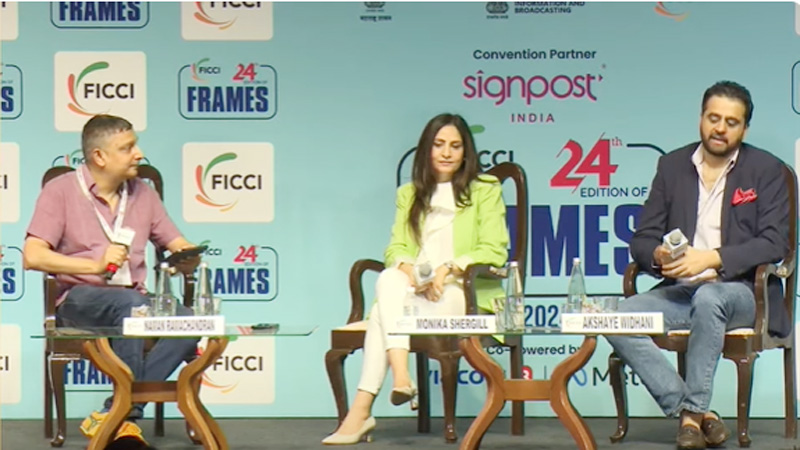
    Mumbai: This session brought together seasoned storytellers and content creators to unravel the transformative impact of disruptive technologies on narrative formats. Delving into the shift from traditional blockbusters to the era of binge-watching, the panel explores how storytelling has evolved. Participants witnessed a dynamic discussion on changing audience dynamics, emerging platforms, and the innovative strategies employed by storytellers to captivate and engage audiences in an era marked by a constant evolution in entertainment consumption.

    The fireside chat was moderated by Indian critic and journalist Naman Ramachandran.

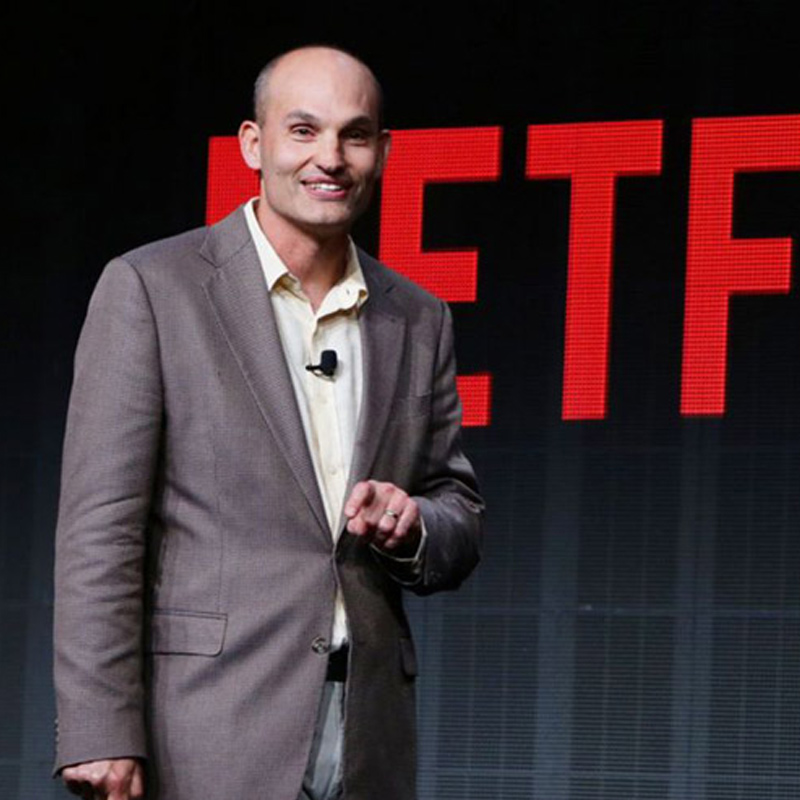
    “We are here to serve our audience with the most diverse & high-quality content. We find ourselves at an intriguing juncture in our streaming journey. Despite being a nascent industry, it is evolving rapidly, with people adopting it at an exceptionally fast rate.”: Netflix India VP – content Monika Shergill.

    Answering the question about the secret sauce in the theatrical business, Yash Raj Films CEO Akshaye Widhani said, “As an organisation, we don’t punish failure. That is the secret sauce at YRF.”

    Answering the second part of the question on what YRF looks for when commissioning a film or a series, Widhani said, “It is a creative business. Either you go right or wrong, but it’s about the story. The north star for us is the story. We’ve been telling stories for the last five decades and we hope we’ll keep telling stories much after that. When it comes to what we decide on how we decide to greenlight, it’s pretty much based on what that story is and how it appeals to us.”

  • FICCI FRAMES 2024: #Reinvent: Navigating the future of media and entertainment industry

    FICCI FRAMES 2024: #Reinvent: Navigating the future of media and entertainment industry

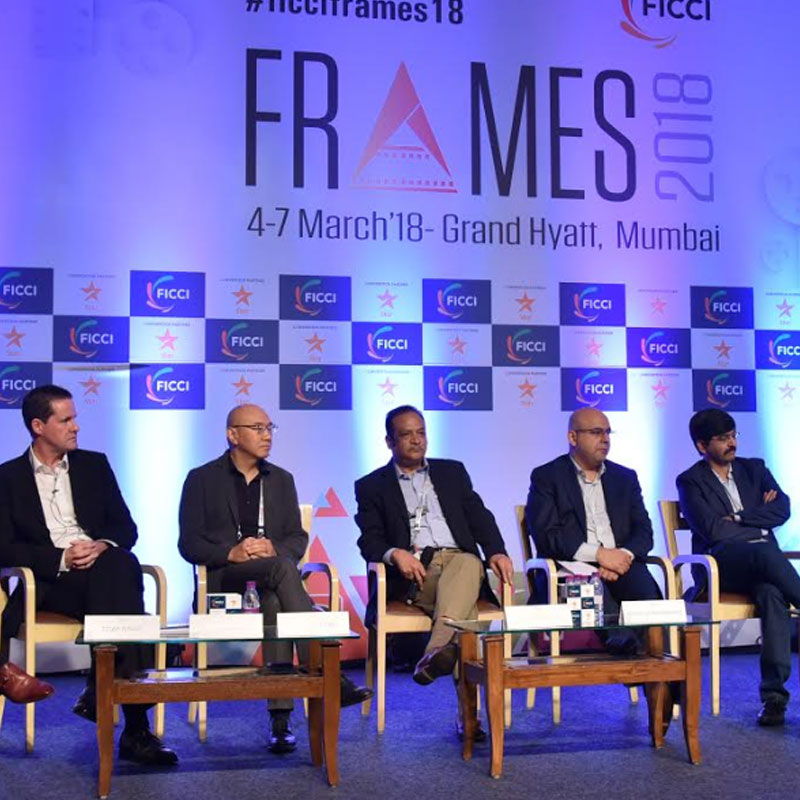
    Mumbai: The Indian media and entertainment industry is witnessing significant changes, with shifting consumer preferences for high-quality content, new broadcasting technologies, pressures on advertising spend, and the advent of AI. The #Reinvent session at FICCI Frames 2024 examined the dynamics driving this transformation and explored a range of enabling policies designed to support an industry navigating through a period of significant upheaval.

    The keynote of this session was given by Ministry of I&B secretary Sanjay Jaju, who said, “As we move forward, the Government of India’s focus is on creating a conducive environment for the Media and Entertainment industry to thrive.”

    The session was moderated by Ernst and Young partner Ashish Pherwani.

    “In the last one year, the skilling ecosystem of Maharashtra has supported 48,000 youths from Maharashtra to be trained only in media and entertainment. This was something of a record under M&E skill council. A big thank you to Mangal Prabhat ji and his government for their proactive efforts to train rural and urban youths,” FICCI India AVGC-XR Forum chair Ashish Kulkarni.

    “Globally, the media and entertainment industry is witnessing remarkable shifts with digital innovation reshaping consumption patterns and content creation dynamics,” FICCI Media and Entertainment Committee chair and Viacom18 CEO – broadcast entertainment Kevin Vaz.

    “India is a significant priority market for Meta globally. We have invested considerable time in developing products tailored to the diverse needs of the hundreds of millions of people using our platforms. We are dedicated to serving both users and businesses by continually enhancing our offerings,” FICCI Media and Entertainment committee co-chair and Meta India VP and head Sandhya Devanathan.

    “There is no one single customer. Customers sit across a spectrum of accessibility, affordability, of languages in which they want to watch their entertainment and what their entertainment needs are. For us, building solutions for India has always been about what we need to build as an end solution and not making piecemeal choices,” Amazon Prime Video country head Sushant Sreeram.

    “Free dish has been growing continuously and consistently. In 2003, when it started, the industry was at a very nascent stage and it set the context for the rest of the industry to grow and develop,” Prasar Bharati chief executive officer Gaurav Dwivedi.

    “We usually focus on the who, what and where. Who is consuming us, what kind of content they are consuming and where do they prefer to consume. I think the new dynamic that is now emerging is for us to focus on when and traditionally linear TV networks didn’t focus on that. By when, I mean consumption patterns that are arising from the situation that you are in – like in an elevator, waiting for a bus or picking your child from school. And in that 30-second to five-minute moment, do you have content form that they find engaging,” FICCI media and entertainment committee co-chair and Warner Bros Discovery Sr VP and general manager  – India & South Asia Arjun Nohwar.

    “Out-of-home advertising is playing a great role in sustenance of smart cities because when we see any social spaces – roadside shelters, libraries or any basic first mile or last mile connectivity solutions, it is the responsibility and obligation of out-of-home player where they invest in basic infrastructure. It is beyond billboards and includes investing in smarter solutions like charging points too,” Signpost India chairman & MD Shripad Ashtekar.

  • AVGC policy to facilitate investments, foster innovation and contribute to building world-class infrastructure: Sanjay Jaju, Secretary, MIB

    AVGC policy to facilitate investments, foster innovation and contribute to building world-class infrastructure: Sanjay Jaju, Secretary, MIB

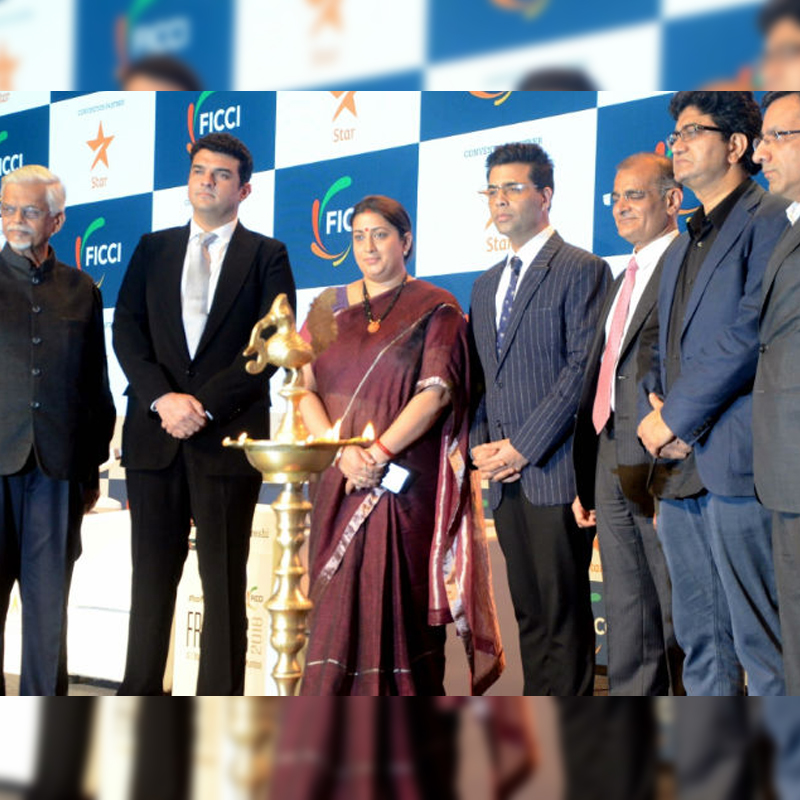
    MUMBAI: Sanjay Jaju, secretary, ministry of information and broadcasting, Govt of India today said that the media and entertainment industry play a pivotal role in shaping our society, influencing our perspectives, and has a multiplier effect on our economy. “The sector is renowned for its creativity, innovation, and cultural richness. It serves as a beacon not only for our nation but also for the world,” he added.

    Addressing the ‘FICCI FRAMES 2024’,   Jaju stated that the government recognizes the pivotal role that the Indian media and entertainment sector plays in shaping our society, influencing our perspectives, and reflecting our collective efforts. “India is going through a digital transformation phase and the sector is also witnessing rapid shifts with the availability of content which is online,” he stated. We are also witnessing a rapid increase in foreign investments especially in the OTT segment which paves the way for looking at this segment as a chief contributor to India’s soft power, noted   Jaju.

    Speaking on the various government initiatives along with the AVGC policy, Jaju further emphasised that the policy is now in an advanced stage. “I can assure you that this policy is not only going to facilitate investments within our country and the states but will also foster innovation. It will ensure skill development and help protect intellectual property and will also contribute to building world-class infrastructure. We also envisage setting up of National Center of Excellence for animation, VFX, and extended reality sector along with setting up incubation centres,” he added.

    Jaju further highlighted that the government is giving a thrust for foreign filmmakers to make films in India. “The Indian media and entertainment sector not only has huge growth potential but also brings in a lot of employment. Our focus will be on creating a conducive environment for the industry to thrive. All stakeholders need to collaborate and innovate to capitalize on the huge opportunities,” he noted.

    Govt of Maharashtra minister of skill development and entrepreneurship Mangal Prabhat Lodha said that the realisation of ‘Viksit Bharat’ depends on the collective contribution of everyone, and skilling is integral to the future of our country.

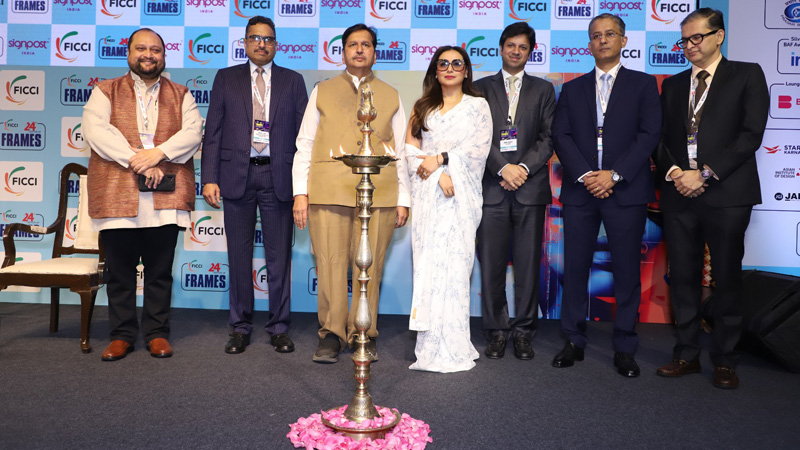
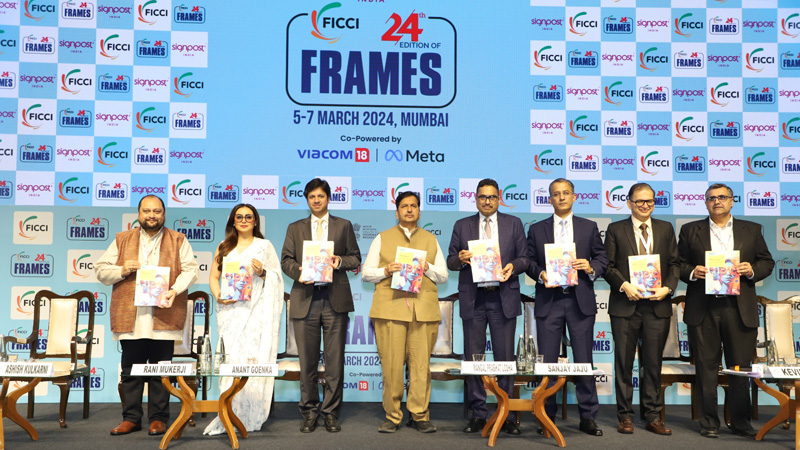
    An Indian actress Rani Mukerji said that FICCI FRAMES 2024 has set the agenda for an ever-changing media and entertainment industry. “The pandemic forced us to adapt, innovate, and reimagine the ways in which we connect with audiences. As consumer preferences evolve, there is a growing demand for unique and innovative content delivery,” she added.

    FICCI and vice chairman, RPG group vice president Anant Goenka said that FICCI FRAMES 2024 has been a cornerstone over the years, significantly influencing the trajectory of India’s media and entertainment industry. The Indian media and entertainment sector has witnessed remarkable growth over the past decade, and the digital revolution has reshaped our industry.

    FICCI Media and Entertainment Committee and CEO of broadcast and entertainment, Viacom 18, chair Kevin Vaz, said that the road ahead for the industry is brimming with possibilities and challenges alike. The integration of artificial intelligence promises to reshape the landscape of content creation, distribution, and consumption, particularly generative AI, which is now an inexorable part of M&E supply chains, he added.

    AVGC-XR committee chair Ashish Kulkarni, FICCI delivered the vote of thanks.

  • The Indian M&E sector anticipated to achieve Rs 3.1 trillion by 2026: FICCI-EY report

    The Indian M&E sector anticipated to achieve Rs 3.1 trillion by 2026: FICCI-EY report

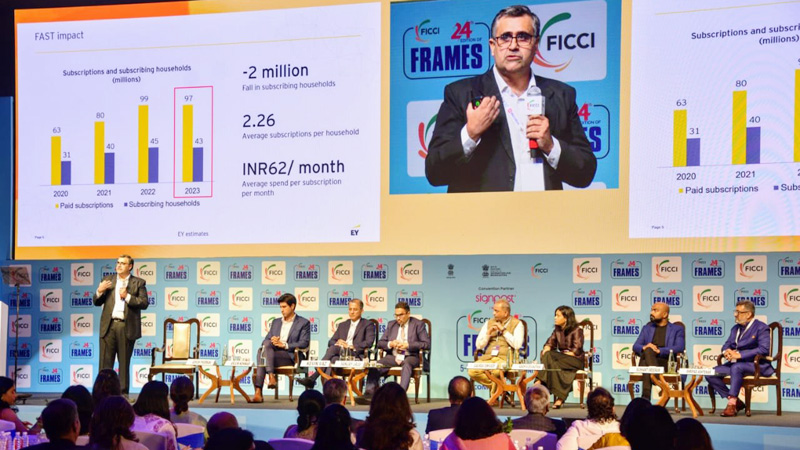
    Mumbai: The latest FICCI-EY report titled ‘#Reinvent: India’s media & entertainment sector is innovating for the future’, launched at the FICCI FRAMES 2024 in Mumbai, revealed that the Indian M&E sector grew by eight per cent in 2023, reaching Rs 2.3 trillion (US$27.9 billion), 21 per cent above its pre-pandemic levels in 2019.

    New media, comprising digital and online gaming, emerged as the frontrunner in growth, contributing Rs 122 billion of the overall increase of Rs 173 billion, and consequently, increased its contribution to the M&E sector from 20 per cent in 2019 to 38 per cent in 2023.

    Experiential (outside the home and interactive) segments continued their strong growth in 2023, and consequently, online gaming, filmed entertainment, live events, and OOH media segments grew at a combined 18 per cent, contributing 48 per cent of the total growth. With the exception of television, which experienced a marginal decline of 2 per cent, all other segments experienced positive growth in 2023.

    FICCI Media and Entertainment committee chairman and Viacom 18 chief executive officer – broadcast entertainment Kevin Vaz said, “India is a unique market where the M&E sector distinguishes itself through a harmonious fusion of tradition and innovation. Here, technology-enhanced entertainment channels, OTT platforms, AI-powered newsreaders, traditional print media, flagship films, and short-form content not only coexist but thrive together, showcasing the vibrant diversity and dynamic growth of our industry. The Government of India’s thrust on improving digital infrastructure in the country combined with our ambition to be at the forefront of the next big technological thrust in media and entertainment, our sector is primed for a massive transformation.”

    EY India partner and media & entertainment leader Ashish Pherwani said, “I believe the M&E sector is at the “inflection point” we foresaw in 2018, with the dominance of digital channels over traditional media. In 2023, new media comprised 52 per cent of total advertising revenues, yet, unlike in many other countries, Indian traditional media also grew. This underscores the unique Indian market where while we are witnessing a seismic shift towards digital consumption, there is still adequate headroom for traditional media to grow.”

    Key highlights:

    Indian advertising reached Rs1.1 trillion:

    Digital advertising grew 15 per cent in 2023 and surpassed traditional advertising for the first time. Social, sports, e-commerce and SME advertisers will continue to drive growth in the sector moving forward.

    A billion screens by 2030:

    India is expected to have almost a billion active screens by 2030. Of these, around 240 million will be large (TV, laptop, PC), while the remaining will be small (mobile phones, phablets). pay TV, free TV, and connected TV are expected to emerge as significant markets, each comprising between 60 to 80 million homes. The 3:1 ratio in favour of mobile phones will sustain the demand for short videos and social commerce.

    Online gaming is expected to reach Rs 388 billion by 2026:

    The segment will see growth across all its verticals, including esports, fantasy sports, casual gaming, and other games of skill to reach an estimated 150 million daily users. Revenue growth will be led by mobile-based real-money gaming and casual gaming.

    Segmental performance in 2023

      . Television: Linear viewership increased by two per cent over 2022, the number of smart TVs connected to the internet each week rose to 19 to 20 million, up from around 10 million in 2022. Television advertising declined by 6.5 per cent due to a slowdown in spending by gaming and D2C brands, impacting revenues for premium properties. The Hindi-speaking market (HSM) experienced softness, resulting in a three per cent overall ad volume de-growth. However, subscription revenue saw growth after three years of decline, driven by price increases, despite a decrease of two million pay TV homes.

     .  Digital advertising: Digital advertising grew 15 per cent to reach Rs 576 billion, constituting 51 per cent of total advertising revenues. This figure includes advertising by SME and long-tail advertisers totalling over Rs 200 billion, and advertising earned by e-commerce platforms amounting to Rs 86 billion.

     .  Digital subscription: Digital subscription grew 9 per cent to reach Rs 78 billion accounting for a third of 2022’s 27 per cent growth, as premium cricket properties were moved in front of paywalls. Paid video subscriptions decreased by two million in 2023 to 97 million, across 43 million households in India. However, paid music subscriptions grew from five million to eight million, generating Rs 3 billion, while online news subscriptions generated Rs 2 billion.

     .  Print: Contrary to the global trend, print media continued to thrive in India, with advertising revenues growing by four per cent in 2023. Notably, there was significant growth in premium ad formats, as print remained a preferred medium for affluent metro and non-metro audiences. Subscription revenues also grew by three per cent due to rising cover prices.

     .  Online gaming: The segment’s growth slowed to 22 per cent in 2023, reaching Rs 220 billion. It surpassed filmed entertainment to become the fourth largest segment. India saw over 450 million online gamers, with approximately 100 million playing daily. Over 90 million gamers paid to play, with real money gaming comprising 83 per cent of segment revenues. Larger players absorbed the impact of a higher GST levy, hurting their margins but safeguarding growth.

     .  Film: The segment grew 14 per cent to reach Rs 197 billion in 2023. Over 1,796 films were released in 2023, and theatrical revenues reached an all-time high of Rs 120 billion. The number of screens grew four per cent. 339 Indian films were released overseas.

     .  Animation and VFX: The Hollywood writers’ strike impacted global supply chains, and consequently, the segment grew just six per cent in 2023. Potential mergers and falling ad revenues also reduced the slate of animated content produced for broadcast in India. A revival in demand in the second half of the year led to growth, boosted by the trend of using more VFX in Indian content.

     .  Live events: The organized segment grew 20 per cent exceeding pre-pandemic levels. Growth was driven by government events, personal events, weddings, and ticketed events, including several international formats and acts that came to India.

     .  OOH: OOH media grew by 13 per cent in 2023, surpassing its 2019 levels. Growth was led by premium properties and locations. Active digital OOH screens crossed 1,00,000 contributing nine per cent of total segment revenues.

      . Music: The Indian music segment grew by 10 per cent to reach Rs 24 billion in 2023, slower than previous years as certain music OTT platforms went pay and stopped or reduced their free services. 87 per cent of revenues were earned through digital means, though most of it was advertising led on YouTube, there being around only eight million paying subscribers despite music streaming’s reach of 185 million.

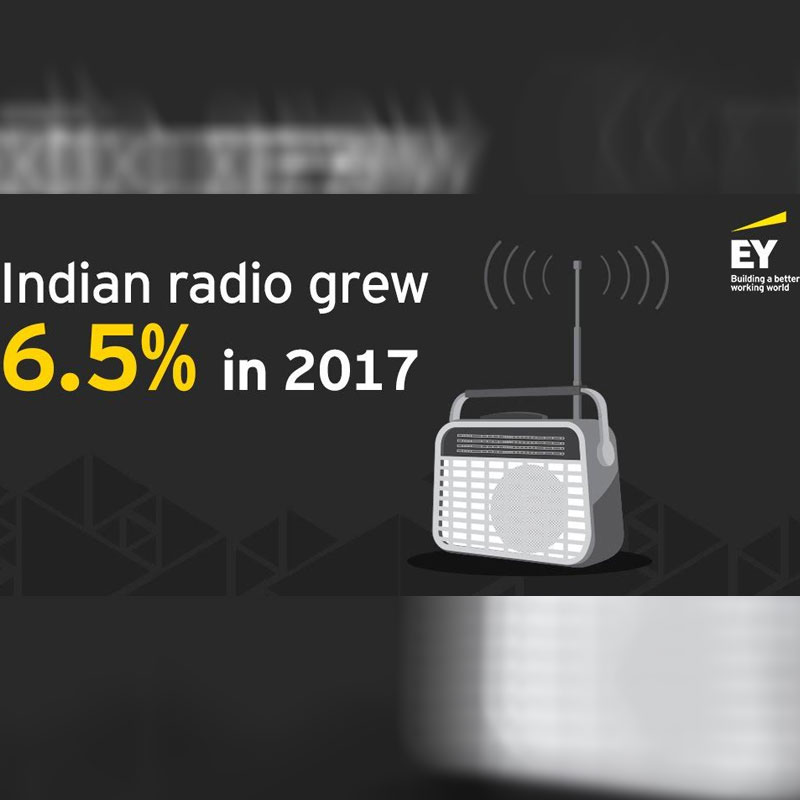
     .  Radio: Radio segment revenues grew by 10 per cent in 2023 reaching Rs 23 billion. This growth was driven by increased retail and local advertising, as well as alternate revenue streams. Ad volumes increased by 19 per cent in 2023 as compared to the previous year, although ad rates remained below their 2019 levels.

  • India should become first country to industrialize without carbonizing; create unique model of development: Amitabh Kant

    India should become first country to industrialize without carbonizing; create unique model of development: Amitabh Kant

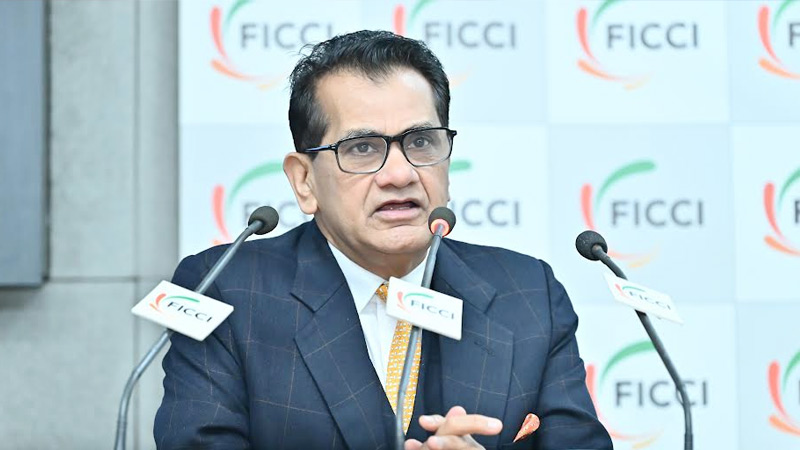
    Mumbai: G-20 Sherpa, Government of India, Amitabh Kant, has said that transition to a circular economy can bring significant benefits to India, ranging from environmental conservation to economic growth and job creation. It’s emphasis on reducing waste generation, promoting local production and resource optimization, and reducing greenhouse gas emissions aligns with India’s commitments to sustainable development and climate change mitigation. “When countries like India begin the long march towards growth and development, it must create a unique model of development where we become the first country in the world to industrialize without carbonizing,” he added.

    Addressing the ‘FICCI Circular Economy Symposium’, Kant further stated that it is imperative for India to grow rapidly from the current rate of 7.5 per cent and accelerate the pace of growth to 9-10 per cent per annum in the years to come. The model of development for India has to be very different and to be able to do that we need to focus on bringing renewable energy in India including producing renewable energy and green hydrogen. “India is climatically blessed to produce green hydrogen. Currently the cost of production of green hydrogen is $4.5 per kg and India’s objective is to bring is down to $1 per kg by 2030,” he added.

    Kant highlighted that the world is going through massive disruption and soon the focus will be on electric mobility especially for two, three and four-wheelers. There is also the need to bring in huge energy efficiency along with huge focus on circular economy. He also emphasized that India must give thrust on the process of recycling. Circular economy is an economic system where means of production are organized around recycling, reusing the inputs so that they can be used to reduce environmental emission and facilitate a sustainable mode of production.

    “We need to achieve the circularity of inputs. India is currently not circular, and the economic model is linear. There is a radical need to transit to circular economy as it opens huge possibility of innovation, disruption, help reduce greenhouse emissions,” he added.

    The transition to circular economy can bring significant benefits to India and we need to become the global champions to accelerate this transition process including investing in infrastructure and encouraging innovations, noted Kant.

    Counsellor, head of section – delegation of the European Union to India Dr Michael Bucki, said that there is a huge potential in circular economy between India and the EU and there is a lot of room for mutual learning between the two.

    SABIC VP,  regional head- South Asia & Australia, Janardhanan Ramanujalu, said that rapid urbanization, deforestation, and exponential population are some of the challenges of carbon dioxide imbalance in the atmosphere and all stakeholders need to find a solution to these. “We need to focus on the concept of circular carbon economy. Carbon capture and utilization, recycling carbon-based products, becoming energy efficient and innovation in materials are few steps to achieve circular carbon economy,” he added.

    National CE Committee chair and Mahindra LifeSpace Developers Ltd MD & CEO Amit Shah said that embracing the circular economy will also be an important contribution to societies effort to handle urgent climate change challenges.

    FICCI National CE Committee co-chair and Aditya Birla Fashion & Retail Ltd chief sustainability officer Naresh Tyagi said innovation and collaboration are the way for the industry to move towards a circular economy.

    During the event ‘4th FICCI Circular Economy Awards’ were announced along with the release of ‘National Unified Circularity Measurement Framework’.