Category: Special Report

  • Greymatter to debut at MIPCOM 2013

    Greymatter to debut at MIPCOM 2013

    Greymatter Entertainment – a 360 degree media company offering end-to-end creative solutions and production services for broadcast, celluloid and digital platforms – is debuting at this year’s MIPCOM with a host of new and innovative formats.

    For a company which produces content across genres, including reality, music, travel, lifestyle, game show and documentary, participating in the world’s largest content market is possibly a natural next step. Says Greymatter Entertainment owner Rahul Sarangi, “MIPCOM helps you network with global content buyers. The market is also a platform for companies with new formats.”

    We believe most of our formats are very differentiated yet palatable to the global audience, says Rahul Sarangi

    So what’s on offer at the fest? “We will launch a factual documentary titled ‘Tribes of the World’, an award winning show ‘Bikini Café’, a never-seen before music reality format named ‘Remix’ and a series about unconditional love christened ‘Thanks Maa’,” Sarangi answers.

    For the uninitiated, Tribes of the World is a factual documentary which explores the unexplored and unseen faces of tribal India. Bikini Café is about testing one’s entrepreneurial skills of owning a shack while Thanks Maa gives mothers a chance to relive their dreams.

    Elaborating on his plans, Sarangi says: “We are looking at co-producing interesting formats/content under the genres we specialise. As far as selling is concerned, one of our music formats ‘Remix’ has been sold to a few markets and is distributed by Global Agency. We have also recently concluded a very successful co- production deal with Novovision on 52 x 30 min non-dialogue humour episodes for the global market.”

    What does Greymatter expect to achieve at MIPCOM 2013? “As you would be aware, Indian broadcasters don’t give rights to producers, but we have figured that if we have a global partner, then we can retain rights and make it a global success. We believe most of our formats are very differentiated yet palatable to the global audience,” explains Sarangi, adding: “We expect to strike some interesting co-production, distribution or strategic partnership with global companies that suit our profile.”

    On the subject of markets, Sarangi says the company is open to any market, from America and Europe to the Middle East and Asia, as long as it shares Greymatter’s sensibilities. The firm will concentrate on platforms like IPTV, mobile and free to air.

  • Brands ready to outshine on Diwali

    Brands ready to outshine on Diwali

    Inflation be damned! Diwali is here and consumers are more than willing to loosen their purse strings. Exactly, why a majority of brands go all out to woo them.

    It is a critical period for most companies and hence, elaborate plans are made to reach out to consumers, says Llyod Mathias

    In any case, most companies are known to allocate nearly 25 to 35 per cent of their marketing budget to the festive season. Not surprisingly, it’s that time of the year when newspaper supplements get to look fatter and fancier, and television ads and hoardings get a colourful new lease of life.


    Says marketing veteran Lloyd Mathias: “It is a critical period for most companies – consumer durables, auto, paints etc. – and hence, elaborate plans are made to reach out to consumers, who are also not hesitant to shell out money.”

    Apart from aggressively marketing existing products, many brands even launch new products.
    Titan, for instance, has launched a new campaign featuring Katrina Kaif to promote its latest Raga collection – Raga Pearls. Says global marketing head Rajan Amba: “In addition to Raga, we also have outdoor campaigns for our premium brands – Nebula & Xylys.” In a first, Titan plans to offer a Tanishq gold pendant free with every purchase below Rs 70,000, and a Tanishq gold and diamond pendant free with every purchase about Rs 70,000. Titan also plans to launch 180 variants in keeping with the festive spirit.


    At Raga we strive to create memorable stories every year, explains Rajan Amba, The World Gold Council, undeterred by soaring gold prices, has launched its new collection named Azva. “This season is the main spending time for us and will go all out with it. GECs, movies, music, regional channels as well as OOH and print will be utilized in the 360 degree marketing plan to optimize sales,” says WGC jewellery director Vipin Sharma.


    There’s no undermining the importance of sweets during Diwali, and this year, Cadbury plans to leverage the entire Mondelez International Portfolio to create a cross-category gift pack containing Cadbury chocolates, Choclairs, Cadbury Bournvita and Oreo biscuits for customers. “As we get into the Diwali season, we will again look at getting consumers to celebrate the true spirit of the festival. The essence of the festival, of spending time together with your loved ones, seems to have been lost. Through, Cadbury Celebrations thus, we look forward to actually enabling people to come together and spend quality time this Diwali,” says Cadbury India chocolate – gifting & strategy AVP Amarpreet Anand. At Cadbury, gifting is all about re-establishing closeness with loved ones which seems to have been replaced in today’s age of technology, busy lives and consumerism; Anand points out.


    In sharp contrast, PepsiCo India plans to capitalize on the ‘sweets overkill’ to promote their salty snack brand Kurkure.


    Vipin Sharma says that the festive season is the main spending time and WGC will go all out with it


    “Over the years, through its campaigns that encourage consumers to spend more time with family, Kurkure has constantly re-invented itself to remain relevant to the Indian ethos and culture.


    Festivals hold special importance in our annual marketing calendar and offer an ideal platform to reach out to consumers. Kurkure, with its unique take on celebrations, seeks to cut down the excessive sweetness that accompanies celebrations. So every year around the festival season, we bring in new flavours and innovative gifting options that strengthen our much loved proposition of ‘Zyaada Meetha ho Gaya? Iss Diwali Muh Kurkure Karo’,” says PepsiCo India Indian snacks category director Nalin Sood. Indeed, Kurkure is launching a new range of ‘Raja Rani’ gift packs designed by Ray and Keshavan, a leading South Asian brand & design consulting firm.

    The festive period also sees a lot of consumer spending in the FMCG and automobile categories. Says Godrej Appliances sales & marketing executive VP Kamal Nandi: “At Godrej, our attempt is to delight our consumers with Best in Class innovative products. Continuing this tradition, we are launching a breakthrough technology in washing machines, which will be a revolution in this category and most of our marketing activity will be focusing on this product this festive season The pre-launch phase of this special campaign has already been launched on digital media and which in itself is a first of its kind initiative in the industry.”

    Godrej plans to focus on consumer engagement through facebook and YouTube apart from regular digital advertising, SEM, etc.

    Godrej plans to focus on consumer engagement through facebook and YouTube apart from regular digital advertising, SEM etc, elaborates Kamal Nandi


    Similarly, Fiat Group Automobiles India has come up with a new ad for its recently launched Linea Classic. The campaign showcases Fiat Linea Classic as an affordable car designed to make the sedan far more accessible to hatchback users, in turn making them ‘feel big’.

    In the electronics segment, Dell India has kicked off its ‘Celebrate Dell Se’ campaign a few weeks ago, part of which is the ‘Hint a Gift’ TV commercial for its Inspiron notebooks. Says Dell India marketing director Ritu Gupta: “Building an emotional connection between our customers and technology is integral to Dell’s branding strategy. In line with our on-going achievement “I can do kuch bhi” campaign, we decided this festive season to inspire the youth with the idea that they have the power to get what they want by hinting to their loved ones about their preferred gift for Diwali, which in this case is the Dell Inspiron range of touch laptops.”

    All said, brands may try to outdo and outshine one another but it is ultimately up to the customer to decide which one to give preference to…

  • Not just couch potatoes

    Not just couch potatoes

    While watching television is the main source of entertainment for millions of Indians, the sheer number of channels and programs from which one has to choose makes for a rather mind-boggling exercise. But don’t fret for there’s help in the form of a new platform where people with similar viewing preferences can exchange views and stay updated with the latest developments.

    Founded by BIT-Meerut B.Tech graduates Rabi Gupta and Ashish Kumar in May this year, iCouchApp helps television viewers engage with the programs they are watching, get TV program alerts, and have loads of fun while they are at it.

    Audiences are attracted more towards a product that has official link-ups explain Ashish and Rabi

    Television enthusiasts Rabi and Ashish wanted more from TV shows than just nicely packaged programs, which is why they entered the domain with iDubba, a platform designed to bridge the gap between television and audiences. “We launched iDubba last year and it basically worked as a TV guide. Like viewers could set alerts for their favourite shows, movies, etc,” says Rabi, who not only was not satisfied with the existing shows but also curious to know more about them.

    Within sometime of launching iDubba, the duo noticed a change in the behaviour of their users, who started interacting on the platform about their likes and dislikes with respect to certain shows. “We came to the conclusion that while TV audience requires information, they also want an interactive platform. And that was the germ from where we started working on the iCouch app,” says Rabi about the genesis of the application, which has now found popularity among more than 25,000 android phone users.

    With very few contacts in the television industry, the duo first ran the idea through Zee Café and found it was taken in good spirit. “The channel was in the process of launching the new season of their popular show, Grey’s Anatomy and tied up with us for the same,” reveals Rabi.

    Zee Café found it an exhilarating idea as it would help them expand their viewer base. Business head Zee – niche channels Anurag Bedi says: “The rate at which various communication vehicles are seeing a decline, this initiative was taken to give the viewers a personalised bite into their TV viewing experience. This differentiated app has been developed in a creative and nimble way to get viewers talking about the show real time. With majority of the urban population now making a shift to smartphones, creating such an app was an obvious choice for engagement for this kind of a show,” adding that the app was meant to unite all fans of Grey’s Anatomy on a common platform and keep them glued to the show.”

        
    Before taking their plan ahead, Rabi and Ashish interacted with different TV channels to understand their problems in engaging with audiences. “It basically required building a kind of trust with the TV audience. Audiences are attracted more towards a product that has official link-ups. So we made sure to promote the app on the TV screen as a ticker while the show was on air,” says Rabi, adding that since the app is still new, their associations with channels are free of monetary give and take.

    After Zee Café, History Channel followed suit, partnering with iDubba for their series Ancient Aliens.

    Says A+E Networks TV18 VP and head marketing Sangeetha Aiyer: “We’re always on the lookout for ideas and activities which can help increase the overall engagement and help make the process of receiving viewer feedback more efficient. In this case, we were looking to integrate the social interactions with television directly, and iCouch solved this problem efficiently. Apart from being a novel experience for our viewers, it helped us receive direct feedback from the viewers – something that regular social interaction was not equipped to deliver efficiently.”

    Social analytics data derived from audience interactions helped the channel to analyse the mood and reception more accurately. “While the App helped us engage with viewers, the ticker playing live during the telecast helped the App accrue more downloads, making it a truly symbiotic relationship for both parties,” says Aiyer, highlighting that the business arrangement between both parties is pretty basic and their prime objective at the moment is to increase engagement.
    Rabi and Ashish were able to generate funds from many people in the industry like Ashok Kurien and Rajan Anandan.

    Currently, the app is really popular with audiences and is promoting few non-partner shows like Kaun Banega Crorepati and Bigg Boss Season 7 that are helping the duo increase their user base. “These are non-partner shows but they have become really popular and have picked up a lot of traction because of the interesting concept,” says Rabi, who has huge plans for the app in future. “It is not just exciting for viewers but broadcasters too. In the time to come, we are going to build a lot of things inside the app which would amplify engagement,” he concludes.

  • Not just couch potatoes

    While watching television is the main source of entertainment for millions of Indians, the sheer number of channels and programs from which one has to choose makes for a rather mind-boggling exercise. But don’t fret for there’s help in the form of a new platform where people with similar viewing preferences can exchange views and stay updated with the latest developments.

    Founded by BIT-Meerut B.Tech graduates Rabi Gupta and Ashish Kumar in May this year, iCouchApp helps television viewers engage with the programs they are watching, get TV program alerts, and have loads of fun while they are at it.

    Audiences are attracted more towards a product that has official link-ups explain Ashish and Rabi

    Television enthusiasts Rabi and Ashish wanted more from TV shows than just nicely packaged programs, which is why they entered the domain with iDubba, a platform designed to bridge the gap between television and audiences. “We launched iDubba last year and it basically worked as a TV guide. Like viewers could set alerts for their favourite shows, movies, etc,” says Rabi, who not only was not satisfied with the existing shows but also curious to know more about them.

    Within sometime of launching iDubba, the duo noticed a change in the behaviour of their users, who started interacting on the platform about their likes and dislikes with respect to certain shows. “We came to the conclusion that while TV audience requires information, they also want an interactive platform. And that was the germ from where we started working on the iCouch app,” says Rabi about the genesis of the application, which has now found popularity among more than 25,000 android phone users.

    With very few contacts in the television industry, the duo first ran the idea through Zee Café and found it was taken in good spirit. “The channel was in the process of launching the new season of their popular show, Grey’s Anatomy and tied up with us for the same,” reveals Rabi.

    Zee Café found it an exhilarating idea as it would help them expand their viewer base. Business head Zee – niche channels Anurag Bedi says: “The rate at which various communication vehicles are seeing a decline, this initiative was taken to give the viewers a personalised bite into their TV viewing experience. This differentiated app has been developed in a creative and nimble way to get viewers talking about the show real time. With majority of the urban population now making a shift to smartphones, creating such an app was an obvious choice for engagement for this kind of a show,” adding that the app was meant to unite all fans of Grey’s Anatomy on a common platform and keep them glued to the show.”

    Before taking their plan ahead, Rabi and Ashish interacted with different TV channels to understand their problems in engaging with audiences. “It basically required building a kind of trust with the TV audience. Audiences are attracted more towards a product that has official link-ups. So we made sure to promote the app on the TV screen as a ticker while the show was on air,” says Rabi, adding that since the app is still new, their associations with channels are free of monetary give and take.

    After Zee Café, History Channel followed suit, partnering with iDubba for their series Ancient Aliens.

    Says A+E Networks TV18 VP and head marketing Sangeetha Aiyer: “We’re always on the lookout for ideas and activities which can help increase the overall engagement and help make the process of receiving viewer feedback more efficient. In this case, we were looking to integrate the social interactions with television directly, and iCouch solved this problem efficiently. Apart from being a novel experience for our viewers, it helped us receive direct feedback from the viewers – something that regular social interaction was not equipped to deliver efficiently.”

    Social analytics data derived from audience interactions helped the channel to analyse the mood and reception more accurately. “While the App helped us engage with viewers, the ticker playing live during the telecast helped the App accrue more downloads, making it a truly symbiotic relationship for both parties,” says Aiyer, highlighting that the business arrangement between both parties is pretty basic and their prime objective at the moment is to increase engagement.

    Rabi and Ashish were able to generate funds from many people in the industry like Ashok Kurien and Rajan Anandan.

    Currently, the app is really popular with audiences and is promoting few non-partner shows like Kaun Banega Crorepati and Bigg Boss Season 7 that are helping the duo increase their user base. “These are non-partner shows but they have become really popular and have picked up a lot of traction because of the interesting concept,” says Rabi, who has huge plans for the app in future. “It is not just exciting for viewers but broadcasters too. In the time to come, we are going to build a lot of things inside the app which would amplify engagement,” he concludes.

  • Will Brand Sachin take a beating?

    Will Brand Sachin take a beating?

    Sachin Tendulkar has had his way with the BCCI after all. His legions of fans and his family will be able to watch the Master Blaster bat one last time on his home ground as he plays his 200th and final match at Mumbai’s Wankhede Stadium next month.


    While this is a small compensation for millions of cricket-crazy Indians who look up to him as almost God, one might argue that they can continue to watch him on television, post retirement, as the face of the many brands he endorses. And, others might question if advertisers will continue to cough up astronomical sums to have Sachin advertise their brands even after he retires from all form of international cricket.

    Watch the video: Boost pays tribute to Sachin’s 23 years of stamina!

    GroupM national director of sports and live events Vinit Karnik feels Sachin’s retirement will make no difference to his brand value. “Sachin appeals emotionally to at least four generations if not more. These are the people who have grown up watching him play and do not mind more of him. Post retirement, if he is seen endorsing a brand, these people would love ‘catching up’ on him, even if it is in the ‘brand’ space,” he says.

    Harish Bijoor feels post retirement Sachin’s brand value will diminish

    On the same thoughts, CAA Kwan’s COO Indranil Das Blah, thinks that though there will be a decrease in number of brands he endorses, his brand value won’t get affected. “Brands will continue to associate with him, especially the ones with older target audience. Post retirement, they will be known for stability, loyalty etc.”

    Having said that he adds that there can be a marginal decrease, around 10-15 per cent, on the brand value. However, this will and shouldn’t impact the price he charges for endorsing a brand.

    Brand consultant Harish Bijoor says: “Sachin’s retirement means a setback to Sachin’s brand endorsement money value for sure. Sport stars are always evaluated on the basis of the last three matches they have played. Add to that the heritage value of the bat that has been wielded.

     Despite it all and despite Sachin being the God of Cricket, endorsement money is bound to go just one way… south.”

    Indranil Das Blah feels that though there will be a decrease in number of brands he endorses but his brand value won’t get affected

    Whichever direction Sachin’s brand endorsements may be headed, most of the industry agrees that it doesn’t get any better than the cricketing legend’s current brand value. “Statistically speaking, with earnings in the range of $18 million, solely from endorsements across categories, even at the age of 40, he is ranked 51 on the Forbes World’s Highest Paid Athletes List for 2013. This places him ahead of the likes of Wayne Rooney, Didier Drogba, Serena Williams, Neymar, Sebastian Vettel, Zlatan Ibrahimovic and Steven Gerrard – all of whom are younger than him,” emphasises Karnik.

    Independent communication consultant Ganapathy Viswanathan, says: “Boost, the beverage drink, is one of the early brands that he endorsed which was followed by several other brands as he grew popular. One of his longest associations has been with MRF Tyres. Sachin almost had a 10-year long relationship with MRF, which proves the trust the brand reposed in him. Besides, there are several other brands he has endorsed that just went well with his personality and fit the brand well.”

    Ganapathy Viswanathan points out that after Boost he endorsed several other brands as he grew popular

    Collectabillia.com that sells Sachin Tendulkar’s memorabilia, informs that post his retirement announcement, the sale of Sachin merchandise and personally autographed products has increased significantly. “Sachin autographed products are selling like hotcakes. A personally signed cap by Sachin which costs Rs 7,500 provides a great investment opportunity for avid collectors and lovers of the game. Besides, Sachin branded T-shirts which starts from Rs 699 onwards are selling very fast,” adds a spokesperson from the portal.

    The overall view is a brand ambassador must fit the bill as he/she is the best way to put a human face to a product or service. Hence, brands must be careful about choosing their ambassadors rather than just going for famous faces to advertise their products. For instance, Virat Kohli is the hottest name right now and most brands want to cash in on him, feel many.
    In Sachin’s case, brands have just about a month to cash in on the phenomenon. Only time will tell which brands choose to stay in action and which try to get away from the clutter…

    Brands endornsed

    Boost (1990–present)
    Fiat Palio (2001–03)
    G-Hanz (2005–07)
    Pepsi (1992–2009)
    TVS (2002–05)
    Sanyo BPL (2007–present)
    Action Shoes (1995–2000)
    ESPN Star Sports (2002–present)
    Toshiba (2010–present)
    MRF (1999–2009), Adidas (2000–10)
    Sunfeast (2007–13), Canon (2006–09)
    Colgate-Palmolive, Philips, VISA, Castrol India (2011–12)
    Britannia (2001–07)
    Airtel (2004–06), Reynolds (2007–present)
    Ujala Techno Bright and Coca-Cola (2011–13)
    He has also been a spokesperson for National Egg Coordination Committee (2003–05),  AIDS Awareness Campaign (2005) and Luminous India (2010–present)

  • IRF 2013: James Cridland: Indians love their radio II

    IRF 2013: James Cridland: Indians love their radio II

    This is the second part of the excerpts/summary of radio futurologist James Cridland’s session on “How People Are Listening to Radio in Today’s Multiplatform World – and what your station needs to do about it” at the recently concluded International Radio Festival 2013 in Zurich (IRF 2013) by The Indian Television Dot Com Pvt. Ltd. South India Head Tarachand Wanvari. You can read the first part here: IRF 2013: James Cridland: Indians love their radio.

    “In Norway, a little piece of research was done where a man called Gunnar listened to internet radio on a full battery charge of his exciting Android device. He got six hours 53 minutes worth of radio streaming on 3G through his mobile phone until his battery ran down. He used it for nothing else, just streaming and then you look at how much he got in terms of FM – he got 48 hours out of the same battery. FM on mobile is a pretty good thing as compared to radio on mobile phone internet on the same device,” opined Cridland.

    “My definition of radio is a live simulcast, Pandora is a not a radio station. My definition of approved mobile phones is that they are a little more than a transmitter-receiver which put the cord in touch with the personalised operator who dials up the number you want and then connects your remote radio extension with the rest of the telephone network.”

    Who is using mobile phones to tune in to radio?

    “In the UK, there is a growth of adult population from a little more than 10 per cent in 2010 to 20 per cent now. If you look at young people then it is considerably higher from about 30 per cent in 2010 to about 40 per cent. Radio on the mobile is definitely a young person’s thing and that’s good news for the future of radio because younger people are by and large tuning into less radio than they ever have. Over 50 per cent of the adults in the UK own smart phones and that number is similar for most other European countries.”

    “They are listening to FM mobile radio on their mobile phones by streaming. Back in 2010, 53 per cent of the listeners tuned into FM on their mobile phones, while 16 per cent ran a branded radio ad from a radio station. If only Apple would listen and included radio into its iPhones, there would be a lot more.”

    “There are discussions in the US about many mobile phones not having FM radio. Many of the US mobile cell operators don’t want to put FM radio into phones because they sell bandwidth and they think its competing. That is a perception that is changing there, partially because of the work that Next Radio has been doing. Now you find less and less mobile phone companies deliberately taking out the FM from phones. I don’t really understand why Apple has not put FM into the iPhone.  One story that I have heard is that Apple do not consider the user experience of FM on a mobile phone to be good enough.”

    Apple v/s Android

    “53 per cent of the mobile applications downloads are happening on the Apple iPhone and 31 per cent on Android devices because most of the Android devices are of poor quality and cheap. So people are not installing too many apps on their Android phones.”

    “In terms of usage in the US, they say that Apple and Android have very similar usage patterns, but Android delivers more users on the apps. Apple delivers more average time spent listening, almost twice the amount of time spent on listening.”

    “I talked to a few research companies about this and one of them said that probably because Apple phones are premium, and are likely to be in peoples’ pockets while they are at work and they are more likely to be at work in an office with Wifi. Androids, which are sometimes cheaper and might be used by construction workers or people who are not necessarily in the office and do not have as much access to Wifi.”

    Understanding the listening habits

    “UK listeners tune into radio for roughly three hours per day across all platforms.  I asked three different mobile phone app manufacturers how long people tune into the radio through their mobile phone? One came back and said 12 minutes 46 seconds. Another one came and said its between 12 and 16 minutes and the third one came back and said that it depends and could be anywhere between 14 to 45 minutes.”

    “But when you look at other research for example O2, one of the large mobile companies in the UK, they say that 15 minutes a day is spent listening to music.”

    “It is interesting to know what’s happening in the Indian market now, because it’s exploding with the amount of new commercial licenses, India has been relatively late in getting 3G as well, so what will that do in terms of consumption of media as a whole? India is very different in terms of culture of music and news and everything else.”

    “As I have said earlier, radio has a future in India because 94 per cent of the listeners in Mumbai who tune into radio do on a mobile phone; only 16 per cent is on radio receiver. By the way all of this is FM, and it’s a really very amazing thing.”

    “Absolute Radio published figures for July 2013- they have 232,000 active users that use 1,040,000 app sessions per month which means that people are using their mobile phone apps once a week, which probably means 15 minutes a week. Now, we listen to 23 hours of radio a week and 15 minutes of that is through a mobile device and it could be potentially quite expensive for people as well in terms of data and bandwidth. In the UK, 26 TB of radio a month is steamed over mobile.”

    Where are people tuning in on mobile phone?

    “In Germany they call the mobile phone ‘Handy’, I think that’s a brilliant name. In the UK, the European Union and Australia, 70-75 per cent of the listening requests are on Wifi of which 25 per cent is over 3G. That shows where people are actually tuning in.”

    When to advertise Mobile Apps?

    “If you want to know when to advertise your apps – advertise them at the end of the week because most people will install them on a Sunday when they have the time to do that.”  “Here is some research -What do people do with their mobile phones? The first thing that they do is to change the background.  Secondly is click on sponsors and ads, which is really surprising.”

    Here are a few takeaways that I have:

    (1)    The majority of app users are not ‘mobile’ but on Wifi at home or at work.

    (2)    Usage is similar to a spare radio when you don’t have anything better – not a replacement to a radio receiver.

    (3)    Apps may increase audience recall of your brand (because of app on home screen) but unlikely to have a massive effect on audience figures right now. Having your radio station logo is going to do very good things to your audience figures.

    (4)    Advertising on them appears to work; but it simply hides the app. Time to add more to your app than just audio? I think you can earn quite significantly from that.

    (5)     Consumers want FM (and HD and DAB+) chips on their phones because that will save them battery life, save them bandwidth and a variety of other things.
    “Even if we get all this stuff, you also have to remember content, because without the content, we won’t make our audiences smile,” concluded Cridland.
  • IRF 2013: James Cridland: Indians love their radio II

    IRF 2013: James Cridland: Indians love their radio II

    This is the second part of the excerpts/summary of radio futurologist James Cridlands session on “How People Are Listening to Radio in Today’s Multiplatform World – and what your station needs to do about it” at the recently concluded International Radio Festival 2013 in Zurich (IRF 2013) by The Indian Television Dot Com Pvt. Ltd. South India Head Tarachand Wanvari. You can read the first part here: IRF 2013: James Cridland: Indians love their radio.

    In Norway, a little piece of research was done where a man called Gunnar listened to internet radio on a full battery charge of his exciting Android device. He got six hours 53 minutes worth of radio streaming on 3G through his mobile phone until his battery ran down. He used it for nothing else, just streaming and then you look at how much he got in terms of FM – he got 48 hours out of the same battery. FM on mobile is a pretty good thing as compared to radio on mobile phone internet on the same device, opined Cridland.

    My definition of radio is a live simulcast, Pandora is a not a radio station. My definition of approved mobile phones is that they are a little more than a transmitter-receiver which put the cord in touch with the personalised operator who dials up the number you want and then connects your remote radio extension with the rest of the telephone network.

    Who is using mobile phones to tune in to radio?

    “In the UK, there is a growth of adult population from a little more than 10 per cent in 2010 to 20 per cent now. If you look at young people then it is considerably higher from about 30 per cent in 2010 to about 40 per cent. Radio on the mobile is definitely a young person’s thing and that’s good news for the future of radio because younger people are by and large tuning into less radio than they ever have. Over 50 per cent of the adults in the UK own smart phones and that number is similar for most other European countries.”

    “They are listening to FM mobile radio on their mobile phones by streaming. Back in 2010, 53 per cent of the listeners tuned into FM on their mobile phones, while 16 per cent ran a branded radio ad from a radio station. If only Apple would listen and included radio into its iPhones, there would be a lot more.”

    “There are discussions in the US about many mobile phones not having FM radio. Many of the US mobile cell operators don’t want to put FM radio into phones because they sell bandwidth and they think its competing. That is a perception that is changing there, partially because of the work that Next Radio has been doing. Now you find less and less mobile phone companies 

    deliberately taking out the FM from phones. I don’t really understand why Apple has not put FM into the iPhone.  One story that I have heard is that Apple do not consider the user experience of FM on a mobile phone to be good enough.”

    Apple v/s Android

    “53 per cent of the mobile applications downloads are happening on the Apple iPhone and 31 per cent on Android devices because most of the Android devices are of poor quality and cheap. So people are not installing too many apps on their Android phones.”

    “In terms of usage in the US, they say that Apple and Android have very similar usage patterns, but Android delivers more users on the apps. Apple delivers more average time spent listening, almost twice the amount of time spent on listening.”

    “I talked to a few research companies about this and one of them said that probably because Apple phones are premium, and are likely to be in peoples’ pockets while they are at work and they are more likely to be at work in an office with Wifi. Androids, which are sometimes cheaper and might be used by construction workers or people who are not necessarily in the office and do not have as much access to Wifi.”

    Understanding the listening habits

    “UK listeners tune into radio for roughly three hours per day across all platforms.  I asked three different mobile phone app manufacturers how long people tune into the radio through their mobile phone? One came back and said 12 minutes 46 seconds. Another one came and said its between 12 and 16 minutes and the third one came back and said that it depends and could be anywhere between 14 to 45 minutes.”

    “But when you look at other research for example O2, one of the large mobile companies in the UK, they say that 15 minutes a day is spent listening to music.”

    “It is interesting to know what’s happening in the Indian market now, because it’s exploding with the amount of new commercial licenses, India has been relatively late in getting 3G as well, so what will that do in terms of consumption of media as a whole? India is very different in terms of culture of music and news and everything else.”

    “As I have said earlier, radio has a future in India because 94 per cent of the listeners in Mumbai who tune into radio do on a mobile phone; only 16 per cent is on radio receiver. By the way all of this is FM, and it’s a really very amazing thing.”

    “Absolute Radio published figures for July 2013- they have 232,000 active users that use 

    1,040,000 app sessions per month which means that people are using their mobile phone apps once a week, which probably means 15 minutes a week. Now, we listen to 23 hours of radio a week and 15 minutes of that is through a mobile device and it could be potentially quite expensive for people as well in terms of data and bandwidth. In the UK, 26 TB of radio a month is steamed over mobile.”

    Where are people tuning in on mobile phone?

    “In Germany they call the mobile phone ‘Handy’, I think that’s a brilliant name. In the UK, the European Union and Australia, 70-75 per cent of the listening requests are on Wifi of which 25 per cent is over 3G. That shows where people are actually tuning in.”

    When to advertise Mobile Apps?

    “If you want to know when to advertise your apps – advertise them at the end of the week because most people will install them on a Sunday when they have the time to do that.”  “Here is some research -What do people do with their mobile phones? The first thing that they do is to change the background.  Secondly is click on sponsors and ads, which is really surprising.”

    Here are a few takeaways that I have:

    (1)    The majority of app users are not ‘mobile’ but on Wifi at home or at work.

    (2)    Usage is similar to a spare radio when you don’t have anything better – not a replacement to a radio receiver.

    (3)    Apps may increase audience recall of your brand (because of app on home screen) but unlikely to have a massive effect on audience figures right now. Having your radio station logo is going to do very good things to your audience figures.

    (4)    Advertising on them appears to work; but it simply hides the app. Time to add more to your app than just audio? I think you can earn quite significantly from that.

    (5)     Consumers want FM (and HD and DAB+) chips on their phones because that will save them battery life, save them bandwidth and a variety of other things.

    “Even if we get all this stuff, you also have to remember content, because without the content, we won’t make our audiences smile,” concluded Cridland.
  • Zees DID, Buddha get takers at Mipcom

    Zees DID, Buddha get takers at Mipcom

    MUMBAI: It’s time for broadcasters to take stock of business at the recently concluded Mipcom 2013 and Zee TV, it seems, has emerged a winner.

    The formats were the highlights for Zee at Mipcom says Sunita Uchil

    Not only is the channel’s Dance India Dance a topper in terms of ratings, the show featured prominently on buyers’ lists at the content festival.

    “It is the only dance format show, which is home grown. The dance format was largely viewed by buyers who came to our booth with the prospect of using the concept,” says Zee global head syndication Sunita Uchil.

    Apart from DID, Zee’s new series Buddha struck a chord with international buyers. “We had a lot of inquiries even for the new series, which has never been made,” says Uchil.

    The historical series Jodha Akbar too found resonance among buyers. “Historicals are always popular. Last year, Jhansi ki Rani was the talking point for buyers and this year, it was Jodha Akbar. It is known and liked because of the images, characters and shots,” says Uchil.


    It was a busy MIPCOM for Zee, which had close to 90 meetings during the four-day fest. “The formats were the highlights for us,” exults Uchil and adds: “So while there were takers for Dance India Dance from Japan, the Asia Pacific region and Europe; the historical series got preference from the Middle East and Africa region. And, there were takers for our drama scripts from the Latin American market.”
    Additionally, the Zee booth had buyers looking for bulk purchase of drama series such as Pavitra Rishtaa, Punar Vivaah, Sapne Suhane Ladakpan Ke and Badalte Rishton ki Daastan. “All these drama shows are a part of anybody’s buy. So when buyers consider us, they look at us with the bulk of our shows,” says Uchil. 

    Just how many deals has Zee cracked at Mipcom? “We are still talking to the buyers, but will soon close the deals,” says Uchil without really answering our question…

  • Clients should want to hear the truth: Meenakshi Menon

    Clients should want to hear the truth: Meenakshi Menon

    “Turbulent but exciting” is how Spatial Access’ founder and chairperson Meenakshi Menon describes the media audit company’s 10 year journey.

    It’s a happy occasion – completion of a decade in business by Spatial Access.

    Turbulent but exciting is how Meenakshi Menon describes the past 10 years
    Menon recalls how a leading media company had sent notice to the company in its very first year and recently too, it got another “love letter” from a media agency. “This just goes on to show that some things never change,” she quips.

    She goes on to observe that though the world around has changed, some media agencies are still stuck in a time warp. “Fortunately, many have broken out of the old mould. We started out in the face of resistance from many agencies but today, it is down. The highpoint for us is the way advertisers’ have stuck to their guns and brought us on board believing in the need for greater accountability and transparency.”

    With over 30 years’ experience which started with Lintas, Menon started India’s first audit and advisory in marketing services in 2003, and ever since, there has been no looking back.

    “Finance and procurement people love what we do. We have also earned the grudging respect of most media agencies – particularly those who believe in transparency. There are still a few who have problems with being audited by Spatial Access but this is more because of the extra income they make and not anything else,” she exults. 

    A media veteran himself, IPG’s Shashi Sinha lauds Menon’s courage to take the path less trodden. “It is credible of her and her team to hang in there. It was the first home-grown auditing agency and that speaks volumes for it,” he says. 

    It is credible of Meenakshi to start something like this and hang in there for so long, says Shashi Sinha

    Over the years, Spatial Access has widened its reach to include all aspects of marketing investment, right from media to production and BTL to digital. The company launched its digital audit service two years ago.

    “Advertisers are increasing their spends on digital but this is one area where most of the investment goes into improving agency profitability rather than delivering impact. The kind of margins made on digital are humongous. As a result, out of every rupee that the client spends on digital on an average, only 50 paise goes out to digital media. We need to separate the media costs from the costs of strategy and ideation. If we don’t, then our concern is that this too will go the way traditional media has – unless media cost transparency is mandated by publishers and media owners,” she says.

    Menon agrees digital is the way forward but is quick to give mass media its due. “Mass media will continue to be the engine of growth but digital media will become more effective, more so for certain categories. Our business will reflect ground realities and continue to be path breaking and innovative with great dependence on technology,” she says.

    Today, the company boasts of 150 clients across six countries, a staff of 40 full-timers with one of the lowest attrition rates in the industry, and a network that spans the entire Asia Pacific region.

    About her clients, Menon says: “I don’t want to disclose client names in the public domain but would like to take this opportunity to thank Kansai Nerolac managing director HM Bharuka, who was the first client to sign us on in November 2003. Nerolac is still one of our clients and we owe a permanent debt to Mr Bharuka for supporting an idea and a concept even before it became a service.”

    Apparently, the feeling is mutual. “Spatial Access’ expertise in the areas of planning and buying has helped us make informative and risk-free decisions that have optimised our budgets and brand campaigns. The team’s responsive nature has helped us stay cued into an ever-changing media environment, on issues affecting ad spends, media buying decisions and performance,” says Kansai Nerolac marketing and sales (decorative) vice president Sukhpreet Singh.

    Are there any regrets? Menon doesn’t have any and feels each drawback has been an opportunity in disguise. She says everyone who is part of the company knows they have a mission and not just another job.


    Sam Blasara wishes Spatial Access 10 more years of success


    What’s the future roadmap? The company is in the process of reinventing the entire service, to add the next level of complexity and sophistication. “We are working with technology partners to develop products and services that can be made available to 500 clients!” replies Menon adding: “Every marketer who wants to ‘understand and manage’ marketing investments is a potential client. We need to be able to offer something to every client, provided they want to hear the truth. Many clients would rather believe in fairy tales and this is something that needs to change. This is our mission for the next 10 years.”

    Like Madison chairman and managing director Sam Balsara who wishes Menon and her team a glorious coming ten years, we too hope the next ten will be better and bigger for Spatial Access.

  • Starsports.coms Sachin Redux

    Starsports.coms Sachin Redux

    He didn’t just play cricket, he wrote history. And, legions of fans watched Sachin Ramesh Tendulkar as he broke record after record, bringing India glory after glory…

    Fittingly, the website selling 6,000-odd tickets to the master blaster’s 200th and final test match starting today at the Wankhede Stadium, garnered a staggering 20 million hits. Whereas the stadium saw a snaking queue outside, with some people even managing to catch a few winks before they got to the ticket counters.

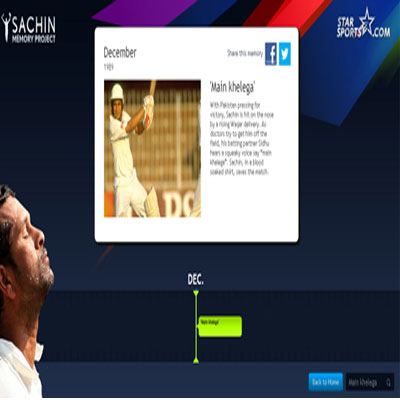
    Indeed, all the excitement around Sachin’s retirement is but a testimony to the love and adulation he has earned after 24 long and hard years in the game. But for the many cricket buffs out there who can’t seem to get enough of the master blaster, the Starsports.com team has come up with a special feature called #SachinMemoryProject on social media platforms.  

    The project gives Sachin aficionados an opportunity to recollect all the great moments in his life. It tracks chronologically not only what happened in the cricketing legend’s life over the past 24 years but world events that unfolded even as his career was taking shape.

    The #SachinMemoryProject brings back almost all Sachin moments in a slide show format, with each anecdote also on the timeline of the Star Sports official facebook page as well as twitter handle. It is rich in content and clubbed with text and videos of eminent people holding forth on the cricketer as well as Sachin talking about his life and times.

    “With the project, we wanted to give fans something special. Almost everybody in the media industry is running a special series on the cricketer but we wanted to create a memorabilia of sorts. Something that is easy to consume and something with which everyone can relate,” says Star India head of digital business Ajit Mohan.

    The #SachinMemoryProject ‘begins from the beginning’, with the first slide of Sachin as a 14-year-old, along with Vinod Kambli, putting up 664 runs for Shardashram, the highest scoring partnership in school cricket. In less than two years, he would go on to make his test debut for India.

    The latter slides reveal lesser known facts about the stalwart. For instance, the ‘main khelega’ slide highlights that moment in 1989 when Sachin had just started his international innings and his contemporaries were yet to get an idea about his patience levels. “With Pakistan pressing for victory, Sachin is hit on the nose by a rising Waqar delivery. As doctors try to stop the blood gushing from his nose and get him off the field, his batting partner Sidhu hears a squeaky voice say ‘main khelega’. Sachin continued batting in a blood soaked shirt, scoring 50 and saving the match for India,” reads the slide.

    Another slide brings to the fore Sachin’s competitive streak even as a 16-year-old. “During the Pakistan tour, Sachin lost a game of table tennis to Sanjay Manjrekar. Sachin challenged Manjrekar to another game, beat him. Beat him again before calling it quits. Even as a 16-year-old, he didn’t like losing,” it says.

    According to Mohan, a separate team of 15 people was designated to work on the project three months ago. “All the members of this team are passionate Sachin fans and are aware of the many nitty-gritties of his life. While working on the project, we also discovered many unknown facts about him. Those were the moments of serendipity,” he says cheerfully.

    Interestingly, the Sachin moments are juxtaposed with important events happening across the globe around the same time. For example, things like who took charge as India’s PM or which actor became a phenomenon while the cricketer was busy adding another century to his portfolio, etc.

    A slide titled ‘The American President(s)’ reads: “George Bush Sr. is elected President of the United States. Sachin’s career ran alongside that of four US Presidents, and seven terms, including two terms of George Bush Jr.”

    Mohan says the idea was to chart the 24-glorious years in the best possible way. “He has stayed in action for a very long time. By mentioning the other consequential events during the period in the project, we have just tried to bring to the fore the fact that the world changed in the long period that he has played and maintained his stature as one of the best cricketers in the world,” he says.

    Not surprisingly, #SachinMemoryProject, which was uploaded on Tuesday, has already grabbed a lot of eyeballs. “We are witnessing almost 25 to 30 thousand views in a day and each viewer is spending at least 30 minutes on it,” says Mohan, adding, “After watching the slide show, most viewers become very emotional and nostalgic while commenting. Viewers are writing about their personal memories associated with particular matches.”

    Mohan points out that the team working on the project didn’t get new quotes from industry for the videos included in the slide show preferring instead to utilize their time packing the project with information. “Over the years, we have built a bank of such videos that have matter on Sachin. We just utilised our resources well and aggregated all those to create this unmatchable show,” he rounds off.