Category: Satellite Operators

  • FM radio players protest WorldSpace terrestrial foray

    FM radio players protest WorldSpace terrestrial foray

    NEW DELHI: It is not only the television broadcasters that are grappling with the issue of distribution and competition. Private radio broadcasters too have started sampling irritants in this regard.

    The private sector FM radio players has complained against satellite radio provider WorldSpace’s attempt to get certain licences that would help it distribute the services terrestrially also.

    According to information available with Indiantelevision.com, WorldSpace, India’s only satellite radio service, is trying to get a license for L-band terrestrial repeater from the information and broadcasting ministry, which, if obtained, will help it to transmit its services on moving vehicles terrestrially — the primary target audience of FM radio.

    “Repeaters are basically targeted at subscribers-on-move like in a car, etc. A satellite radio cannot enter into terrestrial segment by any means,” a letter to the government from the Association of radio Operators in India (AROI) states.

    Raising the emotional quotient, AROI seems to be appealing to the conscience of the government by saying, “We fail to understand why the Government of India is working on the WorldSpace application even when a proper guideline on satellite radio in India is still not available.”

    The letter goes on to add that considering FM radio in India is in a nascent stage and the FM radio broadcasters have paid “an exorbitant OTEF (one-time entry fee)”. the government should “protect FM radio industry for at least next 10 years.”

    “Before even waiting for the commissioning of the new stations, the ministry is already making plans to welcome new players into the terrestrial radio arena, directly threatening the existence of the FM Radio licensees. This is not acceptable at all,” the high-pitched AROI letter states.

    The AROI letter has been marked to prime minister Manmohan Singh, Congress chief Sonia Gandhi, defence minister Pranab Mukharjee, home minister Shivraj Patil and telecommunication minister Dayanidhi Maran and I&B ministry secretary SK Arora.

    The move of AROI comes at a time when the government is working on putting in place a policy for satellite radio services, including caps on foreign investments, which would force the likes of WordSpace to restructure themselves and find majority Indian partners.

    The AROI letter is also likely to put pressure on the government to bring about stringent regulations relating to satellite radio services. The Sector regulator has already submitted a set of recommendations to the I&B ministry.

  • Another Intersputnik satellite gets into orbit

    Another Intersputnik satellite gets into orbit

    Intersputnik’s Express-6A satellite was launched successfully on 12 March (Moscow Time). The satelllite to be located at 80 degrees East, is positioned as a bird that will significantly improve communications capacity across Russia and was lifted off Kazakhstan’s Baikonur Cosmodrome aboard a Proton launch vehicle. Under an agreement with the Russian Satellite Communications Company (RSCC), Intersputnik will utilize the major part of Express-6A’s 17 transponder strong C- and Ku-band relay capacity.

    Express-6A will replace the aging Express-6 spacecraft currently in orbit and allows Intersputnik’s customers to use earth stations without tracking systems, and providing a higher quality of services.

    “The successful launch of Express-6A is the next step in modernizing Intersputnik’s communications system,” Gennady Kudryavtsev, Intersputnik’s Director General, said. “The new Express-A series of spacecraft provides a longer service life, more capacity and higher radiated power. Express-6A will carry all of the television channels currently handled via Express-6, and also will be used for new digital communications and broadcasting channels including relay in Ku-band.”

    In addition to traditional services such as analog broadcasting and public switched telephone networks, Express-6A also will provide such services as digital television and radio broadcasting, Internet access and dedicated corporate VSAT-based Ku-band networks. Users of the Express-6A include such Russian television channels as TV-6, TV-Centre, AST; large telecommunications network operators (Rustel); dedicated networks operators (Insat, Sirena), and telephone companies from Intersputnik’s member nations.

    The second satellite in the new Express-A series is Express-3A, which is to be launched in June and positioned at 11 degrees West. This spacecraft will replace the aging Statsionar-11 (Gorizont-26) satellite. Express-3A will allow Intersputnik to offer more satellite channels to telecommunications companies interested in transAtlantic traffic.

    Russia’s Krasnoyarsk-based NPO PM is prime contractor for the Express-A-series satellites. The satellite bus is developed by NPO PM, while Alcatel Espace of France supplies the payload.

  • Globecast delivers ESPN Classic to the UK via satellite

    Globecast delivers ESPN Classic to the UK via satellite

    MUMBAI: US sports broadcaster ESPN has struck a deal with GlobeCast, a global content management and delivery company, to deliver ESPN Classic, the company’s first UK-dedicated sports channel, to the Sky Digital platform.

    Launched this week using Globecast’s capacity on the Eurobird satellite, ESPN Classic is devoted entirely to the greatest moments and legends of sport with a mix of all-time classic highlights, matches, movies, interviews, profiles and documentaries.

    GlobeCast’s solution for ESPN includes connectivity from the broadcaster’s playout facility in West London to GlobeCast, where the feed is encoded, multiplexed then sent to GlobeCast’s Brookmans Park teleport for uplink to the Sky Digital platform using GlobeCast’s Eurobird capacity. ESPN Classic is available 24 hours a day on Sky’s EPG channel 442.

    GlobeCast has an established relationship with ESPN Classic, providing a content and delivery services for the channel’s existing French, Italian and European feeds via Astra at 19.2ºE, Hotbird at 13ºE and Sirius 2 4.8ºE respectively.

    Globecast is a subsidiary of France Telecom. It is a global content management and delivery company. Via its worldwide satellite and fibre network, the company manages and transports 10 million hours of video and other rich media yearly for its core customer base of broadcasters, as well as corporate, government and retail clients.

    Globecast is network agnostic and ingests once to deliver content to any network via multiple platforms, including direct-to-home satellite, cable, video-to-mobile, IPTV/video-over-ADSL, desktop broadband, and more. The company’s global presence includes 15 teleports and technical operations centres throughout Europe, America, Asia, Africa, the Middle East and Australia.

  • Insat-3B lofted successfully

    Insat-3B lofted successfully

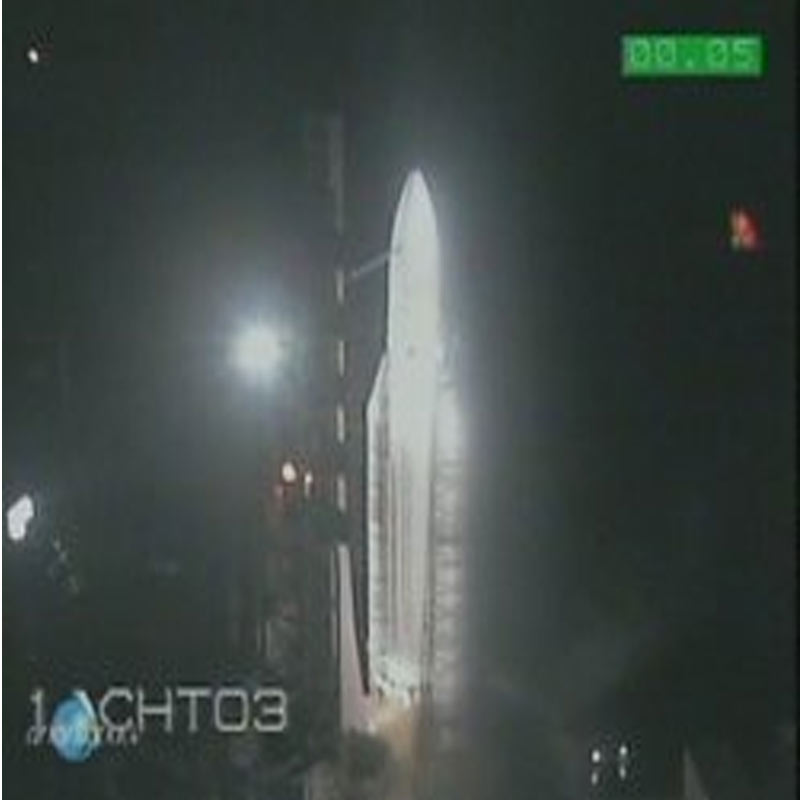
    Arianespace and the Indian Space Research Organisation successfuly lifted the first in the third generation of Insat satellites on 22 March at 04:58 Indian time. The Arianespace-505 launcher had an additional payload in the Asiastar satellite which was launched for digital radio service, WorldSpace.

    Asia Star was first injected into orbit 28 minutes after lift-off, and seven minutes later, INSAT-3B was injected (in a three-axis stabilised mode into a Geo-synchronous Transfer Orbit – GTO) with a perigee of 560 km and an apogee of 35,770 km and an inclination of 7 degree with respect to the equator.

    The satellite is at present orbiting around the earth with a period of 10.64 hours. The Insat Master Control Control Facility (MCF) at Hassan in Karnataka acquired the telemetry signal from Insat-3B at 5.30 (IST) three minutes prior to its separation from the launcher.

    On separation of the satellite from the composite adopter, satellite health checks were conducted and a series of commands issued from the MCF so as to orient its earth-viewing face towards earth. The outermost panel of the stowed solar array on the south side was also oriented towards the sun to start generating the electrical power required by the satellite during its transfer orbit phase.

    The calibration of the gyros on board the satellite has also been carried out. The operations were completed in about (100 minutes). Insat-3B is being tracked, apart from MCF, Hassan, by INTELSAT Organisation’s ground stations at Perth (Australia), Fucino (Italy) and Lake Cowichan (Canada).

    The satellite will go out of the visibility of MCF, Hassan at about 03:36 pm (IST) this afternoon and will come within the radio visibility of MCF, Hassan at 02:36 am tomorrow.

    The satellite’s orbit is being precisely determined by continuous ranging from the participating TTC stations. The orbit raising operations on INSAT-3B will be carried out by firing the 440 Newton liquid apogee motor on board in stages till the satellite attains its final geostationary orbit, about 36,000 km above the equator.

    The first Apogee Motor Firing (AMF-1) is planned during the third transfer orbit tomorrow (March 23, 2000) at about 07:30 am IST. The satellite has about 1,100 kg of propellant (Mono-Methyl Hydrazine – MMH and Mixed Oxides of Nitrogen – MON-3) for orbit raising operations as well as for station keeping and in-orbit attitude control for the duration of its designed life of 10 years.

    When the satellite reaches near geo-stationary orbit, deployment of two solar panels and the two antennas will be carried out and the satellite put in its final three-axis stabilised mode. The payloads will be checked out before commissioning the satellite. The deployment of the solar array and the two antennas will be carried out after the satellite attains near geo-synchronous orbit.

    Insat-3B will be collocated with INSAT-2E at 83 deg East longitude. It may be noted that Insat satellites now occupy four slots — Insat-2B and Insat-2C are collocated at 93.5 deg (E) longitude, INSAT-1D and INSAT-2A are collocated at 74 E longitude and Insat-2DT is located at 55 E longitude besides Insat-2E at 83 deg East longitude.

    Insat-3B is primarily intended for business communication, developmental communication and mobile communication. The communication payload provides 12 extended C-band channels, each having a bandwidth of 36 MHz. The Ku-band payload provides three channels, having a bandwidth of 77/72 MHz. The Mobile Satellite Service transponders operate in C/S band frequencies. Compared to INSAT-2C/2D, the power of extended C-band transponders on board INSAT-3B has been increased from 10 W to 15 W and that of Ku-band from 20 W to 55 W.

    Once commissioned, INSAT-3B is expected to further boost the Very Small Aperture Terminal (VSAT) services. The major VSAT users include banking and financial institutions, stock markets, white goods sector, fast moving consumer goods sector and medium to heavy engineering companies. Several public and private sector units have established dedicated closed-user group networks for their in-house applications. At present seven transponders from INSAT-2B and INSAT-2C are being used for these applications and INSAT-3B will almost double the transponder capacity for these services. For the first-time Ku-band frequencies will also be used for VSAT services, which enables use of smaller ground terminals.

    INSAT-3B will provide the first set of transponders for Swaran Jayanti Vidya Vikas Antariksh Upagraha Yojana (Vidya Vahini) which had been announced by the Prime Minister on 15 August 15 1998. These transponders will be used exclusively for interactive training and developmental communication and will be a further extension of the present Training and Developmental Communication Channel of Insat that is being used by several agencies.

    Tele-medicine is also expected to be introduced that will help in remote iagnostics and extension of super special hospital treatment to the rural population. INSAT-3B Mobile Satellite Service (MSS) has forward link channel in C X S band and return link in S X C band. MSS can support portable terminals and carry voice, fax or data. It also supports messaging service using reporting terminals.