Category: Satellite Operators

  • SES sees robust first half

    SES sees robust first half

    MUMBAI: SES S.A., a leading worldwide satellite operator (NYSE Euronext Paris and Luxembourg Stock Exchange: SESG), reports financial results for the six months ended 30 June 2014.

        
    • H1 Revenue of EUR 938.9 million (2013: EUR 910.5 million)

    – An increase of 6.3% over the prior year period at constant exchange rates (“constant FX”)1


    • H1 EBITDA of EUR 693.8 million (2013: EUR 662.0 million)

    – An increase of 7.4% at constant FX over the prior year

    – EBITDA margin of 73.9% (2013: 72.7% as reported)


    • Operating profit rose to EUR 437.5 million, an increase of 9.4% at constant FX


    • H1 Profit of the group increased 8.5% to EUR 290.9 million (2013: EUR 268.0 million)


    • Contract backlog of EUR 7.2 billion at end of June 2014


    • Closing Net Debt / EBITDA ratio of 2.85 (30 June 2013: 3.07) Karim Michel Sabbagh, President and CEO, commented:


    “SES’s continuing successful development  and execution of the 2014 plan has delivered robust first half results that validate our strategy to address target regions and market verticals. Video remains core to our business. Europe and the International segments posted strong growth, while the North American  segment  continued  to be affected  by the U.S. Government  budget  sequester.  The 2014 financial guidance is reiterated.


    Three satellites were brought into service in the period, further developing our capabilities in Europe, MENA and Asia-Pacific.  Four more satellites are under construction,  including the newly announced SES-12, a hybrid satellite for the Asia-Pacific region, which will benefit from the dual innovations of an HTS  payload  and  all-electric  propulsion.  These  programmes,  all components  of our  medium  term CapEx  plan,  will  enhance  our  differentiated  positioning  in  the  developing  markets  that  we  are targeting.


    On 10 July 2014, O3b Networks, the satellite company building ‘Fibre in the Sky’, in which SES has a significant  interest,  successfully  launched  its  second  group  of  four  satellites.    O3b’s  full  suite  of commercial services will be offered once in-orbit testing is completed.   We look forward to O3b’s successful commercialisation  of its product range with customers across the underserved markets of the world.”

     

    Click here to read the financial highlights

  • India to add maximum satellite TV revenues and subscribers by 2020: Report

    India to add maximum satellite TV revenues and subscribers by 2020: Report

    MUMBAI: A report released by Digital TV Research has thrown some light on how satellite TV revenues will change between now and 2020. The report, that covers 138 countries, estimates that Asia Pacific and Latin America will show strong growth, while western Europe will witness a fall in revenue. This will be due to increased competition from other platforms.

    Satellite TV revenues for all these countries are estimated to hit $ 99.9 billion in 2020, up from $87.8 billion in 2013 and $69.3 billion in 2010. It also predicts that satellite TV revenues will overtake cable TV revenues in 2014. Therefore, satellite TV will comprise 46 per cent of total pay TV revenues in 2014, rising to 47.8 per cent by 2020.

    Even though the US will remain as the leader in revenue generation, India is expected to add the most satellite TV revenues between 2013 and 2020 ($3.2 billion, tripling its total). This is followed by Latin American country Brazil with $1.6 billion and the US with $1.5 billion. In more than 44 countries, revenues will more than double.

    The top five revenue generators in the year 2020 will be the US with $40,570 (up from $39,034 in 2013), Brazil with $7,634 (up from $6,084 in 2013), UK with $5968 (down from $6,124 in 2013), India will add $4,704 and Mexico with $4,204 (up from $3,762 in 2013).

    Report author Simon Murray said: “Satellite TV revenues will decline for 19 countries between 2013 and 2020. Much of this is due to greater competition forcing satellite TV platforms to offer cheaper packages which will lead to lower ARPUs. Furthermore, low-cost satellite TV packages are making a significant impact in several countries.”

    The total number of pay satellite TV homes will be 271 million by 2020, up from 192 million by end of 2013 and 143 million by 2010 end. It also states that out of the expected 78.5 million subscribers that will be added between the years 2013 to 2020, maximum will come from India-27.7 million. This will be followed by Brazil trailing at 5.8 million and Indonesia with 5.4 million.

    Pay TV subscriber total will more than double in 47 countries but will fall in 13 countries. India will lead in the total number of pay satellite TV homes in 2020 with 69.2 million for which it toppled the US in 2012.  India will be followed by Russia and Brazil. Together, India, US, Brazil and Russia will account for just over half the global total by then.

    439 million homes will directly receive TV signals via satellite dishes, up by 100 million by end of 2013. More than a quarter of global TV households will have satellite dishes by 2020, up from 18.3 per cent in 2010 and 22.3 per cent in 2013.

  • ISRO earns over Rs 4 crore for supplying data received on Indian satellites and for leasing transponders

    ISRO earns over Rs 4 crore for supplying data received on Indian satellites and for leasing transponders

    NEW DELHI: Antrix, the commercial arm of the Indian Space Research Organisation, has earned Rs 4,408.07 crore since 1992 through various satellite launch missions by providing services on commercial basis.


    These services include marketing and direct reception of data from Indian Remote Sensing Satellites to national and international clientele and leasing of satellite transponders on-board INSAT/ GSAT satellites.


    In addition, ISRO has launched 40 satellites of 19 foreign countries on commercial basis under contract between respective foreign customers and Antrix and generated income of € 50.47 million and US $ 17.17 million. 

    Minister of State for Department of Space Jitendra Singh told Parliament today that the future course of action plan includes expanding the data and direct reception services of Indian Remote Sensing Satellites to international clientele, enhancing leasing of satellite transponders to Indian customers, increasing launch services for foreign satellites on-board Indian launch vehicles, and enhancing marketing of satellites and sub-systems. 

  • Over Rs 1860 crore spent on 15 communication satellites in last 3 years

    Over Rs 1860 crore spent on 15 communication satellites in last 3 years

    NEW DELHI: After the announcement of Budget 2014 allocations, the space department has laid down the future programme for 2020.


    The plan envisages development of advanced launch vehicle systems, thematic earth observational satellites with improved resolution, high-power, high-throughput communication satellites, microwave multi-spectral remote sensing satellites, weather and climate studies, constellation of satellites for regional navigation, development of critical technologies for human spaceflight and satellites for space science and planetary exploration purposes.


    Fourteen of the 58 space missions slated in the 12th Five Year Plan, 2012-17 are linked to communication.  In addition, five launch vehicle missions will also be linked to these satellites.


    GSAT-10, GSAT-15, GSAT-16, GSAT-17 and GSAT-18 are specifically communication satellites to augment the INSAT system with C and Ku band transponders. GSAT-9 will be a communication satellite to augment the INSAT system with C band transponders. GSAT-14 and GSAT-11S will be experimental communication satellites, while GSAT-6 and GSAT-6A will be multi-media mobile communication satellites for strategic applications.


    GSAT-7 is a communication satellite for special users, and both GSAT-11 and GSAT-Ka are advanced Ka band satellite for VSAT communications.  GSAT-19E is a new generation experimental communication satellite.


    Close to Rs 1867 crore has been spent on the five satellites meant for communication launched in the last three years, out of the total Rs 1987 crore allocated for this purpose. It can be noted this amount was spent by 31 March this year.


    According to sources in the Department of Space, these satellites are GSAT-14 (launched on 5 January this year), GSAT-7 (launched on 30 August last year to reach a wide area over the oceans including the Indian mass), GSAT-10 (launched on 29 September 2012 for communication and navigation), GSAT-12 (launched on 15 July 2011) and GSAT-8 (launched on 21 May 2011 for communication and navigation).

  • CASBAA asks FM, I&B to roll back increased royalty on foreign satellite operators

    CASBAA asks FM, I&B to roll back increased royalty on foreign satellite operators

    NEW DELHI: The Cable and Satellite Broadcasters Association of Asia (CASBAA) has urged Finance Minister Arun Jaitley to withdraw the royalties imposed on foreign satellite operators (FSO) by the Finance Act 2012 and 2013 and let the matter be settled by the Supreme Court which is presently hearing a matter in this regard.


    The Delhi High Court had in January 2011 held in the case of Asia Satellite Telecommunications company Limited (AsiaSat) that the charges received by the Hong Kong based FSO from its customers for provision of transponder capacity cannot be characterised as ‘royalties’ under the Income Tax Act as it stood prior to the amendment in 20l2. It was held by the court that the equipment was used by the FSOs to provide a service to their customers and so the question of royalty taxation did not arise.


    The memorandum by CASBAA CEO Christopher Slaughter says that this view of the High Court was in conformity with the international jurisprudence and model commentaries issued by international tax bodies and renowned jurists / authors and was also followed in case of other FSOs by the High Court and Income Tax Appellate Tribunals.


    However, the memorandum sent to Jaitley with a copy to Information and Broadcasting (I&B) Minister Prakash Javadekar points out that the matter has become sub judice as Income Tax authorities have filed an appeal against this judgment in the Supreme Court.


    I&B Ministry sources told indiantelevision.com that CASBAA has also protested the rise in royalty under the Finance Act 2013 from 10 per cent to 25 per cent as it is not reasonable in view of the competitive margins earned by the industry players. The Association wants the Minister to roll back this increase so that the tax rates are made ‘friendlier’ and both the operators and consumers can benefit from a rational tax regime.


    It is stated that a majority of the Double Taxation Avoidance Agreements (DTAA) that India has entered into provide for a tax rate (on gross basis) on royalties and fees or technical services of 10 per cent.


    Thus, taking a holistic view from the point of alignment with the DTAAs and internationally accepted tax rates, the rate of 25 per cent is highly unjust and implies that FSOs are earning high revenues from India which is not the case.


    Furthermore, any such step to increase tax rates is not right as the matter is sub judice in the Supreme Court. It not only makes the services ‘cost ineffective’ but hits the ultimate Indian end consumers.


    Slaughter points out that India’s participation in the global network of satellite communication is growing and any such move by the Indian Government to tax FSOs may also drive policy-makers of other nations to adopt similar measures for taxing payments flowing into India from foreign jurisdictions. 

  • MEASAT-3b launch rescheduled to September

    MEASAT-3b launch rescheduled to September

    MUMBAI: MEASAT Global Berhad (MEASAT) has announced that the launch of the MEASAT-3b satellite has been rescheduled to September 2014. The satellite will remain in storage at the European Spaceport, Kourou, French Guiana till then.


    MEASAT-3b had previously been scheduled for launch on 6 June 2014 GFT (7 June Kuala Lumpur time). The launch date was rescheduled after the manufacturer of the MEASAT-3b co-passenger requested time for repairs to their satellite.


    “We are clearly disappointed with the delay and are currently in co-ordination with Arianespace (the launch service provider) on the rescheduling of the launch,” MEASAT chief executive officer Paul Brown-Kenyon had then said.  


    It can be noted that the initial date for launch of the satellite was 28 May, which was then rescheduled to 6 June. The reason cited then was to allow the MEASAT-3b co-passenger additional time to prepare for the launch. 


    When the launch was first postponed, MEASAT senior vice president – space system development Dr Ali Ebadi had said, “The main focus of the launch campaign is to ensure that both the satellite and launch vehicle are ready for launch. Given the complexity of the satellite and launch vehicle, it is not uncommon for the technical teams to request time for additional checks.”


    With the satellite launch being pushed to September, Direct to Home (DTH) operator Sun Direct’s plans to move to MEASAT 3b and thus add nine transponders to its existing four and to also take its HD channel offering from the current 11 to 30 and SD from 210 channels to 350 will take a backseat.  


    “We will be shifting to MEASAT 3b and hence, will get nine transponders by first week of June. Our HD offering is currently low, but with the extra capacity we aim to take it to 30, while we expect the number of SD channels to go up to 350,”Sun Direct MD Mahesh Kumar had earlier told indiantelevision.com.


    MEASAT-3b is designed to provide an additional 48 high powered Ku-band transponders at the 91.5°E orbital slot to expand DTH and VSAT services across Malaysia, India, Indonesia and Australia. Co-located with MEASAT-3 and MEASAT-3a, the satellite will more than double MEASAT’s Ku-band capacity at 91.5°E creating one of the region’s most powerful and robust orbital locations.

  • MEASAT-3b launch delayed

    MEASAT-3b launch delayed

    MUMBAI: The much awaited MEASAT-3b launch has been delayed. While the satellite was set for launch on 6 June (7 June Kuala Lumpur time), it has now been postponed after the manufacturer of the MEASAT-3b co-passenger requested time for repairs to their satellite.


    “We are clearly disappointed with the delay and are currently in co-ordination with Arianespace (the launch service provider) on the rescheduling of the launch,” said MEASAT Satellite Systems CEO Paul Brown-Kenyon through a press statement. “We will provide an update when we receive further information on the revised launch date,” he continued.


    MEASAT-3b is designed to provide an additional 48 high powered Ku-band transponders to the 91.5°E orbital slot to expand Direct-To-Home and VSAT services across Malaysia, India, Indonesia and Australia. Co-located with MEASAT-3 and MEASAT-3a, the satellite will more than double MEASAT’s Ku-band capacity at 91.5°E creating one of the region’s most powerful and robust orbital locations.


    The delay in the launch of the satellite will further delay DTH operator Sun Direct’s plans of adding more high definition and standard definition channels. With the launch of MEASAT-3b, Sun Direct is set to add nine more transponders to its existing four transponders.  

  • Mars Orbiter Spacecraft crosses half way mark of its journey

    Mars Orbiter Spacecraft crosses half way mark of its journey

    MUMBAI: India’s Mars Orbiter Spacecraft crossed the half-way mark of its journey to the ‘Red Planet’ along the designated helio-centric trajectory at 9:50 am on 9 April.


    Mars Orbiter Spacecraft was launched onboard PSLV-C25 on 5 November 2013. On 1 December 2013, Trans Mars Injection manoeuvre was conducted successfully and the Spacecraft was set in its course towards Planet Mars through a helio-centric trajectory. Soon after the Spacecraft crossed the sphere of influence of Earth, a Trajectory Correction Manoeuvre (TCM) was performed successfully on 11 December 2013.


    ISRO has been continuously monitoring the Spacecraft using its Deep Space Network complemented by that of NASA-JPL. As the Spacecraft is on its designated trajectory, the TCM planned for April 2014 is not considered essential. If required, the next TCM is planned to be carried out in June 2014.


    Mars Orbiter Spacecraft and its five scientific instruments are in good health. Periodic tests are being done on the different levels of autonomy built into the Spacecraft for managing contingencies.


    As of 9 April, the radio distance between the Spacecraft and the Earth is 39 million km. A signal from the Earth to the Spacecraft and back to Earth takes 4 minutes and 15 seconds. Soon, the High Gain Antenna of the Spacecraft will be put in service for handling communications with the ground stations.


    The Mars Orbit Insertion (MOI) manoeuvre would be performed on 24 September 2014.

  • PSLV-C24 launches IRNSS-1B

    PSLV-C24 launches IRNSS-1B

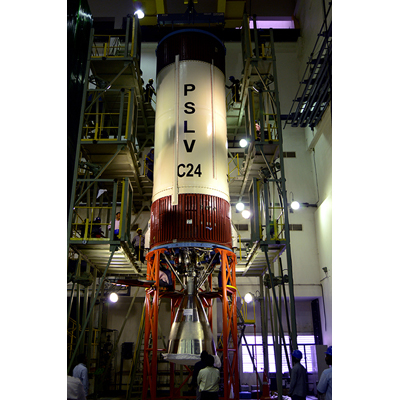
    BENGALURU: ISRO’s Polar Satellite Launch Vehicle, PSLV-C24 has successfully launched IRNSS-1B, the second satellite in the Indian Regional Navigation Satellite System (IRNSS) on 4 April at 1714 hours IST from Satish Dhawan Space Centre SHAR, Sriharikota.


    This is the twenty fifth consecutively successful mission of PSLV. The ‘XL’ configuration of PSLV was used for this mission. Previously, the same configuration of the vehicle was used five times to launch Chandrayaan-1, GSAT-12, RISAT-1, IRNSS-1A and Mars Orbiter Spacecraft.

            .                     .
    After the lift-off with the ignition of the first stage, the important flight events, namely, stage and strap-on ignitions, heat-shield separation, stage and strap-on separations and satellite injection took place exactly as planned. After a flight of about 19 minutes, IRNSS-1B Satellite, weighing 1432 kg, was injected to an elliptical orbit of 283 km X 20,630 km, which is very close to the intended orbit.

    After injection, the solar panels of IRNSS-1B were deployed automatically. ISRO’s Master Control Facility (at Hassan, Karnataka) assumed the control of the satellite. In the coming days, five orbit maneuvers will be conducted from Master Control Facility to position the satellite in its Geosynchronous Circular Orbit at 55 degree east longitude.

    IRNSS-1B is the second of the seven satellites constituting the space segment of the Indian Regional Navigation Satellite System. IRNSS-1A, the first satellite of the constellation, was successfully launched by PSLV on July 02, 2013.     IRNSS-1A is functioning satisfactorily from its designated geosynchronous orbital position.

    Being an independent regional navigation satellite system, it is designed to provide position information in the Indian region and 1500 km around the Indian mainland. IRNSS would provide two types of services, namely, Standard Positioning Services (SPS) – provided to all users – and Restricted Services (RS), provided only to authorised users.
     

    A number of ground stations responsible for the generation and transmission of navigation parameters, satellite control, satellite ranging and monitoring, etc., have been established in as many as 15 locations across the country.

    Two more satellites of this constellation, namely, IRNSS-1C and IRNSS-1D, are planned to be launched in the second half of 2014.  The entire IRNSS constellation of seven satellites is planned to be completed by 2015-16.

  • AsiaSat 7 replaces the ageing AsiaSat 3S today

    AsiaSat 7 replaces the ageing AsiaSat 3S today

    MUMBAI: In early October 2010, Asian satellite service provider, AsiaSat, and International Launch Services (ILS) had announced a contract for the launch of the AsiaSat 7 satellite on an ILS Proton.

    AsiaSat 7 was configured as a replacement satellite for AsiaSat 3S, one of AsiaSat‘s flagship satellites, operating at the orbital location of 105.5°E. AsiaSat 7 will carry 28 C-band and 17 Ku-band transponders, and a Ka-band payload. Its region-wide high power C-band beam covers Asia, the Middle East, Australasia and Central Asia, with Ku-band beams serving East Asia, South Asia and a steerable Ku beam.

    According to plan, the AsiaSat 7 satellite was successfully launched in Hong Kong on November 26, 2011, on an ILS Proton Breeze M launch vehicle from the Baikonur Cosmodrome in Kazakhstan. Nine hours and 13 minutes after lift-off, AsiaSat 7 successfully separated from the launch vehicle. Over the next few days, the satellite will arrive at the geostationary orbit, some 36,000 km above the Equator.sia

    “With AsiaSat 7 successfully launched well ahead of the planned date for AsiaSat 3S‘s replacement, we can assure continuity of service to customers, while at the same time, adding to our on-orbit capacity to service new business,” said AsiaSat president, CEO William Wade, in a press statement earlier. “With this launch opportunity on the ILS Proton, we are continuing our replacement strategy to provide continuity of services to our current and potential new customers across Asia, Middle East, CIS and Australasia. We know that we can count on the professionalism of ILS and Khrunichev for a successful launch for AsiaSat 7.”

    While AsiaSat 3S was launched on March 21, 1999, as a replacement for the ageing AsiaSat 1 in May of that year, AsiaSat 7 marked the launch of the fourth AsiaSat satellite on ILS Proton, the 20th Space Systems/Loral Satellite launched on ILS Proton, and the 69th ILS Proton launch overall.

    AsiaSat 7 is similar to AsiaSat 3S, and has been designed with a 15-year design life and will offer enhanced power and coverage at orbital location 105.5°E.

    As for AsiaSat 3S, it currently beams some of the popular channels in India which include: Zee TV, Star Plus, Star Utsav, Sahara One, Sahara Filmy, Sahara Firangi, Sahara Samay, 9X Media, 9X Jalwa, Big RTL Thrill, Big Magic, Big CBS Spark, B4U Movies, B4U Music and ETC Bollywood, among others.

    AsiaSat’s business continues to be affected by The Finance Act passed in India in May 2012. The Act taxes revenue generated from the provision of satellite transponder capacity to Indian customers and any non-Indian customers considered to have earned income from any business or source in India.

    The Indian government approved in its budget an increase of the royalty withholding tax rate from 10 per cent to 25 per cent, effective from 1 April 2013. Nevertheless, as stated in previous reports, the amount of AsiaSat’s revenue considered to be Indian sourced, and thus taxable in India, is still under discussion as of the date of this report. The increase in the tax rate will have a negative impact on its future business, and to remain competitive in the market, AsiaSat may make pricing adjustments which could negatively impact its margins in the coming financial year.

    In other major announcements by AsiaSat, the company indicated in its operational highlights for the financial year 2014-15 that two of its other satellites, AsiaSat 6 and AsiaSat 8, are on schedule and will launch in mid-2014 to provide new C and Ku-band capacity for business growth. Also, the commencement of the preliminary design phase for AsiaSat 9, the replacement for AsiaSat 4 in 2017, will provide new coverage and services at 122?E.

    AsiaSat chairman Sherwood P. Dodge said in a company statement: “Acquiring new business in 2014 will remain a top priority. Our expanding satellite fleet and reputation for providing quality and reliable satellite capacity, together with our commitment to our customers puts us in an excellent position to develop new business opportunities. The market remains highly competitive, but I believe our able management team and our high-quality services will enable us to move the business forward in 2014.”