Category: Satellite Operators

  • ISRO’s Antrix earns Rs 1860 crore in 2014-15, up Rs 700 crore from 2010-11

    ISRO’s Antrix earns Rs 1860 crore in 2014-15, up Rs 700 crore from 2010-11

    NEW DELHI: The turnover of Antrix Corporation Limited, the commercial arm of the Indian Space Research Organisation (ISRO), was Rs 1860.71 crore (unaudited) during 2014-15 as compared to Rs 1113.58 crore in 2010-11, the Parliament has been informed. 

    Earlier, Minister in the Department of Space had informed the Parliament that India had earned a sum of approximately Rs 662 crore ($17 million and 78.5 million Euros) by launching 45 satellites from 19 countries using ISRO’s Polar Satellite Launch Vehicle (PSLV).

    Antrix has signed agreements for launching 28 more foreign satellites from six countries namely Algeria (3), Canada (4), Germany (4), Indonesia (2), Singapore (6) and the United States (9).

    The launches of these foreign satellites are envisaged during the 2015-2017 time period. Discussions with foreign agencies and companies are going on for providing launch services to their satellites on-board ISRO’s PSLV and Geo-synchronous Satellite Launch Vehicle (GSLV).

    The details of the commercial income generated by Antrix for the last five financial years are: 

    (Rs in crore)

  • AsiaSat announces sales solutions team

    AsiaSat announces sales solutions team

    MUMBAI: Satellite  operator  Asia  Satellite Telecommunications  (AsiaSat)  has  announced  an  enhancement  of  its  sales development and support activities in order to improve the solutions it delivers to its clients.

    A new sales solutions team has been formed and will provide focused and solutions-driven support to the company’s sales and business development activities.  Led by Alan Wong, manager, sales solutions, this team will have an increased focus of identifying and implementing the best solution for each customer’s requirements.

    “With rapidly-changing markets and requirements, this group, working together with our Sales and Engineering & Operations teams, is a key asset for better addressing customer needs and strengthening our partnerships with current and prospective clients,” said Philip Balaam, Vice President, Sales and Business Development.  “As part of our continuous improvement we are looking at offering a more effective and targeted sales approach and the Sales Solutions team will be an important pillar of that effort.”

  • Space Act on the anvil to involve private sector in regulating space activities

    Space Act on the anvil to involve private sector in regulating space activities

    NEW DELHI: A National Space Act for India for regulating space activities in India; facilitate enhanced levels of private sector participation and offering more commercial opportunities is being formulated by the Indian Space Research Organisation (ISRO).


    Towards this, a two-day national workshop was held at ISRO headquarter, Bangalore, on 16 and 17 January with the participation of experts across the country. The draft version of the National Space Act has been prepared and consultations have been held with Space Law experts and internal experts within the Department of Space.


    The Department of Space has initiated the process of charting out a roadmap for the country’s space programme addressing the short-term and long-term needs in the areas of Space Transportation Systems, Satellite Communication and Navigation, Earth Observation, Space Sciences and Planetary Exploration, and Space-based applications for governance and development.


    The Department has initiated a series of reviews towards evolving an action plan for completing all the approved projects, focusing on progress achieved, identifying the tasks to be completed and fix the targets for realising the missions in a timely manner. 

  • India to launch satellite providing telecom & broadcasting applications for SAARC

    India to launch satellite providing telecom & broadcasting applications for SAARC

    NEW DELHI: The satellite proposed to be launched by India for the South Asian Association for Regional Cooperation (SAARC) member nations will have 12 Ku-Band transponders. The total cost of launching the satellite is estimated to be about Rs 235 crore.


    The Indian Space Research Organisation (ISRO) will use Indian Geostationary Launch Vehicle GSLV Mk-II for the launch. 

    While members from other countries of the region expressed enthusiasm at a one-day conference on “Satellite for SAARC Region and Space Technology Applications” here to appraise and discuss the proposal, Pakistan had some questions and wanted some time before giving its consent. 

    Space Minister Jitendra Singh told Parliament this week that the cost associated with the launch will be met by the Indian Government.  

    The proposed satellite enables full range of applications and services to neighbouring countries in the areas of telecommunication and broadcasting applications namely television, direct-to-home (DTH), Very Small Aperture Terminals (VSATs), tele-education, telemedicine and disaster management support. 

  • PSLV successfully launches five British satellites into orbit

    PSLV successfully launches five British satellites into orbit

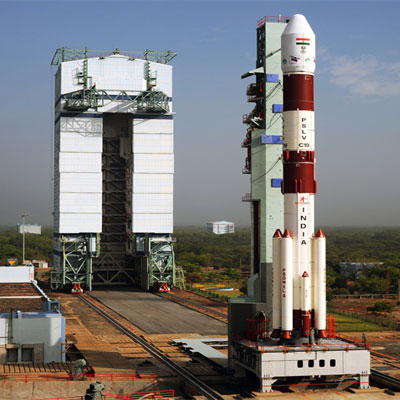
    NEW DELHI: The Polar Satellite Launch Vehicle PSLV-C28 successfully launched three identical DMC3 commercial Earth Observation Satellites along with two smaller satellites from United Kingdom into a polar Sun Synchronous Orbit, which was very close to the intended orbit of 647 km height.


    The five satellites, together weighing about 1440 kg at lift-off, were launched by the Indian Space Research Organisation (ISRO) from Satish Dhawan Space Centre (SDSC) SHAR, Sriharikota on 10 July.


    The five satellites were launched as part of the agreement entered into between DMC International Imaging (DMCii), a wholly owned subsidiary of Surrey Satellite Technology Limited (SSTL), UK and Antrix Corporation Limited, the commercial arm of ISRO, a government of India company under the Department of Space (DOS). This was the twenty ninth consecutively successful flight of PSLV. 


    PSLV was launched in its heaviest ‘XL’ version with six strap-on motors of the first stage. This flight was unique since for the first time, the ‘XL’ version of PSLV was used to launch foreign payloads exclusively. Till now, the lighter ‘core alone’ version of PSLV has been used to launch foreign payloads exclusively. PSLV has successfully launched 45 satellites for customers from abroad including five UK satellites launched. 


    Through 29 successful flights (of a total 30) during the period between 1994 and 2015, PSLV has launched a total of 77 satellites with a total mass of 32.04 tons, of which 4.64 tons (about 14 per cent) comprises 45 satellites for customers from abroad. The vehicle has repeatedly proved its reliability and versatility by successfully launching satellites into a variety of orbits including polar Sun Synchronous, Geosynchronous Transfer and Low Earth orbits thereby emerging as the workhorse launch vehicle of India. 


    After a 62.5 hour smooth count down, the 320 ton PSLV-C28 lifted off from the First Launch Pad (FLP) at SDSC SHAR at 2158 hrs (9:58 pm) IST with the ignition of its first stage. The important flight events included the ignition and separation of strap-ons, separation of the first stage, ignition of the second stage, separation of the payload fairing at about 118 km altitude after the vehicle had cleared the dense atmosphere, second stage separation, third stage ignition and third stage separation, fourth stage ignition and fourth stage cut-off. 


    Once in proper orbit, the three DMC3 satellites were successfully deployed about 18 minutes after lift-off in quick succession. Following this, the seven kg Nanosatellite De-OrbitSail and the 91 kg Microsatellite CBNT-1 were also successfully deployed.

  • Globecast, MEASAT to aid Bright Lights’ HD pay-TV channel launch

    Globecast, MEASAT to aid Bright Lights’ HD pay-TV channel launch

    MUMBAI: Bright Lights Media has selected Globecast to provide a comprehensive suite of services for the launch of a new High Definition pay-TV channel in Southeast Asia called Simply Money.


    The HD channel will be carried on the MEASAT-3 satellite, the premier satellite for HD channel distribution across the wider Asia Pacific region. MEASAT-3 is co-located with MEASAT-3a and MEASAT-3b at 91.5°E, creating Asia’s most vibrant and robust video hotslot.


    Producing locally relevant high-quality personal finance-lifestyle content, Simply Money will also acquire programming from around the world, carefully selected for viewers in Southeast Asia.


    Globecast will be supplying Simply Money with an end-to-end media management solution from its media centre in Mediapolis, Singapore. The solution includes fully managed playout, content preparation and quality control. Globecast will also be providing regulatory compliance review and editing to ensure that content is compliant with regulatory requirements for distribution across Southeast Asia.


    Bright Lights Media CEO Anshuman Misra said, “We are very pleased to engage with Globecast, using a range of its services to ensure both high-quality output as well as a cost-effective result. Globecast has a clear understanding of what we are trying to achieve and has helped us to develop our content management and playout and distribution plans.”


    Globecast Asia managing director Yew Weng Soo added, “This deal reinforces Globecast’s position as the complete media services company with our highly evolved global expertise across the content and channel preparation sectors. This sits alongside our long-established playout and distribution services and we’re very pleased that Simply Money has selected us.”


    MEASAT vice president – broadcast sales Jarod Lopez said, “We are pleased to partner with Globecast in the distribution of Simply Money, which further strengthens MEASAT’s HD bouquet at 91.5°E. The 91.5°E video hotslot leads Asia with more than 60 distributed HD channels.”

  • AsiaSat announces new organisational structure

    AsiaSat announces new organisational structure

    MUMBAI: Asian satellite operator Asia Satellite Telecommunications Co. Ltd. (AsiaSat) has announced its new organisational structure to power the growth of the company in key Asian and global markets.


    Under the new organisational structure, both sales and business development teams will be headed by Philip Balaam. Under his expanded role as vice president, sales and business development, Balaam will assume new responsibilities in driving sales activities in all Asian markets while continuing to oversee the company’s business development initiatives.


    Sabrina Cubbon has been named vice president, marketing and global accounts. In her new capacity, Cubbon will focus on key global strategic accounts while continuing to lead the marketing, communications and corporate affairs functions of the company.


    Commenting on the new organisational structure, AsiaSat president and CEO William Wade said, “2015 is expected to be a challenging year for the satellite sector. I have confidence that our rebranding earlier this year has re-energised our brand presence and as equally important our entire team. With this new structure, we will better utilise our resources and more clearly focus our efforts in the market. By moving ourselves closer to our customers and partners, we are able to better understand and serve their needs.”

  • APAC to witness increased satellite usage: CASBAA Satellite Industry Forum 2015

    APAC to witness increased satellite usage: CASBAA Satellite Industry Forum 2015

    MUMBAI: On 1 June, more than 150 industry speakers and delegates gathered at Grand Hyatt Singapore for the Satellite Industry Forum 2015. This year’s CASBAA event included a number of keynotes and panels exploring the question, “Is the satellite game changing?”


    Intelsat CEO Stephen Spengler gave an opening keynote outlining the wave of changes currently affecting the satellite sector. Technological progress is increasing competition and generating  shifts  in  consumption  patterns,  and  he  emphasized  the  ever-growing  need  to innovate in order to keep up. “To compete, we need to improve performance, economics, and accessibility,” he said.


    Top executives then shared their insights on incoming industry trends during the Asia Pacific Satellite Leadership Round Table. The panel members were optimistic about opportunities for increased satellite usage in the Asia Pacific region, but also saw regulatory challenges ahead for efforts to consolidate. ABS co-founder & CEO Thomas Choi commented, “As long as regulations don’t change, consolidation will not happen.”


    In the next panel, Game Changers?, several officials executing “left field” satellite projects spoke on how these developments will impact the industry. Each panelist described their business ventures and their relevance to the Asia Pacific.


    With the advancement of technology also comes new forms of content distribution such as OTT and IPTV. The third panel, Staring the Future of TV in the Face – A Watershed for the Satellite Industry?, discussed the distinct preferences of millennia’s and how these consumers could be captured in the satellite industry, as well as debated the importance of on-demand vs. linear television.


    Eutelsat Chairman  &  CEO Michel  de  Rosen delivered  an  emphatic  speech  to  engage delegates with the issue of protection of C-band for exclusive satellite industry use at the upcoming World Radio communication Conference 2015 (WRC ’15). In the face of the pending legislative change, which would transfer more spectrum to mobile service providers, he asserted the need for a unified front to protect the industry. “It’s a collective challenge as an industry,” he said. “If we don’t fight it today, they will only be back for more tomorrow.”


    The following panel discussed in more detail the steps to be taken before the WRC ‘15. “We must convince the government of the important usage of C-band,” said Ali Ebadi, SVP, Space Systems Development, MEASAT.


    Regulations  aren’t  the  only  obstacle  satellite  service  providers  face;  at  the  same  time, customers are also raising their expectations.  Another set of panelists discussed cost-effective provision of service in Reducing Costs for Consumers: Are High Throughput Satellites the Answer? “Customers will expect more and more without expecting to pay more,” commented Viasat programme manager Erwin Hudson,


    The discussion was followed by an interview with Myanmar’s ICT Deputy Minister for U Thaung Tin. He described the current state of satellite in Myanmar, as well as national goals to develop the domestic industry and institutional challenges that must be met.


    To close the forum, the final panel answered questions about the next 10-15 years for the satellite industry, expressing optimism for the development of new technology and the continued robustness of satellite in the Asia-Pacific market.


  • AsiaSat to launch UHD broadcast initiative in Asia

    AsiaSat to launch UHD broadcast initiative in Asia

    MUMBAI: Satellite operator Asia Satellite Telecommunications Co. Ltd. (AsiaSat) is planning to deploy Asia’s first dedicated Ultra HD (UHD) broadcast platform in the next few months.


    Initially using a C-band transponder on AsiaSat 4 at 122°E, the UHD platform, based on DVB- S2 and HEVC solutions, will be able to deliver two – five full time UHD channels. Transmissions will be in a free to air format, available for reception by terrestrial TV stations, pay TV platforms and home viewers across Asia which possess appropriate decoding equipment and a C-band antenna as small as 2.4 meters.


    AsiaSat president and CEO William Wade said, “UHD is gaining momentum in Asia with UHD TV sets readily available and affordable. However, there is still a lack of UHD content and consumer receivers in Asia. AsiaSat is proud to play a key role in UHD content delivery in Asia with the launch of this new UHD broadcast platform. We are committed to working closely with content and technology partners to make the delivery economics work for UHD broadcasting in this part of the world.”


    “The adoption of UHD will continue to be driven by consumers’ increasing demand for improved picture quality for sports and movies. Upcoming major sporting events such as the 2016 Rio Olympic Games and the 2018 FIFA World Cup are expected to be key drivers for the adoption of UHD. We look forward to supporting the UHD transmissions of these events on AsiaSat 4 and our future AsiaSat 9 satellite that is designed to meet the higher throughput requirements of UHD broadcasting,” he added.


    “As Asia’s premier satellite operator for over 25 years, AsiaSat has always strived to be at the forefront of advancing satellite communications. We are well positioned to work with our partners to introduce more exciting TV services to Asia,” Wade further said.


    The UHD Research Laboratory was established at AsiaSat’s Tai Po Earth Station in Hong Kong. This initiative is aimed at promoting and incubating the reception of UHD content under the AsiaSat footprint. The Lab is tasked to evaluate UHD solutions including the technical compatibility of satellite reception and transmission, playout and compression technologies, as well as content providers. Over the past few months, tests were successfully conducted on various HEVC encoding equipment, including off-air and real-time transcoding of channels at various bit rates.

  • Six satellites including two for communications to launch in 2015-16

    Six satellites including two for communications to launch in 2015-16

    MUMBAI: India is planning to launch six more satellites during 2015-16, of which two are communication satellites – GSAT-6 and GSAT-15.


    The Rajya Sabha was today informed by MoS in the Prime Minister’s Office and minister of state in the Ministry of Personnel, PG and Pensions, Dr Jitendra Singh about the same.


    The other satellites include three Navigation satellites IRNSS-1E, IRNSS-1F and IRNSS-1G; and one space science satellite ASTROSAT.


    In addition, plans are also afoot to launch 13 more satellites from four countries using Polar Satellite Launch Vehicle.


    Antrix Corporation, which is the commercial arm of Department of Space, is already marketing remote sensing data (images) from Indian Remote Sensing satellites in the global market through establishment of International Ground Stations and reseller network.


    As on April 2015, Indian Space Research Organisation (ISRO) has launched 74 satellites. Out of these, seven satellites failed to reach the orbit due to launch failure and three satellites failed in orbit.


    In addition, ISRO has successfully launched 40 foreign satellites from 19 countries and four micro and nano satellites built by students of Indian Universities using Polar Satellite Launch Vehicle (PSLV).