Category: Satellite Operators

  • Intelsat appoints Jacques Kerrest as CFO

    Intelsat appoints Jacques Kerrest as CFO

    MUMBAI: Intelsat S.A. has appointed Jacques Kerrest as executive vice president and chief financial officer.


    Kerrest will report to Intelsat CEO Stephen Spengler and will be responsible for the leadership of Intelsat’s financial operations, including capital markets, accounting, treasury, financial planning, investor relations and corporate development.


    He will be a member of the company’s Management Committee and is expected to begin his duties on 1 February, 2016.


    Spengler said, “Jacques brings a wealth of experience to Intelsat. He has a strong track record of leading the finance organisations of large, complex and global corporations. His deep financial expertise in the telecom and media sectors will provide new perspectives within our management team. I have confidence that his financial acumen, corporate finance background and sector knowledge will play an instrumental role in shaping our financial priorities and in the attainment of our operational and long-term strategic goals.”


    Kerrest joins Intelsat from DPC Data Inc. where he served as president and led the company’s efforts in providing disclosure-related data products and specialised data services to the municipal bond marketplace in the United States. Prior to DPC Data, he was CFO and COO at ActivIdentity Corporation (known today as HID Global). Kerrest’s experience also includes CFO roles at Virgin Media, Equant, and Chancellor Broadcasting.


  • Intelsat launches Epic next-gen satellite system in orbit

    Intelsat launches Epic next-gen satellite system in orbit

    MUMBAI: Satellite services provider Intelsat S.A. has launched the first of the Intelsat EpicNG high throughput satellites – Intelsat 29e successfully from French Guiana aboard an Ariane 5 vehicle.


    The Intelsat 29e satellite separated from the rocket’s upper stage 38 minutes after launch and signal acquisition has been confirmed.


    Manufactured by Boeing and equipped with the most advanced digital payload on a commercial spacecraft, Intelsat 29e will bring high throughput capacity in both C- and Ku-band to North and Latin America and the North Atlantic region. Intelsat 29e will be placed into service at 310° East, where it replaces Intelsat 1R.


    Intelsat 29e is the first satellite of Intelsat’s next generation, all digital EpicNG satellite platform, which combines wide beams and spot beams with frequency reuse technology and the sector’s most advanced digital payload. The digital payload will provide customers with unprecedented security and flexibility, enabling customers to seamlessly access and shift capacity to match their usage needs in a particular region or timeframe. Intelsat EpicNG is optimized to provide satellite connectivity for applications including the Internet of Things, enterprise, wireless infrastructure, aeronautical and maritime mobility, and government, which are expected to provide a combined $3 billion incremental opportunity by the year 2020.


    “Today’s launch represents a truly ‘epic’ moment in communication’s history, as we begin a new era of high throughput satellite services for our customers. This is a testament to the innovation and creativity of the Intelsat team who envisioned the Intelsat EpicNG platform nearly four years ago. Through design expertise and a deep understanding of our customers’ requirements, the Intelsat EpicNG platform will deliver high performance, improved economics and simplified access that will expand the addressable market for our solutions,” said Intelsat CEO Stephen Spengler.


    The Intelsat EpicNG platform design reflects the company’s innovative approach to introducing high throughput technology into the world’s largest community of enterprise-grade satellite networks which operate on the Intelsat fleet. Intelsat EpicNG is backwards compatible and fully interoperable with Intelsat’s existing satellite fleet and terrestrial infrastructure, allowing customers to use currently deployed network hardware to access the high performance connectivity. The platform’s open architecture allows customers to have control over service offerings and hardware selection, providing differentiation of service offerings.


    The payload will deliver carrier-grade services to fixed and mobile network operators, and broadband for applications such as enterprise, aeronautical and maritime mobility, and government throughout the Americas. The satellite also features spot beams for mobility customers serving the heavily trafficked North Atlantic region. Companies such as Harris CapRock, Panasonic, EMC (formerly MTN), Axesat and leading national telecom operators in Latin America will be among the first to deploy services on the platform.


    Intelsat 29e is the 56th Intelsat satellite launched by Arianespace.  Intelsat expects to launch the second Intelsat EpicNG satellite, Intelsat 33e, which will serve Europe, Africa, the Middle East, and Asia, in the third quarter of 2016, also aboard an Arianespace launcher.

  • Intelsat launches Epic next-gen satellite system in orbit

    Intelsat launches Epic next-gen satellite system in orbit

    MUMBAI: Satellite services provider Intelsat S.A. has launched the first of the Intelsat EpicNG high throughput satellites – Intelsat 29e successfully from French Guiana aboard an Ariane 5 vehicle.


    The Intelsat 29e satellite separated from the rocket’s upper stage 38 minutes after launch and signal acquisition has been confirmed.


    Manufactured by Boeing and equipped with the most advanced digital payload on a commercial spacecraft, Intelsat 29e will bring high throughput capacity in both C- and Ku-band to North and Latin America and the North Atlantic region. Intelsat 29e will be placed into service at 310° East, where it replaces Intelsat 1R.


    Intelsat 29e is the first satellite of Intelsat’s next generation, all digital EpicNG satellite platform, which combines wide beams and spot beams with frequency reuse technology and the sector’s most advanced digital payload. The digital payload will provide customers with unprecedented security and flexibility, enabling customers to seamlessly access and shift capacity to match their usage needs in a particular region or timeframe. Intelsat EpicNG is optimized to provide satellite connectivity for applications including the Internet of Things, enterprise, wireless infrastructure, aeronautical and maritime mobility, and government, which are expected to provide a combined $3 billion incremental opportunity by the year 2020.


    “Today’s launch represents a truly ‘epic’ moment in communication’s history, as we begin a new era of high throughput satellite services for our customers. This is a testament to the innovation and creativity of the Intelsat team who envisioned the Intelsat EpicNG platform nearly four years ago. Through design expertise and a deep understanding of our customers’ requirements, the Intelsat EpicNG platform will deliver high performance, improved economics and simplified access that will expand the addressable market for our solutions,” said Intelsat CEO Stephen Spengler.


    The Intelsat EpicNG platform design reflects the company’s innovative approach to introducing high throughput technology into the world’s largest community of enterprise-grade satellite networks which operate on the Intelsat fleet. Intelsat EpicNG is backwards compatible and fully interoperable with Intelsat’s existing satellite fleet and terrestrial infrastructure, allowing customers to use currently deployed network hardware to access the high performance connectivity. The platform’s open architecture allows customers to have control over service offerings and hardware selection, providing differentiation of service offerings.


    The payload will deliver carrier-grade services to fixed and mobile network operators, and broadband for applications such as enterprise, aeronautical and maritime mobility, and government throughout the Americas. The satellite also features spot beams for mobility customers serving the heavily trafficked North Atlantic region. Companies such as Harris CapRock, Panasonic, EMC (formerly MTN), Axesat and leading national telecom operators in Latin America will be among the first to deploy services on the platform.


    Intelsat 29e is the 56th Intelsat satellite launched by Arianespace.  Intelsat expects to launch the second Intelsat EpicNG satellite, Intelsat 33e, which will serve Europe, Africa, the Middle East, and Asia, in the third quarter of 2016, also aboard an Arianespace launcher.

  • Harmonic and AsiaSat to launch new UHD channel on 1 March

    Harmonic and AsiaSat to launch new UHD channel on 1 March

    MUMBAI: Harmonic and AsiaSat have inked a partnership to launch a new Ultra HD (UHD) channel 4K- SAT2/HVN, which will be AsiaSat’s second free-to-air UHD channel on AsiaSat 4 at 122 degrees East for the Asia Pacific.


    Launching on 4K-SAT2/HVN on 1 March, 2016 will be 4K video content from Harmonic’s video library, as well as content from the new NASA TV UHD channel, in 2160p60 with HEVC Main 10 profile utilising an end-to-end UHD video processing system from Harmonic.


    With the channel, consumers in Asia can explore the beauty of the world and of space in stunning UHD. NASA TV UHD, the first UHD channel in North America, was launched jointly by NASA and Harmonic in North America in late 2015.


    “With the cost of UHD TV sets dropping dramatically over the past year, demand for UHD content in Asia is expected to grow exponentially in the next couple of years. Our partnership with Harmonic for this new channel ‘4K-SAT2/HVN’ following the successful launch of our first UHD channel last year enables the delivery of a choice of rich and compelling UHD content on AsiaSat 4, allowing us to demonstrate the superior quality via satellite of a linear Ultra HD channel in 2160p60 resolution,” said AsiaSat vice president, marketing & global accounts Sabrina Cubbon.


    The UHD channels on AsiaSat 4’s UHD platform are available free-to-air across the satellite’s footprint, spanning from New Zealand to Pakistan and part of the Middle East and encompassing more than 50 countries and regions. Asian TV operators and home viewers with an AsiaSat 4 C-band antenna and a HEVC set-top box will be able to receive the free-to-air UHD channels in native UHD quality.


    The new 4K-SAT2/HVN UHD channel deploys Harmonic’s MediaGrid shared storage system, a highly scalable, Ethernet-based shared storage system optimised for digital media workflows; PolarisTM playout management suite; SpectrumTM X advanced media server system, which brings new levels of efficiency, simplicity and reliability to broadcast playout workflows; and the ElectraTM X3 UHD media processor, to enable full UHD channel production and transmission from the AsiaSat’s Tai Po Earth Station in Hong Kong.


    “Harmonic is the only video infrastructure provider to offer a complete UHD workflow solution for delivery of live and linear UHD broadcasts. This expertise, combined with our UHD channel-as- a-service offering, technology leadership and active involvement in standards bodies and other industry groups, is creating the momentum needed for global UHD service deployment. By providing AsiaSat with a full-scale workflow for delivering 2160p60 UHD video content, and also providing a complete slate of compelling content that showcases the medium of UHD, Harmonic is enabling UHD services to be rolled out quickly and affordably to consumers across the region, with amazing video quality,” said Harmonic chief marketing officer Peter Alexander.

  • Harmonic and AsiaSat to launch new UHD channel on 1 March

    Harmonic and AsiaSat to launch new UHD channel on 1 March

    MUMBAI: Harmonic and AsiaSat have inked a partnership to launch a new Ultra HD (UHD) channel 4K- SAT2/HVN, which will be AsiaSat’s second free-to-air UHD channel on AsiaSat 4 at 122 degrees East for the Asia Pacific.


    Launching on 4K-SAT2/HVN on 1 March, 2016 will be 4K video content from Harmonic’s video library, as well as content from the new NASA TV UHD channel, in 2160p60 with HEVC Main 10 profile utilising an end-to-end UHD video processing system from Harmonic.


    With the channel, consumers in Asia can explore the beauty of the world and of space in stunning UHD. NASA TV UHD, the first UHD channel in North America, was launched jointly by NASA and Harmonic in North America in late 2015.


    “With the cost of UHD TV sets dropping dramatically over the past year, demand for UHD content in Asia is expected to grow exponentially in the next couple of years. Our partnership with Harmonic for this new channel ‘4K-SAT2/HVN’ following the successful launch of our first UHD channel last year enables the delivery of a choice of rich and compelling UHD content on AsiaSat 4, allowing us to demonstrate the superior quality via satellite of a linear Ultra HD channel in 2160p60 resolution,” said AsiaSat vice president, marketing & global accounts Sabrina Cubbon.


    The UHD channels on AsiaSat 4’s UHD platform are available free-to-air across the satellite’s footprint, spanning from New Zealand to Pakistan and part of the Middle East and encompassing more than 50 countries and regions. Asian TV operators and home viewers with an AsiaSat 4 C-band antenna and a HEVC set-top box will be able to receive the free-to-air UHD channels in native UHD quality.


    The new 4K-SAT2/HVN UHD channel deploys Harmonic’s MediaGrid shared storage system, a highly scalable, Ethernet-based shared storage system optimised for digital media workflows; PolarisTM playout management suite; SpectrumTM X advanced media server system, which brings new levels of efficiency, simplicity and reliability to broadcast playout workflows; and the ElectraTM X3 UHD media processor, to enable full UHD channel production and transmission from the AsiaSat’s Tai Po Earth Station in Hong Kong.


    “Harmonic is the only video infrastructure provider to offer a complete UHD workflow solution for delivery of live and linear UHD broadcasts. This expertise, combined with our UHD channel-as- a-service offering, technology leadership and active involvement in standards bodies and other industry groups, is creating the momentum needed for global UHD service deployment. By providing AsiaSat with a full-scale workflow for delivering 2160p60 UHD video content, and also providing a complete slate of compelling content that showcases the medium of UHD, Harmonic is enabling UHD services to be rolled out quickly and affordably to consumers across the region, with amazing video quality,” said Harmonic chief marketing officer Peter Alexander.

  • ISRO launches India’s fifth navigation satellite IRNSS-1E

    ISRO launches India’s fifth navigation satellite IRNSS-1E

    MUMBAI: The Indian Space Research Organisation’s (ISRO) Polar Satellite Launch Vehicle, PSLV-C31, successfully launched the 1425 kg IRNSS-1E, the fifth satellite in the Indian Regional Navigation Satellite System (IRNSS) on the morning of 20 January, 2016 from Satish Dhawan Space Centre SHAR, Sriharikota.


    This is the 32nd consecutively successful mission of PSLV and the 11th in its ‘XL’ configuration.


    After the PSLV-C31 lift-off at 0931 hrs (9:31 am) IST from the Second Launch Pad with the ignition of the first stage, the subsequent important flight events, namely, strap-on ignitions and separations, first stage separation, second stage ignition, heat-shield separation, second stage separation, third stage ignition and separation, fourth stage ignition and satellite injection, took place as planned. After a flight of about 18 minutes 43 seconds, IRNSS-1E Satellite was injected to an elliptical orbit of 282.4 km X 20,655.3 km inclined at an angle of 19.21 degree to the equator (very close to the intended orbit) and successfully separated from the PSLV fourth stage.


    After injection, the solar panels of IRNSS-1E were deployed automatically. ISRO’s Master Control Facility (at Hassan, Karnataka) took over the control of the satellite. In the coming days, four orbit manoeuvres will be conducted from Master Control Facility to position the satellite in the Geosynchronous Orbit at 111.75 deg East longitude with 28.1 deg inclination.


    IRNSS-1E is the fifth of the seven satellites constituting the space segment of the Indian Regional Navigation Satellite System. IRNSS-1A, 1B, 1C and ID, the first four satellites of the constellation, were successfully launched by PSLV on 2 July, 2013, 4 April, 2014, 16 October, 2014 and 28 March, 2015 respectively. All the four satellites are functioning satisfactorily from their designated orbital positions.


    IRNSS is an independent regional navigation satellite system designed to provide position information in the Indian region and 1500 km around the Indian mainland. IRNSS would provide two types of services, namely, Standard Positioning Services (SPS) – provided to all users – and Restricted Services (RS), provided to authorised users.


    A number of ground stations responsible for the generation and transmission of navigation parameters, satellite ranging and monitoring, etc., have been established in eighteen locations across the country. In the coming months, the remaining two satellites of this constellation, namely, IRNSS-1F and IG, are scheduled to be launched by PSLV, thereby completing the entire IRNSS constellation.

  • ISRO launches India’s fifth navigation satellite IRNSS-1E

    ISRO launches India’s fifth navigation satellite IRNSS-1E

    MUMBAI: The Indian Space Research Organisation’s (ISRO) Polar Satellite Launch Vehicle, PSLV-C31, successfully launched the 1425 kg IRNSS-1E, the fifth satellite in the Indian Regional Navigation Satellite System (IRNSS) on the morning of 20 January, 2016 from Satish Dhawan Space Centre SHAR, Sriharikota.


    This is the 32nd consecutively successful mission of PSLV and the 11th in its ‘XL’ configuration.


    After the PSLV-C31 lift-off at 0931 hrs (9:31 am) IST from the Second Launch Pad with the ignition of the first stage, the subsequent important flight events, namely, strap-on ignitions and separations, first stage separation, second stage ignition, heat-shield separation, second stage separation, third stage ignition and separation, fourth stage ignition and satellite injection, took place as planned. After a flight of about 18 minutes 43 seconds, IRNSS-1E Satellite was injected to an elliptical orbit of 282.4 km X 20,655.3 km inclined at an angle of 19.21 degree to the equator (very close to the intended orbit) and successfully separated from the PSLV fourth stage.


    After injection, the solar panels of IRNSS-1E were deployed automatically. ISRO’s Master Control Facility (at Hassan, Karnataka) took over the control of the satellite. In the coming days, four orbit manoeuvres will be conducted from Master Control Facility to position the satellite in the Geosynchronous Orbit at 111.75 deg East longitude with 28.1 deg inclination.


    IRNSS-1E is the fifth of the seven satellites constituting the space segment of the Indian Regional Navigation Satellite System. IRNSS-1A, 1B, 1C and ID, the first four satellites of the constellation, were successfully launched by PSLV on 2 July, 2013, 4 April, 2014, 16 October, 2014 and 28 March, 2015 respectively. All the four satellites are functioning satisfactorily from their designated orbital positions.


    IRNSS is an independent regional navigation satellite system designed to provide position information in the Indian region and 1500 km around the Indian mainland. IRNSS would provide two types of services, namely, Standard Positioning Services (SPS) – provided to all users – and Restricted Services (RS), provided to authorised users.


    A number of ground stations responsible for the generation and transmission of navigation parameters, satellite ranging and monitoring, etc., have been established in eighteen locations across the country. In the coming months, the remaining two satellites of this constellation, namely, IRNSS-1F and IG, are scheduled to be launched by PSLV, thereby completing the entire IRNSS constellation.

  • AsiaSat 6 to provide video services in China

    AsiaSat 6 to provide video services in China

    MUMBAI: AsiaSat 6 has received a permit to provide video services in Mainland China.


    The State Administration of Press, Publication, Radio, Film and Television of The People’s Republic of China (SAPPRFT) has recently given permission for AsiaSat 6 to serve Chinese broadcasters for video distribution to cable headends in China.


    Shanghai Interactive Television Co (SiTV), a subsidiary of Shanghai Oriental Pearl Media Co., has signed a contract with CITICSat, which holds the exclusive right to market AsiaSat 6 capacity in China to broadcast 10 High Definition (HD) pay TV channels.


    “AsiaSat satellites have been serving this market with high-quality satellite services since 1990. This new permit marks a major breakthrough for AsiaSat with our re-entry into the video services market in China. We are thrilled to work alongside CITICSat in offering broadcast clients in China a better choice for high quality satellite capacity to support advanced HD broadcasting,” said AsiaSat president and CEO William Wade.


    “We welcome SiTV on board AsiaSat as they become the first in a list of future Chinese broadcast customers. With their service launch later in January, AsiaSat 6 is able to provide strong support for the development of HD broadcasting in China,” Wade added.


    AsiaSat 6, an advanced Space Systems/Loral 1300 series satellite, is designed to provide excellent power and region-wide coverage at its nominal orbital location of 120 degrees East. With its high-powered C-band transponders and a design life of 15 years, AsiaSat 6 offers high quality capacity to the growing China video market.

  • Eutelsat 9B satellite to address high-growth broadcast markets; to launch on 28 Jan

    Eutelsat 9B satellite to address high-growth broadcast markets; to launch on 28 Jan

    MUMBAI: Eutelsat Communications’ 9B satellite is on track for launch by an ILS Proton rocket on 28 January. Lift-off of the five-ton satellite built by Airbus Defence and Space is scheduled at 04:19 am Baikonour time (January 27 – 22.19 GMT, 23.19 CET).


    Eutelsat 9B will address high-growth broadcast markets through one pan-European footprint delivering wide coverage and four regional footprints serving Germany, Greece, Italy, and the Nordics with the Baltics and Ukraine.


    The first of three Eutelsat satellites to launch in 2016, Eutelsat 9B will be followed into space by Eutelsat 65 West A and Eutelsat 117 West B.


    High-capacity video satellite


    Eutelsat 9B is a high-capacity Ku-band satellite for the 9° East position that sits at the crossroads of Europe’s leading video neighbourhoods. Overall Eutelsat capacity will increase to 50 physical transponders (47 equivalent 36Mz transponders) to take this neighbourhood to a new level of performance.


    The satellite will replace Eutelsat 9A that has built a diverse line-up of over 350 channels, of which 100 in High Definition (HD), broadcasting to cable, DTH and DTT homes across Europe and serving clients that include M7 for the KabelKiosk and AustriaSat Magyarország platforms as well as OTE, AFN, Arqiva, Globecast, Media Broadcast and RR Media.


    Opening a SpaceDataHighway


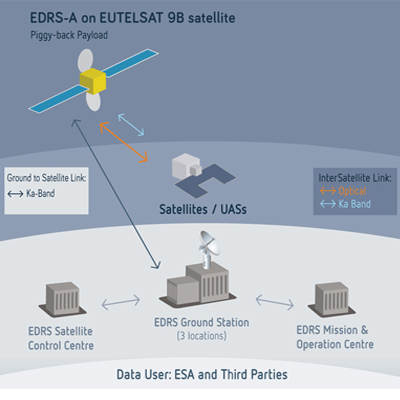
    Eutelsat 9B also hosts EDRS-A, the first node of the European Data Relay System (EDRS) for ESA and Airbus Defence and Space. This new SpaceDataHighway will significantly speed up the flow of information between low-orbit satellites and their ground stations, improving reaction time for a wide range of operations such as disaster monitoring, emergency operations and coastal and maritime surveillance.


    The EDRS-A payload hosted on Eutelsat 9B comprises a laser communications terminal and a Ka-band inter-satellite link that will retrieve high volumes of data sent from low orbit satellites as well as airborne platforms and a Ka-band antenna to transmit the data from geostationary orbit to EDRS ground stations.

  • Intelsat names Naren Mansharamani as VP – financial planning & analysis

    Intelsat names Naren Mansharamani as VP – financial planning & analysis

    MUMBAI: Intelsat S.A. has appointed Naren Mansharamani as vice president of financial planning & analysis (FP&A).


    In his role, Mansharamani will lead Intelsat’s FP&A and Corporate Development team in further enhancing and sustaining a strong analytic framework that will bridge strategy and operations with finance and accounting to support the company’s business objectives. He will be based in McLean, VA and report to Intelsat CEO and interim CFO Stephen Spengler.


    Mansharamani joins Intelsat from SABIC Innovative Plastics formerly known as General Electric (GE) Plastics where he served as director of the Americas. In his role, he was responsible for the overseeing the overall financial performance of the company’s $3 billion Americas division. He also held the role of director of finance & pricing for the company’s $2 billion Global Automotive division. Overall Mansharamani spent 18 years with various business divisions in GE where he held increasing roles of responsibility in GE Plastics, GE Silicones, GE Healthcare and GE Capital. Prior to joining GE, he worked with Ernst & Young for three years.


    Mansharamani holds a B.Com from Delhi University and is a Certified Public Accountant and Chartered Accountant.