Category: Satellite Launches

  • NASA & Harmonic partner to launch UHD consumer channel

    NASA & Harmonic partner to launch UHD consumer channel

    MUMBAI: The National Aeronautics and Space Administration (NASA) has partnered with video delivery infrastructure company Harmonic to launch NASA TV UHD, the first consumer UHD (ultra-high-definition) channel in North America.


    The channel is expected to launch on 1 November, 2015.


    Utilising an end-to-end UHD video delivery system from Harmonic, NASA can deliver live and linear 2160p60 video content, enabling consumers to enjoy crystal-clear footage on a wide range of television and IP-connected devices. A test signal of NASA TV UHD is currently available on the AMC 18C satellite.


    NASA TV UHD video is being sourced from high-resolution images and video generated on the International Space Station (ISS), Hubble Space Telescope, and other current NASA missions. Programming will also include remastered footage from historical missions, shots from NASA’s development and training processes, and ultimately live launches. Leveraging the 8M pixel resolution of the UHD format, the channel will create the closest possible experience to looking out of the viewing Cupola of the ISS, for example.


    Like the current NASA TV channels and on the same transponder, NASA TV UHD will be transmitted via the AMC-18C satellite, in the Clear, with a North American footprint. Harmonic is currently in discussions with pay-TV operators to carry the channel on their satellite DTH, cable and optical networks, for consumer access. The channel will also be streamed on the Internet, which will require at least 13 Mbps access connectivity to receive the signal and achieve the UHD experience.


    Transmitted from NASA’s Atlanta uplink facility, remotely produced by Harmonic and jointly operated, the complete infrastructure includes examples of Harmonic’s Ellipse 3000 contribution encoder, ProView 7100 integrated receiver-decoder (IRD), MediaGrid shared storage system, Polaris playout management suite, Spectrum X advanced media server system, Electra X3 advanced media processor, ProMedia Origin packager and streaming video server and NSG Exo distributed CCAP system.


    A key element in the UHD workflow is Harmonic’s Electra X3 advanced media processor, the industry’s first converged media processor for UHD content with live, full-frame, full-GOP UHD encoding. Powered by the Harmonic PURE Compression Engine, an advanced encoding technology that supports resolutions up to 2160p60 (HEVC Main 10) for broadcast and OTT multiscreen delivery, the Electra X3 enables NASA to deliver superior video quality at minimum bandwidth.


    “As NASA reaches new heights and reveals the unknown, the NASA TV UHD channel can bring that journey to life in every home. And as organisations at the forefront of innovation, together we are leading the adoption of this exciting technology. As the leader in UHD development, Harmonic provides a complete solution for Ultra HD video production and delivery, enabling content and service providers to offer better video quality at a low total cost of ownership,” said Harmonic CMO Peter Alexander. 


    NASA and Harmonic have also begun discussions about adding high dynamic range (HDR) and expanded color-space technologies to the channel as standards emerge. Some testing is expected before the end of the year.
  • India earns Rs 650+ crore by launching 45 foreign satellites

    India earns Rs 650+ crore by launching 45 foreign satellites

    NEW DELHI: The country has earned a sum of approximately Rs 662 crore ($17 million and 78.5 million Euros) by launching 45 satellites from 19 countries using Indian Space Research Organisation’s (ISRO) Polar Satellite Launch Vehicle (PSLV).


    The commercial wing of the ISRO, Antrix Corporation Limited, has been generating income with commercial arrangements through launching of satellites of foreign countries on-board ISRO’s launch vehicle. 


    Space Department sources said the launch missions conducted by ISRO for launching Indian satellites are intended for National development. 

    Antrix has signed agreements for launching 28 more foreign satellites from six countries:  Algeria – three, Canada – four, Germany – four, Indonesia – two, Singapore – six and the United States – nine.


    The launches of these foreign satellites are envisaged during the 2015-2017 time period. Discussions with foreign agencies and companies are going on for providing launch services to their satellites on-board ISRO’s PSLV and Geo-synchronous Satellite Launch Vehicle (GSLV). 

    Furthermore, the images received from the Indian Remote Sensing (IRS) satellites (RESOURCESAT-2, RISAT-1 and CARTOSAT-1) are marketed globally by Antrix through International Ground Stations established outside India. The IRS images of regions outside India received and processed at ISRO’s Ground Station are also marketed to global customers through Antrix.

  • ISRO to build 15 PSLV launcher by decade end

    ISRO to build 15 PSLV launcher by decade end

    NEW DELHI: A total of 15 Polar Satellite Launch Vehicles (PSLV) launchers worth Rs 3090 crore have been sanctioned by the Government for being built during 2017-20. 


    The launchers proposed by Indian Space Research Organisation (ISRO) in the coming years (that is till March 2017) include ten PSLV, two Geosynchronous Satellite Launch Vehicles (GSLV) and one developmental flight of GSLV Mk III. 


    The indigenous GSLV will launch 2-ton class of communication satellites in space. 


    Space Department sources said ISRO has been utilising the Indian industry for the manufacturing and production of the various components and sub-assemblies required for the development of space technology since 1976. In order to ensure the smooth supply chain of hardware, components and sub-systems, ISRO is planning to magnify the role of industry partners by increasing the scope of work from sub-system/hardware level to system level in a phased manner.


    The entire gamut of activities that goes into the realization of the launch vehicles or satellites could be performed by the industry, except mission critical activities and launch operations. 

  • PSLV-C26 successfully launches IRNSS-1C

    PSLV-C26 successfully launches IRNSS-1C


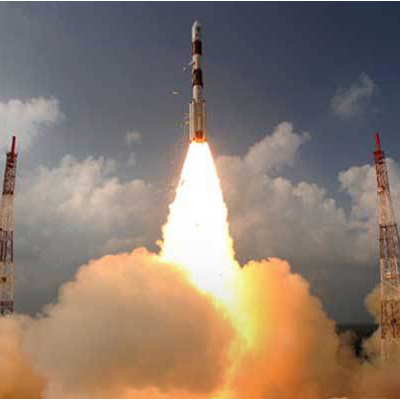
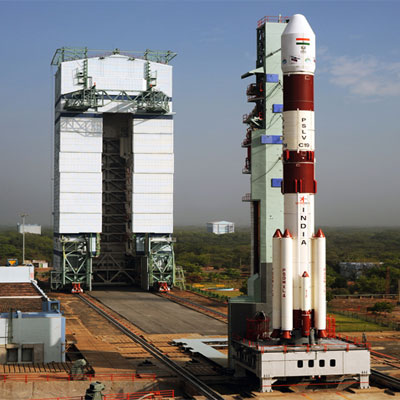
    MUMBAI: ISRO’s Polar Satellite Launch Vehicle, PSLV-C26, successfully launched IRNSS-1C, the third satellite in the Indian Regional Navigation Satellite System (IRNSS) at 0132 hours IST from Satish Dhawan Space Centre, Sriharikota. This is the twenty seventh consecutively successful mission of PSLV. The ‘XL’ configuration of PSLV was used for this mission. Previously, the same configuration of the vehicle was successfully used six times.

    After the lift-off of PSLV-C26 with the ignition of the first stage, the important flight events;  stage and strap-on ignitions, heat-shield separation, stage and strap-on separations and satellite injection, took place as planned. After a flight of about 20 minutes 18 seconds, IRNSS-1C Satellite, weighing 1425 kg, was injected to an elliptical orbit of 282.56 km X 20,670 km, which is very close to the intended orbit.

    After injection, the solar panels of IRNSS-1C were deployed automatically. ISRO’s Master Control Facility at Hassan, Karnataka assumed the control of the satellite. In the coming days, four orbit maneuvers will be conducted from Master Control Facility to position the satellite in the Geostationary Orbit at 83 deg East longitude.

    IRNSS-1C is the third of the seven satellites constituting the space segment of the Indian Regional Navigation Satellite System. IRNSS-1A and IRNSS-1B, the first two satellites of the constellation, were successfully launched by PSLV on 2 July 2013 and 4 April 2014 respectively. Both IRNSS-1A and 1B are functioning satisfactorily from their designated geosynchronous orbital positions.

    IRNSS is an independent regional navigation satellite system designed to provide position information in the Indian region and 1500 km around the Indian mainland. It will provide Standard Positioning Services (SPS) – provided to all users – and Restricted Services (RS), provided to authorised users.

    A number of ground stations responsible for the generation and transmission of navigation parameters, satellite control, satellite ranging and monitoring, etc., have been established in as many as 15 locations across the country.

    In the coming months, the next satellite of this constellation, namely, IRNSS-1D, is scheduled to be launched by PSLV. The entire IRNSS constellation of seven satellites is planned to be completed by 2015.  Minister of State (Space), Dr Jitendra Singh, witnessed the launch from the centre.

  • GSAT-16 to launch in December 2015

    GSAT-16 to launch in December 2015

    MUMBAI: The Indian Space Research Organisation (ISRO) has decided to launch two satellites by next year. GSAT-16 was scheduled to launch by mid 2015, but a new announcement from the ISRO states that it will be launched by December 2014 itself.


    The 3100 kg aircraft will be lifted into space six months earlier on a European Ariane 5 launcher. The decision for advancement was taken due to the expiration of INSAT 3E that expired earlier this year and was to be replaced by GSAT-16. A tentative launch date is 6 December.


    GSAT-16 will have 24 transponders in the C-band, 12 in the extended C-band and 12 in the Ku band to support public and private television and radio services, internet and telephone operations.


    The government had approved Rs 865 crore to build this satellite including fee for foreign launch and insurance that constitute Rs 628 crore.


    The satellite will be positioned at 55 degree east.

  • Union Minister Jitendra Singh presents ISRO report card

    Union Minister Jitendra Singh presents ISRO report card

    MUMBAI: The Indian Space Research Organisation’s (ISRO) commercial arm Antrix Corp has been involved in 10 satellite launches of eight foreign countries from the two operational satellite launch pads at Satish Dhawan Space Centre, Sriharikota over the last three years. In the process, it has earned revenues of 540,000 euros in 2001-2012 and 21.09 million in 2012-2013. This was disclosed by Union Minister of State for Science & Technology and ministry of earth sciences, department of atomic energy and department of space Jitendra Singh in a written reply in the Lok Sabha today.


    Singh revealed that the government is considering setting up a new satellite launching pad, referred as Third Launch Pad, at Sriharikota. The Third Launch Pad is intended to support increased launch frequency, provide active redundancy to existing launch pads and to support launching requirements of advanced launch vehicles. The possible site  for the Third Launch Pad has been identified in Sriharikota taking into account the safety distances and maximal utilization of existing launch pad facilities. The existing launch pads  are used exclusively for launch vehicles developed by ISRO.


    Singh added  that ISRO’s  satellites have done yeoman’s service in improving telecom, long-distance education, telemedicine in rural and flung areas of the company. He pointed out that  ISRO satellites have helped in achieving 100 per cent coverage of the Indian mainland and rural and far flung areas for direct to home  (DTH) satellite television.  


    Additionally, they have helped in three other areas:

       * Telecommunication: About 1.75 Lakh satellite communication terminals are supporting various applications like village telephony, data connectivity, broadband connectivity, Automatic Teller Machines (ATM) of banks, etc., covering the rural and far flung areas of the country.


      * Tele-Education: 56,000 classrooms connected through satellite networking, of which 51,000 are Receive Only Terminals (ROTs) and around 5000 are Satellite Interactive Terminals (SITs) catering to all the sectors of education from primary to higher and professional education.


    * Telemedicine: The Telemedicine network connects the patients at a remote hospital to a speciality hospital for tele-consultation. 60 specialty hospitals connected to 308 remote and rural hospitals and 16 Mobile Vans.
     

    The Developmental Education and Communication Unit (DECU) of ISRO conducted  a study to ascertain the utility of tele-education and tele-medicine networks over the years, a Press Information Bureau (PIB) release states. The findings of the study indicate the following.
     

    * Tele-education networks are very effective to reach out remote and rural areas of the country and also to enhance the understanding level of the students. The target audience for tele-education include students from school, technical education, higher education, teachers training including physically challenged students. On an average 2-3 hours of programmes are transmitted for 4-5 days in a week.


    * Tele-medicine networks are very useful in treating the patients located in remote and rural areas. Through tele-medicine patients get the best doctors for consultation. Tele-medicine provides the advantage of saving time and money to the patients and also provides relief to family members from the hassles of accompanying the patient to speciality hospitals in the urban areas. Mobile tele-medicine vans are found to be ideal to cover larger geographical area with treatment in the fields of Ophthalmology, Diabetic screening, Cancer, General Medicine and hearing impairments in the infants.


  • AsiaSat 8 to launch on 5 August for APAC region

    AsiaSat 8 to launch on 5 August for APAC region

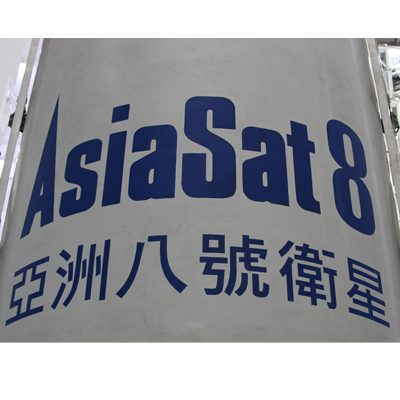
    MUMBAI: A new satellite is all set to be launched on 5 August that will cater to the Asia Pacific countries of India, China, Middle East and south east Asia. Asia Satellite Telecommunications Company (ASTC) will launch AsiaSat 8 from Cape Canaveral in the US.


    The satellite will be propelled into the sky at Hong Kong time 1:35 pm or 1:25 am Cape Canaveral time, by SpaceX’s Falcon 9 launch vehicle from its station in Florida. AsiaSat 8 is a space systems/loral 1300 series satellite with a life span of 15 years.


    Its 24 Ku-band transponders and a Ka-band payload will help to meet the growing market demand for quality satellite services in the APAC region. Co-located with it will be AsiaSat 7 at orbital location 105.5 degrees east. AsiaSat 7 covers the areas of Asia, Middle East, Central Asia and Australasia. The satellite’s inter-beam switching capability will provide flexibility for market requirements and for services including DTH television, private networks and broadband services.


    With a payload power of about 8,500 watts, this will be the most powerful offering from ASTC with a transponder bandwidth of 54 MHz. It has four beams with each addressing the regions of India, China, Middle East and Southeast Asia.


    Soon after, another satellite will be launched from the Hong Kong based provider- AsiaSat 6 that will also be launched by the Falcon.


    SpaceX’s Falcon 9 v1.1 will launch AsiaSat 8 into a geostationary transfer orbit. According to SpaceNews, AsiaSat has paid $52.2 million each for the Falcon 9 launch of AsiaSat8 and AsiaSat 6.

  • GSAT-15 and GSAT-16 satellites to be launched by mid 2015

    GSAT-15 and GSAT-16 satellites to be launched by mid 2015

    NEW DELHI: Two GSAT missions are expected to be launched by the Indian Space Research Organisation (ISRO) by mid 2015. GSAT-15 will be launched in FY 2014-15 while GSAT-16 will be launched by mid 2015, the c was informed by Minister of State for Department of Space Jitendra Singh.


    The launches are expected to augment the communication facilities including the Ku-band and Upper Extended C-band.


    The government has approved a budgetary support of Rs 859.5 crore including a foreign exchange component of Rs 622.5 crore for realisation of GSAT-15 spacecraft project including launch services and insurance. It has also approved a budgetary support of Rs 865.5 crore including a foreign exchange component of Rs 628 crores for realisation of GSAT-16 spacecraft project including launch services and insurance.


    GSAT-15, which had been approved by the government on 17 July last year, will carry 24 Ku-band transponders and provide replacement for the Ku-band capacity of INSAT-3A and INSAT-4B spacecrafts to augment and support the existing DTH and VSAT services in the country. It will also carry a GAGAN (GPS Aided Geo Augmented Navigation) payload to meet the in-orbit redundancy requirement for safety of life (SOL) operations benefiting the civil aviation services in the country.


    GSAT-16, also approved on 17 July last year, will carry 48 transponders in C-band, Ku-band and Upper Extended C-bands and provide replacement for the INSAT-3E spacecraft and augment the C and Upper Extended C-band capacity. The spacecraft will be utilised in augmenting and supporting the existing telecommunication, television, VSAT and other satellite based services in the country.

  • Launch Satellite for benefit of SAARC countries: Modi

    Launch Satellite for benefit of SAARC countries: Modi

    NEW DELHI: Prime Minister Narendra Modi  has asked the Indian Space Research Organisatinon to develop a satellite that India can gift to the South Asian Association for Regional Cooperation (SAARC) region.


    He asked ISRO to expand navigation system to all of south Asia.


     Speaking at Sriharikota spaceport, around 100 km from Chennai, after witnessing the launch of PSLV C23, Modi said, “India’s space programme is driven by a vision of service to humanity. Not by a desire of power.”


    He added that the country must share the fruits of its technological advancements with those who do not enjoy the same – the developing world and India’s neighbours in particular.


     India is already sharing disaster management data with over 30 countries and provides benefits of telemedicines to Afghanistan and African countries. “But we must do more,” said the Prime Minister.


     Earlier, Modi saw the launch of the Polar Satellite Launch Vehicle PSLV-C23 which successfully lifted off from the first launch pad of Sriharikota space station at the Satish Dhawan Space Centre.


     The launch vehicle PSLV-C23, with a height of 44.4 metres and a vehicle lift-off mass of 230 tonne, is carrying SPOT-7, a 714 kg, French earth observing satellite as the main payload, which will be injected into a 655 km Sun Synchronous Orbit (SSO). Other satellites include 14 kg AISAT of Germany, NLS7.1 (CAN-X4) & NLS7.2 (CAN-X5) of Canada each weighing 15 kg and the 7 kg VELOX-1 of Singapore.


    PSLV has had 26 consecutive successful flights till date. The PSLV-C23 will be the tenth flight of PSLV in “core-alone” configuration, which means a configuration without the use of solid strap-on motors.


    After an estimated time of 20 minutes, ISRO’s workhorse PSLV separated all five satellites — one by one into their intended orbit.


    During his first visit to the facility, the Prime Minister took a tour of the facilities, including the launch pad. He was also briefed by ISRO scientists and its Chairman K Radhakrishnan.


    NLS 7.1 and NLS 7.2 are from the University of Toronto, Institute of Aerospace Studies/ Space Flight Laboratory. Canada.


    Both payloads would fly in precise formation using differential GPS with centimeter-level accurate position control system.


    VELOX-1 from Nanyang Technological University, Singapore is a technology demonstrator for design of image sensor, MEMS-based attitude determination and control system and inter-satellite RF link.


    These five satellites are being launched under commercial arrangements that ANTRIX, ISRO’s commercial arm, has entered into with the respective foreign agencies.


    Isro earlier delayed the launch by three minutes due to the threat of space debris getting into the way of the satellites. The PSLV C23 lifted off from the spaceport at 9.52 am on Monday instead of 9.49 am as decided when the launch plan was announced.


    One of the debris objects could have come as near as 40 metres from the spacecraft and by delaying the launch ISRO wanted to avoid the objects by thousands of kilometres as debris move at a velocity of several kilometres per second, said Isro officials.


    A report quoting experts stated that the debris from the 2011 collision of a US satellite and a Russian satellite were found at altitudes above 600 km.


    Until now, the largest number of foreign satellites launched by PSLV was from Germany. In the first launch of satellites of other countries, PSLV-C2 has launched the German satellite with a mass of 45 Kilogram, along with a KITSAT-3 with 110 Kg mass were the payloads. Including this, till April, 2014, eight satellites of Germany reached their destination in space through the launch vehicle of Isro. Canada has sent five satellites till April, 2014 through PSLV while Japan has sent three satellites using the service.

  • EchoStar Acquires European Mobile Satellite Services Provider

    EchoStar Acquires European Mobile Satellite Services Provider

    COLORADO: (NASDAQ: SATS) announced today that it has acquired 100% ownership of Solaris Mobile Ltd., a next-generation mobile satellite services (MSS) operator based in Dublin, Ireland and one of the European Union licensees of mobile satellite service with a complementary ground component (S band).


    Solaris Mobile Ltd. is deploying a satellite and terrestrial network for wholesale access to enhanced mobile communications across Europe in the 30 MHz S band licensed to Solaris Mobile. In connection with the acquisition, EchoStar has entered into an agreement with Solaris Mobile to provide it with MSS capacity on a new next-generation MSS satellite.


    “Through this acquisition and our mobile satellite infrastructure expertise, we look forward to accelerating advanced mobile services throughout the European Union,” said Anders Johnson, president, EchoStar Satellite Services. “We are excited to build upon the groundwork laid by Solaris Mobile by most immediately bringing with us access to a next generation MSS satellite which will support a wide range of innovative services across the European Union.”