Category: Satellites

  • Panamsat unveils new solution for news delivery across the US

    Panamsat unveils new solution for news delivery across the US

    MUMBAI: Global satellite services provider Panamsat and On Call Communications have developed a new satellite-based communications solution to enable the coverage of breaking news and live events by local and independent news stations in the US. By using PanAmSat’s QuickSPOT on-demand satellite technology and On Call’s OnSpot auto-deploying broadband satellite communications systems, broadcasters can now report on breaking news events as they happen and then transmit the coverage to viewers in real time with unrivalled simplicity, mobility and cost-efficiency.

    Koce, a PBS-affiliate based in California, is using the new system to provide live news coverage to viewers of events that previously could only be pre-recorded. Koce says that the QuickSPOT/OnSPOT solution gives it the opportunity to deliver live remote broadcasts at far lower costs and convenience than anything it has been able to do in the past. Koce says that being live on the scene gives it a new dimension, covering the news as it happens, making the story much more ‘real’ to viewers. The recent fires in Southern California exemplified this as it reported from the field, delivering the latest updates from fire officials, what areas were being evacuated and what schools remained open. Thereffore the news was much more relevant to our viewers compared to something written and broadcast from the studio.

    The QuickSPOT/OnSPOT solution provides a cost-effective broadcast delivery system making it possible for smaller broadcasters to access the formerly cost-prohibitive world of live broadcasts. These stations can now avoid the expense of dedicated satellite space by paying only for their on-air time. And, no technical knowledge is required to operate the auto-deploying terminals.

    Panamsat executive VP, global sales and marketing Mike Antonovich says, “Through our work with OnCall, we’ve developed a truly game-changing broadcasting solution that transforms the world of satellite news gathering. By using smaller auto-pointing antennas in conjunction with the latest generation of digital encoding and compression and our bandwidth-on-demand provisioning service, live news coverage is now simpler, smarter and smaller then ever before. These lower-cost systems can now affordably be made available to support everyone from major market television stations to local community cable channels. Smaller communities benefit by getting up-to-the-minute reports on local weather, storm conditions and developing news events. And, independent stations can provide a wider variety of coverage and perspectives as they serve up their own live reports. It is a win-win for everyone—the broadcaster and the viewer.”

    On Call Communications specialises in providing quick deployments of mobile satellite telecommunications systems for broadcasting, disaster recovery and government applications. They design, integrate and install custom satellite communications networks.
  • Isro to ramp up number of satellite launches

    Isro to ramp up number of satellite launches

    BANGALORE: Indian Space Research Organisation (Isro) has responded positively to the increasing demand for satellite space. Speaking at the launch of the Satellite Integration and Testing Establishment (ISITE) facility in Bangalore, Isro chairman G Madhavan Nair hinted at Isro upping its ante in this area.

    “Presently, we are doing about one and a half Insat class satellites a year and one remote sensing satellite launch in every eighteen months. The demand from all segments is high and rising and we should actually be doing around four Insat class satellites, two to three remote sensing satellites and around three to four micro satellites of the around 100 kg payload,” said Nair.

    Nair added that Isro had its hands full with many projects including a couple of commercial satellites for Europe. He said Isro was expecting orders for two more satellites from this region.

  • Isro unveils Satellite Integration and Testing Establishment

    Isro unveils Satellite Integration and Testing Establishment

    BANGALORE: Finding the current facility too small and congested, Indian Space Research Organisation (ISRO) has come up with a brand new facility spread over 100 acres of land on the outskirts of Bangalore. The facility is christened ISRO Satellite Integration and Testing Establishment (ISITE).

    So far, Isro had to carry the satellite from one part of the complex to the other for various tests. The new facility at Marthahalli offers world class Assembly Integration and Test (AIT) complex bringing all spacecraft integration under one roof. A tested satellite comes out of the same door through which its knocked down parts go into.

    ISITE is equipped with world class facilities and will enable Isro to assemble, and carry out various tests and then pack the assembled satellite for dispatch to the launch site. Some of the state of art facilities and equipment include:

    (1) Assembly Integration & Test (AIT) Clean room – this is a huge room of size 54.6mts (about 179 feet) x 34.6m (about 113.5 feet) x 16.7m (about 55 feet) height which is maintained at a temperature of about 22 deg C (72 deg F) with a relative humidity of around 55, a cleanliness level of 1,000,000 class maintained at a positive pressure of 20 mbar.

    The bare structure of Insat 4B, which is scheduled for launch in January 2007, was under assembly when Indiantelevision.com visited the site. This room can integrate up to six satellites in various stages of assembly simultaneously of Insat 4B class and is equipped to integrate around 800 elements in the bare structure of the spacecraft. This area has an Electro Static Discharge (ESD) floor to dissipate the micro electric charges from human bodies which could effect some sensitive equipment in the room.

    (2) Comprehensive Assemble and Test Vacuum Chamber (CATVC) is capable of testing satellites under vacuum conditions and at temperatures as low as 173 deg K {(-)100 deg C or (-)343 deg F }. Satellites up to 4.5m diameter (about 14.75 feet) and 6 meters length (about 20 feet) having a weight of 3 metric tons can be tested in this Chamber which has Ariane-5 adapter interfaces.

    (3) Comprehensive Assembly and Test Vibration Facility: This test facility has a peak sine force of around 29 ton-force and a maximum bare table acceleration capacity of 75 gm.

    (4) Compact Antenna Test Facility (CATF): This is a 30 meter long (100 feet), 20 meter wide (67 feet) and 16m high (52 feet) chamber for testing of antenna in space simulated conditions. ISRO officials claim that no other facility in the world has a similar arrangement.

    The facility was officially thrown open by national security advisor M K Naraynan. Other dignitaries who were present to witness the inauguration included former Isro chairmen U R Rao and K Kasturirangan, secretary Department of Ocean Development P S Goel (formerly from Isro and one of the persons who conceived the idea for the Integration and Testing facility) and ISAC director K Shankara. On completion, the project is estimated to cost around Rs 4 billion.

  • Isro schedules Insat 4C launch for July

    Isro schedules Insat 4C launch for July

    MUMBAI: All indications point to the second half of the year being when we will see some fresh action on the direct-to-home (DTH) television services front. Even as the timeline for the Tata Sky DTH service looks to be June-July, the Indian Space Research Organisation (Isro) is all set to launch Insat 4C, the latest in the Insat series, in July.

    Kalanithi Maran’s Sun Group, which has booked space on Insat 4C, is negotiating with Isro for eight Ku-band transponders. Earlier Sun had indicated that it would start its Sun Direct DTH service with five transponders which it would ramp up to nine.

    “Sun now wants to start with eight transponders. The company is in discussions with Isro,” an industry source says.

    Though Insat 4C has a capacity of 12 Ku-band transponders, the problem with Isro is that it has got demand from other operators as well. The government requires four transponders for village telephony over a period of time. Even National Informatics Centre (NIC) has asked for four transponders to start with. “We have committed to giving them one transponder each. We may give some transponders to NIC on Insat 4B, which is slated for launch in the first quarter of 2007 as we have to coordinate with the launch vehicle (Arianespace’s commercial launcher Ariane 5),” says Isro contract management and legal services director SB Iyer.

    Isro will also be handing over two Ku-band transponders to media companies for digital satellite news gathering (DSNG) activities. “DSNG is a fast-growing segment. We are providing two transponders for DSNG operators,” Iyer says.

    With one-to-two transponders reserved for spare capacity, Sun may have to finally settle for less than what it wants. But Isro will allocate transponders to customers who are ready to take them first.

    Meanwhile, Anil Ambani’s Reliance has also booked space for its own DTH plans. As things stand now, there may be no room even on Insat 4B as the space on Insat 4B is reserved for Doordarshan which wants six Ku-band transponders at the minimum.

    Subhash Chandra’s Dish TV, which is on NSS satellite, has not yet indicated to Isro whether it wants space on the Insat series. BPCL, the other player which is waiting to launch, has also not applied to Isro for transponder space.

    Insat 4C will be put into orbit in July by the Geo-synchronous Satellite Launch Vehicle-5 (GSLV), to be launched from Isro’s Sriharikota facility.

    With 12 high power Ku-band transponders, Insat 4C is the first Indian satellite to exclusively offer DTH playout facilities. The satellite will have the capacity to beam about 150 television channels in all.

    The other two satellites of the Insat 4 series — 4A and 4B — have both Ku-band and C-band capacity, carrying 12 transponders of each. Insat 4A launched last December.

    Isro has already allocated all the 12 transponders on Insat 4A for Tata Sky, the 80:20 joint venture between the Tatas and Star Group.

  • Intelsat launches open architecture content management service

    Intelsat launches open architecture content management service

    MUMBAI: Satellite operator Intelsat has introduced Ampiage. This is a new satellite-based, open-architecture, content delivery and management service for US multiple system operators (MSOs) seeking to cost-effectively upgrade to MPEG-4 and telecommunications operators (telcos) looking to enter the IPTV market.

    Intelsat CEO David McGlade says, “Our goal is to offer services that help our customers reach their goals, and Ampiage will benefit phone companies and cable operators in two very different ways. This is a game-starter for phone companies looking to launch IPTV services for their subscribers and make a video play.

    “Separately, it is also a cost-effective way for cable companies to upgrade to MPEG-4 without having to invest new capital in equipment. Lastly, Ampiage also showcases Intelsat’s ability to introduce innovative services that address new and growing markets created by the convergence of telecom and media.”

    Modelled on a “super head-end” for content distribution Ampiage will upgrade and convert video stream for MSOs from MPEG-2 to MPEG-4 using state-of-the-art equipment. The move to MPEG-4 is being driven by the desire for both higher transmission quality and efficient utilization of bandwidth. The service is designed to include fully redundant facilities and transmission capacity, thus it is expected that Ampiage services will have the ‘gold standard’ service excellence and high availability for which Intelsat is known.

    Intelsat says that Telco customers will realise cost savings by taking advantage of Intelsat’s packaged offering, which, if the elements were procured separately and on their own, would cost them millions of dollars. Telco customers are expected to benefit from Intelsat’s volume relationships with content creators worldwide, its ability to secure transport rights and its relationships with coveted niche and international programmers, which will enable them to create local packages that are highly customised to demographic concentrations.

    Ampiage cost-effectively packages the acquisition, aggregation, encoding, encapsulation and encryption of licensed TV programming from content providers and has the ability to redistribute it in MPEG-2 or MPEG-4 format to cable and telecom service providers. This allows MSOs and telcos either to establish or enhance their digital programming lineups quickly and with low capital investment.

    Ampiage completely centralises the aggregation of national TV programmer content and offers hundreds of video and audio channels in full digital quality. This enables telcos to efficiently bundle an attractive standard and high definition programming package with their voice and broadband services without incurring a significant upgrade cost.

    Ampiage originates from Intelsat’s Video Operations Center, where video and audio are received and processed for distribution to telco and MSO video hubs nationwide. Leveraging the complete coverage of North America offered by the Intelsat Americas fleet, Ampiage distributes the programming to regional telecom and cable service providers. Telcos and MSOs then distribute this programming content via xDSL, fiber, conventional cable networks and other broadband networks to their residential subscribers across North America.

  • FM radio players protest WorldSpace terrestrial foray

    FM radio players protest WorldSpace terrestrial foray

    NEW DELHI: It is not only the television broadcasters that are grappling with the issue of distribution and competition. Private radio broadcasters too have started sampling irritants in this regard.

    The private sector FM radio players has complained against satellite radio provider WorldSpace’s attempt to get certain licences that would help it distribute the services terrestrially also.

    According to information available with Indiantelevision.com, WorldSpace, India’s only satellite radio service, is trying to get a license for L-band terrestrial repeater from the information and broadcasting ministry, which, if obtained, will help it to transmit its services on moving vehicles terrestrially — the primary target audience of FM radio.

    “Repeaters are basically targeted at subscribers-on-move like in a car, etc. A satellite radio cannot enter into terrestrial segment by any means,” a letter to the government from the Association of radio Operators in India (AROI) states.

    Raising the emotional quotient, AROI seems to be appealing to the conscience of the government by saying, “We fail to understand why the Government of India is working on the WorldSpace application even when a proper guideline on satellite radio in India is still not available.”

    The letter goes on to add that considering FM radio in India is in a nascent stage and the FM radio broadcasters have paid “an exorbitant OTEF (one-time entry fee)”. the government should “protect FM radio industry for at least next 10 years.”

    “Before even waiting for the commissioning of the new stations, the ministry is already making plans to welcome new players into the terrestrial radio arena, directly threatening the existence of the FM Radio licensees. This is not acceptable at all,” the high-pitched AROI letter states.

    The AROI letter has been marked to prime minister Manmohan Singh, Congress chief Sonia Gandhi, defence minister Pranab Mukharjee, home minister Shivraj Patil and telecommunication minister Dayanidhi Maran and I&B ministry secretary SK Arora.

    The move of AROI comes at a time when the government is working on putting in place a policy for satellite radio services, including caps on foreign investments, which would force the likes of WordSpace to restructure themselves and find majority Indian partners.

    The AROI letter is also likely to put pressure on the government to bring about stringent regulations relating to satellite radio services. The Sector regulator has already submitted a set of recommendations to the I&B ministry.

  • Another Intersputnik satellite gets into orbit

    Another Intersputnik satellite gets into orbit

    Intersputnik’s Express-6A satellite was launched successfully on 12 March (Moscow Time). The satelllite to be located at 80 degrees East, is positioned as a bird that will significantly improve communications capacity across Russia and was lifted off Kazakhstan’s Baikonur Cosmodrome aboard a Proton launch vehicle. Under an agreement with the Russian Satellite Communications Company (RSCC), Intersputnik will utilize the major part of Express-6A’s 17 transponder strong C- and Ku-band relay capacity.

    Express-6A will replace the aging Express-6 spacecraft currently in orbit and allows Intersputnik’s customers to use earth stations without tracking systems, and providing a higher quality of services.

    “The successful launch of Express-6A is the next step in modernizing Intersputnik’s communications system,” Gennady Kudryavtsev, Intersputnik’s Director General, said. “The new Express-A series of spacecraft provides a longer service life, more capacity and higher radiated power. Express-6A will carry all of the television channels currently handled via Express-6, and also will be used for new digital communications and broadcasting channels including relay in Ku-band.”

    In addition to traditional services such as analog broadcasting and public switched telephone networks, Express-6A also will provide such services as digital television and radio broadcasting, Internet access and dedicated corporate VSAT-based Ku-band networks. Users of the Express-6A include such Russian television channels as TV-6, TV-Centre, AST; large telecommunications network operators (Rustel); dedicated networks operators (Insat, Sirena), and telephone companies from Intersputnik’s member nations.

    The second satellite in the new Express-A series is Express-3A, which is to be launched in June and positioned at 11 degrees West. This spacecraft will replace the aging Statsionar-11 (Gorizont-26) satellite. Express-3A will allow Intersputnik to offer more satellite channels to telecommunications companies interested in transAtlantic traffic.

    Russia’s Krasnoyarsk-based NPO PM is prime contractor for the Express-A-series satellites. The satellite bus is developed by NPO PM, while Alcatel Espace of France supplies the payload.

  • Globecast delivers ESPN Classic to the UK via satellite

    Globecast delivers ESPN Classic to the UK via satellite

    MUMBAI: US sports broadcaster ESPN has struck a deal with GlobeCast, a global content management and delivery company, to deliver ESPN Classic, the company’s first UK-dedicated sports channel, to the Sky Digital platform.

    Launched this week using Globecast’s capacity on the Eurobird satellite, ESPN Classic is devoted entirely to the greatest moments and legends of sport with a mix of all-time classic highlights, matches, movies, interviews, profiles and documentaries.

    GlobeCast’s solution for ESPN includes connectivity from the broadcaster’s playout facility in West London to GlobeCast, where the feed is encoded, multiplexed then sent to GlobeCast’s Brookmans Park teleport for uplink to the Sky Digital platform using GlobeCast’s Eurobird capacity. ESPN Classic is available 24 hours a day on Sky’s EPG channel 442.

    GlobeCast has an established relationship with ESPN Classic, providing a content and delivery services for the channel’s existing French, Italian and European feeds via Astra at 19.2ºE, Hotbird at 13ºE and Sirius 2 4.8ºE respectively.

    Globecast is a subsidiary of France Telecom. It is a global content management and delivery company. Via its worldwide satellite and fibre network, the company manages and transports 10 million hours of video and other rich media yearly for its core customer base of broadcasters, as well as corporate, government and retail clients.

    Globecast is network agnostic and ingests once to deliver content to any network via multiple platforms, including direct-to-home satellite, cable, video-to-mobile, IPTV/video-over-ADSL, desktop broadband, and more. The company’s global presence includes 15 teleports and technical operations centres throughout Europe, America, Asia, Africa, the Middle East and Australia.

  • Insat-3B lofted successfully

    Insat-3B lofted successfully

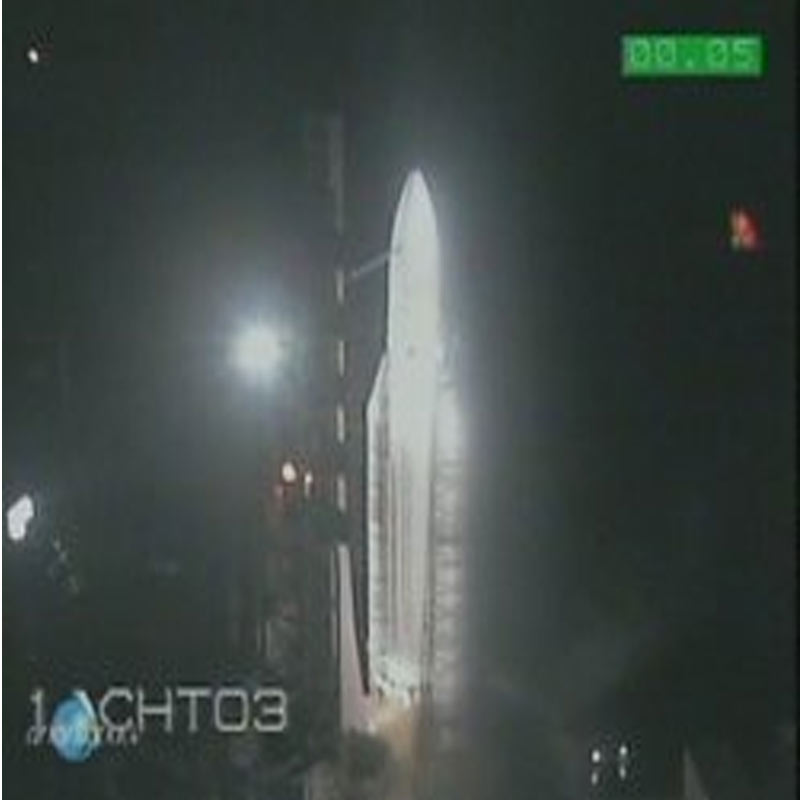
    Arianespace and the Indian Space Research Organisation successfuly lifted the first in the third generation of Insat satellites on 22 March at 04:58 Indian time. The Arianespace-505 launcher had an additional payload in the Asiastar satellite which was launched for digital radio service, WorldSpace.

    Asia Star was first injected into orbit 28 minutes after lift-off, and seven minutes later, INSAT-3B was injected (in a three-axis stabilised mode into a Geo-synchronous Transfer Orbit – GTO) with a perigee of 560 km and an apogee of 35,770 km and an inclination of 7 degree with respect to the equator.

    The satellite is at present orbiting around the earth with a period of 10.64 hours. The Insat Master Control Control Facility (MCF) at Hassan in Karnataka acquired the telemetry signal from Insat-3B at 5.30 (IST) three minutes prior to its separation from the launcher.

    On separation of the satellite from the composite adopter, satellite health checks were conducted and a series of commands issued from the MCF so as to orient its earth-viewing face towards earth. The outermost panel of the stowed solar array on the south side was also oriented towards the sun to start generating the electrical power required by the satellite during its transfer orbit phase.

    The calibration of the gyros on board the satellite has also been carried out. The operations were completed in about (100 minutes). Insat-3B is being tracked, apart from MCF, Hassan, by INTELSAT Organisation’s ground stations at Perth (Australia), Fucino (Italy) and Lake Cowichan (Canada).

    The satellite will go out of the visibility of MCF, Hassan at about 03:36 pm (IST) this afternoon and will come within the radio visibility of MCF, Hassan at 02:36 am tomorrow.

    The satellite’s orbit is being precisely determined by continuous ranging from the participating TTC stations. The orbit raising operations on INSAT-3B will be carried out by firing the 440 Newton liquid apogee motor on board in stages till the satellite attains its final geostationary orbit, about 36,000 km above the equator.

    The first Apogee Motor Firing (AMF-1) is planned during the third transfer orbit tomorrow (March 23, 2000) at about 07:30 am IST. The satellite has about 1,100 kg of propellant (Mono-Methyl Hydrazine – MMH and Mixed Oxides of Nitrogen – MON-3) for orbit raising operations as well as for station keeping and in-orbit attitude control for the duration of its designed life of 10 years.

    When the satellite reaches near geo-stationary orbit, deployment of two solar panels and the two antennas will be carried out and the satellite put in its final three-axis stabilised mode. The payloads will be checked out before commissioning the satellite. The deployment of the solar array and the two antennas will be carried out after the satellite attains near geo-synchronous orbit.

    Insat-3B will be collocated with INSAT-2E at 83 deg East longitude. It may be noted that Insat satellites now occupy four slots — Insat-2B and Insat-2C are collocated at 93.5 deg (E) longitude, INSAT-1D and INSAT-2A are collocated at 74 E longitude and Insat-2DT is located at 55 E longitude besides Insat-2E at 83 deg East longitude.

    Insat-3B is primarily intended for business communication, developmental communication and mobile communication. The communication payload provides 12 extended C-band channels, each having a bandwidth of 36 MHz. The Ku-band payload provides three channels, having a bandwidth of 77/72 MHz. The Mobile Satellite Service transponders operate in C/S band frequencies. Compared to INSAT-2C/2D, the power of extended C-band transponders on board INSAT-3B has been increased from 10 W to 15 W and that of Ku-band from 20 W to 55 W.

    Once commissioned, INSAT-3B is expected to further boost the Very Small Aperture Terminal (VSAT) services. The major VSAT users include banking and financial institutions, stock markets, white goods sector, fast moving consumer goods sector and medium to heavy engineering companies. Several public and private sector units have established dedicated closed-user group networks for their in-house applications. At present seven transponders from INSAT-2B and INSAT-2C are being used for these applications and INSAT-3B will almost double the transponder capacity for these services. For the first-time Ku-band frequencies will also be used for VSAT services, which enables use of smaller ground terminals.

    INSAT-3B will provide the first set of transponders for Swaran Jayanti Vidya Vikas Antariksh Upagraha Yojana (Vidya Vahini) which had been announced by the Prime Minister on 15 August 15 1998. These transponders will be used exclusively for interactive training and developmental communication and will be a further extension of the present Training and Developmental Communication Channel of Insat that is being used by several agencies.

    Tele-medicine is also expected to be introduced that will help in remote iagnostics and extension of super special hospital treatment to the rural population. INSAT-3B Mobile Satellite Service (MSS) has forward link channel in C X S band and return link in S X C band. MSS can support portable terminals and carry voice, fax or data. It also supports messaging service using reporting terminals.