Category: Research

  • Synopsis of Auto Advertising on TV during Jan – Dec 2013

    Synopsis of Auto Advertising on TV during Jan – Dec 2013

    Highlights:
    Auto Advertising accounted for 11% growth during Jan – Dec 2013 in comparison with Jan – Dec 2012

    Top 5 Product Groups advertised with in Auto Sector accounted for more than 96% of Category advertising

    Note:

    The analysis is based on Ad Volume in Seconds

    Auto Advertising accounted for 11% growth during Jan – Dec 2013 in comparison with Jan – Dec 2012

    Cars / Jeeps is the maximum advertised Product Group within Auto Category with 46% share

    Top 5 Product Groups advertised with in Auto Sector accounted for more than 96% of Category advertising

    TATA Motors Ltd was the top advertisers with in Auto Sector advertising followed by Hero Motocorp India

    For further information contact:
    Ashvini Khandekar
    Manager – Communications
    TAM Media Research Pvt. Ltd
    9th Floor, Hincon House (Tower B)
    247 Park, LBS Marg,
    Vikhroli (West)
    Mumbai – 400 083
    India
    Tel: +91 22 66531213
    E-mail: ashvini.khandekar@tamindia.com
    Website: www.tamindia.com


  • MPA issues Asia Pacific pay TV slowdown warning

    MPA issues Asia Pacific pay TV slowdown warning

    MUMBAI:  Digital pay TV is slowing down in Asia. That was the key takeaway from Media Partners Asia (MPA) executive director Vivek Couto’s annual report on the Asia Pacific market during the Asia Pacific Operators Summit in Bali, last week.


    MPA estimates are that entire Asia Pacific pay television ecosystem added 26 million net new customers in 2013, the lowest annual growth since 2007. This reflects a marked deceleration in China and India as well as softer growth in Southeast Asia, especially Thailand, which was the weak link in the region.


    MPA which was until this year bullish on the digital pay-TV universe in Asia Pacific seems to have turned cautious if not bearish. It says that net new additions will accelerate in APAC over 2015-16, largely due to some gains in India associated with next, delayed phase of digitisation but the general trend is one of deceleration. Overall, MPA has downgraded pay TV growth for the region at 9 per cent CAGR until 2018.  Adjusted for multiple subscriptions, the data firm indicates that pay-TV penetration will increase from 52 per cent market share in 2013 to 60 per cent by 2018. 


    In India, phase I and II of digitisation boosted growth in 2012 but with that done and amidst various structural factors plus the macro environment along with currency depreciation, growth slowed in 2013. “Now we see the next delayed phase of digitisation that is phase III, boosting net new subscribers to 8 million a year in 2015 and 7 million in 2016 before decelerating again by 2018,” informed Couto.


    He estimates that on an active paying basis, India has more than 60 million paying digital subscribers. Of this, while 37 million come from DTH, 23 million is from cable. 


    “Over the last 24 months, it’s been a transitionary process for the cable industry in India. While in the analogue regime, the multi system operators were at Rs 11 per subscriber, in the digital era, the MSOs are now getting anywhere between Rs 50-70 in Mumbai and Delhi. They will now need to get to Rs 100-110 to start breaking even on video excluding carriage,” said Couto.


    Net additions in southeast Asia slowed by almost half last year from 3.7 million to 1.9 million and the two big DTH platforms in Indonesia in particular and Malaysia contributed more than 45 per cent to that growth.  According to MPA, the net additions will reaccelerate in southeast Asia to about 2 – 2.5 million a year driven largely by Indonesia, steady growth in Malaysia and the Philippines but the expectation is that disruption to continue in Thailand and only incremental growth to show up in Vietnam while Singapore will remain somewhat flat.


    The brakes have been slammed on cable TV growth in China – the other large TV market globally – courtesy direct competition from IPTV, internet TV (the most popular of which are services provided by Wasu, LeTV, XiaoMi and BesTV’s own OTT service platform), and to some extent, online video. Couto said that IPTV in China saw a steady growth of 5.6 million net additions in 2013, driven by content and increasing broadband reach.


    North Asia, consisting of Hong Kong, Taiwan, Japan and Korea, saw a rise last year only because of Korea, which contributed 80 per cent to growth due to new customers on IPTV and DTH in a market where penetration exceeds 100 per cent.


    “Looking at the macro landscape, you can see pay-TV penetration marginally improve in China over the next five years and this will deliver real pay models, driven largely by IPTV. It might improve further as operators become challenged by the new regulatory policy that establishes a set-top box internet-TV model. A number of online video operators have formed partnerships to enter into the internet TV space,” informed Couto.


    In China, India and Indonesia too, the growth in TV houses and wireless broadband users will drive increases in consumption of content. Fixed broadband subscribers across the APAC region will increase too, from 310 million in 2013 to 400 million by 2018 – driven by China, India, Thailand, Philippines and Australia.


    For Couto, the growth of video on demand (VOD) is now starting to take shape.  “Our metrics just cover pay-TV but this 13 per cent average annual growth to almost US$ 4 billion is driven by China, Korea and Japan while in southeast Asia, Malaysia is the clear market leader with Astro being the best,” he said.

  • Indians Optimistic About Future: Ipsos Study

    Indians Optimistic About Future: Ipsos Study

    MUMBAI: 50 per cent Indians are optimistic about Indian economy and expect that the economy will be stronger in next six months, a rise of two points, according to a report by global research firm Ipsos.


    According to the “Ipsos Economic Pulse of the World” study, India’s economic confidence level has declined to 58 per cent in March 2014, a decline of three points. However, India continues to hold sixth position as the most economically confident country in the world after Saudi Arabia, Sweden, Germany, China and Canada.


    Only 35 per cent Indians believe that the local economy which impacts their personal finance is good, a drop of two points.


     “Inflation in India increased on account of higher food costs in March, breaking a three-month easing trend, this would give RBI little scope to support the economy amid fresh signs of slowdown,” said Mick Gordon, CEO, Ipsos in India.


     “However Indians are hopeful that the new central government which will come to power with fresh mandate in May will bring in stability, push economic growth and build investor confidence,” added Gordon.


    The online Ipsos Economic Pulse of the world survey was conducted in March 2014 among 18,675 people in 25 countries.


    Holding steady for a second month in a row, the average global economic assessment of national economies surveyed in 24 countries remains unchanged this month as 38 per cent of global citizens rate their national economies to be ‘good.’


    Saudi Arabia (86 per cent) remains the top-ranked country on this measure, but runner-up countries are not far behind: Sweden (80 per cent), Germany (76 per cent), China (69 per cent), Canada (66 per cent) and India (58 per cent). Those least likely to rate their national economies as ‘good’ are in Spain (6 per cent) and Italy (6 per cent) followed by France (10 per cent), South Korea (16 per cent), Hungary (17 per cent) and Argentina (18 per cent).


    Countries with the greatest improvements in this wave: Sweden (80 per cent, 11pts), Russia (39 per cent, 7pts), South Africa (21 per cent, 4pts), Canada (66 per cent, 3pts), Hungary (17 per cent, 3pts) Germany (76 per cent, 2pts) and France (10 per cent, 2pts).


    Countries with the greatest declines: Egypt (36 per cent, -20pts), South Korea (16 per cent, -7pts), Japan (25 per cent, -4pts), Argentina (18 per cent, -3pts), Poland (22 per cent, -3pts), Australia (54 per cent, -3pts) and India (58 per cent, -3pts).


    Six in ten Brazilians (58 per cent) indicate they predict their local economies will be stronger in the next six months. The rest of the highest-ranking countries are: India (50 per cent), Saudi Arabia (49 per cent), Indonesia (42 per cent), China (36 per cent), Argentina (33 per cent) and Egypt (33 per cent).


    Only one in twenty (5 per cent) of those in France expect their future local economies will be “stronger” in the next half year, followed by  Belgium (8 per cent), Hungary (12 per cent), Poland (14 per cent), and South Korea (14 per cent).

  • Broad categorisation of FM radio in India; Industry has seen double digit growth

    Broad categorisation of FM radio in India; Industry has seen double digit growth

    BENGALURU:  The FICCI-KPMG Media and Entertainment Report 2014 (M&E-2014 Report) says that the private FM radio industry comprises network players (national, regional and metro-focused), single stations and some niche players. A broad categorisation of the FM radio industry is Private FM radio companies and Public sector companies.


    The eco-system


    Prasar Bharti operates All India Radio (‘AIR’), India’s public sector radio service. AIR’s home service comprises 406 stations across the country, reaching nearly 92 per cent of the country’s area and 99.19 percent of the total population. AIR originates programming in 23 languages and 146 dialects.


    At present, AIR operates 18 FM stereo radio channels, called AIR FM Rainbow, targeting the urban audiences. Four more FM radio channels called, AIR FM Gold, broadcast composite news and entertainment programmes from Delhi, Kolkata, Chennai and Mumbai. With FM popular across the country, AIR is augmenting its Medium Wave transmission with additional FM transmitters at Regional stations.


    As mentioned above, private sector companies can be further classified into companies that have an all India presence; companies that have a metro focus; companies that are non-metro focused; niche radio stations.


    Some of the major private FM players in each of the categories are:


    Red FM with 47 radio stations in the country is the biggest FM radio player closely followed by the Reliance ADAG group’s Big FM that has 45 radio stations. The Times group affiliate Radio Mirchi with 32 radio stations and Radio City with 20 radio stations are amongst the biggest radio operators in terms of number of radio stations in the country says the report.


    Oye FM with 7 metro stations, Digital Radio with three stations and Fever with four stations are among the metro focused private FM radio stations in the country.


    The non-metro focused players in the country are My FM with 17 stations; Dhamal with 10 stations; CCL radio with nine; Radio Mantra with eight stations; Hello FM with seven stations; Club FM and Radio OOOLALA with four stations each.


    Radio Tadka and Radio Mango with four stations each and Nine FM, Radio Indigo and Radio Choklate with two stations each are among the niche radio stations in India.


    An industry that has seen double digit growth rate


    The report further says the overall revenues of listed radio players exhibited double-digit growth rate over the previous year, approximately 12-14 per cent. This growth was driven equally by volume enhancements in tier II and tier III cities and increase in ad effective rates (‘ER’). The industry managed to keep the Compounded Annual Growth Rate (‘CAGR’) steady in 2013 with smaller players turning profitable during the year as their networks matured. Categories like real estate, FMCG, government, retail and media and entertainment increased their spend on radio.


    The report further says that one witnessed a change of attitude towards radio – FM radio is no longer seen as an add-on medium; today, it is an integral part of a media plan and sometimes, campaigns are planned around it. The innovations in radio advertising along with growth of the industry and the positive vibe surrounding it have made sure that advertisers can no longer afford to take the industry lightly.


    The report adds that revenue growth in FM radio is expected to be driven by:


    Launch of stations and increase in their popularity across more tier II and tier III cities, which enables radio companies to provide advertisers with a bouquet of channels that can support brand launches across states or regions as a substitute for print or regional TV


    Growth in advertising ER on radio


    Expected regulatory reforms are likely to improve profitability and stimulate foreign investment.


    Implementation of an accurate nationwide measurement mechanism including allowing multiple station ownership in a single city and content networking will increase returns across FM stations.

  • Bollywood on Sandalwood’s private FM Radio land rocks

    Bollywood on Sandalwood’s private FM Radio land rocks

    BENGALURU:  The FICCI-KPMG Media and Entertainment Report 2014 (M&E-2014 Report) says that the radio industry outperformed all other traditional media segments by clocking a growth of about 15 per cent in 2013. The report further goes on to say that clients are being forced to re-evaluate their media mix as their advertising budgets are constantly under pressure. There has been a tendency to shift focus from nationwide pure brand building to more tactical, local, focused promotional targeting. This has played in radio’s favour as it enables local reach to advertisers, who are looking to target specific audiences at affordable pricing.


    Be it a product launch, realty, education institutes, restaurants, jewellery brands, theatres, movie and movie audio launches, the elections, events or artist performance, radio is now an important part of a plan for any media planner.


    Click here for full report

  • Chrome data: Not much change in week 16

    Chrome data: Not much change in week 16

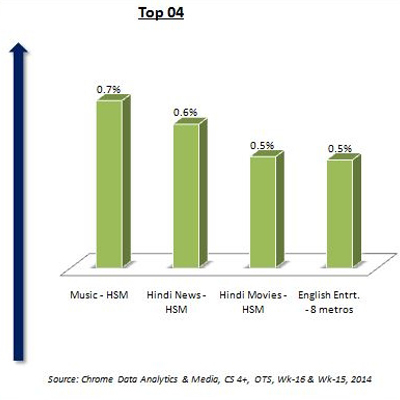
    MUMBAI: In week 16 of opportunity to see (OTS) data collated by Chrome Data, Analytics & Media, Music genre in the Hindi speaking market (HSM) was the chart topper.


    The genre gained 0.7 per cent with Sony Mix ruling the charts with 88.3 per cent OTS.


    The genre was closely followed with Hindi news channels with 0.6 per cent gain. ABP News continued to be on the top in the genre with 94.1 per cent OTS.


    Hindi movies weren’t far behind with 0.5 per cent gain. Star Gold in the HSM garnered 95.6 per cent OTS.


    English entertainment channels in the eight metros saw the gain of 0.5 per cent too. AXN continued to be on top with 70.7 per cent OTS.


    As for the bottom four, Sports genre across India saw the maximum drop of 1 per cent. Ten Sports with 76.3 per cent OTS topped the genre.


    Infotainment channels across the country dropped 0.5 per cent with Discovery channel gaining the most with 85.7 per cent OTS.


    English movies and Business news in the eight metros dropped 0.3 and 0.2 per cent, respectively. Pix with 75 per cent and Zee Business with 80.4 per cent OTS topped their respective genres.

  • E&M CEOs optimistic about global economy: PwC study

    E&M CEOs optimistic about global economy: PwC study

    MUMBAI: Continuing its trend of surveying top CEOs across the globe, PricewaterhouseCoopers (PwC) surveyed 1344 business leaders across 68 countries out of which 72 were media and entertainment CEOs in 33 countries to find out what exactly is their business sentiment for the coming years. In depth interviews were conducted with Interpublic Group’s Michael Roth, II Sole 24 Ore SpA’s Donatella Treu and SKYCITY’s Nigel Morrison. Some of the salient points of the study on entertainment and media (E&M) CEOs are:


    CEOs are confident of the company as well as global economy. 93 per cent (compared to 80 per cent in 2013) are somewhat or very confident in their company prospects for revenue growth in the next three years. They are also more optimistic about the global economy despite some concerns. 39 per cent of E&M CEOs believe that the global economy will improve in the next 12 months, compared to 20 per cent last year.


    CEOs have to be hybrid- run today’s business and create tomorrow’s business.


    Product and service innovation will provide the greatest opportunity for revenue growth and is likely to play a pivotal role in addressing their greatest concerns.  Over half of E&M CEOs surveyed (56 per cent) see product/service innovation as the main opportunity to grow their business in the next 12 months, more than any other industry surveyed


    71 per cent of E&M CEOs are somewhat or extremely concerned about shifts in consumer spending and behaviours, more than any other industry surveyed (and compared to a global total response of 52 per cent)


    65 per cent of E&M CEOs are somewhat or extremely concerned about the speed of technological change (compared to a total global response of 47 per cent)


    26 per cent E&M CEOs, more than any other industry surveyed, are extremely concerned about new market entrants.


    11 per cent of E&M CEOs believe that strategic alliances and joint ventures will be the main opportunity to grow their business in the next 12 months


    94 per cent of E&M CEOs rank technological advances as one of the top three global trends that will have the most transformative effect on their businesses over the next five years. This is more than any other industry.


    68 per cent of E&M CEOs rank demographic shifts as one of the top three global trends that will have the most transformative effect on their business over the next five years


    43 per cent percent of CEOs believe that as a result of regulation they haven’t been able to innovate effectively


    Pwc says in 2014 it forecasts that consumer spend on mobile Internet will overtake that from fixed broadband.

  • IPSOS Study: Watching ‘Live TV’ mainstay, but other forms of viewing catching on

    IPSOS Study: Watching ‘Live TV’ mainstay, but other forms of viewing catching on

    BENGALURU: Though a majority of Indians prefer watching ‘live TV’, other forms of content viewing such as streaming or downloading from a computer, internet TV, etc., are catching up reflect a new online poll of 15,551 adults in 20 countries conducted by Ipsos OTX – the global innovation centre for Ipsos, a global market and opinion research firm.


     “With so many new ways to view television programming, it might come as a surprise that 82 per cent of TV watchers in India still watch their shows “live on TV” – that is, on a regular television at the time they are programmed to appear. The indication, then, would be that television is still a prime venue for marketers to advertise,” said Ipsos in India head marketing communication, Biswarup Banerjee.


     “That is, of course, unless those couch-comfortable viewers are attached to their remote control devices and start surfing every time commercials come on or if they reach for their mute buttons when commercials are airing. What is clear is that while new televisions are capability-packed, most people watch TV as they are used to watching it – live,” added Banerjee.


    Most (82 per cent) Indian respondents who watch TV indicate they usually watch TV programming “live”, although other popular modes of watching are catching on like streaming or downloading from a computer (40 per cent), streaming from the internet to TV (23 per cent), using a DVR or other recording device attached to a TV (16 per cent), and on mobile device (21 per cent) says the study.


    Traditional ‘live’ TV watching is significantly more popular among Indian respondent’s ages 50-64 (89 per cent) compared to those 35-49 (88 per cent) and under 35 (76 per cent). Other modes of watching TV programming are more popular among younger respondents: on computer and laptop – under 35 (35 per cent), 35-49 (25 per cent), 50-64 (17 per cent); streaming from the internet – under 35 (20 per cent), 35-49 (16 per cent), 50-64 (11 per cent); on mobile device – under 35 (15 per cent), 35-49 (10 per cent), 50-64 (5 per cent). Using a DVR or other recording device attached to a TV is most popular with those 50-64 (18 per cent) compared to 35-64 (16 per cent) and under 35 (15 per cent).


    TV watching across geographies

    Live TV

    Those most likely to choose watching TV programming on live TV are from France (93 per cent), Spain (93 per cent), Germany (92 per cent), Turkey (90 per cent), Argentina (89 per cent), Sweden (89 per cent), and Australia (89 per cent). Those rounding out the middle of the pack are from: Brazil (89 per cent), Italy (89 per cent), South Korea (87 per cent), Great Britain (83 per cent), Mexico (82 per cent), Poland (82 per cent), and India (82 per cent). Those least likely to watch TV programming live are from: Japan (82 per cent), Russia (81 per cent), South Africa (81 per cent), United States (81 per cent), China (80 per cent), and Canada (77 per cent).


    TV on computer or laptop

    Watching TV on computer or laptop is chosen most often by those from: China (52 per cent), Russia (43 per cent), Turkey (42 per cent), India (40 per cent), Sweden (35 per cent), South Korea (31 per cent), and Great Britain (29 per cent). Those clustering around the center of the list are from: Poland (27 per cent), South Africa (26 per cent), Canada (26 per cent), Germany (24 per cent), Mexico (24 per cent), Spain (23 per cent), and Brazil (21 per cent). Those from Argentina (20 per cent), the United States (20 per cent), Australia (19 per cent), Italy (17 per cent), Japan (14 per cent) and France (12 per cent) are least likely to watch TV on computer or laptop.


    Streaming from the internet

    Streaming from the internet to TV is most popular among those in Turkey (44 per cent), Russia (36 per cent), China (33 per cent), South Korea (25 per cent), India (23 per cent), Sweden (19 per cent), and Great Britain (17 per cent). Those in the middle of the pack are from: Canada (17 per cent), the United States (17 per cent), Brazil (15 per cent), Mexico (13 per cent), Spain (12 per cent), Italy (11 per cent), and Australia (10 per cent). Those from South Africa (9 per cent), Argentina (9 per cent), Poland (7 per cent), Germany (5 per cent), France (5 per cent), and Japan (3 per cent) are least likely to choose streaming from internet to TV.


    DVR or other recording devices attached to a TV

    Those who are most likely to use a DVR or other recording devices attached to a TV are from Japan (45 per cent), the United States (40 per cent), Canada (32 per cent), Great Britain (31 per cent), South Africa (27 per cent), and Australia (25 per cent). Those in the middle of the pack are from Poland (18 per cent), India (16 per cent), Germany (11 per cent), France (11 per cent), China (10 per cent), Mexico (9 per cent), and Sweden (8 per cent). Respondents from Turkey (7 per cent), Brazil (7 per cent), Spain (7 per cent), Italy (7 per cent), Argentina (6 per cent), South Korea (5 per cent), and Russia (4 per cent) are least likely to use a DVR or other recording devices.


    TV on mobile device

    Watching TV programming on mobile device is most popular among respondents who are from South Korea (26 per cent), China (25 per cent), India (21 per cent), Turkey (20 per cent), Mexico (13 per cent), Great Britain (12 per cent), and Sweden (12 per cent). Those in the middle are from the United States (10 per cent), Australia (9 per cent), Spain (9 per cent), Brazil (8 per cent), Canada (7 per cent), South Africa (7 per cent), and Italy (7 per cent). Least likely to watch TV on mobile device are respondents from Argentina (7 per cent), Japan (6 per cent), Poland (5 per cent), Russia (5 per cent), Germany (4 per cent), and France (4 per cent).

  • VoIP services market revenues to rise to $88 billion by 2018: Infonetics

    VoIP services market revenues to rise to $88 billion by 2018: Infonetics

    NEW DELHI: The global business and residential VoIP services market rose eight per cent in 2013 to $68 billion and are expected to yield a revenue of $88 billion by 2018.


    According to Infonetics Research, SIP trunking increased 50 per cent in 2013 from the prior year, driven predominantly by activity in North America.


    Infonetics Research says EMEA is expected to be a strong contributor for SIP trunking business in 2014.


    “Business VoIP services have moved well beyond early stages to mainstream, strengthened by the growing adoption of SIP trunking and cloud services worldwide. Hosted unified communications are seeing strong interest up market as mid-market and larger enterprises evaluate and move more applications to the cloud, and this is positively impacting the market,” said Infonetics Research principal analyst for VoIP, UC, and IMS Diane Myers.


    Sales of hosted PBX and unified communication (UC) services increased 13 per cent in 2013, and seats grew 35 per cent due to continued demand for enterprise cloud-based services, the report said.


    Global residential VoIP subscribers increased eight per cent to 212 million in 2013.


    Infonetics Research says managed services are benefitting from the continued adoption of IP PBXs: Roughly 10 per cent–20 per cent of new IP PBX lines sold are part of a managed service or outsourced contract.