Category: Research

  • Indian M&E sector increasingly victimised: Ernst & Young

    Indian M&E sector increasingly victimised: Ernst & Young

    MUMBAI: In the last two years, the Indian Media and Entertainment industry has seen a stark increase in fraud related cases that have contributed to a major loss in profits as well as increased costs according to EY’s Media and Entertainment (M&E) Fraud Survey 2014.


    Commenting that the Indian M&E sector has been increasingly victimised, EY partner, fraud investigation and dispute services Mukul Shrivastava said, “Being on an upward trajectory, the Indian M&E sector is increasingly victimised by the growing challenges around governance breakdowns and unethical practices. This has led to extensive losses (monetary and reputational), sub-par performance and arrested development.”


    Of the total respondents, approximately 98 per cent said that unethical practices had led to a major loss in profits and at the same time had increased costs. One out of six respondents also said that they had seen an increase in fraud within their organisations.


    Another serious issue that the survey reported was false invoicing and overbilling. Shrivastava went on to add that “In light of the changing industry dynamics, organisations will have to improve vigilance, boost internal controls and raise compliance benchmarks for sustainable growth.”


    An astonishing 57 per cent of the respondents are yet to set up a whistle blowing mechanism within their organisations and 41 per cent do not have much knowledge about anti corruption laws and regulation laws.


    EY India M&E sector leader Farokh Balsara said, “As companies in the M&E sector increase in size and move from unorganised to organised operations, the need for proactive fraud prevention has increased. The adoption of an ethical business conduct and sound governance policies will play a crucial role in determining its true success.”


    The report also outlined ways for organizations in preparing a strong fraud management programme through regular training, awareness programmes, interactive sessions with case studies and scenarios.


    The survey features insights of companies with domestic operations as well as multinational corporations. It also reveals content distribution and TV/film content production, finance and advertisement sales functions as particularly vulnerable areas.

  • GroupM forecasts ad spends to reach $560 billion by 2015

    GroupM forecasts ad spends to reach $560 billion by 2015

    MUMBAI: WPP’s GrpupM is out with its biannual ‘This Year, Next Year’ report forecasting the global advertising investments.

    As per the report the ad spends will reach $534 billion in 2014, a 4.5 per cent increase over 2013. The company predicts investments in 2015 rising an additional 5 per cent to $560 billion.

    In further says that globally, ad recovery is localised, with 17 markets accounting for 93 per cent of expected ad growth in 2014. Even at its moderate 3.4 per cent rate of ad investment growth this year to $162 billion, the US contributes fully one-quarter of incremental ad dollars. China ranks second as it climbs a predicted 9.8 per cent to $76 billion. Other countries making the cut include Nigeria, Kenya and Vietnam.

    “Many companies are still operating with very strong balance sheets,” said GroupM Global president Dominic Proctor. “Coupled with a rising general confidence and a specific comfort around digital marketing, though notwithstanding some geo-political uncertainty, we are seeing an uplift in some of the ‘older economies’ as well as the new.”

    Of marketplace performance, ‘This Year, Next Year’ report editor Adam Smith stated, “Despite the slowdown in China’s general economy from 2012, its consumer economy continues to expand. This, plus intensive digitisation of advertising, keeps China ad investment rising at or near double-digits, with no large print legacy to correct.”

    It is a different story in Western Europe, where 73 per cent of the regional economy is in the Eurozone, where demand remains suppressed by debt, internal imbalances and deflationary politics. In real terms, the Eurozone remains 20 per cent below its 2007 advertising peak, and the hardest-hit ‘periphery’ of Greece, Ireland, Spain, Italy and Portugal, 47 per cent below the peak.1

    Smith added, “Western Europe, however, is the most-digitised ad region in the world; though this may finally be maturing to judge by digital ad investment growth slowing from double- to high-single digits in 2014 and 2015.”

    Western Europe also has the world’s most print-heavy advertising, though here too, the downward adjustments to annual advertising investment are moderating from double- to mid-single-digits in 2014 and 2015.    

    Elsewhere, GroupM notes that some members of its south-east Asia group (Indonesia, Malaysia, Thailand, Philippines, Singapore and Vietnam) face political and economic challenges, and this year will collectively slip from double- to mid-single digit ad growth.

    “This group will still contribute to the global ad recovery, but we are on alert for central banks ‘tightening into the downturn’ if inflation becomes a problem,” said Smith.

    India, Brazil and Russia remain among the faster-growing ad markets, though GroupM warns that its reduced Russia forecast – from an annual run-rate of 10 per cent to 6 per cent — depends on no worsening in domestic affairs. 

  • UK TV industry sees revenue growth: Ofcom report

    UK TV industry sees revenue growth: Ofcom report

    MUMBAI: The Communication Market 2014 report of Ofcom, an independent regulator and competition authority for the UK communications industries, highlights that TV industry generated ?12.9 billion in revenue during 2013, an increase of ?426 million (3.4 per cent).


    The increase was driven by growth in subscription revenues and net advertising revenues. However, there was a small decline in publicly-funded television programming in 2013, following an eventful year in 2012, including the London Olympic and Paralympic Games.


    The report examines the key developments and trends seen in the UK television market during the past year. Some of them include:


    Pay-TV subscription revenue continues to drive the growth as subscription revenues increased by 6.7 per cent in 2013 to reach almost ?5.9 billion. Subscriptions now account for 46 per cent of all television industry revenues in the UK.


    As far as broadcast-based TV advertising income is concerned, it returned to growth in 2013, increasing by 4 per cent (or ?146 million) to reach almost ?3.7 billion, its highest level in the past five years. The largest proportional growth was in the commercial PSBs’ portfolio channels, where revenues increased by 14 per cent to reach a combined total of ?669 million.


    Online TV revenue saw an increase of 41 per cent in 2013 to reach ?364 million. The subscription model saw the steepest growth; revenue rose by 76 per cent to ?112 million, possibly indicating that online streaming services are gaining traction in the UK market.


    Spend on content by all UK TV channels rose by 3.7 per cent to reach ?5.8 billion. In a year  of English Premier League broadcast rights renewal, spend on sports programming grew by 19 per cent to reach ?1,808 million or 59.1 per cent of all programme spend on commercial non-Public service broadcasting (PSB) channels. Spend on BBC digital channels and the other PSBs’ portfolio channels also increased, rising by 6 per cent and 4 per cent, respectively. However, spend on first-run originated programming for the main five PSB channels declined by 5 per cent; from ?2,588 million in 2012 to ?2,451 million in 2013, partly due to there being no major sporting events that year.


    In Q1 2014, 12 per cent of TV households had a smart TV, an increase of five percentage points on the previous year. Among smart TV owners, use of the internet functionality is increasing. 82 per cent used the internet connection on their TV in 2014 compared to 77 per cent in 2013 and 65 per cent in 2012.


    Nonetheless, the TV viewing has remained resilient, although there was a decline in 2013 across all age groups. According to broadcaster audience research board (BARB), average viewing dropped from 241 minutes in 2012 to 232 in 2013 among all individuals, with all age groups experiencing declines. This may be due in part to changing media habits, but it might also have been influenced by the hotter summer in 2013 and a lack of ‘event’ viewing – in previous years viewing was boosted by major sports events such as the 2010 Football World Cup or the Olympic Games in 2012. However, among 16 to 24 year olds viewing has declined for three consecutive years: from 169 minutes in 2010 to 148 in 2013.


    Click here to read the finer details

  • Chrome Data: Week 31 sees only one gainer

    Chrome Data: Week 31 sees only one gainer

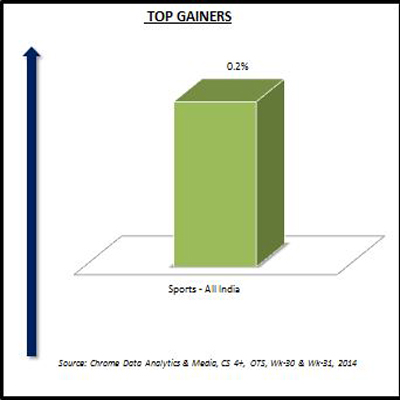
    MUMBAI: The week 31 of opportunity to see (OTS) for the data collated by Chrome Data Analytics & Media saw only one gainer.


    The sole gainer of the week, Sports, across India jumped 0.2 per cent. Ten Sports ruled the genre with 73.5 per cent OTS.


    As for the top losers, English News channels in the eight metros dropped 1.9 per cent. Times Now continued its reign with 86.8 per cent OTS.


    Religious channels and Hindi GECs in the Hindi speaking markets (HSM) dropped 0.9 per cent. Aastha with 96.5 per cent OTS and Star Plus with 97.9 per cent OTS, topped their respective genres.


    English Entertainment channels in the eight metros followed suite with 0.8 per cent drop. AXN with 70.6 per cent OTS ruled the charts in the category. 

  • APAC digital subscribers to reach 503 million by 2018: MPA

    APAC digital subscribers to reach 503 million by 2018: MPA

    MUMBAI: Media Partners Asia (MPA) has come out with its report on the Asia Pacific pay-TV and broadband market for the next five years. It predicts that DTH satellite pay-TV customers in Asia are expected to grow from 56.3 million in 2013 to more than 110 million by 2018, a CAGR of 14 per cent.


    The report titled ‘Asia Pacific Pay-TV and Broadband Markets 2014’ states that by 2023, DTH’s share of the total pay-TV market will nearly double to 24 per cent as the customer base reaches 150.4 million. Meanwhile, HD DTH subscribers will increase from 10.4 million in 2013 to 37.3 million by 2023, driven by high growth in India and China as well as steady growth in Japan, Korea and Southeast Asia.


    DTH subscription revenue is expected to grow at a five year CAGR of 9 per cent to $ 12.3 billion by 2018 and $ 15.2 billion by 2023. It also predicts that the market for DTH pay-TV will further consolidate as growth converges across fewer operators in markets such as India and Indonesia. In markets such as Thailand, DTH pay-TV is struggling as free DTH services have started to breed, penetrating 60 per cent TV homes. One such is Free Dish that will prove to be important to digitisation in rural and smaller towns.


    The APAC pay-TV market will grow at a 10 per cent CAGR between 2013 and 2018. This will be enhanced by the subscriber jump from 312 million in 2013 to 503 million by 2018 while digital penetration of pay-TV homes expands from 62 per cent to 83 per cent.


    Commenting on the findings, MPA executive director Vivek Couto said, “We see operating leverage growing for market leaders in India, Indonesia and Malaysia in particular as well as long-term upside from strategic recalibration in Australia and New Zealand. Better monetisation in the Philippines should help the market leader properly scale its DTH business and take it to the next level. We also predict incremental growth and value in Vietnam.”


    The report states that among maturing markets, Malaysia is a leader with Astro as one of the most innovative operators in the world, good at increasing both subscriber growth and ARPUs as well as investing in product innovation. DTH ops in Australia and Japan continue to face headwinds. Hybrid DTH-IPTV distribution has helped sustain KT SkyLife’s proposition in Korea.


    In India, broadband is a long term consideration even though all the top four DTH operators are looking at mobile partnerships and wireless broadband strategies.


    IP-based distribution and broadband delivery is a challenge for DTH networks which are adapting to these realities to reduce long-term challenges. In Korea, the KT SkyLife combination retails triple play services. In Indonesia, MNC group that owns MNC Sky Vision (MNCSV) plans to rollout a bundle of IPTV and fiber-based broadband services and merge them with MNCSV.  In Malaysia, Astro has adapted to IPTV partnerships but with slow progress. In Philippines, Cignal has also embraced hybrid IP delivery.

  • Chrome Data: Week 30 sees growth in 8 cities

    Chrome Data: Week 30 sees growth in 8 cities

    MUMBAI: Once again the opportunity to see (OTS) numbers collated by Chrome Data Analytics & Media saw an upward peak.


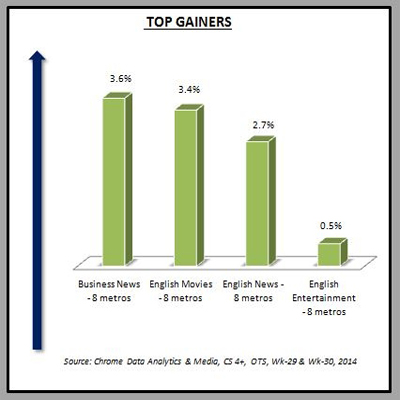
    Week 30 saw maximum growth in the eight metros. Business News with 3.6 per cent topped the chart followed by English Movies with 3.4 per cent. Zee Business with 82.2 per cent OTS and Sony Pix with 73.7 per cent OTS were the top gainers in their respective genres.


    English News saw a jump of 2.7 per cent with Times Now continuing its reign in the category with 86.9 percent OTS. English Entertainment channels with 0.5 per cent too saw a minor jump in its genre. AXN with 70.1 per cent OTS was the chart topper.


    On the other hand, Religious channels in the Hindi speaking market (HSM) fell 1.5 per cent. Aastha with 96.8 per cent OTS continued its supremacy in the genre.


    Hindi News dropped by 1 per cent in the HSM with ABP News ruling the category with 95.9 per cent OTS.


    Across India, Kids channels and Sports channels dropped 0.7 per cent and 0.6 per cent, respectively. Cartoon Network with 85.6 per cent OTS and Ten Sports with 74.9 per cent OTS, both topped their respective genre.

  • Only 70 per cent of the Indian pay-TV market will be digitised by 2023: MPA report

    Only 70 per cent of the Indian pay-TV market will be digitised by 2023: MPA report

    MUMBAI: The process of digitisation in India currently seems to be stuck in limbo. Even with several deadlines being set, the country doesn’t seem to have progressed much even in digital addressable systems (DAS) phase II, let alone phases III and IV. A new report from Media Partners Asia (MPA) has predicted key findings about the cable and DTH industry in India between 2013 and 2023.


    It expects the next five years to be a period of robust growth of India’s pay-TV market. MPA projects that the pay TV industry in the country will grow from $7.4 billion in revenue in 2013 to $12.3 billion by 2018.


    The growth in revenue will be equal to an average annual growth rate of 11 per cent between the years 2013 to 2018. By 2023, it expects the industry to generate revenues of approximately $ 16.4 billion. The findings by MPA were published in the report ‘India Pay-TV and Broadband-Future Trends’.


    The study states that by the end of 2013, India had approximately 65 million paying digital subscribers. MPA projections indicate that only 70 per cent of the Indian pay-TV market will be digitised by 2023.


    The total number of TV households in India is currently pegged at around 160 million with nearly 20 million on terrestrial only. This will be the growth opportunity for alternative platforms as cable and DTH will find it unviable to penetrate into the interiors of the country. The Ministry of Information and Broadcasting (MIB) has given a deadline of 31 December 2014 for completion of digitisation. If one goes by the MPA report, India has a long way to go for 100 per cent digitisation.


    From 2015 to 2017 will see an upward trend as DAS will take off in phase III and IV areas. After 2017, the time will be for consolidation and monetisation as subscriber growth will decelerate.


    While the growth during 2009 to 2013 was driven by volume, the next five years will be led by average revenue per user (ARPU). At the end of the 2018, pay TV subscribers will hit 165 million and by 2023, it will be 180 million. This implies a long term penetration of 80 per cent.


    The growth will also give wide space for alternative platforms such as Doordarshan-owned Free Dish, headend-in-the-sky (HITS) and over-the-top media (OTT) apart from cable and DTH, which will address the need gap between TV households and pay TV subscribers.


    DTH industry revenues are expected to reach $4 billion by 2018 and $5.5 billion by 2023. This will be due to healthy subscriber additions from 2014 to 2016 and by improved churn and suspension management. The active DTH subscriber base is expected to grow from 37 million in 2013 to 60 million by 2018 and 70 million by 2023. Thus, DTH will have a 39 per cent share of the pay-TV market by 2023 and 56 per cent share of the digital market.


    MPA predicts that the total digital cable subscribers will be 50 million by 2018 and 55 million by 2023. Digital cable conversion will shoot up from 29 per cent in 2013 to 48 per cent by 2018 and 50 per cent by 2023. This will enable growth in cable broadband. It expects share of cable in the fixed broadband market to grow from 6 per cent to nearly 15 per cent from 2013 to 2023.


    The projected total pay-TV channel revenues for broadcasters, including advertising and subscription will grow from $3.3 billion in 2013 to $6 billion by 2018 and $8.3 billion by 2023.


    Meanwhile the pay-TV ad market is expected to grow at 8.6 per cent CAGR over 2013 to 2023 while broadcaster subscription revenues are expected to grow at 11.3 per cent over the same period. This will be due to improved macro-economic conditions, sub-segmentation of existing genres and new advertiser categories.


    “The Indian market is important because of its accessibility for global media distributors and investors and its high levels of pay-TV penetration. Ever changing regulations are destabilising but the government’s DAS mandate will be an important catalyst while improved supply side factors, including healthy financial markets and investments from international strategists are also critical,” says MPA India VP Mihir Shah.

  • India to add maximum satellite TV revenues and subscribers by 2020: Report

    India to add maximum satellite TV revenues and subscribers by 2020: Report

    MUMBAI: A report released by Digital TV Research has thrown some light on how satellite TV revenues will change between now and 2020. The report, that covers 138 countries, estimates that Asia Pacific and Latin America will show strong growth, while western Europe will witness a fall in revenue. This will be due to increased competition from other platforms.

    Satellite TV revenues for all these countries are estimated to hit $ 99.9 billion in 2020, up from $87.8 billion in 2013 and $69.3 billion in 2010. It also predicts that satellite TV revenues will overtake cable TV revenues in 2014. Therefore, satellite TV will comprise 46 per cent of total pay TV revenues in 2014, rising to 47.8 per cent by 2020.

    Even though the US will remain as the leader in revenue generation, India is expected to add the most satellite TV revenues between 2013 and 2020 ($3.2 billion, tripling its total). This is followed by Latin American country Brazil with $1.6 billion and the US with $1.5 billion. In more than 44 countries, revenues will more than double.

    The top five revenue generators in the year 2020 will be the US with $40,570 (up from $39,034 in 2013), Brazil with $7,634 (up from $6,084 in 2013), UK with $5968 (down from $6,124 in 2013), India will add $4,704 and Mexico with $4,204 (up from $3,762 in 2013).

    Report author Simon Murray said: “Satellite TV revenues will decline for 19 countries between 2013 and 2020. Much of this is due to greater competition forcing satellite TV platforms to offer cheaper packages which will lead to lower ARPUs. Furthermore, low-cost satellite TV packages are making a significant impact in several countries.”

    The total number of pay satellite TV homes will be 271 million by 2020, up from 192 million by end of 2013 and 143 million by 2010 end. It also states that out of the expected 78.5 million subscribers that will be added between the years 2013 to 2020, maximum will come from India-27.7 million. This will be followed by Brazil trailing at 5.8 million and Indonesia with 5.4 million.

    Pay TV subscriber total will more than double in 47 countries but will fall in 13 countries. India will lead in the total number of pay satellite TV homes in 2020 with 69.2 million for which it toppled the US in 2012.  India will be followed by Russia and Brazil. Together, India, US, Brazil and Russia will account for just over half the global total by then.

    439 million homes will directly receive TV signals via satellite dishes, up by 100 million by end of 2013. More than a quarter of global TV households will have satellite dishes by 2020, up from 18.3 per cent in 2010 and 22.3 per cent in 2013.

  • Chrome Data: Only two genres see a jump in week 29

    Chrome Data: Only two genres see a jump in week 29

    MUMBAI: After seeing a peak in opportunity to see (OTS) of various genres collated by Chrome Data Analytics & Media, week 29 didn’t see much rise.


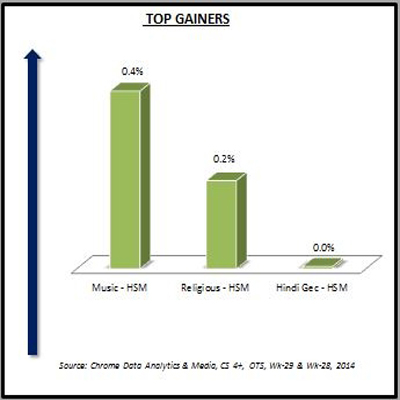
    Only two genres namely music and religious channels in the Hindi speaking markets (HSM) saw a jump of 0.4 per cent and 0.2 per cent, respectively.


    Sony Mix continued ruling the charts in the genre with 87.9 per cent OTS. Similarly, Aastha channel with 95.9 per cent OTS topped the genre.


    The week saw steep drops with English Entertainment channels in the eight metros with 4.3 per cent drop in the genre. AXN with 70.4 per cent OTS maintained its rein in the category.


    Business News in the eight metros followed with 3.5 per cent drop. However, Zee Business remained on top with 76.8 per cent OTS.


    English Movies with 2.6 per cent and English News with 2.3 per cent too saw a drop in the eight metros. Movies Now with 72.9 per cent OTS and Times Now with 85.2 per cent OTS topped their respective genres.

  • USD 1 trillion to be spent on telecom and datacom over next 5 years

    USD 1 trillion to be spent on telecom and datacom over next 5 years

    NEW DELHI: The Asia Pacific region has shown major growth of six per cent year-over-year in the telecom/datacom equipment and software revenue as against 4.5 per cent by North America.


    This trend is expected to continue through at least 2018, Market research firm Infonetics Research says. It also projects a cumulative $1.01 trillion will be spent by service providers and enterprises on telecom/datacom gear and software over the five years from 2014 to 2018.
     

    Sales of telecom and datacom equipment and software came globally to $183 billion in 2013, three per cent above the previous year.
     

    According to research data from its 2014 Telecom and Datacom Network Equipment and Software report, Infonetics says the overall telecom and datacom network equipment and software market share leaders are in rank order: Cisco, Huawei, Ericsson, Alcatel-Lucent and ZTE – the same top five vendors with virtually the same shares as the year prior.


    Vendor share positions also held steady in the enterprise segment, with Cisco in the driver’s seat and followed distantly by tightly bunched Avaya, Brocade, HP, and Juniper (listed in alphabetical order).
          

    Infonetics Research principal analyst Jeff Wilson said: “Despite the fact that enterprises and service providers are in the middle of massive network upheavals due to the evolution of software-defined networking (SDN) and network functions virtualisation (NFV) technology, the telecom and datacom networking equipment and software market is on track to grow annually through 2018 with the fastest growth coming in 2015.”
     

    Infonetics co-founder and co-author of the report Michael Howard added: “Looking at just the service provider equipment space, we’re seeing a shakeup in vendor market share, with Huawei leapfrogging longtime number-one Ericsson to take the top spot in 2013. While Huawei’s been doing well in a number of regions, China’s economy is a key factor keeping Huawei’s growth so strong.”
     

    The report has compiled worldwide and regional market size, vendor market share, and forecasts through 2018 from all of its reports that track enterprise and service provider gear. It is the majority of all data networking and telecom equipment for service providers, cable companies, and small, medium, and large organisations, excluding consumer electronics.

    The 11 major categories of equipment and software tracked in Infonetics’ report include broadband aggregation; broadband CPE; pay TV; optical network hardware; carrier routing, switching, and Ethernet; service provider VoIP and IMS; service provider mobile/wireless infrastructure; service enablement and subscriber intelligence; security; enterprise and data center networks and enterprise communications. Companies tracked include Alcatel-Lucent, Avaya, Brocade, Ciena, Cisco, Ericsson, Fujitsu, HP, Huawei, Juniper, Motorola, NEC, Nokia, Samsung, Siemens, ZTE, and many others.