Category: Research

  • 900 MHz spectrum expected to sell for four times the reserve price: HSBC Research

    900 MHz spectrum expected to sell for four times the reserve price: HSBC Research

    NEW DELHI: Government proceeds are expected to be $ 9 billion from the upcoming spectrum auctions, 20 per cent higher than the government’s own estimates, according to a study by HSBC Telecom and Media Global Research.


    The research also says that it is possible that in a few markets the cost for 5 MHz of 900 band may exceed the 3G prices as well.  


    The estimates are 1.4 times higher than the reserve price recommended by the Telecom Regulatory Authority of India (TRAI) for 900 MHz spectrum band. For 1,800 MHz band, the estimates are 1.2 times of the reserve price suggested by TRAI, the report adds.


    Demand for data spectrum is likely to be a key driver in the upcoming spectrum auctions, if one goes by earlier auctions. At present, the two top players who are better placed to add more spectrums – Idea and RCOM – are likely to be more defensive, according to the study.

    It further noted that there is uncertainty for both investors and operators whenever there is talk of spectrum auction.


    The spectrum auction earlier this year saw an unexpected contest for 1,800 MHz spectrum as the entry of pure 4G players forced incumbent operators to add 4G spectrum selectively, stated the research paper.


    Moreover, it added that the most interesting trend has been robust data revenue growth (data revenue growth in FY14 was 90 per cent year on year for the top three players).


    “While this is positive, it raises the need for additional capacity spectrum (incumbent telcos are already talking about congestion particularly in metro markets with 20 per cent to 30 per cent of their BTS). Operators have so far been highlighting the need to add data footprint but in the markets where they have 5MHz of spectrum, and it will be important for them to get to 10MHz sooner than later (over the next couple of years) to accommodate data growth,” the research revealed.


    The study has found that ‘doubling of spectrum will more than double the throughput for telcos and in turn allow them to benefit from lower per unit costs as well with doubling of spectrum.’ 

    The need for capacity spectrum, the study said, is likely to drive prices up for spectrum in the upcoming auctions.  


    While both Bharti and Idea face auctions in some of their key markets, the latter has more exposure in the upcoming auctions versus Bharti. The study says this implies that telco Idea is likely to focus more in retaining spectrum in existing markets.


    On the other hand, the top two players Bharti and Vodafone could look at adding more spectrum in the 900 band, according to the report. HSBC was positive on Bharti with a target price (TP) of Rs 481 and Neutral on Idea Cellular with a TP of Rs 172. The key downside risk for Bharti will be losing spectrum in the 900 MHz band.  The key upside risk for Idea will be the release of additional data spectrum and the key downside risk will be losing spectrum in the 900 band. The study is somewhat negative on RCOM with TP of Rs 100 and the key upside risk for them will be ability to benefit from spectrum trading. 

  • Automotive brands struggle to differentiate themselves in India

    Automotive brands struggle to differentiate themselves in India

    MUMBAI: The automobile industry of India has always been a favourite among consumers, but according to the recent JD Power Asia Pacific 2014 India Brand Influence and Positioning Study (BIPS), very few automotive brands in the intensely competitive India passenger-car market are able to establish a distinct position in car buyers’ minds.


    In India, brands with the highest brand influence scores (on a 1,000-point scale) are Maruti Suzuki (837), Hyundai (758), Toyota (729), Honda (723) and Tata (703), while Mitsubishi (565) and Fiat (586) are amongst brands with the lowest influence.


    According to the study, strong brand influence may have a positive effect on purchase intent for a particular brand, as brand influence scores correlate highly with brand consideration rates. The study also segments the market using psychographic, demographic and behavioral attributes to help automakers identify and understand who their best prospects are in the new-car market.


    “Brand image and reputation have gained significant importance over the last five years for consumers in the Indian auto industry and are key purchase criterion,” said JD Power Asia Pacific Singapore executive director Mohit Arora. “Brand Influence scores measure the impact a brand has in the market, which is critical for automakers to track and measure,” he aaded.


    As per the report, in the Northern and Eastern regions of India consumers in India have substantial difficulty distinguishing between many of the larger European and US automotive brands such as Fiat, Ford and Renault. In contrast, Japanese brands, such as Honda and Toyota, are able to more effectively differentiate themselves from other brands.


    Despite its Japanese origin, consumers view Maruti Suzuki as an Indian brand, less modern than other brands but distinctly positioned as offering affordable and fuel-efficient cars. Similar to Maruti Suzuki, Tata is also seen as a brand primarily positioned on affordability and fuel efficiency.


    Consumers in India perceive these Japanese brands to be more contemporary, offering the latest technology and engineering and perceive them to have a more global image than their European, Korean and US counterparts.  


    Explaining the brand positioning, Arora elaborated, “Understanding their current positioning relative to the competition from a consumer’s perspective as well as the type of messaging themes that appeal most to a target segment helps automotive manufacturers sharpen their marketing efforts. Generally, consumers are able to differentiate more effectively on vehicle features they can see, touch and feel than on intangibles.”


    The 2014 India Brand Influence and Positioning Study is based on interviews with 8,009 car owners who have owned their vehicles from 30 to 42 months and who were asked to compare two vehicle brands. The study was fielded from January through April 2014 across 30 cities in India, a period when Indian car industry was at an all time low in sales and spirit.

  • Luxury goods market in India on a lower growth curve

    Luxury goods market in India on a lower growth curve

    MUMBAI: As the global economy recovers, the luxury industry is growing accordingly. Not unexpectedly, growth is disproportionately focused on the Asia Pacific region.


    In 2012, India had the fastest growing luxury markets in the region. The country grew much faster than China, but lost steam due a lack of sustenance of the growth, which once made the country an attractive market. Today, the Indian luxury goods market appears to be on a lower growth trajectory as pointed out in the Deloitte Touche Tohmatsu (DTTL) first annual report on ‘Global Powers of Luxury Goods’.


    “The entire luxury goods market in India has seen a significant dip in the growth rate and is likely to see a couple of more turbulent years. However, the long term outlook remains positive and India’s luxury market is expected to rise with a strong performance. To supplement this long term growth trajectory, holistic implementation of new reforms and initiatives by stakeholders and regulators would only facilitate the vision” said Deloitte senior director Gaurav Gupta.


    The report says that the very rapid growth of recent years have created a bottle neck leading to inflation this has caused the central bank to tighten its monetary policy to control inflation and stabilise the currency; hence, further slowing the booming market. From the regulatory side, there was not much of a focus to implement reforms that could boost productivity, unleash, more investment and induce a faster growth rate in the sector.


    ‘Global Powers of Luxury Goods’ highlight the fact that along with Indian markets, many emerging markets like China, Brazil and Russia have seen deceleration of growth in the past year. This follows a period of rapid growth that was driven by several factors. Going forward, the emerging world is likely to have a year or two of disappointing growth while imbalances are unwound. However the long term view remains positive.


    In the last five years the expanding global middle class in the emerging markets has supported growth in the luxury sector and is continuing to grow through 2018. According to Euromonitor the emerging markets like Asia Pacific, Latin America, Middle East and Africa combined together accounted to 9 per cent of the luxury market in 2008 these figures spiked to 19 per cent in 2013 and is expected to leap up to 25 per cent in 2025.


    The developed economies like US and Europe benefits from the emerging markets. Over the 2012 to 2017 Euromonitor projects China to lead the tourist expenditure growth followed by India and the other emerging Asian countries. The appetite for American and European brands in the underpenetrated markets is strong and growing many luxury companies to expand its international presence hence creating opportunities in emerging markets like India.


    The world’s 75 largest luxury goods company generates total goods sales of $171.8 billion. Three of the top ten companies are conglomerates.

  • Entertainment and media industry to double in five years

    Entertainment and media industry to double in five years

    MUMBAI: India’s entertainment and media industry is expected to double and grow to over Rs 2,27,000 crore by 2018 from Rs 1,12,044 crore in 2013, according to a report by industry body Confederation of Indian Industry (CII) and professional services firm PwC.


    “The industry growth is expected on account of healthy growth in areas like advertisement and television industry,” the report – India Entertainment & Media Outlook 2014 predicted.


    In 2013, the broad entertainment and media industry, anticipated to be Rs 1,12,044 crore rose 19 per cent over the preceding year. The film segment was estimated at Rs 12,600 crore in 2013 and is projected to grow steadily at a CAGR of 12 per cent, on the back of higher domestic and overseas box-office collections as well as cable and satellite rights.


    Internet access and internet advertising were the fastest growing segments in 2013, clocking growth rates of 47 per cent and 26 per cent respectively over the previous year. The report added that the companies in the sector will need a business strategy fit for the digital age. The industry needs to get even closer to the consumer and adopt more flexible business models.


    “The revenue from advertising is expected to grow at a CAGR of 13 per cent and will exceed Rs 60,000 crore in 2018 from Rs 35,000 crore in 2013. Internet access has overtaken the print segment as the second-largest segment contributing to the overall pie of entertainment and media sector revenues,” it said. 


    Television and print are expected to remain the largest contributors to the advertising pie in 2018 as well. Internet advertising will emerge as the third-largest segment, with a share of about 16 per cent in the total entertainment and media advertising pie, as per the estimates.


    PwC India Entertainment and Media practice leader Smita Jha said, “Digital success does not just necessarily mean better, improved technology. It means applying a digital mindset to build the right behaviours among industry stakeholders. This includes getting ever closer to the customer–across the entire organisation, and in everything it does.”


    With the rapidly increasing mobile usage, the gaming sector is also emerging as a promising source of revenue for the industry. Efforts by industry players as well as support from the government are expected to provide a major boost to the gaming sector, which is still in its infancy.


    Out-of-home advertising is gradually expected to slide to the last position in terms of revenue contribution to the sector, with its share declining to 1 per cent in 2018, while music remains constant at 1 per cent revenue share between 2013 and 2018.

  • Chrome Data: week 36 sees a minor rise

    Chrome Data: week 36 sees a minor rise

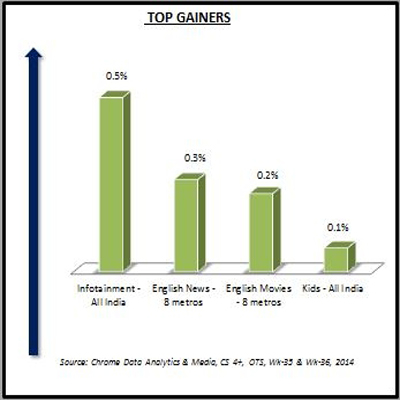
    MUMBAI: The week 36 of opportunity to see (OTS) collated by Chrome Data Analytics & Media saw unnoticeable jump in various genres.


    Infotainment channels across India saw 0.5 per cent rise with Discovery Channel topping the genre with 86.6 per cent OTS.


    English News channels with 0.3 per cent and English movies with 0.2 per cent rose in the eight metros. Times Now with 85.6 per cent OTS and Pix with 74.5 per cent OTS topped their respective categories.


    All India, Kids genre jumped 0.1 per cent with Cartoon Network ruling the roost with 79.6 per cent OTS.


    Meanwhile, Hindi movies in the Hindi speaking market (HSM) dropped 1.8 per cent. Max with 97.1 per cent OTS topped the chart.


    Business News with 1.3 per cent and English Entertainment with 1.2 per cent saw downward trend in the eight metros. CNBC Awaaz with 74.6 per cent OTS and Star World 66.8 per cent OTS topped their respective genres.


    In the HSM, music genre too saw a loss of 0.7 per cent. However, Mix with 87.9 per cent OTS topped the chart.

  • Online ad market to reach Rs 3575 crore by March 2015: IAMAI-IMRB report

    Online ad market to reach Rs 3575 crore by March 2015: IAMAI-IMRB report

    MUMBAI: As of June 2014, there were 243 million claimed internet users in India out of which 192 million are active internet users who access internet at least once a month. There has been a consistent growth in the number of internet users over the past few years. In urban cities, the penetration of active internet users is nearly 36 per cent whereas in rural villages the penetration is 6 per cent. There is a large part of the population that still needs to be included in ensuring a large-scale digital adoption in the country.


    The latest finding of the ‘Digital Advertising in India’, a report jointly published by the Internet and Mobile Association of India (IAMAI) and IMRB International, reveals that the online advertising market in India is projected to reach Rs 3,575 crore by March 2015 with a y-o-y growth rate of 30 per cent.


    The report finds that currently, search and display are the top two contributors to the total digital advertisement spends in India. Of the Rs 2,750 crore digital advertisement market, search ads constitute 38 per cent of the overall ad spends followed by display ads which contribute 29 per cent and social media contributing 13 per cent of overall digital advertisement spends. It is estimated that the proportion of spends on search advertisements will reduce and spends will increase on email, video and mobile advertisements.


    By 2015, spends on video ads will grow by a CAGR of 56 per cent and contribute 12 per cent to the overall market share of digital advertisements. In FY ending in March 2014, the contribution of search spends reduced to 30 per cent of the overall digital advertisement spends i.e. contributing Rs 825 crore to the Rs 2,750 crore digital advertisement market.


    According to the report, ad spends on mobile devices are growing at a CAGR of 43 per cent and social media is grew at a CAGR of 41 per cent y-o-y and touched Rs 385 crore and Rs 440 crore in March 2014. Spend on video grew at CAGR of 51 per cent and reached Rs 303 crore. Spends on email ads grew at a CAGR 16 per cent to reach Rs 88 crore.


    Further, on industry wise spends, the report finds that e-commerce, telecom and FMCG & consumer durables are the top three verticals driving the digital advertisement spends in India.


    Digital ad spend on mobile devices is 14 per cent whereas on desktop PCs, laptop computers, it is 86 per cent. Although traditional media still holds strong ground in the Indian ad space, digital advertising is catching up fast and is expected to overtake traditional media within the next 5 -10 years.

  • Chrome Data: No drop in OTS in week 35

    Chrome Data: No drop in OTS in week 35

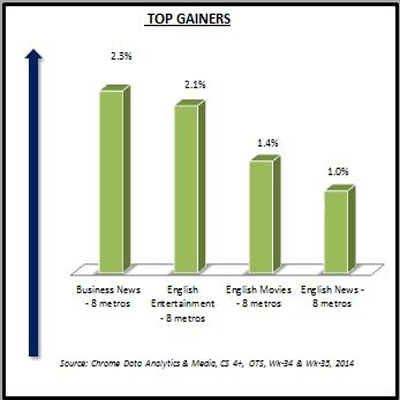
    MUMBAI: The week 35 belonged to the eight metros as various genres saw a rise in opportunity to see (OTS) collated by Chrome Data Analytics & Media.


    The highest peak was witnessed by Business News. The genre hiked 2.3 per cent with CNBC Awaaz topping the category with 78.5 per cent OTS.


    English Entertainment followed closely with 2.1 per cent. Star World with 67.6 per cent OTS gaining the most in the genre.


    English Movies jumped 1.4 per cent. Movies Now with 72.5 per cent OTS topped the chart. English News garnered 1 per cent hike. In the genre Times Now continued its reign with 86.3 per cent OTS.


    The week didn’t drop in genres.

  • Chrome Data: Eight metros see a hike in week 34

    Chrome Data: Eight metros see a hike in week 34

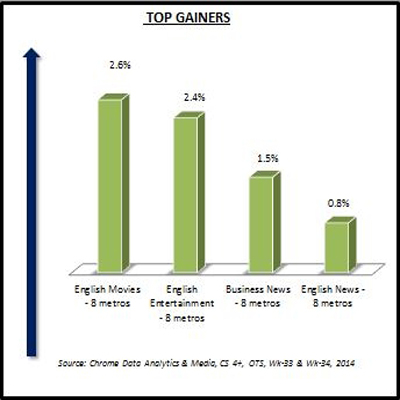
    MUMBAI: The week 34 of the opportunity to see (OTS) collated by Chrome Data Analytics and Media saw a rise in different genres in the eight metros.


    English Movies gained the maximum with 2.6 per cent and Movies Now topping the chart with 72 per cent OTS.


    The genre was closely followed by English Entertainment channels with 2.4 per cent hike. AXN with 66 per cent OTS gained the most in the category.


    Business News and English News genre came in next with 1.5 per cent and 0.8 per cent OTS, respectively. In the particular categories, CNBC Awaaz continued its reign in the genre with 75.8 per cent OTS while Times Now reigned supreme with 86 per cent OTS.


    Only one genre witnessed a drop during that week. Hindi News channels in the Hindi speaking markets (HSM) fell by 0.3 per cent. ABP News with 95.9 per cent OTS gained the most in the genre.

  • Interactive Television’s CAM auditing cinemas

    Interactive Television’s CAM auditing cinemas

    MUMBAI: The highly competitive market has created new venues for marketers to advertise their products and reach out to their audiences.


    With multiplexes mushrooming in every nook and corner of the country, cinema halls are providing ample space for advertisers. And to give a fair view to marketers if the money is well spent or not, Interactive Television, a part of WPP group, has released Cinema Audit Monitoring Report, which gives comparative analysis of cinema advertising and movie marketing throughout the country.


    Interactive Television’s proprietary tool CAM claims to be a game changer for brands investing in cinema advertising in India. “The results of the monthly audit will help our existing and potential clients recognise the growth opportunities for their brands whilst choosing cinema as an advertising medium. With this audit, we aim to provide transparency and visibility to our set of clients to assist them in result oriented media planning and buying. It is a key differentiator for our existing and potential clients,” says Interactive Television CEO Ajay Mehta.


    The report captures all the brand ads screened before the movie and during the interval. It also includes the order in which they are played. The analysis helps brands monitor if their ad was played on cinema or not and also to understand their presence in market in comparison with its competitors. The report provides useful insights for cinema media planning and buying similar to what exists for TV, print and radio.


    Two hundred premium multiplexes like PVR, Big Cinema, Cinemax, Inox, Fame, Fun, DT, SPI and Wave Cinemas are audited in Delhi & NCR, Mumbai, Chennai, Kolkata, Bangalore, Hyderabad, Ahmedabad and Pune. The monitoring is carried out in collaboration with IPSOS-MEDIA CT, and only shows between 12 noon and 8 pm are audited.


    The category with maximum spots is of course food and beverages followed by beauty and personal care.  Chocon featuring Katrina Kaif is the top most brand to be advertised.


    When asked how does it benefit the industry? Mehta says, “People in media have long recognised the power of cinema advertising but lack of measurement and accountability reduced cinema ads potential. As a result, clients always question the measurability and ROI of the medium.  As a solution to this problem ITV launched Cinema Audit Monitoring (CAM), a proprietary tool in 2013 to ensure transparency in the audit of cinema advertising. The monitoring is carried out in top eight cities, which contribute to approximately 60 per cent of the cinema ADEX in a given week. The main objective of CAM is to provide a study that will quantify the reach and impact of advertising in cinema. From consumer point of view, we conduct exit interviews among cinemagoers to understand the recall of brands active on cinema.”

  • Chrome Data: Hindi GECs, the lone gainer in week 33

    Chrome Data: Hindi GECs, the lone gainer in week 33

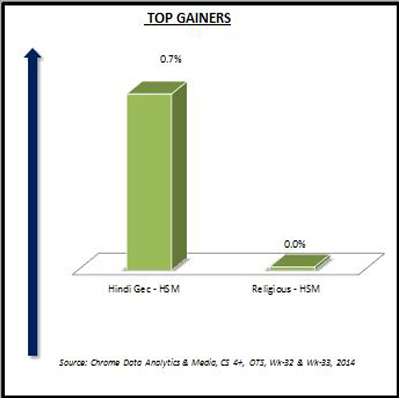
    MUMBAI: Following the previous week’s trend, week 33 of Chrome Data Analytics and Media too saw only one gainer when it comes to opportunity to see (OTS).


    Hindi GECs across HSM markets jumped 0.7 per cent. Star Plus in the category garnered 97.4 per cent OTS.


    The eight metros saw a huge fall when it came to English Movies and English Entertainment. English movies genre fell 2.8 per cent closely followed by English Entertainment with 1.8 per cent. AXN with 66.4 per cent OTS and Movies Now with 73.6 per cent OTS topped their respective genres.


    Infotainment across India fell by 1.2 per cent. National Geographic channel with 86.1 per cent OTS topped the genre.


    Hindi News across HSM markets fell by 1.0 per cent with ABP News as the reigning channel in the genre with 95.5 per cent.