Category: Research

  • Kantar makes management changes at IMRB International

    Kantar makes management changes at IMRB International

    MUMBAI: Kantar has announced a change of leadership at IMRB International, which will see Preeti Reddy take over from long-serving president Thomas Puliyel when he retires in August, this year.

    Reddy, currently senior vice-president, will work alongside Puliyel during the next few months as the transition takes effect. Once president, she will report to Kantar president Wayne Levings.

    Levings commented, “Thomas has made an outstanding contribution to IMRB and the broader Indian research market throughout his long and distinguished career. Under his leadership, IMRB has continued to improve and innovate around its offering, expanded into new markets and sectors and has been consistently recognised as the leading research agency in India. He leaves with our thanks and best wishes for his retirement.”

    Levings further added, “In Preeti, we have an excellent new leader of IMRB. She brings a combination of strong client leadership, general management and consulting capabilities. With the very strong leadership team she has around her, IMRB will continue to build on its world-class foundations.”

    Reddy has close to three decades of experience in research and consulting, working with leading Indian and multinational companies. She joined the IMRB group in 2009 when she was appointed CEO of LMRB in Sri Lanka. She has previously worked in consumer consulting at Technopak, was senior vice-president at TNS India and has worked with the BAT group in India.

    Reddy said, “I’m delighted to be leading such a diversified and vibrant business which continues to define research in the region. We have a great team of experienced and highly competent managers to head our different businesses and I look forward to working with them to build IMRB into an even bigger and better business.”

    In other management changes, effective 1 February, 2015, Jasojit Mookerjea, currently responsible for International Business Unit (IBU) senior vice-president and IMRB One joint head will take on full responsibility for IMRB One as well as heading change management and managing the key account directors within the company.

    Currently IBU BAT global account director and vice president Sreeram Sreenivasan will take overall charge as IBU senior vice-president based in London. Diptya Mukherjee will continue in his role as IBU vice-president based in Calcutta. The management team at IBU is being further strengthened under the leadership of Sreenivasan and Mukherjee and the proposed changes will be communicated in due course.

    Senior vice-president Vivek Gupta will head the Auto, BFSI and Telecom sectors, while the Brand Science business will be merged into IMRB One.

    Puliyel joined IMRB in 1981 as manager, overseas projects and remained with the company until 1992 before moving to set up Research International India as country manager. He returned to IMRB as president in 2000. The company has been named research agency of the year eight times since 2005 and Puliyel has twice served as president of the Market Research Society of India.

    Puliyel said, “IMRB is a wonderful place to work in. The open, empowered work environment is a great magnet for the best research talent. The freedom that the company provides makes it a great place to learn and realize one’s potential.”


     

  • MPA report values Asia Pacific online video revenue opportunity at $12 billion by 2020

    MPA report values Asia Pacific online video revenue opportunity at $12 billion by 2020

    MUMBAI: A research report published by Media Partners Asia (MPA) indicates that the total market for online video services across 13 countries in Asia Pacific will grow from $3.5 billion in net revenues in 2014 to reach $12.4 billion by 2020, representing an average annual growth of 23.5 per cent. Advertising will contribute more than 80 per cent to the online video pie by 2020 with the subscription revenue opportunity, largely driven by subscription video-on-demand (SVOD) platforms, growing from less than $700 million in 2014 to more than $2.3 billion by 2020.

    The report, entitled ‘Asia Pacific Online Video Distribution 2015’, evaluates  the commercial distribution of legal over-the-top (OTT) video services in 13 markets with historical data and forecasts plus profiles of key OTT platforms.

    Commenting on the report, MPA executive director Vivek Couto said, “The market for the legal consumption of OTT services in Asia Pacific is at an early stage with monetisation models nascent in most countries. As barriers to entry reduce and broadband penetration increases, more disruptors are emerging and host of new platforms are proliferating, though business models are not always scalable and issues such as piracy; content; and platform operation remain problematic. This is especially true in a number of Asian markets where piracy is significant and the limited scale of OTT video revenues are not commensurate with content costs.”

    “Meanwhile, large scale global digital brands (from YouTube to Netflix) are expanding rapidly in a number of Asian markets or readying to launch in key territories over 2015 and 2016. Major local and regional television companies are also in the early stages of launching a number of large scale advertising and subscription based OTT platforms, anchored to local, Asian and Hollywood content while telecom operators are either moving upstream into content and OTT services or providing a crucial link for the ecosystem,” he added.

    Key takeouts from the report include:

    •    Infrastructure. Fixed broadband subscribers reached 325.3 million in 2014 across Asia Pacific, equivalent to an average household penetration rate of 36 per cent. By 2020, MPA projections indicate that this penetration level will reach 40 per cent as fixed broadband subs grow to 403.5 million mobile broadband will grow rapidly, expanding at CAGR of 15 per cent over 2014 and 2020 to reach almost 2 billion subs by 2020 (58 per cent penetration of population) versus 866 million (26 per cent penetration) in 2014.


    •    OTT Video Consumption. Active Asia Pacific OTT video subscribers reached 594 million in 2014, according to MPA. China accounted for more 85 per cent of the market size in 2014 and will represent 80 per cent by 2020. Ex-China, the largest markets in 2014 were Korea; India; Japan; and Hong Kong. By 2020, MPA projections indicate that active OTT video customers will reach 977 million. By 2020, in Asia ex-China, India will emerge as the second largest market, followed by Korea, Japan and Hong Kong. In Southeast Asia, Malaysia will be joined by Indonesia and the Philippines as market leaders.  

    The market for subscription-based OTT video reached 75.3 million active subscribers in 2014 and is expected to reach 225 million by 2020. China will be the largest contributor, driven by internet-enabled TV and set-top box platforms and online video companies offering premium services. Japan, Korea, India and Australia will emerge as material opportunities, powered by SVOD but India will trend towards more a freemium-oriented model.

    •    Industry economics. MPA divides industry monetization models into distinct segments:

    o    SVOD.  In terms of SVOD revenue across OTT platforms, the largest markets in Asia Pacific by 2020 will be Japan; China; Korea; and Australia. New Zealand and India will lead the next best placed group of geographies. MPA projections indicate that total SVOD-based OTT revenues in Asia Pacific will grow at a CAGR of 16 per cent between 2014 and 2020, growing from $953 million in 2014 to more than $2.3 billion by 2020.

    o    Online video and OTT advertising. Asia Pacific online video advertising exceeded US$3.7 billion in net terms in 2014, up 35 per cent year-on-year. The largest markets for online video advertising in 2014 were, by far, China and Japan, followed by Australia, India and Korea. By 2020, the total Asia Pacific online vide advertising pie is expected to grow to $10 billion, a CAGR of 18 per cent from 2014, with China dominant, followed by Japan and Australia. India will gain increasing scale and overtake Korea while Indonesia will be the clear leader in Southeast Asia.

    OTT video advertising revenue, a subset of the online video advertising pie, reached $2.1 billion in 2014, up 43 per cent year-on-year from a low base, and almost entirely driven by China. This pie, is projected by MPA to expand to $5.5 billion by 2020 at a CAGR of ~18 per cent. China will be the largest contributor with India, Korea and Indonesia starting to become gradually significant over time.

  • Asia’s investment in US Sports makes it an ‘Emerging Giant’: Repucom

    Asia’s investment in US Sports makes it an ‘Emerging Giant’: Repucom

    MUMBAI: Over the past three years, investment from Asia into US sports franchises has been growing consistently. This comes in wake of a report released by sports management company Repucom titled ‘Emerging Giants’, which states that in the past two years, close to $1.1 billion has been invested by Asian businessmen in US Sports franchises.

    All of the US big leagues now have at least one team fully or partially owned by an Asian-born investor. Asian ownership first came to American sport when Japanese company Nintendo bought the Major League Baseball (MLB) Seattle Mariners back in 1992. Ever since the team imported Ichiro Suzuki, who emerged as one of the great players in MLB history, there has been a steady stream of Japanese talent into the US league, drawing the world’s two biggest baseball markets closer to one another. Nintendo remains one of the few corporate owners of US teams.

    According to the report, one of the most well-known Asian investors in US sport is Chinese-born software mogul Charles Wang of Computer Associates became the majority owner of the New York Islanders of the National Hockey League (NHL) in 2004. After failing in his efforts to get a new arena approved for the team in its original suburban New York location, he has decided to move the Islanders to Brooklyn’s Barclays Center for the 2015-16 season as the new arena’s anchor ice hockey tenant. India’s Vivek Ranadive’s investment in National Basketball Association (NBA)’s Sacramento Kings’s is pegged at $ 348 million.

    Major investment in US sports sponsorship has been dominated by three big exporters from the region i.e South Korea, Japan and China and the key industry sectors are  automotive, consumer electronics and sports apparel.

    Recent deals such as India’s Tata Consultancy Services’ decision to sponsor the New York Marathon has been pegged at $ 3.8 million. South Korean automotive brand Kia and their deal with LeBron James has been reported to be around $ five million and Kumho Tires’ deal with the NBA has been pegged at $ 2.6 million.

    South Korean investment has come mainly in the shape of Hyundai, Samsung and Kia. Hyundai invested $8 million into the naming rights of the Hyundai Tournament of Champions on the PGA Tour in 2011 and Samsung’s $33.3 million per year deal with the NBA in 2013 has made the electronics company the league’s supplier of mobile device and televisions. As part of the agreement, referees of games in the NBA as well as the WNBA and NBA Development League will use Samsung tablets alongside the basketball court to review plays. Kia chose another route into US sports by targeting one of the most iconic venues in the country. Their $ seven million sponsorship deal with Madison Square Garden (MSG) in New York gives the company prominent signage in this famous arena, a custom-built display space at the entrance for its cars, tie-ins with the MSG owned New York Knicks (NBA) and Rangers (NHL) and an expanded presence on the MSG regional sports networks. Japan’s Sony Electronics sponsorship and technology agreement with the Barclays Centre in Brooklyn, home of the Nets NBA franchise, is another example of big name property rights purchasing. As part of the deal, 600 Sony professional and consumer HD screens are positioned throughout the arena.

    Besides economic growth, the report mentions the various reasons for the driving trend for investment in sport which are as follows:

    1) Health-The rise in interest and participation in sport is a reflection of efforts to promote health, and companies in the Middle East and Asia are using sponsorships of global sports as a means to engage local consumers with a healthy and active lifestyle message.

    2)  Entertainment- With the growth of television and internet, the appetite for entertainment has surged across the Middle East and Asia. Given the lack of local sports attractions and the time required to build new clubs and franchises, investment in global sports properties is a short-cut to delivering programming that engages audiences.

    3) Growing young population- Brands from the Middle East and Asia are using sponsorships of key global sports to target and engage this youth population.

    4) National Unity- Governments from the Middle East and Asia see investment in sport as a key means by which to promote national unity in what are often markets which have very fragmented sociocultural sub-pockets, domestically speaking.

    5) Social mobility- Encouraging people from all levels of society to follow and engage with sport, offers them a level playing field for social interaction.

  • Bengali film viewing has dropped: CII & IMRB report

    Bengali film viewing has dropped: CII & IMRB report

    KOLKATA: Majority of Bengali film viewers in Kolkata have not been in theatres in the last one year to watch a Bengali film, despite proliferation of multiplexes. However, it is interesting to note that in the districts, around two thirds have visited movie theaters to catch a Bengali film, but the frequency of visits are quite low, not even three films in a year, reveals a report ‘Bengal Bioscope: A Big Picture Outlook for Sustainable Growth’ launched jointly by the Confederation of Indian Industry (CII) and IMRB.

    The report further reveals that around 30 per cent of Bengali cinema viewers do not contemplate watching a Bengali film in a hall in near future and an additional 10 per cent have stopped watching Bengali films on big screens in the last one year.

    This is further corroborated by IMRB’s primary survey of 35 single screen theatres across Kolkata and West Bengal revealing 30 per cent occupancy on weekends and around 20 per cent on weekdays.

    The tastes and preference of viewers in Kolkata and rest of Bengal are quite different which is echoed by only handful of releases successfully straddling both geographies.
    While original engaging content, a larger pool of good actors and directors and better in hall experience can drive Bengalis back to cinema halls.

    The report was launched at CII Big Picture Summit – Vision Bengal, 2014 on 12 December. The CII has partnered with IMRB International to conduct a study on Bengali film industry that focuses on understanding the emerging business models, importance of internet and innovative viewer engagement methods that are vital for the growth of the industry. 

    As a part of this project, IMRB conducted a first of its kind consumer survey across eight districts in urban West Bengal to learn the changing nature of film viewership and the general perception of Bengali films among its target audience. In addition to the consumer survey, a series of interviews were conducted to understand the trade insights of the film industry through in depth interactions with producers, actors, directors, distributors, exhibitors and broadcasters of Bengali cinema, it is further learnt.

    “With the increasing investment in infrastructure and production as well as growing consumer interest in regional cinema, we see a very bright future for Bengali film industry which has always been a flag bearer of creative excellence. The study encompasses the key constituents of the industry – producers, creative artists, distributors- as well the opinions of consumers who decide the fate of the creative products,” said IMRB International SVP media & retail Hemant Mehta.

    CII director General Chandrajit Banerjee said, “CII’s vision is to take the Indian Media and Entertainment sector towards achieving $100 billion by the year 2020. We expect that this growth will also come from regional media and entertainment markets across India.”

    “Regional is the new national and it fits well for the media and entertainment sector. Bengali Cinema has an enviable past and it continues to be one of the most vibrant regional film industries in the country,” Banerjee concluded.

  • India’s ad spend estimated at 13.3 per cent by Magna Global Forecasts 2015

    India’s ad spend estimated at 13.3 per cent by Magna Global Forecasts 2015

    MUMBAI: In its latest study of global media owner advertising revenues, covering 73 countries, Magna Global estimates that ad revenues grew by more than 5.5 per cent this year, to reach the half-trillion mark ($512 billion). Advertising sales will grow by more 4.8 per cent in 2015 to reach $536 billion.

    Some of the most significant revisions in the 2015 forecasts are found among BRIC markets. China and Brazil advertising revenues are still predicted to grow by a decent amount (+8.6 per cent and +5.9 per cent, respectively) although two to three points below previous expectations. Russia is the single biggest negative revision, due to the combination of declining energy prices and the partial withdrawal of Western investors amidst geopolitical tensions; the 2015 advertising growth forecast is cut from 7.0 per cent to 0.8 per cent.

    India will, thus, become the most dynamic among the four BRICs, with an expected ad spend growth of +13.3 per cent following a similar pace of 2014 (+13.2 per cent).

    The general elections that took place in the first part of the year generated massive incremental spend. The outcome of the election, bringing a new BJP-led Government to power, improved business and consumer confidence, is what prompts ad growth forecast in the coming year. The new government is also committed to invest billions in order to connect millions of rural Indians to broadband internet, in a plan advertised through a recent meeting between the new Prime Minister Narendra Modi, and the Facebook founder Mark Zuckerberg.

    Magna Global global forecasting director and author of the report Vincent Letang said, “In 2014, the long-awaited European recovery finally came in time to partly offset a weaker- than-expected growth in the US and the BRICs. In 2015, the lack of non-recurring events, the continued slowdown of the BRICs and the deflationary effects generated by the rise of digital media will inhibit global advertising growth, in a slight disconnect with the positive acceleration in the macro-economic environment.”

    The report highlights that in the APAC, within digital, the fastest growing formats are social (+58.6 per cent growth), followed by video (+37.6 per cent growth) and search (+25.5 per cent growth). Mobile spend on social formats continues to lead the way, and other formats will follow.

    Television remains the dominant format for advertising spend in APAC, and spend will grow by 3.5 per cent this year and represent slightly over 40 per cent of all advertising dollars. Broadcast television continues to dominate the TV landscape, although multi-channel television is gaining share due to slightly higher growth rates, and by 2019 will represent nearly one quarter of TV dollars. Print continues to lose market share, and newspaper and magazines together will represent less than one in five advertising dollars this year. This is down from one third of all spending as recently as 2008.

    APAC will continue to be one of the stronger regional drivers of global advertising spend, although its lead on the global growth rate continues to narrow. Its total share of global ad spend will only increase slightly between this year and 2019, from 29 per cent to just over 30 per cent of total spend.

  • TV’s 10% growth will add to AdEx growth in 2015 in India, predicts ZenithOptimedia

    TV’s 10% growth will add to AdEx growth in 2015 in India, predicts ZenithOptimedia

    MUMBAI: The year 2014 saw the biggest Lok Sabha elections held in the country with Bharatiya Janta Party winning with a majority giving people a hope of ‘aache din’.

    It has been just over six months of the newly elected government led by Prime Minister Narendra Modi and it seems to have captured the collective consciousness of the country. And as the year comes to an end, ZenithOptimedia’s Advertising Expenditure Forecasts says that falling food prices as well as oil prices have contributed to a reduction in the Consumer Price Inflation to a historic low of 5.52 per cent in October. IMF and World Bank have forecast an identical 6.4 per cent growth in 2015, up from 5.6 per cent in 2014. The stock market index has crossed 28000, up from 20000 in November 2013.

    Hence, we enter 2015 with a strongly positive consumer and business sentiment, albeit recognising that consistent on-ground delivery and reforms will be needed to keep this sentiment up. Hence, cautious optimism, though with way more optimism than same time last year, is still the right expression.

    The agency expects consumption to continue picking up, with passenger car and utility vehicle sales turning positive, credit card spending on the rise, loans for durables growing. From an ad-expenditure point of view, FMCGs will continue their dominance but given the weak monsoons, some categories might stay flat or have slow growth. High growth is expected from telecom, e-commerce, mobile phones, cars and two wheelers, retail, realty and the BFSI sector. 2015 will also be the year of ICC Cricket World Cup, which will also be a trigger to growth in ad expenditure.

    And with the new TV measurement system scheduled to launch in 2015, as is the much-awaited phase III expansion of FM Radio. Regional media, across print, TV and all other media continues to drive growth in media consumption. With internet base increasing to 250 million, smartphone ownership expected to reach 200 million by 2014 end, and the country awaiting the launch of 4G services by telecom operators, online and mobile will continue to see the maximum growth rate. Digital advertising however, has become dearer as the government decided to re-impose service tax.

    Given these factors ZenithOptimedia expects the ad-ex to grow by 12 per cent to Rs 40,307 crore, at an overall level in 2015, as against 10.7 per cent in 2014 (over 2013). This growth will be primarily fuelled by print at 12 per cent, TV at 10 per cent and online and mobile at 25 per cent. Other media are expected to grow between 5 – 10 per cent.


    Global forecast

    The year 2014 continued the trend of seeing the rise of mobile advertising and social media, and the transition to programmatic buying of digital display, will help the global advertising market grow 5-6 per cent a year over the next three years.

    According to ZenithOptimedia, global ad spend will grow 4.9 per cent to reach $545 billion in 2015. The global economy is expected to improve (the IMF predicts 3.8 per cent global GDP growth in 2015, up from 3.3 per cent in 2014), but advertising faces a tough year-on-year comparison after the Winter Olympics, World Cup and US mid-term elections in 2014. Ad spend growth will therefore be slightly below 2014’s 5.1 per cent.

    2016 will be a quadrennial year – with the Summer Olympics, US Presidential elections and the UEFA European Football Championship – and we expect these events to propel ad spend to 5.6 per cent growth that year, before it slips back to 5.2 ad spend in 2017 in their absence.


  • HSBC raises Hathway’s target price to Rs 432

    HSBC raises Hathway’s target price to Rs 432

    MUMBAI: HSBC Securities and Capital Markets’ latest report on multi system operator (MSO) Hathway Cable & Datacom has improved its rating from ‘normal’ to ‘overweight’.


    While it continues to value Hathway using a DCF based approach, it has raised the target price from Rs 276 to Rs 432. This is on the assumption of 12.5 per cent WACC, cost of equity of 13.5 per cent and cost of debt of 11 per cent.


    One of the main reasons for this is the expectation of increase in Average Revenue Per User (ARPU). HSBC expects gross billing to increase in phase I markets by around 15 per cent and phase II by around 10 per cent over the next two quarters. Gross ARPU is estimated to grow at 16 per cent CAGR from its earlier 8 per cent.


    Increase in ARPU would mean a near 10 to 20 per cent rise in cost, despite the incentives that are being offered by Star’s new RIO deals. The report also says that moving to prepaid would be necessary, even if it is restricted to Star  channels for now as in the long run it would allow MSOs to scale up to full prepaid gradually over the next 18-24 months.


    “LMOs will need to move to a prepay backend. Both these factors are positive for the sector and in our view build a long-term case for ARPU improvement, fewer bad debts, reducing friction between MSO and LMO relations, improving the industry structure and allowing the industry to benefit from sector consolidation,” it states.


    The report also highlights that if Star is successful in reaping benefits out of its new RIO policy, other big networks may follow suit, though not in the immediate 12 months.


    This apart, HSBC also sees broadband ARPUs increasing with a more robust DOCSIS 3.0 platform but with a slight concern on the slow pace of subscriber net addition. The delay in digitisation is positive for cable TV industry to consolidate market share in the first two phases. Side by side, issues such as revenue share and prepaid billing can be sorted and easily applied in phases III and IV.


    HSBC has raised its medium- term EBITDA estimates by 11 per cent (FY16e-21e CAGR of 13.5 per cent), cable TV ARPU assumptions by 12 per cent (FY16e-21e CAGR of 11 per cent) and broadband ARPU by 8 per cent for the same period.


  • Asia PAC advertising to grow 5% in 2014, 5.7% in 2015, 4.5%CAGR for 2014-19: MPA study

    Asia PAC advertising to grow 5% in 2014, 5.7% in 2015, 4.5%CAGR for 2014-19: MPA study

    MUMBAI: A new report published by Media Partners Asia (MPA) indicates that net advertising revenues, measured after discounts across 14 markets, will grow at 5.0 per cent this year to top US$121 billion. Next year, MPA projects a re-acceleration in growth with the advertising market to expand at 5.7 per cent. Between 2014 and 2019, MPA forecasts indicate that net advertising in Asia will climb at an average annual growth rate of 4.5 per cent.


    Commenting on the findings of the report, entitled Asia Pacific Advertising Trends & Database 2014 – 15, MPA executive director Vivek Couto said: “The macro landscape is uneven and there are headwinds to economic growth across Asia Pacific. Encouragingly, governments and policymakers across the region have implemented reforms to address structural issues and this trend is likely to accelerate in markets where positive political change has occurred. Ad spends from large multinational advertisers softened through much of 2014, partially offset by spends from domestic advertisers but this has dampened growth across Southeast Asia and other key markets. Multinational advertising demand may return but weakness across global emerging and developed ad markets may exert downward pressure on Asia.”             


    Key highlights from the report include:  


    o    Southeast Asia rebound. Contraction in advertising across Malaysia, Singapore and Thailand, partially offset by robust though slower growth in Indonesia, Philippines and Vietnam, means that net advertising revenues will grow at only 1.2 per cent in Southeast Asia in 2014, the lowest in five years. A rebound is expected in 2015 with 7.2 per cent growth.


    o    Market rankings. China will overtake Japan as Asia’s largest advertising market by 2016 while India will overtake Korea in 2017. By 2019, the six largest ad markets in Asia will be China; Japan; Australia; India; Korea and Indonesia.              


    o    TV. TV’s share of the advertising market peaked in 2011 at 42.9 per cent and while still resilient, market share has been edging downwards, reaching 41.6 per cent in 2014 with MPA projecting 40.7 per cent share by 2019. In mature markets, TV will remain a growth media in Hong Kong and to a smaller extent, Australia but the future will be more challenging in Japan and Singapore. In Korea, terrestrial TV also faces a challenging future. In growth markets, TV’s best performers, from a relatively high base, will be Indonesia, India, Philippines, Thailand and Vietnam.


    o    Digital. Total digital advertising revenue (including search, display and mobile) is expected to climb at a CAGR of 11.1 per cent over 2014-19 with aggregate market share growing from 23 per cent in 2014 to 31 per cent by 2019. Digital has overtaken TV to be the largest media in terms of advertising on Australia; by 2019, it will also be the largest media by advertising in China, Korea and New Zealand. In more developing online markets such as India, Indonesia, Malaysia and Thailand, digital will have a 10-20 per cent advertising market share by 2019 versus 6-8 per cent in 2014. Mobile advertising will become increasingly significant in China, Japan, Korea and Taiwan while the online video ad pie will continue to expand in China, Japan, Korea and Taiwan and grow rapidly from a low base in markets such as India.   

  • Online shopper base in India to reach 100 million by 2016

    Online shopper base in India to reach 100 million by 2016

    MUMBAI: Convenience and variety is what today’s shoppers look for. And the platform giving them these both is e-commerce.


    As per Google in its annual online shopping growth trends report, consumer confidence to shop online will only continue to rise and India will have 100 million online shoppers by 2016.


    The report compiled by combining an extensive research conducted by Forrester Consulting and Google search trends revealed that India’s e-tailing market is at an inflection point and will see rapid growth to become a $15 billion market by 2016.


    The research conducted by Forrester Consulting by interviewing 6859 respondents covering both online buyers and non-buyers in 50 cities/towns, found out that online shoppers base will grow three times by 2016, and over 50 million new buyers will come from tier I and II cities.  The confidence to shop online was on the rise as 71 per cent non-buyers from tier I and II cities said they plan to shop online in next 12 months. The findings also revealed that women buyers in tier I cities were more engaged in online shopping, and outspend men by double. Women were also responsible for driving growth in categories like apparels, beauty & skincare, home furnishing, baby products and jewellery.


    Over 60 per cent respondents also felt that buying online was directly correlated with social status. Mobile phones emerged as an important access device for online shoppers with one out of three online buyers transacting on their mobile phones in tier I and II cities. In tier III cities, one in two buyers said they use mobile phones to purchase products online. This was also reflected in Google search trends with mobile phones queries growing three times in last three years. Today, over 50 per cent of shopping queries were coming from mobile phones; this share was as low as 24 per cent just two years back.


    Google India local and classified ecommerce industry director Nitin Bawankule said, “The consumer confidence to shop online has grown significantly in  last year and a half, and our objective was to understand the factors that are driving this growth and arrive at indicators that will help propel the Industry forward. As the report indicates, behavior of Indian online buyer is fast mirroring buyers in more developed markets as more subjective product categories have started to see significant growth. The e-tailing Industry needs to act now to cater to this strong user growth trend. Improved customer experience across all touch points, easy to use mobile apps can create a strong pull for non-buyers to shop online in tier I and II cities. Women buyers are set to become the most significant contributor to the growth of online shopping and there is a huge opportunity waiting to be unlocked in this user segment.”


    Amongst the challenges, 62 per cent buyers said they were not satisfied with their online shopping experience. 67 per cent buyers also highlighted that the current return process was too complicated and expensive. Trust was a major issue with non buyers, 55 per cent non buyers did not trust the quality of products sold online, 63 per cent said they were concerned about the safety of transacting online and 65 per cent said, they don’t feel comfortable sharing personally identifiable information online. 66 per cent of total respondents said that poor connectivity was also a major barrier for them to shop online.


  • Chrome Data: Week 44 sees fall in HSM

    Chrome Data: Week 44 sees fall in HSM

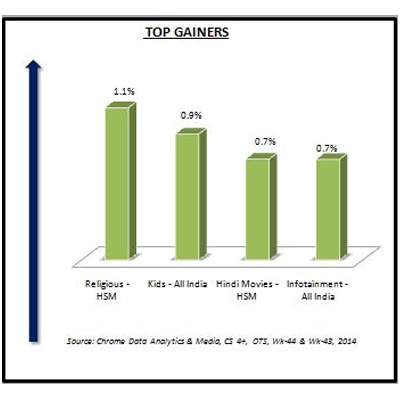
    MUMBAI: The week 44 of opportunity to see (OTS) collated by Chrome Data Analytics & Media saw Religious channels in the Hindi speaking market (HSM) gaining the most.


    The genre grew by 1.1 per cent with Aastha channel continuing its run at the top with 96.8 per cent OTS.


    It was closely followed by Kids genres across India which saw a jump of 0.9 per cent. Cartoon Network with 79.2 per cent OTS once again remained on top.


    Hindi Movies in the HSM and Infotainment channels across India witnessed a high of 0.7 per cent. Star Gold with 96.7 per cent OTS and Discovery with 87.3 per cent OTS topped their respective genres.


    The downward trend was witnessed by the eight metros with English Entertainment channels losing the most with a fall of 2.2 per cent.


    However, AXN with 68.8 per cent OTS continued with its winning trend in the genre.


    English News and Business News too dropped by 1.8 per cent and 1.2 per cent, respectively. Times Now with 84.9 per cent OTS and CNBC Awaaz 78.7 per cent OTS topped in their respective categories.


    English Movies too saw a drop of 1.2 per cent with Pix topping the chart with 72.8 per cent OTS.