Category: Research

  • GroupM ESP lists top 10 trends for IPL season 8

    GroupM ESP lists top 10 trends for IPL season 8

    MUMBAI: Move over Cricket World Cup, welcome Indian Premier League (IPL) Season 8! 


    With the home grown league becoming a global reputable property, GroupM ESP (Entertainment & Sports Partnerships), has predicted top trends in 2015.  


    Commenting on the trends for this season, Group M ESP national director Vinit Karnik said that the sports entity has come a long way in how it addresses sponsorship sales and convergence of technology. “From selling tickets to selling an experience, IPL has come a long way. This further extends from the execution of sponsorships across major platforms — all the way to the idea/solution generation phase during the sales process,” he added.


    Karnik also stated that in 2015 teams will continue investing in the in-stadia experience content delivery. With feeds available through internet, Sony’s regional channels, mobile applications etc the content is truly taking the center stage. “It makes sense because if fans aren’t in the stadium consuming content, they’re consuming it somewhere else — work/ home/ in a cafe… wherever,” he informs.


    According to him there will be an amalgamation of technology integration and enhancement throughout the sport. The proliferation of video and statistical information backed by increased social exchange will define the popularity of teams.


    Uniquely positioned at the intersection of media and marketing, GroupM ESP has made the following predictions: 


    1) Smart talent acquisition by franchises increasing competitiveness with teams evenly matched.


    2) Enhanced broadcast production quality with regional language feeds from the broadcaster MSM.


    3) Fan Park idea will heighten interest and involvement in smaller cities and towns.


    4) Digital platforms to create sustained and deep engagement with real time analytics.


    5) Surround content to drive social conversations via social media platforms.


    6) Technology to enhance spectator interactions and engagement inside stadium.


    7) Realistic sponsorship pricing strategies resulting in repeat purchases and a stable sponsor ecosystem.


    8) Apparel as an emerging and popular sponsor category among franchises.


    9) Sponsor’s increased dependence on crowd sourcing to create excitement around their brands .


    10)  E-commerce brands will dominate ad spends on broadcast platform.


    “In all aspects, IPL offers a consumer delight by integrating newest technologies and enhanced fan experience while building affinity with future generations of fans who have moved from passive viewers to engaged amplifiers. We also see a lot of new generation brands jump onto the IPL bandwagon, making it a high spend high visibility and now high engagement business,” concluded Karnik.

  • India continues to be the second most economically confident nation: study

    India continues to be the second most economically confident nation: study

    MUMBAI: India continues to be the second most economically confident nation globally on the back of improved performance by industry and services sector, according to a report by global research firm Ipsos.


    According to the ‘Ipsos Economic Pulse of the World’ study, Saudi Arabia (94 per cent) solidified its position at the top of the national economic assessment in February 2015, followed by India (80 per cent), Germany (76 per cent), Sweden (73 per cent), China (71 per cent), and Egypt (61 per cent).


    The lowest average global economic assessment this month is in Italy (eight per cent). Close behind are France (10 per cent), Brazil (12 per cent), Spain (12 per cent), South Korea (13 per cent) and Hungary (16 per cent).


    One in two (50 per cent) Indians believe that the local economy, which impacts their personal finance is good, a sharp drop of five points.


    Indians are very hopeful that the Narendra Modi-led NDA government will continue making progress on its domestic reforms agenda and encourage investments that will trigger economic growth and create more jobs; with more than six in ten (64 per cent) people expecting that the economy in their local area will be stronger in next six months, a rise of two points making India the most optimistic country globally.


    “The Indian economy is reviving, aided by positive policy actions by the government that has improved investors’ confidence and lower global oil prices. However, India needs to revitalize the investment cycle and fast-track structural reforms to speed up growth further,” said Ipsos managing director – India Amit Adarkar.


    “India – Asia’s third-largest economy is expected to grow faster than China in the next few years backed by strong GDP growth, low inflation and stable development focused government at the center,” added Adarkar.


    The online Ipsos Economic Pulse of the World survey was conducted in February 2015 among 18,235 people in 24 countries.


    Starting the New Year on a positive note, the average global economic assessment of national economies surveyed in 24 countries is down one point as 40 per cent of global citizen’s rate their national economies to be ‘good’.


    Countries with the greatest improvements in this wave: Saudi Arabia (94 per cent, +7 pts.), Belgium (39 per cent, +6 pts.), Japan (26 per cent, +3 pts.), Argentina (24 per cent, +3 pts.), Mexico (22 per cent, +3 pts.), France (10 per cent, +3 pts.), Russia (28 per cent, +2 pts.), Sweden (73 per cent, +1 pts.), South Africa (27 per cent, +1 pts.) and Spain (12 per cent, +1 pts.).


    Countries with the greatest declines: China (71 per cent, -9 pts.), Egypt (61 per cent, -6 pts.), Germany (76 per cent, -5 pts.), Brazil (12 per cent, -5 pts.), Canada (59 per cent, -4 pts), the United States (47 per cent, -4 pts.), Australia (56 per cent, -2 pts.), Great Britain (44 per cent, -2 pts), Turkey (43 per cent, -2 pts), and Poland (25 per cent, -1 pts.).


    Saudi Arabia (68 per cent) regains the top position in the local economic assessment, which impacts their personal finance. Sweden (59 per cent) is in the distant second, followed by China (53 per cent), Germany (53 per cent), Israel (51 per cent), India (50 per cent) and Canada (40 per cent). Small minority assess their local economy as ‘good’ in Italy (11 per cent) followed by Hungary (12 per cent), South Korea (13 per cent), Spain (13 per cent), France (15 per cent), Japan (15 per cent) and Mexico (15 per cent).


    India (64 per cent) remains in the lead of the future outlook assessment, followed by Saudi Arabia (60 per cent), Brazil (51 per cent), China (44 per cent), Egypt (44 per cent), Mexico (38 per cent) and Argentina (32 per cent). Once again, only a fistful in France (five per cent) expect their local economy to be strong six months from now, followed by Israel (eight per cent), Belgium (10 per cent), Sweden (10 per cent), Hungary (11 per cent), South Korea (11 per cent), Italy (12 per cent), Poland (12 per cent) and Japan (14 per cent).

  • Indian ad spends to grow by 11.3% in 2016; digital to lead way: Carat

    Indian ad spends to grow by 11.3% in 2016; digital to lead way: Carat

    MUMBAI: Global media network Carat’s first forecast for worldwide advertising expenditure in 2016 shows that Indian advertising spend is poised to grow by 11.3 per cent in 2016.

    Following the formation of a stable government in 2014 led by Narendra Modi, the economic prospects look bright in India.While Indian advertising spends increased by +8.7 per cent in 2014, as per the agency’s forecast, it is poised to leap by double digits of +11 per cent in 2015.

    Carat’s also released its latest forecasts for 2015 and actual figures for 2014, with all markets ring-fencing digital media spending, even when faced with negative economic headwinds.

    Asia Pacific

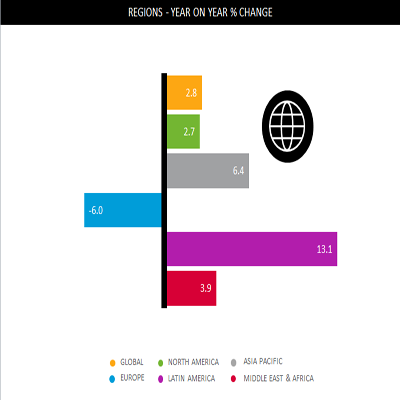
    In the Asia Pacific market, advertising spend is forecast to grow by a solid +5.2 per cent in 2015. This has however been revised down from the +5.9 per cent previously forecast in September 2014, with its major market Japan moderating forecasts from +1.7 per cent to +0.9 per cent, alongside a number of other markets including Hong Kong, Taiwan, Malaysia and Vietnam. Growth is expected to pick up pace in 12 out of the 14 markets in 2016 with growth overall of+5.8 per cent in 2016. 

    Based on data received from 59 markets across the Americas, Asia Pacific and EMEA, Carat’s global advertising expenditure forecast showsthat digital media, with a predicted $17.1 billion or +15.7 per cent increase in spend in 2015, is outpacing previous Carat predictions from September 2014. Powered by a dramatic rise in mobile ad spending globally of +50 per cent and online video of +21.1 per cent predicted in 2015, Carat forecasts that digital will, for the first time, account for more than a quarter of all advertising spend in 2016 with a market share of 25.9 per cent.

    From a global perspective, Carat forecasts that in 2015, advertising spend across all media will increase by $23.8 billion to reach $540 billion, accounting for a +4.6 per cent year-on-year increase. Market optimism continues into 2016 with Carat’s first forecast for the year predicting a year-on-year global advertising growth of +5.0 per cent.

    Carat Advertising spend forecast -March 2015

    Digital media spend continues to be the star driver of growth in the global advertising market, with a predicted $17.1 billion increase in spend in 2015 corresponding to a 15.7 per cent year-on-year growth rate, outpacing previous Carat predictions from the September 2014 report.New predictions for 2016 highlight that digital will continue to grow at double-digit levels, at 13.8 per cent, and will account for more than a quarter of all advertising spend globally.

    Trend Highlights from the report:

    ·Digital’s unwavering positive trajectory is being powered by a dramatic rise in mobile, online video, social media and programmatic spending. Carat predicts that in 2015, global mobile spend will increase +50 per cent, and online video will be up +21.6 per cent. US programmatic display advertising spending is predicted to grow +137 per cent to reach $10 billion this year, accounting for 45 per cent of the US digital display ad market.

    ·Digital media spend is being ring-fenced by advertisers even in markets with significant negative economic headwinds.In Central & Eastern Europe for instance, while total advertising spend is predicted to decrease by 2.2 per cent this year, digital media will see a double-digit growth of +12.9 per cent. Digital media is the only media expected to grow in this region this year.

    ·Carat’s first advertising expenditure forecasts for 2016 show elevated confidence in the advertising market, a robust +5 per centgrowth despite a still-recovering economic climate boosted by a year of events- the UEFA European Football Championships, Rio 2016 Olympic Games and US presidential elections.

    ·Global forecasts for 2015 have been revised down from the +5.0 per cent previously forecast in the September 2014 report, to +4.6 per cent. This is due to a reduction in advertising spend predictions in key markets including Russia, Japan and Brazil.

    ·The recovery in Western Europe has driven a second consecutive year of growth in 2015, predicted at +2.8 per cent. This follows a +2.3 per cent increase in advertising spend in the region in 2014. Growth is driven by the UK market, which is predicted to grow strongly by +6.4 per cent, and Spain by +6.8 per cent following the improved economic climate and consumer sentiment there. Greece (+8.0 per cent), Ireland (+5.7 per cent) and Portugal (+9.4 per cent) are also showing relatively high growth rates this year recovering after suffering severely from the global economic recession. Growth of advertising spend in Western Europe in 2016 is forecast to continue at the predicted level for 2015 of +2.8 per cent.

    By media, whilst Digital is the star performer in terms of growth, achieving higher that predicted levels in 2014 of +17.4 per cent and accounting for 21.7 per cent of market share, TV will continue to command the majority of market share for the foreseeable future, reaching 42.7 per cent in 2014, and is predicted to grow by more than +3 per cent year-on-year in 2015 and 2016. The steady decline in Print is expected to continue, however Out-of-Home is now positioned as the second fastest growth media, behind Digital, with a global market share of spend of 7.1 per cent. For the first time, Out-of-Home is predicted to outpace Magazines global share of advertising spend, with Magazines forecast to achieve 6.9 per cent market share in 2015, and with continuing declines for this media, it is predicted to fall behind Radio for the first time in 2016.

    Commenting on the Carat Advertising Expenditure forecasts, Dentsu Aegis Network, CEO Jerry Buhlmann said, “The strength of Digital continues to dominate discussions and the new distribution of spending. With a quarter of the global population now owning and relying on their smartphones daily, they are our second brain in our hands. Mobile dominates the way consumers access information, view content, browse products and purchase goods and this is reflected in the innovative services and approach we are discussing with our clients.

    By media:

    Globally,digital media spend is forecast to increase by $17.1 billion this year to reach 23.9 per cent of total global media spend in 2015.Digital’s growth far outpaces all other media types with a forecast increase of +15.7 per cent in 2015 and +13.8 per cent in 2016.

    Growth in digital spend is high in all regions. The highest in Asia Pacific at +20.1 per cent in 2015, followed by an impressive +16.4 per cent in North America and +16.2 per cent in Latin America. Even in Central & Eastern Europe, which is showing overall sluggish ad market growth, digital spending is predicted to achieve double digit growth this year of +12.9 per cent. In Western Europe growth is in high single digits (+9.8 per cent) this year.

    Mobile spend is notably rising dramatically at +49.7 per cent in 2015 with circa 50 per cent growth in each of the regions – Western Europe, Asia Pacific, North America and double digit growth in Latin America and C&EE. With the rise in smartphone ownership rates and data usage, mobile is playing a huge role in the way consumers access information, view content, browse products and purchase services and goods.

    Carat is seeing a major shift in behaviour with internet usage on mobile devices catching up with PC usage and exceeding it in some markets yet at an investment level, there is still a significant discrepancy with the amount of time spent with mobile media disproportionate to the advertising share mobile attracts.A factor, which is holding back investment in mobile is the difficulty in proving the ROI for more traditional businesses. Much of the early investment in mobile advertising has been amongst pure-play, app economy brands and business for whom there is an easily demonstrable ROI for investing in mobile.

    Mobility is the primary reason behind social’s explosive growth. Facebook and Twitter will continue to be the big winners in the mobile social space. Facebook leads the way in mobile advertising investment with their cost effective solution to advertisers, non-intrusive native advertising experience to audiences, targeting capabilities and selection of ad formats. Twitter is moving up with an increase in spending behind promoted tweets, its Amplify pitches and improvements to its targeting options such as the development of its TV targeting offering. One of its big plays this year is the introduction of Promoted Video for advertisers – a new way for brands to post videos that users can play in their timelines with a single tap.

    Online Video demonstrates continuing strong growth, +21.6 per cent forecast for 2015, with growth partly driven by a shift of investment away from TV. Expectations are particularly high for original content. In the US, nearly half (48 per cent) of online video budgets will go to ’made for digital’ video.

    Display spends including Video and Social is forecast to increase by 15.8 per cent in 2015. However it is ‘Search’ that continues to command the highest share of total Digital spend at 45 per cent, with growth of+12.6 per cent this year and +11.5 per cent in 2016.

    TV continues to command the highest share of spend, 42.2 per cent globally in 2015, remaining popular particularly in Latin America and the Middle East with share of spend above the global average in APAC and C&EE.

    There are indications, however, of TV’s share slowly eroding as it has decreased by 1.2 per cent points over the past five years. Growth was boosted last year by a slew of events with +4.4 per cent growth. TV spend is predicted to increase by +3.6 per cent this year, picking up in 2016 a quadrennial year – to +3.9 per cent.

  • TV home shopping market to generate Rs 45-50 billion in FYE March 2015: MPA

    TV home shopping market to generate Rs 45-50 billion in FYE March 2015: MPA

    MUMBAI: India’s retail landscape has changed rapidly in recent years. Owing to increasing disposable incomes and a growing number of nuclear families with evolving lifestyles, the country is experiencing a shift towards organised retail.


    Organised players accounted for nine per cent of India’s overall retail trade in 2013. However, the year saw sales from modern retail formats growing slowly.


    Rising costs, combined with India’s infrastructure hurdles have prompted retailers to reconsider their expansion plans. This scenario has forced brands to look for newer mediums to distribute their products, especially in areas where modern retail penetration continues to be low. Backed by domestic as well as international investors, e-tailers such as Flipkart and Snapdeal have taken advantage and created a Rs140 billion ($2.3 billion) online retail industry.


    In the midst of this marketing blitzkrieg by e-tailers, TV home shopping, an established distribution platform with a much wider reach, has also taken giant strides.


    Although much smaller in comparison to the e-tailing industry, the TV home shopping industry has started to effectively leverage the reach of cable and satellite in India, estimated at 140 million households or 650 million people as of December 2014. In comparison, the number of internet users is estimated at 302 million.


    The HomeShop18 and Star CJ Revolution

    According to a report released by Media Partners Asia (MPA), although the industry has been in existence since the 1990s, most of the earlier TV home shopping companies were restricted to selling religious or unbranded beauty products by purchasing commercial airtime to run infomercials on TV channels. The pre-digitisation era also saw an attempt to launch a dedicated TV home shopping channel – TVC Online. However, it stopped airing within one year of its launch in 2003. Majority of these products failed to meet quality expectations. As a result, consumers grew skeptical of TV home shopping. “Logistical challenges and infrastructural constraints added to the woes of the industry as they resulted in delayed product delivery to customers,” says the MPA report. 


    However, following the arrival of 24-hour dedicated TV home shopping channels, there has been a turnaround.


    HomeShop18 and Star CJ launched in 2008 and 2009 respectively, focusing on building customer trust by: 


    · Ensuring high quality products;


    · Creating technology enabled delivery and logistics networks; 


    · Establishing 24/7 multi-lingual customer service support centers.


    As the industry’s credibility rose, brands such as Samsung and Videocon started utilising the services of TV shopping players. In addition, leading service brands such as Bajaj Allianz and ICICI Lombard have also experimented with the platform. Since its inception, HomeShop18 has fulfilled over 20 million orders, having served more than 11 million customers, while Star CJ has catered to six million customers since launch.


    Industry Dynamics and Business Models

    The success of these two channels has encouraged more players to enter the market. Naaptol, which started as an e-commerce platform, has recently launched Blue, a 24-hour dedicated TV channel. In addition, the company has partnered with multi system operator (MSO) Hathway Cable & Datacom to launch Hathway Shopee, which is exclusively available on the MSO’s digital platform. 


    Similarly, another MSO Den Networks has entered into a 50:50 JV with Snapdeal to launch Den-Snapdeal TV Shop, the pilot for which launched in September 2014. Other key players include Planet M Shopping, HBN Telebrands and TVC Retail.


    Growing at 40-50 per cent year on year, the industry, as per MPA, has generated gross merchandise volume (GMV) sales of Rs 32 billion in FYE March 2014. MPA analysis also indicates that the TV home shopping market could generate between Rs 45-50 billion in FYE March 2015. The top three players: HomeShop18, Star CJ and Naaptol, hold the lion share with 85 per cent market share.


    Comprising both 24-hour dedicated channels and small and medium-sized firms, which buy independent airtime slots from multiple channels, gross commission revenues are estimated to range between Rs 10-12 billion for FYE March 2014. 


    On the cost side, while TV home shopping companies pay carriage fees to DTH and cable operators, they also incur airtime charges for slots on TV channels. MPA estimates that while a one-hour midnight slot on GECs costs Rs100,000, news channels charge between Rs 25,000-Rs 50,000.


    Overcoming the hurdles

     As is the case with e-tailers, India’s low credit card penetration and poor logistics infrastructure are proving to be the main challenges for TV home shopping players. As consumers in smaller towns are used to a “touch and feel” approach to the product before making payment, about 80 – 95 per cent of TV home shopping sales are driven by cash on delivery (COD). However, logistical difficulties often result in delayed deliveries and consumers refusing to accept delivery. Return rates are as high as 10-20 per cent of total transactions and adversely impact the business economics of TV home shopping companies, according to the MPA report. 


    To counter last mile delivery challenges, players such as Naaptol and TVC use the services of India Post, which has over 155,000 post offices of which more than 139,000 are in rural areas.


    TV home shopping versus e-tailers

    Although e-tailers function on a similar business model, the strategies adopted by TV home shopping players are in stark contrast to their online counterparts. 


    On an annual basis, TV home shopping players advertise between 3,000-4,000 products with a high majority being private labels and small to mid-scale brands. In comparison, Flipkart and Snapdeal stock over 15 million and five million products, respectively, points out MPA. 


    “This strategy enables TV home shopping players to command commissions in the range of 30-40 per cent of the sale price, compared to 5-20 per cent for e-tailers,” says the report.


    The consumer demographic is also different. With over 80 per cent of TV households having access to pay-TV, majority of the orders originate from smaller towns. In contrast, sales of e-tailers are driven by markets with high English language proficiency and internet penetration. 


    Comparison with e-tailers on financials and value creation

    The MPA report highlights that despite incurring significant losses, most e-tailers are focused on driving valuations through exponential top-line growth. In contrast, TV home shopping firms have delivered balanced growth with profitability. In FYE March 2014, net revenue growth for HomeShop18 was similar to players such as Amazon India and ebay India. Moreover the TV segment for HomeShop18 was also profitable at Rs 150 million for 9M FY 2014.


    For the similar period, TVC Retail, which enjoys superior margins for its product profile, reported a net profit growth of 42 per cent year on year. While Star CJ and Naaptol are on the cusp of profitability, even newer players are exhibiting robust growth. 


    Den-Snapdeal JV has been growing at 200 per cent month-on month and is clocking a GMV of Rs 1 billion. The network expects to cross the Rs 5 billion mark by the end of the first year of operations. 


    Similarly, Hathway-Naaptol, primarily offering semi-branded products at high margins, is already enjoying an average monthly run-rate of Rs 15 million, since its launch in June 2014.


    E-tailer valuations seem justifiable only as a multiple of GMV. However, it is worth noting that their long-tail strategy is highly dependent on a substantial rise in India’s internet penetration. 


    “Partnering with MSO platforms or TV home shopping players can enable e-tailers to mitigate the risk of slower than expected internet growth. Hence, going forward, more JV deals such as Den-Snapdeal are likely to occur. This will mutually benefit both partners by drawing synergies from their existing businesses,” says the report. 


    Becoming future ready

    On the back of rising smartphone penetration, global TV home shopping giants such as QVC and HSN have streamlined their m-commerce operations to maximise revenue and profitability.


    “Realising that mobile internet, which accounts for 57 per cent of India’s internet users, could drive the next leg of growth, Indian players have followed suit. Although TV continues to account for 70 per cent of its transactions, HomeShop18 has witnessed 100 per cent Q/Q traffic growth on mobile platforms. Similarly, Star CJ expects its mobile website to account for 20 per cent of its transactions in the near future versus 6 per cent at present,” says MPA. 


    In the meantime, the industry continues to record impressive numbers. Naaptol expects its revenues to increase from Rs 1.65 billion in FYE March 2014 to Rs 3.45 billion in FYE March 2015. “Given that TV home shopping is still in its infancy in India, such trends are likely to continue for the next three – five years,” highlights the report. 


    The India Today group, recently launched Bag It Today. Business entrepreneur Raj Kundra in partnership with Bollywood actor Akshay Kumar has launched Best Deal TV, a celebrity driven venture. Targeting a reach of 35-40 million households, the channel will tie-up with celebrities such as Ekta Kapoor, Sonakshi Sinha and Yuvraj Singh. The celebrities will be signed on a profit sharing model. The channel will start by advertising 30 products from select categories such as lifestyle, home, health, fashion and beauty. Subsequently, it also plans to tap regional markets by roping in local celebrities in Tamil and Telugu markets.


    Apart from these, a few regional players are already working towards setting up TV home shopping channels. It might not be long before global home shopping giants and other strategic and financial investors start to enter the market.

  • China fuels record global box-office revenue in 2014: MPAA

    China fuels record global box-office revenue in 2014: MPAA

    MUMBAI: China’s fillip in ticket sales saw the Hollywood box office touching a new high in 2014. 


    The Motion Picture Association of America, Inc. (MPAA) released its annual Theatrical Market Statistics Report for 2014, which shows that global box office receipts for all films released around the world reached $36.4 billion in 2014, an increase of one per cent over the previous record in 2013.


    Growth continued to be driven by a dramatic expansion in the Asia Pacific region, which was up by 12 per cent overall, including China, which jumped 34 per cent and became the first international market to exceed $4 billion in box office ($4.8 billion total). The global growth occurred despite a drop in the US/Canada box office, which at $10.4 billion was down five per cent.


    “In the past few years, more people than ever before around the world are going to their local cinemas to see movies made by filmmakers in the United States and all around the globe. This is not just an American story of success, but a worldwide story about the value of craft, creativity and the importance of a story well told. We tell stories that transcend borders and transform individual experiences into shared ones. 2014 was a strong year, and 2015 is starting out tremendously, with box office in the US/Canada up 11 per cent in the first two months of this year,” said MPAA chairman and CEO Senator Chris Dodd.


    Additionally, the report showed that films released in the US/Canada by MPAA member studios increased for the first time in five years, reaching 136 in 2014. Total films and total films released by non- MPAA member studios also increased from 2013 (up seven per cent and five per cent, respectively).


    In the US and Canadian marketplace, more than two-thirds of the population (68 per cent) – or 229.7 million people – went to a cinema at least once in 2014, comparable to the previous year. Frequent moviegoers who go to the cinema once a month or more continue to drive the movie industry, accounting for 51 per cent of all tickets sold.

  • Television ad revenue in UK touches new high in 2014

    Television ad revenue in UK touches new high in 2014

    NEW DELHI: The total television advertising revenue in the United Kingdom increased by six per cent in 2014 to reach a new record high of ?4.91 billion.


    This is the fifth consecutive year that TV ad revenue has grown in the UK, according to full year revenue figures provided to Thinkbox, the marketing body for commercial TV in the UK by the UK commercial TV broadcasters.


    The figure represents all the money invested by advertisers in commercial TV: linear spot and sponsorship, broadcaster VoD, and product placement. 


    TV advertising investment is forecast to grow again in 2015. The Advertising Association/Warc predicts TV ad revenue to grow by 5.5 per cent in 2015.


    TV advertising prices in 2014 were some 40.7 per cent cheaper in real terms than 20 years ago and commercial TV dominated viewing with viewers watching 45 ads a day. Around 65.8 per cent of TV set viewing in 2014 was to commercial TV channels, meaning that the average person watched two hours and 25 minutes of commercial TV a day.


    A significant trend in TV advertising is the increasing investment from online brands and services, such as Amazon, Google and Netflix. Based on data from Nielsen, which details advertising investment, when online brands and services are grouped together they form the second biggest spending category on TV having doubled investment since 2010 to over ?400 million. According to Nielsen, in 2014 Amazon and Google each invested ?10.5 million in TV advertising in the UK for their online services and Netflix invested ?8.5 million.


    There were 800 new or returning advertisers to TV in 2014 (returning after no TV advertising for at least five years), based on Nielsen and Sky’s AdSmart data. Notable new or returning investors were Ryanair, Booking.com and Swinton Insurance.


    Commercial impact – the number of TV ads watched at normal speed – during 2014 decreased by 3.3 per cent compared with 2013 but have grown by 27 per cent over the last ten years. The average viewer watched 45 ads a day – seven ads more a day than ten years ago. Collectively the UK watched an average of 2.65 billion ads a day in 2014.


    Thinkbox chief executive Lindsey Clay noted that 2014 was the fifth consecutive year that TV advertising revenue had increased in the UK. 

    “Confidence in TV advertising reflects its unrivalled ability to create business profit and sales. It is also a testament to the brilliant content invested in by the UK broadcasters and the unique qualities of TV as a medium. No other form of advertising can do what TV does. And, as TV viewing evolves to become more flexible for viewers, this is opening up new opportunities for brands to harness its power,” she said.

  • Hatchback car models zoom ahead of SUVs & sedans on TV news: Esha Media Research

    Hatchback car models zoom ahead of SUVs & sedans on TV news: Esha Media Research

    KOLKATA: Hatchback car models occupied more news space on television at 18.5 per cent out of the 99 hour coverage put together on business, general and regional television channels in the month of January 2015, as per media monitoring agency Esha Media Research.


    The study conducted by Esha Media further finds that SUVs and sedans occupied 16 per cent and 15 per cent respectively out of the total coverage for the month. 


    Among the auto companies, Maruti accounted for 10 per cent of the coverage followed by Mercedes and Tata Motors at seven per cent and 6.5 per cent respectively.


    Segment-wise, Maruti led the coverage in hatchback model followed by Nissan, while in the SUV segment, Volvo was ahead of Mahindra. In the sedan segment, Mercedes led the coverage with 4.78 per cent followed by Audi at 2.9 per cent.


    Talking on the news trend, Esha Media Research managing director RS Iyer said the data indicates that business news channels accounted for 88 per cent of the total news coverage of 99 hours across all channels while the general and regional news channels accounted for the rest. “We intend to capture key data across several industry verticals and provide them with an invaluable analytical tool for their in-house and outsource PR professionals,” he said.


    Though Ford Motors did not figure in any of the segment from news coverage, the company’s executive director Don Butler appeared the most with 1.20 hours of coverage followed by Rajiv Bajaj of Bajaj Auto and Mayank Parekh of Tata Motors with 1.16 hours and 1.13 hours respectively, the report further illustrates.


    Among auto experts, Tutu Dhawan held 98 per cent of pie leaving Dilip Desai and Bertrand far behind, while Adil Jal Darukhanawala was marginally ahead of Hormard Sorabjee in the anchor segment.

  • New age of TV viewing: Do you trust your friends or followers?

    New age of TV viewing: Do you trust your friends or followers?

    MUMBAI: With 115.6 million television viewing homes in the US, watching a favorite program is nothing like it used to be. In the world of social media and mobile devices, people don’t huddle around one television set at night and discuss their favorite TV moments over the water cooler at the office the next day in the same way anymore.


    Individuals are tuning-in with a “second screen,” like an iPad or laptop computer, and are interacting in new ways with TV. With social media, a television program can get positive or negative feedback from a viewer almost instantaneously. Given this growing trend, one would think social media is dominating the battle for TV viewership.


    But, surprisingly, social media does not rule the tube and old-fashioned word-of-mouth, or “water cooler conversation,” still holds more influence over viewers, according to new research from Simon Business School at the University of Rochester titled, “Talking Social TV 2.”


    While social media, especially Twitter, can benefit a television show in real-time, offline word-of-mouth is more influential to get a new viewer to watch a new program, thus increasing a show’s ratings.


    Simon Business School associate professor of marketing Mitchell Lovett and The Jerusalem School of Business Administration associate professor of marketing Renana Peres conducted the original study in 2012 and built on their original findings with this latest installment. This research comes out of a collaboration between Lovett and Peres as the academic research team, the Keller Fay Group, a marketing research company specializing in word-of-mouth research, and the Council for Research Excellence, a body of senior-level research professionals in the media and advertising industry. The research examines the likelihood a viewer would tune in to a program after receiving a message about the show via word-of-mouth, promotions, social media, or SMS/text message.


    “Our research, which included a major data integration effort, shows that television viewing is influenced by all types of communication, whether it’s social media, offline word-of-mouth, or a text message,” said Lovett.


    Results show that for repeaters (individuals who watch the same program regularly) and infrequents (individuals who do not view the same show regularly) offline word-of-mouth is the strongest form of communication that influences their television viewing. For infrequents, social media communications are actually more influential than promotions for shows, whereas for repeaters the opposite is true.


    This new study comprised 1,665 respondents between the ages of 15 to 54, who used a mobile app to report any time they saw, heard, or communicated something about primetime television shows over the course of 21 or more days. This data set contains 78,310 diary entries for approximately 1,596 shows from September 2013 through October 2013.


    Researchers took into account the potential effect of all forms of communications on different types of programs, whether network or cable, new or returning. According to their model, they predicted that reach-focused word-of-mouth would raise ratings for returning shows like The Voice, as well as new shows like Brooklyn Nine-Nine.

  • India produced 36% of global chatter for World Cup week 1: Repucom study

    India produced 36% of global chatter for World Cup week 1: Repucom study

    MUMBAI: The ongoing ICC Cricket World Cup 2015 is seeing a strong rush of trends on social media platforms. Comparing the social media buzz from both the first weeks’ action of the 2011 and 2015 Cricket World Cups, the growth of India’s online community has made them the dominant force in international social engagement within the sport, states a report released by sports marketing research company Repucom. 


    According to the report, in the first week of the tournament held in 2011, the top 10 most active nations talking about the Cricket World Cup had produced just under 9,000 (8,930) online interactions. When compared to the same period of this year’s competition, the top 10 most active nations produced over 82 times as much traffic (7,39,050). Besides over 36 per cent of the global chatter was produced by one nation, India.


    Speaking about the emerging social media trends, Repucom South Asia senior vice president and India director Joseph Eapen said, “Commercially speaking, India’s official Facebook page generates $16,156 per post of potential media value to their sponsors. This average was taken from a sample of 10 posts during the first seven days during the World Cup.”


    Eapen also states that the ICC has been making big efforts in bringing digital platforms to the foreground of this year’s tournament through collaborations with Twitter as well as extending their digital coverage with live scores, in-match clips, exclusive videos and an official app. 


    According to the report, other teams which have produced the biggest online buzz this year include Pakistan, Australia and the UK. Surprisingly though nations like the US have  also contributed to a good deal of engagement. “In 2011, the US was responsible for 29 per cent of the global online buzz. In 2015, that percentage has dropped to nine per cent, showing the growth in online competition and share of voice,” the report adds.


    In its concluding remarks the report says that of all the competing nations, England and South Africa join India as the only teams to rank in both the top five most well followed Facebook and Twitter accounts.

  • Modi effect: India’s economic confidence upbeat, reports Ipsos

    Modi effect: India’s economic confidence upbeat, reports Ipsos

    MUMBAI: The Lok Sabha elections of 2014 were won on the promise of ‘achhe din aane wale hai’ (good days are going to come).


    And riding on that hope, Indians are very confident that Narendra Modi-led NDA government will carry on making progress on its domestic reforms agenda and encourage investments that will trigger economic growth and create more jobs.
     
    With more than seven in 10 (71 per cent) people expecting that the economy in their local area will be stronger in next six months, makes India the most optimistic country in the world.


    Indians have emerged as the second most confident people about their economy globally by end of 2014. This is on account of falling inflation due to lower oil prices, government’s commitment to contain fiscal deficit, promote investment and economic development, according to a report by global research firm Ipsos.

     
    According to the ‘Ipsos Economic Pulse of the World’ study, India’s economic confidence level has shot up to 81 per cent in December 2014, a very significant rise of 29 points over the past 12 months.

    More than half, 53 per cent Indians believe that the local economy, which impacts their personal finance is good. “The repo interest rate cut by RBI on Thursday from 8 per cent to 7.75 per cent is expected to boost economic confidence and add further momentum to economic growth,” said Ipsos India managing director Amit Adarkar.


    “The decision was primarily guided by dip in inflation, a sharp fall in global crude prices and expectations that the government would be doing enough to keep the fiscal deficit in check,” he added.


    The online Ipsos Economic Pulse of the World survey was conducted in November 2014 among 19,152 people in 24 countries.

     
    The clear winners in economic confidence recovery over the past 12 months in 2014 include India (+29), Great Britain (+19), China (+17), Russia (+12, but with a precipitous slide over the past four months (-18)), Poland (+11), United States (+11), Spain (+10) and Saudi Arabia (+5). The clear losers include Brazil (-11), South Korea (-11), and Argentina (-7).

     
    Those countries with marginal positive movement include Belgium (+2), Italy (+2), Egypt (+1), France (+1), Germany (+1), Hungary (+1) and Mexico (+1). Countries on positive watch include China (although it may have peaked), Great Britain, Poland, Spain and the United States.

     
    Those countries with marginal negative movement include Canada (-1), South Africa (-1), and Turkey (-2). Countries on negative watch include Argentina, Belgium, Brazil and Sweden.


    After showing slight improvement in November 2014, the average global economic assessment of national economies surveyed in 24 countries is down one point as 40 per cent of global citizen’s rate their national economies to be ‘good’.


    Despite two point decline, Saudi Arabia (85 per cent) remains at the top of the national economic assessment in December 2014, followed by India (81 per cent), China (78 per cent), Germany (74 per cent), Canada (67 per cent) and Sweden (67 per cent). At the other end of the assessment, only a small minority rate their national economy as good in France (6 per cent), followed by Italy (8 per cent), Spain (10 per cent), South Korea (11 per cent), Hungary (13 per cent) and Romania (16 per cent).


    Gaining momentum since last sounding, China (63 per cent) takes the lead in the local economy assessment ratings, which impacts people’s personal finance, followed by Saudi Arabia (61 per cent), India (53 per cent), Germany (52 per cent), Canada (47 per cent), Sweden (47 per cent) and Australia (40 per cent). Only one in ten (9 per cent) in Spain agree that the state of the current economy in their local area is ‘good’, followed by Italy (10 per cent), Japan (10 per cent), Romania (10 per cent), France (12 per cent), South Korea (13 per cent) and Hungary (14 per cent).


    Once again, India (71 per cent) holds the lead in the future outlook assessment rating. The rest of the highest-ranking countries are: Brazil (58 per cent), China (53 per cent), Saudi Arabia (50 per cent), Egypt (46 per cent), Argentina (34 per cent) and Mexico (31 per cent). The lowest-ranking country this month is France (4 per cent), followed by Italy (9 per cent), Japan (10 per cent), Belgium (11 per cent), Hungary (11 per cent), South Korea (11 per cent) and Germany (15 per cent).