Category: Research

  • Global ad spend goes upward in the first half of 2013

    Global ad spend goes upward in the first half of 2013

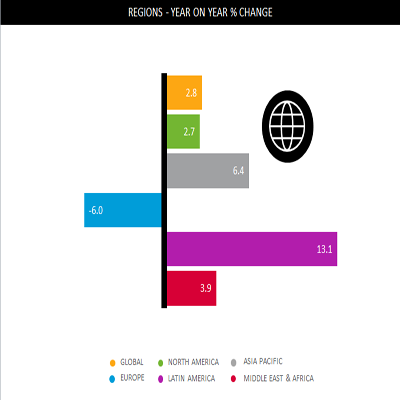
    NEW DELHI: Ad spends grew by a substantial 6.4 per cent in the first half of 2013, making it the largest growth among different regions of the world.

    Marketers continue to gradually increase their global ad spending, as expenditures grew 3.5 per cent in the second quarter of 2013 and 2.8 percent on a year-over-year basis for the January-June periods of 2013 and 2012, according to Nielsen’s quarterly Global AdView Pulse report.

    Although many marketers remain conservative with advertising budgets, those in Latin America continue to buck the norm, increasing their expenditures by 13.1 percent (to $13.5 billion) for the January-June period.

    All regions contributed to global growth for the first half of the year except Europe, where marketers remain modest with their ad budgets amid the regions’ continued fiscal crisis, resulting in a six percent decline for the period. Ad spend continued to recover after slumping during the economic downturn, with growth of 3.9 percent in the Middle East and Africa, and 2.7 percent in North America.

    Argentina contributed significantly to growth for the Latin America region with nearly 30 per cent growth. Indonesia, China and the Philippines all contributed to double-digit ad growth in Asia-Pacific for the first half of 2013, with expenditures reaching $51 billion. In Europe, ad spend increased in Norway, Switzerland, and Greece (2.5 per cent, 0.6 per cent, and 7.4 per cent respectively), while expenditures declined in all other countries in the region.


    Nielsen Global AdView Pulse measures ad spending for TV, newspapers, magazines, radio, outdoor, cinema and Internet display advertising. Ad spend is based mainly on published rate-cards. Some markets may exclude select media due to data availability.

    The external data sources for the other countries included in the report are:

    Argentina: IBOPE
    Brazil: IBOPE
    Croatia: Nielsen in association with Ipsos
    Egypt: PARC (Pan Arab Research Centre)
    France: Yacast
    Greece: Media Services
    Hong Kong: admanGo
    Japan: Nihon Daily Tsushinsha
    Kuwait: PARC (Pan Arab Research Centre)
    Lebanon: PARC (Pan Arab Research Centre)
    Mexico: IBOPE
    Pan-Arab Media: PARC (Pan Arab Research Centre)
    Portugal: Mediamonitor
    Saudi Arabia: PARC (Pan Arab Research Centre)
    Spain: Arce Media
    Switzerland: Nielsen in association with Media Focus
    UAE: PARC (Pan Arab Research Centre)

  • Music channels see uptick in OTS in week 49

    Music channels see uptick in OTS in week 49

    MUMBAI: From exit polls to winning speeches, week 49 should have been the week of news channels. However, the truth is far from it. According to the Delhi-based Chrome Data & Analytics which keeps a tab on around 73 million TV homes nationally in analogue cable TV, digital cable TV and DTH, it was the week for music.

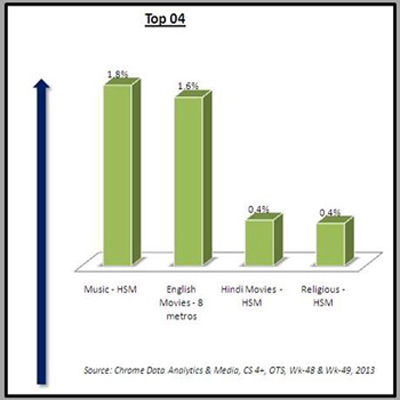
    Yes, you read it right. Music genre was the top gainer with a 1.8 per cent opportunity to see (OTS) gain.  For week 48, in Hindi speaking markets (HSM), the OTS was 47.4 per cent and in the following week reached 48.2 per cent. The music genre recovered what it lost in the previous week.

    Second in line is the English movie channel genre which saw an increase of 1.6 per cent in the eight metros. The year is coming to an end and as most channels air the biggest blockbusters of the year to wrap up the year, one can say that there are a lot of movie fans in the metropolitan cities.

    Next come the Hindi movie channels and religious channels with both seeing an increase of 0.4 per cent in the HSM. Star Gold continued to be the biggest gainer with 97.0 per cent OTS. In the religious genre, Aastha channel rose above all in the category with and OTS of 97.5 per cent.


    As for the bottom four genres, English Entertainment channels saw the biggest drop with 2.5 per cent in the eight metros. Star World topped the chart with 82.0 per cent. Even with elections in five states, the English news channels should have continued to gain but the genre failed to do so and saw a drop of 0.3 per cent unlike the previous week (week 48) where it was the highest gainer. Times Now was the leader in the genre with 88.3 per cent OTS in the eight metros.

    Next were Hindi GECs which dropped 1.0 per cent in HSM. The channel in the genre which saw the biggest drop is Colors; its  OTS was 95.7 per cent in week 49 as compared to 97.3 in week 48.

    The kids’ genre across the country and Hindi news in HSM too saw falls of 1.0 per cent and 0.8 per cent, respectively. Cartoon Network caught children’s attention and ranked number one in the category with 85.9 per cent while ABP News was the highest gainer with 92.7 per cent in the genre.

    The OTS numbers might be music for executives operating in  certain genres, but let’s wait and watch how things unfold for them in the coming week.

    Click here for the full analysis

  • Jodha is the most popular fiction character among TV audience

    Jodha is the most popular fiction character among TV audience

    MUMBAI: If you thought only the make-up clad, good-looking bahu from a traditional Indian household managing everything perfectly, could grab the attention of the Indian TV viewers, it is time to think again!

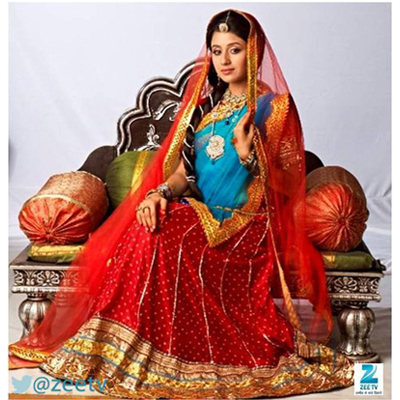
    This time, it’s a blast from the past. While the indelible historic story of Jodha and Akbar on Zee TV are fascinating many, Jodha seems to have won all the appreciation. According to the latest findings (November 2013) of the Ormax Characters India Loves (CIL) research, Jodha from Zee TV’s daily fiction show Jodha-Akbar has emerged as the most popular fiction character on Indian television.

    The CIL research that is conducted in 19 Hindi-speaking markets in India, covering a monthly sample size of more than 3,000 respondents in the 15-44 years age group, was started in August 2009. Interestingly, Jodha is only the fifth character to have taken the top position, the other four being Anandi (Balika Vadhu), Suhaana (Sasural Genda Phool), Jethalal (Taarak Mehta Ka Ooltah Chashmah) and Ram Kapoor (Bade Achhe Lagte Hain). Jodha is also the first Zee TV character to have taken the top position.


    Speaking about the findings, Ormax Media insights head – television Anurag Bakhshi said: “Jodha’s popularity is a result of her unique portrayal of a historical character whose aspirations are relevant to the young audience of today’s evolving India. Her popularity is particularly strong in Uttar Pradesh, Madhya Pradesh and Punjab markets.”

    According to the November 2013 Ormax CIL Report, the other most liked fiction characters on television are Sandhya (Diya Aur Baati Hum), Jethalal (Taarak Mehta…), Anandi (Balika Vadhu) and Mahadev, while Kapil Sharma (Comedy Nights With Kapil) is by far the most popular non-fiction character on television.

  • News channels record increase in OTS in metros

    News channels record increase in OTS in metros

    MUMBAI: Connectivity of a television channel is something that every executive is concerned about in the industry – whether in the media or broadcast sector or cable TV. And pioneering this data and analytics information is Delhi-based Chrome Data & Analytics which keeps a tab on around 73 million TV homes nationally in analogue cable TV, digital cable TV and DTH.

    We take a look at what the opportunity to see (OTS) was for various television genres and channels in week 48 of the year. It appears it was a week of the news channels, both business and general English news, as far as the eight metros are concerned.

    The reach of English news channels grew by 1.5 per cent and business news channels witnessed a 1.1 per cent gain. However, the English entertainment channels in the eight metros witnessed a drop of 0.3 per cent while the English movie channels saw a 0.6 per cent rise.

    Tarun Tejpal’s alleged misconduct with a journalist colleague in an elevator in a five star hotel in Goa, raised not only eyebrows of most urban Indians but also their interest as they tuned into news channels to catch up on the latest with the iconoclastic senior scribe.

    Hindi GECs in the Hindi speaking markets (HSM) saw a drop of 0.9 per cent, while Hindi movies and Hindi news dropped by 0.1 per cent and 0.8 per cent respectively. Only the religious channels saw a 1.4 per cent increase in HSM.

    The all India performance of sports and infotainment channels dipped in week 48. While sports recorded a one per cent drop, infotainment witnessed 2.6 per cent shaving respectively. Only the position of the kids’ channels in the all India market remained stable.


    The top Hindi GEC channel in HSM was Star Plus with a 97.8 per cent OTS. Zee TV and Colors were not too far behind with 97.4 per cent and 97.3 per cent OTS respectively. Life OK lagged behind in the race with 94.9 per cent OTS.

    Amongst the Hindi movie channels in HSM, Star Gold was the biggest gainer with 96.7 per cent OTS, while UTV Movies lagged at 88.8 per cent.

    ABP News was the leader in the Hindi News genre with an OTS of 93.2 per cent. And with 88.9 per cent, CNN-IBN was leading in the English news genre in eight metros, while CNBC Awaaz topped in the business news genre.

    Undoubtedly, it has been an interesting week for the channels. Let’s wait and watch how things unfold for the channels in the coming week.

    Click here for the full analysis

  • Ipsos study claims three in ten Indian drivers are on the phone while driving


    MUMBAI: About three in ten (29 per cent) Indians who drive indicate they text, email, or use social media while they are driving (even when they’re at a stop sign or a red light) compared to 22 per cent globally according a new poll conducted by Ipsos OTX – the global innovation center for Ipsos, the world’s third largest market and opinion research firm.


    However, a majority of Indian driving respondents (71 per cent) say they do not do this. The findings reflect a new poll of 14,160 drivers conducted by Ipsos globally, the number of respondents from India was 851 drivers.


    Commenting on the findings, Ipsos in India head marketing communications Biswarup Banerjee said, “Motor vehicle accidents are the leading cause of accidental death in India, and using a phone while driving significantly increases the risk of accidents. Trying to do two visual tasks at once hurt performance in both tasks significantly, sadly many people have this overconfidence in how well they can multitask which may prove fatal.”


    he countries with the highest proportions of drivers indicating they have texted, emailed or used social media while driving are from: Saudi Arabia (43 per cent), South Africa (41 per cent), South Korea (33 per cent), India (29 per cent), China (27 per cent), United States (27 per cent), Brazil (25 per cent) and Russia (25 per cent). This group of distracted drivers is followed by Indonesia (24 per cent), Sweden (24 per cent), Mexico (23 per cent), Argentina (21 per cent), Australia (20 per cent), Germany (20 per cent), Canada (19 per cent) and Italy (19 per cent), rounding out the middle of the pack. The lower group includes: Japan (18 per cent), France (17 per cent), Poland (17 per cent), Turkey (17 per cent), Belgium (15 per cent), Spain (14 per cent), Hungary (9 per cent) and Great Britain (8 per cent).


    As for demographics of Indians, age is among the most important variable in determining a driver’s likelihood to message behind the wheel in India as those under the age of 35 years (34 per cent) are most likely to say “yes” they engage in the behavior, compared with those 35-49 years (25 per cent) and those 50-64 years (14 per cent). However, Indian male drivers (31 per cent) are more likely to use their smart phone while driving compared to 26 percent female.


    Communicating digitally while in the car appears to be highly related to a person’s work life as those who are employed (32 per cent) are more likely than those unemployed (17 per cent) to say “yes”. Seniority is even more of an indicator as those who own a business (48 per cent) are among the most likely to say they do it (22 per cent among non-business owners), as are those who say they have a senior decision making role in their place of employment (38 per cent vs. 18 per cent non). Similarly, income (31 per cent high, 30 per cent medium, 25 per cent low) and education (29 per cent high, 26 per cent medium, 48 per cent low) are also indicators of greater likelihood to drive and message.

  • 88% of Indian internet users “share” social media content monthly: Ipsos Study

    MUMBAI: About nine in ten (88 per cent) online consumers in India indicate that in the past month, they have shared some type of content on social media sites compared to 71 globally. The findings reflect a new poll of 18,150 respondents conducted by Ipsos OTX – the global innovation center for Ipsos, the world’s third largest market and opinion research firm. About one in ten (12 per cent) indicate they ‘haven’t shared any content in the past month’. 


    The most popular shared item found in the poll is pictures, as about six in ten (58 per cent) indicate they have shared pictures online in the past month. Following next are: ‘my opinion’ (56 per cent), ‘links to articles’ (37 per cent), a ‘status update of what/how I’m doing’ (36 per cent), ‘news items’ (34 per cent), ‘something I like or recommend, such as a product, service, movie, book, etc.’ (32 per cent), ‘status update of what I’m feeling’ (29 per cent), ‘video clips’ (29 per cent), ‘links to other websites’ (27 per cent), ‘reposts from other people’s social media posts’ (25 per cent), ‘plans for future activities, trips, plans’ (17 per cent) and ‘other types of content’ (15 per cent). 


    Of the online consumers, those from Turkey (93 per cent) are most likely to indicate they have shared any content online in the past month, followed nine in ten in each of: Mexico (89 per cent), Brazil (88 per cent), India (88 per cent), Indonesia (88 per cent), Argentina (86 per cent), South Africa (86 per cent) and China (85 per cent). This group of highly engaged content-sharers is followed by Russia (79 per cent), Saudi Arabia (78 per cent), Spain (75 per cent), Hungary (83 per cent), South Korea (73 per cent), Italy (71 per cent), Poland (64 per cent) and Sweden (64 per cent) rounding out the middle of the pack. The lower groups of social media sharers begin with Australia (63 per cent), Belgium (62 per cent), the United States (60 per cent), Canada (59 per cent), Great Britain (58 per cent), France (49 per cent), Germany (44 per cent) and Japan (30 per cent). 


    As for demographics, Indian citizens indicated that those under the age of 35 (92 per cent) are most likely to share any type of content on social media sites, in particular when compared with those aged 35 to 49 (86 per cent) and those 50 to 64 (78 per cent). Women (88 per cent) appear somewhat more likely than men (89 per cent) to have shared some content in the past month.

  • Cable TV carriage fees head south

    Cable TV carriage fees head south

    Carriage fees have been a bane of the Indian television industry. Most broadcasters have been groaning and moaning how they have been choking up their capital, preventing them from investing in content, especially news channels.

    Now throwing some light on the trend in carriage fees is five year old television media and distribution audit company Chrome Data Analytics & Media which has just released its Chrome Dii R3 (Distribution Investments Index – Round 3).

    Chrome Dii,says the company, has been worked out while tracking deals done by broadcasters over the past year, with information gathered from across various sources including broadcasters as well as distribution platforms. After eliminating high variance deals, an average of six solo deals per cable network were studied for their investments for S band and UHF.

    Jeffrey Crasto…

    “For the digital scenario, Chrome Dii indicates a benchmark carriage to be available on the basic tier that is channels under BST (mandated FTA channels) along with the first tier of pay channels,” says Chrome Data executive director Jeffrey Crasto. “The study is inclusive of both new launches/new deals done in the last one year and existing deals expiring in April/May 2013.”

    Adds Chrome Data founder & CEO Pankaj Krishna: “Digitisation was expected to be a harbinger of correction leading to nullification of carriage fees. As per TRAI, they had anticipated the Chrome Dii to come down to Rs 1, however though there has been a significant drop; it has not come down to Rs 1.As compared to R2, Dii has come down from Rs 20 to Rs 11.6. “

    .. & Pankaj Krishna have attempted to demystify the burden broadcasters have to bear

    In its third round, the Dii has revealed that north India has emerged as the costliest region with a whopping 16.7 crore in carriage fees for 100 per cent availability across Basic + S band for new channel launches and 13.3 crorefor renewals of existing deals whereas central India is the lowest with 3.11 crore and 2.73 crore for Basic + S band for new launches and renewing existing deals respectively.

    While a different image is revealed if the Dii (cost per contact for the television channels) is studied, Chrome Dii R3 data shows the cost (renewals, S-band) per contact (household) is the highest in west India with an average of 17.6 followed by Central at 14.4. The national average for renewals stands at 11.6.

    Out of a total universe of 47 million households in Class I India, 42 million are C&S Homes. Chrome Dii study tracks 31 million homes, 2 million remain uncovered and balance 9 million are DTH!


    Source: Chrome Data Analytics & Media

    C&S Households
    89%
    DTH
    74%
    Non TV Households
    11%
    Chrome Dii
    21%
     
     
    Balance
    5%

    Chrome Data says that its Dii R3 was pre-subscribed by eight leading TV networks. And it is an addition to the other services that it offers (covering1800+ cities and towns) Chrome Track 2.0, Chrome DPi, Chrome Dii & Chrome SES, Chrome AV, Chrome LC1, Chrome NE and Chrome Language Feed.Some 132 channels subscribe to its various services.

    Some interesting facts according to Chrome Dii R3 –

    Carriage Fee Cost
     
    Existing
    New Launch
    REGION Basic + S BAND Basic + UHF Basic + S BAND Basic + UHF
    CENTRAL 273,75,000 194,70,000 311,95,000 235,30,000
    EAST 376,65,000 281,25,000 404,65,000 340,00,000
    NORTH 1330,33,300 1118,71,800 1673,03,300 1343,67,800
    SOUTH 549,50,000 466,67,000 625,65,500 527,32,500
    WEST 1099,80,000 1014,80,000 1320,00,000 1195,00,000
    Grand Total 3630,03,300 3076,13,800 4335,28,800 3641,30,300

    * To cite an example as per the above data, comparing how much a Hindi News channel would spend for 75 per cent HSM availability as per Dii R3 as compared to Dii R2 – it would pay 75% of (Rs 36.30 croe minus Rs 5.49 crore for the south) = Rs. 23.1 crore as per Dii R3, whereas it would have paid Rs 38.2 crore as per Dii R2 – a saving of over 39 per cent! But has the overall pie reduced, not really! As there has been an increase in network bandwidth, hence the number of takers has increased.

    North emerged as the costliest region with Rs 16.7 crore for 100 per cent availability across Basic + S Band and Rs 13.4 crore for 100 per cent availability across Basic + UHF for New Launches. Renewals of existing deals for Rs 13.3 crore for Basic + S Band and Rs 11.2 crore for Basic + UHF.

    The study also provides a benchmark for carriage fee efficiency with respect to the investment indices that is Chrome Dii that is cost per contact (see tables below). Chrome reveals that the Dii (renewals, S-band, household) is the highest in West India with an average of Rs 17.6 followed by the Central at Rs 14.4. The national average for renewals stands at Rs 11.6.

    Carriage Fee Cost per contact for existing channels in Rs


    Existing-Basic+S Band

    West
    17.6
    Central
    14.4
    North
    14.1
    East
    7.1
    South
    6.6

    Source: Chrome Data Analytics & Media

    * In terms of highest Chrome Dii, West was followed by North, Central, East and South.

    * The gap between Dii for Existing and New Launches has reduced over the years owing to digitization and increase in bandwidth of the networks.

    Carriage Fee Cost per contact for new channels being launched in Rs


    New Launches –
    Basic+S Band

    West
    21.1
    Central
    17.7
    North
    16.4
    East
    7.6
    South
    7.5

    Source: Chrome Data Analytics & Media

    * Further, the gap between Dii for S Band and UHF has also reduced due to digitization

    * Chrome Dii for a New Launch in Central and East India has halved.

  • 51.2 million C&S homes in India: IRS 2006

    The Media Research Users Council (MRUC) has released the topline findings of the Indian Readership Survey (IRS) 2006 (Round 16). The study, conducted for the period July 2005 to June 2006, covers 4,686 towns and villages across the country and involves a sample size of 250,357 individuals.

    The survey notes that the number of C&S homes has increased from 49.1 million in in the previous R15 (January 2005 to December 2005) survey to 51.2 million in the latest R16 one. The total number of TV homes in India has grown from 90 million to 91.9 million. The total TV viewing audience in the country meanwhile, has grown from 430.7 million to 437.8 million.

    As has been the trend in the recent past, the IRS numbers are far more conservative than those thrown up by the National Readership Studies Council‘s (NRSC) findings of the National readership Survey (NRS) 2006. According to the NRS 2006 findings (released in end-August 2006), the number of C&S homes has increased from 61 million in 2005 to 68 million this year. NRS 2006 showed that there are 112 million TV homes in India compared with 108 million last year.

    Minutes 
    2003
    2006
    Avg Time TV 108 92
    Avg Time Radio 80 70
    Avg Time press 31 29
    Avg Time Internet 58 68
    All Media – Av time spent 132 119

    If there is one common thread running through the IRS findings, it is that the explosion in media offerings is leading to increasing casualness in consumption and therefore a concommitemt reduction in stickiness. Viewers are cutting back on time and frequency in consumption.

    There is an overall dispersion in media consumption. More media is being consumed, but time spent has gone down. This is fairly consistent with the changes in urban lifestyles where traveling, socialising, maintenance all eat into leisure time.

    Key Trends in Audience Dispersion

    *More media is being consumed
    *It is being consumed more casually than before
    *With lesser frequency
    *And lesser time being devoted

    This is the case with both TV and Print. Both are experiencing a churn in their relationship with media consumers. On the one hand, there is an explosion in media vehicles, both TV and Print. On the other hand, audiences have really got busy and are compromising on media consumption – in terms of time as well as frequency. They are sharing time across media.

    What this is resulting in is that regular viewers are giving way to occasional viewers. The number of channels watched yesterday increased to 2.2 suggesting higher surfing. While on the other hand, a decline in the number of channels watched in the last one week just suggests further fragmentation.

    Summary

    *Declining stickiness
    *Polarisation in frequency of viewing
    *Overall time spent – a downward trend
    *Audience skew towards lower time slabs


    10 Lakhs=1 million

    News & Current Affairs is the fastest growing genre on TV. At 31 per cent reach in the population, it has the highest penetration by genre.

    While News and CA audiences have grown at a faster pace, dailies have grown much more in terms of size – 55 million vs 51 million.


    Explosion in media offerings Vs In-elastic Time

    Media proliferation has provided more consumption opportunities. But the consumer is time-constrained. He is cutting back on consumption within the medium, as reflected in the lowering of duplication. But is adding on another medium, as reflected in the increased inter-media duplication.

    He is also cutting back on time and frequency. And clearly moving towards casualness in consumption.

    Impact of TV on Print – Medium is not the message


    Quality news and information available more than before through means other than newspapers
    Consumption of news not restricted to newspapers alone
    TV and Internet serve the news-seekers immediacy
    While TV News channels provide specific styles
    Internet is a on-demand medium

    TOP 15 MEDIA OPPORTUNITIES
    DD1 (National Network)
    220
    Star Plus
    72
    Dainik Jagran
    54
    Aaj Tak
    51
    DD News
    49
    Zee Cinema
    46
    Sun TV
    44
    Sony TV
    33
    Gemini TV
    33
    ETV
    32
    Zee TV
    31
    Dainik Bhaskar
    29
    Amar Ujala
    29
    KTV
    25
    Hindustan
    24
    All figs in Millions
    Channels – Last 1 week
    Dailies – Claimed Reach

    The great news here for all news media owners is that this increased appetite for news is fuelling readership growth as well so it is not as if TV is eating into print but that both are growing and expanding.

    Readership has grown in absolute numbers, led by Dailies
    *But the AIR Reach has reached a plateau:
    *Regular reading giving way to casual reading
    *Decline in average number of titles read and a gravitation towards reading a single title, within a language & periodicity
    *All this leading to decline at vehicle-level readership, but keeping the AIR constant at an aggregate level

    Dainik Jagran has the highest readership in the country with 18.19 million readers, followed by Dainik Bhaskar with 13.48 million readers.

    Among English newspapers, The Times of India leads with 6.92 million readers, followed by hindustan times with 3.5 million. As before, The Times of India is the only English daily among the top 10 publications.

    In conclusion, the challenge in front of media is to reassemble and deliver to advertisers a mass audience for news, not in one place but across different geographies, different genres and different platforms.

    Click below for bigger picture

    Snapshot of population SEC changes Household penetration of ent. durables
    Exposure to various media Press reach by age Top 10 dailies
    Top 10 language dailies Top 10 English dailies Top 10 TV channels Tuned
    Top 10 watched channels Top 10 GEC/ lifestyle channels Variations in Press Reach
    Top 10 radio channels Top 10 movies channels Top 10 music channels
  • Lintas Media Guide 2006 Print pocketed 57% of the total ad spends in 2005

    Media matters and how. Lintas Media Services has churned out a comprehensive media guide, which is an analysis of media spends and buys in the year gone by.Released by Intellect, a part of the Lintas Media Group, it studies all genres; television, print, radio, internet, cinema, outdoor and gives a break up of the media environment and general media industry trends of last year.

    Expansion clearly has been the mantra for the print industry all through 2005. Across publications there have been launches of editions across cities or to penetrate into the lower pop-strata. Increasing competition has brought more and more supplements everyday to seek niche reader segments. The battle of the dailies in Mumbai market is an example of the expansion drive and the result of competition adding to the product. In magazines due to the allowing of foreign direct investment (FDI) we have seen the start of foreign mastheads coming to India and this will only get faster in the years to come.

    Publishers are seeing a balance between driving subscription revenues and advertising revenues. While a few have been able to push up issue prices, most others have kept the issue prices stable. Need to garner growing advertising revenues is aided by the geographical expansion and the niche targeting possible by supplements.

    Print advertising had a share of 57 per cent of the total ad spends for the year 2005. The buoyant categories such as finance, education, auto, retail, etc are all set to adding a lot to the advertising revenues further for the print industry. Realising their strength in terms of ground network, most publication networks are extending their services beyond print space selling to solutions that give a combination of print advertising along with activation programmes at the ground level. Some publications are also able to extend the solution into the web space or other media depending upon the properties they own or are aligned with.

    Like TV, advertising avoidance is an issue for print advertisers too and there are more and more instances of innovative advertising. Advertorials are also increasing besides all efforts to align with related content. However, these as yet form a minuscule percentage of the total advertising space though it is expected to grow in the years to come.

    Readership research does not offer anything new and the issues between the IRS (Indian Readership Survey) and NRS (National Readership Survey) continues as always. There is a need for the print research to reevaluate the needs of the medium and reorient their offering.

    GROWTH OF PUBLICATIONS


    Language
    2003
    2005
    #
    Circ(mm)
    %
    #
    Circ(mm)
    %
    Hindi
    213
    13.1
    28
    203
    12.4
    25
    English
    174
    10.1
    22
    166
    10.6
    22
    Marathi
    57
    2.9
    6
    43
    2.9
    6
    Tamil
    39
    3.2
    7
    37
    3.6
    7
    Gujarati
    32
    2.7
    6
    34
    1.1
    2
    Bengali
    28
    2.9
    6
    31
    3.1
    6
    Malayalam
    32
    5
    11
    33
    6.1
    13
    Kannada
    27
    1.5
    3
    26
    1.8
    4
    Telegu
    20
    2.2
    5
    18
    2.7
    6
    Other
    83
    3.1
    7
    76
    4.4
    9
    Total
    705
    446.7
    100
    667
    48.7
    100


    READERSHIP TREND


    Claimed Readership(%)
    2004 (IRS ‘03 R2) 2005 (IRS ‘05 R2)
    All India
    Urban
    Rural
    All India
    Urban
    Rural
    Dailies 33.2 54.7 24.8 35.9 56.1 27.0
    Magazines 13.6 25.3 8.7 14.5 25.5 9.6
    Any Publication 34.6 56.4 25.4 37.5 58.1 28.5
    Source: IRS 2005 R2


    The Times of India tops the English dailies list when it comes to the top five dailies according to IRS 2005 R2 (all India average issue readership). Hindustan Times, Hindu, Telegraph and Deccan Chronicle (in that order) follow in the list.

    In the regional dailies category, Dainik Jagran rules the roost, whereas Dainik Bhaskar, Daily Thanthi, Amar Ujala and Malayala Manorama follow suit.

    In the Top five English magazines, India Today tops the charts, whereas Readers Digest, General Knowledge Today, Filmfare and Competition Success Review feature in the top five list.

    In the regional magazines category, Saras Salil is the top read magazine. Vanitha, Kumudam, Grihsobha and India Today (Hindi) also feature the top five list.

    PRINT TOP CATEGORIES IN 2004 – 2005


    Category
    2004
    Rs crores
    Category
    2005
    Rs crore
    Educational Institutes
    435
    Educational Institutes
    506
    Corporate Brand Image
    400
    Property / Real Estate
    362
    Car / Jeeps
    300
    Corporate Brand Image
    323
    Property / Real Estate
    272
    Car / Jeeps
    304
    Two Wheelers
    257
    Independent Retailers
    250
    Coaching Centers
    146
    Two Wheelers
    222
    Financial reports
    145
    Readymade Garments
    166
    Cellular Phone Services
    138
    Coaching Centers
    156
    Social Ads
    125
    Cellular Phone Services
    144
    Events
    121
    Travel & Tourism
    142
    Source: Tam Adex & Lintas Media estimates based on indicative market costs


    PRINT TOP ADVERTISERS IN 2004 – 2005


    Advertiser
    2004
    Rs crores
    Advertiser
    2005
    Rs crore
    Maruti Udyog Ltd
    135
    Hewlett Packard
    115
    Bajaj Auto LTD
    100
    LG Electronics India
    86
    LG Electronics India
    89
    Hero Honda Motors
    72
    Samsung India
    85
    Bajaj Auto LTD
    72
    Tata Motors
    69
    Maruti Udyog LTD
    63
    Hero Honda Motors
    65
    Tata Motors
    57
    TVS Motor Co
    60
    Pantaloons Retail India
    56
    Hyundai Motor India
    59
    Hyundai Motor India
    56
    Hindustan Lever LTD
    57
    Samsung India
    54
    Hewlett Packard
    54
    Toyota Kirloskar
    52
    Source: Tam Adex & Lintas Media estimates based on indicative market costs


    Stay tuned for the next in the series…

  • Lintas Media Guide 2006 Movie channels gain in HSM; main Bangla channels lose share

    Media matters and how. Lintas Media Services has churned out a comprehensive media guide, which is an analysis of media spends and buys in the year gone by. Released by Intellect, a part of the Lintas Media Group, it studies all genres; television, print, radio, internet, cinema, outdoor and gives a break up of the media environment and general media industry trends of last year.

    In the second of the series, we take a look at the channels that dominated 2005 in the Hindi speaking markets as well as in the East, Tamil Nadu, Kerala and Karnataka.

    While Star Plus continued to reign supreme in the Hindi speaking market, Hindi movie channels like Max and Zee Cinema have managed to strengthen the position of the genre in 2005.

    In the Hindi speaking markets, Star Plus continued to enjoy its leadership position throughout 2005. Its channel share, however decreased by one per cent last year to 19 per cent as compared to 2004‘s 20 per cent in the C&S 4+ SEC ABC Hindi speaking markets between week 40 – 44. Sony and Zee‘s channel shares, on the other hand, too dipped by a per cent last year to settle at six per cent and four per cent respectively.

    Meanwhile, movie channels like Max and Zee Cinema gained momentum and overall managed to their strengthen the position of the genre in 2005. While Zee Cinema, which didn‘t figure in the 2004 charts, managed to rear its head with a channel share of five per cent; Max retained its channel share of five per cent in 2005. Thus, strengthening the movie genre in the overall pie.

    Cable channels in the Hindi speaking markets too shed their numbers from 13 per cent in 2004 to 11 per cent in 2005. The channel share of DD1 dipped in 2005 from that of four per cent in 2004.

    Also, the basket of “other” channels increased from 46 per cent in 2004 to 50 per cent in 2005 in the Hindi speaking markets.

    In East India, as cable penetration increased, DD7 as a viewing choice of people reduced. Regional channels too suffered as ETV Bangla and Aakaash Bangla each lost two per cent market share last year as compared to a market share of 17 per cent and six per cent in 2004. Zee Bangla too lost one per cent in 2005 with a channel share of four per cent.

    Star Plus, on the other hand, gained one per cent and stood with 12 per cent channel share. Sony managed to hold on to its share of five per cent, whereas Zee TV and Zee Cinema both managed a four per cent channel share in 2005.

    In Tamil Nadu, Kalanithi Maran‘s empire continues to reign supreme. While the flagship channel – Sun TV – continues to rule with a channel share of 49 per cent, its sibling KTV has emerged as a frequency builder with a channel share of 12 per cent in 2005. Two other Sun channels Sun Music and Sun News also made their presence felt with channel shares of six per cent and two per cent respectively.

    On the other hand, while specific time bands of Vijay TV and Jaya TV are doing well, both channels had a share of five per cent each in 2005. Jaya TV‘s share went down by one per cent in 2005, while that of Vijay TV‘s remained status quo. The share of “Other” channels dropped in Tamil Nadu from 17 per cent in 2004 to 14 per cent in 2005.

    In Kerala, Surya TV and Asianet have been loosing their share to other channels. While Surya TV‘s share fell from 27 per cent in 2004 to 22 per cent in 2005, that of Asianet fell from 25 per cent to 23 per cent. “Other” channels have gained share from 24 per cent in 2004 to 31 per cent in 2005.

    On the other hand, in Karnataka, while Udaya leads in terms of channel share, Ushe TV has been emerging as a frequency builder. Udaya‘s shares increased from 17 per cent in 2004 to 21 per cent in 2005. ETV Kannada, on the other hand, managed to retain its share of 12 per cent through 2004 and 2005, while Sun TV‘s shares in Karnataka dropped from seven per cent to nine per cent.

    Stay tuned for the next in the series…